

When I think of children’s stories about being lost, Hansel and Gretel is one of the first that comes to mind. Whether or not this gruesome story is suitable for children, I’ll leave for another discussion. The children were correct in thinking it was important to mark their way into the forest in order to find their way out. They were incorrect in their choice of markers.
Encouraging children to identify features of their environment has benefits beyond encouraging them to question and wonder. It is important for children to learn, from a young age, to identify markers on routes around the neighbourhood, shopping mall and school, as well as strategies to implement if lost or separated. Taking note of seasonal and other changes, both temporary and permanent, in addition to permanent features helps to build knowledge of one’s environment. This knowledge can be developing long before the need to find one’s way alone arises.

One day there will be a need to navigate independently, whether it be to walk to school, go to the shop, visit a friend, catch a bus or drive a car. All of these will be far less daunting for the child, and much less worrisome for the parents, if the ability to find one’s way around has already been demonstrated through discussions or deciding which route will be taken for a journey.
Often the first time children are required to navigate independently is when commencing school. They may need to find their way to the classroom in the morning, or to the gate in the afternoon. They will have to find the way to the playground, the office, the library, and the toilets and back to the classroom. Just as parents show children around the neighbourhood by pointing out landmarks, it is important for teachers to orient children in the school grounds and ensure they know how to find their way around confidently.
A delightful book that can be used by both teachers and parents to discuss the importance of knowing one’s way around and of staying safe is the beautiful Pat Hutchins’ book Rosie’s Walk which tells the story of a hen who goes for a walk around the farmyard and gets back home safely in time for dinner. The story also introduces many positional words.
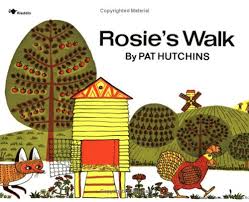
Understanding of positional terms and describing the location of neighbourhood and school landmarks in relation to each other helps to develop spatial awareness along with language; for example:
- past the shop
- across the bridge
- over the road
- through the park
- in the middle
- beside the lake
- along the road
- next to the bakery
- around the corner
- behind the fence
- as well as left and right.
Discussing the placement of landmarks on a mud map of the neighbourhood or school and discussing different paths that could be taken encourages divergent thinking about ways of getting from one place to another. Sometimes it helps children to think of these maps as being from a birds’eye view, or from a plane. Other maps, for example Google Maps and street directories are also useful and children can learn to point out or mark places they have visited.

There are many opportunities, whether in the car or on foot, to take note of landmarks; for example:
- house numbers,
- types of fences
- the number of streets to cross
- large trees
- the shopping centre entry
- carpark space row and number
- bridges crossed
While the flash fiction challenge set by Charli Mills at the Carrot Ranch this week was to In 99 words (no more, no less) write a story about someone or something that’s lost, I have taken the theme of lost and used it to provide strategies that may help children avoid becoming lost. My flash is a rhyme for young children, and an example of the types of things that children can be encouraged to observe in their neighbourhood.
To Grandma’s House
Bub’s buckled in, away we go.
Mum’s going to work, we can’t be slow.
Down the street past the green painted door.
Past the house with big number four.
Stop at the curb and look each way.
Off to Grandma’s, hip-hip-hooray!
Quiet past here so the dogs don’t bark.
Left at the corner and cut through the park.
Up the hill, past the posting box.
Open the gate, give three big knocks.
Hugs for Grandma waiting for us.
Wave to Mum as she boards the bus.
Go inside for milk and toast.
Days with Grandma we like the most.

Thank you for reading. I appreciate your feedback. Please share your thoughts about any aspect of this post or flash fiction.


 I much prefer, “Left at Charlie’s pub, right at Joe’s pizza, left at the huge oak tree, follow to the ice cream place with the giant dancing strawberry cone, left at the high school, then it’s the house with the purple fence and gnomes in the garden.” Yes. I’ll get there if I get those directions.


 Norah Colvin
Leave a reply to Charli Mills Cancel reply