

I often say that children are born scientists. From the moment they are born they are actively finding ways of figuring out how the world works, and how they can get it to work for them.1
Some people say children are sponges. But I say they are more than that. They are creators. They don’t just copy what they see. They don’t just repeat what they hear. They find new ways of working things out, new ways of expressing ideas, and new ways of thinking about things. Parents often remark, when children exhibit new behaviours or cute new phrases or ways of expressing themselves, “Where did they get that from? Where did they learn that?” Often the source cannot be identified, for the source is within the child.
An important way to keep children creating their own understandings and ideas is to not only allow them to ask questions, but to actively encourage them to do so, and to help them seek answers to their questions. Adults can be quick to quiet children’s questions for a number of reasons including not knowing the answer, being too busy at the time to investigate an answer, or even considering the question unimportant or “dumb”.
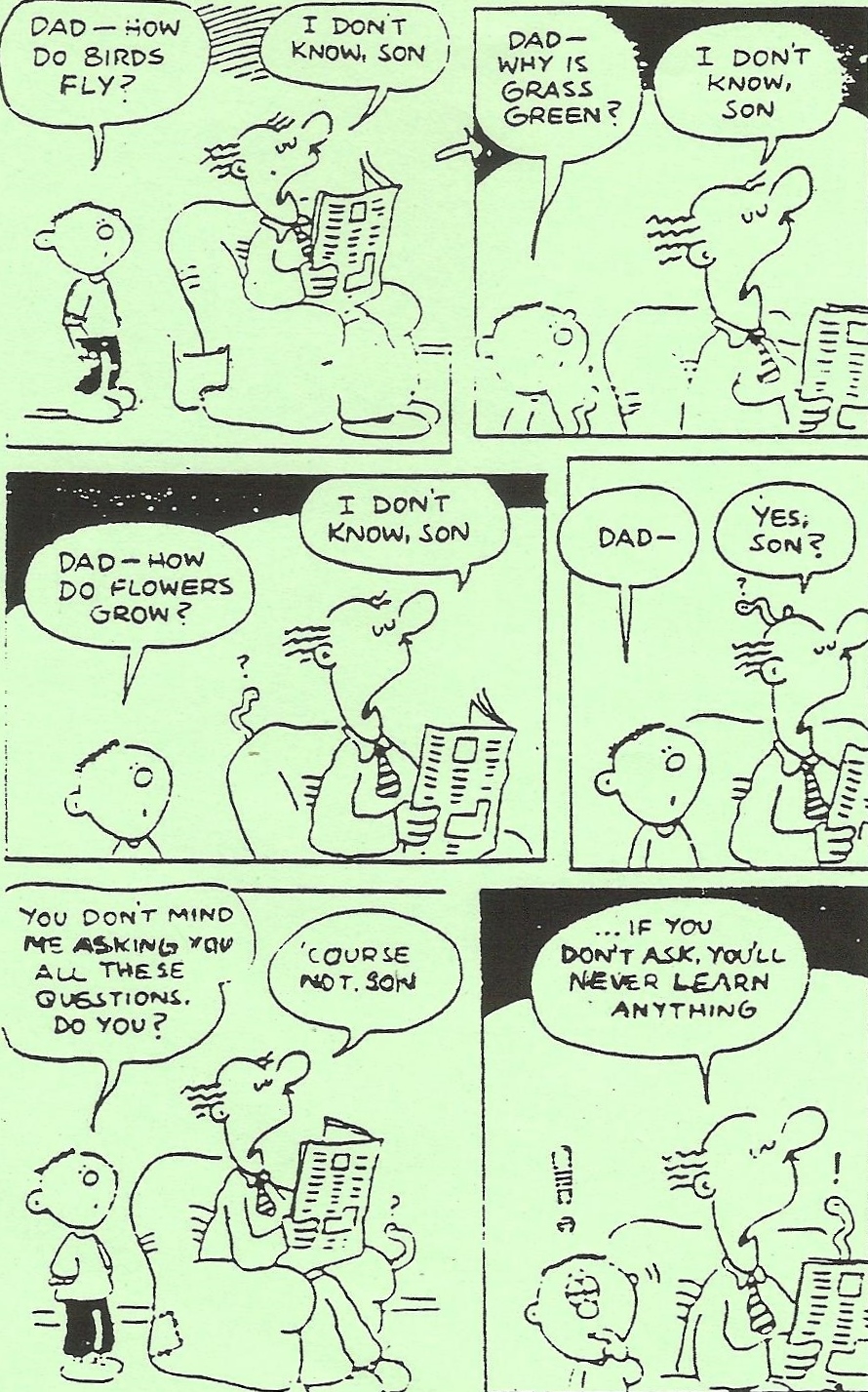
Remember, many things that adults may take for granted or that they may no longer question but simply accept (possibly as a result of not receiving appropriate answers or responses to their childhood questions) are new and unfamiliar to the child.
Sometimes it is easier to accept than to question for questioning means that something is unknown; and not knowing can lead to feelings of insecurity, doubt and instability. But it is these self-same feelings which drive innovation and progress. If everything was known, there would be no room for improvement, no need for anything new, no need for greater understanding.
This inspiring TED talk by Beau Lotto and Amy O’Toole, Science is for everyone, kids included emphasizes the need for children to be given the opportunity of asking, and exploring answers to, questions.
Beau explains that what we see is based upon our experience, upon our expectations. But he asks,
“if perception is grounded in our history, . . . (and) we’re only ever responding according to what we’ve done before . . . how can we ever see differently?”
He goes on to explain that seeing things differently begins with a question and that questions lead to uncertainty. He says that

and explains that the answer to uncertainty is play. He says that play “is a way of being” and is important for five reasons:
- Uncertainty is celebrated in play and makes play fun
- Play is adaptable to change
- Play is open to possibility
- Play is cooperative
- Play is intrinsically motivated
“Play is its own reward.”
Beau says that science, also, is a way of being; and that science experiments are like play.
He describes working with a group of 8-10 year old children, encouraging them to ask questions and involving them in an investigation of a question they posed.
Amy O’Toole, one of the children involved, joins Beau and describes the experiment which investigated the ability of bees to “adapt themselves to new situations using previously learned rules and conditions.”
The really exciting thing about the project, Amy says, was that they “had no idea whether it would work. It was completely new, and no one had done it before, including adults.”
The process of taking the findings of the project to publication, as Beau explains, was rather complex with a variety of complications, taking two years to achieve. The experiment itself took only four months! Publication of the paper made Amy and her friends the youngest ever published scientists.
The response to the paper, The Blackawton Bees is amazing:
30 000 downloads on the first day
Editor’s Choice in Science (a top science magazine)
the only paper forever freely accessible on Biology Letters and
the second-most downloaded paper from Biology Letters in 2011
Amy wraps up the talk by stating that
“This project was really exciting for me, because it brought the process of discovery to life, and it showed me that anyone, and I mean anyone, has the potential to discover something new, and that a small question can lead into a big discovery.”
She finishes by saying that
“science isn’t just a boring subject … anyone can discover something new.”
We might not all make those big scientific discoveries, but it is the questions we ask each day which lead to our own discoveries, no matter how small; it is our curiosity which keeps us learning.
What have you learnt today?

1 This is just my opinion formed from observations, discussions and reading. I am not supporting it with research references.


 Norah Colvin
Leave a reply to Annecdotist Cancel reply