Live Love Laugh Learn … Create the possibilities

Learning about minibeasts at home or at school – #readilearn

learning about minibeasts at home or at school

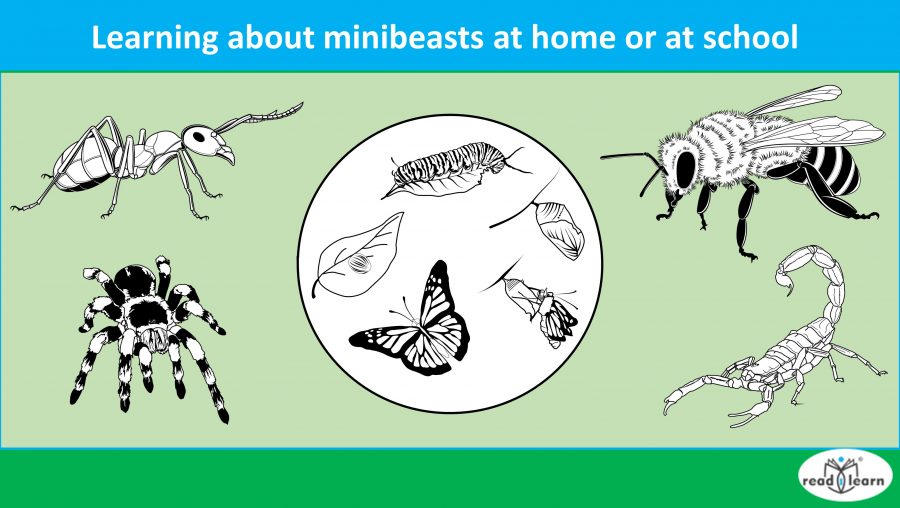
Whether learning at home or at school, there is a world of minibeasts for children to explore, inside and outdoors. Regardless of our feelings towards certain species, all are important to our environment and contribute to our lives in different and often unseen ways including pollinating our plants, decomposing waste and providing food for other species. It is fair to say that we need minibeasts more than they need us.

Learning about living things is an important part of the science curriculum for children in their first few years of school. They learn about the features of living things, their needs and their life stages. Studying minibeasts allows for learning in all these areas in a small space over a short amount of time.

At readilearn, we support your teaching and children’s learning about minibeasts with a constantly growing collection of resources. In fact, three new resources were uploaded this week.

Observe and record

An interesting project is to use a magnifying glass to discover the different species of minibeasts that live in and around our classrooms and homes. Much can be learned through observing their behaviour.
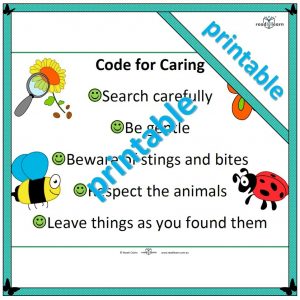
The Code for caring explains how to observe while maintaining safety for self as well as the minibeasts.

My Minibeast Diary provides a format and suggestions for recording children’s observations.

Continue reading: Learning about minibeasts at home or at school – readilearn

Comments

21 responses to “Learning about minibeasts at home or at school – #readilearn”

  1. robinettercleave Avatar

    Love it, Norah. Great idea!

    Liked by 1 person

    1. Norah Avatar

      Thanks, Robin.

      Like

  2. Jennie Avatar

    Minibeast is a perfect word. Nature and discovery is so important for children. This year at school, we have created play packs for each child which include binoculars and magnifying glasses. Due to Covid -19 we’re spending as much time outside as possible. I’m so glad!

    Liked by 2 people

    1. Norah Avatar

      How wonderful, Jennie. The children will love exploring the outdoors with their binoculars and magnifying glasses. The world will take on a whole new perspective for them.

      Liked by 1 person

      1. Jennie Avatar

        I think you are absolutely right, Norah!

        Liked by 1 person

  3. calmkate Avatar

    what an interesting tool to inspire future scientists/biologists!

    Liked by 1 person

    1. Norah Avatar

      It is indeed. Thanks, Kate.

      Liked by 1 person

      1. calmkate Avatar

        welcome Norah!

        Liked by 1 person

  4. Patricia Tilton Avatar

    First time I’ve heard the term “minibeasts” — seems very appropriate for young children as it will capture their imaginations.

    Liked by 2 people

    1. Norah Avatar

      Thanks, Patricia. It’s a good term which encompasses all the little invertebrates.

      Like

  5. Jacqui Murray Avatar

    “Minibeast”–good way to put it!

    Liked by 1 person

    1. Norah Avatar

      Thanks, Jacqui. 🙂

      Like

  6. Anne Goodwin (Annecdotist) Avatar

    Maybe it’s for older children, and infantile adults, but we particularly enjoy finding bonking beetles
    https://en.wikipedia.org/wiki/Common_red_soldier_beetle
    Do you get them in Australia?

    Liked by 1 person

    1. Norah Avatar

      I had to ‘Google’ them, Anne. It seems we don’t have them in Australia, yet. 🙂

      Liked by 1 person

        1. Norah Avatar

          I’m not so sure with what I read about them. 🙂

          Liked by 1 person

  7. Chel Owens Avatar

    Up till this point, I had never heard the term ‘minibeast.’ Our go-to is ‘bugs.’

    Liked by 1 person

    1. Norah Avatar

      The word ‘bugs’ is commonly and acceptably used that way but it does refer to a specific type of insect that has a mouth like a straw. The minibeast is a non-scientific term that refers to all small invertebrates including insects, arachnids, snails and molluscs (to name just a few), not just what you might refer to as ‘bugs’.

      Liked by 2 people

      1. Chel Owens Avatar

        😀 I never knew!

        Liked by 1 person

        1. Norah Avatar

          You’re not alone. Most of us don’t. 🙂

          Liked by 1 person

Leave a reply to Norah Cancel reply

This site uses Akismet to reduce spam. Learn how your comment data is processed.