

Play is essential to learning, and creating an environment which allows for play while nurturing children’s learning and development is as important as creating an environment that nourishes and encourages the growth of plants in a garden. The link between the two was first recognised by Froebel in the early 19th century when he coined the term “kindergarten” which translates to “garden for children” (kinder meaning child and garten meaning garden), and created the first educational toys.
Froebel “devoted his life to educating children and developing methods to maximize human potential”. He was the first to recognise the importance of a child’s early years (birth to three) and considered creativity to be something in all of us.
Froebel’s kindergartens were the first “formal” education for young children and his work greatly influenced that of other educators such as Maria Montessori and Rudolf Steiner. His beliefs, for example that children have both unique needs and capabilities are still influential today. He believed in the importance of play and some of his toys were favourites of people such as Buckminster Fuller and Albert Einstein.
I have touched on the topics of play, creativity and children’s uniqueness in previous posts. A respectful, encouraging, nurturing and stimulating environment underpins all that I value in education; as does a belief in the power of play to develop understandings of self, of others and relationships, of the world and how things work, and to inspire thoughts of what could be, to imagine possibilities never before imagined.
While Froebel’s beliefs, and those of his followers, are still valid, sadly they are often disregarded by those who wield the power in education, who dictate otherwise.
In a previous post I shared an article by Paul Thomas who attributed his readiness to learn at school to the richness of his home environment. He also decried the formal tedium of school lessons which contribute much to curbing a child’s enthusiasm for learning. Paul is not alone in his views. There are many teachers who agree with him, myself included, as I have shared many times before, including here and here.
I am not the only early childhood teacher to be saddened and appalled by the formal approach that has been enforced upon teachers, replacing play-based approaches in classrooms for children as young as four. With the administration of standardised tests and the publication of graded results, children are labelled successes or failures before they have had a chance to develop. Those children from privileged backgrounds, as described by Thomas in Formal Schooling and the Death of Literacy will be immediately successful. Those from less advantaged backgrounds will be labelled failures. Unfortunately, the labels are often reinforced with little chance of replacement.


I am always gladdened when I hear another expounding the benefits of play and the importance of child-centred approaches to learning and teaching. I hope that when enough voices unite in this important message, the tide will start to turn, and those with the power to make changes will do so in favour of children.
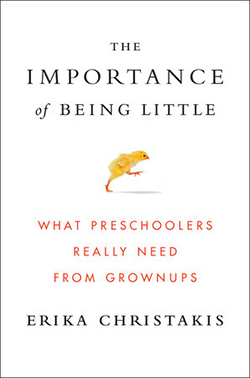
This week I read another article stressing the importance of play for young children. The article, written by Susan Gonzalez for Yale News, introduces a recently published book by Erika Christakis The Importance of Being Little. I have not yet read the book, but I know that I will agree wholeheartedly with its content. The title itself tells me the value of its message.
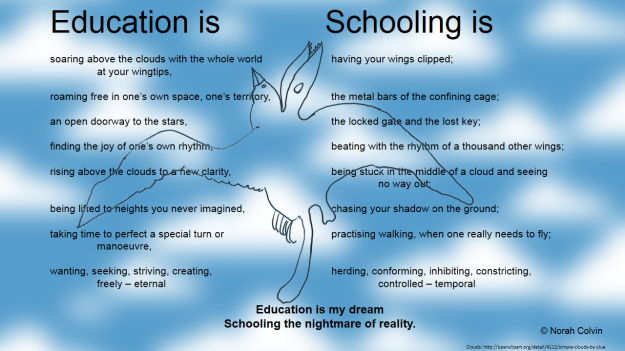
In words reminiscent of my poem “Education is” Christakis says that “schooling and learning are often two different things.” Here is just a sprinkling of her thoughts reported in the article.
- children are capable and powerful but our expectations are often mismatched
- we ask too much of children pragmatically but not enough cognitively
- there is too much teacher-direction and not enough time for play in many preschool classrooms
- teachers need to take the time to listen to children’s stories, to laugh with them, to get down on the floor, at their eye level, and figure out what makes them tick … (through) … respectful observation
- childhood pedagogy should be based on ideas, not on the repetition of simple skills
- respect for early childhood as a life stage worthy in its own right and not merely as a training ground for an adult future
These are ideas I have oft repeated here on my blog. Please read the article in full and, if you are as inspired as I am, read the recently published book The Importance of Being Little. I’d love to know what you think.

Thank you for reading. I appreciate your feedback. Please share your thoughts.


 Norah Colvin
Leave a reply to Gulara Cancel reply