
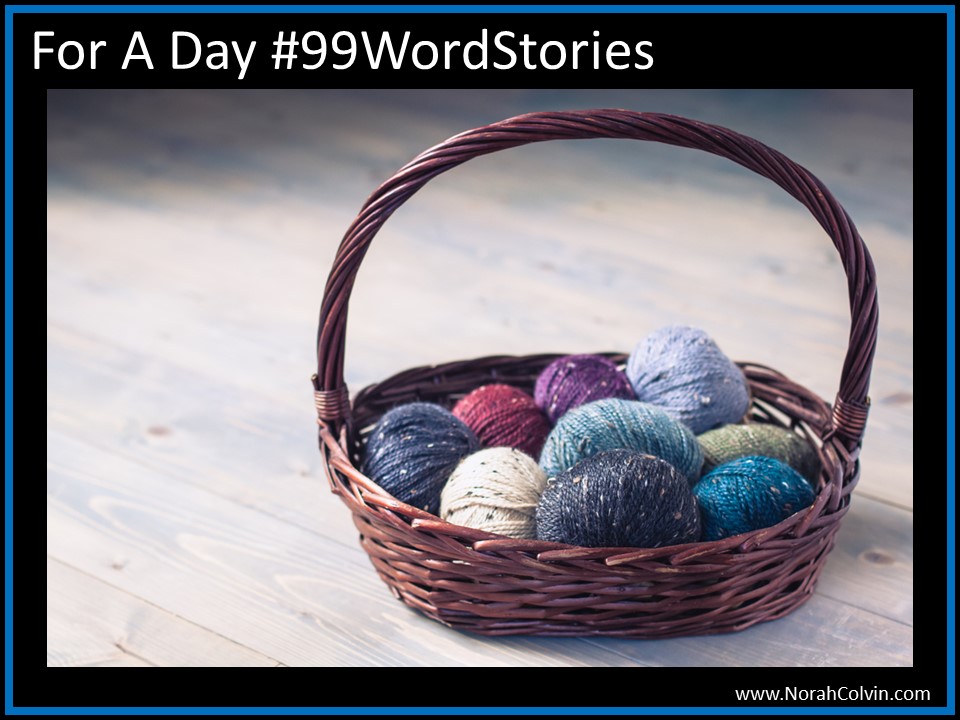

This week at the Carrot Ranch, Charli Mills challenged writers to In 99 words (no more, no less), write a story inspired by the idea, “for a day.” It doesn’t need to be never-ending, like me forgetting to update a prompt. What is so special about the action, person, or object experienced for a day? Go where the prompt leads!
In the post, Charli mentions how difficult it is to be “a transitional generation … a cutting from one’s roots.” It made me think of my mum, and my dad too I guess, who grew up in the country and moved to the suburbs. Like Charli’s children, and unlike most of my cousins, my mum’s children (me and my siblings) were the first generation to grow up in the suburbs. While few of us returned to the country permanently, I think the love for it remains in our veins and we appreciate opportunities we have of visiting.
Charli says, “If you had a day to spend with an icon of your past what would that be?”
That’s a tough one. I’m probably harsh when I think there’s not much in my childhood I’d like to return to. I can’t think of much that’s an icon. If anything is, perhaps it’s the red cliffs of the peninsula where I spent most of my childhood days. Captain Cook saw the cliffs as he sailed up the east coast of Australia (before it was called Australia). Prior to Europeans calling the area Redcliffe, it was known as Kau-in-Kau-in, which means Blood-Blood (red-like blood) by the Ningy Ningy people, the original inhabitants and custodians of the area.
However, perhaps as I said that the love of country still runs through our veins, I should return to my first six years which were lived on a farm. In my memory, I was the best chicken catcher and probably egg collector. I was also good at spotting snakes. I was probably a bit mischievous and even a little destructive (driven by curiosity as I recall) so a bit of a nuisance at times. Maybe no more than my other siblings though.
One day that stands out in my memory was my third birthday. It may not have been the actual day, but it was close to it.
For my birthday, I received a plastic boat and a knitted rabbit that my mother had spent hours making for me. I don’t remember what happened to the bunny, but I may have operated on it or changed its appearance, as I did with many toys, at some stage. Sadly, however, I do remember what happened to the plastic boat.
Living on a farm, it was not unusual for a fire to be lit to burn “stuff”. I can’t remember what was being burned at the time. I do remember being mesmerised by the flames and wondering what would happen to my boat if I threw it in the fire. (What kind of a child thinks like that?) My curiosity overwhelmed me, and I sought the answer to my question. I saw the flames find my beautiful bright red, blue and yellow boat and turn its colours to black. I watched as the boat became distorted, grotesque even, and shrivelled into almost nothing. My curiosity satisfied; I was happy.
Needless to say, my parents were not. And who could blame them? We didn’t have a lot and they would have gone without something to buy me that boat.
I consider that event to be the day my curiosity died. Further experimentation was discouraged, and at school, questions weren’t encouraged. We were told what was important for us to know. While my parents were very much in favour of education, it was more of the ‘fill the empty cup’ variety than the ‘draw out’ type.
My curiosity remained dormant for many years. (Though it can’t have been entirely so, as I remember changing the hairstyles of various dolls ‘to see what they looked like’ over the years.)
I remember it being reawakened by a plastic helicopter owned by my two-year-old son. No, I didn’t throw it in the fire or destroy it by any other means. I was fascinated by its propellor that moved around in a circle and up and down at the same time. I was desperate to take it apart to see how it worked. I resisted the urge. However, the feelings of curiosity I had so long forgotten came flooding back. I spent a lot of time studying it, attempting to figure out how it worked.
I am now passionate about encouraging curiosity in young children and reassuring young parents that their children’s curiosity is not ‘naughtiness’ but a search for answers and a need to know how things work. If the situation is neither dangerous (nor destructive), there is often no harm in letting them find their own answers to the questions.
I guess if I could go back to that one day, I’d find another way of satisfying my curiosity while avoiding destruction and my parents’ displeasure. They didn’t have and couldn’t afford much, but they bought me a boat. To show my thanks, I destroyed it. You can hardly blame them for being cross. Life was difficult and there was enough heartbreak without a small child’s needless destruction. They were, after all, coming from a place of love and doing the best they could. No one can expect more than that of anyone.
After that long, convoluted path, Charli does say to go where the prompt leads, I must now try to weave those thoughts together into a flash fiction. Let’s see how I go.
The Blue Bunny
By the light of a kerosine lamp, when the day’s chores were done and the house was quiet as the children gave in to sleep, but only after a one-millionth drink of water and a final trip to the outside dunny in the cool night air, she knitted a blue bunny for her third child’s third birthday. A baby slept in the cot beside her, and another stirred within her. It took a basketful of creativity and a pinch of magic to feed the growing brood, but stitched with love, a child’s gift was creativity of a different kind.
Thank you for reading. I appreciate your feedback. Please share your thoughts.


I appreciate your feedback. Please share your thoughts.