
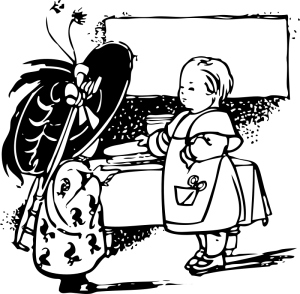
It is a wonderful thing to see children engaging in imaginative creative play. Let them loose with an assortment of bits and pieces and it’s amazing to see what they can construct, both physically with the equipment and in the ways they interact with their constructions, creating imaginative worlds and stories.
A fabric offcut might be a cape, a veil, an apron, a dress, the sail of ship, a red carpet, or the curtain for a puppet theatre.
A cardboard box might be a car, a home for a pet, a high-rise building, an explorer’s ship or a magician’s table.
A cardboard tube might be a ship’s funnel, a car’s garage, a railway tunnel, a fairy wand, or a telescope for gazing at the far-off stars and planets.
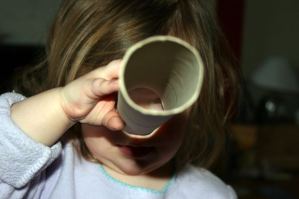
Anything can create magic in a child’s imagination. Sometimes the cheapest things can offer the most value. You only have to watch a young child discard the expensive toy and spend hours playing with the wrapping and packaging materials to see this.
Of course there is value in construction sets and other toys that allow children to imagine and create. However, a cardboard box decorated by the child can be as effective an oven as a fancy store bought one. And while most construction sets come with suggestions of what to build, it is best to put the instructions away and let the children discover for themselves what they can create, and how to incorporate the materials into their play.
While learning to read and follow instructions is an important skill, making only what someone else has already created stifles the imagination and can even suppress the willingness to try, especially if the instructions and constructions are too difficult for the child, and sometimes even the adult, to follow.
I expect young children to have ready access to a variety of materials, as well as opportunities to use them to support their play, both at home and in educational settings they attend. It is something I take for granted as being fundamental to early childhood development. It’s always been, and hopefully will always be.
I was surprised, therefore, when I recently came across an unfamiliar term and theory for describing this type of play.
Loose Parts Theory, according to articles like this one, was first proposed by architect Simon Nicholson. He believed that it is the loose parts in our environment, such as those that can be “moved, carried, combined, redesigned, lined up, and taken apart and put back together in multiple ways”, that stimulate creativity. The term was unfamiliar, but not the thinking.
It took me a little while to find the source of this theory but I finally found a paper written by Nicholson through this post by Kate on An Everyday Story.
I find use of the term Loose Parts interesting. It is appropriate. However, the creative, imaginative play it describes was occurring long before anyone thought to apply such a term to it. If I suggested that it could be a “trendy” term to describe what has always been, I’d be showing just how much of a slow learner I am. Nicholson proposed the term in 1972!
What do you think of Loose Parts Theory? Have you heard the term before? Did you engage in loose parts play when you were a child, or have you observed children playing imaginatively and creatively with loose parts?

Thank you for reading. I appreciate your feedback. Please share your thoughts.


 Norah Colvin
I appreciate your feedback. Please share your thoughts.