
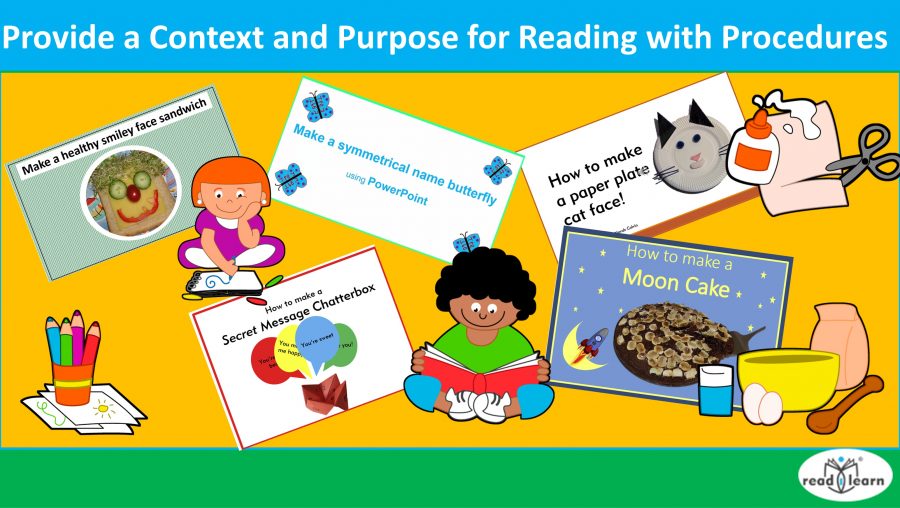
This post is a revisit of one of the first posts I published on readilearn almost six years ago in 2016. Since it was first shared, I have added many more procedures to the collection. All procedural texts and activities can be found in the Procedures subsection of Literacy resources.
Why teach procedures?
Reading and following procedures are a part of everyday life. We need to follow a procedure to make a cake, take medicine, repair a bicycle, treat head lice, assemble a DIY bookcase, or install an app on a digital device. The list in inexhaustible.
Sometimes procedures are presented as text, sometimes as illustrations or diagrams, and sometimes as a combination of both. They work best when each step of the sequence is accurately described and illustrated.
However, not all procedural texts are created equal. Sometimes the language may be inappropriate and unclear. Sometimes steps are omitted or sequenced incorrectly. Sometimes diagrams have little resemblance to what is required and confuse, rather than clarify, the process.
Trying to figure out what to do can cause a great deal of frustration in such circumstances. The more practised we are with following procedures, the more adept we are at interpreting inadequate instructions to achieve a good outcome.
It is never too soon for children to learn to read and follow procedures. The inclusion of procedural texts in a classroom literacy program has many benefits.
Following a procedure provides a context and purpose for reading. It requires children to interpret instructions through a combination of text and visual representation. It generally implies that children are doing or making something, which engages their interest and encourages participation. It develops an essential real-life skill that is transferrable to a range of situations. The sense of achievement in successfully completing a project is both affirming and empowering and often requires no other feedback.
Procedural texts can be easily incorporated into a class reading program as an independent or group reading activity. An assistant to support, encourage and oversee can be invaluable.
Features of procedural texts
The reading of procedural texts differs from reading fiction or other non-fiction texts.
Continue reading: Provide a Context and Purpose for Reading with Procedures – readilearn


 Norah Colvin
I appreciate your feedback. Please share your thoughts.