

Gardeners understand that effort is required to create a garden that provides the desired outcome. The same is true for raising children, with the adage “we reap what we sow” appropriate in both instances.
A school principal surmised once, after observing my interactions with children, that I must have a beautiful garden. But such was not so. The time that may have been spent nurturing plants, I turned instead to nurturing minds, including my own.
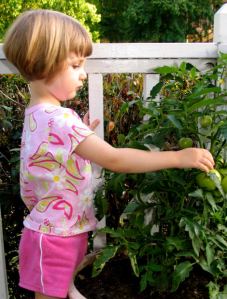
While the sowing is important, so too is the nurturing. Just as there is more to raising a seed than simply sowing one, there is more to raising a child than simply having one. The amount of care required depends on the stage of growth. How they are nurtured in the beginning stages sets the foundation for future growth and determines the harvest.
Susan Scott was thinking along similar lines when she wrote New Moon, Rosh Hoshanah and the Equinox for her Garden of Eden blog this week. She says,
“A good time to plant – seeds of whatever kind – love, patience, kindness, joy are a few that come to mind – anything that blossoms in receptive and fertile soil.”
The words resonate with me at any time, but especially this week when writing my response to the flash fiction prompt at the Carrot Ranch Literary Community. Charli Mills challenges writers to In 99 words (no more, no less) write a story about what it is to gather a harvest.
With the International Day of Peace and its 2017 theme Together for Peace: Respect, Safety and Dignity for All falling just a few days ago on 21 September, it all seems very timely.
Jennie Fitzkee, a remarkable early childhood teacher who blogs at A Teacher’s Reflections, shared her, and her students’, thoughts about peace on the International Day of Peace. Jennie is a wonderful role model for peace and is passionate about nurturing young children. She says,
“peace is about the heart, thinking and doing the right thing. The little things are the most important of all, because they’re the foundation for the big things. By teaching children’s heart they come to understand peace.”
In a previous post Plant the seeds of literacy, I included this excerpt from Jackie French’s 2015 Senior Australian of the Year Valedictory Speech:
“You never know what seeds you plant will grow; if they will keep growing; who will take them and tend them. But there is one thing I have learned in my 62 years: keep planting seeds.

Never think: I am 62 and still have not achieved world peace, universal tolerance and justice, or even an Australia where every single child is given the chance to learn to read.
Change is never fast enough for any person of goodwill.
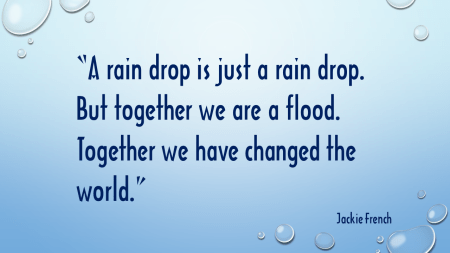
A rain drop is just a rain drop. But together we are a flood. Together we have changed the world.”
She concludes her speech with these words:
“Let us give our children role models who do not, will not despair, no matter how long it takes to change the world. And let us never surrender, no matter how tired we are, or how long it takes. Because with these weapons we shape the future of our planet.”
I also employed the garden analogy in a post entitled The classroom garden. Responding to Charli’s prompt to write about “fruit”, I included the word “harvest”. Rather than simply repeat that story, which would be pleasingly easy but teach me little, I’ve gone in a different direction this time.
In her post, Charli talks about harvesting peas; peas in a pod. It doesn’t take much imagination to turn this into “Peace in a pod.”
Wouldn’t that be wonderful, to plant a seed of peace with “respect, safety, and dignity for all”; “love, patience, kindness, joy”; and “universal tolerance and justice”; nurture it, watch it grow, and then harvest the bountiful rewards. It’s not only the role of teachers and parents, it’s the responsibility of society at large.
Here’s my story. I hope you like it:
Peace in a pod
“The Peace Prize goes to …”
The applause was deafening. It took minutes to realise it was their life’s work being recognised. Who’d have thought? Against a long-range solar-powered superstealth aircraft with adaptive camouflage, how would a peace capsule stand a chance? They stumbled to the stage, minds a-tumble with words, phrases, and blank spaces. In their years of preparation, of tweaking combinations of ingredients, they’d never prepared for this. The standing ovation relieved them of the necessity, drowning each word. Finally, peace pods were ready for harvest and distribution. With mass inoculation, peace was now a real possibility.
After writing the story, I realised that such a pill may not be the panacea I was initially contemplating. Any pill that controls the thoughts and behaviour of the masses could be just as easily used for evil as for good. I may have to send those two back to the lab for further tweaking.
Thank you for reading. I appreciate your feedback. Please share your thoughts.


 Norah Colvin
Leave a reply to Book Club Mom Cancel reply