

How many of these did you hear when you were a child?
- You’re too small
- You’re too big
- You’re too young
- You’re too old
- It’s too far
- It costs too much
- It’s too dangerous
- Girls don’t do that
- Boys don’t do that
- It’s too …
Sometimes it was difficult to find an activity that, like Baby Bear’s bed, was just right. Oftentimes it was only ‘just right’ in the eyes someone wielding the power; and not always in the eyes of the one wishing to have, do, go, or be. Setting limits is often easier than chasing possibilities.
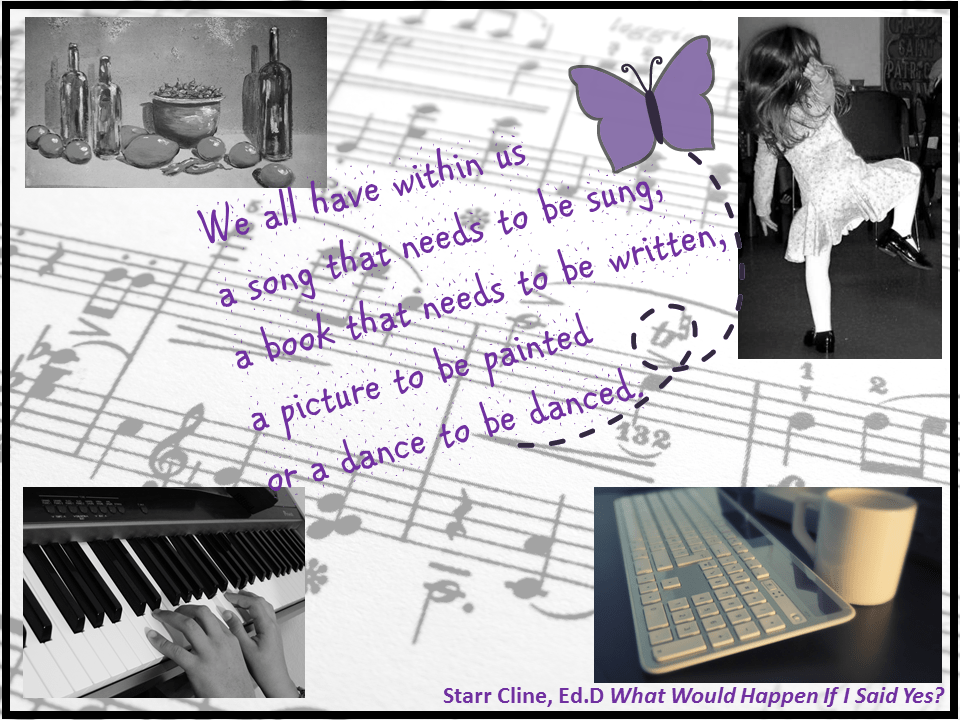
Many years ago I read What Would Happen If I Said Yes?… A Guide to Creativity for Parents and Teachers by Starr Cline. Cline writes about creativity, emotional intelligence, giftedness, intelligences, diversity, and the power of “Yes”. On her website, she makes this statement:
“After years of observation and research, I have drawn the following conclusions:
- Everyone has the ability to create.
- The external environment is critical in the development of one’s potential, whether it be in mathematics, language, the arts, etc.
- Individuals may have one or more areas in which they excel
- IQ scores do not reflect specific talents or abilities
- Creativity begins diminishing at about third grade”
I’m inclined to agree, and feel especially sad about the last point she makes.
What Would Happen If I Said Yes? challenged me to think about ways in which I could parent (and teach) more positively and encourage, rather than inhibit, creativity; encourage a willingness to try new things; and to avoid placing unnecessary limitations upon others and myself. I can’t say I was entirely successful, but I did make some gains.
In the book, Cline suggests that you “STOP every time you are about to say no. THINK about what might happen if you said yes!” Consider the worst scenario that could occur if you said yes, and whether it would be really that bad, or even likely.
She says to consider why you may say No.
“Is it because …
You don’t want to be bothered
It wasn’t your idea
It’s a habit
Someone treated you that way
It makes you feel powerful”
She reminds that the messages saying “No” often sends are:
“Your idea is stupid
You are stupid
You’re not capable
You’re not worth it.”
In the long term, are these negative messages more important than a temporary inconvenience, or than the benefits that would accrue from positive responses?
But don’t get me wrong. Cline doesn’t suggest you just say “Yes” to everything. She says that sometimes you may need to come up with a creative way of saying no. She provides many ways of doing so in her book, which I recommend as a great read for both parents and teachers.
Even as adults we can find ourselves in situations where certain things are not allowed and rules are imposed, such as in the workplace or in clubs and other organisations.
Sometimes the things we are not allowed to do are self-imposed limits; we may not allow ourselves to do things because:
- It’s scary
- It’s unfamiliar
- We feel uncomfortable
- We don’t know anybody there
- It costs too much

Sometimes, as I explained about my attitude to camping in a previous post Around the campfire, we make choices and find ways of justifying our decisions, at least to ourselves if not to anyone else. There are many reasons I choose to avoid camping, many other things I’d prefer to do, and I don’t often consider myself to be missing out.
Although I can appreciate camping’s appeal to others, it was only when I read a late comment by Bruce Mitchell that I began to consider some of the wonders, including Antarctica, I had missed. Maybe I’ll be more adventurous next time round!
This week at the Carrot Ranch Charli Mills has challenged writers to In 99 words (no more, no less) write a story about something or someone not allowed.
In her post, Charli speaks of many injustices, including the rules that say who is and is not allowed to vote in elections in the United States. The rules affect many, for many different reasons (or petty excuses based on power) and tend to be divisive rather than inclusive.

Charli says that,
“The greatest gift you can give is to allow another. Allow someone else to listen to their favorite music. Allow someone else to tell you their story. Allow someone to connect to you even if you feel harried. Smile back, nod, acknowledge, empathize. Be loving. Some among us have denials you can’t see stamped upon their countenances because of circumstances.”
While deciding what we will or will not allow our children to do may seem trivial in comparison, surely bringing up our younger generations to be confident, independent, responsible, and accepting of others, allowing them to join in; creating an inclusive society, is something to strive towards. Perhaps if we allow our children, they will allow others.
For my response to Charli’s flash, I’ve gone back to childhood. Where else? I hope you enjoy it.
Not allowed
She knew they were in there. She heard their chatter. Her knocks began timidly, then louder. The room hushed. There was rustling, then padding feet. She waited. The door opened a peek. Her loving sister’s smiling face appeared, then contorted unrecognisably.
“You’re not allowed!” the monster screeched, and slammed the door.
She froze – obliterated, erased, smashed to smithereens. She was nowhere, nothing. Why? What had she done?
She could only shrug when Mum asked why she wasn’t playing with her sister.
Later, at dinner, she viewed her sister’s sweet smiles cautiously. Was she real? When would the monster reappear?

Thank you for reading. I appreciate your feedback. Please share your thoughts.


 Norah Colvin
I appreciate your feedback. Please share your thoughts.