Live Love Laugh Learn … Create the possibilities

Category: Mathematics

  • STEM in early childhood classrooms – readilearn

    Making space for STEM in early childhood classrooms is easy; or should be.

    Children are naturally curious about the world. They want to know:

    • Why is it so?
    • How does it work?
    • What will happen if?
    • How can I?

    It is important to harness their curiosity, explore their questions, engage their interests and inspire their imaginations.

    Provide them with opportunities to investigate objects and phenomena in the world around them. Don’t always be in a rush to provide answers to their questions. Help them explore ways of finding the answer for themselves, if possible, or conduct the research with them.

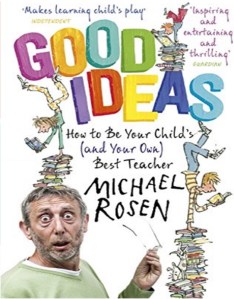
    A story reported by Michael Rosen in his book Good Ideas: How to Be Your Child’s (and Your Own) Best Teacher inspires me. The story explains that, as a child, David Attenborough took an interest in bones. If he was out walking and found some bones, he would take them home and ask his father about them.

    His father, who was a GP and would have known, didn’t just tell him. Wanting his son to be curious and interested in finding things out for himself, he responded, for example: “I wonder if we can work it out . . .” They would then look through books about zoology and anatomy and try to identify the bone’s origin.

    However, the answers don’t always have to be found in a book or on the internet. Some answers can be discovered through explorations and experimentation. Experts can also be consulted.

    In a stimulating early childhood classroom where children have access to a range of resources and opportunities

    Continue reading: STEM in early childhood classrooms – readilearn

  • I spy butterflies – Readilearn

    I spy butterflies

    Learning about butterflies in the classroom, especially when observations of the life stages with a live learning kit are possible, is almost magic for children. The growth of the caterpillars is obvious and children can watch as they moult and pass through each instar. The voracious appetite of the caterpillars means that plants are quickly stripped of their leaves and, if children listen carefully, the munching of the mandibles can be heard.

    Many resources to support an early childhood science biology unit about butterflies in particular, or minibeasts in general, already exist in the readilearn collection; including:

    Butterfly diary

    Minibeast project

    My minibeast ABC

    Code for Caring

    I included suggestions for teaching about minibeasts, including butterflies, in a previous post Classroom minibeasts. While there are many minibeasts suitable to study in the classroom, butterflies are my favourite. This week the readilearn collection has grown with some new resources to support learning about butterflies; including:

    butterfly word cards

    Butterfly word cards

    Butterfly word cards is a collection of forty butterfly-relevant words which may be printed and displayed on a word wall or used to label a butterfly display. The words are presented in three different formats for printing choice.

    The words include some fascinating scientific terms; such as:

    • instar
    • frass
    • chrysalis
    • prolegs

    Continue reading: I spy butterflies – Readilearn

  • Logical thinking and problem solving – Readilearn

    logical thinking and problem solving

    Logical thinking and problem solving are important skills for children of all ages to develop, including those in early childhood classrooms. We employ thinking skills each day, in many situations, from deciding the order in which to dress ourselves, complete simple tasks, collect items for dinner or set the table; through to more complex problems such as assembling furniture, writing work programs, juggling timetables, and organising class groupings for activities.

    This week I am excited to upload a new interactive digital story that encourages children to use logical thinking to solve a problem.

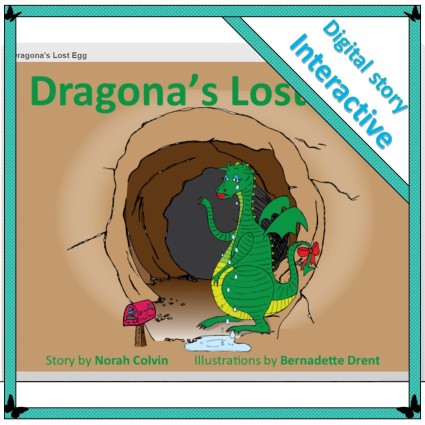
    Dragona's Lost Egg

    Dragona has lost her egg and turns to her friend Artie, owner of a Lost and Found store, for help. Artie is confident of helping her as he has many eggs on his shelves. He asks Dragona to describe features of her egg, including size, shape, pattern and colour. He uses a process of elimination to identify which egg might be Dragona’s. Children join in the process by choosing eggs with the characteristic described.

    What is Dragona’s egg really like, and will Artie be able to help her find it?

    You’ll have to read the story to find out.

    The process of writing this story also required a problem to be solved; and I love nothing better than a good problem to solve.

    What’s an ovoid? Do you know?

    what's an ovoid


    To find out, continue reading at: Logical thinking and problem solving – Readilearn

  • Inspiring creativity – celebrating Dot Day – Readilearn

    inspiring creativity - dot day

    Next Friday 15 September is International Dot Day, a day for celebrating and promoting creativity, courage and collaboration.

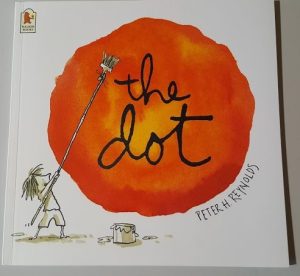
    Celebration of the day was initiated in 2009 with teacher Terry Shay introducing his class to the picture book The Dot by Peter H. Reynolds.

    The story is of Vashti and a teacher who encouraged her to make a mark and have a go. Lacking self-belief and courage, Vashti was reluctant to participate in art class. When the teacher framed and hung her signed painting of a tiny dot, Vashti was determined to do better. She painted all kinds of dots that wowed the people at the school art fair. What happened when one little boy admitted to Vashti that he wished he could draw will inspire children everywhere to be brave, have a go, and be creative.

    For a wealth of celebratory suggestions, visit the International Dot Day Get Started page and sign up to download a free Educator’s Handbook, which includes a lovely certificate of participation which can be printed and personalised for each child.

    I have included a link to the page in the new resource Getting creative with dots in which I suggest additional ideas to add to the celebration.

    getting creative with dots

    The suggestions, of which examples are shown below, can be used in conjunction with International Dot Day, or any day when you feel like going a little dotty.

    Continue reading: Inspiring creativity – celebrating Dot Day – Readilearn

  • The value of parent volunteers in the classroom – Readilearn

    value of parent volunteers

    I have always welcomed and appreciated parent volunteers in the classroom. The value they add to the classroom program and children’s learning is enormous. I always loved that we could do much more with the assistance of parent volunteers than we could without.

    But effective use of the parent volunteer’s time requires a certain amount of organisation and preparation. Just as there is little point in a parent volunteer turning up at a scheduled time if you are unprepared; there is also little value in a parent appearing at the door during class time and asking, “Can I help?”

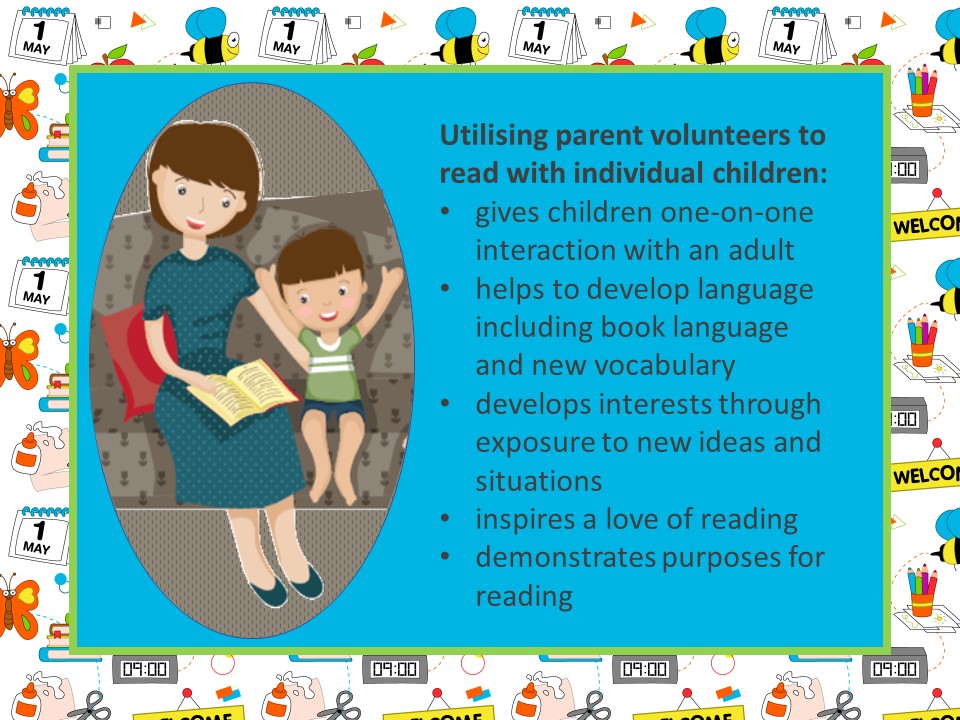
    Parent volunteers can play a very important role in the classroom, especially with group work in literacy and maths, assisting with art lessons, outdoor activities and work in the computer lab. They may also help in administrative-type roles such as changing reading books and checking sight words. Perhaps they could read to groups or individual children, or listen to children read.

    utilising parent volunteers

    How their support is utilised will depend upon their availability and your class program.

    For a variety of reasons, not every parent is able to offer regular assistance in the classroom. Indeed, parent help should not be viewed as an expectation but appreciated as a gift of their precious time.

    when parents volunteer

    Sometimes parents welcome the opportunity to share a special skill or information related to their

    Continue reading: The value of parent volunteers in the classroom – Readilearn

  • Happy first birthday, readilearn! – Readilearn


    This week we celebrate readilearn’s first birthday. Last year we launched with just over one hundred resources to support early childhood teachers in their role. Now there are more than 250, and the number continues to grow with new resources uploaded nearly every week.

    Resources across most areas of the curriculum support teachers of children in their first three years of school. All resources are original and teacher-made, designed to lighten workloads by providing lessons and activities teachers would make themselves, if they only had time.

    The collection consists of digital stories, and interactive resources for use on the interactive whiteboard. There are printable activities, teaching suggestions, and notes for distribution to parents. If you can’t find what you’re looking for, let us know and we’ll do our best to support you.

    This week, in celebration of the milestone, I have uploaded two new free resources which can be personalised for individual children on their birthday.

    Continue reading: Happy first birthday, readilearn! – Readilearn

  • Is the ‘right way’ always the best way?

    Giving children opportunities to question, to be creative, and to problem solve are high on my priorities. Children need to be given the time and opportunity to figure out things for themselves. While it is sometimes easier just to tell or show them what to do, or even do it for them, it is generally better for their development, to let them have a go at finding a method or solution. Please note: I am not talking about dangerous things here like playing with fire, testing to see how fierce that dog really is, or driving a car.

    If children are constantly told there is a right way of doing things, they will stop exploring, discovering, and inventing their own or new ways of doing things. This is an issue because, if we always do what we’ve always done, we’ll never progress. There is generally no harm in, but much to learn from, each successive attempt.

    Opportunities to explore, discover, and use intuition are also important to the development of mathematical thinking. When children are developing understanding of number, they often invent their own strategies for working with numbers. Sometimes, as attested in this paper by Heirdsfield, Cooper and Irons, the strategies used display more advanced thinking, and are more efficient, than those taught as ‘the’ correct way of solving a problem using pencil and paper.

    I have noticed a change in the speed and agility with which my seven-year-old grandson works with numbers now that he has learned there are certain ways of; for example, adding two numbers. He tends to second-guess himself as he attempts to mentally calculate using the pencil and paper method he has been taught, rather than other more effective strategies he had previously invented and used. Perhaps you have noticed something similar.

    Provocations, such as these 3 Fun Inquiry Maths Activities for the Last Week of School by Steph Groshell on Education Rickshaw,  are great to get children thinking about different ways of solving real problems.

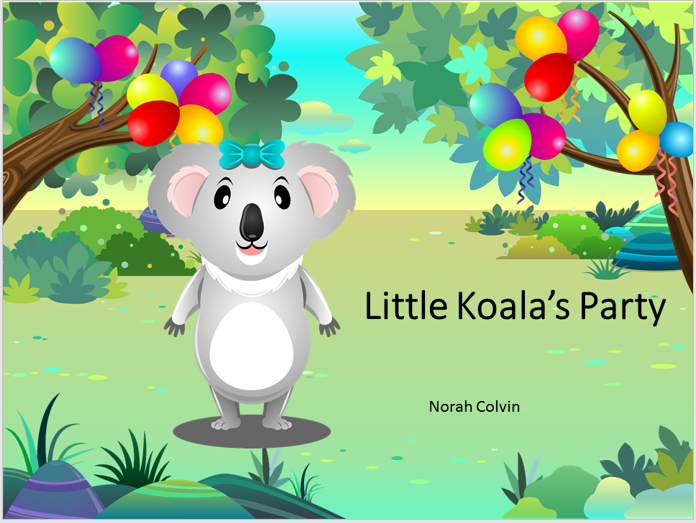
    Little Koala’s Party – a story for problem solving in the readilearn mathematics resources also encourages mathematical thinking and planning. Children help Little Koala organise a party for her family and friends, deciding who will be invited, the number of guests, and what’s on the menu. The suggestion is made that children plan a party of their own and they are asked to consider how they would go about it. The discussion and sharing of ideas, rather than the imposition of one ‘right’ way, is the important thing in developing mathematical thinking.

    Now it might seem a stretch to tie this in with a piece of flash fiction, but I hope you’ll be able to follow my thinking through the mist and into the light.

    This week at the Carrot Ranch, D. Avery took the reins from Charli Mills and challenged writers to in In 99 words (no more, no less) write a story that symbolically, mythically, mystically, or realistically involves dawn, as a noun or verb. Write about the dawn of time or the time of dawn, or the dawning of an idea. As always, go where the prompt leads.

    The right way

    Father and Son sat side by side. Father cracked his knuckles and sighed repeatedly while Son sharpened his pencils, each pencil, and arranged them meticulously according to undisclosed criteria.

    “Come on. Just get it done. Then you can play.”

    “I’m thinking.”

    “Think faster.”

    “I know it’s 96.”

    “Well write it down.”

    “Sir says I have to do the working out.”

    “Then do it.”

    “I don’t know how.”

    “Like this. See.”

    “That’s not how we do it. Sir says…”

    “Then do what Sir says.”

    Slowly it dawned on Dad: Sir’s way may not be the best way for all.

    Thank you for reading. I appreciate your feedback. Please share your thoughts.


  • Getting active with maths – Readilearn

    Many games involve children in practising maths skills, and playing games is a great way of incorporating fun into the maths program. With the additional benefit of supporting the development of social skills and, oftentimes, literacy skills, there is no reason to not include games. A daily dose of fun with maths contributes much to an enjoyable classroom experience, developing positive attitudes to maths, in addition to providing opportunities for consolidation and practice of maths learning.

    Adding a little physical activity to the game increases the benefits, and there are many simple games that can be played with the whole class, indoors or out; some that require equipment and some that don’t; some that take just a few minutes, and some that take several. Many games can be invented on the spot to suit current learning.

    Continue reading: Getting active with maths – Readilearn

  • Shaping up – activities with 2D shapes. – Readilearn

    Shapes are all around. Everything we see has a shape. Some of those shapes are regular, some not so regular. In early childhood, children are introduced to the basic regular shapes of circles, triangles and rectangles, including the special rectangle that we call a square.

    Even before they begin formal learning, most young children can recognise and name these four basic shapes. They see them in picture books and encounter them in puzzles and games.

    But learning about shape goes much deeper than just being able to recognise and label those colourful images.  An understanding of shape has relevance to many other activities such as reading maps, construction, laying tiles, and stacking items. They need to know how shapes can be combined to form others, and what happens when they are cut, flipped or turned. They will use their knowledge of shape in more advanced geometry such as finding perimeter, area, and volume.

    The colourful, and sometimes humorous cartoon-like, ways in which shapes are introduced to young children, can make them appear fairly basic, and parents and teachers may state with pride, “My child knows all the shapes.” But with shape forming a basis for so much other understanding, it is important to use language that enables understanding and discourages the formation of misunderstanding.

    Misunderstandings occur when objects

    Continue reading: Shaping up – activities with 2D shapes. – Readilearn

  • Fair trade – what’s it to you?

    What do you think of when you hear the word “trading”?

    International trade? Stock market trading? Trading one item for another? Perhaps a Trade Fair, or selling items at a market stall? Trading as your *business name*? Maybe you are committed to purchasing “Fair Trade” in support of the  World Fair Trade Organisation’s aim of making international trade more equitable?

    As an early childhood teacher, I think of trading games that we use in maths lessons to help children understand place value. In our decimal system, we use ten digits in various combinations to represent numbers. Placement of each digit is vital; for example, 290 is very different from 902.

    Without a firm understanding of place value, it is difficult to work with numbers efficiently. I believe that many difficulties with number stem from insufficient understanding of place value. Children need to experience numbers in a variety of contexts to fully understand the decimal system.

    For younger children just beginning to learn about two-digit numbers, we may connect interlocking blocks or bundle popsticks to form groups of ten.
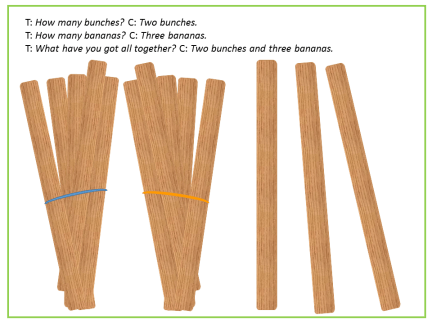
     

    When children have a firm understanding of the grouping process, and the way the numbers are represented with two digits, they move to a similar process with numbers over one hundred. It is at this time that we introduce trading.

    Instead of using interlocking cubes or other items that can be linked or bundled, ten individual cubes are traded for one ten, and ten tens are traded for a one hundred flat, and so on.

    I feel so strongly about the importance of children learning place value, that I have made a variety of resources for teaching it. The resources, available from readilearn; include:

    Beginning place value – the train game
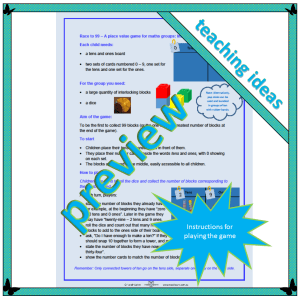
    Race to 99 – A place value game for maths groups

    The interactive resources
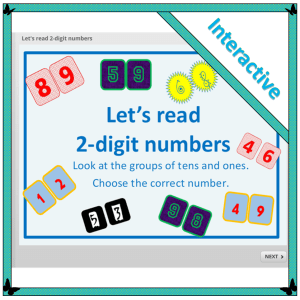
    Let’s read 2-digit numbers
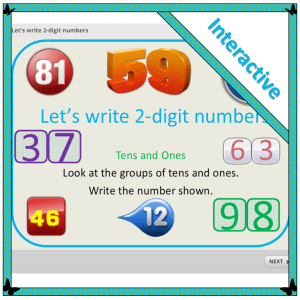
    and Let’s write 2-digit numbers

    Playing games has always been a favourite activity for me, and always popular for family gatherings. We’d quite often we’d spend holidays, like Christmas and Easter, when the children were growing up, playing board games or card games. One of our favourite games, especially if there were larger numbers of people (up to ten) was a trading game called “Billionaire”. It is a raucous game. Everyone is engaged all the time. Play involves trading cards (commodities) with each other, and this involves much shouting (over the top of each other) and laughter. If you have never played it, but enjoy games, and have a group of four or more to play, I highly recommend it. (Sorry, I couldn’t find it to add a photo. It’s hidden away in the games cupboard somewhere.)

    I couldn’t write about trading without mentioning Jack and the Beanstalk. Mother sends Jack off to the market to sell the cow. Along the way, he meets a man with a handful of “magic” beans which he offers to trade for the cow. Not having heard the saying, if it sounds too good to be true, it probably is, Jack agrees. Of course, Mother is none too pleased and throws the seeds out the window. But, as the story shows, Jack was right to trade and rewarded for his ignorance of the oft-touted adage. (The story also raises other issues regarding trespass, theft, and causing fatal injuries. But we won’t go there this time.)

    This week at the Carrot Ranch Charli Mills has challenged writers to In 99 words (no more, no less) write a story about trading. It can be the profession of old or of modern day traders on Wall Street. It can be trading places or lunches at school. What is traded? Is it a fair deal or a dupe? Trade away and go where the prompt leads you.

    For my response I’ve ended up in the playground yet again. It involves a little trading of cards, but more a trading of power. I hope it works.

    Trade fair

    Cards, were coveted like gold. To belong, one was enough; more better. Each lunchtime the boys showed off new acquisitions, compared intelligence and strength points, and traded duplicates. Fair and friendly battles pitted minds, the winner claiming card supremacy. Then bully Boris won, and none dared challenge. Until Justin, tired of Boris’s tactics, dared.  The group gasped. It seemed Justin would be crushed. But clever cardless Frank slipped in and showed the winning move.  Boris growled, “Inadmissible” and threatened repercussions. Defiant, Justin handed Frank a card, bestowing membership. Empowered, each boy followed, declaring Frank the Master, and trading opened.

    Thank you for reading. I appreciate your feedback. Please share your thoughts.