The beginning of a school year is usually filled with anticipation and expectations: new books, new stationery, new friends, new activities, new things to learn. The excitement may be tinged with a little anxiety: will they like me? will I like them? will I be able to do what’s expected of me? what will I do if (insert any likely or unlikely event) occurs? These questions are shared by students and teachers alike.
In addition to all the usual anxieties, with the beginning of this school year occurring at the peak of the Omicron outbreak, many more questions are raised: will school begin as usual? will it be delayed? will lessons be online or face-to-face? will teachers and students’ health be affected and impact attendance? how safe will we/I be if everyone is not vaccinated?
While I am unable to give you any answers about the impact of coronavirus on the school year, I know that whether you are teaching online or in the classroom, or a combination of both, readilearn resources will help reduce your workload with lessons that are ready to teach and activities that can be done at school or at home. The resources now number over 500 and all are for use by teachers with children in the first three years of school. You know when you come to readilearn, you don’t have to wade through lessons for other year levels as well.
Interactive Lessons
Over 100 of the lessons in literacy, maths, science and HASS are ready for you to teach on the interactive whiteboard. They can be used in the classroom or delivered to students if teaching online using screen-sharing as I explain in this video.
Days to Celebrate
When planning the school year, in addition to the ongoing curriculum program, it is good to have some special days and events to celebrate.
A list for each individual months includes more information about each date and provides teaching suggestions and lesson ideas. Each of these documents is available to download free in the Days and Events/Calendars section of Classroom Management resources.
Welcome to the first post for 2022. Although, globally, we are all still confronted with the ‘inconveniences’ caused by the pandemic, I hope you will find much joy and many successes to celebrate throughout the year.
This year has been designated as:
International Year of Artisanal Fisheries and Aquaculture
International Year of Glass
International Year of Sustainable Mountain Development
International Year of Basic Sciences for Sustainable Development
all of which have relevance to our classroom programs and the Sustainable Development Goals. While I give but a brief introduction to each in this post, I hope to bring you additional lessons and teaching ideas throughout the year.
I thank you for your support throughout 2021 and wish you all a very happy, healthy and successful 2022.
While Covid still pulled more strings on our lives than we had expected at the end of 2020, I hope that you have been able to achieve at least some of your goals and ambitions in 2021.
In August of this year, we celebrated readilearn’s 5th birthday. It’s an achievement of which I’m proud. Five years seemed such a long time in the future when I began. Now, looking back, it’s gone so fast. I have continued to post a weekly article on the blog, publish a newsletter each month, and upload new resources throughout the year so that the collection now numbers over 500. I hope you have had the opportunity to use many of them with your children.
In addition to the work for readilearn, I had twelve more stories added to the Library For All collection. You can read about them here.
I also wrote three phonic workbooks for Pascal Press which should be available for purchase early in the new year. Look out for the Targeting Phonics series.
And I continue to write manuscripts for picture books hoping that one day I will see a picture book with my name on the spine on the shelves of book stores and libraries. It’s been a goal since my childhood. One day …
Goals help us move forward. Without goals and without hope, life may stagnate and become dull. I hope it never does for you.
As we move into another new year, I share with you two quotes about hope that inspire me:
I take this opportunity to wish you and your loved ones a happy and safe holiday season. May the magic of Christmas brighten your days and fill your heart and home with joy — now and always.
For some light Christmas entertainment for the children, Norah reads Who’s Hiding at Christmas?
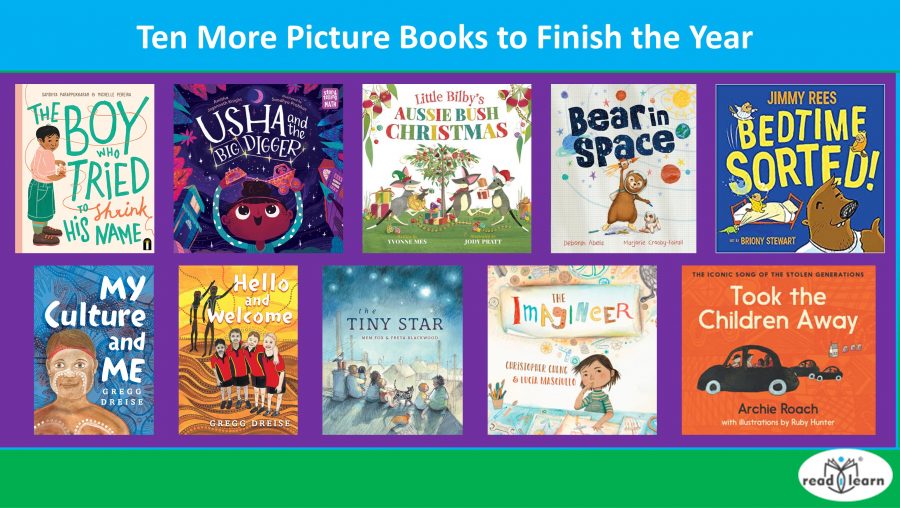
Last week I provided you with a list of picture books I had reviewed or whose authors and illustrators I had interviewed throughout the year. Of course, I read many more than that. It would be impossible to review all the books I read. However, in this post, I share just ten other picture books I have read and enjoyed this year, not all of which were published this year. I hope you find at least one that appeals to you or your young people. (Note: where I was able to source a video, I have included one.)
The Boy Who Tried to Shrink His Name
by Sandhya Parappukkaran and Michelle Pereira (a Bright Light book published by Hardie Grant, 2021)
The blurb states that ‘No-one should ever have to shrink themselves down to fit in.’ I think we would all agree with that.
However, when Zimdalamashkermishkada starts school, he knows he will have to do something about his name. He is asked to spell it and repeat it before a friend shortens it to Zim. When he asks his mother if he can shorten Zimdalamashkermishkada to Zim, she explains the reasons for giving him his name and suggests he gives people a chance to learn it. Which is just what he does. He stretches his name out bit by bit to teach his new friend Ella who shares pride in his name and teaches others to use it correctly too.
I love the theme of this book and its message about recognising and accepting others. How many times do we have children in our classes with names that we at first find difficult to pronounce? How tempting is it to simply shorten them because it is easy? How much more important is it for us to acknowledge and learn their given names showing respect for them and their culture and modelling that respect for the children in our class as well as our colleagues. Shortening names may be easy, but it can be hurtful too. This book is a great reminder of that and of appreciating our differences and what it means to be unique.
(Note; while there is a reading of this book on YouTube, I haven’t shared it here as I was disappointed that the reader didn’t even pronounce the author’s name correctly. Sorry, Sandhya.)
Usha and the Big Digger
by Amitha Jagannath Knight and Sandhya Prabhat (a story telling Math book published by Charlesbridge, 2021)
This is another wonderful book that I received as a gift from the author, simply for leaving a comment on an interview with Kaitlyn Sanchez on her blog Math is Everywhere.
In my comment, before reading the book, I simply said, ‘This book sounds amazing. I love that the constellation is viewed from different perspectives. What a great introduction to perspective for children – both the maths, and the ideas/points of view. The cover is appealing with the gorgeous night-sky colours. Yes, I’d love to read this one and have added it to my Good Reads Want to Read list. Here in Australia, we have different ways of looking at the constellations too. While we see the images drawn by connecting the dots (stars), our Indigenous Peoples see the shapes in the dark. It’s quite fascinating.’
And for that I received a free book from Amitha. That’s amazing. And the book doesn’t disappoint either. The deep colours that Sandhya Prabhat has used to illustrate the dark of the night and the sky with its stars are just beautiful and add so much depth of the discussions and the themes.
In the story, three girls observe the constellation that I know as the Big Dipper or the saucepan. The older sister also refers to it as the Big Dipper or a big spoon. The younger sister Usha, who loves trucks, sees it as a big digger. Unable to agree, they call on their cousin. But Gloria sees neither a dipper nor a digger. She sees a kite. When they try to see the stars from the others’ perspective, they come to a whole new understanding.
I love the way this book deals with looking at things from different perspectives and coming to an understanding. I also like that it includes information about the constellation, including that it isn’t really a constellation, it’s an asterism, and how it is seen by different cultures around the world. In addition, it includes suggestions for exploring maths related to the story. I wasn’t previously aware that there was a publisher of STEM related books such as Storytelling Math. I’ll be looking for more of their titles as I think picture books are a great way to encourage a love of maths as well as reading. That’s definitely a win-win.
You can listen to Amitha talk about her book here.
Books and reading are two of my favourite things. Or should they be combined into just one favourite thing? If so, it’s a mammoth favourite thing.
I have loved books and reading for as long as I can remember and turning others on to a love of books and reading gives me great joy. Finding that joy is one of the reasons I interview authors and illustrators and review their books. I hope my interviews and reviews have encouraged you to read some of the beautiful books I’ve brought to you this year.
Just in case you may have forgotten some of them and are thinking of last minute gifts for those young children in your lives, look no further. Books make great presents for persons of any age, and any of these books will give long-lasting pleasure.
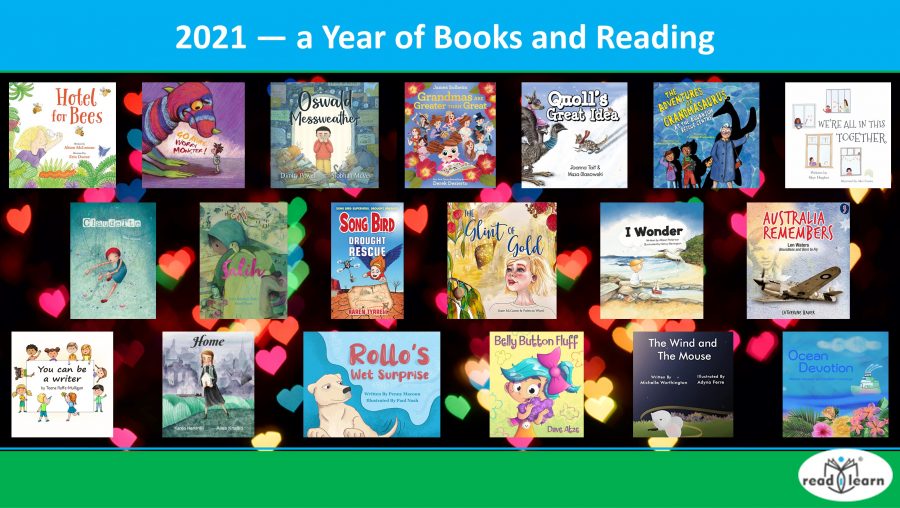
I this post, I remind you of the books I’ve reviewed and authors and illustrators I’ve interviewed throughout the year. It’s been a bumper year. Just follow the link to find out more about a book you are interested in.
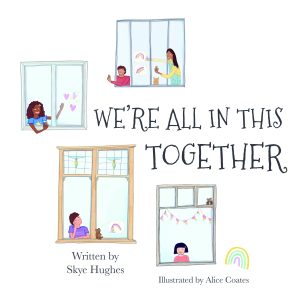
School friends – Kiana, Amin, Roshan, Casey, Ming, and Tyler all have one thing in common — they can’t go to school. The world changed very quickly and now they have to stay home to keep themselves and their families and friends safe. They discover that even apart, they can find new and fun ways to be together.
Worry Monster loves ‘helping’ Archie worry, especially on the night before he starts at a new school. Archie feels so anxious that his head hurts, his tummy flutters and his heart pounds. He soon realizes that the only way to feel better is to make Worry Monster go away. He does his belly breaths and challenges his inner fears by facing facts, and Worry Monster is forced to leave Archie alone! Go Away, Worry Monster! gives children useful strategies to cope with their anxieties and stress, showing them how to make their own Worry Monsters leave, even in highly stressful times.
This article was written for and first published at the Carrot Ranch Literary Community as part of a series supporting parents with children learning at home. Although it is now the 3rd of December, you will still be able to complete most of the activities, especially since many of you will be on holidays and entertaining your own children during December. Enjoy!
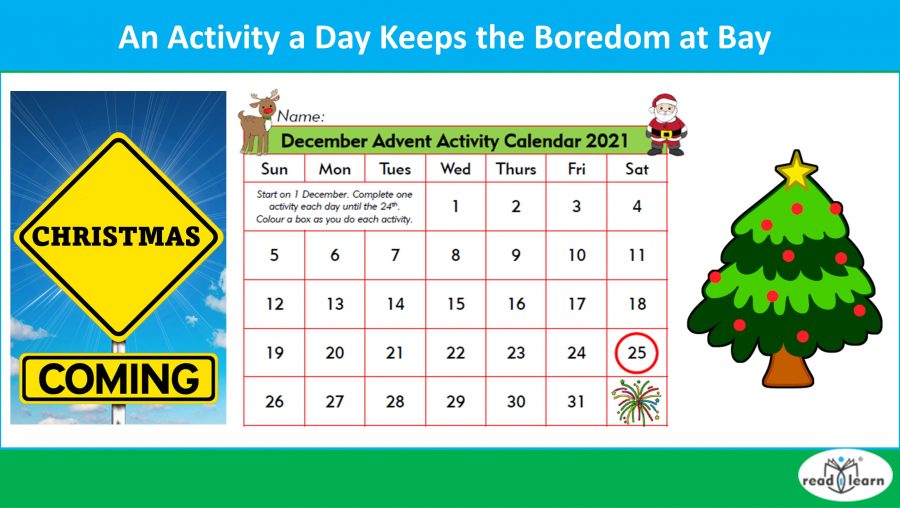
With the timing of this post on the last day of November, I have prepared a December Advent Activity Calendar for families (parents and children) to use in the lead-up to Christmas. There is one suggestion for each day until Christmas. In this article, I provide a brief outline of each activity. For those who want more, I have prepared a PDF with additional details for each activity which you can download freeby following this link.
Put up the Christmas Tree
It is traditional for Christmas trees to be put up and decorated at the beginning of December. In my family, we try to do it on, or as close to, the 1st of December. If you haven’t put your tree up yet, perhaps it’s time to think about it.
I have provided the outline of a Christmas tree which can be cut, coloured and hung on the real Christmas tree. Write the year on it. On the back, write something you wish for yourself, something you wish for others, and something you wish for the world. Hang it on the Christmas tree. If you do the same thing each year, you can reflect on changes in yourself and in the world.
Make Paper Chain Decorations
Paper chains are easy to make and add colour to the tree or can be hung around the room.
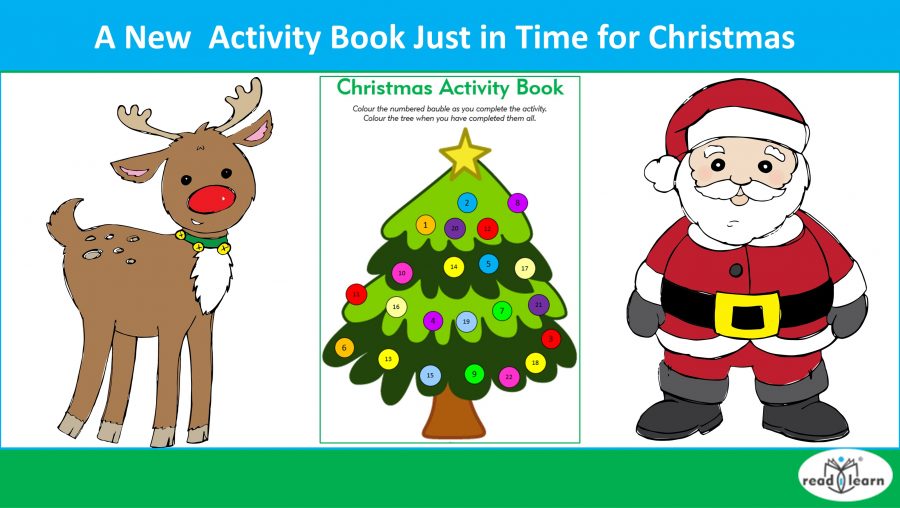
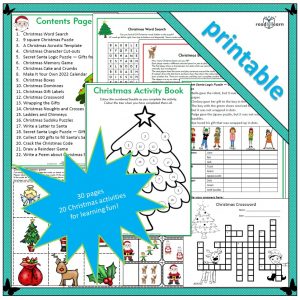
In this post, I am sharing information about a new Christmas Activity Book I have recently complied and uploaded to the readilearn collection. It is a 30-page booklet with 20 different activities and is perfect for 5 ̶ 7 year-old children to use at home or in the classroom.
The book includes:
games to play alone
games to play with others
literacy activities
maths activities
word puzzles
number puzzles
logic puzzles
poems to write
and much more.
Some of the activities are already available as separate items in the readilearn collection, but not available together. More than half the activities are new. I decided to put them together in one book for ease of printing and distributing. You still have the option to print pages separately if you prefer, but you have access to all 20 activities in one document.
Here at readilearn we recognise that not all learning takes place in school. We know that learning can occur anywhere at any time and continues throughout life. It can be planned or incidental. It can be fun and joyful. It can even cause frustration at times. In fact, some frustration may encourage the learner to push further and try harder to find a solution. That is especially so when the frustration occurs in a purposeful activity in which the learner is engaged and feels a need to solve. Unsuccessful attempts don’t mean failure. They mean it’s time to try again. We see this in situations from a child learning to walk or ride a bike to scientists finding a cure for disease. What we most need to do to develop a love of learning is inspire curiosity and creativity and avoid ringbarking either through confinement.
As the end of the school year in Australia approaches, most teachers and parents are looking forward to the holidays as much as the students are. The last couple of years have been tough with changes to teaching and learning circumstances and the increased involvement of parents in monitoring their children’s school learning at home. While parents may have become more familiar with teaching methods used in the classroom, it is important for them to realise that learning can still occur during the holidays without the formality of classroom exercises.
The most important things parents can do for children, right from birth and through their developing years and beyond, is to talk with them, play with them and read to them — every day. The same can be said for teachers.
I previously shared this wonderful TEDtalk by 7-year-old Molly Wright in a post about The Importance of the Early Years. But it is inspiring and watching it gives me joy and I thought watching it might also give you joy. It is definitely worth sharing with parents to encourage and affirm positive interactions with their children.
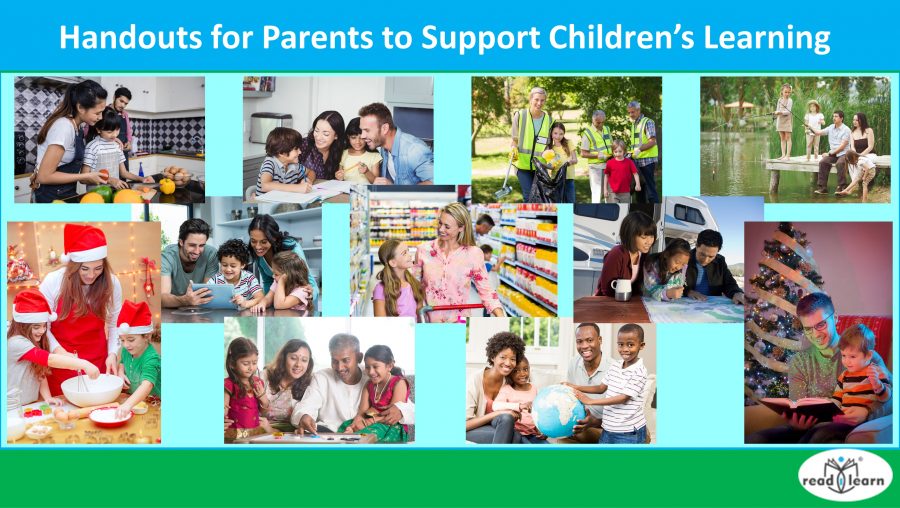
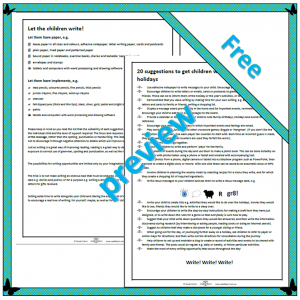
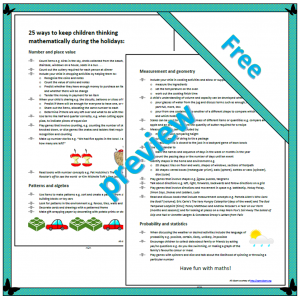
We also have some handouts of suggestions which you are welcome to copy and send home to parents. You can find them in the Classroom Management — For Parents collection. They are all free resources and suggest ways of increasing the learning in everyday situations, mostly by being aware of the opportunities that arise incidentally throughout the day.
A few weeks ago, I was delighted to be interviewed by Yvette Prior on her Priorhouse blog.
I have known Yvette for a few years now and always enjoy reading her posts that share photography, art, humour and wisdom.
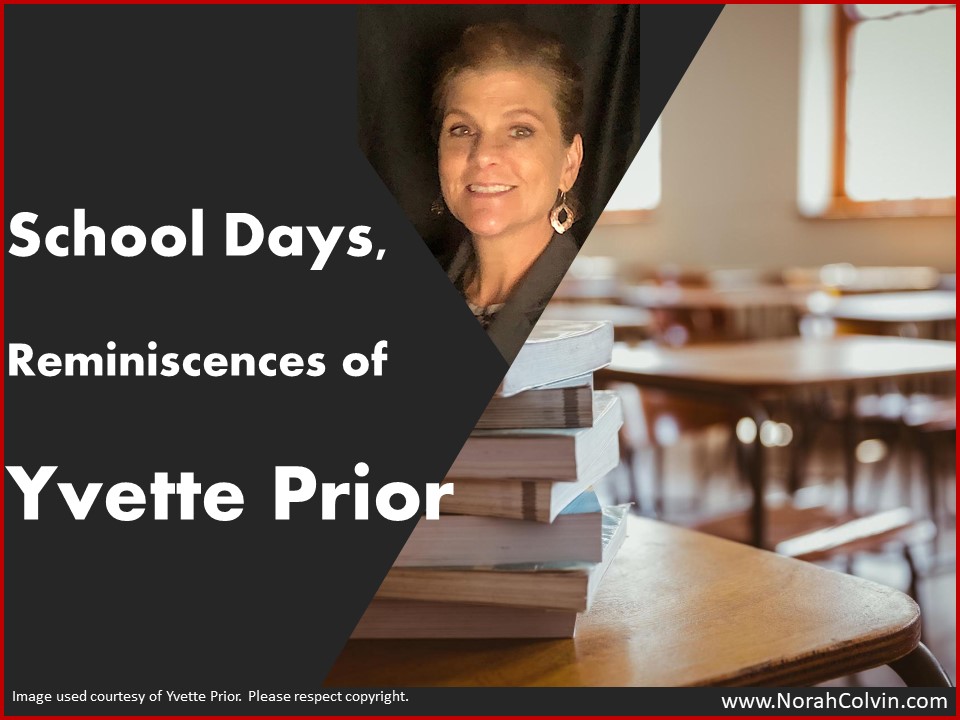
A couple of years ago, Yvette participated in my School Days, Reminiscences series. You can read her post here. You can also find out about her books at the end of that post or on her website here.
Yvette has a wonderful way of presenting interviews on her blog. If you are interested in reading our conversation and finding out a little more about me, please pop over to Yvette’s blog to read : Norah Colvin @ Readilearn (Priorhouse Interview)














 Norah Colvin