Live Love Laugh Learn … Create the possibilities

Category: Early childhood education

  • Stop bullying now!

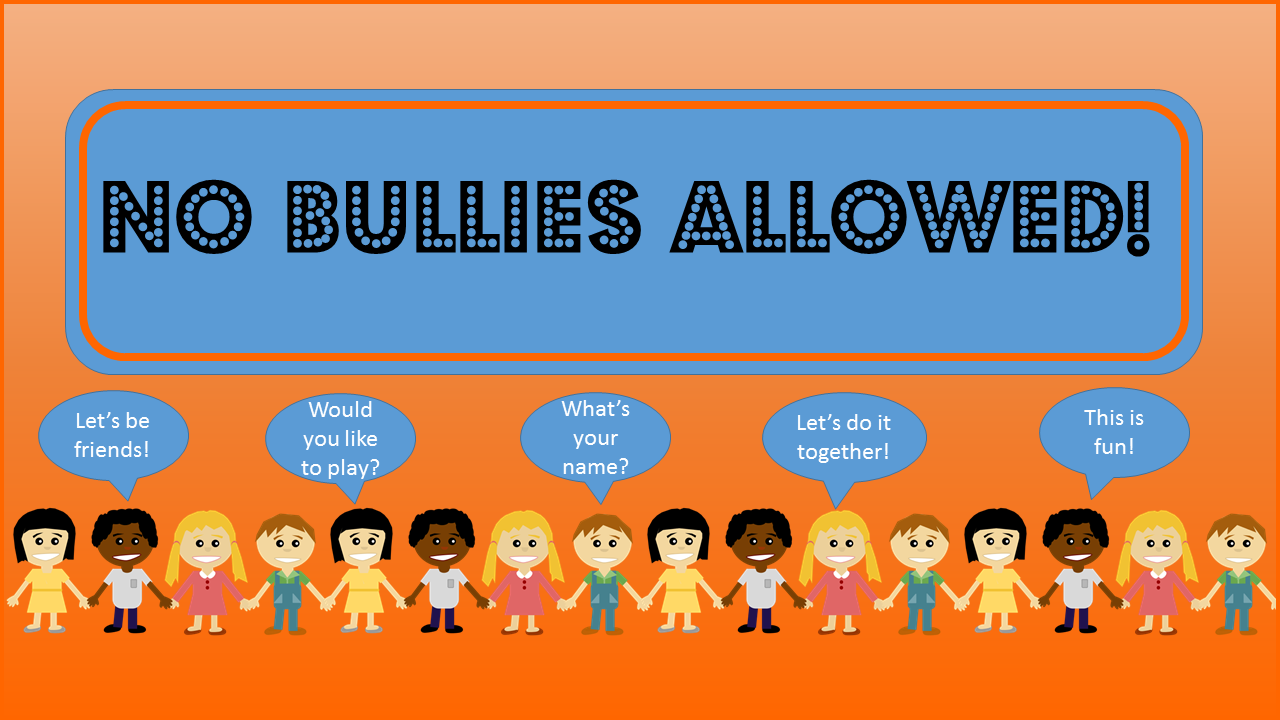
    No bullies allowed2

    Today all across Australia children, teachers and other school personnel are dressing in orange to mark the National Day of Action against Bullying and Violence. The Bullying No Way! Program aims to

    “create learning environments where every student and school community member is safe, supported, respected and valued”

    A very worthwhile goal, I’m sure you’ll agree.

    The Bullying No Way website has resources for parents, teachers and students, including this video for young children:

    The Prime Minister Tony Abbott delivered a message to children telling them that there is no place for bullying in Australia, that bullying is wrong.  I definitely agree!

    Picture1

    Last month Yvonne Spence organized a very successful #1000 Speak for Compassion campaign. This month she has placed the focus on bullying and requested bloggers to unite their voices against bullying. You can join in by visiting the Facebook page. I have already linked my most recent post Bully for you! as well as this one. There are many others there to read.

    Last week Charli Mills extended a challenge to write a flash fiction story about bullies. She has compiled the wonderful stories in her post Circling the Bullies.

    My previous post, Bully for you! received many comments, some sharing experiences of bullying, either of themselves or someone close to them. One comment was from a new visitor to my blog Sherrill S Cannon who shared information about her books dealing with bullying for children, and also explained her involvement with I’m bully free.org to which she donates 50% of the revenue from her books purchased through that page.

    There are many other organizations that promote information about and actions against bullying worldwide.  Hopefully as more voices unite in making others aware of, and in speaking out against bullying, we can come close to eradicating it from our society.

    As Michelle James commented on my previous post

    “More needs to be done to prevent bullying. I really believe that there should be more intensive courses for teachers and administrators to learn to deal with the bully issue. We will never eradicate bullying completely. It is a tactic used by despots and terrorists, and sadly, they seem to thrive.”

    Many of the comments on the post last week were in relation to the bullying incident involving Marnie. I share her story again here in case you missed it:

    Not funny at all!

    Jasmine and Georgie rushed towards the cluster of children who were laughing hysterically at something unseen. They expected to see an entertainer performing magic tricks. Instead they saw Marnie, face down in a puddle, reaching for her unicorn; sobbing.

    “Good one, Brucie!” Two boys high-5ed. Another called, “Way to go!”

    The children stood transfixed by the spectacle. Jasmine pushed through. She picked up the muddied unicorn, stretched out a hand to help Marnie up, then put an arm around her waist,

    As she led Marnie away Jasmine glared at the group of disbelieving faces.

    “Shame on you,” she said*.

    *Thanks to Donna Marie for suggesting I change “mouthed” to “said”.

    In this piece I tried to show that there may be many participants in bullying, not just the obvious “victim” and “bully”.

    Marnie is the obvious victim. But there were many onlookers. None, except Jasmine, spoke up against the bully. By their silence were they condoning it? Or were they fearful that they would be the next targets if they said anything? Does that also make them victims? How does that affect their confidence and self-image?

    Brucie was the obvious bully, causing Marnie’s embarrassment. But what of the boys who applauded with their high-5s and words of encouragement? Were they joining in because they too were mean; part of a gang of bullies? Or like the other onlookers, did they feel threatened about what may happen to them if they didn’t join in?

    But is Brucie also a victim? What makes a bully a bully? Why did he pick on the vulnerable? What in his life caused him to act this way?

    And what of Georgie who stood back in the crowd and did nothing while her friend Jasmine went to Marnie’s rescue? Why was she reticent to support her friend?

    I wonder, too, what they all said when they turned away. Did they speak out in private about the bullies? Geoff Le Pard commented on a similar lack of support for him when he was bullied at school.

    Jasmine was the only one who came to her rescue? Why did she? How was she feeling? Had she been the victim of bullying and so felt empathy with Marnie? Did she just know it was wrong and that it was important for someone to take a stand? What had happened in her life to make her so strong?

    Donna Marie of Writer’s Side Up commented how being bullied had ruined her boyfriend’s life and suggested that more needs to be done to change the bully’s behaviour. Perhaps some bullies need protection from bullies themselves. Did they need to learn the behaviour somewhere?


    https://openclipart.org/detail/205654/Angry%20Smiley
    https://openclipart.org/detail/205654/Angry%20Smiley
    https://openclipart.org/detail/213515/Emoticon%20-%20tongue
    https://openclipart.org/detail/213515/Emoticon%20-%20tongue

    The word bullying is sometimes used to describe a one-off unpleasant incident, like poking out a tongue or showing the “rude” finger. However bullying usually refers to something more ongoing, where there is an imbalance of power, the “stronger” picking on the “weaker”.

    To avoid becoming the weaker, I think children need to develop resilience. They need to realise that just because somebody says it doesn’t make it true. They need to learn to take responsibility for their feelings, realise that they can choose to feel upset or choose to ignore it. I am in no way saying they should ignore aggressive, violent, intimidating behaviour, but learning to be resilient about the little things helps to develop strength of character.

    I think we would probably all agree that bullying is a complex issue with many facets. That education is required to reduce its incidence is a given. What do you think?

    Thank you

    Thank you for reading. I appreciate your feedback. Please share your thoughts about any aspect of this post.

     

  • Who wants five-year old sheep? Bah!

    Who wants five-year old sheep? Bah!

    Recently, thanks to a recommendation by Anne Goodwin, I read a great article on the website of The Writers’ Centre at Norwich. This article is called “Fuelling Creative Minds” and was written by Meg Rosoff. The article is part of The National Conversation about writing reading, publishing and bookselling, or why books matter.

    Rosoff introduced her article by questioning what we consider to be success in life. She discussed a study of 268 men over seventy-five years conducted by George Vaillant who concluded that “warmth of relationships throughout life have the greatest positive impact on ‘life satisfaction‘”.

    Rosoff said that,

    “If you live a happy and fulfilled life, then you die successful. “

    but wondered why, then, “do we persist in measuring success in terms of salaries, job titles and assets?” if they have little real impact on one’s happiness.

    Rosoff suggested that a good place to start thinking about attitudes to success is in school.

    The next part of her article was devoted to attitudes towards success in schools. Rather than provide just an outline of her thoughts, I am quoting them in entirety, as I don’t want to misrepresent her ideas and she says it all so well. While she discusses specifically the situation in the UK, I think many readers will recognise similarities to their own locale. I have highlighted parts that I find particularly noteworthy. I do recommend, however, that you follow the link and read her article in full.

    Excerpt from: “Fuelling Creative Minds” by Meg Rosoff and published by The Writers’ Centre Norwich 1 March 2015

    “In the twenty-first century, educational success is largely determined by the government.  The government puts in place a series of goals that evaluate children as young as three against measures of socialisation, reading proficiency, an understanding of numbers, the ability to answer questions in an acceptable, established manner, and later – during GCSEs and A levels – the ability to pass exams in up to twelve subjects and write essays in a strictly approved fashion.  

    Success in school requires hard work and a competitive approach to study on the part of students – but more to the point, a successful student is one capable of achieving goals as defined by the exam graders, as defined by the government.

    A successful student is one capable of matching learning to this very specific series of goals.

    In other words, a child who reads all day is not a successful student.  A child who writes brilliantly and with a distinctive voice but can’t spell, is a failure. A child who loves history but can’t write an essay in the approved manner, is doomed.  A child who loves stories, who loves to dream, who makes unusual connections, whose brain works in unconventional, peculiar ways – but who can’t multiply 11 x12 – is not a successful student.

    Successful students must sit still and concentrate for long periods of time, temporarily memorise large amounts of information, understand and achieve received goals, think inside the box.  A desire to please and a willingness to conform are key.

    The least successful children in this sausage factory will be branded from the age of five. Children with parents or carers who don’t talk or read to them enough are most likely to fall into this category of early failures. As are dyslexic children.  Or eccentric thinkers. An irregular schedule, disorderly home life and financial instability all interfere with the attainment of ‘success’ as determined by the government.

    Less support at home, fewer books, a less regular schedule, a less orderly home life, less healthy meals, less consistent love – all these economic or emotional disadvantages further condemn the five year old to failure.  Food banks, immigration problems, substance abuse problems, unemployment, parental absence or mental illness – all of these elements interfere with the attainment of ‘success’ as determined by the government.

    I see them when I visit secondary schools – the children branded failures because they can’t get on in school. Because they’re bored, or not very verbal, or not very good at sitting still and taking information in as required in a classroom situation – or the ones who just don’t see why thirteen years of their lives should be spent taking exams they’re not good at, absorbing information in a manner that hasn’t changed much in two hundred years.  ‘Not a student’ is a label that has condemned decades of children to a diminished sense of what they’re capable of in life.  When in fact all it means is, ‘does not thrive within government parameters’.

    Do I buy into the idea that these students are without value?  Of course not.  Put them in a different sort of learning environment or teach them something that stimulates their imaginations and they’ll be fine.  But sit them in a classroom for thirteen years with a series of targets chosen by a government that knows nothing at all about education and they’re doomed.

    In contrast, the most successful children in this whole process of learning and taking exams will get all A*s and go to Oxford or Cambridge, after which they will go on to have what most people consider to be the most successful lives – the best jobs, the highest salaries, large and comfortable and expensive houses and cars.

    And yet.

    In a 2014 book, Excellent Sheep: The Miseducation of the American Elite and the Way to a Meaningful Life, award winning American essayist and educator William Deresiewicz concerned himself with what’s going at the top level of American education.

    ‘Our system of elite education manufactures young people who are smart and talented and driven, yes, but also anxious, timid, and lost, with little intellectual curiosity and a stunted sense of purpose … great at what they’re doing but with no idea why they’re doing it.’

    This was written about Harvard and Yale but applies just as well to elite British universities. Like the highest rated state primary and secondary schools, these institutions take few risks – they admit top performing, highly driven teenagers and turn out graduates with no motive to question the status quo, no motive to question the structure of society or the weight that society puts on a certain kind of success.  

    If you win a beauty contest, you don’t dedicate your life to challenging society’s perceptions of beauty.

    William Deresiewicz continues:

    ‘So extreme are the admission standards now that kids who manage to get into elite colleges have, by definition, never experienced anything but success. The prospect of not being successful terrifies them, disorients them. The cost of falling short, even temporarily, becomes not merely practical, but existential. The result is a violent aversion to risk.’

    All of this is happening at exactly the moment at which the world most needs risk takers: individuals willing and able to retell the story of society in a more positive way.  People willing to take risks with meaningful social and political change. Hardly anyone would disagree that our political system needs changing – free market capitalism has led to terrifying extremes of wealth and poverty.  The pharmaceutical industry needs meaningful change along with the system of drug patents that price simple, inexpensive drugs out of the reach of entire populations whose lives they might save. The legal system favours those with money, as does education, as does housing.  In the meantime, there is little financial motive to stem – or even acknowledge – the devastating effects of global warming.  It is difficult to think of a single aspect of life on earth today that couldn’t do with rigorous deconstruction and rethinking.

    If schools are going to train a better class of political leaders, entrepreneurs, scientists, parents, and social policy-makers, they’re going to have to ask themselves which qualities to promote.  If we require a more compassionate, more radical, less class-riven and self-centered definition of success, where does it begin?

    I would like success to be redefined.  I would like a successful man or woman to be defined as one who thinks creatively and laterally, who questions authority and accepted wisdom, who lives thoughtfully, generously and not entirely for personal gain.  To be successful, I believe, it is important to leave the world a little bit better than you found it.

    How do we do this?  By listening to the wise and enduring voices of our civilization – by encouraging each new generation to read history and philosophy and to think big thoughts – about religion, politics, ethics, love, passion, life and death and the origins of the universe.  The extraordinary imagination of our species – as expressed in poetry and fiction, music, art, dance – might someday spill over into cures for cancer and war and inequality. This will happen not by thinking about what we are, but what we might be.

    A further striving after knowledge and meaning is the proper goal for education.  Everyone doesn’t need to achieve A*s.  But everyone needs to learn how to live a good, creative, questioning life.

    What we don’t need are more five-year-old failures and more excellent sheep. “ 

    Thank you


    Thank you for reading. I always appreciate your thoughts and feedback but, if you have some to share about this article, I’m sure The Writers’ Centre would love to hear them too. If you have time, please copy and paste them over there as well to keep their conversation going.


  • #SOL15: Day 5, Reflecting Back

    The themes of emotional intelligence, empathy and compassion have featured frequently on my blog, especially the need for them to be incorporated into classroom practice and taught, particularly through modelling, to children.
    My most recent series of posts about compassion, starting with Who cares anyway? and concluding with Ripples through time, with three more in between, were prompted by the #1000Speak for Compassion Project.
    I thought I was done with that theme for a little while at least, but last night I read a very moving post by Julieanne Harmatz on her blog To Read To Write To Be.
    Julieanne wrote with much emotion and compassion about a child in her class; a child who tears at your heartstrings, (and sometimes makes you want to tear out your hair), a child most teachers will recognise from their practice, a child you wish to be everything to but know that at least if you can be someone who really sees the child within, for a little while, you have done something worthwhile.
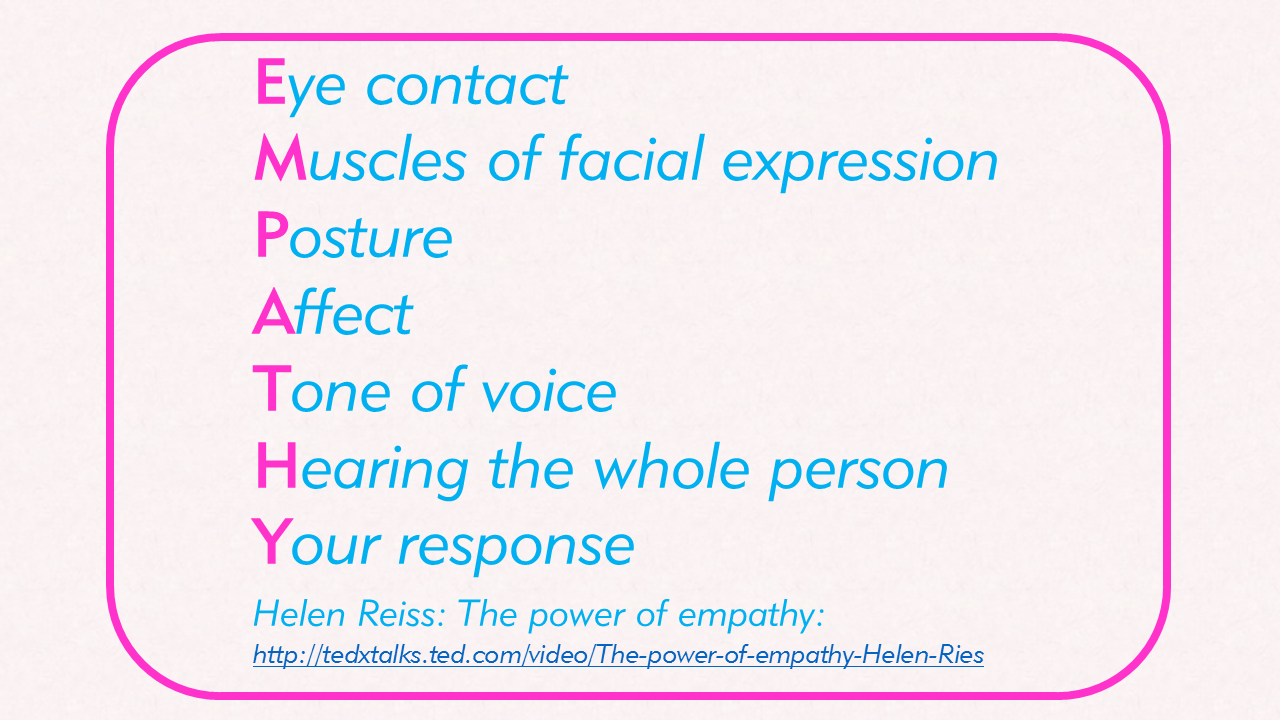
    I urge you to read Julieanne’s story, and watch the TEDxtalk by Helen Riess that Julieanne has embedded in her post. Riess explains what empathy means through this acronym:

    Empathy

    Thank you

    Thank you for reading. Please share your thought about any aspect of this post.

    jarhartz's avatarTo Read To Write To Be

    Magic moments happen in teaching, and they make our hearts soar.

    But, there are moments that can break. Us and our hearts.

    Z is struggling. He lies down on the picnic table outside the room. When we’re all inside, he enters saying, “I don’t want to sit there.” He paces. We look for a place. He settles beside N. Then moves. Again and again. Searching for a spot.

    Sitting is painful. School doesn’t fit, and the discomfort emanates from his being.

    Someone says something about dads. He blurts, “My dad doesn’t come home no more.”

    Gulp.

    Enter Reading Workshop. Z gets together with his book group they are planning. Z says, “I don’t read at home. I read here, not at home.”

    Later, Z paces in the corner, reading his book, Reading and walking, in circles. This is his way.

    Lunch happens. Z doesn’t eat. He doesn’t want to. Can’t. He just…

    View original post 333 more words

  • Why do you read?

    CoD_fsfe_Books_icon

    I read every day.

    I read:

    • Blog posts
    • Emails
    • Tweets
    • Articles
    • News reports
    • Notifications
    • Comments on blogs
    • Road signs
    • Menus
    • Labels on products
    • Receipts
    • Bills
    • Bank statements
    • Letters
    • Instructions

    The list could go on …

    At the moment my reading of full-length books is limited, though recently I read a novel (Dead Flies and Sherry Trifle by Geoff Le Pard) and a memoir (On Hearing of My Mother’s Death Six Years after it Happened by Lori Schafer), both of which I read as ebooks. I also read a non-fiction paper book (Retiring with Attitude by Caroline Lodge and Eileen Carnell) and am part-way through a number of other non-fiction titles.

    Most of the full-length book reading I currently do is in audiobook format. My in-car time on the way to work is usually from about 45-60 minutes and I use this time to listen to audiobooks. During the past year I have listened to quite a variety including both fiction and non-fiction. I particularly enjoy it when the author reads the book, as with my current “read” Alphabetical: How Every Letter Tells a Story by Michael Rosen.

    Blog posts are probably my number one source of reading material at the moment. I read a variety of blogs; some about writing for writers, some about teaching for teachers, some with a variety of information about a range of subjects, lots about books! Picture books, young adult novels, fiction and non-fiction. I am always on the lookout for something new to read or to give as a gift for someone else to read.

    I always enjoy Anne Goodwin’s reviews on her blog Annecdotal. Not all of the books that Anne reviews appeal to me, and few of them will I read. Last year I did read one of her suggestions (The Examined Life by Stephen Grosz) and we had quite a discussion about his chapter on praise. I also read Stephen Pinker’s Better Angels of Our Nature, that was recommended to me by Geoff Le Pard, and Stephen King’s On Writing that was recommended by Lisa Reiter.

    Sometimes when I read reviews or think of all the wonderful books I could be reading, I chastise myself for the little “reading” I do. But then I remind myself that the reading I choose/need to do at the moment is different. One day soon I’ll be back to more fiction rather than informational texts.

    I was reminded of this when I re-read an article written by Charlotte Zolotow and published in The Horn Book: Writing for the Very Young: An Emotional Déjà Vu.

    In the article Zolotow says,

    “I have so much left to read and reread and so little time left in which to do it that I want to select what fills my emotional needs — needs which are often different from, or unknown to, even my closest friends.”

    Zolotow goes on to explain that

    “It was not this way when I was an adolescent or in my middle years, when I had a wide, all encompassing, devouring, greedy desire to read everything. But if I think back, I do remember as a child wanting certain books over and over again and others not at all. Very young children, like older people, want to read or hear read books that help them sort out their own most acute needs, their own inquiries about life.”

    I thought how true it is. Throughout life our reading habits and choices change. I have always been a reader. As a child and teenager I read fiction, and lots of it. Even as a young adult I continued to read fiction and poetry, but my reading of non-fiction, mainly but not exclusively to do with education, began to exceed those choices. At that time there were only paper books, and I loved them, thinking that nothing could come between me and my books.

    How wrong I was and how times change. Now I read online, ebooks and audiobooks. There is a much greater variety of material available for readers and, I think, the demands are greater. In days gone by if you weren’t reading books you weren’t reading. Now the distinction is not so clear. Because I am not reading full-length paper books as frequently as before, I think of myself as a non-reader. But that is unfair and untrue. I spend most of my day reading, and when I am not reading, I am writing. But these days reading is a huge part of my writing. I am constantly researching and reading online to give extra credence or support to what I am writing.

    What about you? How do you view yourself as a reader? Does one need to read books to be considered a reader?

    Thank you

    Thank you for reading. I appreciate your feedback. Please share your thoughts.

  • All in the family

    https://openclipart.org/image/800px/svg_to_png/20496/CoD-fsfe-calendar.png
    https://openclipart.org/image/800px/svg_to_png/20496/CoD-fsfe-calendar.png

    The nature/nurture debate wages constantly. Are we who we were born to be, or are we shaped by our environment to be who we are?

    To my untrained mind (I have no qualifications in psychology) it appears that who we become results from a mixture of each in combination with a dose of self-determination. Sometimes it can be difficult to separate the nature from the nurture. Are we that way because of genetics or because of the family environment in which we grew up?

    tweedles

    It is true that no two individuals, even siblings, experience identical environments. Even in the closest of families the differences can be as pronounced as the similarities; in interests, capabilities, personalities and attitudes as well as physical characteristics. Both similarities and differences can be used to argue equally well for nature or nurture.

    A paper published by NATSEM (National Centre for Social and Economic Modelling) in 2013 described a close link between education standards, employment and poverty, leading to social exclusion and disadvantage in Australia. It explained that lower education levels resulted in higher levels of unemployment, and therefore poverty, and that children living in poverty were at risk of not completing high school and of having poor nutrition. And so the cycle would continue.

    That is not to say that children living in poverty are doomed to continue doing so throughout their lives (we all know successful people who through their self-determination have pulled themselves up and out of the situation) but it may be much more difficult for them to achieve the levels of success that seem to come so easily to others in kinder circumstances.

    According to the Institute for Social Science Research at the University of QueenslandResearch shows that when schools, families and community groups work together to support learning, children tend to do better in school, stay in school longer, and like school more.” Commencing this year, the “Parental Engagement in Schools” project aims to discover what type of involvement best supports student learning and outcomes. Encouraging parents to be involved is another issue.

    While my general observations as a teacher, and those of many colleagues, support the notion of a connection between economic status and educational advantage, a paper recently released by the University of Bristol states that “Poorer parents are just as involved in their children’s activities as better-off parents”, and that “The findings support the view that associations made between low levels of education, poverty and poor parenting are ideologically driven rather than based on empirical evidence.

    Perhaps over-generalisations in this area are just as problematic as those that expect all family members to be alike. I think that, regardless of background, it is important for teachers to support all students to make positive choices for their future. This can be done through demonstration and modelling rather than criticism and blame.

    8-12-2013 7-38-33 PM

    I also recommend a certain set of strategies that all parents, regardless of their economic status, can employ to give their children a great start is life, including:

    • Love them
    • Talk with them
    • Read to them
    • Encourage their questions and curiosity
    • Help them seek answers and solve problems
    • Encourage their independence
    • Foster confidence, a willingness to have a go and to try multiple times and ways
    • Be accepting of differences and don’t prejudge their future based on the experiences and futures of others.


    https://openclipart.org/image/800px/svg_to_png/18499/Chrisdesign-Glossy-Smiley-Set-3.png
    https://openclipart.org/image/800px/svg_to_png/18499/Chrisdesign-Glossy-Smiley-Set-3.png

    The old saying goes that “You can choose your friends, but you can’t choose your family”. Although I have read suggestions that we may be genetically close/distantly related to those we choose as friends, I can’t testify to the authenticity of the “science” that makes those claims. However, I think many families have at least one member they would probably prefer to disclaim relationship with! Not my family of course!

    https://openclipart.org/image/800px/svg_to_png/30271/face-kiss.png https://openclipart.org/image/800px/svg_to_png/202307/Pink-Funny-Cartoon-Face.png
    https://openclipart.org/image/800px/svg_to_png/30271/face-kiss.png
    https://openclipart.org/image/800px/svg_to_png/202307/Pink-Funny-Cartoon-Face.png

    Which brings me to the flash fiction challenge set by Charli Mills at the Carrot Ranch this week. She wrote about an Aunt Bronco Billy and challenged other writers to: In 99 words (no more, no less) write a story that includes a nutty aunt.

    I hope I’m not that “nutty aunt” that everyone in the family shies away from, but I am aware of some who are. (Again, not in my family!)

    Here is my response to Charli’s challenge. I hope you enjoy it.


    “Aw, Muuuum!”

    “Don’t ‘Aw Mum’ me. She’s your dad’s only sister . . .”

    “But Mum …” I could already smell her stale cigarette breath and feel the stickiness of her too-red lipstick that wouldn’t rub off.

    “It won’t hurt you. She’s not staying long.”

    “Why can’t Jason?”

    “Because Jason’s going to work,” she said.

    “Yeah, Squirt,” grinned Jason, throwing his backpack over his shoulder.

    “Smoochie Coochie,” he mocked, squeezing my cheeks into a pucker while making loud lip-smacking sounds. His laughter followed him down the street.

    Suddenly she was there with her sharp green pistachio grin.

    “Smoochie Coochie!”

    Smoochie Coochie


    Thank you


    I appreciate your feedback. Please share your thoughts about any aspect of this post or flash fiction.

  • Curious scientists

    Curious scientists

    In my current out-of-the-classroom position I write science curriculum materials for use in early childhood classrooms. It is an interesting and challenging role, but also lots of fun as I work with a number of other writers who are also teachers, with an added qualification in science. As many of them have studied science at tertiary level, worked in various other fields, and taught science at high school level, I am surrounded by people with a lot of knowledge and experience different from mine.
    One thing that is wonderful about working with a group of scientists is the range of topics that are raised for discussion around the table at lunch time. Scientists are naturally curious and they don’t take anything at face value. They delve into it, interrogate, investigate and explore until they have answers to questions that may have arisen. I learn a lot! Like the difference between degradable and bio-degradable; how close the asteroid came to Earth; and mitochondria, genetics and children with three parents!
    On the home front too, I am surrounded by scientists; computer scientists and environmental scientists, each with a strong sense of social responsibility and ethics. I am fortunate to be swept along in learning by their interests and enthusiasm.
    In previous posts I have shared some thoughts about the importance of curiosity and of my opinion that children are born scientists. I am always delighted when I come across something that supports my opinion. (Yes, there are others!)
    I have recently discovered a lovely blog Musings of a Frequent Flying Scientist written by a local scientist Desley Jane. This week she shared an interview with another local scientist Julia Archbold. I enjoyed it so much I decided to share it with you.

    These are just a few of things I like about it:
    They are both young female scientists. (For too long science was seen as a male-only province.)
    The importance placed upon curiosity, asking questions and ‘quizativity’ (what a great word!)
    The excitement of learning.
    That their engagement with science makes a positive contribution ‘the world’.

    Please visit Desley’s blog to read the entire interview and explore what else she has to offer.

    Thank you

    Thanks for reading. I appreciate your feedback. Please share your thoughts about any aspect of this post.

    desleyjane's avatarMusings of a Frequent Flying Scientist

    Scientist SpotlightThis is my first interview for my Scientific Reasoning feature. The questions will be the same for each interviewee and I hope that they will give us some insight into the lives of a few of today’s scientists.

    201501_Julia-15

    Dr Julia Archbold is a good friend of mine. We have known each other for many years and have worked together in the past in our twenties (ish). I admire Julia greatly, both as a scientist and as a person. She is warm and talented, with a quick wit and a very kind soul. She is about to embark on an exciting new adventure and I caught her just in time for this interview.

    me: So I know you’re a scientist, but when did you decide to become a scientist? What were you thinking? (Not WHAT WERE YOU THINKING?!?! but what made you decide that science was going to be your future?)

    Julia: I…

    View original post 1,449 more words

  • “If you want intelligent children, give them a book …”

    If-you-want-intelligent children

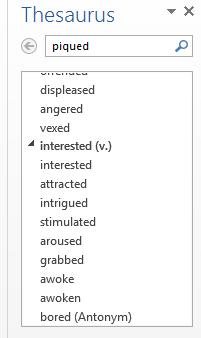
    These words piqued* my interest as they wafted to my ears from the TV set in the other room.

    Who is that?” I called out.

    Jackie French,” he replied.

    I jumped up, eager to see and hear more.

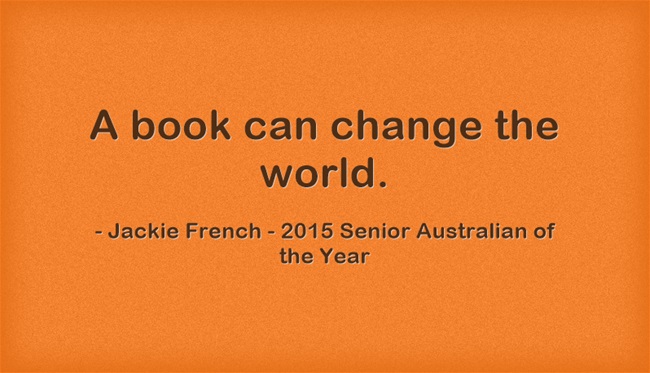
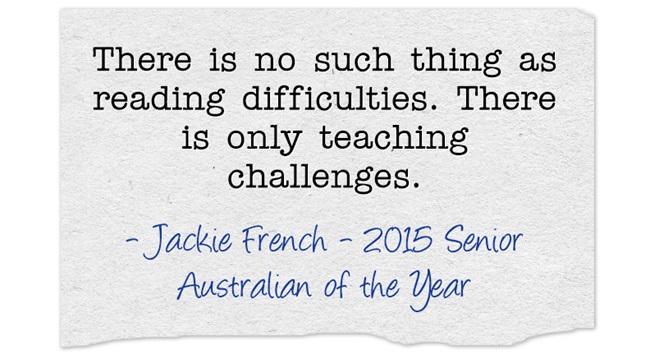
    Jackie French is a well-known Australian author and advocate for literacy and the environment. She is currently the Australian Children’s Laureate with the task of promoting “the importance and transformational power of reading, creativity and story in the lives of young Australians”.

    I was delighted to find that Jackie’s speech was in acceptance of an Australian of the Year Award.

    The media announcement released by the Minister for Social Services explains that Jackie was recognised for her “long and distinguished career as a beloved children’s writer, earning more than 60 literary prizes for her books.”

     “Jackie embodies this commitment (to changing lives in our community) and I’d like thank her for the work she continues to do sharing the power of reading and story-telling for young Australians, and her work in conservation.” 

    Here is Jackie, Senior Australian of the Year 2015, accepting her award.

    Failure-is-not-an-optionA-book-can-change-theThere-is-no-such-thing


    In this next video Jackie talks about her book “Hitler’s Daughter”. You don’t have to have read the book to glean much of interest from the interview. In the discussion Jackie shares her thoughts about reading and writing. She questions how the ‘world’ in which one is, influences thoughts about good and evil and decisions that are made. She discusses how the need for evil to be resolved in a work of fiction differs between children and adults. She talks about whether it is necessary for a child to apologise for the sins of the previous generation, and how still controversial issues can be dealt with in an historical situation. It is worth listening to if you simply want something to ponder over.

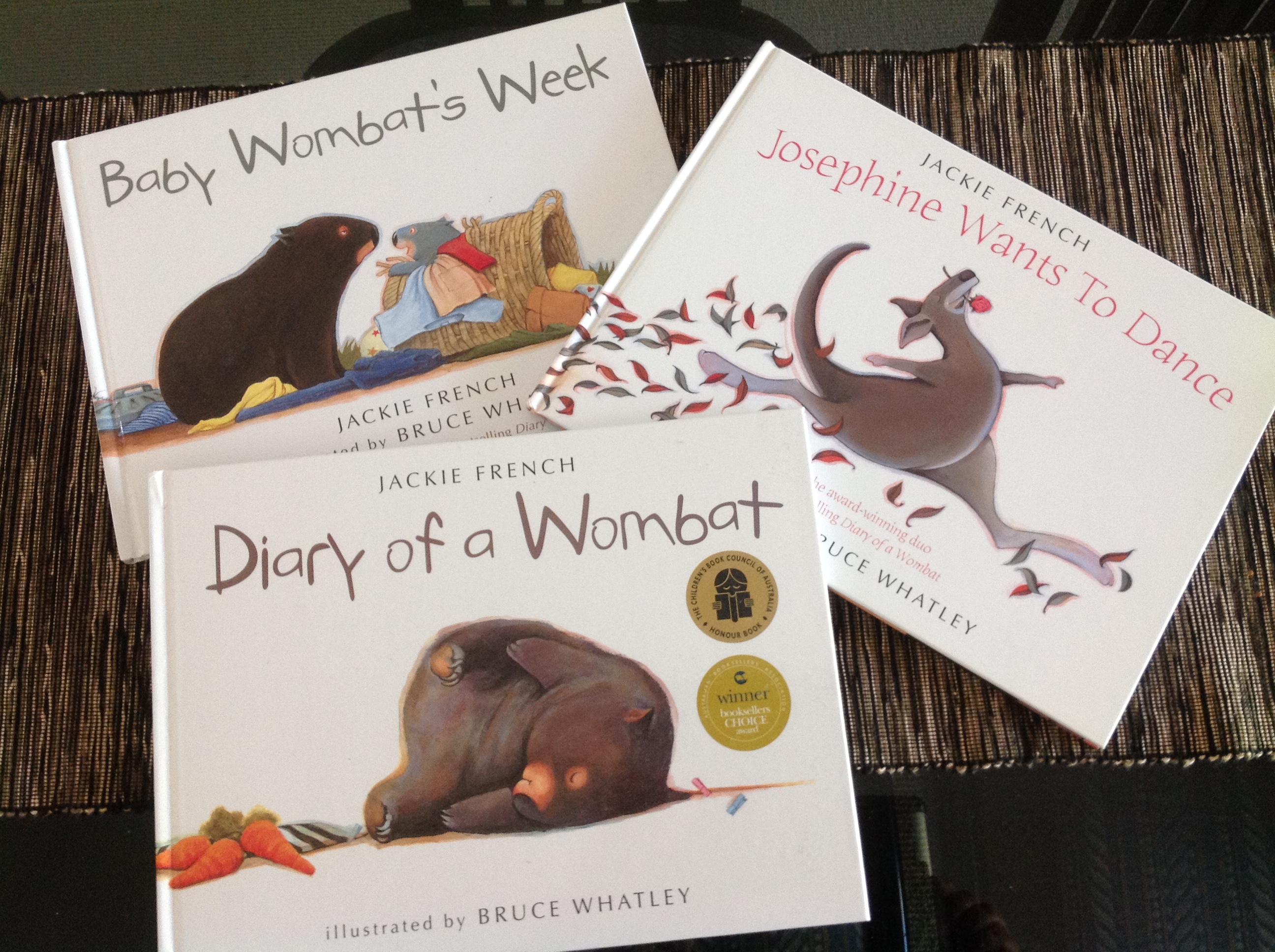
    Being an early childhood teacher I am more familiar with Jackie’s picture books such as

    Diary of a Wombat, Baby Wombat’s Week, and Josephine Wants to Dance, which are delightful.

    IMG_4302

    Here is a video of Jackie reading Diary of a Wombat.

    I have just discovered that Hitler’s Daughter is available as an audiobook, so it is going onto my list!

    https://openclipart.org/image/800px/svg_to_png/148843/1310261210.png
    https://openclipart.org/image/800px/svg_to_png/148843/1310261210.png


    I congratulate Jackie on her award and thank her for the contribution she is making to the lives of so many and the future of our planet.


    *piqued

    In this sentence, I am using the word “piqued” to mean “stimulated or aroused my interest”.

    How can one word be used to express opposite meanings? I don’t know how anyone is expected to learn or understand the nuances of this language we call English!

    When I checked with my thesaurus to ensure I had chosen the correct word, this is what I found:

    piqued 1         piqued 2

    How many other words do you know that could almost be listed as its antonym?

    Thank you

    Thank you for reading. I appreciate your feedback. Please share your thoughts about any aspect of this post.
  • In their own time

    This quote by Albert Einstein is one of my favourites:

    “The only reason for time is so that everything doesn’t happen at once.”

    https://openclipart.org/image/800px/svg_to_png/20496/CoD-fsfe-calendar.png
    https://openclipart.org/image/800px/svg_to_png/20496/CoD-fsfe-calendar.png

    Without the addition of a date to signify, I would find it difficult to separate out the memories and distinguish how far apart events occurred or in which sequence.

    If the “The only reason for time“ was applied to the school situation, it might be quite different, for example,

    “The only reason for time is to ensure that everyone is doing the same thing at the same time.”


    school cropped

    In previous posts I have talked about the importance of having a growth mindset and the power of ‘not yet’ thinking. Most respondents to these posts agreed on a preference for thinking about their own goals as not yet achieved, rather than as failed to achieve. Much like for a twelve month old child who is not yet walking, ‘not yet’ implies no failure, just steps in the right direction, an expectation of success, when the time is right and the child is ready.

    https://openclipart.org/image/800px/svg_to_png/20496/CoD-fsfe-calendar.png
    https://openclipart.org/image/800px/svg_to_png/20496/CoD-fsfe-calendar.png

    For many things we do in life there is no hard and fast rule about when they should be achieved. Most developmental milestones are presented as an average, a range of ages during which time most will achieve. But the edges are blurred and, unless attainment falls way beyond the guide, there is generally no cause for concern.

    When it comes to school learning there is much more anxiety about achievement and reaching particular benchmarks by certain ages. Anne Goodwin hinted at this is her comment on my post Reading is out of this world. Anne said,

    “we need to create the conditions in which children want to learn to read and to continue reading regularly. Sadly, I think some kids are put off by attempts to teach them to read before they are ready, which just gives the message that it’s hard or boring or both.”

    She said that we need ways to “get them in their own time, to where they need to be.”

    Anne is right. Children may be put off reading by attempting to teach them before they are ready; just as often, I would add, by inappropriate methods that present reading as a series of unrelated skills devoid of context, meaning and enjoyment.

    Children may come to reading at various ages and in various ways. Some read early. Mem Fox says that, if she were queen of the world, “children would learn to read easily, long before they came to school”, like my two did.  Others suggest a “better late than early” approach or not hurrying the child.

    I think it is important to recognise that a ‘one size fits all’ approach has no place in education. I would love Mem Fox to be queen of the world and for all children to learn to read easily and with joy before school age, but there is much to do for that ideal situation to exist. David Elkind says that no one believes in hurrying children but parents, educators and legislators can always find a reason to do so.

    Being out of step with peers can be a great cause of anxiety; and anxiety begets anxiety which further impedes learning, as shown in this presentation by Heidi Lyneham.

    To improve the situation for learners we need to recognise that

    • Learners learn in their own time. We need more flexible timeframes that honour each child’s development and learning journey.
    • Learners learn in ways that are as individual as they are. However there are conditions which improve the chances of learning occurring, such as these conditions for literacy learning  as proposed by Brian Cambourne.

    In her comment on my post Reading is out of this world, Nicole Hewes indicated support for this view by describing how she assisted a student’s learning by providing books about whales, a topic the student was greatly interested in.

    Along with the recognition of different timeframes, there must be recognition of and value placed upon the time required by students to develop the skills; and time and opportunity must be provided for that development.

    Just when I was writing this post, Bec, who loves to look after my reading and learning needs, sent me a link to this article by Pernille Ripp who asks,

    “Why do we forget that time to read is the one thing readers need the most to become better readers?”

    And then Charli Mills of the Carrot Ranch posted her flash fiction challenge for this week: In 99 words (no more, no less) write a 2 a.m. story.

    Time: everything was pointing in the same direction.

    Thinking of a learner’s timing being out of sync with that of others made me think about waking up in the middle of the night (say 2am) and not being able to get back to sleep; knowing that one should be asleep; that everyone else is asleep; that one needs to be asleep because there’s a “big” day head. And all the while the anxiety grows as quickly as the ability to sleep fades. Maybe you can identify?

    https://openclipart.org/image/800px/svg_to_png/19413/manio1-Digital-Clock-2.png
    https://openclipart.org/image/800px/svg_to_png/19413/manio1-Digital-Clock-2.png

    Wakefulness

    One moment deep asleep. Next, upright; breath still; ears intent; staining to hear above her pounding heart.

    Nothing. Just the familiar: fan whirring, palm frond swishing against the house.

    Must investigate: bravely, fearfully.

    With limbs trembling, palms sweating and mouth dry, she eases her legs out of the bed, puts her feet on the floor, pushes herself up and pads to the window.

    Peeking out she scans the yard, illuminated by the full moon.

    Nothing. A dream?

    She pads back to bed. 2am.

    “Ooh! Only three hours!” She closes her eyes, wishing hopelessly for sleep until morning’s liberation.

    Thank you

    Thank you for reading. I appreciate your feedback. Please share your thoughts about any aspect of this post or flash fiction.

  • Reading is out of this world!

    Space-Sketched

    Reading is a wonderful pastime. Since you are reading this blog I am sure you will agree.

    People read for many different reasons, including:

    • for information e.g. about world events or something of interest, to find out what’s on offer, how to do something, or the time and place to catch a bus,
    • to be challenged e.g. by philosophical or ethical arguments and viewpoints
    • to stay in touch e.g. through letters, emails, blogs, Twitter, Facebook and other social media
    • to be enthralled by a story or delighted by poetic words and imagery
    • to escape the everyday.

    I am certain you could add to the list in breadth and specificity without too much trouble.

    Robert 2

    Developing a lifelong habit, if not love, of reading is important to fully function in society. The “bug” is more easily caught in early childhood but can be developed at any stage throughout life when its rewards become apparent.

    Nor and Bec readingI have previously shared ideas about the importance of talking with and reading to young children, including here and here.

    Another highly influential factor in creating readers is for children to see adults engaged in reading for real purposes, for information and pleasure; and having the opportunity to discuss the purposes of, and ways of reading, different material e.g. the way we read a menu is different from the way we read a story or a newspaper.

    peole_computer

    Additionally, it is useful for children to realise that the importance of reading extends beyond the home. There may be opportunities for them to observe people reading in the workplace or to discuss the need for reading in different roles.

    The Very Hungry Caterpillar

    Another important aspect of reading that I have previously discussed, using ”The Very Hungry Caterpillar” by Eric Carle as an example here, is critical literacy, the ability to interrogate the veracity of the information, its source and author.

    I recently read discussions about difficulty experienced incorporating non-fiction material, especially science information, into classroom reading programs. I was a bit blown away by this because I believe that children will be interested in anything and everything if it is presented in an interesting way.

    An information book doesn’t have to be read all at once, from cover to cover in any particular order. It can be dipped into, pored over, or explored bit by bit.

    Sometimes information can be found in a work of fiction, but it is important, as cautioned with “The Very Hungry Caterpillar”, to check the source and the “facts”.

    So to tie together the elements discussed above, these are important elements for motivating children to read:

    • Talking with them about things of interest to them
    • Reading to them
    • Modelling and discussing positive reading habits
    • Demonstrating the importance of reading
    • Discussing the importance of not believing everything that is read and of evaluating the source of the information and the intent of the author

    In my exploration this week of one of my favourite educational websites, edutopia, I discovered through a post written by Ben Johnson and called When Astronauts Read Aloud Children’s Stories – From Space! a site that met many of the above criteria: Story Time From Space

    Story Time From Space features astronauts on the space station reading story books to children. At the moment there is one story available, but more are planned, as are teaching suggestions and activities, including experiments.

    The story, Max Goes to the International Space Station is the first of a series of five stories written by Dr. Jeffrey Bennett who describes himself as “an astronomer by training and a teacher by trade, but currently spend most of my time as a writer.”

    In his post, Johnson expands on that, describing Bennett as “a research associate at the University of Colorado Center for Astrophysics and Space Astronomy, … (who) has worked at the California Institute of Technology Jet Propulsion Laboratories and NASA Headquarters in Washington, D.C.” He goes on to say that “Dr. Bennett strives to write books that are factually correct, fun, and interesting for students to read.” The experiments that the astronauts do will correspond to those in the books.

    roto-spacesuit-mkiii-clean-new


    While parts of the Story Time From Space site are still “coming”, I think this project has great potential for motivating children to read and for inspiring an interest in the world and beyond. Being read a story by an astronaut isn’t something that happens every day!

    Thank you

    Thank you for reading. I appreciate your feedback. Please share your thoughts about any aspect of this post.

  • Talking the way out

    https://openclipart.org/image/800px/svg_to_png/100009/Coffee-by-netalloy
    https://openclipart.org/image/800px/svg_to_png/100009/Coffee-by-netalloy

    Recently I met up with some teacher friends and, as always happens with teachers, the discussion turned to school, teaching and children. There was talk about the crowdedness and inappropriateness of many aspects of the curriculum, of resources that were ambiguous and poorly written, of time spent practising and preparing for tests, of (other) teachers who were ill-equipped to teach and not interested in professional learning.

    It made me sad. It has always made me sad. Sad and frustrated with the inappropriateness of so much that happens in schools and the effect it has on diminishing our most precious resource: the ability to think, learn, innovate and create.

    The fact that I am unable to do anything about this situation at times overwhelms me and I just want to curl up in a ball in the corner and cry. That I have spent almost my entire adult life swimming against the tide trying, through a variety of means, to make a positive difference through education with an effect as insignificant as a grain of salt in the ocean, makes my efforts seem futile and worthless. A waste of time and energy. I should just give up.

    But, foolishly maybe, I haven’t and don’t. Here I am writing a blog about education. One more way to try; with a website on the way as well. What effect will they have? Probably very little, but at least I am doing something that is important to me; something that gives my life meaning; even if it has no real value beyond that.

    I have been out of the classroom now for three years. I escaped before the introduction of new programs which I would have found philosophically and pedagogically impossible to implement. It had always been a balancing act, doing what my employer expected of me and what I believed to be best for the children and their learning. (Of course there is no saying that what I thought was better. The value of my thinking may well have been just in my head!)

    Five times before I had left the classroom, only twice for reasons unrelated to dissatisfaction (the birth of children). But I could never shake off my belief that education delivery could be improved. I read widely, seeking alternative ways of making a positive difference but, although I had vowed at each departure to never return, something always drew me back.

    Man-resigning
    https://openclipart.org/detail/211086/man-resigning.-by-doodleguy-211086

    Rather than allowing the situation to overwhelm me by accepting that there was nothing I could do; rather than throwing my hands in the air, walking away and admitting that it’s all too hard, I didn’t let go. Perhaps it was foolhardy. Maybe I should. Maybe one day I will. But not yet.

    Instead I choose to focus on the good things I see happening; the parents, teachers, nannies and child care workers who strive to make a positive difference. We know we can’t change the whole world. We can’t rid it of all the injustices, inequalities, violence and other wrongdoings against humanity and the Earth. But we can make a difference in our own little corner; and my own little corner has always been my focus. If I can make a difference with something as simple as a smile or sharing a positive thought then I will do it. If I can do more than that then I will, but I will focus on what I can rather than what I can’t.

    So for my little bit of positivity today, I am sharing some of what I think are great things that are happening, making a positive contribution to education and children’s lives; some things that make my heart sing and confirm my belief that if we want to, we can make a difference.

    marshmallow 5

    I have previously shared some thoughts that stimulated great discussion about the famous Marshmallow Test conducted by Professor Walter Mischel.

    On All Our Words I recently read a report of an address made by Mischel to the team at All Our Kin.

    In that address, Mischel is quoted as saying,

    “When a child grows up in a high-poverty, extremely unpredictable environment – in which anything can happen, in which danger is constantly present, in which chaos is always possible – it affects him at a biological level. Those experiences turn into chronic stress, or toxic stress, and they actually change his brain. They limit the potential of the cool system to make long-term plans and be patient and work for a distant goal.”

    The author of the article, Christina Nelson writes

    “Fighting against the biology of disadvantage requires a sustained effort that begins at birth, or even earlier, which is why creating high quality early care and education is so important for vulnerable children.”

    Mischel’s address further supports that view and congratulates the team at All our Kin for their work, saying

    “By providing a sense of trust, a sense that the rewards are attainable, that promises will be kept, that life doesn’t have to be chaotic and unpredictable, you folks are providing exactly the basis for the development of the cool system, and for the regulation of the hot system. The kids who have that when they are two years old are the same kids who are successful at the marshmallow test at five.”

    The praise from Mischel would not have been given lightly. I’m impressed with what I have read about All Our Kin, including this from their mission statement:

    “. . . children, regardless of where they live, their racial or ethnic background, or how much money their parents earn, will begin their lives with all the advantages, tools, and experiences that we, as a society, are capable of giving them.”

    family1

    The Talking is Teaching program, which was launched by Hillary Clinton as part of the Too Small to Fail initiative, in Oakland aims to reduce educational (and life) disadvantages by teaching parents the importance of talking to their children from birth.

    Thanks to my friend Anne Goodwin and daughter Bec I was also alerted to an article in the New Yorker The Talking Cure which described a program in Providence that also encourages low-income parents to talk more with their children.

    The author of the article, Margaret Talbot says that “The way you converse with your child is one of the most intimate aspects of parenting, shaped both by your personality and by cultural habits so deep that they can feel automatic. Changing how low-income parents interact with their children is a delicate matter”. The aim of the program is to support parents in non-threatening ways to support their children.

    I have previously mentioned a recent publication by Michael Rosen entitled Good Ideas: How to Be Your Child’s (and Your Own) Best Teacher. This book provides wonderful support for parents of children of any age. In very readable, accessible language, Rosen’s book is packed full of simple, inexpensive, fun and powerful ways for parents to support their children’s learning, effectively but unobtrusively, in their everyday lives. I think this book should be supplied to all parents on the birth of their children.

    Closer to home here in Australia are Community Hubs  and other programs such as Learning for Life run by the Smith Family and Acting Early, Changing Lives by the Benevolent Society.

    These are but a few of the good things that are happening. I have focussed on community programs rather than individuals (except for Michael Rosen’s book) in this post. I know there are many more great programs, and individual teachers doing amazing work. I’d love to hear about some that you admire.

    Thank you

    Thank you for reading. I value your feedback. Please share your thoughts about any aspect of this post.