Live Love Laugh Learn … Create the possibilities

Category: Creativity

  • Are you game?

    This week at the Carrot Ranch Charli Mills is talking about childhood games and has challenged writers to In 99 words (no more, no less) write a story that involves a children’s game or rhyme. I think she chose this topic just for me. Thank you, Charli.

    I love games and am a strong believer in the use of games to enhance learning. I have memories of playing games that span my lifetime, from early childhood until the present, and have visions of playing games far into the future.
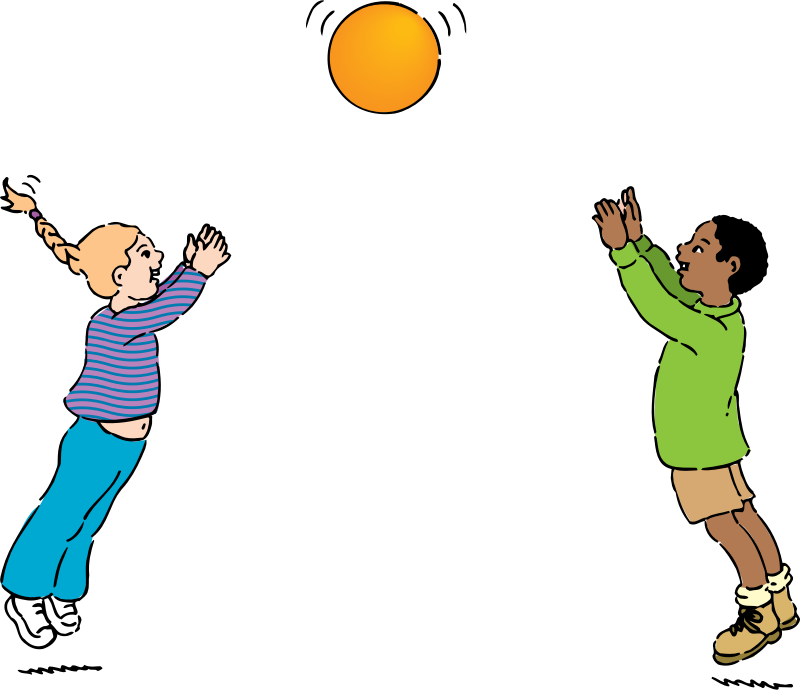
    Johnny Automatic, cartoon of a girl and boy playing with a ball https://openclipart.org/detail/721/playing-ball
    Johnny Automatic, cartoon of a girl and boy playing with a ball https://openclipart.org/detail/721/playing-ball

    One of my earliest memories of an organised game was of “Drop the hanky” played at a birthday party. I was about five years old at the time. I think that perhaps, until this event, I had only ever played imaginative games with my brothers and sisters. I was obviously not familiar with the rules or the ethos of the game. I’ll let my flash (non-) fiction explain.

    Plum pudding

    We sat in the circle chanting,

    “I wrote a letter to my love and on the way I dropped it.”

    “It” skipped around the outside, waving a handkerchief.

    “One of you has picked it up and put it in your pocket.

    Not you. Not you. Not y-o-u!”

    Suddenly “It” was running and children were scrabbling behind them.

    “Run,” they called.

    Then “It” was beside me.

    “Plum pudding!” they all screamed hysterically.

    The adult pointed to the centre of the circle. “We’ll have you for dessert,” he grinned.

    I cried, wondering what it would be like to be eaten alive!

    © Norah Colvin 2015
    © Norah Colvin 2015

    Obviously I was traumatised for the memory to be so vivid and almost nightmare-like since the memory ends abruptly with the fear. Obviously I wasn’t eaten for dessert, I survived the trauma and, to complete the fictional narrative, I guess you could say “I lived happily ever after.”

    But games don’t need to be traumatic. Games are better when they are fun; and I have many more memories of having fun with games than I do of being traumatised by them. Some of my “best” memories are of the laughs shared playing games like “Balderdash” and “Billionaire” when we (hub, son, daughter and partners) set aside traditional holidays for playing games together as a family. My house may have shelves laden with books, but they also have cupboards bursting with games.
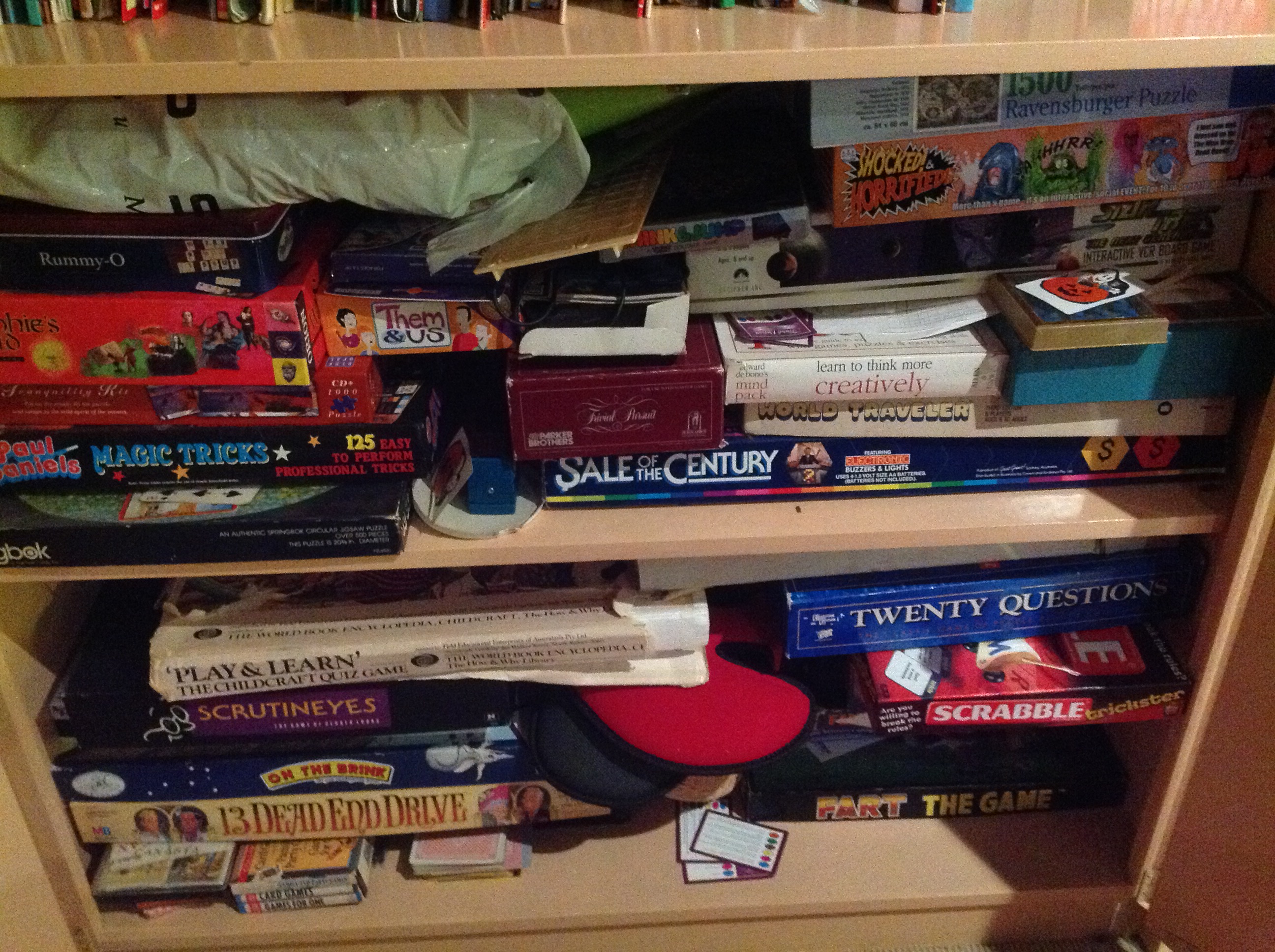
    © Norah Colvin
    © Norah Colvin

    We didn’t always play purchased games. Sometimes we made up our own. It takes some skill in problem solving to think up a new game that will be fun to play with just the right amounts of challenge and competition, and an equal chance of “winning”, if there is a winner. Games without a winner, played for the fun of playing, are just as enjoyable.

    I have always included games in my class program. As well as being fun, if carefully chosen they can also progress learning. Games can be played at the beginning and conclusion of sessions; at transition times to reenergise, refocus and refresh; and as part of the teaching/learning program with whole class, small group or individual participation for targeting practice of particular concepts.

    One obvious benefit of playing games is the development of social skills such as:

    • Sharing
    • Taking turns
    • Cooperation
    • Dealing with competition
    • Accepting a loss
    • Accepting a win graciously

    In their book “A New Culture of Learning: Cultivating the Imagination for a World of Constant Change”, Douglas Thomas and John Seely Brown talk about ““arc of life” learning, which comprises the activities in our daily lives that keep us learning, growing and exploring.” They say, “Play, questioning, and — perhaps most important — imagination lie at the very heart of arc-of-life learning.”

    Throughout the book they talk about the importance of collaboration in engaging online in multi-player games and say that When understood properly . . . games may in fact be one of the best models for learning and knowing in the twenty-first century . . . Because if a game is good, you never play the same way twice.

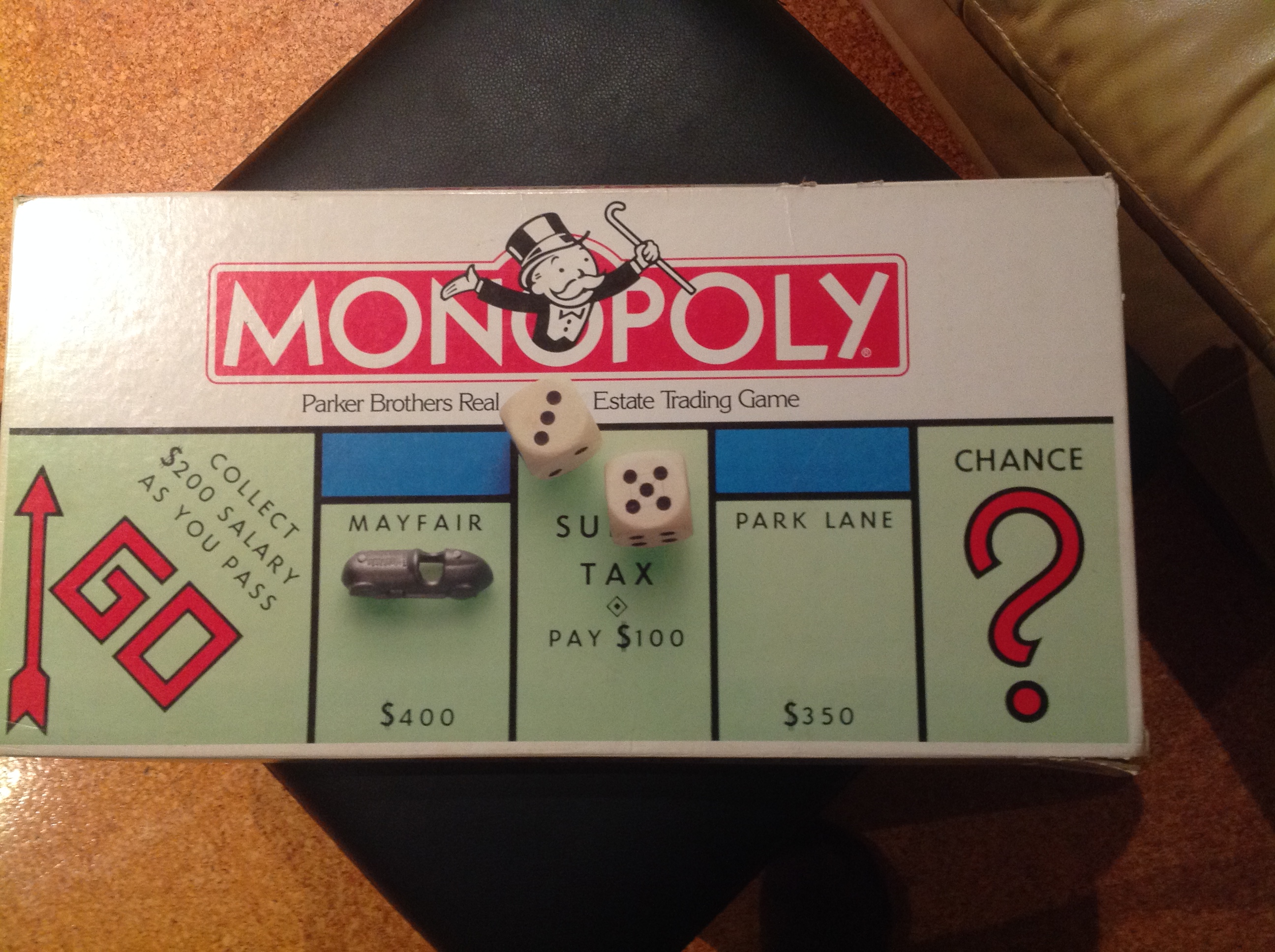
    monopoly

    Robert Kiyosaki in his book “Why “A” Students Work for “C” Students and Why “B” Students Work for the Government” talks about the importance of learning through games and explains how he learned, and was inspired to learn more, about finance from playing “Monopoly”. He says that Games are better teachers than teachers.” While I prefer to not agree with that statement in its entirety (I don’t even like playing Monopoly), I could understand his reasons for making it.

    Rarely a day would go by that at least one game wasn’t played in my classroom. We would play games in literacy groups that required children to read and think critically. We would play games in maths groups to practice skills in fun ways or to solve problems cooperatively. We would play games in science to try out ideas or research information. Some of the games involved physical as well as mental activity. Some were played with the entire class, and some on their own.

    One game we used in maths groups as well as an activity in the last few minutes of the day was a problem solving game that I was involved with from its inception, The Land of Um or, as it is known in the UK, Scally’s World of Problems. (Also available as an app.)
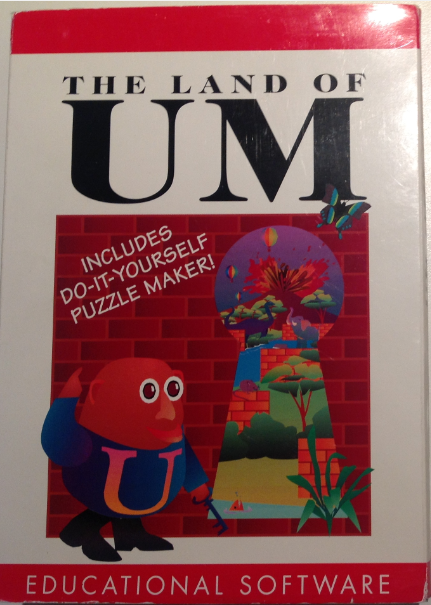
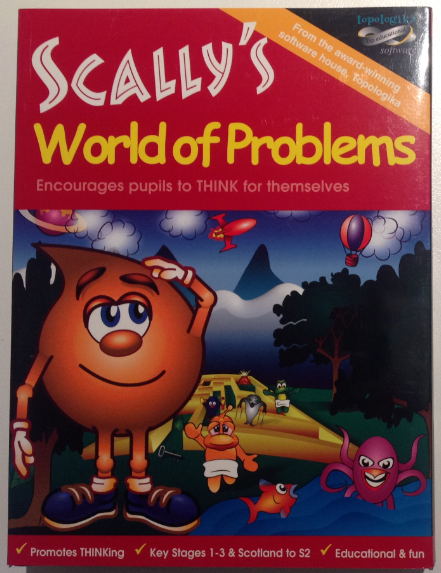
    http://www.greygum.com.au/nebula/index.php/the-land-of-um

    Scally


    When I was asked for an idea for a program, I suggested something that required children to explore to find out “what happens if” and “how things work”, much as they learn from their exploration of the “real world”. I also suggested that what they learn be consistent and apply at the next level. From that small seed and through the collaboration and synergy of a small group of creative people the “Land of Um” was born.

    Because, in my recollections anyway, it was “my” idea, I am very proud of “Um” and enthusiastic about its potential to encourage children to develop the thinking skills involved in solving problems.
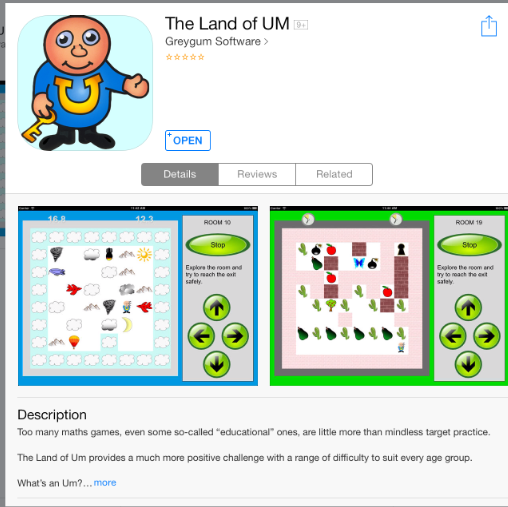
    Um app

    In my class the children worked enthusiastically and collaboratively in small groups on an interactive whiteboard, taking turns to control the “Um” while working together to find the solution to each puzzle. As the level of difficulty increased the children needed to plan ahead, to visualise steps and predict what would happen and the effects of different actions. At each new level and in each new world, while the basics remained consistent, there was always something different to learn and explore. The children never tired of the using the program and were always eager to be the one to suggest the solution to the next problem. It was/is a joy to know that I had a part to play in the design of this program that has so many benefits to learners, not least of which is the fun of working together to solve problems.

    How significant are games in your life? What special memories do you have?

    If you are interested, there are many more stories about games to read on Charli’s blog.

    Thank you

    Thank you for reading. I appreciate your feedback. Please share your thoughts on any aspect of this post or flash fiction.



  • Five Photos Five Stories — Day four

    Back to Day one (books) and introduction to the challenge

    Back to Day two (writing)

    Back to Day three (Break out)

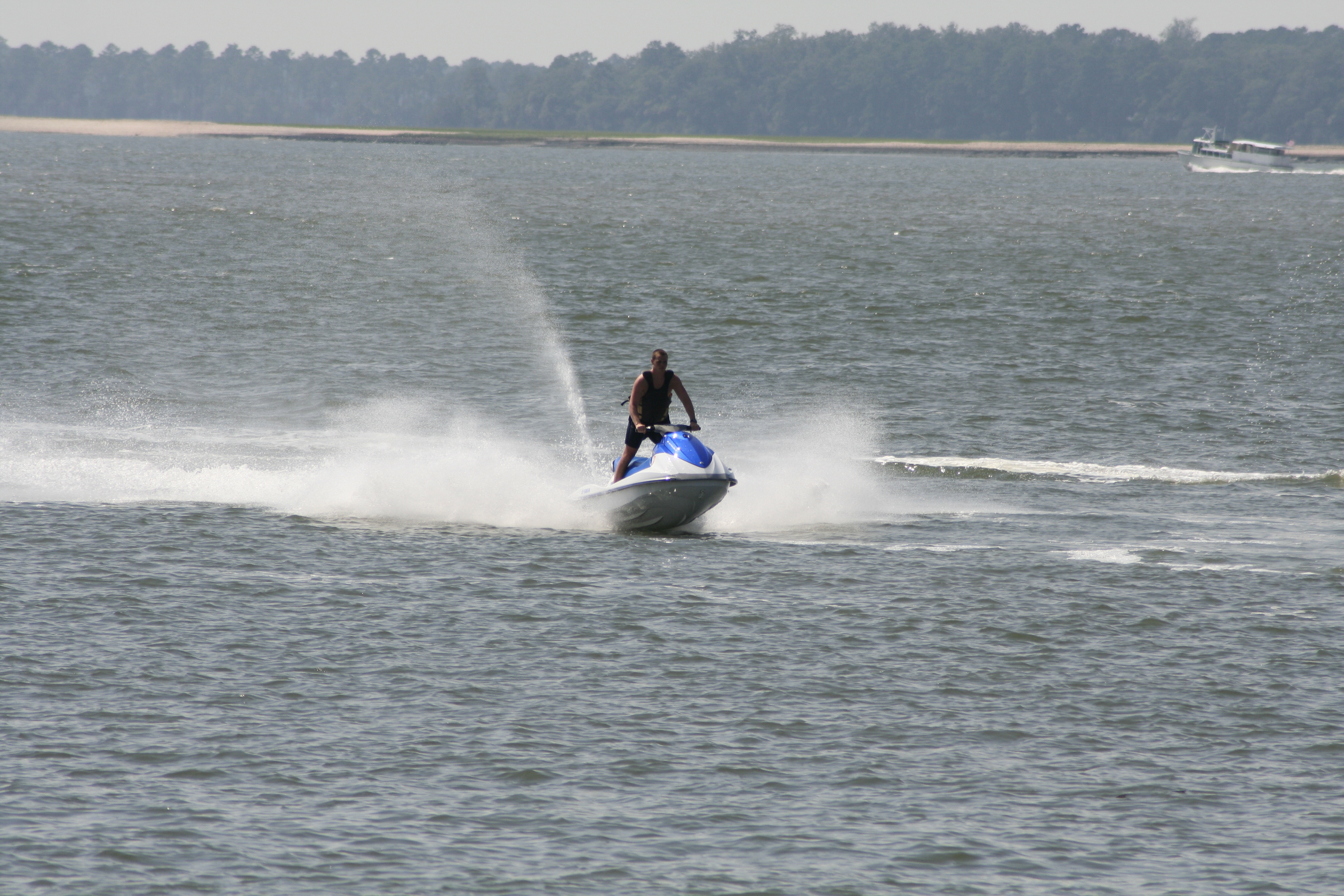
    My retirement jetski

    My retirement jetski
    My retirement jetski

    Geoff Le Pard threw me a challenge to post five photos and five stories over five days. He is probably just as surprised as I am that I took him up on it, especially as this week is particularly busy and significant.

    Tomorrow I finally break up with a relationship that has been on-again-off-again for over forty years. Tomorrow is my last day working for Education Queensland. While I then become “officially” retired, some of you may know that I am not very fond of that “R” word and prefer to think of my life as taking a redirection.

    In a couple of weeks’ time I commence another part-time job at the University of Queensland with the exact number of hours for me to remain “officially” retired, but nominally “working part-time”. The remainder of the week I will continue to write and work towards fulfilling my goal of establishing an online store of educational resources. This is where the jetski comes in.

    There are many expenses involved with preparing content for the website including getting work illustrated, having the website designed and, hopefully, if I can figure out a way, having interactivity added to some resources. Deciding how much cost is acceptable is difficult when there is no guarantee of ever getting any return, and often the time I spend tapping away on my computer keyboard when I could be doing other things comes into question.

    The fact is I love tapping away on my computer keyboard writing works of my choosing, and the expenses involved are necessary in order to make my “creations” available to others through a website. If I were to choose a jetski, a sports car or an around the world cruise as a retirement gift for myself, as many do, and spend hours each day riding the waves or the roads, no one would question my choice of activity or the cost of the initial purchase or ongoing maintenance. They would be pleased that I was having fun, enjoying my later years. Well, for the moment at least, writing is my pleasure and I (try to) justify the expense by calling it my “jetski”.

    As my work targets an early childhood market, illustrations are an essential accompaniment to my work. When I first registered my business and domain name, my (graphic designer) niece designed my logo and beautiful banner, which you see at the top of my blog, and produced illustrations for some stories. Recently I have had other illustrations done by artists from 99designs so I am starting to make headway in that direction.

    Kari Jones (ArtbyJonz), who did the S.M.A.G. badge has produced illustrations for two stories. Here is a sneak peek at one illustration from each:

    ArtbyJonz ©Norah Colvin 2015
    ArtbyJonz ©Norah Colvin 2015
    ArtbyJonz ©Norah Colvin 2015
    ArtbyJonz ©Norah Colvin 2015


    and sneak peeks of illustrations for stories by Sketcherlady, Goetia and Tyohermawan, to whom I awarded the first contest.

    sketcherlady ©Norah Colvin 2015
    sketcherlady ©Norah Colvin 2015
    Goetia ©Norah Colvin 2015
    Goetia ©Norah Colvin 2015
    tyohermawan ©Norah Colvin 2015
    tyohermawan ©Norah Colvin 2015

    I have been very happy working with each of these designers. They have all been very helpful and accommodating and worked hard to produce illustrations to match my requests. I am happy to recommend any of them if you are looking at getting some work illustrated.

    The next step is to speak with a web designer. I must say I’m a bit fearful of the cost, but hey, it’s my jetski.

    What seems to be more problematic at the moment is adding interactivity to some resources. PowerPoint has some facility but not enough. I looked at another program recently which promised any interactivity I could imagine. But unfortunately the program designers had not imagined what I had! I discussed some of my requirements with a friend who is learning to code and he thought it would even be difficult to code what I want. Since these open-ended interactions are to be a point of difference for me, if I can’t have them, I may need to trade-in my jetski on something completely different. Maybe a novel? (That must be pretty easy, eh Geoff?) I’m not sure I’m ready for that. If you have any suggestions about adding interactivity to resources I’d love to receive them please.

    I nominate my lovely fellow local Queensland bloggers to take up this Five Photos Five Stories challenge should they so wish:

    Irene Waters who writes memoir and blogs at Reflections and Nightmares and already shares many beautiful photos and stories;

    Desley Jane, a girl with a camera who blogs at Musings of a Frequent Flying Scientist; and

    Marigold Dicer who blogs at Versus Blurb but who has popped off the scene temporarily while she completes what used to be called “prac” teaching when I went to college.

    Please be aware that your participation is completely voluntary. I know each of you already post frequent photo stories. However if you choose to participate, I hope you enjoy the challenge as much as I have. 🙂

    The “rules” of the Five Photos, Five Stories Challenge are:

    1) Post a photo each day for five consecutive days.
    2) Attach a story to the photo. It can be fiction, non-fiction, poetry, or a short paragraph. It’s entirely up to the individual.
    3) Nominate another blogger to carry on the challenge. Your nominee is free to accept or decline the invitation. This is fun, not a command performance!

    Thank you

    Thank you for reading. I appreciate your feedback. Please share your thoughts.


  • Five Photos Five Stories – Day two

    Back to Day one and introduction

    What am I?

    One may wonder why I have responded to Geoff Le Pard‘s challenge almost immediately when there are other invitations that have lain opened but unanswered for longer than I like to admit. For example, some months ago Anne Goodwin tagged me in a writing process blog hop. She shared the what, how and why of her writing process and invited me to share mine. She applied no pressure or time constraints and neither nudged me to comply nor chastised me for not having done so.  Not quite as long ago Sherri Matthews tagged me in a work space blog hop. She shared beautiful images and descriptions of her delightful Summerhouse writing space and invited me to share mine. Sarah Brentyn then shared some questions for writers that I hinted I might answer, but haven’t yet.

    Why the procrastination?

    1. I’m still figuring out what kind of writer I am and how to describe my process.
    2. My writing space isn’t all that exciting. It’s a just a laptop sitting on a desktop that is cluttered with books and other paraphernalia waiting to be organised or dealt with, and surrounded by shelves filled with more of the same; not a bad analogy to my writing process perhaps.
    3. I’ve been working in other quadrants, dealing with ‘easier’ stuff as it arises.

    As with Geoff’s challenge, responses to these blog hops are not compulsory and there is no set time-frame but I do wish to, and do intend to, answer them. Thank you Anne, Sherri and Sarah for your patience. I will get there. Eventually.

    My writing space 14 May 2015
    My writing space 14 May 2015

    My procrastination is in part due to the way I view myself as a writer.

    I find it difficult to define the “type” of writer I am. That I am a writer is true. But what kind? I wonder if I am a writer without a label, without a box?

    Perhaps if you can help me answer this I’ll be more confident about joining in conversations about writing.

    I am not a novelist, not a poet, not a biographer or an auto-biographer, not a picture book writer . . . I am an educational writer, incorporating something of each genre.

    I remember doing a psychometric test at some past time. The results suggested that a desire to be everything to everybody would be my undoing. Perhaps that is also an issue with my writing?

    Sometimes when asked by other writers what type of writing I do, for want of another label I refer to myself as an educational writer. I immediately feel a shrinking away as if educational writing isn’t ‘real’ writing and I’m perhaps not a “real” writer.

    “Oh educational writing,” they judge, “that’s so prescriptive. It’s not creative.”

    Sure I have done my share of prescriptive writing. The “writing” for which I have been employed for the past three years is definitely prescriptive – more cross the “t”s and dot the “i”s without a modicum of creativity; and as my list of publications shows, I have written workbooks for other publishers, “prostituting” myself one kind-hearted friend suggested. But there are worse ways to earn a living, right?

    I don’t consider my self-initiated educational writing as prescriptive. Most of what I write is designed to encourage thinking, problem solving, creativity, interest in a variety of topics, or develop literacy and numeracy skills, but definitely not in a structured, skills-oriented, prescriptive approach. I write fiction, non-fiction and poetry; and open ended materials that encourage children to question. I love to add a touch of humour where possible and mostly aim for engaging materials that motivate thinking and learning.

    My current writing schedule involves writing content for this blog and for an in-progress online store of early childhood educational resources.

    So, what sort of writer am I?

    There is one I know I am not. I am not a songwriter.

    I nominate Anne Goodwin, Sherri Matthews and Sarah Brentyn to take up this Five Photos Five Stories challenge if and when they so choose. But they need to be aware that I require no more of them than they have expected of me!

    The “rules” of the Five Photos, Five Stories Challenge are:

    1) Post a photo each day for five consecutive days.
    2) Attach a story to the photo. It can be fiction, non-fiction, poetry, or a short paragraph. It’s entirely up to the individual.
    3) Nominate another blogger to carry on the challenge. Your nominee is free to accept or decline the invitation. This is fun, not a command performance!

    Thank you

    Thank you for reading. I appreciate your feedback. Please share your thoughts about any aspect of this post.

  • Playing with possibilities

    127

    Creating an environment which nurtures children’s learning and development is as important as creating an environment that nourishes and encourages the growth of plants in a garden. The link between the two was first recognised by Froebel in the early 19th century when he coined the term “kindergarten” which translates to “garden for children” (kinder meaning child and garten meaning garden), and created the first educational toys.

    Froebel “devoted his life to educating children and developing methods to maximize human potential”. He was the first to recognise the importance of a child’s early years (birth to three) and considered creativity to be something in all of us.

    Froebel’s kindergartens were the first “formal” education for young children and his work greatly influenced that of other educators such as Maria Montessori and Rudolf Steiner. His beliefs, for example that children have both unique needs and capabilities are still influential today. He believed in the importance of play and some of his toys were favourites of people such as Buckminster Fuller and Albert Einstein.

    I have touched on the topics of play, creativity and children’s uniqueness in previous posts. A respectful, encouraging, nurturing and stimulating environment underpins all that I value in education; as does a belief in the power of play to develop understandings of self, of others and relationships, of the world and how things work, and to inspire thoughts of what could be, to imagine possibilities never before imagined.

    The poem Education is expresses my beliefs about education and has informed my decision making every step of the way.

    In documents prepared for introducing myself to other educators or potential employers I explained it this way:

    Statement of values:

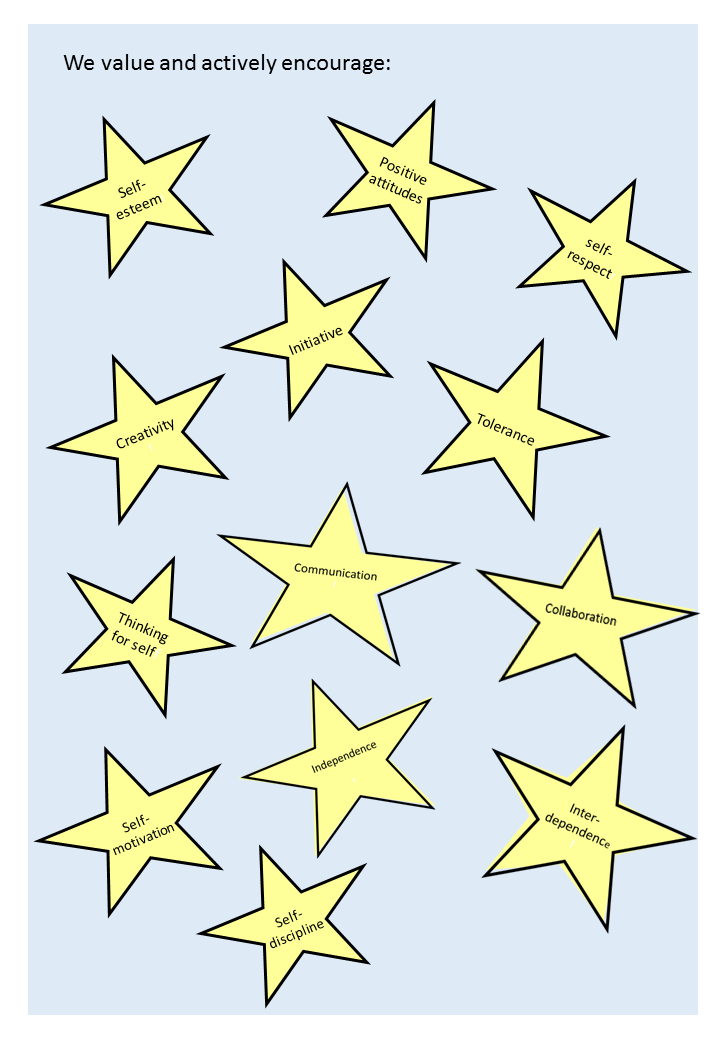
    I value individuality over group consensus

    I value creativity over conformity

    I value self-discipline over imposed order

    I value ingenuity over “one right way”

    I value choice over restriction

    I value questioning over silence

    I value independence over dependence

    I value self-confidence over submission

    I respect children as people in and with their own rights. I provide an environment which is rich, stimulating, open and caring, and in which the characteristics I value can flourish.

    At the time of writing it I believed it to be a true reflection of my values and the environment I provided in my “Create-A-Way” sessions, and would provide in the independent/alternative school I was working towards establishing.

    The values of the “school” I was setting up were stated this way:

    Colo Values

    Just as it is important for gardeners to learn from the wisdom collected by other gardeners, it is important for teachers to learn from the wisdom collected by other educators.

    56


    Without a set of guiding principles it is easy to be blown off-course by the winds prevailing at the time. While I acknowledge that I may have fallen far short of the values espoused, that they guided my direction, decisions and choices could not be questioned. The current climate makes it difficult, but I am yet to read of a time that could be considered a golden age of education.

    36

    This week at the Carrot Ranch Charli Mills is talking about roses; roses that grow in gardens and roses as symbols of life’s pleasures and joys. She challenged writers to In 99 words (no more, no less) write a story that includes a rose.

    Because my blog has an educational focus, I always like to give Charli’s prompt an educational twist. Over recent months I have enjoyed the additional challenge of finding a way of applying the prompt to the life of Marnie, a character whose story I have been developing.

    Marnie is from a dysfunctional family and suffers many disadvantages. Fortunately she has found an ally in an art teacher who helps her develop self-respect and hope for a better future. A few weeks ago (in response to a different prompt) we learned that she had lived under a different name after leaving home. Could it perhaps be Rose, a name inspired by this interaction with her adored teacher?

    99

    Still life

    Marnie observed the roses Miss R. had arranged for class, carefully assessing the colours and studying the lines while sketching them on the canvas, striving to match their perfection. Oblivious to all but Miss R. and the roses, for one hour nothing else mattered.

    As other students streamed out Marnie hung back to chat with Miss R.

    Miss R. handed her a rose from the vase saying, “You are that rose. You may be surrounded by thorns, but the beauty of the rose is inside you. Remember that always. A rose by any other name would smell as sweet.

    Thank you

    Thank you for reading. I appreciate your feedback. Please share your thoughts about any aspect of this post or flash fiction.
  • A creative mistake

    Today I am sharing a lovely post published by Marilyn Warner on her blog Things I Want To Tell My Mother. Her post Ooops! is just a short one but it includes some mighty fine reminders:
    • that mistakes can become successes if one doesn’t give up
    • that mistakes are only failures if one chooses them to be

    The ability to accept mistakes as inevitable, and to embrace the messages in them as stepping stones to success are important attitudes for learning at any stage. (And as Marilyn says, we are not talking here about life-changing, heart-breaking mistakes with tragic consequences, just the little ones that can be redefined if we don’t give up.)

    Enjoy!

    Thank you


    Thank you for reading. I appreciate your feedback. Please share your thoughts about this post.

    Marylin Warner's avatarThings I Want To Tell My Mother

    It would be a mistake to hire a 4-year-old to be your carpenter.  Cute, maybe, but still a mistake.  (Pictures by Marylin Warner) It would be a mistake to hire a 4-year-old to be your carpenter. Cute, maybe, but still a mistake. (Pictures by Marylin Warner)

    Using the wrong fork is  embarrassing, but it's a minor mistake. Using the wrong fork is embarrassing, but it’s a minor mistake.

    Texting and speeding and driving the wrong way is a serious mistake. Texting or speeding and driving the wrong way can be a very serious mistake.

    Years ago, before my dad’s Alzheimer’s and my mother’s dementia, they were included in a tour of one of the 3M facilities. When I asked how they’d liked it, my dad told me details from a businessman’s perspective. My mom’s perspective was different.

    She remembered ACM—the initials of Acrylate Copolymer Microspheres—from the tour. She nicknamed them “A Creative Mistake,” and they became an inspiration.

    In 1968 3M intended to create a super strong adhesive for the aerospace industry. But there was a mistake in the plan, and the end result was an incredibly weak product.  Years later, the reworked mistake became Press’n…

    View original post 278 more words

  • Who wouldn’t be excited with high test scores?

    Regular readers of my blog are aware of my attitude to didactic top-down, content and assessment driven methods of schooling students to become machines regurgitating meaningless facts on command. A bit of push and shove it in and belch it out.  For those of you who weren’t aware – now you are!

    I probably should apologise for my indecorous description as I’m usually a little more temperate in the way I express my views, but I won’t as that is how I am feeling about it at the moment. The authorities who have the power to make the changes necessary are so caught up in their own murky visions that they fail to see either effects or solutions. Every time I read another report of test scores or hear of another child damaged by a faulty system my frustration grows.  It becomes one of those hysteria blossoming days.

    bag

    A few moments ago I read a post titled “Vietnam Wallops US on PISA. Vietnamese educators belittle value of PISA” on Diane Ravitch’s blog. Ravitch is an education historian.

    As the title suggests, Vietnamese fifteen year old students did better than their US, UK and most other EU counterparts in the 2012 PISA tests, ranking 12th out of 76. What I found interesting about the article was not the results but the attitude of Vietnam’s Deputy Minister of Education and Training. His view that the tests don’t reflect students’ overall competence, reminded me of a letter, shared in my previous post, written by teachers to students sitting the national tests last week in Australia. (PISA are international tests).

    In the article referred to by Ravitch, Dr Giap Van Duong was reported as making reference to UNESCO’s four pillars of learning: Learning to know, Learning to do, Learning to be and Learning to live together. His opined that PISA addresses only the first pillar, and in only a limited way. He said that while Vietnamese students did well on the tests, “many … students fail to land a job after graduation. (and that when) they study overseas, many have difficulties in meeting the requirements of advanced education systems like team-work, problem solving and creativity”. Perhaps they are not “out of basement ready” as described by Yong Zhao.

    Duong said that the reason Vietnamese students do well on the tests is because the “The whole system operates to serve only one purpose: exams.”

    Duong’s admission that Vietnamese students lack the ability to work in teams, to problem solve and to think creatively reiterates the fears of many teachers who are  ruled by expectations of high test results and provided little opportunity to inspire learning, which surely remains the real (if neglected) purpose of education. Counterbalancing one’s philosophy with an employer’s expectations sometimes seems like being caught between a rock and a hard place.

    This week at the Carrot Ranch Charli Mills is talking about rocks and hard places. But Charli knows that good can often spring from those seemingly hard places through making connections. She has challenged writers to In 99 words (no more, no less) write a story that shows a hard place and a connection.

    It is connections that are most important in my two main roles in life: parent and teacher. Neither is easy and neither will result in much good without making connections. I often worry about things I have said and the affect they may have had on others. To be truthful, occasionally it even keeps me awake at night. While I would rather think of my words and actions creating a positive ripple, there is no guarantee that, even when delivered with my best intentions, they won’t do harm.

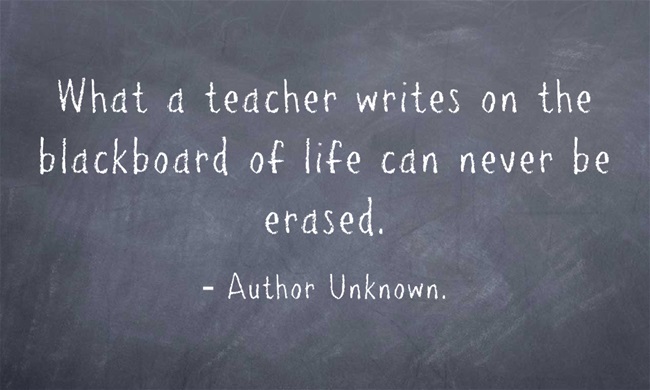
    Trevor Pilgrim shared a quote which puts it this way:

    What-a-teacher-writes-on

    In his article Pilgrim says,

    “teachers have (the power) to develop their students and shape their future lives.  The power to turn them on or off academically, stimulate or dampen their minds and heighten or destroy their engagement and intellectual curiosity.”

    Scary stuff!

    At about the same time I read an article that said that the influence of teachers is not as great as one might think; that socio-economic status, amongst other things, is more important. While I am happy with the thought of having a positive effect, I definitely do not wish to ruin anyone’s life so am happy to know that my influence is not be the most important to the lives of my students.

    https://openclipart.org/image/800px/svg_to_png/59389/happy_sun_gm.png
    https://openclipart.org/image/800px/svg_to_png/59389/happy_sun_gm.png

    For this challenge of Charli’s I am back thinking about Marnie’s art teacher and the hard place she found herself in when she saw the brown muddy mess that Marnie seemed to have made of her paints. That she must respond is a given; but how? Whatever she says will probably have a lasting impact so she must ensure that her response is appropriate. While her initial instinct is to express disappointment, she maintains her professional composure and delays commenting until she has thought it through.

    Here is my response:

    Brown.

    She glanced at the child, usually so eager to please, and knew this was no ordinary day.

    Downcast and avoiding eye contact, the child trembled. Her instinct was to reach out with comfort to soothe the hurt; but stopped. Any touch could end her career. What to say? Brown earth/brown rocks? would ignore and trivialise the pain. Any talk now would be insensitive with other ears listening. Any word could unravel the relationship built up over time. Nothing would harm more than doing nothing. Her steps moved her body away but her heart and mind stayed; feeling, thinking.

     Thank you

    Thank you for reading. I appreciate your feedback. Please share your thoughts about any aspect of this post or flash fiction

  • Are you ready or what?

    When thinking about schooling and education there is always a lot of discussion about readiness and the things that must be done to have a child ready for school, ready for the next class, ready go to college or university . . .

    While I agree that a learner must be ready to take the next step, to broaden understanding of a concept or to grasp the complexity of deeper issues; just what that readiness requires is often up for conjecture.

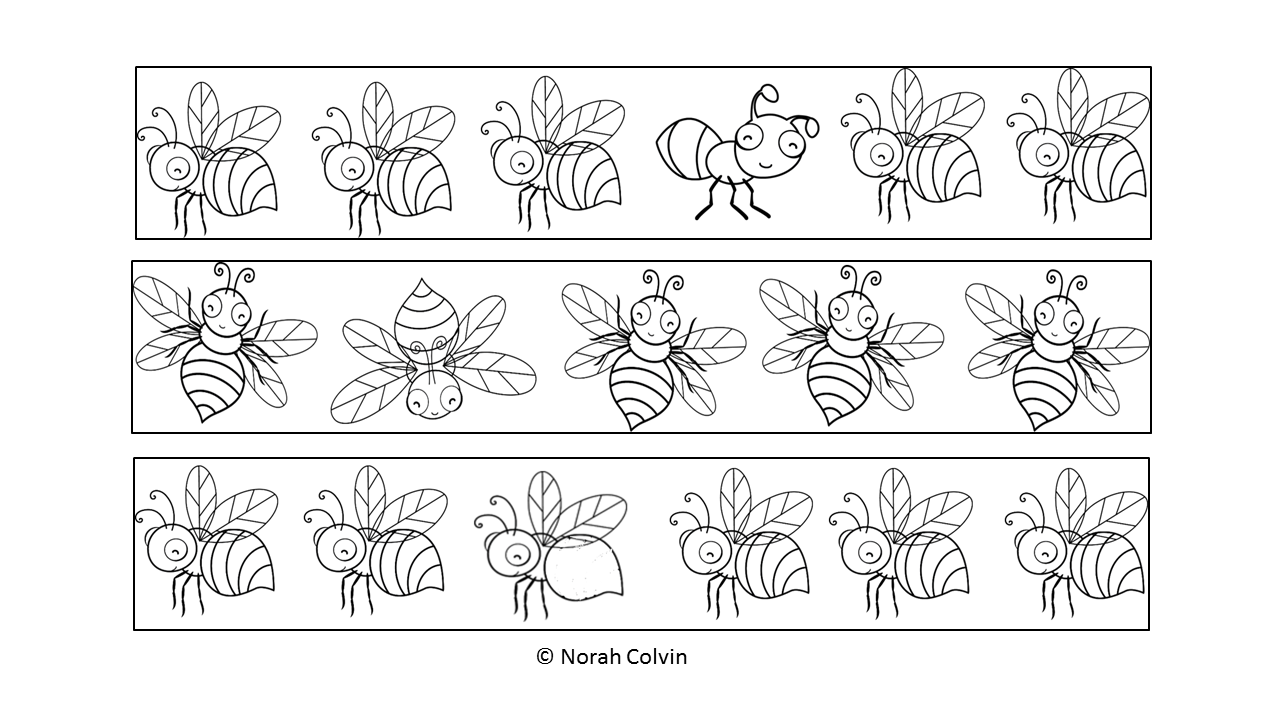
    Back in the early days of my teaching experience workbooks of ‘reading readiness’ exercises were frequently used with students in their first year of school. These activities generally required children to identify the one that was different in a group of objects. The exercises, such as those shown below, progressed through various levels of difficulty with the aim of preparing children for reading.
    reading readiness exercises

    Fortunately our understanding of how reading is learned has progressed since then and it is now recognised that exercises such as those did little to prepare children for learning to read. We now know that the best preparation for reading is to be immersed in language through conversations, with adults especially; to be read to frequently; and to develop a love of books and interest in print by sharing with others. The role of parents in preparing children for reading cannot be underestimated.

    This week I watched a video of a presentation by Yong Zhao about a type of readiness he referred to as “Out of basement readiness”. I admit I hadn’t heard the term before but the concept is definitely familiar.

    I do recommend you listen to Zhao’s talk. It is interesting, thought-provoking and humorous. I think I enjoyed listening to this talk as much as to Ken Robinson’s on How schools kill creativity which I have mentioned in previous posts here and here, amongst others. However at 55 minutes some of you may not be willing to commit the time. For me, it is 55 minutes of my life I’m very happy to not get back!

    I will not attempt to share all the content of the talk; there is too much of value, but here are just a few snippets that resonated with me:

    Zhao explains out of basement readiness this way:

    out-of-basement readiness - Yong Zhao


    Zhao says that students are being mis-educated, that they are being educated for something that doesn’t exist, and suggests that we should remove several phrases from the language we use to talk about education, especially

    • Under-performance
    • Evidence based
    • Data driven


    His description of the traditional education paradigm will be familiar to any frequent readers of my blog. He says that it is “about forcing people to do what some other people prescribe them to do” and that we reduce it to just a few subjects that can be tested.


    He talks about the “homogenisation” of schooling, and explained that homogenisation was the best way of getting rid of creative people and innovative thinkers.


    He mentioned kindergarten readiness tests, and suggests that the only test should be whether the kindergarten was ready for the children and parents.


    He recognises the uniqueness of every student, with different backgrounds, motivations and talents; and stresses the importance of effort. He says, “You cannot be born to be great. If you do not put effort into it you can never be good at it.” He explains it this way:

     “If you put ten thousand hours into something you are good at, something you are interested in you get great talent. But if I force you to spend time on something you have no interest in, you hate and something you are not good at, you at best become mediocre.”

    He says that countries that produce high test scores, score low on confidence and interest.

    He says,

    “Everyone is born to be creative, that’s a human being, that’s our gift: to be able to adapt, to learn and relearn and do new things. But school has typically tried to suppress it (with) . . . short term learning. . . Direct instruction may give the short-term gain but cause long term damages Studies show that if you teach children how to play with the toy, they lose creativity, lose curiosity and if you allow children to explore more they may not test very well but they maintain creativity and curiosity.”

    American schools _ Yong Zhao

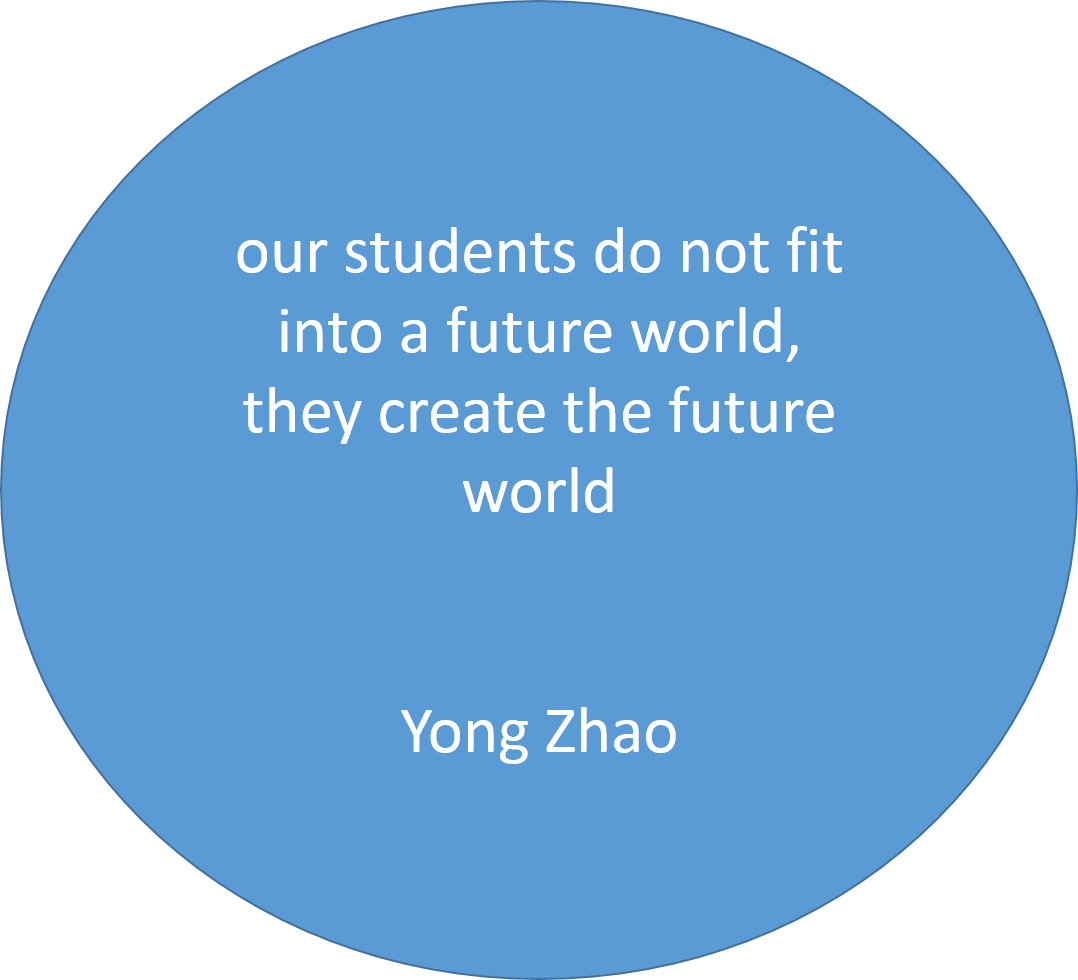
    Zhao says that “our students do not fit into a future world, they create the future world. This is why we need a different type of education.” He says that “education is to create opportunities for every individual student, they are not an average, they are not a probability, they need to be improved as individual human beings.”

    our students do not fit - Yong Zhao

    I couldn’t agree more. What do you think?


    I was led to Zhao’s talk via Diane Ravitch’s blog which is about the education system and situation in the US. Much of what she writes has applications further afield and I recommend it to anyone wishing to stay informed of current issues in education.

    Thank you

    Thank you for reading. I appreciate your feedback. Please share your thoughts on any aspect of this post.


  • A sprinkling of semicolons

    wordle semicolons

    This week at the Carrot Ranch Charli Mills is talking about semicolons; but not the little squiggles on a page, the semicolons that are sprinkled liberally through life as new beginnings. Sometimes we see them and grasp the opportunity for renewal, other times we ignore them and miss the chance to revitalize. Sometimes we get pushed down and it takes all our strength to pull back up, grasping onto the semicolon as if it was a dragon’s tail.

    mystica, A remix of dragonart  https://openclipart.org/detail/132805/rainbow-dragon
    mystica, A remix of dragonart https://openclipart.org/detail/132805/rainbow-dragon

    Charli was inspired by Project Semicolon that provides this explanation:

    “A semicolon is used when an author could’ve chosen to end their sentence, but chose not to. The author is you and the sentence if your life.  Project Semicolon exists to encourage, love and inspire.”

    Every day can be a new beginning in some way. With our thoughts, words and actions we can change our own lives, or the lives of others. The impact may be deliberate or unintentional. We may be aware of the effects, or we may never know the consequences.

    Without wishing to diminish the importance of helping those “who are struggling with depression, suicide, addiction and self-injury”, which is the focus of Project Semicolon, my focus as always is on education and the importance of maintaining curiosity and an interest in and love of learning.

    jimmiet, A colourful monarch butterfly   https://openclipart.org/detail/19002/monarch-butterfly
    jimmiet, A colourful monarch butterfly https://openclipart.org/detail/19002/monarch-butterfly

    What better analogy of a semicolon of life than the transformation from a caterpillar in a pupa to the beauty and flight of a butterfly. An inspiring teacher can mean the difference between full stops and semicolons in learning.

    To illustrate this I refer a post called Deeper Learning: Highlighting Student Work written by Ron Berger and shared on Edutopia.

    In the article Berger discusses his obsession with “collecting student work of remarkable quality and value . . . the work of regular students in typical schools around the country . . . (whose) teachers have helped them develop the skills and mindsets necessary to produce work of exceptional quality, and have built classroom and school cultures in which exceptional work is the norm”.

    Berger discusses ways of engaging students in authentic work, work that can have an impact on their communities and on the way they see themselves as learners. I remember Charli Mills telling me about similar work that her children were engaged in when they attended The School of Environmental Studies in Minnesota; and I shared some of Chris Lehmann’s work at the Science Leadership Academy in Philadelphia here.

    Berger says,

    “Once a student creates work of value for an authentic audience beyond the classroom — work that is sophisticated, accurate, important and beautiful — that student is never the same. When you have done quality work, deeper work, you know you are always capable of doing more.”

    Semicolons in teaching and learning, all.

    As with the three cited above, the situations referred to are often of teenagers in high schools. I am an early childhood teacher and, while I find the work exciting, I sometimes struggle to see the relevance to my situation. However, in this article Berger shares the work of Austin, a year one student from Boise, Idaho doing a project about a tiger swallowtail butterfly.

    Austin was to illustrate his project with a detailed scientific drawing of the butterfly. His initial drawing was what I would consider to be fairly typical of a year one child. However he received feedback that was specific and not mean from follow students; and through a series of six drafts finished with a drawing that was much more sophisticated and demonstrated more careful ‘scientific’ observation.

    Berger also shared work by year two students at another school, demonstrating what can be achieved “when students are allowed, compelled and supported to do great things”.


    Last week Charli’s flash fiction challenge “the day the earth turned brown” prompted me to write about a student mixing all the colours together to make one muddy brown. The teacher paused before responding. There are many such pauses, (semicolons) in a teacher’s day. The teacher knows the power of every remark and must consider the impact that a response may have.

    If you had provided each child with a palette of primary colours and black and white expecting them to mix a variety of colours and shades and tones to create an interesting picture; then found that one child had mixed them all together to make one muddy brown, how would you respond?

    There were a number of comments on the flash including one from Geoff Le Pard  who said that there were “So many questions as to why the little girl is making muddy browns and lathering them everywhere.”

    So true. The teacher’s response would be influenced by knowledge of the child’s background, interest in art, and behaviour that day, among other things.

    Charli Mills said that “It could mean many things and nothing!” She recalled, “mixing paints as a child hoping to create a vivid new color and (being) disappointed to end up with mud.Anne Goodwin agreed, saying that “mixing paints to make a muddy brown, (was) a distinctive childhood memory”.

    In my experience there was usually one child who ended up mixing all the colours together, often for no other reason than to see what happened. Sometimes the process of discovery gave as much pleasure as would a colourful painting of a house a tree and a sun.

    house and sun

    However, there might be more to it than that. Charli Mills sympathesised with the teacher, saying that “So much is put on the teacher to figure it out.” She thought that the child “might be disturbed, highly imaginative or confident enough to experiment”.  Sherri Matthews suggested that perhaps the child was “troubled . . . living in a dark, mixed up world, but . . . trying to find their way”.

    So much to consider. So powerful the response. Will it be a full stop, or a semicolon?

    This is my response to Charli’s challenge to In 99 words (no more, no less) write a renewal story that proclaims, “This isn’t the end; I will go on.

    muddy brown

    She paused. The muddy brown extended beyond the paper virtually cementing it to the desktop. The palette too was brown with little trace of the beautiful primary colours she had prepared. Looking from desk to child she observed two large smears adorning the shirt. A bruise-like smudge on the cheek showed where an intruding hair had been brushed away. “Oh!”

    She breathed; she counted to ten; and back again; “Breathe,” she told herself. “Why?”

    She moved on, observing the assortment of smiling suns, houses and garden paths, but her mind was on the mud; the child . . .

    What would be the appropriate response?

    Thank you

    Thank you for reading. I appreciate your feedback. Please share your thoughts about any aspect of this post or flash fiction.


  • A palette of colours

    Moini, Painter penguin https://openclipart.org/image/800px/svg_to_png/174634/painter_penguin.png
    Moini, Painter penguin https://openclipart.org/image/800px/svg_to_png/174634/painter_penguin.png

    I think few of us would deny that each of us is unique, or question the importance of an individual’s interests and abilities to learning. Much has been written about learning styles, multiple intelligences and differentiation of instruction.

    Most teachers try to incorporate a variety of experiences into their programs in order to maximise learning opportunities in the hope that, if students don’t “get” it one way, they will “get” it in another. The imposition of national standardised assessment makes doing this a challenge for teachers. The increased requirement for the implementation of particular approaches to teaching makes it even more so.

    To say that I hold fairly strong views about learning, and the differences I consider there to be between education and schooling is perhaps an understatement, but it wasn’t always so.

    My memory tells me that, while I probably didn’t “love” school, I probably didn’t “hate” it either. It was simply something that I had to do. I didn’t question it. I did my best to be a “good” girl, do what was expected of me, and conform. All of which I think I did pretty well.

    The questioning came later and had more impact upon my teaching and parenting than it did on my own schooling. I came to view schooling as something that is “done” to us, and education as something that we do for ourselves. That is not to say that no worthwhile learning takes place in school, for it does, but education is a whole-of-life experience and schooling is but one small part of that.

    Education is a whole of life experience

    However, if the importance of schooling, and here I mean learning of particular content by particular ages, is inflated and rated more highly than children’s natural curiosity, interests and abilities, then the consequences to individuals and the community in general can be more negative than positive. One consequence may be that children don’t enjoy school; another may be the view that only school knowledge is important; and yet another may be that children are turned off learning all together.

    My first conscious discomfort with what, for convenience, I’ll call a factory model of schooling (children go in one end, have things “done” to them, and come out the other end all the same) was as a young teacher when all five year two teachers were expected to be doing the same thing at the same time. That imposition, along with other inadequacies that were beginning to become apparent, set me on a quest to learn more about learning and education. My quest has never ceased and I am still searching for answers.

    Recently I read a book by Daniel T. Willingham entitled Why Don’t Students Like School? The title had instant appeal, of course, and I thought I’d recognise a few of the reasons at least. My initial expectation was of reading views similar to those of authors like John Holt, Ivan Illich, A.S. Neill and John Dewey whose books I had read in the 70s and 80s; but a closer look at the subtitle told me I was in for more: “A Cognitive Scientist Answers Questions About How The Mind Works and What It Means For The Classroom”.

    The book is a wonderful read and I’m certain to share many of Willingham’s ideas with you in future posts. I enjoyed it because, in almost equal measure it reinforced, challenged and extended my thinking about many aspects of learning and how best to provide for and stimulate it in a classroom setting.

    Sometimes Willingham would make a statement with which I agreed, and then go on to explain the faulty thinking behind it. Sometimes his statement would seem to completely contradict what I think but his explanation would show that we simply had different ways (mine perhaps inadequate) in explaining it.

    What I really appreciate about the book is that Willingham carefully translates what has been learned from research into practices that can be implemented in the classroom to enhance student learning. Often research seems only to tell teachers what they already know from experience and observations, or provides information in such an abstract way that nothing of practical use can be gleaned.

    The section of Willingham’s book that I refer to today is “Chapter 7 – How Should I Adjust My Teaching for Different Types of Learners?” Willingham opens the chapter with the words “All children are different.” He says that some learn visually, some auditorily; that some are linear thinkers and some holistic, for example, and that

    “It seems that tailoring instruction to each student’s cognitive style is potentially of enormous significance”.

    The important word in that sentence is “seems”. He talks about the differences in the way that hypothetical Sam and Donna might learn and says that “An enormous amount of research exploring this idea has been conducted in the last fifty years, and finding the differences between Sam and Donna that would fit this pattern has been the holy grail of educational research, but no one has found consistent evidence supporting a theory describing such a difference.”

    He states that the “cognitive principle guiding this chapter is:

    “Children are more alike than different in terms of how they think and learn.”

    That statement really made me sit up and take notice: “Children are more alike than different”. But it turns out, those words are not the most important ones in the sentence. The most important ones are: “in terms of how they think and learn.

    He goes on to say that, “the claim is not that all children are alike, nor that teachers should treat children as interchangeable. Naturally some kids like math whereas other are better at English. Some children are shy and some are outgoing. Teachers interact with each student differently, just as they interact with friends differently; but teachers should be aware that, as far as scientists have been able to determine, there are not categorically different types of learners.”

    He also talks about it in this video:

    Willingham acknowledges that students differ in their cognitive abilities and styles. What he does in the chapter is “try to reconcile the differences among students with the conclusion that these differences don’t mean much for teachers.” In reading these words one might expect that Willingham is proposing that differentiation is not an important part of classroom practice. But such is not the case, as stated in this video:

    In the book he writes, “I am not saying that teachers should not differentiate instruction. I hope and expect that they will. But when they do so, they should know that scientists cannot offer any help.” According to Willingham, scientists have not identified any types of learners or styles of learning.  He says, “I would advise teachers to treat students differently on the basis of the teacher’s experience with each student and to remain alert for what works. When differentiating among students, craft knowledge trumps science.

    What Willingham says is of most importance for a learner to learn is background knowledge. If a student does not have sufficient background knowledge to understand the content or concepts which are presented, learning will not take place. This supports the advice that I repeatedly give to parents: read to your children, talk with them, and provide them with a wide range of experiences and activities. The same is true for teachers: ensure the students have sufficient knowledge on which to build the new work you are expecting them to grasp.

    This week at the Carrot Ranch Charli Mills has thrown a prompt with which I have struggled: In 99 words (no more, no less) write about the day the earth turned brown. I always like to tie my responses to the educational focus of my blog and this one had me stumped for a while. A mind journey following various twists and turns, retracing well-worn paths, and hitting many dead ends, finally led me to an oasis in the parched brown earth: the uniqueness of each of us; the amazing potential of each new child to create possibilities beyond our imagining; and the contrasting effect of a narrow test-driven school system that attempts to reduce each to the sameness of minimum standards and age (in-)appropriate benchmarks. A paint palette seemed a suitable medium for the story.

    For those of you who have been following Marnie’s story, I apologise. She makes no appearance this time, though I have not ruled out the possibility with student M. I’d be pleased to know what you think.

    palette

    Palette potential

    She walked between the desks admiring their work. From the same small palette of primary colours, and a little black and white for shades and tones, what they produced was as individual as they: J’s fierce green dinosaur and exploding volcanoes; T’s bright blue sea with sailing boat and smiling yellow sun; B’s football match . . . At least in this they had some small opportunity for self-expression. She paused at M’s. M had mixed all the colours into one muddy brown and was using hands to smear palette, paper, desk and self . . .

    Thank you

    Thank you for reading. I appreciate your feedback. Please share your thoughts about any aspect of this post or flash fiction.


  • Assessing the impact of blogging on writing goals

    cyberscooty, a basketball about to enter a basketball hoop https://openclipart.org/detail/205569/basketball
    cyberscooty, a basketball about to enter a basketball hoop https://openclipart.org/detail/205569/basketball

    I love writing. Always have. I usually confess that I am a better writer than a speaker.

    I like the time that I can take to choose a word or phrase and combine them to mean just what I intend.

    I like the opportunity to check a word’s appropriateness before using it. Often when speaking I leave my sentence hanging embarrassingly in mid-air while I grope around in the murkiness of my mind for the “correct” word.  Why can my fingertips find the right word, without any thought, and the tongue cannot?

    And of course there are all the opportunities that writing provides for self-expression, creativity and sharing ideas with a wider audience.

    I started out writing stories, poems and songs, as most children, do and tried my hand at short stories, children’s stories and poetry as I got older. As I became more involved with my career in education, and in raising my children, I had (or made) less time for those creative pursuits.

    There are many reasons I loved being a teacher and one of those was the opportunity it provided for me to be creative: creative and innovative in the way I worked with children to encourage their learning; and creative in writing resources to assist my teaching and the children’s learning.

    I was fortunate in having a variety of opportunities to write materials for educational publishers at different times during my career, and I am currently writing documents to support curriculum implementation for my state educational authority. But I really wanted to be in control of my own writing.

    At the back of my mind there was always the thought of sharing my teaching and learning resources with a wider audience. (Just a little bit further back, or maybe even close to equal footing, is the thought of publishing children’s stories, short stories, and maybe even a novel . . . one day.) I had had no success with submitting unsolicited manuscripts before and couldn’t think what publisher might be interested in the variety of educational resources I had made, many specifically for use on a computer.

    So a couple of years ago I decided that a website of my own was the ideal platform for sharing my resources.  Getting that website up and running is my primary goal. However, observers could be mistaken in thinking that writing a blog is my primary goal. The path to establishing a website has taken a side-track via blogging.

    venkatrao, A butterfly flying with a dotted path over a hill background https://openclipart.org/detail/69967/1278212857
    venkatrao, A butterfly flying with a dotted path over a hill background https://openclipart.org/detail/69967/1278212857

    Blogging, Twitter, Facebook and other forms of social media were recommended me to right from the beginning as a way of targeting and establishing an audience. At the time I was familiar with none of these and set off learning how to become involved. It has been an exciting journey. I have learned lots and made many wonderful online friends.

    However I am not sure how far it has moved me towards achieving my website goal. In fact, I think very little progress has been made.

    • I have not found and established my “target” audience and am really none the wiser about doing that.
    • The time that I am spending writing, reading and commenting on blogs is time that I am not spending on preparing materials for my website.
    • I need to be more proactive in finding illustrators for my work.
    • When I discovered the Teachers Pay Teachers site and established my Teachers Pay Teachers Store I had thought this may be an alternative avenue for sharing my work. But I haven’t been as successful there as I would like either. This may be telling me something about my website goal. What is it telling me? Should I listen?

    So my dilemma comes down to these questions”

    To blog or not to blog?

    How to blog?

    How much time for blogging?

    The answer to the first one is easy:

    Yes! I very much enjoy writing my post and receiving the almost immediate feedback from the wonderful community of writers I engage with.

    Yes! I love reading and commenting on others’ blogs and joining in the discussions that ensue. We are a S.M.A.G. group: Society of Mutual Appreciation and Gratitude. What’s to not like?

    The second two questions are a little more difficult.

    The focus of my blog is education, but my audience consists of writers. Educators have shown little interest in developing a relationship with me online. I haven’t been able to figure that one out, but I have a few hazy ideas, none of which I think I want to address at this stage. If I change the way I blog I would quite likely fall out with the community I have become part of; and there is no guarantee I would pick up a teacher audience. So I’ll have to keep mulling this one over for a while.

    The third question is the one I have been “researching” for close on five months. As time is limited and I need to devote more time to achieving my primary goal, it is important that time spent on blogging activities is worthwhile.

    I decided to find out who is keen to engage with me and who isn’t.

    I began keeping a record of the number of comments I made on others’ blogs, and of those they made on mine.  It wasn’t always as I expected, and highlighted some interesting trends; the main one of which I have noted above:

    Writers have a wonderful sense of community.

    The record helped me ensure that, if someone visited and commented on my blog, I would visit and comment on theirs, maintaining a balance as much as possible.

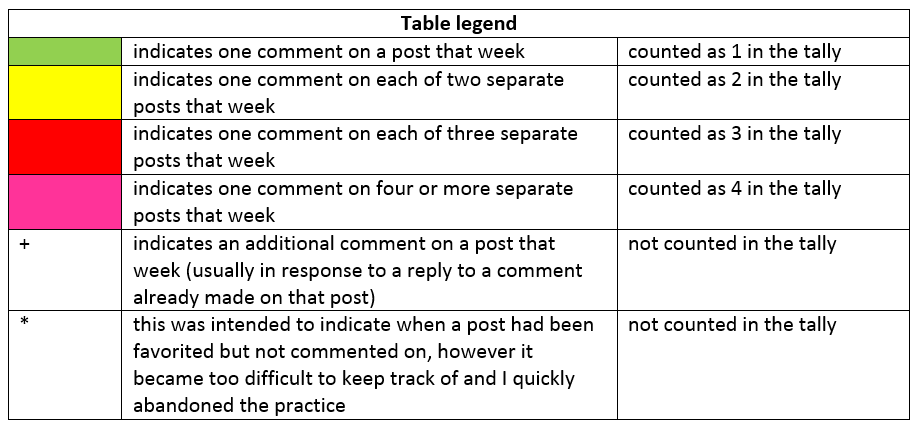
    This key explains how to interpret the information on the tables below.

    Table legend

    I have removed names from the tables to respect privacy. (I don’t really expect you to look too hard at the tables. You have better things to do. But they do look pretty!)

    November 9 2014 – Jan 24 2015

    Slide1


    Jan 25 2015 – March 26 2015


    Slide2

    I have not included all blogs I “follow”, or even all the ones I have ever commented on. Only the ones on which there has been some consistency in connecting.

    I have also not included the comments of those who follow and comment on my posts but do not have a blog of their own on which I could reciprocate.

    I generally post twice a week.

    Others post more often.

    Sometimes the number of comments I make on their posts in relation to their comments on mine is affected by the greater number of times they post. If someone chooses to post more often than twice a week, I will not necessarily read all their posts, regardless of how much I enjoy reading them, as there are other ways I must use my time, including a reading greater variety of writer’s work, and getting more done on my own. I’m sure they have enough other readers to not miss me!

    Sometimes when a blogger posts less frequently than I do, their comments on my posts may tip the scales in my favour. I can’t do much about that either, but I do try to catch up when next they post.

    I have found that it can take a few weeks of commenting on a blog I like to get a return visit and comment on my blog. Frequently I don’t even get a response to a comment I’ve made on theirs. I guess that’s how it goes. Some bloggers blog to develop community. Others blog to broadcast. I just need to decide how best to use my time.

    If you have walked with me to the end of this post, thank you. It is rather longer than I intended. I had intended to respond to Anne Goodwin’s invitation to join in a writing process blog hop , Sherri Matthews’ invitation to join a workspace blog hop, and Sarah Brentyn’s questions for writers, as well as explain my writing goals to Sacha Black, thank Julie stock for her Sisterhood of the World bloggers award and draw on Paula Reed Nancarrow’s wonderful survey about Twitter #hashtag days and blogging. But they will have to wait. We all have others things to do.

    Contributing partly to my procrastination with responding to these wonderful invitations, which I do very much appreciate, is that I have already nominated the majority of bloggers I follow, or if I haven’t someone else has. And the remaining ones don’t wish to be nominated. What is a girl to do? I’d appreciate your suggestions.

    Thank you

    Thank you for reading.

    I appreciate your feedback. Please share your thoughts and advice, especially about how to increase time. If anyone knows a good time alchemist, I’d love to meet her!