Live Love Laugh Learn … Create the possibilities

Category: Celebrations

  • A Celebration of Australian picture books #5 — Jeannie Baker

    Jeannie Baker - planet changing

    This post is the fifth in a series celebrating picture books by Australian authors. If you missed earlier posts, please follow these links to the introduction, Mem Fox, Kim Michelle Toft and Narelle Oliver.

    In this post I introduce you to Jeannie Baker, a collage artist and author. Jeannie was born in the UK but has lived most of her adult life in Australia, and most of her books, though having universal themes, are set in Australia.

    2015-09-19 11.09.45

    Jeannie had already published a number of books prior to 1992 when I first became aware of her work through “Window”, winner of the Australian Picture Book of the Year Award.

    Window tells, in beautifully detailed collage, of the transformation of a landscape from natural bush to city-scape. The changes are observed through a window by a boy as he celebrates alternate birthdays from birth to 24 years. Like many of Jeannie’s books, “Window” carries a strong environmental message. In her note at the end of the book, she says,

    “Our planet is changing before our eyes. However, by understanding and changing the way we personally affect the environment, we can make a difference.”

    The intricate details in this textless picture book provide many opportunities for discussion. Children and adults are enticed to study and compare the changes that take place in each successive picture. The carefully constructed collages give a sense of being able to almost step into the scene and experience the sights, sounds and smells of each landscape.

    Jeannie Baker - time

    I was fortunate to attend an exhibition of Jeannie’s artwork for “Window” as it toured the country in 1992. What surprised me most was the size of the collages. With all their detail I had expected them to be quite large; but they weren’t. They are miniature, much smaller than a page of the picture book on which they appear. The collection and arrangement of a mix of natural and artificial materials is amazing. Jeannie describes the process of constructing her collages here.

    2015-09-19 11.11.04

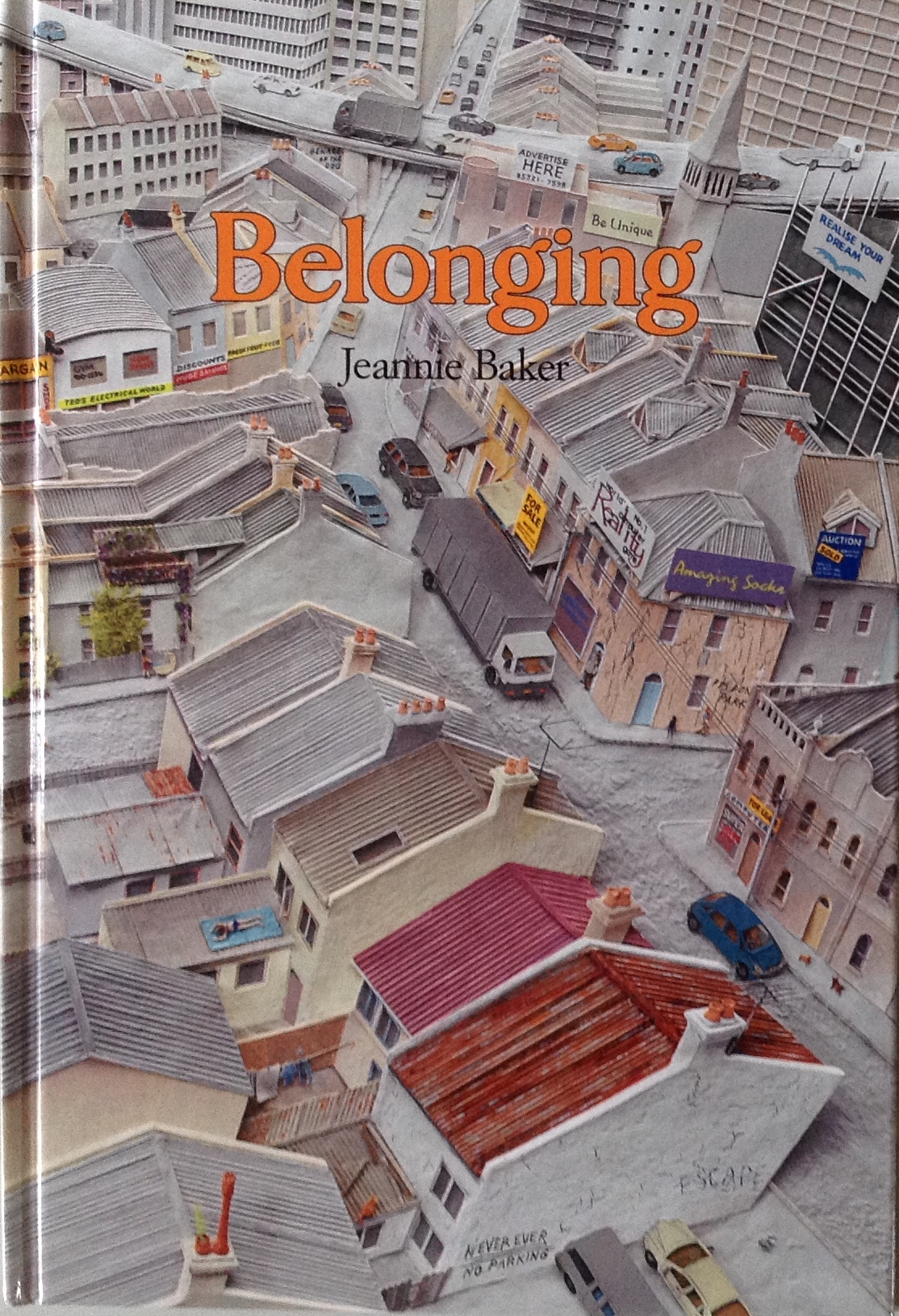
    In 2004 Jeannie published a companion book to “Window” called “Belonging, which, in 2005, also received a number of awards, including one from the Wilderness Society. This textless picture book tells a story of a changing landscape over a number of years as a city is transformed with plants and welcoming spaces for children and families. In a note at the end of this book, Jeannie says,

    “It takes time … But by understanding the land on which we live and by caring for it we can choose between just having a place to live or belonging to a living home.”

    2015-09-19 11.10.25

    One Hungry Spideris the third of Jeannie’s books I own. Unlike “Window” andBelonging, the illustrations in this one are accompanied by text. One Hungry Spideris a counting book, but a counting book with a difference: it includes information about the spider. For example when one of seven ladybirds gets caught in the web we find out that “the spider took no notice (because) spiders don’t like the taste of ladybirds.” And when nine wasps fly by the spider left the web and hid because wasps catch spiders. Additional details about the spider are provided at the back of the book. Once again the illustrations throughout the book are magnificent.

    Surprisingly I own only these three of Jeannie’s books. However I am familiar with others. At school I had access to many of her titles in big book format (approximately 50 x 40 cm) which were perfect for sharing with a class of children.

    4 of Jeannie Baker's books

    These are other favourites:

    Where the Forest Meets the Sea”, “The Hidden Forest”, “Mirrorand The Story of Rosy Dock”.

    Are you familiar with Jeannie’s work? If so, which ones and what do you think of them?

    Please check out these and other titles of Jeannie’s if you have a chance. Their illustrations will intrigue you and their positive messages will inspire you.

    As a writer, I found inspiration in Jeannie’s response to the question,

    “Of all the books you have made, which is your favourite?”

    She answered,

    “When a book is finally finished, I find it hard to think about it anymore …I want to fill my
    head with something totally different, with a new book.  My favourite book is the
    ‘new’ book I’m working on, still working out and trying to make better than the books I
    made before it!”

    I think that indicates a strong growth mindset and Jeannie’s joy in the “continual challenges this medium gives … to invent techniques and explore and experiment with materials and their textures.”

    Jeannie Baker - favourite book

    It affirms the quest for improvement and a reason to embrace the challenges we both set for ourselves and meet along the way.

    Thank you

    Thank you for reading. I appreciate your feedback. Please share your thoughts.

  • A celebration of Australian picture books #4 — Narelle Oliver

    This post is the fourth in a series celebrating picture books by Australian authors. If you missed earlier posts, please follow these links to the introduction, Mem Fox and Kim Michelle Toft.

    Narelle Oliver

    In this post I introduce you to Narelle Oliver, a Brisbane-based author and illustrator. There is much to explore on Narelle’s site, including: information about her writing process and tips for would-be picture book authors; the research involved in creating her books, many of which are about nature; and illustration techniques that involve the use of linocut printing and rubbing, and other assorted media.

    Narelle conducts workshops for children and adults. She visits schools to share with children the wonder of her books and talks to them about her writing and illustrating processes. When she visited “my” school she brought along first thoughts and illustrations for, and a dummy book of, The Very Blue Thingamajig, plus a soft toy prototype – and we all wanted one! She also brought a fox from the museum and talked about illustrating Fox and fine feathers. She read to the children, involved them in activities and gave them an experience of linocut printing. It was fascinating for both children and teachers.

    Narelle talks about her workshops and sessions in this video.

    While you can find a complete list of Narelle’s books here, I will share those I have on my bookshelf (in no particular order).

    2015-09-19 11.14.10

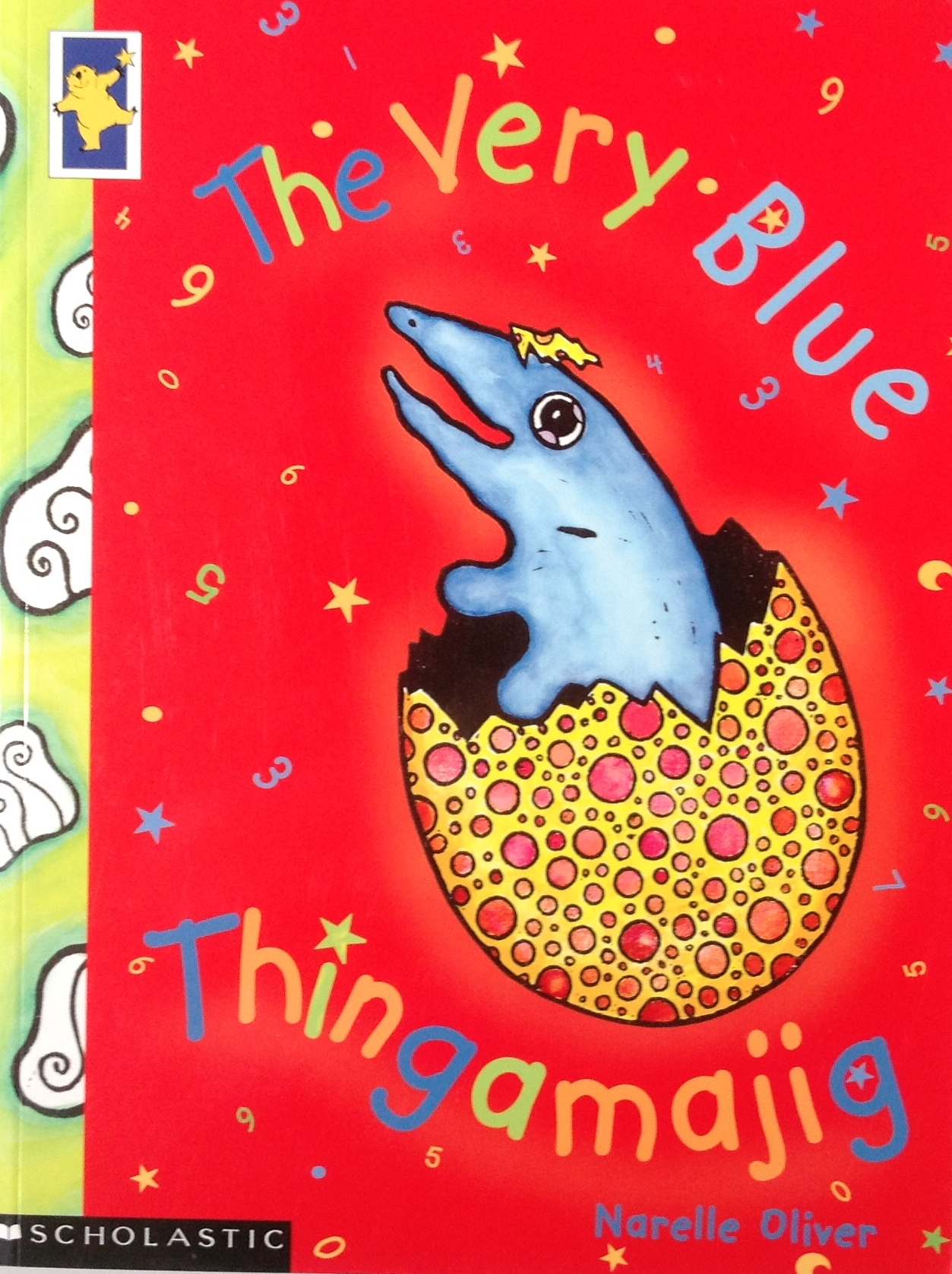
    The Very Blue Thingamajig is as story about difference and acceptance told in a fun way involving mathematical concepts of patterns, counting and days of the week. The colourful illustrations made using hand-coloured linocuts are appealing, and children love to find the little bird who provides a secondary story throughout the book. On Narelle’s fun page you can colour and decorate your own thingamajig.

    2015-09-19 11.11.44

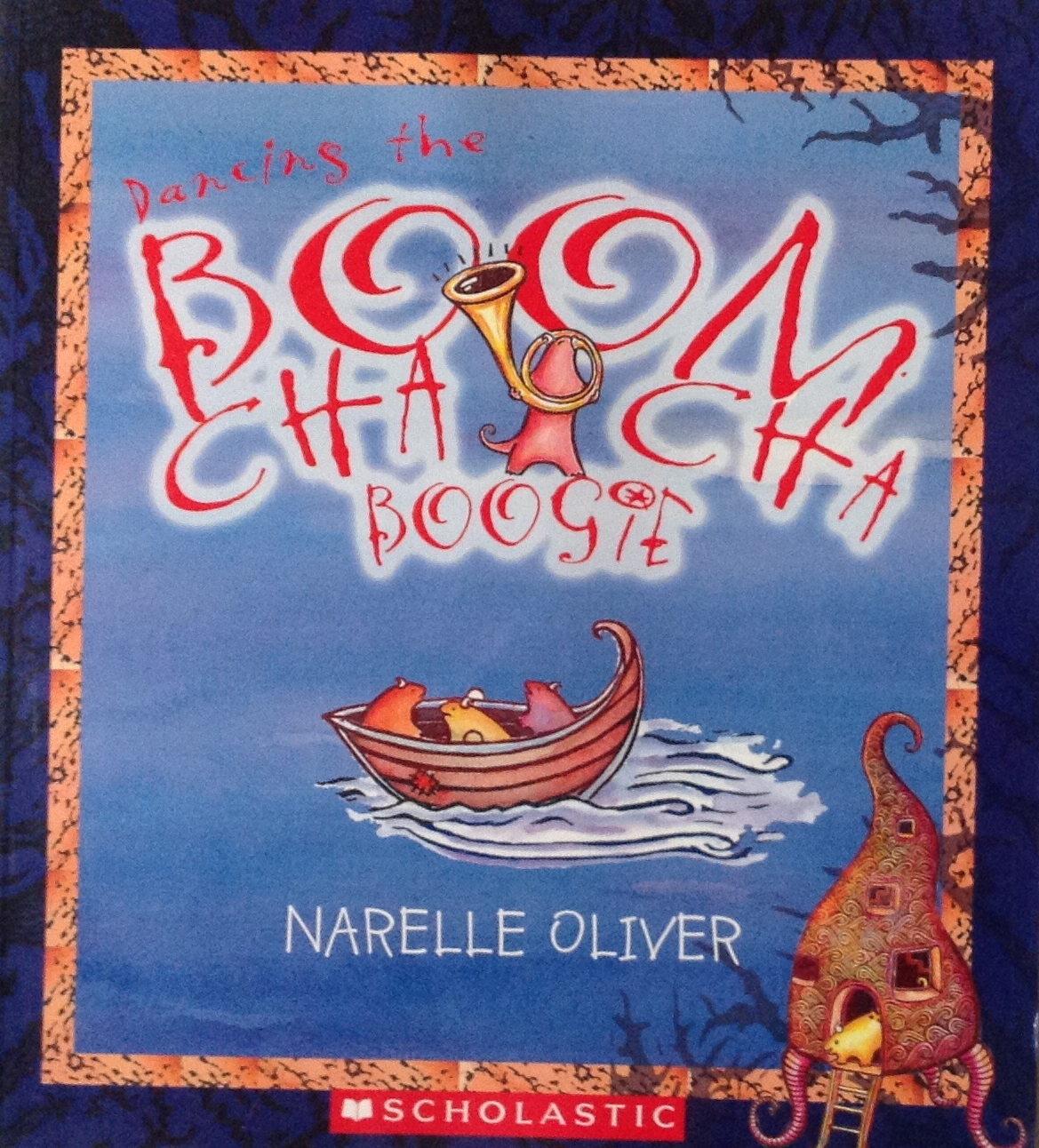
    Dancing the Boom Cha Cha Boogie is a gorgeous tale of three little murmels who are washed out to sea in an arkel and arrive on a foreign shore where they are not welcomed by the resident snigs. They are imprisoned until when, the arkel is repaired, they are to leave. At night a young snig releases the murmels who teach the snig to have fun. In the end the murmels are accepted and stay happily in Snigdom with the snigs, learning from and enjoying each other’s company. This book is illustrated with hand-coloured linocuts.

    2015-09-19 11.13.26

    Fox and fine feathers is a story of friendship, of looking out for each other and keeping each other safe. The attention to detail in these linocut illustrations coloured with pencils and pastels is amazing and accurately depicts the five creatures and the forest setting. Narelle has supported the story with information about the birds, their habitat and the dangers imposed by the feral fox, which is now a serious threat, along with other feral animals, to native species in Australia.

    2015-09-19 11.12.23

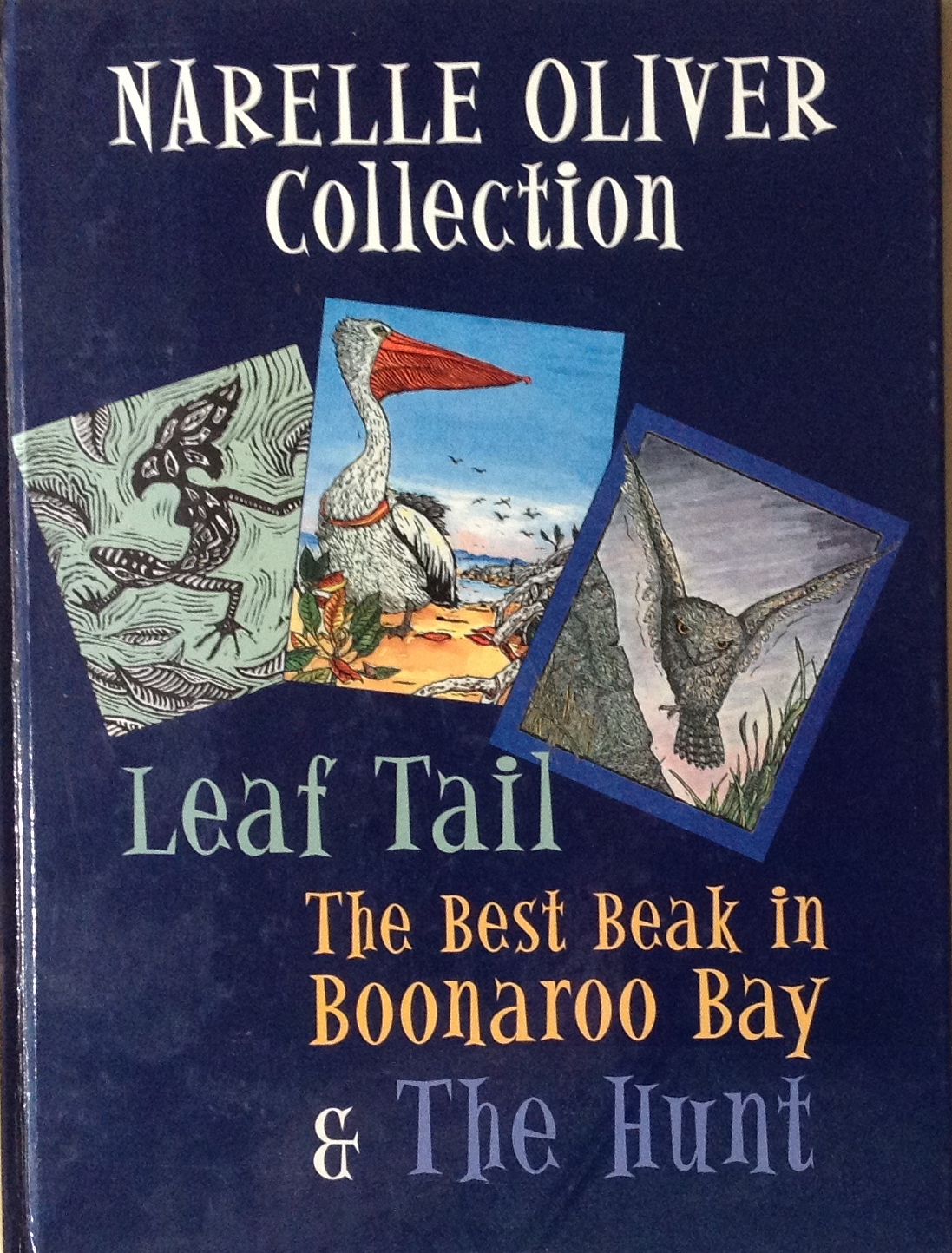
    Narelle Oliver Collection of three stories: Leaf Tail, The Best Beak in Boonaroo Bay and The Hunt.

    • Leaf Tail, Narelle’s first picture book, illustrated by beautiful linocuts, tells the story of a leaf tail gecko and the importance of camouflage to survival in the Queensland forest.
    • The Best Beak in Boonaroo Bay, also illustrated with hand-coloured linocuts, tells of a squabble between five different birds, each professing its own beak to be the best. Finally clever pelican holds a contest that enables the birds to see that each beak is best in its own way. As well as a delightful story about wildlife, it also provides a springboard into discussions about, and appreciation of, differences.
    • The Hunt is another beautifully illustrated wildlife story of camouflage and survival. The story is supported with information about its setting and the workings of animal camouflage and disguise. There are also black and white drawings showing where to find the animals camouflaged in each illustration. It is fun to see if all the animals can be found without referring to the guide.

    2015-09-19 11.15.11

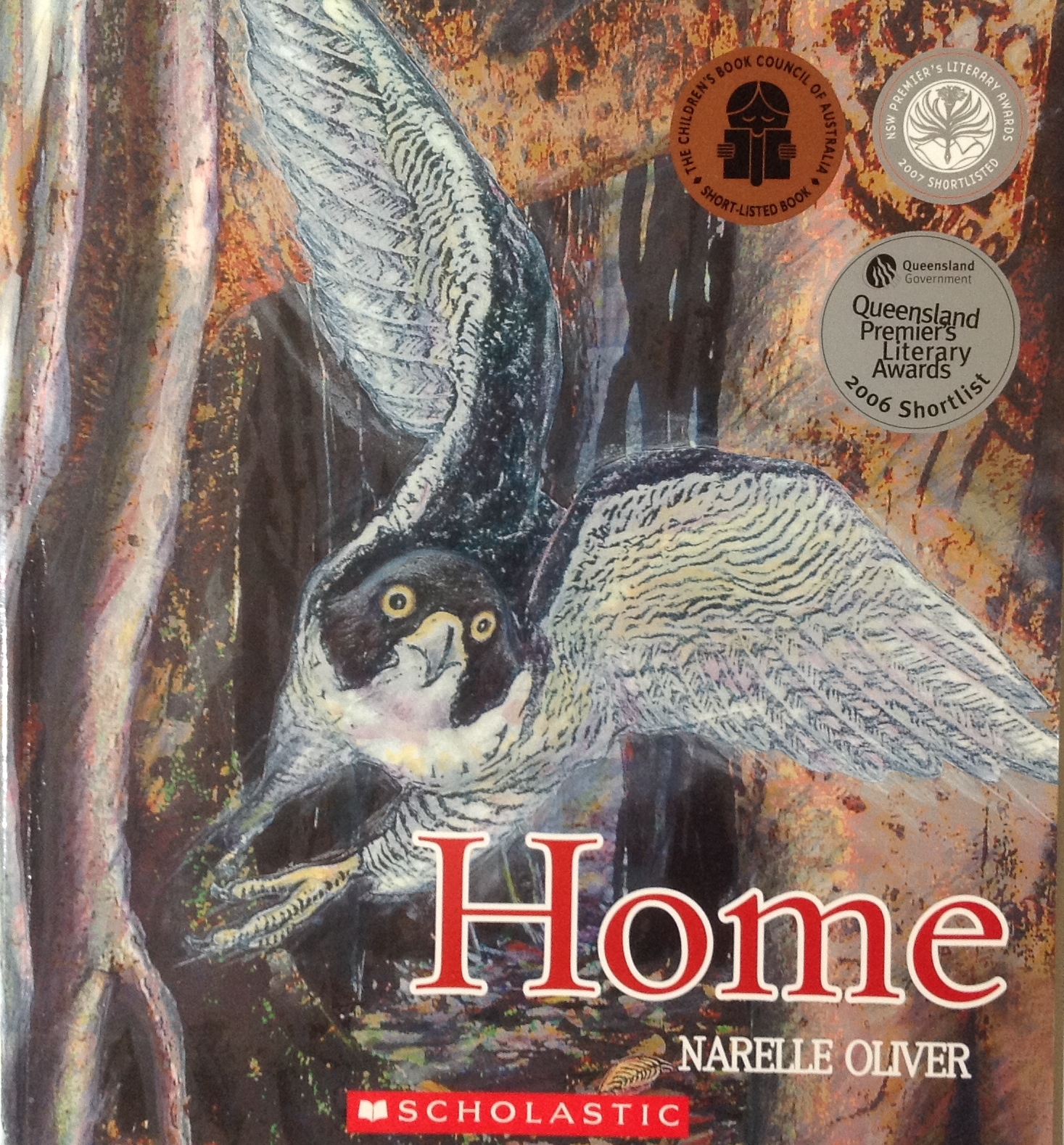
    Home, referred to in a previous post Home or away, is perhaps a favourite if only because it is based on a true story of a pair of peregrine falcons that nested at the top of a 27-storey building in the city of Brisbane. The birds, named Frodo and Frieda, fascinated a city and, for a while, had their own reality show “Frodocam”. The story, beautifully illustrated using a combination of media including linocut rubbings, collage, photographs, pencil, pastels and watercolours, tells of the adaptation of wildlife to new landscapes and environments.

    Each of these books can be appreciated for its story or used as a springboard for discussion. The illustrations appeal to adults and children alike for the attention to detail and accurate representation of wildlife. The addition of supporting information encourages an appreciation for wildlife and their habitats and develops an awareness of the need for their protection. They would be a wonderful addition to any book collection and be much appreciated as gifts.

    Thank you

    Thank you for reading. I appreciate your feedback. Please share your thoughts.

  • A celebration of Australian picture books #2 – Mem Fox

    I own and have given away more picture books by Mem Fox than by any other author. To say I appreciate Mem’s work would be an understatement. I currently have on my shelves twelve of her more than thirty picture book titles and two of her eight nonfiction titles.

    2015-09-19 10.55.23

    Her first picture book Possum Magic was published in 1983. I love the story behind this book, as much as the story itself. Mem wrote the first draft in 1978 and over the next five years it was rejected by nine publishers. When it was finally picked up by Omnibus Books she was asked to reduce it in length by two-thirds and to change the characters from mice to possums. The book is now one of Australia’s most popular with more than 3 million copies sold around the world.

    You can listen to Mem read Possum Magic or some of her other books here.

    File 23-09-2015 11 32 24 am

    In the ten years after the publication of Possum Magic Mem published almost twenty other books. I read her autobiography Mem’s the Word (released in the US as Dear Mem Fox) not long after it was published. At the time I was in my late thirties and was thrilled to find that Mem had also been in her late thirties when her first book was published. I thought there was still hope for me. I’d certainly had enough rejections by that time to fill a rather large shoebox, so maybe I just needed a few more!

    Since then Mem’s output has hardly lessened and she has another new book coming out next month. In the meantime, I’m still hoping there’s time for me!

    Mem is an author, not an illustrator. The twelve picture books I own were illustrated by eight different artists. Four illustrators did two of these books each. A quick glance at the list of Mem’s books confirms the number of artists who have been engaged to illustrate her work and the variety of artistic styles used. How wonderful for the artists to have that experience, and for teachers and parents the opportunity for discussing artistic styles with children.

    My reason for raising this issue of author and illustrator is that I also am not an illustrator. A number of years ago when discussing picture book authors, an acquaintance scoffed at  my praise for Mem’s work: how could she possibly consider herself a picture book author if she didn’t do the illustrations? This acquaintance, in the process of having her first picture book published, was author and illustrator. In the intervening years Mem has gone on to publish a number of books, and this acquaintance none. Okay, neither have I. Yet!

    Reading magic

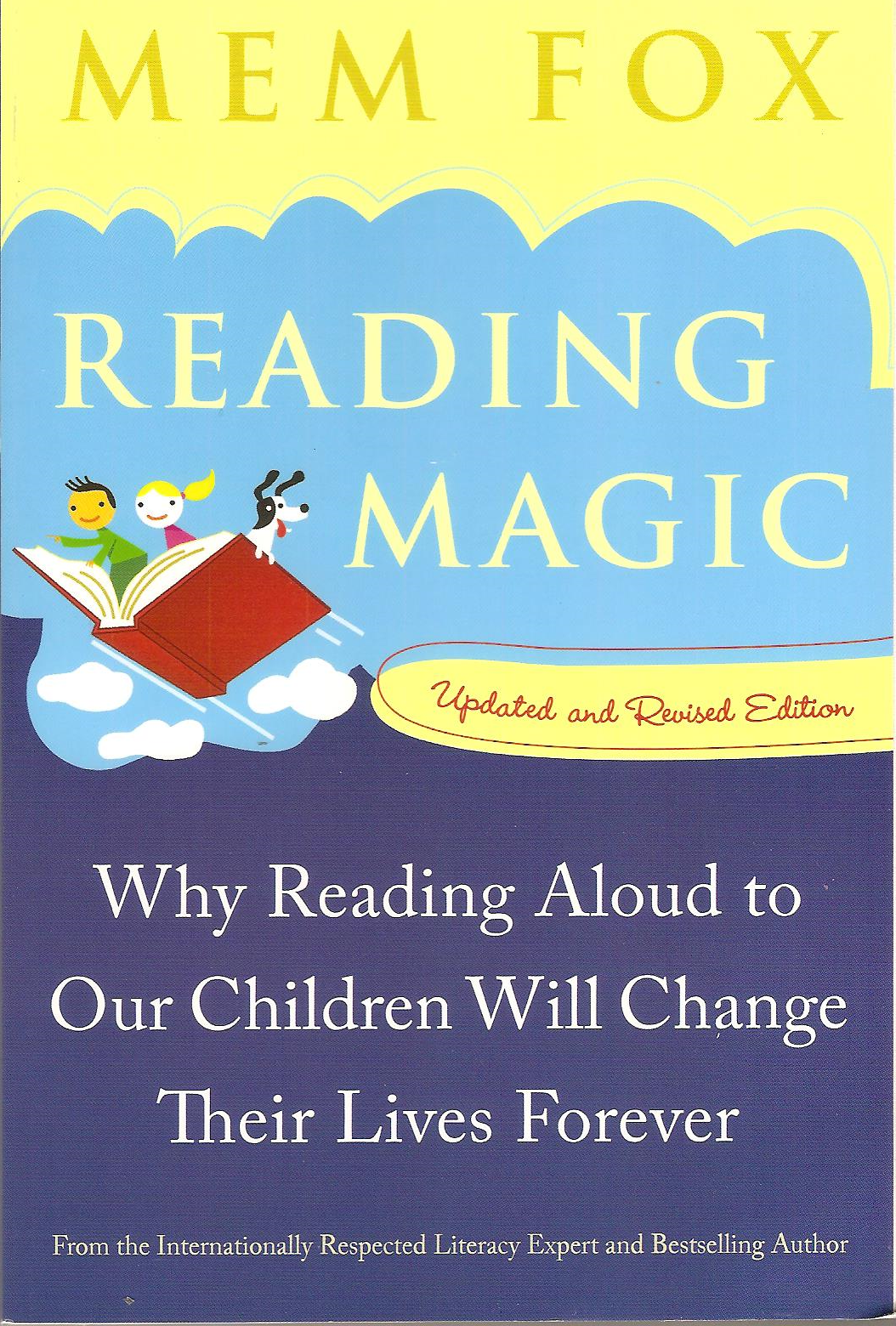
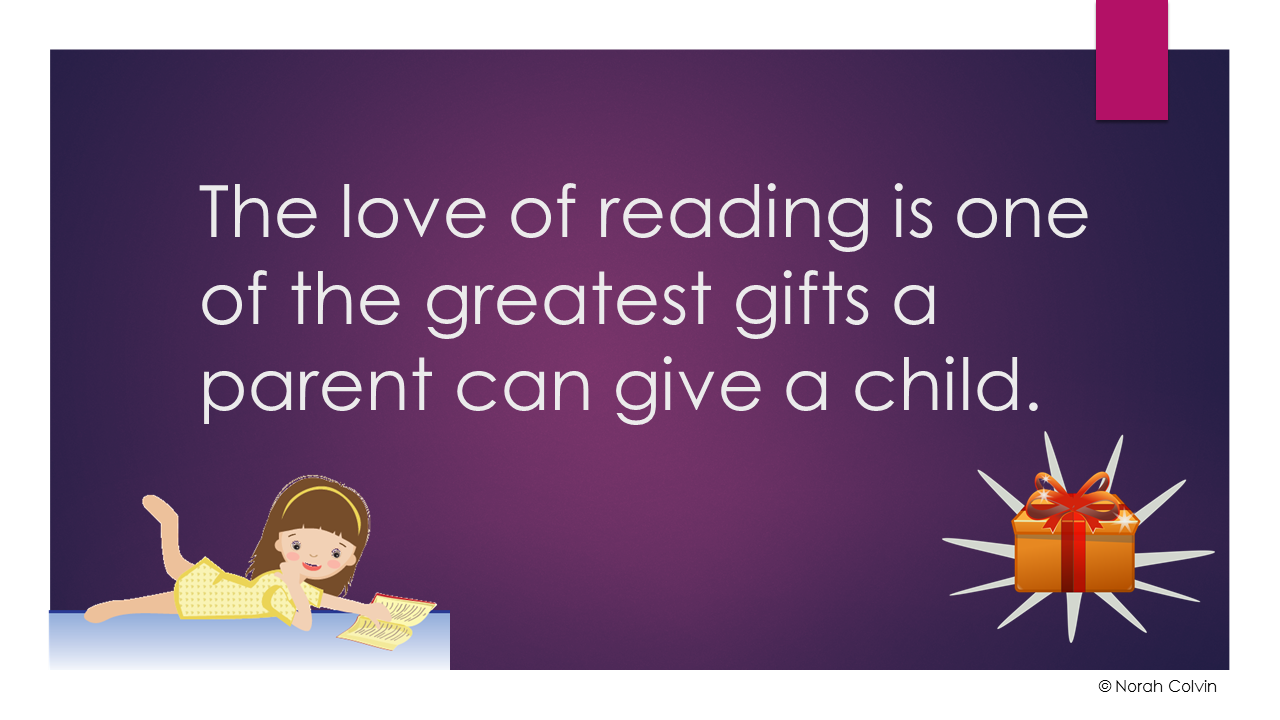
    Another thing that Mem and I have in common is our passion for literacy and our advocacy of reading to children every day. Mem’s book Reading Magic should be placed in the hands of every new parent along with a collection of picture books. I practice what I preach by giving a bundle of these as gifts to friends with newborns. I have written about that here. As well as Reading Magic, the bundle generally includes Where is the Green Sheep? and Ten Little Fingers and Ten Little Toes, among others. Nurturing a love of books and reading is one of the greatest gifts a parent can give a child.

    The love of reading is gift

    Below is a list of the Mem Fox books on my shelves at the moment (a few have mysteriously disappeared!) but the best way to check out Mem’s books is on her website here. While you are exploring her website, there is much else of value to discover, including suggestions for writers, teachers, parents, and children as well as other interesting information. Exploring Mem’s site is the best way of finding out about her wonderful books.

    Here are the ones I own, in addition to the three mentioned above (in no particular order), with links to further information about each title on Mem’s site and to information about the illustrator where possible:

    2015-09-19 11.05.48

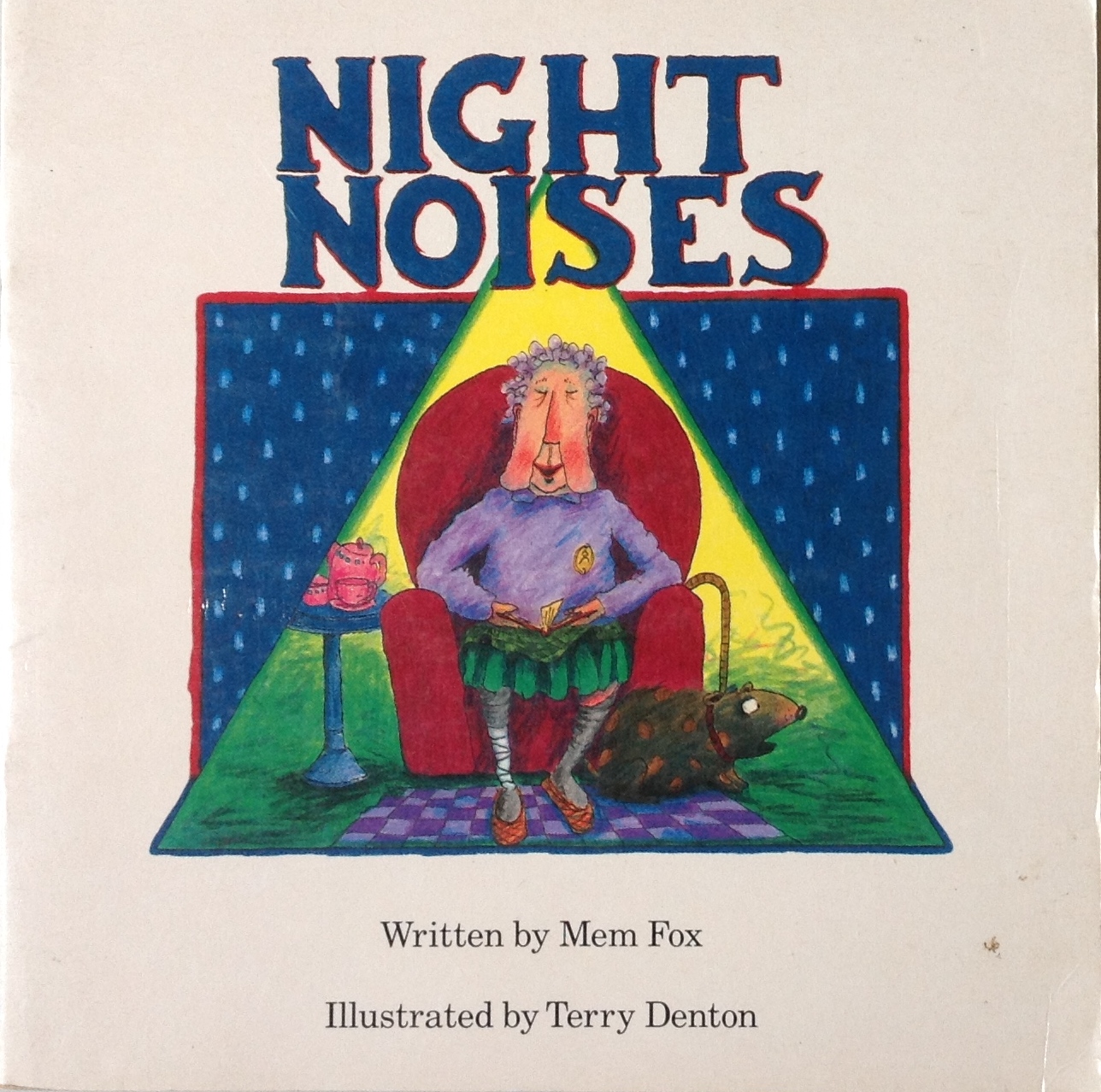
    Night Noises illustrated by Terry Denton

    2015-09-19 11.04.33

    Just like that (Now published as Harriet, You’ll Drive Me Wild!) illustrated by Kilmeny Niland

    2015-09-19 11.02.14

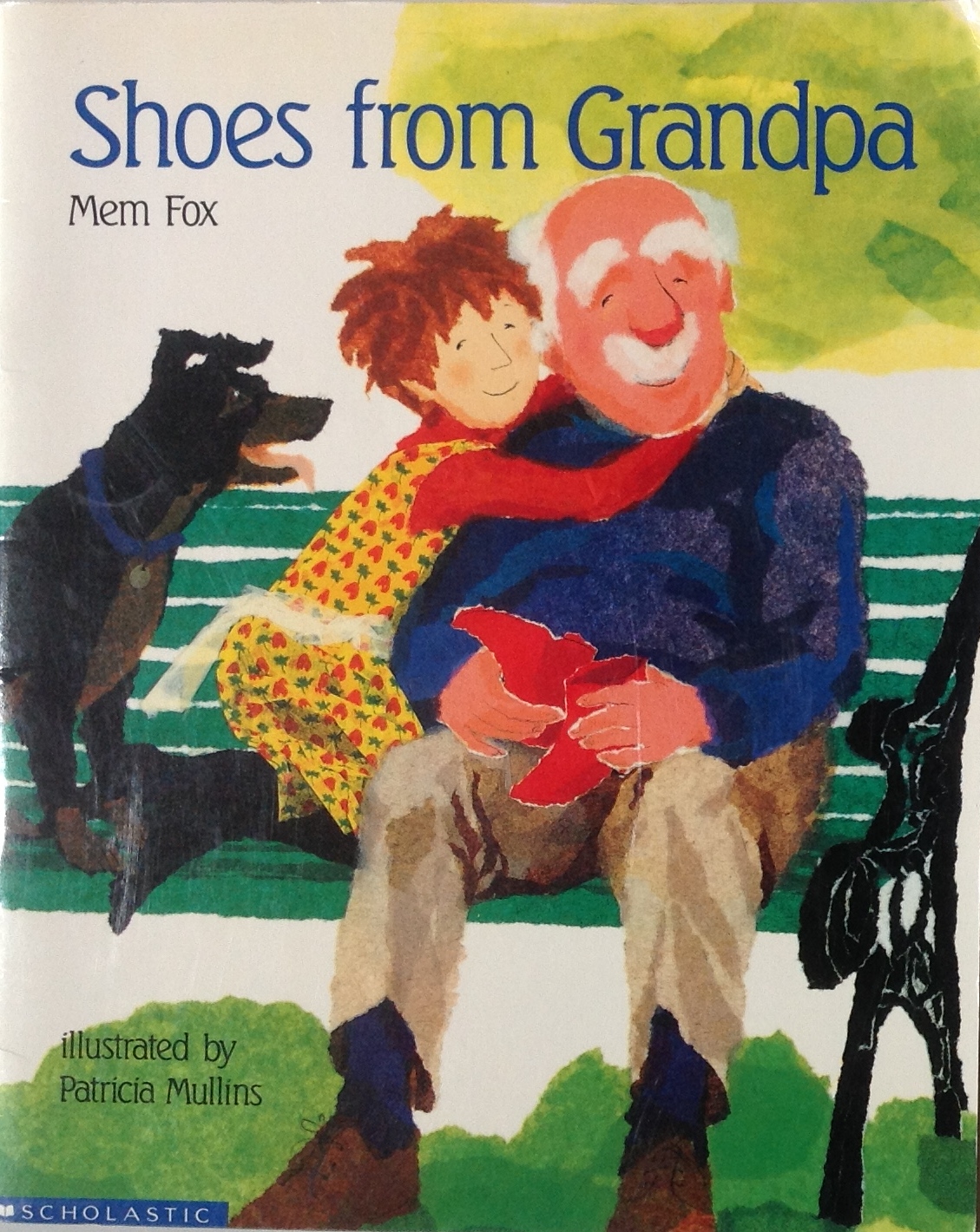
    Shoes from Grandpa illustrated by Patricia Mullins

    2015-09-19 10.56.05

    Hattie and the Fox illustrated by Patricia Mullins

    2015-09-19 11.03.31

    Guess What? illustrated by Vivienne Goodman

    Whoever you are.

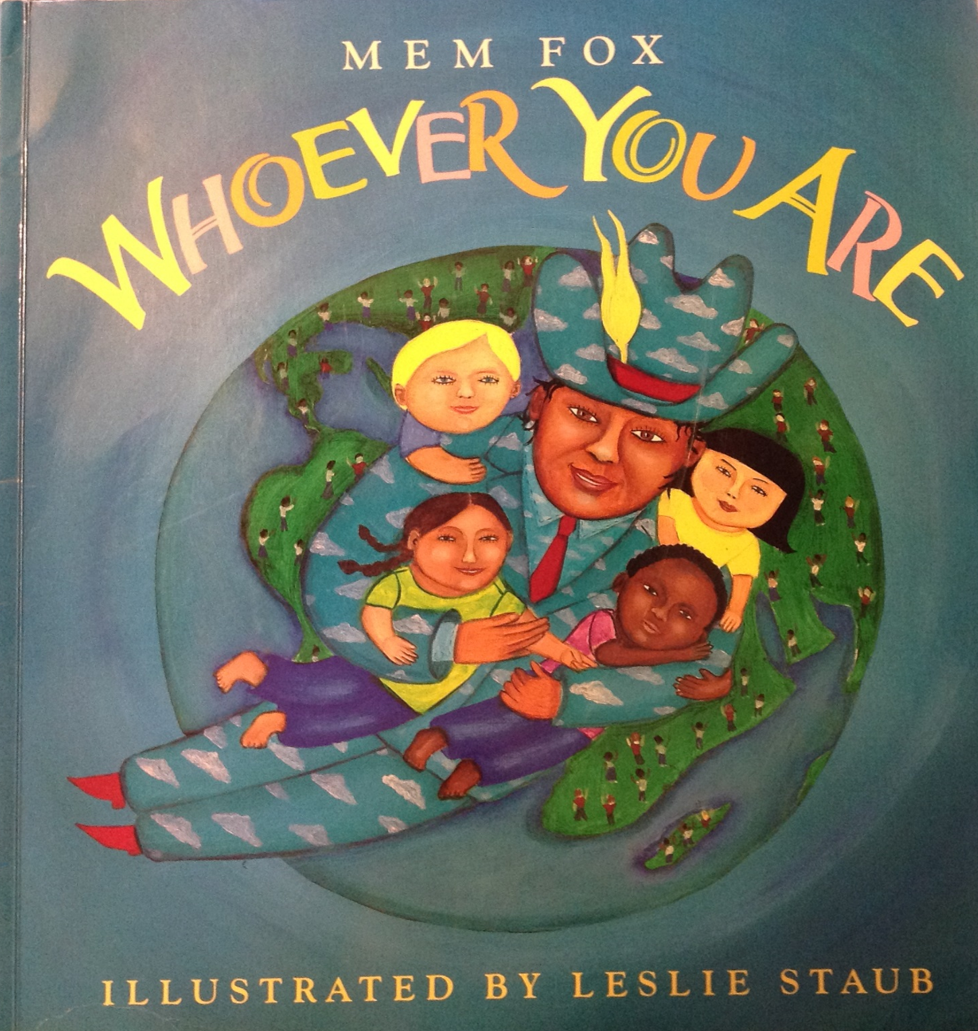
    Whoever You Are illustrated by Leslie Staub

    Wombat Divine

    Wombat Divine illustrated by Kerry Argent

    2015-09-19 11.00.26

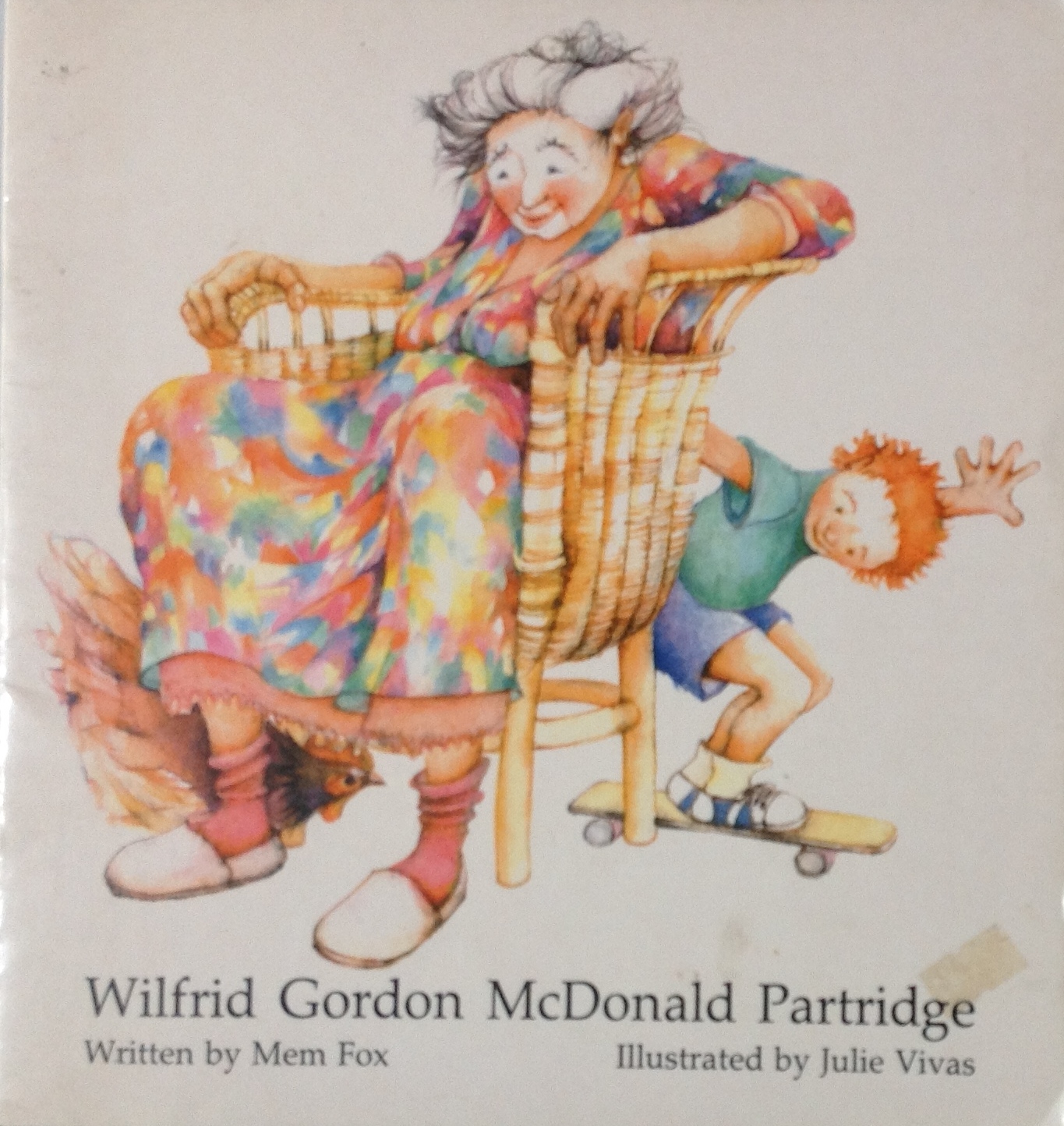
    Wilfred Gordon McDonald Partridge illustrated by Julie Vivas

    2015-09-19 10.58.22

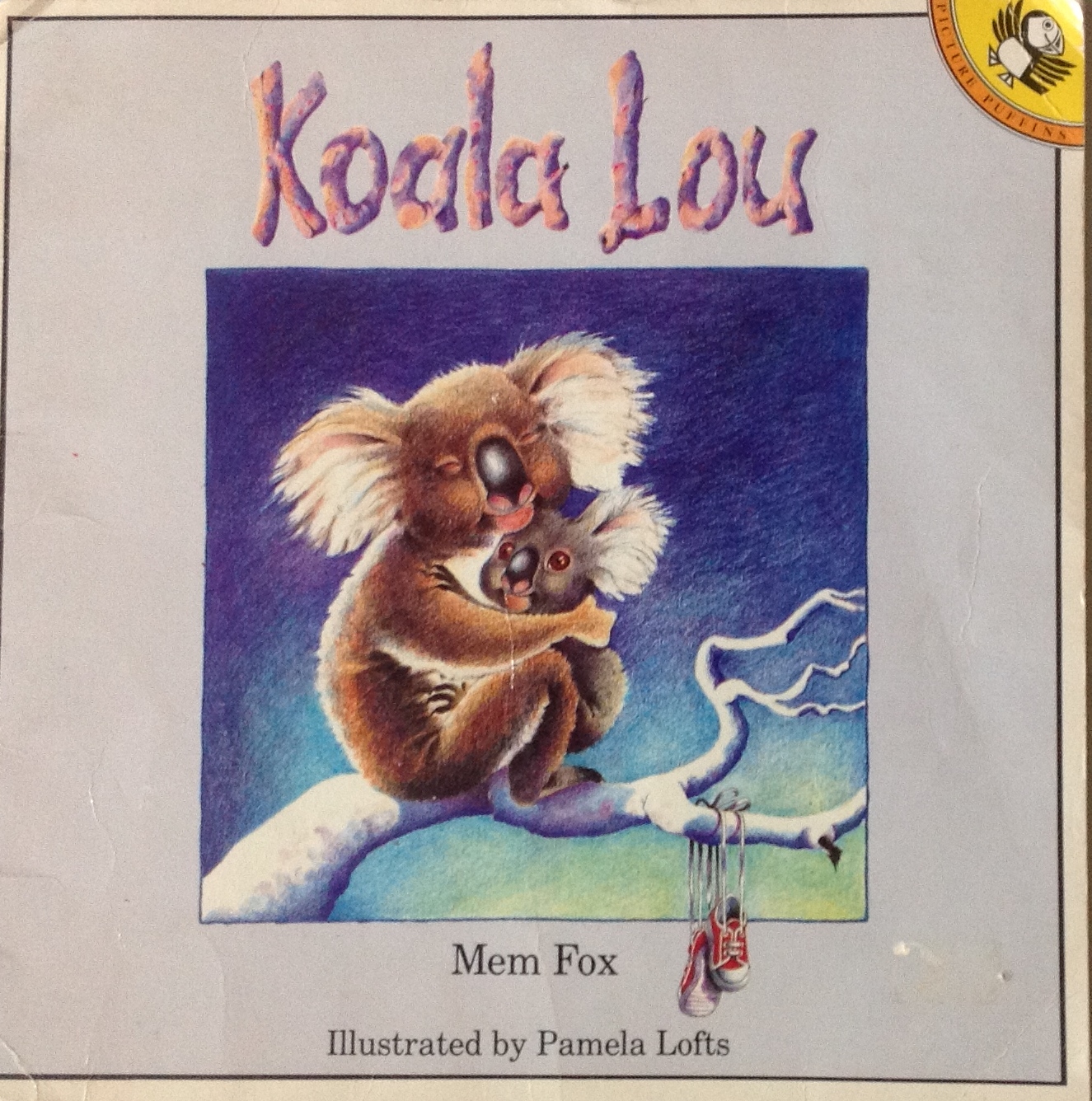
    Koala Lou illustrated by Pamela Lofts

    2015-09-19 10.59.08

    Sail Away illustrated by Pamela Lofts

    2015-09-19 11.02.52

    A Particular Cow illustrated by Terry Denton


    Thank you

    Thank you for reading. I hope you have found something of interest. I appreciate your feedback. Please share your thoughts.


  • A celebration of Australian picture books #1

    Recently my friend Sarah Brentyn, who blogs at Lemon Shark: Navigating the Unchartered Waters of Parenting and Life, shared a series of posts about first lines (paragraphs, sentences and pages). She discussed the importance of hooking the reader and shared some of her favourite first lines from a variety of genres. When she shared picture books I was inspired to share some by our many wonderful Australian authors and illustrators.

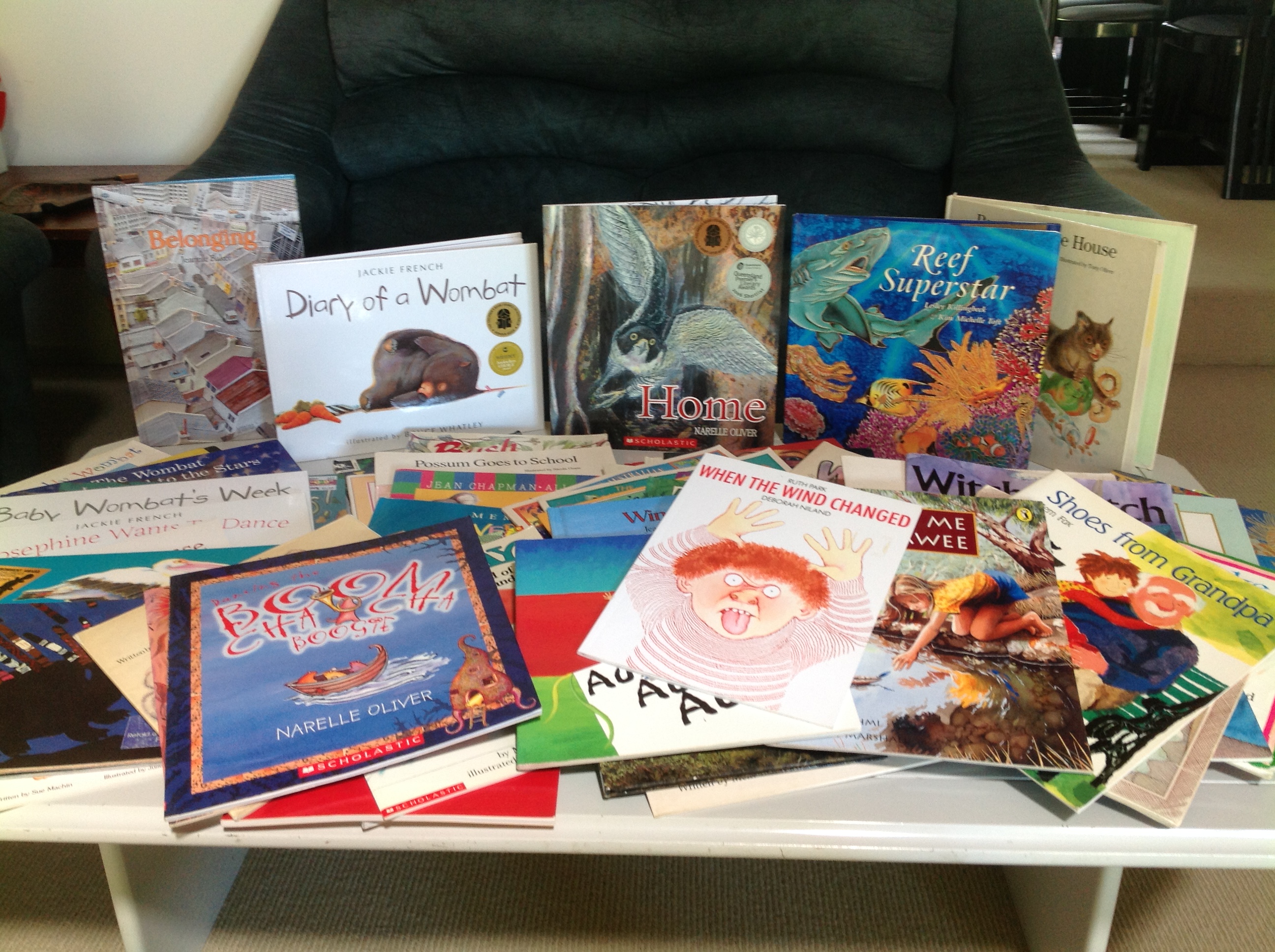
    These are just some of the Australian picture books I quickly located on my shelves:

    Australian picture books

    I own multiple titles of some authors’ work, and of others’ I own but one or two. Sadly, there are many whose work I don’t own. There are too many wonderful books to share in just one post so I have decided to write a series with a post dedicated to each author of whose work I own multiple titles, including Mem Fox, Narelle Oliver, Jeannie Baker and Kim Michelle Toft (and I might sneak in New Zealander Pamela Allen).

    In this post I share some lovely books, their first lines (according to Sarah’s definition) and tell you a little about why they are on my shelves.

    For this series I have commandeered “celebration” as a collective noun for Australian picture books so it is fitting that the first I share is A Compendium of Collective Nouns by Jennifer Skelly.

    A Compendium of Collective Nouns

    This delightful little book was a gift from my grandchildren (chosen by their mother). In the introduction Jennifer asks, “Do you remember laughing when you first learned that a group of crows is called a murder? Or a group of owls is called a parliament?” Like me, Jennifer has always been interested in collective nouns but, unlike me, she has published a collection of them. Her beautiful drawings illustrate collections such as “a crash of rhinoceroses”, “a flamboyance of flamingos” and “a wisdom of wombats”, but who ever heard of “a rabble of butterflies”?

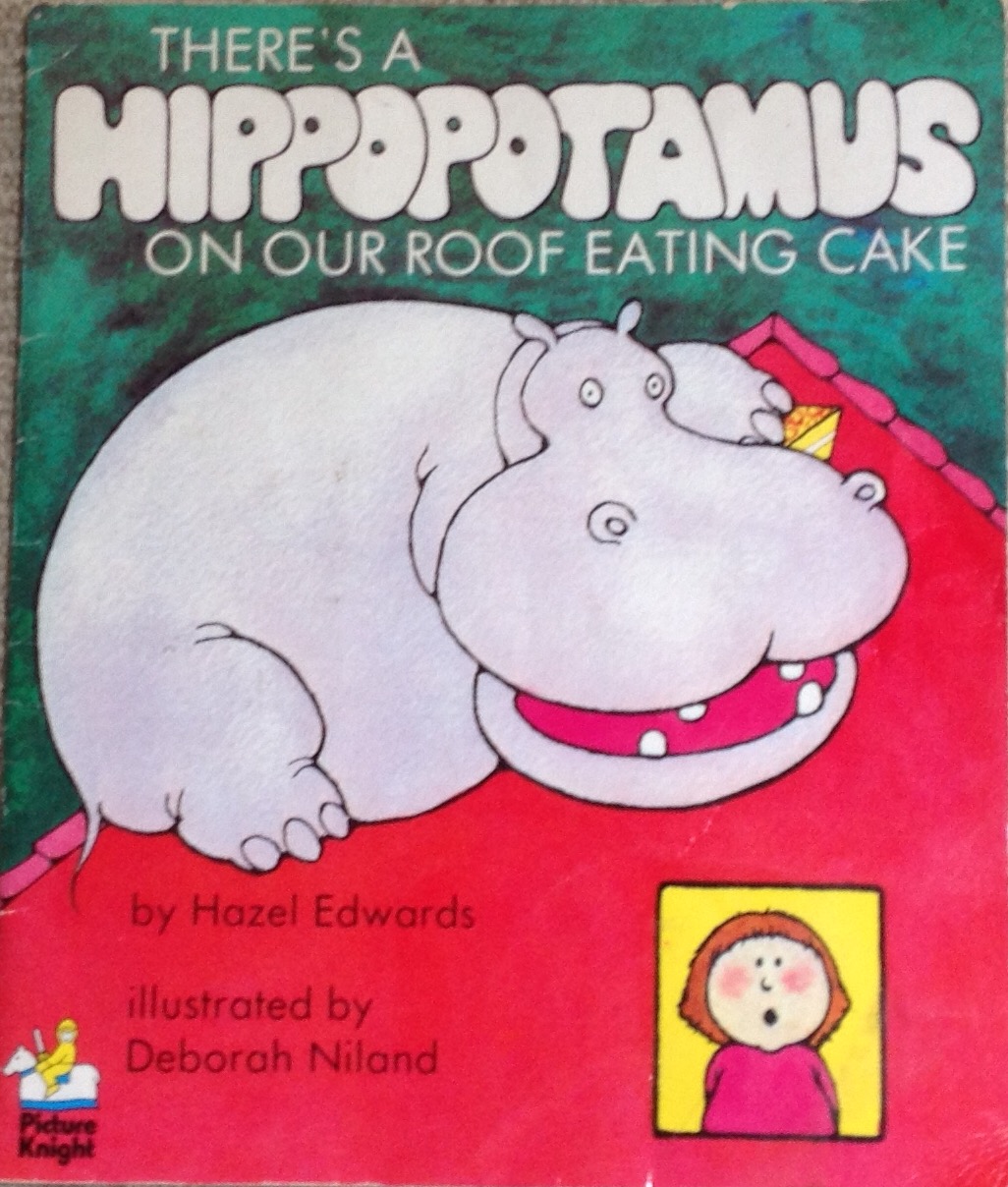
    While there are a number of Hippopotamus on the Roof books I have only the original, There’s a Hippopotamus on our Roof Eating Cake by Hazel Edwards (illustrated by Deborah Niland).

    There's a Hippopotamus on the Roof Eating Cake

    It begins,

    “Our roof leaks.

    Drip!

    Drip!

    Drip!

    My Daddy says there’s a hole in our roof.

    I know why there’s a hole.

    There’s a hippopotamus on our roof eating cake.”

    The copy on my shelf actually belongs to Bec. Her dad bought it for her on a trip back home to Belfast in 1990. He went all the way to Belfast and brought her back an Australian picture book! A good one though.

    In this video Hazel Edward talks about the original idea for the book, other contributing ideas and changes as well as the the important relationship between author and reader. She also reads the book.

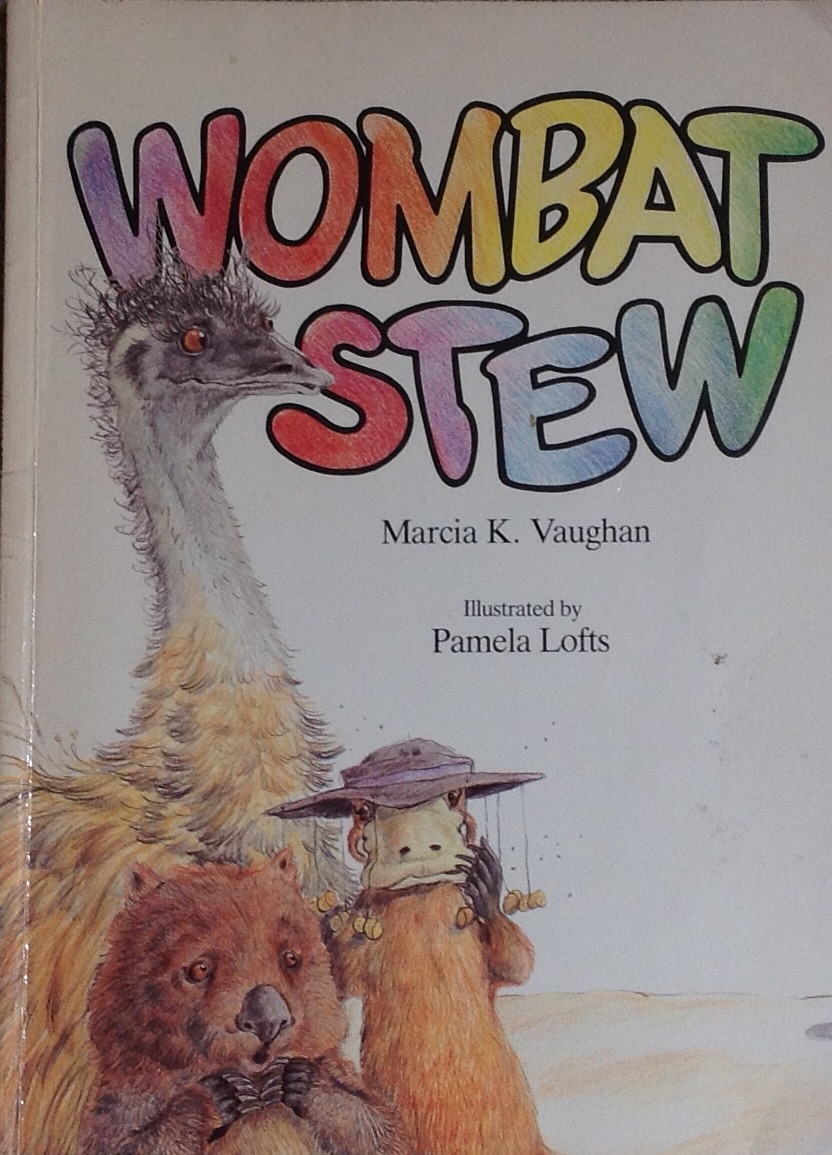
    Wombat Stew by Marcia K. Vaughan (illustrated by Pamela Lofts) is a favourite.

    Wombat Stew

    It begins,

    “One day, on the banks of a billabong, a very clever dingo caught a wombat …

    and decided to make  …

    Wombat stew,

    Wombat stew,

    Gooey, brewy,

    Yummy, chewy,

    Wombat stew!”

    The amusing story tells how the animals trick the dingo and save wombat from his fate. It is a great book to read aloud with its rhythmic language and repetition of the song “Wombat stew” with slight word changes each time. Children enthusiastically join in with the reading and love acting it out. One year I wrote a play with my year one class and they performed it for the school and their parents. It was a lot of fun.

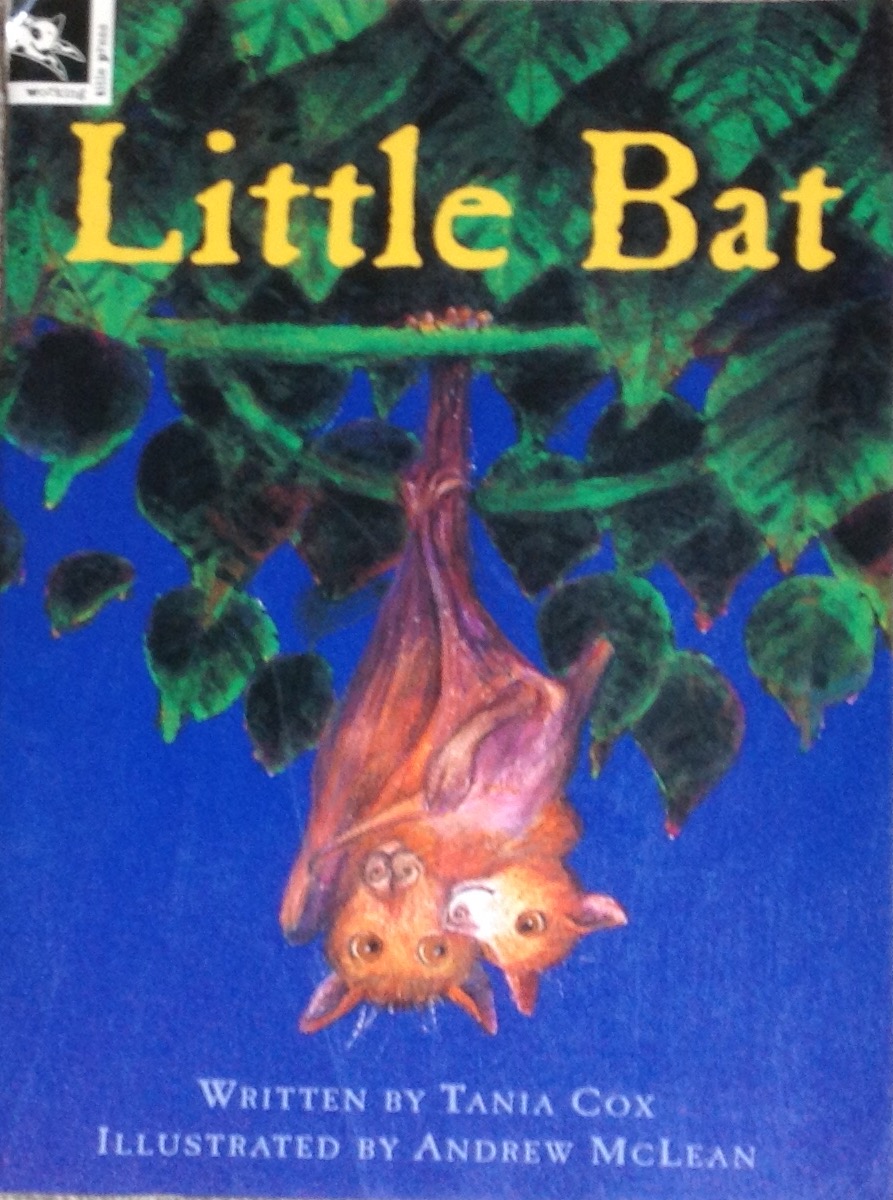
    Little Bat

    Little Bat by Tania Cox (illustrated by Andrew McLean) begins

    “Little Bat was nervous.

    She’d never done this before.”

    With the encouragement of her mother and other animal friends, Little Bat discovers that she can fly. I like the story’s positive message that if you try you can succeed. Books with this theme were always popular and inspired lots of discussion in my classroom.

    When I saw When the Wind Changed by Ruth Park (illustrated by Deborah Niland) in a bookstore, I had to have it for my bookshelf! When I was a child I, like Josh, must have been good at making faces, because my mother was always telling me that if the wind changed I’d stay like that. Well, I don’t think that happened to me, but it did to Josh! The book begins

    “There was this boy named Josh.

    He could do lots of things.

    There was one thing he could do best of all.

    He could make faces.”

    Of course one day the inevitable happens! Fortunately the story has a happy ending, for Josh anyway – I’m not so sure about Dad!

    Are you familiar with any of these books? Have you seen them in bookstores near you? What books by Australian authors have you read?

    Thank you

    Thank you for reading. I appreciate your feedback. Please share your thoughts.


  • I’m new here

    Australia is a land of immigrants. The first Australians arrived, it seems, about 65 000 to 40 000 years ago, after the second migration out of Africa. The second group arrived only little more than 200 years ago. Some think of Australia as a young country with a history beginning with arrival of Europeans in 1788. But Australia is not only the oldest continent, it is also home to the oldest living culture and was inhabited long before many other parts of the world. It is a tragedy that little recognition and respect is given to this culture and its peoples.

    Disharmony and conflict, on a scale from the personal to global, often occurs because of perceived differences: “He’s not like me. She doesn’t think like me. They don’t believe what we believe. I am right and you are wrong.” The realisation that what we share in common far outweighs the differences, and the appreciation of those similarities and differences, would go a long way to soothing that discord.

    The National Geographic Genographic Project aims to find out more of our collective human history; where we originated and how we came to populate the world. Projects such as this may help to strengthen the focus on what we share rather than ways in which we differ.

    Young children are generally accepting of differences they may notice in each other and are usually more concerned about having someone to play with than about visible differences.  Fear of and discomfort with differences is often learned.

    https://openclipart.org/image/800px/svg_to_png/192642/Children_holding_hands.png
    https://openclipart.org/image/800px/svg_to_png/192642/Children_holding_hands.png

    Mostly my classrooms were a microcosm reflecting the rich diversity of cultural heritages represented in Australia. Learning about those heritages from the children and their families, as well as through literature and other media, helped us all develop an appreciation for our differences as well as our commonalities.

    The celebrations of International Days when children would wear traditional clothing, bring items from home to display and discuss, contribute cultural food to a shared lunch, teach how to play traditional games or share traditional stories were always appreciated by the children and families; including those who considered themselves to have a cultural background and those who didn’t.


    http://pixabay.com/en/diversity-ethnic-global-literature-154704/
    http://pixabay.com/en/diversity-ethnic-global-literature-154704/

    Units of work, such as my Getting to know you — Early childhood history unit, learning to greet each other in the languages represented in the class, reading traditional tales and discovering each other’s favourites of anything also contribute to developing understanding and empathy.

    Whoever you are.

    Whoever You Are by Mem Fox is a wonderful picture book which can be used to discuss similar themes. It explains in a simple and beautiful way that although children around the world may live in different houses, wear different clothes or eat different foods, for example ‘inside, their hearts are just like yours.’ Mem Fox explains the story on her website.

    I have drawn upon the ideas discussed above for my flash fiction response to this week’s challenge by Charli Mills at the Carrot Ranch to In 99 words (no more, no less) write a story that shows the interaction of a migrant culture on the place of migration.

    Playground connections

    The adults dotted the perimeter, holding tight to their own; bound by the security of sameness reflected in their own eyes, excluded by fear felt for differences perceived in others: different dress and hair, unintelligible words and unfamiliar scents.

    In the centre the children romped together, united in the secret language of smiles and laughter, funny looks and gentle patting hands; no words needed.

    The children smiled, waving promises of future plays, as one by one the adults called them home, delighting in their children’s easy ways, wishing for their own nonprejudicial days. A nod. A smile. A beginning.

    Recently I found this quote on Yvonne Spence’s post in 1000 Voices for Compassion. I think it sums up the intentions of this post  beautifully.

    we are together


    Thank you

    Thank you for reading. I appreciate your feedback. Please share your thoughts about any aspect of this post or flash fiction.


  • Sugar and Snails: On friendship, fact and fiction

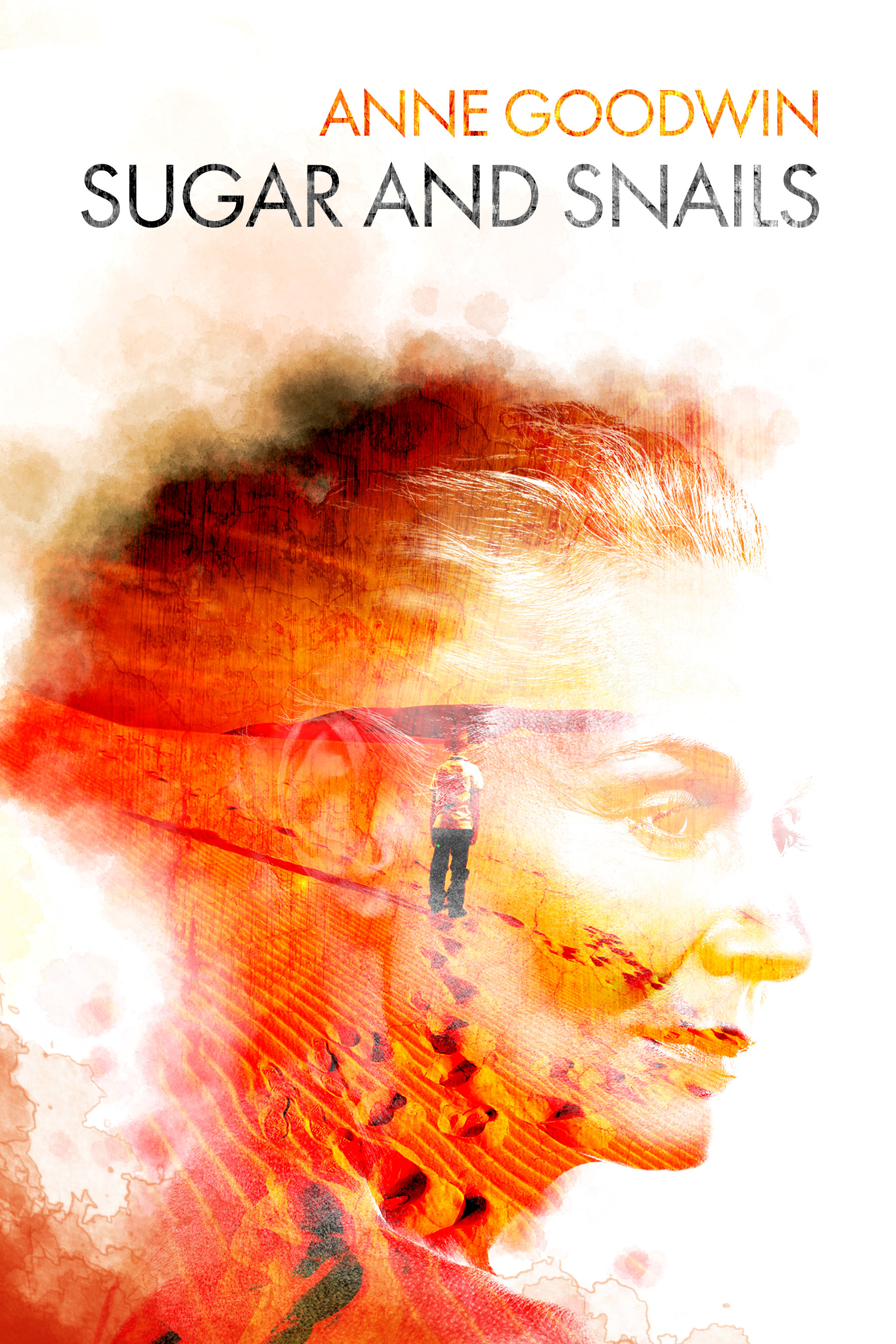
    sugar-and-snails cover

    In this post I am very excited to introduce Anne Goodwin sharing tidbits from her debut novel Sugar and Snails, published just last week by Inspired Quill. It is already receiving rave reviews and I am happy to add my voice to those in praise of it.

    Anne and I have been friends for the best part of two years. I can’t quite remember just how we met but I do remember it was on Twitter and that we hit it off almost immediately. I followed up one of our Twitter conversations with a post and we haven’t looked back. We have enjoyed many wonderful discussions on each of our blogs, and the blogs of others. With Anne’s background in psychology and mine in education there is considerable opportunity for a meeting, as well as divergence, of minds.  I learn from her, I think, as much as she learns from me. Or should that be the other way round?

    On her blog Annecdotal Anne shares reviews of novels she has read and her thoughts about and understanding of the writing process. I have read some of Anne’s recommendations, including “The Examined Life” by Stephen Grosz, which stimulated a great discussion on my blog, including a first guest post by Anne.

    Anne is also a fabulous teller of short stories with over sixty published either online or in print. I must confess I have not yet read all of Anne’s stories but have thoroughly enjoyed each I have read. I think she has a gift for a surprise ending, though she does not employ the technique in every story.  Her style is easy to read with a natural flow of language. Her portrayal of characters shows a depth of understanding that may be attributed to her background in psychology, but the variety of settings and topics displays a much broader understanding of the human condition in different environments and from different cultural backgrounds.

    It is my great pleasure to hand this post over to Anne.
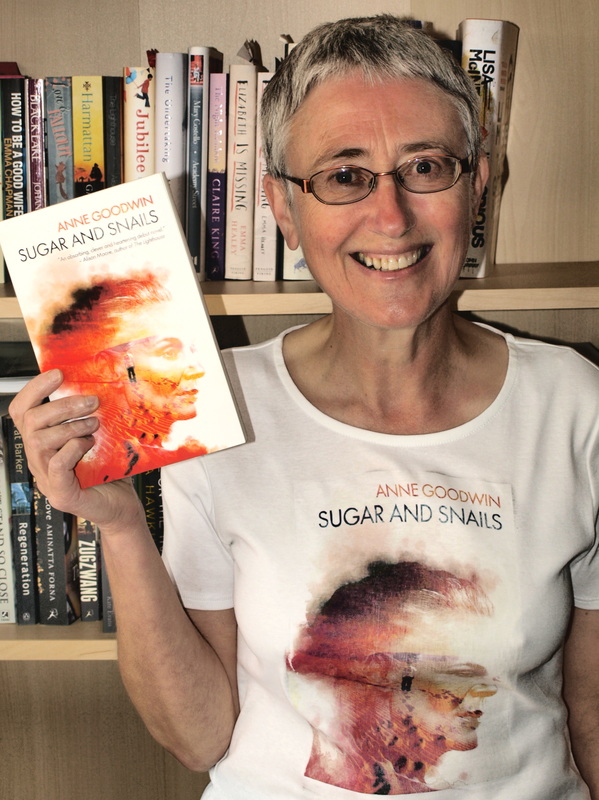
    Anne

    Anne Goodwin: On friendship, fact and fiction

    The year I turned fifty, I wanted to do something special, but a party really wasn’t my thing. Instead, I celebrated with a long distance walk: 190 miles across northern England from the west coast to the east. As the route begins only a few miles from where I grew up, I took the opportunity to meet up with a bunch of old school friends the evening before I set off.

    About a dozen of us got together for a meal in the pub we used to frequent after school. I’d kept in sporadic touch with a few of the women over the years, but some I hadn’t seen since I was fifteen. Although there was some lively conversation, I spent a lot of the time sitting staring, overwhelmed by how I could detect within these middle-aged faces the teenagers they’d once been, and the pleasure of being back among them.

    After hiking across three national parks, meeting up with various friends and family along the way, I reached my destination at Robin Hood’s Bay, exhausted and exuberant. Back home, with a couple of days free before returning to work, I began writing the novel that was to become Sugar and Snails.

    Like many writers, I’m an introvert. I relish my time alone. I need to be able to withdraw into the privacy of my own mind to reboot. But friendship is important to me as well. Those two and a bit weeks of reconnecting with old friends served as a reminder of that, and also that, in the right form, sociability can revitalise me too. It felt so important I dedicated my novel to the coast-to-coasters and old school friends.

    Yet it wasn’t until very recently that I realised that my novel was itself a celebration of friendship. Of course I’d given my main character friends but, in my head, I didn’t distinguish them from other people who drive the plot forward: a troubled student; her difficult boss; the social worker who found her a place at boarding school at fifteen. Maybe, because Diana herself doesn’t fully trust her friends, I wasn’t able to appreciate them either.

    Two of her friends are crucial to the story and, although they never meet, they are brought together strongly in Diana’s mind early on. Attending a dinner party to mark the forty-fifth birthday of her best friend, Venus Najibullah, Diana is asked to pop upstairs to tell Venus’s daughter a bedtime story. In response to the seven-year-old’s insistence on a story about “when you were a little girl going on adventures”, Diana finds herself lost in the memories of Geraldine Finch “the girl who ruled my childhood”.

    As with many childhood friendships, Diana recalls an intense connection with Geraldine as the pair absorbed themselves in dressing up for role-play games. But as they approached their teens, Geraldine proved fickle, neglecting her playmate in favour of other friends, unless there was something she wanted. The friendship ends abruptly in what appears to be a betrayal, followed by Diana’s departure for boarding school a few months later. But it would be premature to regard this strand of the novel as about the dark side of female friendship. From the vantage point of adulthood, Diana might come to view this childhood friendship differently, just as the reader might gain a different perspective on learning more about the character of Diana.

    Meeting for the first time aged eighteen, Diana is somewhat intimidated by Venus until she discovers they have something in common:

    On my first Sunday night at university, I was en route from the bathroom to my study-bedroom in the student halls, clutching a damp towel and my quilted wash-bag to my chest like a shield. My gaze levelled at my fluffy primrose slippers peeping out from under the hem of my stripy galabeyah as I shuffled along the corridor. I didn’t notice the other girl until I’d almost bashed into her: tall, with a cascade of ebony hair and skin the colour of butterscotch.

    I made to move on, but the girl blocked my path, looking down her long nose at me from beneath heavy eyebrows: “You do realise that’s a man’s galabeyah you’re wearing?” Her voice was as haughty as the girls’ at Dorothea Beale, with an exotic lilt that brought to mind the rhythms of Cairo.

    No doubt I blushed. At boarding school I’d kept it hidden in my trunk. But university promised another chance and, besides, who was going to be able to tell the difference between a traditional Arab shift and an ordinary nightgown? Who, apart from this arrogant girl who was scrutinising me like I was an exhibit in the Egyptian Museum?

    I glanced down at the loose cotton gown I’d picked out with my dad at the Khan el Khalili three years before. “That’s what I like about it,” I told the girl. “A dress that’s meant for a man.”

    A wide smile softened her features. “Fair enough, although I prefer a dash of frill myself.” It was only then that I recognised her floor-length lilac robe as another galabeyah, trimmed with lace around the neckline, with pearl buttons where mine fastened with bobbles of cord. “I’m Venus Najibullah, by the way. Come back to my room and I’ll make you a coffee and you can tell me how an English girl came by such a thing already.”

    Yet, although they become close friends, and remain so for years, Diana can’t tell Venus the full story of her trip to Cairo, fearing rejection if she does. She’s become so accustomed to presenting a false self to the world, she genuinely wouldn’t know how to share the secret of her past. Over the course of the novel, she has to take a risk to discover whether she can trust Venus with a more authentic version of who she is.

    When Norah first offered me a guest slot on her blog, I thought I’d write something more closely tied in to the theme of learning. Yet when she showed me the draft of her lovely introduction, I knew this was the right way to go. To both give and receive friendship is something best learnt through experience but, to do so, we have to be prepared to take the risk of being rebuffed.

    Norah is a prime example of the wonderful new friends I’ve found through writing, and I’ve been especially touched by the support I’ve received from friends, old and new, online and off-line, as I publish my debut novel. Tonight I’ll be at the second of my book launch parties along with a few blog/Twitter friends I’ll be meeting in person for the first time. Norah can’t be there, but I’ll be conscious of her presence in spirit, as well as that of other dear friends from across the continents. A few of those “old school friends” to whom I have dedicated my novel will be there, however, closing the circle of friendship that is a central theme both of my novel and my journey to write it.

    Anne Goodwin author photo

    Anne Goodwin writes fiction, short and long, and blogs about reading and writing, with a peppering of psychology. Her debut novel, Sugar and Snails, was published last week by Inspired Quill. Catch up on her website: annethology or on Twitter @Annecdotist.

    blog tour week2


    Thank you, Anne, for sharing your thoughts. I am delighted  to join in the excitement of your publication celebrations. I have thoroughly enjoyed reading Sugar and Snails and am happy to recommend it to others.

    Thank you

    Thank you for reading. I appreciate your feedback. Please share your thoughts.


  • Are you game?

    This week at the Carrot Ranch Charli Mills is talking about childhood games and has challenged writers to In 99 words (no more, no less) write a story that involves a children’s game or rhyme. I think she chose this topic just for me. Thank you, Charli.

    I love games and am a strong believer in the use of games to enhance learning. I have memories of playing games that span my lifetime, from early childhood until the present, and have visions of playing games far into the future.

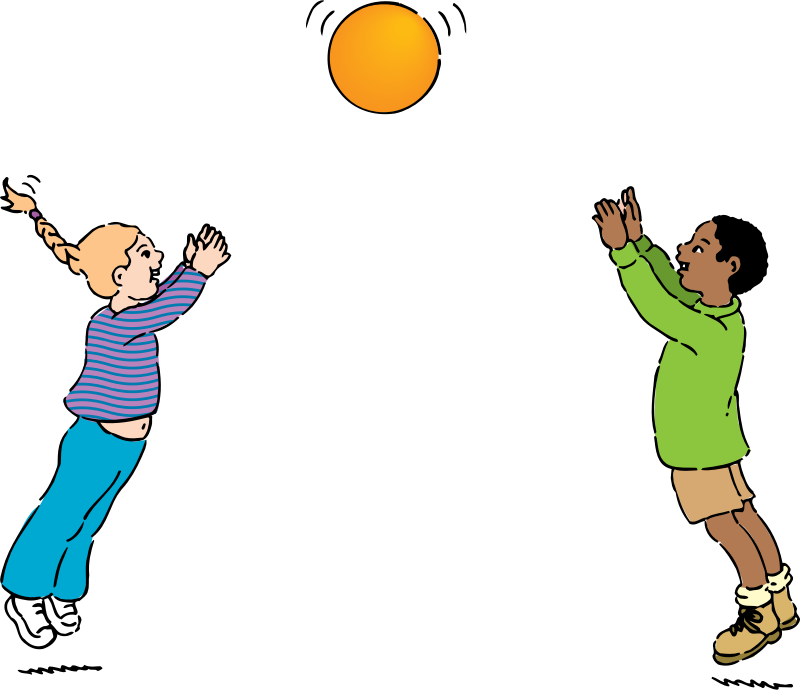
    Johnny Automatic, cartoon of a girl and boy playing with a ball https://openclipart.org/detail/721/playing-ball
    Johnny Automatic, cartoon of a girl and boy playing with a ball https://openclipart.org/detail/721/playing-ball

    One of my earliest memories of an organised game was of “Drop the hanky” played at a birthday party. I was about five years old at the time. I think that perhaps, until this event, I had only ever played imaginative games with my brothers and sisters. I was obviously not familiar with the rules or the ethos of the game. I’ll let my flash (non-) fiction explain.

    Plum pudding

    We sat in the circle chanting,

    “I wrote a letter to my love and on the way I dropped it.”

    “It” skipped around the outside, waving a handkerchief.

    “One of you has picked it up and put it in your pocket.

    Not you. Not you. Not y-o-u!”

    Suddenly “It” was running and children were scrabbling behind them.

    “Run,” they called.

    Then “It” was beside me.

    “Plum pudding!” they all screamed hysterically.

    The adult pointed to the centre of the circle. “We’ll have you for dessert,” he grinned.

    I cried, wondering what it would be like to be eaten alive!

    © Norah Colvin 2015
    © Norah Colvin 2015

    Obviously I was traumatised for the memory to be so vivid and almost nightmare-like since the memory ends abruptly with the fear. Obviously I wasn’t eaten for dessert, I survived the trauma and, to complete the fictional narrative, I guess you could say “I lived happily ever after.”

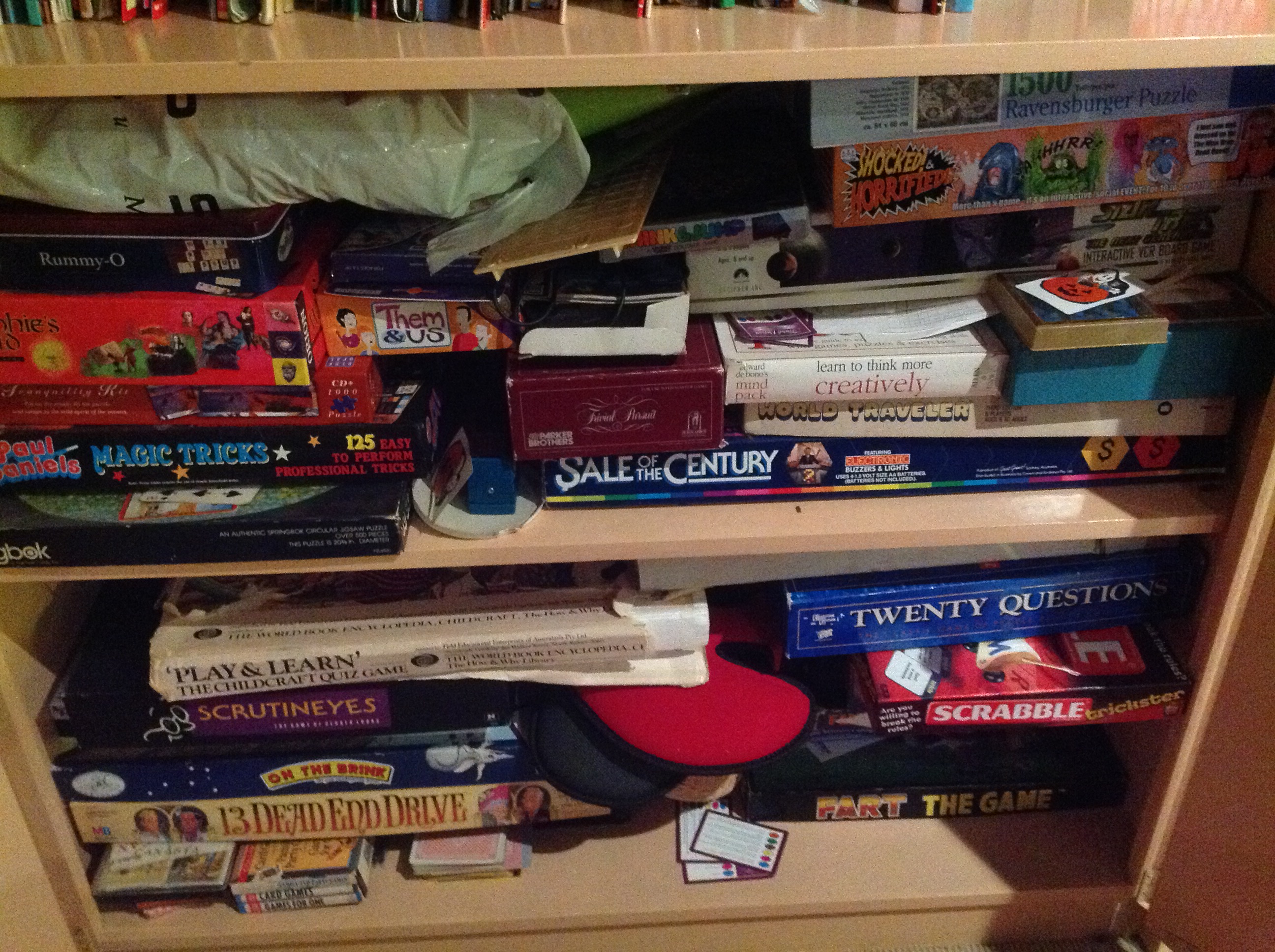
    But games don’t need to be traumatic. Games are better when they are fun; and I have many more memories of having fun with games than I do of being traumatised by them. Some of my “best” memories are of the laughs shared playing games like “Balderdash” and “Billionaire” when we (hub, son, daughter and partners) set aside traditional holidays for playing games together as a family. My house may have shelves laden with books, but they also have cupboards bursting with games.

    © Norah Colvin
    © Norah Colvin

    We didn’t always play purchased games. Sometimes we made up our own. It takes some skill in problem solving to think up a new game that will be fun to play with just the right amounts of challenge and competition, and an equal chance of “winning”, if there is a winner. Games without a winner, played for the fun of playing, are just as enjoyable.

    I have always included games in my class program. As well as being fun, if carefully chosen they can also progress learning. Games can be played at the beginning and conclusion of sessions; at transition times to reenergise, refocus and refresh; and as part of the teaching/learning program with whole class, small group or individual participation for targeting practice of particular concepts.

    One obvious benefit of playing games is the development of social skills such as:

    • Sharing
    • Taking turns
    • Cooperation
    • Dealing with competition
    • Accepting a loss
    • Accepting a win graciously

    In their book “A New Culture of Learning: Cultivating the Imagination for a World of Constant Change”, Douglas Thomas and John Seely Brown talk about ““arc of life” learning, which comprises the activities in our daily lives that keep us learning, growing and exploring.” They say, “Play, questioning, and — perhaps most important — imagination lie at the very heart of arc-of-life learning.”

    Throughout the book they talk about the importance of collaboration in engaging online in multi-player games and say that When understood properly . . . games may in fact be one of the best models for learning and knowing in the twenty-first century . . . Because if a game is good, you never play the same way twice.

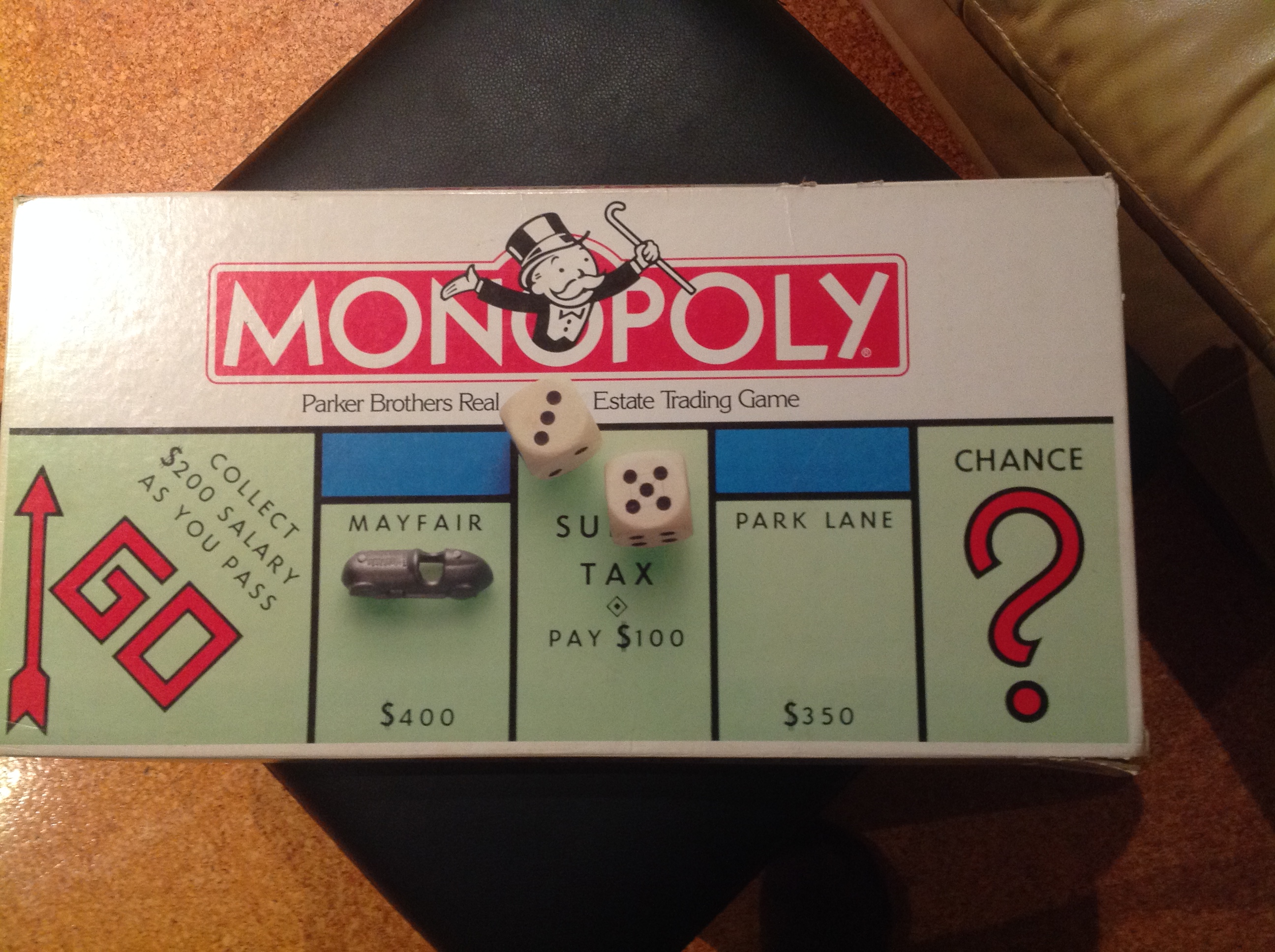
    monopoly

    Robert Kiyosaki in his book “Why “A” Students Work for “C” Students and Why “B” Students Work for the Government” talks about the importance of learning through games and explains how he learned, and was inspired to learn more, about finance from playing “Monopoly”. He says that Games are better teachers than teachers.” While I prefer to not agree with that statement in its entirety (I don’t even like playing Monopoly), I could understand his reasons for making it.

    Rarely a day would go by that at least one game wasn’t played in my classroom. We would play games in literacy groups that required children to read and think critically. We would play games in maths groups to practice skills in fun ways or to solve problems cooperatively. We would play games in science to try out ideas or research information. Some of the games involved physical as well as mental activity. Some were played with the entire class, and some on their own.

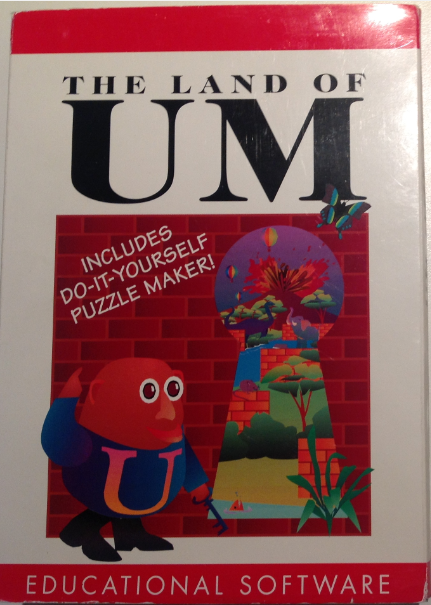
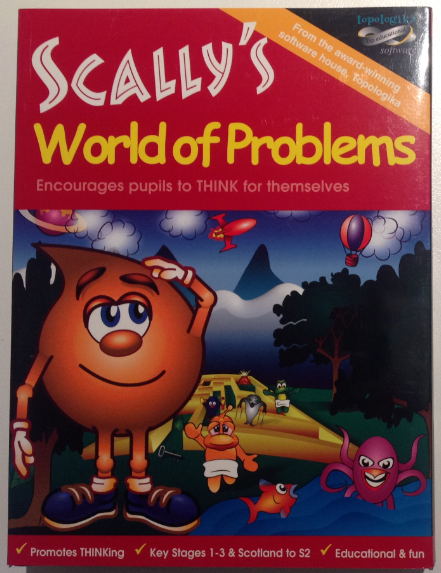
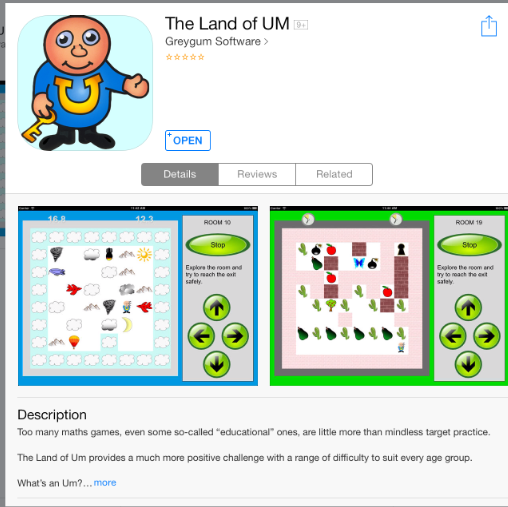
    One game we used in maths groups as well as an activity in the last few minutes of the day was a problem solving game that I was involved with from its inception, The Land of Um or, as it is known in the UK, Scally’s World of Problems. (Also available as an app.)

    http://www.greygum.com.au/nebula/index.php/the-land-of-um

    Scally


    When I was asked for an idea for a program, I suggested something that required children to explore to find out “what happens if” and “how things work”, much as they learn from their exploration of the “real world”. I also suggested that what they learn be consistent and apply at the next level. From that small seed and through the collaboration and synergy of a small group of creative people the “Land of Um” was born.

    Because, in my recollections anyway, it was “my” idea, I am very proud of “Um” and enthusiastic about its potential to encourage children to develop the thinking skills involved in solving problems.

    Um app

    In my class the children worked enthusiastically and collaboratively in small groups on an interactive whiteboard, taking turns to control the “Um” while working together to find the solution to each puzzle. As the level of difficulty increased the children needed to plan ahead, to visualise steps and predict what would happen and the effects of different actions. At each new level and in each new world, while the basics remained consistent, there was always something different to learn and explore. The children never tired of the using the program and were always eager to be the one to suggest the solution to the next problem. It was/is a joy to know that I had a part to play in the design of this program that has so many benefits to learners, not least of which is the fun of working together to solve problems.

    How significant are games in your life? What special memories do you have?

    If you are interested, there are many more stories about games to read on Charli’s blog.

    Thank you

    Thank you for reading. I appreciate your feedback. Please share your thoughts on any aspect of this post or flash fiction.


  • A garden party

    www.openclipart.org
    http://www.openclipart.org

    The purposes of education are many; but perhaps one important purpose of “free” public schooling is to ensure that everyone is provided with the opportunity of being educated. While this goal is achieved to a certain extent, inequalities of opportunity still exist, many of which are related to socioeconomic status (SES).

    letter from Camus

    While there is no doubt that a teacher can have a powerful effect upon the lives of students and any teacher would love to receive a letter such as that written by Albert Camus, socioeconomic status is often considered to be the most reliable predictor of success in school and, therefore, in life. There are many reasons for this, few of which have anything to do with intelligence.

    www.openclipart.com
    http://www.openclipart.com

    According to Macquarie University the majority of students in tertiary education are of mid to high socioeconomic status. The parents of these students may have professional backgrounds and may have attended tertiary institutions themselves.  Most have an appreciation of the benefits of higher education and are able to continue supporting their students, to some extent, while they study.

    While students of lower SES are attending tertiary institutions in greater numbers they are disadvantaged in doing so by a number of factors, primarily financial in origin. Although Australia is supposedly free of class distinctions, attitudes towards those from lower SES areas are often demeaning and unsympathetic. Students from these areas may battle to develop the self-esteem that seems to be a birthright for others from more privileged backgrounds. The negativism with which they are viewed, and some come to view themselves, can become a self-fulfilling prophecy.

    Ready for school - year 2
    Ready for school – year 2

    I was a fortunate one for, while I grew up in a family with low SES background, my parents saw the value in education and sacrificed much for their children to have the opportunities it provided. The high costs of tertiary education that are now incurred could not have been afforded, but I achieved well enough in school to obtain a scholarship to teachers’ college and a three-year bond (guaranteed employment) when that was finished.

    Nowadays there is no such thing as guaranteed employment and few scholarships. Many families cannot afford to have post-secondary/adult students continue to live at home and not contribute to expenses while they undertake further study. This means that students have the additional burden of working while they are studying. Many opt out of study altogether to seek long term employment, often in low paying jobs with little opportunity for advancement. And so the cycle continues. The lack of permanent employment even for graduates makes deferring earnings less desirable again.

    caravan

    Of course the disadvantage doesn’t just begin when approaching final years of school. The impacts can be observed from the earliest age. (My suggestion for an early learning caravan addresses this in part.) Although education is provided “free” to students, there are many other associated costs that families may struggle to meet, such as books, equipment, and extra-curricular activities such as excursions and incursions.

    In most Australian schools, the wearing of uniforms helps to minimize differences that may otherwise be obvious by choices of clothing and footwear. It also helps to reduce costs. Sometimes additional activities can be a drain on family expenses, and while many schools will fund expenses for those in need, not all families are willing to ask for that help.

    DCF 1.0

    Studies have shown that many children arrive at school without having eaten breakfast. While this phenomenon can occur in any family, it is more prevalent in low SES areas. Some schools are now providing a healthy breakfast for students when they arrive at school. I think this great as hungry children tend to have difficulty concentrating and learning, are often lethargic and may suffer from mood swings and negative attitudes. I know how irritated I become when I am hungry. My family “joke” about not getting in the way of me and my food! How much worse for children who come to school with empty bellies.

    Of course these issues are compounded for children who live in dysfunctional families. As much as we may try to be inclusive and equitable in the way we treat them, these students are often the ones who notice their differences and inadequacies and become most self-critical. It can be a very difficult task to change the attitudes and habits of generations.

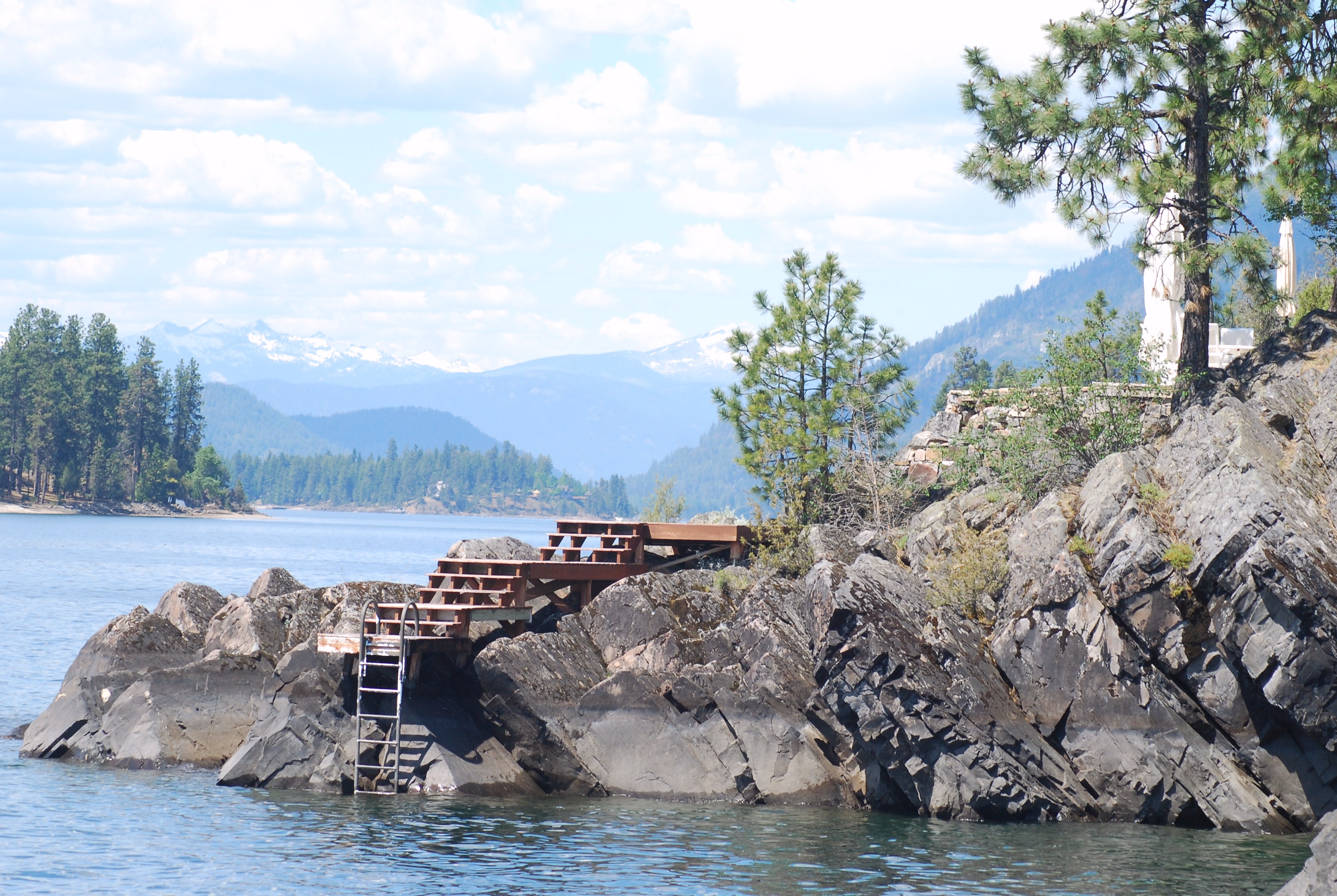
    This week at the Carrot Ranch Charli Mills talked about attending a garden party. The hosts and guests at this party had obviously enjoyed some of the finer things that life reserves for a few.

    lake-pend-oreile-cruise-may-21-31

    Charli shared a photo of a rather idyllic spot on an island and challenged writers to In 99 words (no more, no less) write a story, using the above photo as a prompt.

    Well the photo is beautiful, but I couldn’t get away, I was stuck at the garden party. I thought it was a wonderful analogy for the rewards that can be had from an education; rewards that may be obvious and perhaps available to many, but rewards that may be out of reach to others because of circumstances over which they have no real control. I thought of Marnie who suffers the double disadvantage of a dysfunctional family in a low SES area; but who knows there is something better out there and wants it for herself.

    Thanks to Charli for her prompt, here is another episode from Marnie’s life. I hope you enjoy it.

    The garden party

    Marnie’s face pressed into the bars of the tall white gate with amazement: white-covered tables laden with food; chairs with white bows; white streamers and balloons; and a band!

    But the ladies had her spellbound with elegant dresses and high, high heels; flowers in their hair and bright painted lips.

    A man in uniform opened the gate to guests arriving in limousines. Marnie followed.

    “Not you, Miss,” said the uniformed man.

    Marnie held out her invitation, “Jasmine . . .”

    But he’d closed the gate and turned away.

    Marnie looked down at her stained dress. What was she thinking?

    Thank you

    Thank you for reading. I appreciate your feedback. Please share your thoughts about any aspect of this post or flash fiction.

  • How important is it, if it can’t be tested?

    A+

    This week, all across Australia, students in years 3, 5, 7 and 9 took part in the National Assessment Program NAPLAN.

    In previous posts I have questioned the purpose of this type of assessment, the importance placed upon the results, and the undue stress caused to students, teachers and families. You can read some of my thoughts here, here and here for starters.

    Of course I am not the only one questioning, and Australia is not the only country in which nation-wide testing is set, and questioned. The tests are no more popular in the US with many students opting out. Diane Ravitch does much to raise awareness of the issues on her blog. Concerns are also raised in the UK, and no doubt elsewhere.

    However sometimes something good can arise where it is least expected. Out of the melee of the testing environment this week came a wonderful letter written to students by teachers who know that there is more to each one than the score on a test. A parent of one of the students posted the letter on Facebook and it went viral. The story was picked up by a variety of media outlets.

    I congratulate the teachers for writing and distributing the letter. I couldn’t have said it better myself.

    Check it out on Facebook here, or read some of the media reports:

    ABC Brisbane

    Daily Mail UK

    The Independent UK

    A similar letter went viral in the UK last year, and according the ABC article, the letter was based on one written to students in the US a number of years ago. I don’t think the message can be repeated often enough.

    Maybe it is one thing to tell the students, but how do we get the policy makers first to listen and then to act?

    Perhaps they should have a listen to the discussion by Tim and Debbie, one of my favourite pieces from the 80’s.

    Actually, in relation to the letter, I was looking for one of my favourite quotes by Tim but sadly couldn’t find it. He says, “My thoughts exactly. I would have said it if I’d thought of it!”

    Thank you

    Thank you for reading.

    I appreciate your feedback. Please share your thoughts.

  • #1000Speak for Compassion

    #1000Speak for Compassion

    Today is the day that over 1000 bloggers have answered the call to unite in dedicating a post to and voicing an awareness of the need for compassion. The call is to “flood the blogosphere with good”. I am adding my voice to the number.

    In my most recent post Who cares anyway? I linked to a TED talk by Joan Halifax.

    In her talk Halifax explains that compassion is good for us, it enlivens us and makes us resilient, it also develops our immunity. She asks “if compassion is so good for us, I have a question. Why don’t we train our children in compassion?

    I think Halifax’s question is an excellent one. It has great appeal and interest to me as an educator. In this and one or two future posts I will explore and provide suggestions for developing compassion.

    Early last year I introduced you to psychologist Daniel Goleman, author of Emotional Intelligence, in a post entitled The importance of emotional intelligence,

    In this post I will share some Goleman’s thoughts about compassion from his TED talk “Why aren’t we more compassionate?

    In the talk Daniel talks about a study into the reasons why, when we have many opportunities to help, we don’t always do so. He suggests that one reason is that we are not focused in the right direction. He says, “if we attend to the other person, we automatically empathize, we automatically feel with them.” He suggests that if we are focused on ourselves; our own needs and problems like time constraints; then we won’t be focused on the needs of the other, and are therefore less likely to help, less likely to be compassionate.

    This issue of attention has been raised previously on my blog, including in the guest post written by Anne Goodwin Examining Praise which discussed the work of psychoanalyst Stephen Grosz.  Paying full attention to the other seems to be the best form of praise as it means really tuning in to the other. It is only by that tuning in, by attending to the other than any real understanding, and therefore compassion can be felt.

    In his talk about compassion, Goleman says that the differences between focusing on self and focusing on the other can be subtle, but he urges us to be mindful of them. He talks about atrocities being done because the perpetrator was able to “turn off” the part of himself that would feel empathy. If that part had not been turned off, the actions would have been impossible.

    He goes on to talk about “the possibilities of a compassionate consumerism”, pointing out that everything we buy has hidden consequences. He says that often “we’re oblivious to the ecological and public health and social and economic justice consequences of the things we buy and use.”
    https://openclipart.org/image/800px/svg_to_png/172704/cesta-llena.png
    https://openclipart.org/image/800px/svg_to_png/172704/cesta-llena.png
    https://openclipart.org/detail/2707/happy-fish-by-machovka
    https://openclipart.org/detail/2707/happy-fish-by-machovka


    These hidden consequences are something that I am learning to be mindful of, but although I use my Shop ethical supermarket and Sustainable Seafood guides, I know that I still have a long way to go to be truly ethical and, as a consequence, compassionate in all my purchases.
    He talks about “Stuff: The Secret Lives of Everyday Things” a book about sustainable living that “draws the reader’s attention to the domino effect of consumption and explores the possibility that “less stuff can mean more happiness. Hearing about that brought me to The Secret Life of Things website which is full of great information to help each of us make more informed choices.

    Goleman raises a lot of interesting issues regarding compassion. I urge you to watch his entire video. There is sure to be at least one idea worthy of your further consideration. Goleman concludes the video saying that all it takes to get people to act compassionately is “that simple act of noticing, and so I’m optimistic.”

    Goleman says that compassion is implicit to TED talks. There are many others about compassion. You can find a list of them here.

    For me, Daniel’s talk highlights the fact that there are many ways of expressing compassion. Some are of those ways affect people who are near to us, and the effects are clearly visible. Others have a more lasting impact upon people we may never see, but for whom the effects can be just as, if not more, life changing.

    Two important actions we can begin implementing immediately, and which we can model for children to implement, in order to become more compassionate are:

    Pay attention

    • be more attentive to others
    • take notice of those around us
    • give our full attention to those we engage with by focusing on what they are saying rather than what we can say next

    Consume ethically

    become aware of hidden consequences:

    • to others who are engaged in the production processes
    • to the environment
    • to the long-time economy


    In future posts I will explore further suggestions for developing compassion.

    Thank you

    Thank you for reading. I value your feedback. Please share your thoughts about any aspect of this post. Please visit  #1000Speak for Compassion to read many more thoughts and suggestions about Compassion.

    Use the ripple effect to spread compassion around.


    https://openclipart.org/image/800px/svg_to_png/59389/happy_sun_gm.png
    https://openclipart.org/image/800px/svg_to_png/59389/happy_sun_gm.png