Live Love Laugh Learn … Create the possibilities

Category: Blogging

  • Flash fiction – It’s just the wind.

    The fourth flash fiction challenge from Carrot Ranch Communications:

    In 99 words (no more, no less) write a story that includes the phrase, “It’s just the wind.”

    This is my contribution. I hope you enjoy it.


    Her crumpled body pressed tightly into the corner; she willed herself a part of it.

    He was coming to get her.

    His tendril-like fingers scratched the window pane, prised up the screen, tore down the blind, demanded entry.

    With her eyes clamped shut, the images took charge: too terrifying to forget, too horrible to remember.

    He’d never let her be.

    His powerful hands pummelled the door, jangled the handle, wrenched it free.

    Hands blocking her ears failed to exclude the menacing howl.

    “There’s no escape.”

    Her screams found voice.

    “Hush,” they soothed the quivering mass. “It’s just the wind.”


    Thanks for reading. I welcome all feedback.

  • Flash fiction: Hyperbole – Spider attack!

    The third flash fiction challenge from Carrot Ranch Communications:

    In 99 words (no more, no less) write a hyperbolic response to a frustrating situation (an hyperbole is an exaggeration).

    I hope you enjoy it.

    johnny_automatic_spider

    Spider attack!


    Arms flailing like a helicopter, eyes wide like headlights on full beam, her screeches rent the quietude.  

     They came running.

     “What’s wrong?”

     “Get it off! Get if off me!” she shrieked.

     “What? Where?” they asked.

     “In my hair! A spider!”

     “Stay still.”

     They looked. 

     “Nothing. No spider,” they said.

     “Are you sure?” she implored. “Something ran across my cheek.”

     “Maybe this?” He chuckled, untangling a wizened leaf.

     She scowled.

     In agreement, another leaf fluttered down.

     They raised their eyebrows, smirking conspiratorially.

     She stormed away, tumbling over chairs and cushions, leaving them speechless with mirth in her wake.


    I welcome any feedback.

  • Paying it forward – a Liebster Award!

    Paying it forward – a Liebster Award!

    Last week I was intrigued, surprised and delighted to find that I had been nominated for a Liebster Award.

    I was intrigued because I had never heard of a Liebster Award; had no idea of what it was for or why I should have been nominated for it;

    I was surprised because I’d had no inkling that such an honour was about to befall me;

    and I was delighted to receive the nomination from fellow blogger, Harriet the Bloom whose blog is “A place for educators to reflect, recharge, and revive.” Thank you, Harriet, I am indeed honoured.

    In reality, before feeling delighted and honoured, I felt a little confused. Confusion, if acted upon, leads to learning. So I headed over to Google and Harriet’s blog to see what I could find out.

    It appears that the purpose of the Liebster Award is to:

    • provide encouragement for new bloggers with a following of fewer than 200
    • promote communication between bloggers,
    • recommend blogs to others.

    Nominating others for the award is like paying a compliment forward.

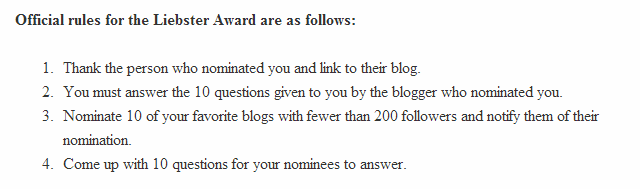
    According to Harriet, the

    Liebster rules

    Answers to the 10 questions posed by Harriet:

    1. Congratulations! You just won the Liebster Award! What are you going to do next?

    The immediate answer is contained in this post. The longer term answer is: keep on blogging!

    2. Describe yourself in three words.

    Happy. Thoughtful. Loyal.

    3. Describe your thoughts on your very first job.

    In my early teens I swept out a carpenter’s workshop on a Sunday morning. It was hard, dirty, tiring work. The head of the heavy wooden broom was about 60 cm long and difficult to manoeuvre. It would take about 2 hours to sweep up all the sawdust and I would go home and sleep for about the same length of time to recover. For hours I would be blowing black dust out of my nose, but the crisp $1 note I received in payment was sufficient encouragement for me to return and do it all again the following week.

    4.If you could go anywhere in the world, where would you go and why?

    I would love to visit Monet’s garden. I would love to sit on a seat near the bridge overlooking the waterlilies and ponder the big questions of life. I would like to share my contemplations with the artist, his contemporaries and philosophers from all eras. I love the works of Impressionist painters, especially Monet’s Waterlilies and Van Gogh’s Starry Night. The mood evoked by these beautiful paintings is especially conducive to philosophical musings.

    5. I like food. What is your favorite recipe?

    Whenever we have a family get-together it is expected that I will make a pavlova. It is enjoyed by all generations, and although I make a double (using 8 egg yolks) there is rarely any left over.

    However, for birthdays and Christmas with my immediate family (husband and children) I usually make a strawberry torte. It is a special treat that I have been making on these occasions for almost 40 years. While the in-laws find it a little rich for their taste buds, the grandchildren are taking to it in true Colvin fashion.

    OLYMPUS DIGITAL CAMERA

    strawberry torte

    6. Give a short summary of the book you are currently reading.

    As usual I have a few books “on the go” at the moment, but the one of which I have read most at this stage is “Why ‘a’ Students Work for ‘c’ Students and Why ‘b’ Students Work for the Government: Rich Dad’s Guide to Financial Education for Parents” by Robert Kiyosaki. Of course it appealed to me because of its relevance to education and because I had read others of his books years ago: “If You Want to be Rich & Happy: Don’t Go to School” and “Rich Dad Poor Dad”. In this book Kiyosaki contends that schools don’t educate students for financial success and urges parents to teach children about finances at home. He suggests that playing “Monopoly” is a great way to start. He is greatly concerned about the “entitlement mentality” which he considers to be so pervasive in our society. Some of his ideas are challenging and confronting; others make perfect sense. I recommend the book to anyone wanting to achieve financial independence. I would love the opportunity of discussing his ideas with others.

    7. What inspired you to start blogging?

    Blogging wasn’t a goal, or even an idea, initially. My intention is to create my own website to market teaching resources that I produce. I have a lot of learning to do before I am ready, and part of that learning involves attending seminars. Some of these seminars recommended having an online presence and building a “brand”. Blogging was suggested as one avenue for achieving this. I decided to give it a go, and have found it rewarding in itself – an unexpected pleasure, delightful detour and amazing adventure.

    8. How did you come up with the name for your blog?

    My blog is simply my name; that wasn’t difficult.

    9. What do you do when you experience writer’s block?

    Eat. Procrastinate. Go on with something else. Push through it. Write around it.

    10. Which post are you most proud of and why? Provide a link.

    This is tricky. I don’t think I’ve written it yet! However I very much enjoyed the comments and discussion that ensued from my series of posts about “The Examined Life” by Stephen Grosz.  The series includes:

    A book worth reading: Stephen Grosz “The Examined Life”

    Seeking praise – Stephen Grosz revisited

    and a guest post by Anne Goodwin in response:

    Examining praise: Stephen Grosz – the third instalment!

    The discussion stretched my thinking and learning and I am grateful to all participants in the conversation. Learning is what life is all about!

    Nominate 10 bloggers for the Award:

    As the rules appear to be blurred rather than definite e.g. Harriet’s rules differ slightly from those on Wording Well , which differ again from those on Sea Play Photography, I decided to nominate 13 bloggers.

    Belinda Pollard of Small Blue Dog Publishing (Australia)

    I’m starting with Belinda Pollard of Small Blue Dog Publishing because it was Belinda’s recommendation that prompted me to enter the world of blogging and tweeting. At a seminar hosted by Queensland Writers Centre last year Belinda urged all writers to have an online presence. She said that Twitter was like the water cooler for writers. I’m beginning to see that she was right. Belinda’s posts about all aspects of writing and self-publishing, including blogging, have been a great source of information for me and I appreciate what I have learned from her.

    Belinda, I know you have thousands of followers on Twitter but Word Press tells me that you have fewer than 200 followers on your blog so I hope you are happy to accept this award.

    NANNY SHECANDO (Australia)

    Next I’d like to introduce you to Hope who blogs at NANNY SHECANDO. Hope blogs about her experiences as a nanny, cooking and craft. She says, “We’re staying young, Peter Pan style, by embracing the creativity and sunshine in life.”

    Anne Goodwin (UK)

    Anne Goodwin’s website is rich with things to read: short stories, interviews with authors, book reviews, blog posts and more. Anne is one of the writers I met at ‘the water cooler’ and we have had many interesting and thought provoking conversations since then. I love the way Anne has called her website Annethology and her blog Annecdotal. She tweets @Annecdotist. Very clever!

    Caroline Lodge (UK)

    Caroline Lodge blogs at book word . . . about books, words and writing. She joined with Anne and me and we stood around the water cooler sharing ideas and exchanging thoughts. I’m certain you will find much of interest on her blog including suggestions for blogging, great books to read and writing tips.

    PS Cottier (Australia)

    For a little bit of poetry I recommend PS Cottier who posts a poem every Tuesday, and occasionally writes prose.

    Teachling (Australia)

    Teachling is a blog dedicated to improving education with ideas about teaching, learning and parenting. Teachling believes that “Improving a child’s life-chances is everyone’s responsibility” Along with me and millions of others, Teachling is a big fan of Ken Robinson.

    I have always enjoyed reading philosophy and engaging in philosophical discussions. I support the teaching of philosophy as an active thinking subject in schools and am excited about the benefits of a thinking population to the future of our world. I have two great blogs to recommend in this category:

    Peter Worley’s philosophy foundation (UK)

    Michelle Sowey at The Philosophy Club (Australia)

    Note: Last year I reblogged one of Michelle’s posts:

    Can you kill a goat by staring at it? A critical look at minimally invasive education

    There’s No Food ( Australia)

    A bit closer to home (actually much closer to home, it’s my daughter’s blog) I’d like to recommend There’s No Food. Bec blogs about “wholefoods, vegetarianism, slow living and their existential friends.” She has interesting thoughts about the impact of our food choices on the environment and practical suggestions for changes we can make to our everyday routines.

    Obscure Pieces (Australia)

    Glenn at Obscure Pieces expresses himself through black and white photography. His special interest is urban and landscape photography. He frequently offers support and comments on my posts and has generously allowed my use of some of his photographs. Thanks Glenn.

    Cultivating Questioners (USA)

    On her Cultivating Questioners blog, Nicole posts about her experiences as a teacher, especially encouraging her young students to use higher-order thinking skills . I love to see a young teacher so passionate about education.

    Nillu Nasser Stelter (UK)

    Nillu Nasser Stelter is a fiction and freelance writer and her blog features short stories, flash fiction and tips for writing. I love the ways she uses words effectively in her writing to create a picture or emotion.

    Carrot Ranch Communications (USA)

    Charli Mills at Carrot Ranch Communications also blogs about writing. As of Wednesday 5 March she launched a flash fiction challenge. Each week writers have the opportunity to accept the challenge to write a 99 word “story”. This is something I haven’t done before so I’m hoping to join in the fun. What about you? I’m sure it’s not as easy as it sounds!

    Now my nominees, it is your turn.

    These are the things I would like to know about you:

    Note: Although I have listed 13 questions, you need answer only 10. You may substitute one of your own if you wish.

    1. What do you value most in life?
    2. What activities do you enjoy and why?
    3. What is something you wish you had more time for?
    4. What is one change you would like to make in the world?
    5. What is something you would like to change about yourself?
    6. What surprises you most about your life – something good in your life that you hadn’t expected, dreamed of or thought possible?
    7. What ‘big” question do you often ponder?
    8. What sorts of things amuse you?
    9. What do you like to collect?
    10. If you could talk with anyone and ask them to explain their ideas and/or actions, who would it be, and why?
    11. What is something you can’t do without?
    12. What is something important you learned about life, and how did you learn it?
    13. What is your earliest memory?

    I look forward to reading your responses and continuing our discussions at my place or yours!

    Happy blogging!

    Footnote:
    How to find out the number of followers on a blog:
    For Word Press blogs:
    View the blogs in the Reader
    Click on the blog name at the top of the blog
    Lo and behold, you will be provided with the number of followers. Easy for Word Press.
    For other blogs
    I wasn’t sure how to find out for others not using Word Press so I sent them a message on Twitter asking their numbers. Simple.
  • Would you believe?

    When I was growing up “Get Smart” was a popular show with my family and friends.  The question “Would you believe . . .?” was often asked humorously, in Max-style, starting off with an exaggerated and unbelievable suggestion, then moving through a series of diminishing magnitude to the, often insignificant, reality.

    I am not going to start with an exaggeration for I am rather pleased with what I have achieved. I wish to make no comparison with anyone else who may have achieved a whole lot more, or even those who may have done less. I just know that I have learned a lot, and in fact, have learned so much that I now know what future learning I need to do.

    If you know nothing, you don’t know what you need to know. It is only when you know something that you get an inkling of what there is to learn.

    If, this time last year, you had said to me:

    “One year from now you will be writing a blog and publishing your fiftieth blog post; you will have over 800 followers on Twitter and you will engage in conversations with people from all over the world.”

    I would have laughed and said you were crazy. I had no thought of writing a blog and thought Twitter was just for twits.

    travel-map
    http://www.openclipart.org
    van
    http://www.openclipart.org

    I had followed only one or two blogs posted by family and friends on holidays so knew nothing of the pleasure or potential of writing or following blogs.

    Eating-Breakfast-like-Pig-1
    http://www.openclipart.org

    What I “knew” of Twitter was minimal and misinformed. I thought it was people sending messages about eating breakfast, going to the bathroom and other mundane events. I couldn’t see the point in that.

    How wrong were my misconceptions how they have changed!

    How I have changed.

    What I would have considered a Max-style exaggeration a year ago is now a reality. And it didn’t take a year. It has all happened in just six months.

    tweet_birs-2
    http://www.openclipart.org

    Six months ago I published my first blog post and tweeted for the first time.

    I was both nervous and excited and had no expectations other than to see what would happen.

    I am delighted with the result: the learning I have done, the people I have met and the way my writing has grown. One of the greatest pleasures is having control over what I write; another is meeting so many interesting people, some like-minded and others with differing views, but all supportive and willing to share their knowledge, ideas and thoughts.

    I wouldn’t have started upon this journey without the Queensland Writers’ Centre (QWC).

    cropped forest
    http://www.morguefile.com

    In late 2012 I did a couple of sessions about digital publishing with Simon Groth (Manager of if:book Australia), and another at the beginning of 2013. While the talks were fascinating and I learned a lot, I was such a N00b that it was all still a forest to me and I couldn’t see the path to take me in and didn’t have the tools to clear a path. I needed more time to absorb the information I had heard and work out what to do with it. I still wasn’t convinced that blogging and social media were for me.

    Belinda Pollard of Small Blue Dog Publishing changed all that at another QWC session in June. I am very grateful to her for convincing me that this was the way to go and that I just needed to get started. She described Twitter as the “water cooler for writers” and a great way to meet other writers.

    Less than two months after hearing Belinda speak I was on my way, hacking a path through the undergrowth, searching for the warmth of sunlight through the canopy.  My quest for information started with her website  and crawled its way out and around other websites and blogs, some of which I return to often for reassurance, reminders and more information.

    Now in answer to the question, “Are you experienced?” I can reply with a very definitive: ”Yes, I am experienced!”

    I have lost my nervousness, but not my excitement. I have grown in confidence and knowledge but know that there is so much more to learn. In my Twitter profile I say that I was born too soon, but maybe I just started late. Considering that there were no computers and no internet for more than half my life and the only “mobile” phone I knew in my younger days was Maxwell Smart’s shoe, I think I’m doing okay in the catch-up.

    In addition to all the generous bloggers and twitter users who have helped me along the way, many without knowing it, I am also very grateful to you, my readers and followers, who have visited, commented, liked, favourited and otherwise shared my posts and tweets, but more especially your knowledge, support and ideas.  While I had no expectation that any of you would drop by to read or engage me in conversation, I’m so glad you did. Thank you. Please stay with me as my journey continues.

    Thank_you_pinned_note
    http://www.openclipart.org
  • Seeking praise – Stephen Grosz revisited

    Praise may be defined as an expression of approval or admiration.

    Who wouldn’t want that?

    If you write a blog, don’t you love it when others “like” a post, leave a positive comment, re-blog your article or link to it via theirs? I do. Aren’t these all expressions of approval or admiration?

    What about on Twitter when someone Re-tweets, favourites or replies positively to your comment, engaging you in conversation?

    Aren’t these also expressions of approval or admiration?

    I love to receive all these signs of encouragement and support that let me know that my efforts are appreciated and confirm that I am on the right track. If I did not receive any of this feedback I would feel quite isolated and consider my efforts to be fruitless and a waste of time. I would probably just give up.

    As a teacher I have always considered it of primary importance to create a happy and welcoming classroom environment in which children feel valued, affirmed and supported. Expressions of approval and admiration for behaviour, effort and achievement were generously given with the aim of encouraging the desired response, a happy child being foremost. I have written about this in previous posts, including:

    Happy being me

    Affirmations: How good are they?

    As a parent too I considered it important to affirm my children and display my approval and admiration for them. I still do, even now they are adults. The need for approval never ends. I know sometimes you just have to go out there and say what you know is right, even though others will disagree or ridicule you. I am not talking about those instances here.

    My strong belief in the power of affirmations and approval stems partly from the dearth of them in my childhood and school days. I have also mentioned this in a previous post: 

    Mouthing the words – the golem effect

    Recently I listened to a fabulous (audio)book, “The Examined Life: How We Lose and Find Ourselves” by Stephen Grosz. I wrote about it in my previous post A book worth reading: Stephen Grosz “The Examined Life” saying that

    “What appeals to a reader about a book, or what a reader takes away from a book is as individual and personal as the reader. What is of most significant to one, may be of lesser importance, or even insignificant to another. “

    For me the chapter of most significance is chapter 3 “How praise can cause a loss of competence”.

    To say I was startled by the title would be an understatement. I was puzzled, intrigued and challenged. How could praise cause a loss of competence? Surely negative feedback or a lack of encouragement altogether would be major contributors to diminishing competence. Was everything I had believed and practiced wrong? (Oh no –there’s my need for approval and affirmation!)

    Grosz says that during the past decade studies into self-esteem have found that praising a child as “clever” may not only inhibit school achievement, it may cause under performance. He suggests children may react to praise by quitting. Why would you try to improve or do something new if you have already done something really well or are the “best”?

    Studies showed that children who were praised for effort, rather than for being clever, were more willing to try new approaches and were more resilient. Children who were praised for being clever, tended to worry more about failure and chose unchallenging tasks, tasks they knew they could achieve or had already achieved. Being told they were clever led to a loss in self-esteem and motivation and to increased anxiety. Some children who had been praised for being clever (rather than working hard), when confronted with a more difficult task and asked to comment on it, were so unhappy with the results they lied about them, exaggerating their achievements to others.

    Grosz questions whether we may lavish praise on our children nowadays in order to demonstrate that we are different from our parents who possibly used criticism, rather than praise, on us. I hinted at something similar earlier in this article.

    While admiring our children with words like “Good boy” or “Good girl” may temporarily lift our self-esteem by showing others what wonderful parents we are or how wonderful our children are, Grosz says, it isn’t doing much for a child’s sense of self. He says that in trying to be different from our parents we end up doing the same thing: doling out empty praise where an earlier generation doled out thoughtless criticism.

    Grosz says that if we offer this empty praise without thinking about the child’s individuality and needs we are effectively showing the child indifference.

    So what do we do?

    I think the emphasis here is on the empty praise. I think support, encouragement and positive feedback are all essential. Sure, knowing in yourself that you have done well is fine but a little recognition certainly helps too. I think the difference is in recognizing what has been achieved, the learning or progress made, and the effort it took, the message communicated in a story or painting and the techniques used; not a hollow “Well done”, “Good work” or “Good boy” but “Tell be about . . .”, “Why do you think that?” “How did you work it out?” “I like the way you . . .”

    As Grosz says, this is being attentive to the child, to what the child has done and how it has been done.

    To read more on this topic:

    Sian Griffiths interviewed Stephen Grosz and reported on the interview in the article “Praise her . . . and see her fail” which adds even more clarity to my precis above.

    Maria Popova delves into the messages of this same chapter in her article “Presence, Not Praise: How to Cultivate a Healthy Relationship with Achievement

    Being attentive, being present, being really with someone, noticing what they have done and how they have done it – is it more precious than praise?

    In these days of constant distractions and must-dos to put all aside to be in the present with the child, friend or partner to talk, listen share and laugh, what better affirmation is there than that?

    What do you think?

    How has praise encouraged or discouraged you?   When has criticism hindered you?

    I’d love to hear your thoughts.

  • Must read: Neil Gaiman – “Reading and obligation”

    When I first stepped, rather tentatively, into the world of blogging and tweeting I had no idea of the pleasures I would find. I found a whole community of others who share my passion for education, learning, literacy and writing. I found a comfortable niche, discussion group, and a place for sharing ideas like I hadn’t for a long time. I’ve “come home” on the internet.

    In these few short months I have come across some bloggers with very powerful messages that I wish everyone could read and act upon in the ways described. What a wonderful world we would have!

    Over the coming months I will let you know about some  articles I consider  ‘must reads’.

    Please let me know of others you think I should also be reading!

    Thanks for sharing and supporting me on my learning journey thus far.

    The story has just begun!

    This first in the series is a lecture given by Neil Gaiman entitled “Reading and obligation”

    Neil Gaiman lecture in full: Reading and obligation

    Neil captivates me with his opening statement:

    “It’s important for people to tell you what side they are on and why, and whether they might be biased.”

    If you have read any other articles on my blog, you will know that I am biased; biased towards a child-centered, hands-on, creative and innovative approach to education. I believe that children are capable of far more than a structured didactic approach to schooling gives them credit for; and that big changes in the way education is delivered are necessary if we are to make best use of our most valuable resource – human potential.

    As a reader, writer and literacy educator I am biased towards approaches which foster a love of reading and writing. The pleasures to be gained from a literate existence are immeasurable. But more than that, being literate is not only personally empowering, it is a basic human right.

    Obviously the articles on my must read list will be those that share my biases.

    Please follow the link to watch the video or read the complete transcript of Neil’s lecture.

    I offer a few teasers below to incite your interest.

    “everything changes when we read”

    Wow! How powerful is that statement!

    “The simplest way to make sure that we raise literate children is to teach them to read, and to show them that reading is a pleasurable activity. And that means, at its simplest, finding books that they enjoy giving them access to those books and letting them read them.”

    “Fiction has two uses. Firstly, it’s a gateway drug to reading. . .

    And the second thing fiction does is to build empathy.”

    “Fiction can show you a different world. It can take you somewhere you’ve never been. Once you’ve visited other worlds, like those who ate fairy fruit, you can never be entirely content with the world that you grew up in. Discontent is a good thing: people can modify and improve their worlds, leave them better, leave them different.”

    Don’t you love that last statement? I do. If we are always “happy” with the way things are, why would we ever try to improve or change them? A little discontent can be a good thing!

    “We need to read and write, we need global citizens who can read comfortably, comprehend what they are reading, understand nuance, and make themselves understood.”

    Neil goes on to talk about our obligations as readers, writers and citizens of the world.

    He lists the following (read or listen for his explanation)

    • Read for pleasure
    • Support libraries
    • Read aloud to our children
    • To use the language
    • We writers – and especially writers for children, but all writers – have an obligation to our readers: it’s the obligation to write true things, especially important when we are creating tales of people who do not exist in places that never were – to understand that truth is not in what happens but what it tells us about who we are. Fiction is the lie that tells the truth (underlining is mine)
    • not to bore our readers
    • not to preach, not to lecture, not to force 
    • never, ever, under any circumstances, to write anything for children to read that we would not want to read ourselves.
    • to understand and to acknowledge that as writers for children we are doing important work,
    • to daydream We have an obligation to imagine. . . . individuals change their world over and over, individuals make the future, and they do it by imagining that things can be different.
    • to make things beautiful.
    • to tell our politicians what we want

    Neil reminds us that

    Albert Einstein was asked once how we could make our children intelligent. His reply was both simple and wise.

    If you want your children to be intelligent,” he said, “read them fairy tales. If you want them to be more intelligent, read them more fairy tales.

    I couldn’t agree more.

    What about you? What do you think of Neil’s list of obligations? Are there any you would omit, or any you would add?

  • Season’s Greetings!

    Season’s Greetings!

    A big thank you to all who have walked with me all, or any part, of the way as I took my first tentative steps into the world of blogging (and tweeting) earlier this year.

    I appreciate every contribution, from visits and suggestions, to liking, commenting and re-blogging.

    I have learned more than I probably even realise, from many different people, and  the encouragement from all interactions has helped me find my voice and the strength to maintain the journey.

    This post offers a break from my usual educational fare by providing a little Christmas jollity. I hope you enjoy it.


    Wishing you and your loved ones much joy during this holiday season.

    Norah

  • Flag this Twitter advice

    stop email

    I have just read a very helpful post by Claire Diaz-Ortiz explaining how to unsend an email.

    Reading it prompted me to write me this post which I have been mulling over for some time now. I would like to read a post entitled:

    “How to unflag on Twitter”.

    You see, I am a newcomer to Twitter; reading, tweeting and re-tweeting for just over two months now.

    Luckily for me there are many wonderful bloggers who generously share their tips and information to help newbies like me get started. I have read and re-read some of these blog posts many times in order to glean as much information as possible in order to avoid making it obvious to everybody just what a newbie I am.

    Just as an email can be unsent, the delete button on Twitter can be used to withdraw a message tweeted by mistake. That’s easy.

    However it is not so easy, in fact it is impossible, so far as I can see, to unflag a flag.

    Now I’m a reasonably intelligent person, and I have used a number of computer programs and applications over the years, and one thing that I have discovered is that learning is transferrable. What is learned in one program or application can generally be applied in others. I have also learned that one should not worry too much about clicking the wrong button because most things can be undone and not much harm can be done anyway.

    I had plenty of prior experience with flags to understand their use.

    Anonymous_globe_of_flags_1

    nicubunu_Game_marbles_-_flags

    In Microsoft  Word, the little flag icon is used to bookmark a part of the text one wishes to locate later.

    The flag in Microsoft Outlook is used to mark an email to follow up.

    I may use a flag to highlight a section of text in a book if I consider its content important or interesting enough to revisit another time.

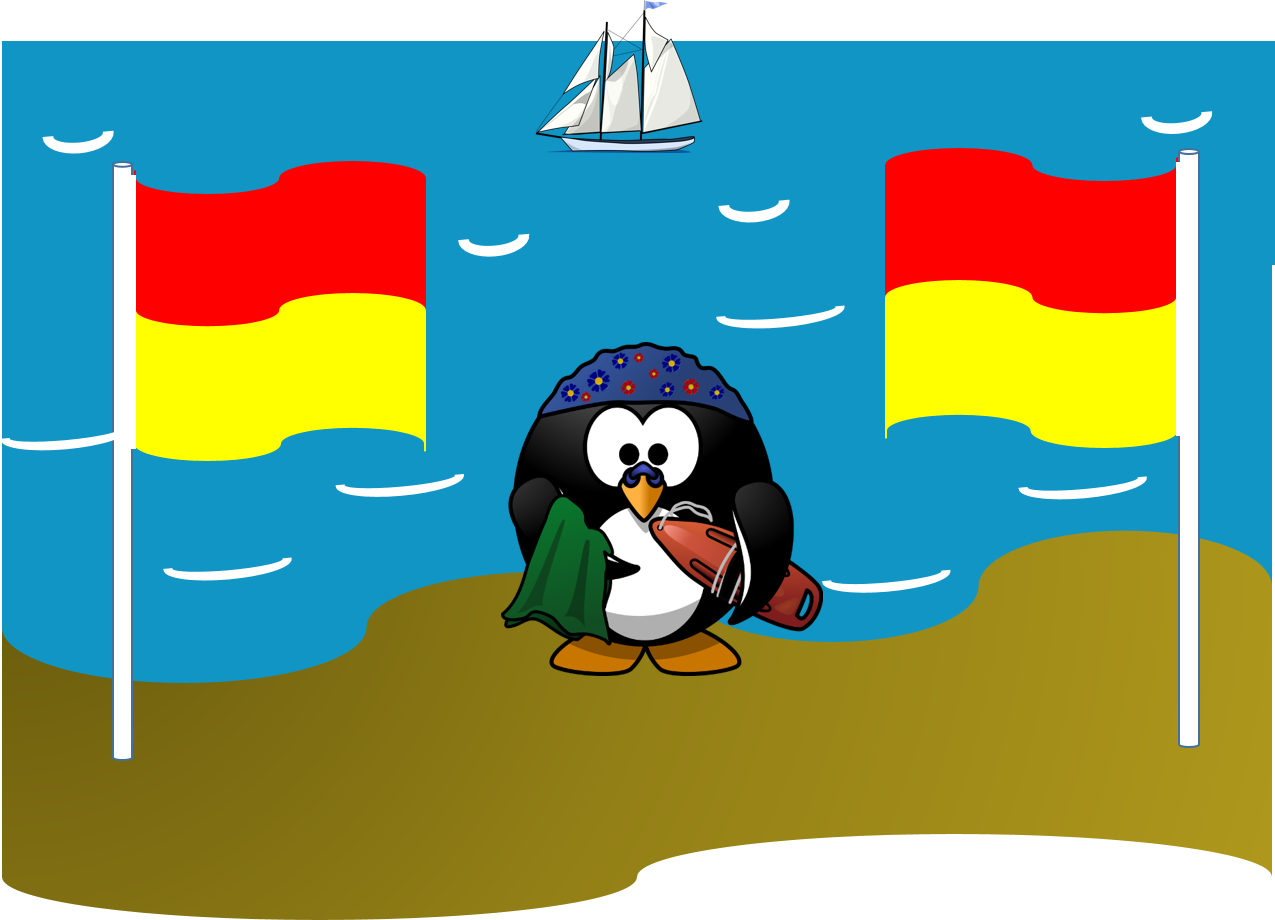
    swim between the flags

    Flags on the beach indicate areas where it is safe to swim.

    Flags on a car-yard are there to entice would-be buyers.

    HappyNewYear_by_Rones
    Party time!

    In all these instances flags are used to draw attention to items of interest or importance to make them easy to locate. So it follows that I should be able to transfer this knowledge to other applications. Right?

    Well, usually; but not with Twitter.

    tweet bird
    A little Twitter panic!

    I learned this from my own first-hand experience though, so the learning is powerful and permanent and I will not need to revisit this situation again to make sure I have got it right. The learning was also accompanied by quite a degree of embarrassment and anguish, so if I can prevent anyone else from making the same mistake, my purpose in writing this post will be accomplished.

    tragicmaskThis is how the tragedy unfolded:

    One day I encountered a tweet with a fun poem attached as media. I wanted to be able to come back to this poem at a later time to reflect on it some more. I wondered how I might do that.

    Flag media

    Then, out of the corner of my eye, I noticed a little box down to the right that said “Flag media”.

    “Great,” I thought, “Easy,” and pressed the button.

    Immediately the button changed to “Flagged learn more”.

    Now where there’s a link there’s a way to new learning, so of course I clicked on it . . .

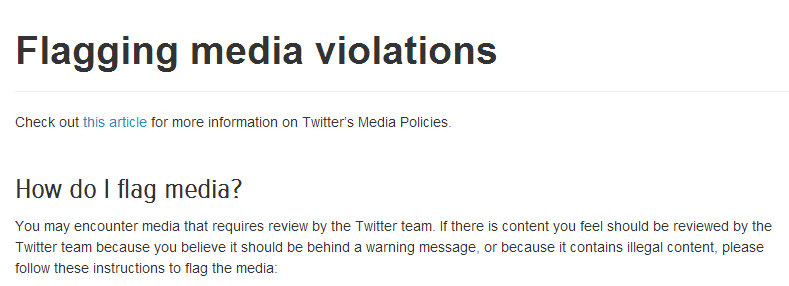
    and was totally aghast when I came to the Twitter Help Centre “Flagging media violations”.

    flagging media violations

    I hadn’t wanted to flag the poem as a media violation. I just wanted to read it again later.

    “Quick,” I thought, “better unflag it before anyone notices; especially the author!”

    As I frantically searched the Twitter Help Centre, the panic started to rise as I could find no instructions for unflagging.

    I couldn’t remember it being mentioned in any of the articles I had read, but I went back and checked, just to make sure. Nowhere could I find mention of flagging, let alone unflagging. I just had to let it be and hope that when the Twitter team checked the flag, they would realise that an error had been made. However, I do sincerely apologise to George and can only be thankful that my followers were few, and hopeful that nobody, especially George, noticed.

    So here is my number one piece of advice when using Twitter: Don’t flag!

    don't flag

    Not unless you consider “there is content you feel should be reviewed by the Twitter team because you believe it should be behind a warning message, or because it contains illegal content”.

    I wish I had read that before I flagged George’s poem, “Everything is a car!”

    Anonymous_double_star

    However you could use this strategy if you wish to come back to a tweet later:

    favourite it.

    That way it will turn up in your favourites list and you will easily be able to locate it.

    Just be wary of favouriting too many tweets as advised by Mary C. Long in the Social Times earlier this year. However Mary’s warning doesn’t apply to favouriting a tweet in the way I have just suggested.

    What have you learned about Twitter that you think I should know?

    What learning experiences would you like to share?

    Here are seven great bloggers or websites with useful advice about using Twitter appropriately:

    Mom this is how Twitter works

    The eLearning coach Ten ways to learn from Twitter

    Claire Diaz-Ortiz How to create your own Twitter profile (and others)

    Belinda Pollard Why emerging authors need Twitter (and others)

    Molly Greene  Ten tweets you should never send (and others)

    Jeff Bullas 10 tips for creating marketing and sharing content on Twitter

    Judy O’Connell Being web savvy includes twitter

    Rachel in the OC Ten quick tips to help any author

    And don’t forget the Twitter Support Centre

    Happy tweeting!

    All clipart courtesy of  www.openclipart.org  some with minor modifications and additions.