Live Love Laugh Learn … Create the possibilities

Tag: Teaching Resources

  • Feeling a little prickly?

    Australia is home to a great diversity of, and many unique animals. Most native Australians are not found anywhere beyond its territories. I guess that’s not surprising since it is the world largest island or smallest continent country with vast expanses of ocean between it and other continents.
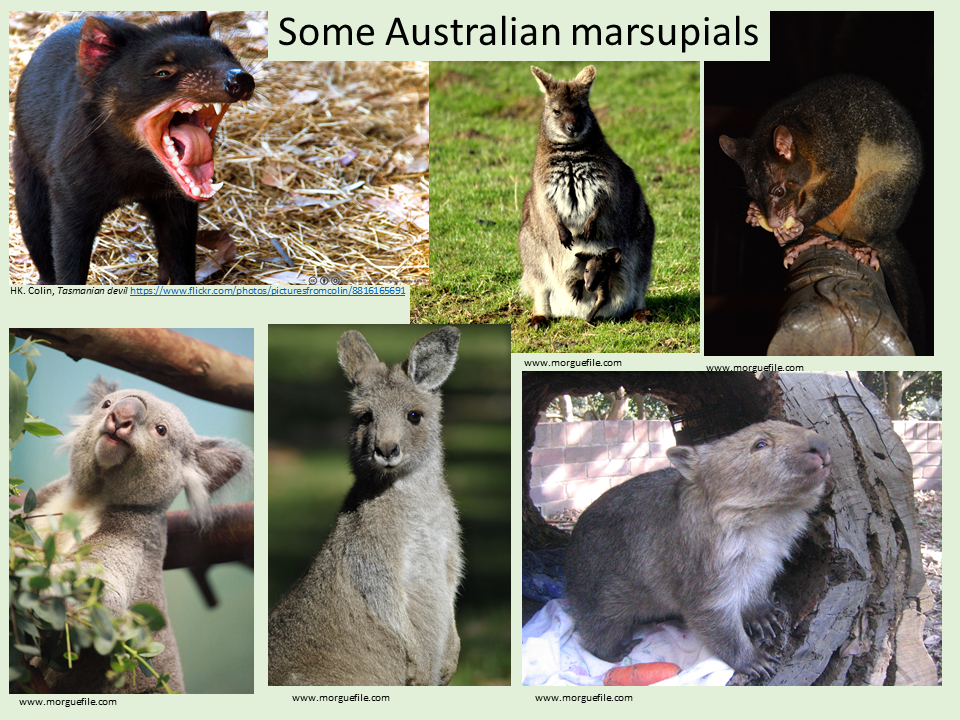
    feeling-prickly-marsupials

    Australia is home to almost 70% of the world’s marsupials. Other marsupials are found in the Americas, mostly South America. Kangaroos, wallabies, koalas, possums, wombats, Tasmanian devils, numbats, bilbies, and quolls are among the species of marsupials found in Australia.

    Marsupials are mammals that give birth to live young before they are fully developed. The young, usually referred to as joeys, continue to develop in the mother’s pouch for a number of months, suckling on their mother’s milk.
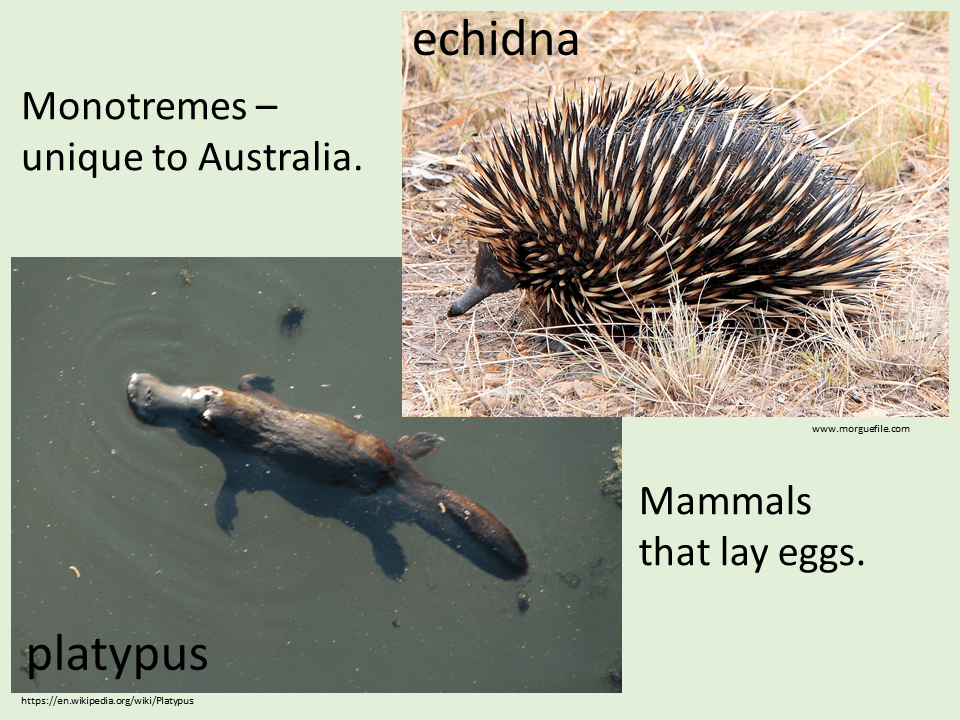
    feeling-prickly-monotremes

    There is another group of even more unusual mammals: the monotremes. Monotremes are egg-laying mammals. The platypus and the echidna, the only existing species of monotremes, are unique to Australia.

    The platypus

    When Europeans first saw a platypus, they thought it was a hoax with its bill like a duck’s, tail like a beaver’s, and feet like an otter’s. It has fur like other mammals but, unlike other mammals, it lays eggs.

    The platypus lives in burrows on the banks of freshwater streams and small rivers in eastern Australia, including Tasmania. It spends much of its time foraging in the muddy river beds for crayfish, worms and insect larvae.

    Female platypus usually lay two eggs. When the young hatch, the mother releases milk from pores in her skin. The milk pools on her abdomen and is lapped up by the young for about three to four months. There is no special baby name for baby platypus. They are simply called ‘baby platypus’.

    The male platypus, with a poisonous spur on its hind foot, is one of only a few venomous mammals.

    Platypus predators include crocodiles, eagles, dingoes, and introduced animals such as foxes and feral cats.

    The echidna

    Echidnas, the oldest surviving mammals, live all over Australia in many different habitats. They usually live alone and are not territorial. Although it is rare to see an echidna in the wild, they are considered common. They generally hide away under vegetation, in logs, or in the burrows of other animals.

    Echidnas eat termites and ants, and sometimes the larvae of other insects. They use their long snouts to forage in leaf litter, rotting logs, or ant mounds in search of food. Their long tongues are covered in sticky saliva for catching prey.

    Echidnas are covered with spines along the head, back and tail. The spines are sharp and used for defence against predators.

    Female echidnas usually lay one egg at a time. When the young, called a “puggle”, hatches, it makes its way to the mother’s pouch area to suckle milk. When the puggle starts to develop spines, at about 50 days, it is removed from the pouch. The mother continues to suckle it until it is about six to seven months old, at which time she deposits it at the entrance to the burrow, then walks away and abandons it.

    Predators include goannas, Tasmanian devils, dingoes, eagles, and introduced animals such as foxes and feral cats. When threatened an echidna may run away or curl up in a ball.

    Although all have spines, echidnas are not related to either hedgehogs or porcupines.

    Here is a great article about these amazing echidnas.

    If you are looking for books about Australian animals, check out the Steve Parish Storybook Collection by Rebecca Johnson, featured in last month’s Author Spotlight, which includes stories about both monotremes, many marsupials, and other fabulous creatures.

    Monotremes and marsupials feature in the readilearn stories Bullfrog’s Billabong and Little Koala’s Party and their suite of resources.

    Bullfrog's Billabong - coverlittle-koalas-party-cover

    I was prompted to think about the diversity and uniqueness of these Australian animals, especially the echidna, by this week’s flash fiction challenge set by Charli Mills at Carrot Ranch Communications. She challenged writers to In 99 words (no more, no less) write a prickly story. I thought there was no better opportunity to share with you some of our amazing creatures, particularly since just last week I was lucky enough to see an echidna in the wild for the very first time.

    The uniqueness and diversity of Australian animals reflects our own individual uniqueness and the diversity among us. We have much to learn about accepting difference, appreciating diversity, and acknowledging the unique characteristics each individual contributes to the enrichment of our collective humanity. Together we stand. Divided we fall.

    Here is my response. I hope you enjoy it.

    Stronger together

    She bristled, warning platypus to stop. He didn’t.

    “Feeling a little prickly, are we?”

    Kookaburra, oblivious, laughed at the “joke”.

    She smarted. Couldn’t he see the hurt in his words? Like a spur in her side, that last barb, really stung. Mocking difference pushed them apart.

    The bush quietened. Not a breath of wind. Not a leaf’s rustle. Not a bird’s chirrup. Were all waiting for the victor to be decided?

    Suddenly, out of the undergrowth, rushed a devil, hungry for blood.

    Platypus turned to echidna. She contemplated leaving him. But stayed. Spur and spines together: a powerful defence.


    Author’s note: Tasmanian devils have been known to eat echidnas, spines and all!

    Thank you

    Thank you for reading. I appreciate your feedback. Please share your thoughts.

  • What’s the procedure?

    This post is republished from the readilearn blog.

    sift

    Reading and following procedures is a part of everyday life. We need to follow a procedure to make a cake, take medicine, repair a bicycle, treat head lice, assemble a DIY bookcase, or install an app on a digital device. The list in inexhaustible.

    Sometimes procedures are presented as text, sometimes as illustrations or diagrams, and sometimes as a combination of both. They work best when each step of the sequence is accurately described and illustrated.

    However, not all procedural texts are created equal. Sometimes the language may be inappropriate and unclear. Sometimes steps are omitted or sequenced incorrectly. Sometimes diagrams have little resemblance to what is required and confuse, rather than clarify, the process.

    Trying to figure out what to do can cause a great deal of frustration in such circumstances.  The more practised we are with following procedures, the more adept we are at interpreting inadequate instructions to achieve a good outcome.

    It is never too soon for children to learn to read and follow procedures. The inclusion of procedural texts in a classroom literacy program has many benefits.

    Following a procedure provides a context and purpose for reading.  It requires children to interpret instructions through a combination of text and visual representation. It generally implies that children are doing or making something, which engages their interest and encourages participation. It develops an essential real-life skill that is transferrable to a range of situations. The sense of achievement in successfully completing a project is both affirming and empowering and often requires no other feedback.

    Procedural texts can be easily incorporated into a class reading program as an independent or group reading activity. An assistant to support, encourage and oversee can be invaluable.

    Features of procedural texts

    The reading of a procedural texts differs from reading fiction or non-fiction texts.

    • The title, and sometimes a short description, tells what will be done or made.
    • There is generally a list of requirements.
    • The body of the procedure is written as a sequential series of commands.
    • The verb, telling the action to be performed, occurs at the beginning of the sentence.
    • The sentence is directed to the reader, and means, “You do this.”
    • Each sentence is generally short with one action to be performed in each step.

    There is a range of readilearn resources to involve children in reading and following procedural texts. Many of the procedures are provided in different formats for use with the whole class or with small groups or by individuals. Some are supported by additional resources, and How to make a paper plate cat face is presented with two levels of text.

    These include:

    How to make a paper plate cat face

    how-to-make-a-paper-plate-cat-face-level-1

    How to make a 2D bus with wheels that move

    how-to-make-a-2d-bus

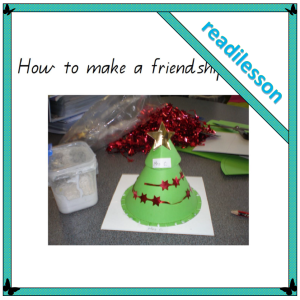
    How to make a friendship tree

    how-to-make-a-friendship-tree-readilesson

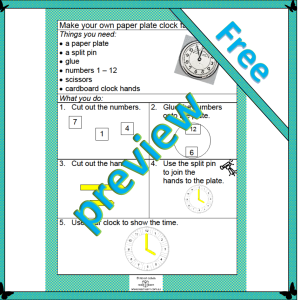
    Make your own paper plate clock face

    make-your-own-paper-plate-clock-face-free-preview

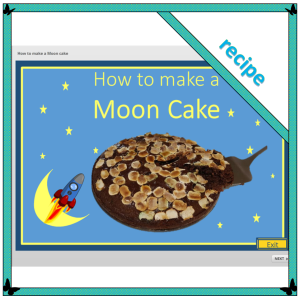
    How to make moon cake

    how-to-make-a-moon-cake-sl

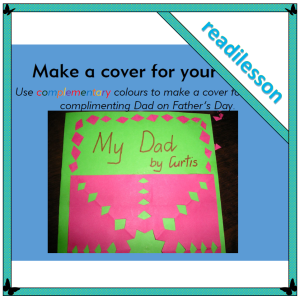
    How to make a book cover

    how-to-make-a-book-cover-readilesson

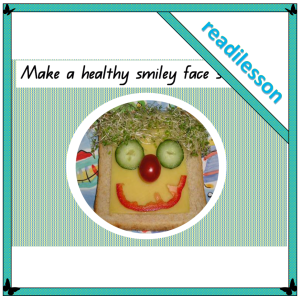
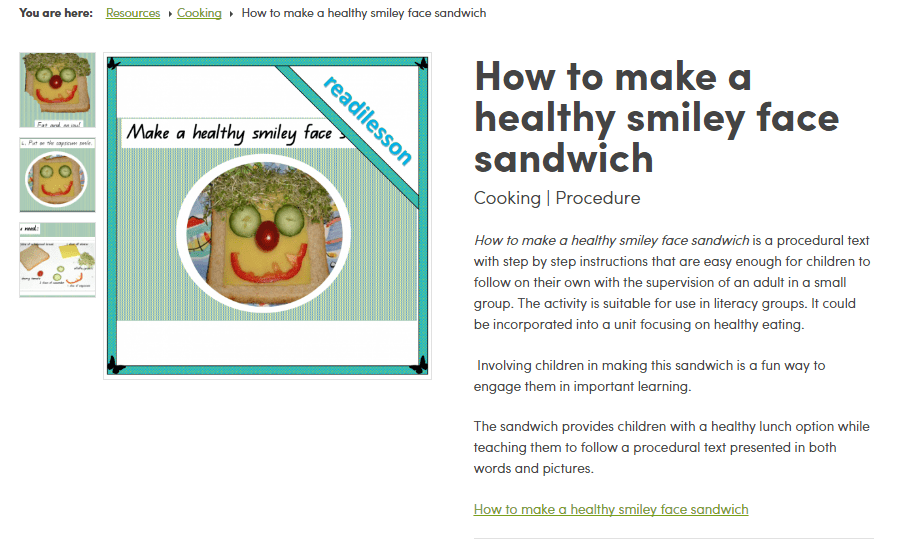
    How to make a healthy smiley face sandwich

    make-a-healthy-smiley-face-sandwich-readilesson

    I hope you and your children enjoy using these resources. They were always enjoyed in my own classroom, and have been the most popular resources in my Teachers Pay Teachers store.

    Please contact me if you have any questions. I welcome your feedback, especially suggestions for improvements to existing resources and ideas for new ones.

    Remember, if you haven’t yet subscribed, an introductory discount of 20% is available to all who subscribe this year. Just use the coupon code welcome2 at the checkout to receive your discount.

    I’ll see you next week. In the meantime, enjoy the weekend.

    Thank you

    Thank you for reading.

    Happy teaching and learning,

    Norah


    You can contact me:

    via email hello@readilearn.com.au

    via the Contact page

    on Twitter @readilearn or @NorahColvin

    on Facebook @readilearnteachingresources

    on my other blog NorahColvin.com

    I invite you to rate and review any resources you use, and to share information about readilearn on social media.


  • Author Spotlight: Rebecca Johnson

    This post is republished from the readilearn blog.

    Hi, welcome to the readilearn blog and the first in our Author Spotlight series.

    Spring is here and summer is on its way in Australia. The excitement of new life is everywhere as flowers bloom, birds sing, and insects abound. The excitement flows into the classroom as children observe and record the life stages of the amazing minibeasts that inhabit our world.

    There is no better time than spring to introduce you to Brisbane author Rebecca Johnson and her Insect Series which was awarded the 2014 Whitley Certificate of Commendation for Best Educational Series.

    rebecca
    Rebecca Johnson: award-winning author and primary school science teacher

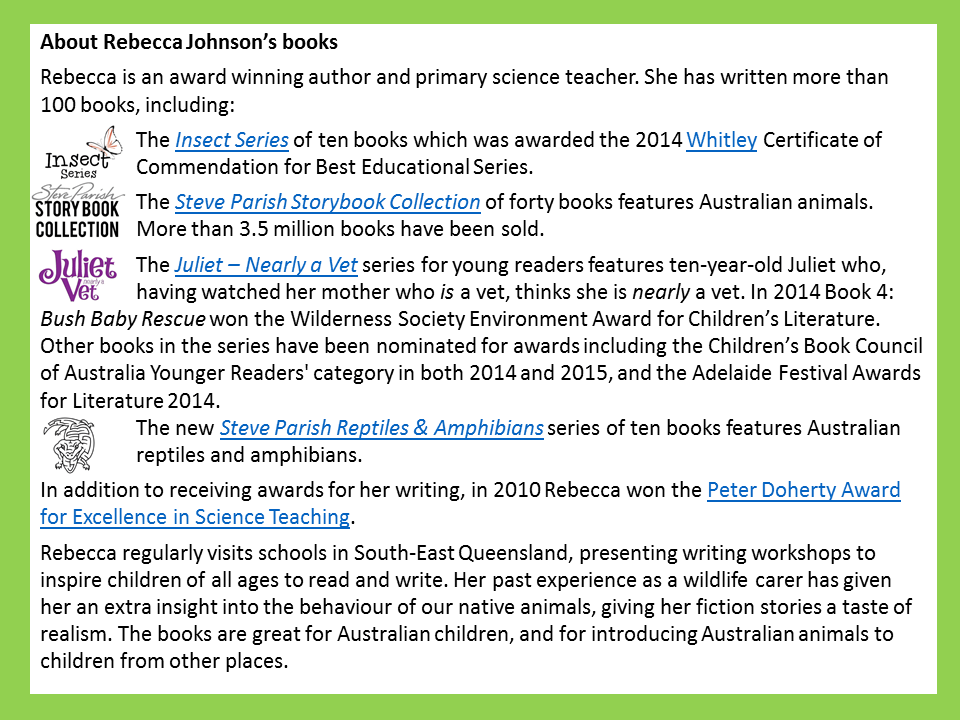
    about-rebecca-johnsons-books

    Rebecca’s Insect Series of ten books focuses on metamorphosis, survival, adaptations, properties of natural materials and the usefulness of insects through fiction stories. The stories are accompanied by stunning close-up photos of insects of all kinds.

    The books, which won the 2014 Whitley Award for Best Educational Series, have strong listed links to the Australian Curriculum for many year levels. They are a great resource for teaching and learning about insects. The fiction stories that accompany the facts make the learning even more fun. Two free blackline masters support the use of each book. The blackline masters can be accessed on the Blake Education Website.

    While the books feature Australian insects and have links to the Australian curriculum, they are loved by children all over the world. I am happy to introduce you to Rebecca and her lovely series of books.

    Welcome to readilearn, Rebecca. We are looking forward to getting to know you a little better.

    Thanks for inviting me!

    When did you know you wanted to be a writer?

    When I was reading a lot of picture books to my very young children and could see how much they loved them.

    Where do you write? Do you like to be by yourself in the quiet, or do you like to write in a noisy space?

    I do most of my ‘writing’ in my head.  I think about my stories for ages and pitch them verbally to victims until I am sure I have it all sorted in my head, then I sit to write in my lovely, quiet study overlooking my garden. I encourage children to tell their stories out loud before they write too, because, in my opinion, it is almost impossible to write a good story if you can’t tell one.

    What do you use to write – pencil and paper or computer?

    Head first. VERY few drafts, then I type it into the computer. I can type a 7000 word novel in a week that is publisher-ready, but I have thought about it and pitched it and sounded it out in my head for weeks beforehand. I hate sitting down all day, and I hate re-doing things over and over even more, so I do heaps of my drafting mentally whilst I do other (fun) stuff like gardening, then by the time I sit down to write, it’s like typing out a movie I know really well. People give you more honest feedback too, when you tell them a story. They feel less nervous about letting you know how they really feel about it. Try it some time.

    When is the best time for you to write?

    I do my best work from 5am when the house is really quiet. I’m always too tired at night (I still teach three days a week) for anything too creative.

    When and where do you get your ideas?

    From my life’s experiences as a mother, teacher, child and my own children. I think you have to write about what you know and love.

    What gave you the idea for this series about insects?

    I am a science teacher and I love insects, and I just couldn’t find the books I needed to succinctly and factually tell kids about the life-cycles and characteristics of insects in a fun way, so I wrote some.

    What do you like best about the series?

    Kids love them because they are funny and a bit silly, but they are still full of facts and information. I think they remember things better if it is presented in more appealing and humorous way.

    What can you tell us about the photographs that illustrate the books?

    My sister (Narinda Sandry) took most of them and it was hilarious. We didn’t want to harm any of the insects, so we had to put some, like the mealworms, in the fridge for a while to slow them down to get the shots. I will always smile as I recall the day we sat around a cow pat in a paddock trying to photograph dung beetles before they re-dug themselves in! The old farmer that had let us into the paddock stood to the side scratching his head in disbelief.

    caterpillar-spread

    How did your feel when you wrote these stories?

    I was really pleased when they came out because the photos are just gorgeous, and they were very well received by schools and parents. Winning the Whitley awards was really lovely recognition too.

    How do you hope readers will feel?

    Hopefully empowered with more information and knowledge, and perhaps inspired to look more closely at the wonderful world of insects and an appreciation of the benefits they bring.

    How would you like teachers to present your books to children?

    I’d love them to make them part of their science lesson, and even team them with some real insects (like mealworms) to make it all so much more engaging. There are two free blackline masters for each one too, that are designed to be able to be used independently by children in reading groups etc. There are heaps of facts inside the covers, and a glossary of terms, so plenty to learn in each one.

    Are there any messages you would like them to discuss?

    The main thing is that insects are so important and not just a good excuse to whack something!

    Do you have any advice for teachers in their role as writing guides?

    As I said earlier….talk before writing as much as you can. It is amazing how hard kids find it to describe something verbally and yet we ask them to do it in the written form all the time with disappointing results.

    Do you have any advice for children as writers?

    Tell, tell, tell, and don’t be too hard on yourself if it takes a long time to get it right. It took me five years to get my first book published.

    What is your favourite picture book? What do you like about it?

    I have so many favourites, but Bob Graham’s Greetings from Sandy Beach always makes me laugh out loud, and humour is really important to me in a book.

    Who is your favourite children’s author? What do you like about his or her work?

    The Lion the Witch and the Wardrobe (CS Lewis).  He made me see a movie in my head. I could picture every scene, decades before there was a movie.  I remember thinking that one day, I wanted to make a reader feel like that.

    thank-you-authors-and-illustrators

    Thank you Rebecca Johnson for sharing these insights about your Insect Series and your writing process. We wish you success.

    Thank you, and thanks for having me!

    To find out more about Rebecca and her award winning books visit her website at rebeccajohnson.com.au. You can find out about and purchase her Insect Series and other books on her website.

    Look what's new

    This interview and information about Rebecca is available as a printable resource in a new subcategory in readilearn literacy resources: Author Spotlight. The information may be displayed in your classroom or included in a class book about authors and illustrators.

    Check out the readilearn resources My Minibeast ABC and Minibeast Alphabet – A list for teachers which can also be used when learning about minibeasts.

    Thank you

    Thank you for reading.

    Happy teaching and learning.

    Norah


    You can contact me:

    via email hello@readilearn.com.au

    via the Contact page

    on Twitter @readilearn or @NorahColvin

    on Facebook @readilearnteachingresources

    on my other blog NorahColvin.com

    I invite you to rate and review any resources you use, and to share information about readilearn on social media.

  • Caps off for maths!

    This post is republished from the readilearn blog.

    Hi, and welcome again to the readilearn blog. I hope you’ve had a good week.

    Rarely, when the costs of education are being calculated, is the contribution made by teachers from their own pockets acknowledged. It is not very well publicised that many teachers spend a lot of their own money resourcing their classrooms, which would be far less interesting places if teachers refused to contribute in this way.

    Today I demonstrate that not all resources need be expensive. A versatile, free, and readily available resource is the humble bottle cap or lid, which  is often discarded, but can fulfill a number of functions in the classroom.

    collection

    It doesn’t take long to gather an extensive collection of lids even on your own. But ask your children to bring in lids from home and the collection builds even quicker.

    Lids have many uses.

    Children can, for example:

    Sort by colour or size

    sort-colour sort-size

    Order according to size – diameter or height

    order-diameter order-height

    Make patterns – repeating or growing

    growing-pattern repeating-ab-pattern

    Count – by ones, twos or fives

    count-in-onescount-in-2s count-in-5s

    Learn to subitise, and discover conservation of number

    conservation

    Compare, add, substract and share

    compare

    Measure length and mass

    measure-length measure-mass

    Use for collage or craft, or as tokens when playing games

    collage snakes-and-ladders

    These are just a few ideas. What other uses have you found for lids? Please share in the comments below.

    Look what's new

    What’s new – Uploaded this week!

    These ideas and others are  now available in a free maths resource Caps off for maths.

    caps-off-for-maths

    have-you-used

    Getting to know readilearn resources

    Snakes and Ladders is a popular game and great for maths groups. With some guidance from an adult, the game can be used to stimulate mathematical thinking alongside practice of computations. The readilearn resource Snakes and Ladders – An activity for maths groups provides suggestions that can be given to an assistant to maximise learning opportunities while playing the game.

    snakes-and-ladders-printable-preview

    Please contact me if you have any questions. I welcome your feedback, especially suggestions for improvements to existing resources and ideas for new ones.

    Remember, if you haven’t yet subscribed, an introductory discount of 20% is available to all who subscribe during 2016. Just use the coupon code welcome1 at the checkout to receive your discount.

    I’ll see you next week. In the meantime, enjoy the weekend.

    Thank you

    Thank you for reading.

    Happy teaching and learning,

    Norah

    You can contact me:

    via email hello@readilearn.com.au

    via the Contact page

    on Twitter @readilearn or @NorahColvin

    on Facebook @readilearnteachingresources

    on my other blog NorahColvin.com

    I invite you to rate and review any resources you use, and to share information about readilearn on social media.

    All images in this post are copyright Norah Colvin.

  • Asking and accepting help

    Last week I shared with you the post in which Charli Mills acknowledged that the Carrot Ranch was in Crisis. She admitted that, although she doesn’t like to ask for help, she needed it. She explained not only the type of help she required, but also the ways in which she is able to help others. I know many of you popped over to the Carrot Ranch to read Charli’s story and lend a helping hand. I sincerely thank you for doing so.

    Difficulty in asking for help is something from which many of us suffer. The reasons are probably quite complex and may differ depending on the circumstance; for example, we may not:

    • wish to inconvenience others
    • consider ourselves worthy, there are always others with greater need
    • know who or how to ask
    • wish to admit that we can’t do it on our own, that we’re not perfect, not coping, or can’t do it all.

    We may:

    • fear rejection
    • or fear making our vulnerabilities obvious when we had tried so hard to obscure them.

    Of course, once one asks for help, then one must be prepared to accept kindness from others. Again, this is not always easy.

    Susan Bruck who blogs at To Wonder at Beauty admitted as much in her recent post Appreciating kindness — the Practice of Gratitude.

    Susan says, “I used to feel that I had to do everything myself.  I never thought I was perfect, but I wanted other people to think I was.” She says that she needed to learn how to accept that making mistakes was a part of life.

    In the post, Susan shares some quotes from Brené Brown’s book The Gifts of Imperfection: Let go of Who You Think You’re Supposed to Be and Embrace Who You Are, including this one:

    “One of the greatest barriers to connection is the cultural importance we place on “going it alone.” Somehow we’ve come to equate success with not needing anyone. Many of us are willing to extend a helping hand, but we’re very reluctant to reach out for help when we need it ourselves. It’s as if we’ve divided the world into “those who offer help” and “those who need help.” The truth is that we are both.”

    Barbara Vitelli who blogs at Book Club Mom also confessed her reluctance to ask for help in a post entitled The Art of Asking, using the title of  Amanda Palmer’s book, which she reviews. Although the title appealed for its “self-help” potential, Barbara considers herself to have been misled as it is “mostly a memoir about Palmer’s performance and music career.” I guess this demonstrates, in part, that admitting help is required, if only to oneself, doesn’t always bring forth the assistance required. We need to know where to look and who to ask.

    Barbara alerted me to a  TED talk by Palmer about the art of asking.

    Palmer talks about her time as a street performer, then as a musician when she asked her fans for a place to sleep, for food, and for musicians to support her performances. She talks about making her music available for free, and explains the difference between making people pay, and asking people to pay. My son-in-law has been telling me about this concept for some time as he uses it for music he performs and purchases.

    Three other organisations that do something similar by requesting financial support rather than payment by subscription are Wikipedia, The Conversation, and Brain Pickings . I’m sure there are others but these ones came immediately to mind.

    Launching soon - readilearn2

    As readilearn, my website of early childhood teaching resources, moves ever so slowly towards launch day, these ideas have got me thinking about my decision to go with a subscription model. My intention is that some resources will be available free to registered users, but the majority will be available through an annual subscription of $25.

    I’m not about to change my mind, but I wonder how well it would work if I was to ask users to pay on an honour system, as others do. Of course I don’t have a following like Palmer’s fan base, or a readership to match Wikipedia. How useful others will consider my resources is yet unknown.

    It will be impossible for me to ensure that users of my site don’t share with others or keep resources after their subscription expires. It’s just the way it is in the digital world, and with teachers. I know that. In this way I am already placing a certain amount of trust in people’s sense of fairness. I hope they consider my price fair, and that they will treat me fairly in return.

    It is an interesting concept. It is often said that you only get what you pay for. If you don’t have to pay, will you? Everybody loves to get something for nothing, don’t they? It would be interesting to be able to compare two similar (small) projects, one with a set price, one with an honour system.

    What do you think? Do you find it easy to ask for help, or are you in the reluctant boat? Have you ever put your hand out and asked for help? Have you used an honour system of payment, either in a project of your own, or when using the products of someone else? Do you consider, as Palmer does, that the honour system of payment is similar to asking for help?

    Thank you

    Thank you for reading. I appreciate your feedback. Please share your thoughts.
  • Recipes for the classroom

    cooking banner
    © Norah Colvin 2016

    As completion, and therefore launch, of readilearn, my website of early childhood teaching resources approaches, it has become obvious that some categories are less well-resourced than others.

    I consider food preparation to be a great way of involving children in learning that is fun, purposeful, integrates curriculum areas, and develops skills that can be applied in everyday life. I have previously written about learning in the kitchen with suggestions for parents at home.

    In the introduction to the readilearn cooking resources I write

    Cooking, including food preparation that doesn’t include any heating, is a great way to teach life skills and integrate learning in a meaningful and enjoyable way across curriculum areas. When children are involved in food preparation they may be developing:

    • Social skills of cooperation, turn taking, sharing, patience
    • Literacy skills – reading and following the recipe, selecting ingredients, writing a menu and invitations, writing a recount, writing a shopping list
    • Mathematics – counting e.g. the number of eggs, measuring with spoons and cups, measuring time, sharing (e.g. the number of cookies, how many slices to make)
    • Science – mixing, adding or removing heat
    • Safety – with knives, peelers and hot implements and ingredients
    • Social Studies: Culture – when preparing ethnic food

    readilearn materials are designed to engage children in activities that are both fun and purposeful, with opportunities for learning across the curriculum in a meaningful context.

    I was disappointed to realise that I had only one cooking resource prepared: How to make a healthy smiley face sandwich

    © Norah Colvin 2016
    © Norah Colvin 2016

    A remedy was required and I tried to think of other resources I could add.

    I have previously made ladybird biscuits by icing an Arrowroot biscuit and adding Smarties for spots. I will probably add that recipe in the future, but I was trying to think of something healthier to begin with. I wondered if it might be possible to make a ladybird from an apple. This is what I did:

    © Norah Colvin 2016
    © Norah Colvin 2016
    © Norah Colvin 2016
    © Norah Colvin 2016
    © Norah Colvin 2016
    © Norah Colvin 2016
    © Norah Colvin 2016
    © Norah Colvin 2016
    © Norah Colvin 2016
    © Norah Colvin 2016
    © Norah Colvin 2016
    © Norah Colvin 2016
    © Norah Colvin 2016
    © Norah Colvin 2016
    © Norah Colvin 2016
    © Norah Colvin 2016
    © Norah Colvin 2016
    © Norah Colvin 2016

    When I made one for my grandson on the weekend, I was pleased that he recognised it as a ladybird beetle, even without the spots!

    Unfortunately, it’s more suitable for an adult to make for a child than for children to make for themselves. Apples are too difficult for young children to cut. It is therefore not suitable for readilearn. However, I had fun making it and will continue to think of other recipes I can add to readilearn’s cooking collection.

    Thank you

    Thank you for reading. I appreciate your feedback. Please share your thoughts.
  • Are we finished?

    work-in-progress
    Anonymous, Work in progress https://openclipart.org/detail/12941/work-in-progress

    I am a work in progress. I reflect on the past, predict the future, and live in the present moment. Nearly everything I do is a work in progress. Some things just make more progress than others!

    Over the past few years I have been preparing resources for my readilearn website. It’s slow going, slower than I expected, but I’m getting … somewhere. Even when the website launches it will be a work in progress as I update old and add new resources.

    Launching soon - readilearn2

    In a flurry of activity, with the intention of completing additional resources as development of the website nears completion, I experimented with making a product promotional video. My intention is to make a number of these, possibly explaining the use of each interactive resource. Doing so is far more time consuming that I had expected.

    Below is my first attempt. But please don’t let that word “first” mislead you into mistakenly thinking it was my only attempt. I lost count of the number of takes and couldn’t believe how difficult it was to utter just a few short sentences. While I am sharing it, please consider it a work in progress. Making promotional videos for my products is something I need much more practice with.

    My purpose in sharing the video is to illustrate the importance of being a lifelong learner, which involves a combination of persistence, resilience and confidence, including:

    • a willingness to make mistakes and repeated attempts
    • a growth mindset without an expectation of immediate success
    • confidence to say “I haven’t got it yet, but I’m working on it”
    • belief in the ability to succeed, either independently or with support
    • an ability to adjust future attempts according to feedback provided from the past.

    I learned a lot in making this video, perhaps more about what doesn’t work than what does. But eliminating what doesn’t work is crucial in finding out what does. For example, I learned after repeated attempts on both, that selfie videos recorded with phone or iPad just weren’t going to be good enough. I learned that neither of the software programs for making videos I owned would allow me to achieve what I wanted on its own. I needed to combine recordings from each. After many trials I finally made something that at least has the semblance of an attempt.

    Included in my passion for learning is a passion for learning about learning: how we learn, why we learn and the conditions that contribute to our learning. I am fascinated by learning that occurs at all ages, but particularly during early childhood.

    Morguefile http://mrg.bz/omEd2M
    Morguefile http://mrg.bz/omEd2M

    In the process of repeated attempts described above, I responded constantly to feedback provided, and adjusted each new attempt accordingly. Feedback is necessary for learning. But perhaps more important than the feedback is the response to it.

    Hopeful of getting some other feedback, I shared the video with my family on the weekend. They made some helpful suggestions. But perhaps the most interesting feedback, about feedback, was that given by my four-year-old granddaughter, G2.

    G2 watched the video with her mother and immediately wanted to play the game. I was delighted, of course, and opened the resource on the iPad for her to use. She had no trouble manipulating the objects to make the ice creams and quickly made a few combinations. When I asked if a mango with strawberry on the top was the same as, or different from, a strawberry with mango on the top, she confidently explained that they were different because “this one’s got the strawberry on the top and this one’s got the mango on the top”. She went on making combinations.

    icecreams
    © Norah Colvin

    After she’d made about ten combinations she asked, “Are we finished yet?” I said, “We can finish whenever you like.” I wasn’t using it as a “teaching episode”, simply as something fun for her to do. She asked again, “But are we finished? You know –“ and she indicated for something to happen on the screen showing that we had finished.

    Suddenly I realised that she was wanting feedback from the program to tell her that she was finished, that she was successful; perhaps some bells, whistles or fireworks. Because I designed the resource as an open-ended teaching episode, for use by a teacher with a class rather than by individual children, the resource does not have any inbuilt feedback. The feedback occurs in the discussion between teacher and students.

    What I intended as a teaching episode became, for me, a learning episode; thinking and learning about feedback.

    • G2 expected to receive feedback about completion, and
    • she wished to continue until she received that feedback.

    However,

    • she doesn’t’ require feedback about completion from all apps, for example, drawing programs: she decides when she is finished, and
    • during play she decides which activity she will take up and when she will finish.

    G2 has a good balance of activities with home and Kindy; indoor and outdoor with a variety self-selected and self-directed imaginative play mixed with cooperative activities including reading, board games and screen time with a variety of apps.

    GDJ, Playful stick figures https://openclipart.org/detail/230070/playful-stick-figure-kids
    GDJ, Playful stick figures https://openclipart.org/detail/230070/playful-stick-figure-kids

    With such variety she receives feedback from many sources including self and others, as well as from manipulation with real and electronic objects. I think her question “Are we finished yet?” was related to use of the specific device and type of activity (game to her), not indicative of a generalised need for feedback from outside.

    But what of children who are more engaged with electronic games, have less time for self-directed activity, and fewer opportunities to engage with others? Will the need for feedback from an outside source overtake the ability to provide feedback for self? I hope not. I believe the abilities to self-monitor, self-regulate and self-determine to be extremely important to life-long learning. What do you think?

    Thank you

    Thank you for reading. I appreciate your feedback. It is important to me! Please share your thoughts about any aspect of this post.


  • The industrious child

    http://www.morguefile.com/archive/display/902642
    http://www.morguefile.com/archive/display/902642

    The advice to go to school, work hard, get a good job seems to be often repeated, as if it is advice given to all young people as they are growing up. Funnily enough, I don’t remember receiving it when I was in school, though I may have been given it. With or without it, I think I was fairly industrious, for the final year anyway, studying six hours long into the evening each day after school. I devoted one hour to each of my six subjects. I needed to work hard to get the job of my dreams: all I wanted to be was a teacher.

    SnipsandClips, Teacher and Child https://openclipart.org/detail/205589/teacher-and-child
    SnipsandClips, Teacher and Child https://openclipart.org/detail/205589/teacher-and-child

    I think I have probably always worked fairly hard, even when I wasn’t ‘working’. Maybe I should rephrase that, and say that I consistently put in a good effort, as long as low marks for exercise and housework are not put into the aggregate.  Effort doesn’t always produce the hoped-for results, and sometimes the results can be achieved without any apparent effort. I have not yet found that in relation to exercise or housework, though. I’ll let you know when I do.

    This week at the Carrot Ranch Charli Mills is talking about being industrious. She says that

    “Making a living as a writer is not exactly the career path any school counselor would promote, but any industrious writer can make it work.”

    Tony Wagner - iterations

    I hope she’s right. In the current iteration, of which there have been a few, of my teaching career, I am combining my passion for education with my love of writing.

    Charli says that

    “You have to find a niche … an outlet and fair payment.”

    I’m working on those and I’m hoping that this time my effort will produce the desired result.

    My niche: early childhood educational resources with a point of difference being interactivity in some

    My outlet: a website readilearn, soon to be launched

    Fair payment: while some resources will be available free of charge, others, including the interactive resources will be available only to subscribers

    The relationship between effort and result is relevant when thinking about growth mindset and praise, both of which have previously been discussed on this blog, here and here for example.

    fixed - growth mindset

    Growth mindset is a way of thinking about learning proposed by Carol Dweck; of viewing learning as occurring on a continuum of possibilities that may not yet be, but have the potential to be, achieved. It differs from thinking about the ability to learn as being fixed or limited in various unalterable ways.

    Much of the discussion about praise, see here, here, and here, referred to how the effect of praising for effort, “I can see you worked hard on this” differed from that of praising achievement ‘Great job!”. Personally, I’m hoping for a bit of both once my website launches. I’d like some praise for the product, but also recognition of the effort. I just have to hope others find it worthy. I definitely don’t want to receive any hollow praise, which I think is a major criticism of the comment “Good job!”.

    ryanlerch_thinkingboy_outline

    Needless to say my interest was piqued by a statement in the opening paragraph of the post Mindset, abundance by Mary Dooms on Curiouser and Curiouser this week:

    “a colleague … and I continue to commiserate on the implementation of Carol Dweck’s growth mindset research.”

    Dooms goes on to say that “nurturing a growth mindset is a daunting task” and explains that their fear “that growth mindset has been reduced to the grit mentality of telling the students to work harder” is shared by Dweck.

    I followed the link provided to an article published in September 2015 in which Carol Dweck revisits the ‘Growth Mindset’. In this article Dweck says that one of the biggest misconceptions about a growth mindset is equating it with effort. She says there is more to achievement than just effort and reminds us that effort has a goal: learning, improvement or achievement. Effort is not made simply for effort’s sake and there is no point if it is not achieving something. She cautioned that we need to be aware of when effort is not productive and to provide students with a range of strategies to use when they get stuck.

    She says

    “Too often nowadays, praise is given to students who are putting forth effort, but not learning, in order to make them feel good in the moment: “Great effort! You tried your best!” It’s good that the students tried, but it’s not good that they’re not learning.”

    She explains that

    “The growth-mindset approach helps children feel good in the short and long terms, by helping them thrive on challenges and setbacks on their way to learning. When they’re stuck, teachers can appreciate their work so far, but add: ‘Let’s talk about what you’ve tried, and what you can try next.’”

    She goes on to say that having a growth mindset is not a destination, it is a journey. We all have some thoughts and responses that are more akin to a growth mindset and some akin to a fixed mindset. It is important to recognise both and continue to grow in growth mindset thinking. I know I still have a lot of learning and growing to do, but with Dweck’s acknowledgment of the same, I know I am in good company.

    Dooms also links to an article by Peter DeWitt published in Education Week Why a ‘Growth Mindset’ Won’t Work. DeWitt states that according to John Hattie, whose work I have previously mentioned here, a growth mindset has little effect on classroom results. Now that’s putting the cat among the pigeons.

    www.morguefile.com
    http://www.morguefile.com

    However, DeWitt explains that the reason for the low effect is that most adults have fixed mindsets which they transfer to students. He says that, for the growth mindset to be more effective, we need to do things differently.

    First of all, he says, ditch the fixed mentality. Don’t see the problem as being with the student, see it in how or what is being taught. Adjust the teaching. (I’ve also mentioned this before here.)

    • Test less for grades and more to inform teaching
    • Provide feedback that supports student learning
    • Avoid grouping students by ability
    • Ask questions that require deep thinking
    • Stop talking!

    In fact, what he is saying is that we need to practice the growth mindset, not just preach it.

    Teachers with a growth mindset appreciate the incremental

    Which brings me back to being industrious, putting in the effort, and responding to Charli’s flash fiction challenge to “In 99 words (no more, no less) write an industrious story.

    I’m thinking of putting in the effort as being industrious. I’m thinking of our impression of it and responses to it in others, particularly of the need to recognise where difficulties lie for students and how to praise to assist learning.

    “Could do better”

    The words blared from the page.

    “Needs to try harder.”

    Down through the years the judgement repeated.

    “More effort required.”

    No one tried to understand his unique way of seeing, his particular point of view.

    “Doesn’t apply himself.”

    He struggled to repeat their pointless words and perform their meaningless tasks.

    “Needs to concentrate in class.”

    Inside his head the images danced in brilliant choreography.

    “He’ll never amount to anything.”

    Outside their white noise words crackled a cacophony of dissonance.

    Finally, school days done, they clamoured for the inspired works of the overnight success.

    “Brilliant!” “Talented” “Exceptional!”

    Thank you

    Thank you for reading. I appreciate your feedback. Please share your thoughts.


  • School’s out for another year!

    Teaching is forever in my heart

    It is almost the end of another school year in Australia. I can’t believe that it is now four years since I left the classroom, both sadly and probably, to never return. I often hear advice given to never say “never”, but although a large part of my heart remains in the classroom, I’m fairly certain that I’ll not physically return; not full-time anyway.

    It is also the end of the first year of formal education for Gorgeous 1 (first-born grandchild). I’m pleased to say that he has had a wonderful year and very much enjoyed attending school. His parents are happy too and relate many positive things about the teacher and the ways in which she has nurtured the children. That makes grandma happy too.

    https://openclipart.org/image/800px/svg_to_png/59389/happy_sun_gm.png
    https://openclipart.org/image/800px/svg_to_png/59389/happy_sun_gm.png

    However a few queries have been raised in recent discussions. One of these is with regard to class allocations for next year. The parents commented that Gorgeous 1 won’t know what class he is in, including teacher, classmates or classroom, until he turns up for school on the first day. They wondered if this was common practice and about its purpose.

    Sadly, I think it is a fairly common practice for which a variety of reasons may be given. However I’m not convinced that any of the stated reasons are justified or have any real validity.

    I very much liked the way my most recent school dealt with class allocations. I thought it worked well for everyone: children, parents and teachers.

    Towards the middle of October children were asked to identify three friends they would like to be in the same class with the following year, and any they wouldn’t. I never emphasised the “not like” part but made sure that children knew it was there if they wished to use it. Few did.

    friendship choices


    At the same time parents were invited to submit in writing things they wished included for consideration when class allocations were made. Requests were to be specific to their child’s needs; for example friendship issues or the type of teacher thought best suited to the temperament,  learning style or needs of the child. Identifying a teacher by name would invalidate the request.

    SnipsandClips, Teacher and Child https://openclipart.org/detail/205589/teacher-and-child
    SnipsandClips, Teacher and Child https://openclipart.org/detail/205589/teacher-and-child

    The process of allocating children to classes was time consuming with many things to be considered; including, for example, the distribution of children of high, mid and low achievement levels; boys and girls; children from non-English speaking backgrounds; children with disabilities or requiring support with learning or behaviour.

    Current class teachers collaborated to draw up lists which were checked by an administrator to ensure even spreads and that parent requests (not revealed to the teachers) were complied with. It was no small feat. We would go into the meetings armed with lists of children’s friendship groups on sticky notes, scissors, coloured pencils, erasers, and more sticky notes. It was always amazing to see the classes come together.

    https://openclipart.org/image/800px/svg_to_png/651/ryanlerch_kids_with_hats.png
    https://openclipart.org/image/800px/svg_to_png/651/ryanlerch_kids_with_hats.png

    The best part of this process occurred in the second-last week of term when teachers and children met their new classes for the following year. Another feat of organisation. Class teachers told children which class they would be in and distributed to each their portfolio of work to be given to the new teacher.

    All year levels met in their respective assembly areas, divided into their new classes, met their new teachers and went off to their new classrooms for about 45 minutes. The new teacher would explain class expectations and topics the children would learn about. Sometimes the teacher would read a story or engage the students in discussions about what they had learned in the current year and what they were hoping to learn in the following year. Oftentimes children returned with a small gift from their new teacher; for example a book mark, pencil or eraser. They always returned excited.

    In addition to stories and discussions, I would always ask my new students to draw a picture of themselves, write their name and anything else they would like to tell me about themselves or their picture. I would also take their photograph and attach it to their drawing. In addition to the portfolio of information coming from the previous teacher, this would provide me with valuable information that I could use when preparing for the new year.

    Michael likes dogs

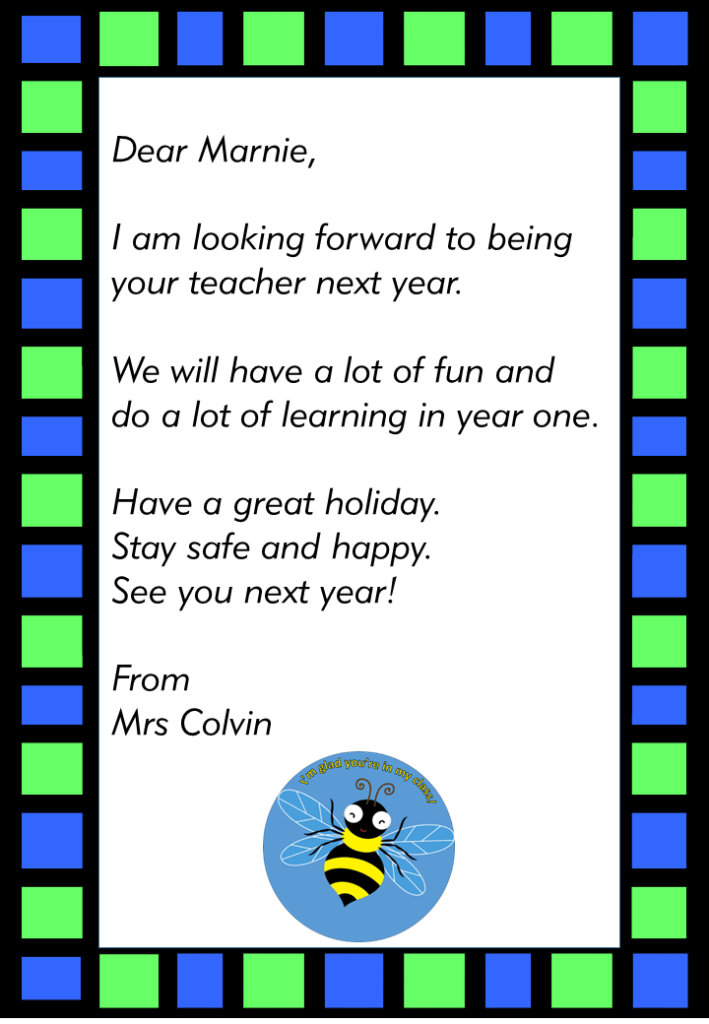
    In addition I would have a letter and a small gift ready for my new students. The letter helps to create a positive connection, makes them feel special and helps to ease the transition back to school after the holidays. It also ensures they remember what class they are in and who their teacher is. It lets their parents know as well.

    end of year letter


    I think this is a wonderful process and one that should be adopted in all schools. It has many benefits; including:

    • helping teachers get to know important information about students before the year begins and aiding preparation.
    • reducing the anxieties of children and parents over the holidays, wondering about which class they would be in and which teacher, even whether they would be in the same class as their friends.

    Once children knew their new classes I arranged their seating and named their groups to match. This provided opportunities for children to bond with future class mates as well as identify their class for the following year. There would be no unnecessary confusion or anxiety on the first day of school.

    https://openclipart.org/image/800px/svg_to_png/192642/Children_holding_hands.png
    https://openclipart.org/image/800px/svg_to_png/192642/Children_holding_hands.png

    I’d love to know what you think of this process or of other processes with which you are familiar.

    With the holidays just around the corner I provide links back to previous posts which provide suggestions for maintaining children’s learning in informal and fun situations.

    Learning fun for the holidays, without a slide in sight!

    Counting on the holidays!

    Let the children write! 20 suggestions to get children writing during the school holidays

    20 suggestions for maintaining reading momentum during the school holidays

    The lists are all available for free download and distribution to parents from my Teachers Pay Teachers or Teach in a Box stores.


    Thank you

    Thank you for reading. I appreciate your feedback. Please share your thoughts about any aspect of this post.

  • It’s a steal

    cyberscooty, The Thief https://openclipart.org/detail/220956/the-thief
    cyberscooty, The Thief https://openclipart.org/detail/220956/the-thief

    This week at the Carrot Ranch Charli Mills is talking about theft; of family pets, of the apples from her garden, of property, and even of good name through myths and false accusations.

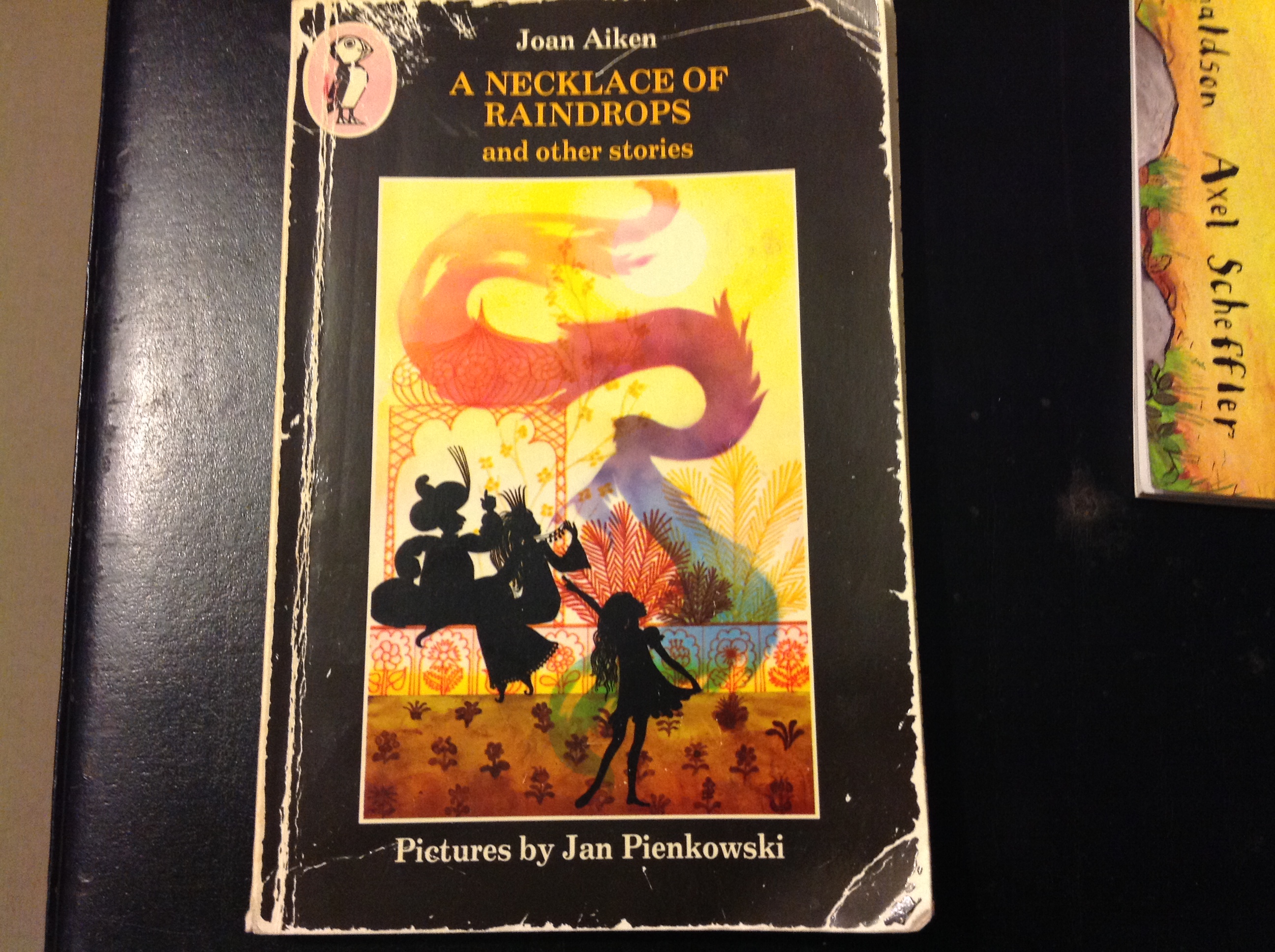
    I didn’t have to think for long to come up with three fairy tales that deal with the issue of theft. Why three? Because three is the fairy tale number. I’m sure most of you will be familiar with these two traditional fairy tales: Goldilocks and the Three Bears, and Jack and the Beanstalk. Some will not be familiar with Joan Aiken’s more modern (1968) fairy tale A Necklace of Raindrops.

    girl and bear

    If you were to search online for teaching resources to support use of Goldilocks and the Three Bears in an early childhood classroom, you would have much from which to choose. Many of the available resources are worksheets and printables with few requiring children to think beyond the surface level of the story.

    youk_k, Beanstalk https://openclipart.org/detail/20020/beanstalk
    youk_k, Beanstalk https://openclipart.org/detail/20020/beanstalk

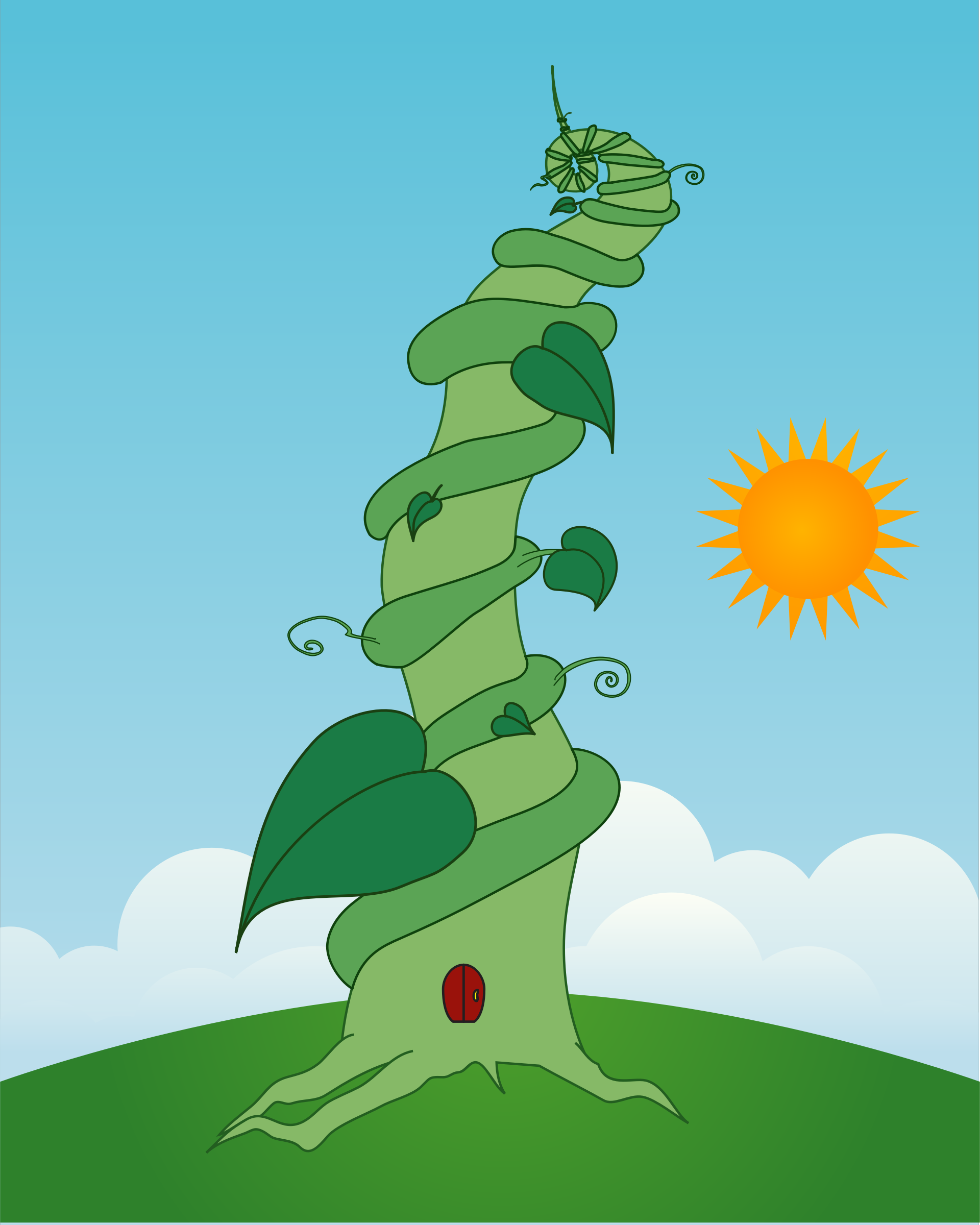
    The same is true for Jack and the Beanstalk. A search for supporting teaching resources also brings up a plethora of worksheets and printables for colouring, cut and paste and writing activities.

    While it’s no secret that I am not a fan of worksheets, activities such as those may have a place if they are used to stimulate language development through retell and role play, support beginning readers and writers in a meaningful context and develop basic mathematical concepts. Children might also be involved in activities associated with the story such as making porridge or growing beans.

    www.openclipart.com
    http://www.openclipart.com

    However children can be encouraged to think more deeply through discussion of the motives and feelings of the characters and the morality of their actions. After all, both Goldilocks and Jack were guilty of break and enter and theft; Jack repeatedly so. Jack didn’t follow his mother’s instructions and was “conned” by the man with the beans. Goldilocks was also guilty of vandalism.

    A strategy for encouraging thinking:

    Ask children to:

    • retell story events
    • tell about the character and character traits
    • make a judgement about  the character’s actions: Was what Goldilocks did good or bad? Was what Jack did good or bad? (Note: It is best for children to make and record this judgement independently of others before sharing their thoughts. The method of recording would be dependent upon the age and ability of the children. They could, for example, write the word “good” or “bad” in a book; or colour a picture of the character e.g. green for good, red for bad.)

    Tally and/or graph children’s responses.

    Invite individuals to explain the thinking behind the decision. A lively discussion may ensue, particularly if there are mixed responses. It would be of interest to note which children maintain their position, which waiver and which change their opinion.
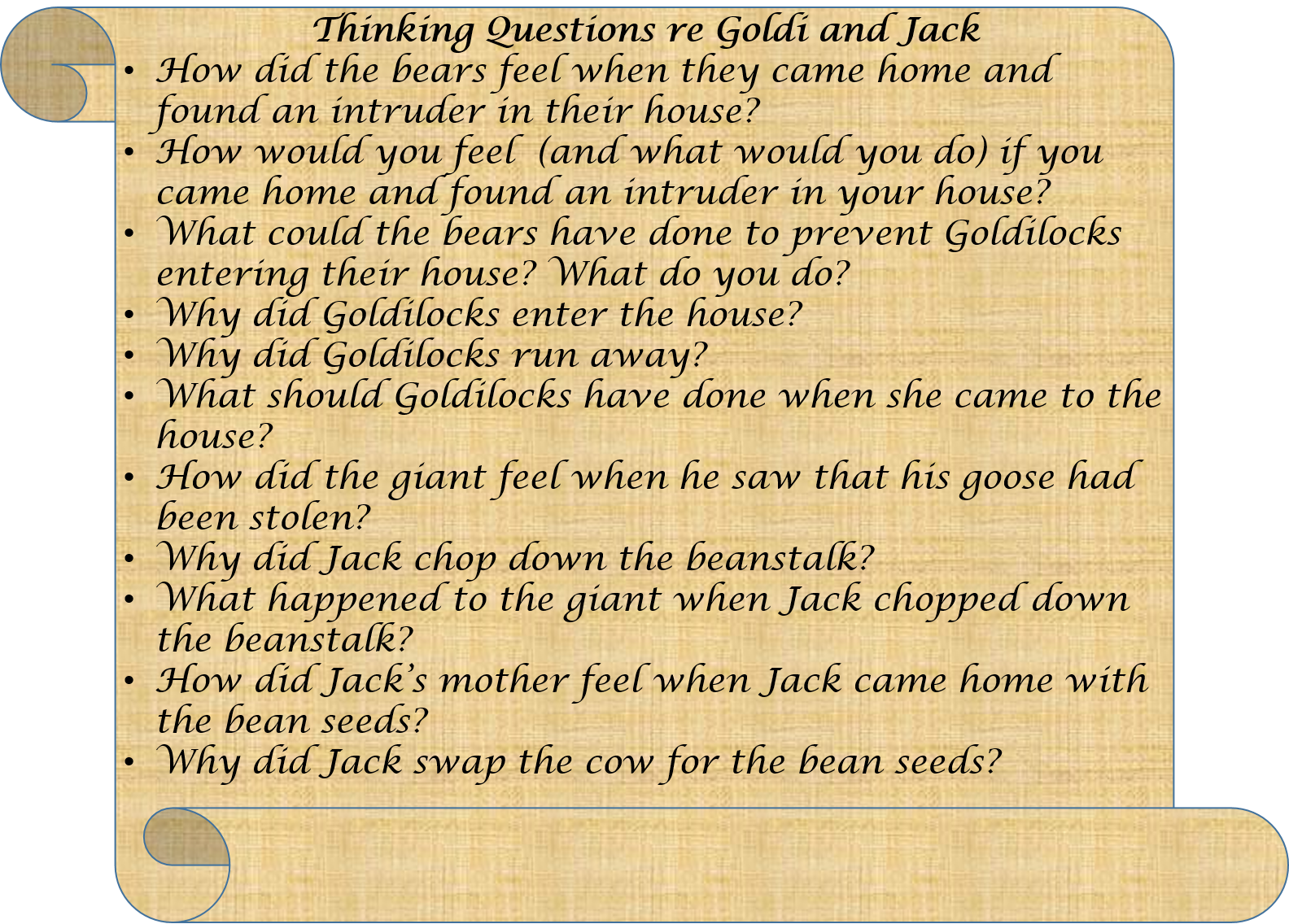
    Other questions can also be asked, and children can be encouraged to ask questions of their own, for example:

    Questions re Goldi and Jack

    Hopefully the events of these stories will be just as fanciful to the children as the settings. Most children will not have records of breaking and entering, and any incidences of petty pilfering or even vandalism will have occurred as part of their learning about property and ownership. Some appropriation of another’s toys or breakages in frustration or misuse are common and nothing to cause concern about future morality.

    a necklace of raindrops

    While the setting of A Necklace of Raindrops is equally fanciful with the personification of the North Wind, talking animals and a magic necklace, the situation, involving schoolyard jealousy and theft, may be more familiar. You will find few teaching resources to support it in an online search.

    book 3

    Here is a brief synopsis:

    A man frees the North Wind from a tree.

    The North Wind gives the man a necklace of raindrops with magical powers for his baby girl, Laura.

    Each year a new raindrop with new powers is added.

    Laura must not remove the necklace.

    At school Meg is jealous of Laura’s necklace. She tells the teacher who insists Laura remove the necklace.

    Meg steals the necklace.

    The animals help Laura get the necklace back.

    The North Wind punishes Meg.

    (Note: My few words have not done justice to Joan Aiken’s beautiful story. If you can, please read the full version.)

    The story is rich with opportunities for discussion with children, including:

    Envy and jealousy — feelings familiar to many children who may have taken, borrowed or used something that didn’t belong to them. They may have squabbled about ownership or use of an item or had someone take something of theirs. Learning a sense of ownership as well as sharing is important in early childhood.

    Telling the teacher — sometimes called “dobbing” in Australia. When is it important, when doesn’t it matter? What were Meg’s motivations?

    Honesty — Was it okay for Meg to tell her father that she had found the necklace on the road? Why did she tell him that? What would he have done if she told him the truth?

    Finders keepers” — Is it ever okay to keep something you find? When might it be okay to do so?

    Following the rules – The teacher insisted that Laura remove the necklace. What could Laura have done or said? What else could the teacher have done? Was it fair for Meg to tell the teacher?

    Stealing the necklace — Was Meg good or bad to take the necklace? Why?

    Why did the magic not work for Meg?

    Was the North Wind’s punishment of Meg appropriate? (He blew the roof off her house so she got wet.)

    Thinking of these issues familiar to many in the schoolyard and playground made me think of Marnie who has experienced some similar situations. In this episode a boy dobs on Marnie for having a unicorn at school. Toys weren’t allowed, but this boy knew it meant Marnie was troubled again and needed the teacher’s help. A teacher is also called upon in this episode when Marnie has locked herself in the toilet and won’t come out. In both those instances the children were dobbing for good reason.

    In this episode Marnie is purposefully tripped and falls into a puddle losing hold of her “security” unicorn, and in this longer episode we find that, later that day, the same boy took her paint brush, and stashed it out of reach on a high shelf. He hadn’t taken it because he wanted it, as Meg had taken the necklace. He had taken it simply to torment, be mean and bully.

    Children, like Brucie, who tease, torment and bully are often themselves victims of similar behaviour. They feel powerless, lacking control in their own lives, and probably lowest in the pecking order at home. Targeting someone more vulnerable provides an opportunity to find a sense of power; for a while at least.

    So that’s where I’m headed for my response to Charli’s challenge to In 99 words (no more, no less) write a story about a thief or a theft. 

    Motives

    The morning started badly; nothing unusual in that. He’d been woken in the night by shouting, slamming doors, and screeching car tyres. Nothing unusual there either.

    There was no milk to moisten his cereal, only a slap to the head for daring to ask. He grabbed his bag and disappeared before she used him as an ashtray, again.

    Looking for a fight, he couldn’t believe she was just sitting there clutching her stupid unicorn. He snatched it; danced a jig to her wails, then threw it onto the roof.

    “I’m telling,” said a witness.

    “Who cares?” was his response.

    Thank you

    Thank you for reading. I appreciate your feedback. Please share your thoughts about any aspect of this post or flash fiction.