Live Love Laugh Learn … Create the possibilities

Tag: School

  • Bully for you!

    No bullies allowed

    Everybody knows what a bully is. If you have never experienced bullying of some kind on a personal level, then you are probably pretty lucky. But you have possibly witnessed, or were at least aware of, bullying at school, in the community, or in the workplace, maybe even at home.

    https://openclipart.org/detail/27915/Thug
    https://openclipart.org/detail/27915/Thug

    Bullies feature strongly in traditional fairy tales such as the stepmother and stepsisters in Cinderella and the mean Rumpelstiltskin in the story of the same name. Roald Dahl also introduced us to bullies through Veruca Salt in Charlie and the Chocolate Factory and Mr and Mrs Twit in The Twits.

    The first picture books I think of when the topic of bullying is raised are Anthony Browne’s Willy the Wimp and Willy and Hugh. They are great to read and use to stimulate discussion of bullying with young children. In this video author Anthony Browne explains that most children recognize a little of themselves in Willy. The transformation from timidity to self-confidence appears achievable and encouraging to all.

    The opposite of being a bully is being kind. This article by Kari Kubiszyn Kampakis, Raising a Kind Daughter tells a heart-warming story of selfless kindness shown by a daughter and her mother. As was commented on in many posts about compassion, including this one, modelling is the best way of teaching children attitudes and behaviours we wish them to learn.

    This week at the Carrot Ranch, Charli Mills has challenged writers to In 99 words (no more, no less) write a story that shows the bully mentality countered with a different, unexpected or kind action.

    Over the past year while I have been engaging with Charli’s flash fiction challenges, I have been developing a character, Marnie, who is definitely no stranger to bullying. Each of Charli’s prompts encourages me to think a little more about Marnie, what may have occurred in her life, and what her responses would be. While I sometimes write about other things, I could not ignore Marnie with this prompt.

    This is what we already know about Marnie,

    as a child:

    • she has a dysfunctional family
    • she suffers physical and emotional abuse, including neglect, from both parents
    • she has a toy unicorn as a comforter
    • she finds the expectations of school challenging
    • she feels alone and excluded at school with few friends
    • she gains the support of one teacher who helps her to develop more self-confidence

    as a teenager:

    • the teacher continues to support her
    • she leaves home and breaks contact with her family

    as an adult:

    • when both her parents have passed she is contacted and returns to the family home, which she sells, relieved that there is no longer any chance of abuse such as occurred in her childhood

    There are still many gaps and unknowns which I am hoping to explore in more detail in the future. In a recent discussion with Charli, I commented that each time I write about Marnie she reveals a little more, in much the same way as she would reveal herself to a new friend or a therapist. I’m thinking she may need to talk to a therapist at some stage. I might need to see who, and what, Anne Goodwin would recommend!

    I hope that somewhere in her life, Marnie has a friend like Annie, described in the article by Kari Kubiszyn Kampakis. Maybe it is Jasmine who we have already met in a previous episode, which also touched on a situation which may have involved bullying. Please let me know what you think.


    https://openclipart.org/detail/117199/Friendship
    https://openclipart.org/detail/117199/Friendship

    Not funny at all!

    Jasmine and Georgie rushed towards the cluster of children who were laughing hysterically at something unseen. They expected to see an entertainer performing magic tricks. Instead they saw Marnie, face down in a puddle, reaching for her unicorn; sobbing.

    “Good one, Brucie!” Two boys high-5ed. Another called, “Way to go!”

    The children stood transfixed by the spectacle. Jasmine pushed through. She picked up the muddied unicorn, stretched out a hand to help Marnie up, then put an arm around her waist,

    As she led Marnie away Jasmine glared at the group of disbelieving faces.

    “Shame on you,” she mouthed.


    Thank you

    Thank you for reading. I appreciate your feedback. Please share your thoughts about any aspect of this post or flash fiction.


  • Who wants five-year old sheep? Bah!

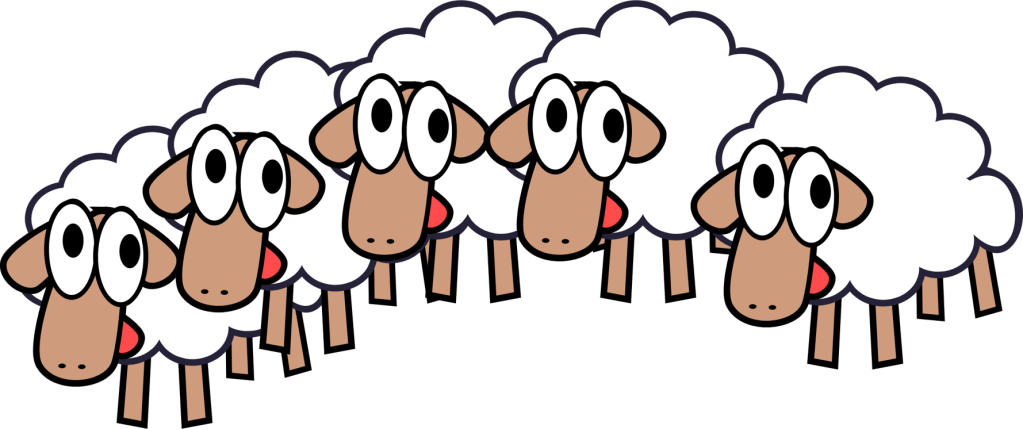
    Who wants five-year old sheep? Bah!

    Recently, thanks to a recommendation by Anne Goodwin, I read a great article on the website of The Writers’ Centre at Norwich. This article is called “Fuelling Creative Minds” and was written by Meg Rosoff. The article is part of The National Conversation about writing reading, publishing and bookselling, or why books matter.

    Rosoff introduced her article by questioning what we consider to be success in life. She discussed a study of 268 men over seventy-five years conducted by George Vaillant who concluded that “warmth of relationships throughout life have the greatest positive impact on ‘life satisfaction‘”.

    Rosoff said that,

    “If you live a happy and fulfilled life, then you die successful. “

    but wondered why, then, “do we persist in measuring success in terms of salaries, job titles and assets?” if they have little real impact on one’s happiness.

    Rosoff suggested that a good place to start thinking about attitudes to success is in school.

    The next part of her article was devoted to attitudes towards success in schools. Rather than provide just an outline of her thoughts, I am quoting them in entirety, as I don’t want to misrepresent her ideas and she says it all so well. While she discusses specifically the situation in the UK, I think many readers will recognise similarities to their own locale. I have highlighted parts that I find particularly noteworthy. I do recommend, however, that you follow the link and read her article in full.

    Excerpt from: “Fuelling Creative Minds” by Meg Rosoff and published by The Writers’ Centre Norwich 1 March 2015

    “In the twenty-first century, educational success is largely determined by the government.  The government puts in place a series of goals that evaluate children as young as three against measures of socialisation, reading proficiency, an understanding of numbers, the ability to answer questions in an acceptable, established manner, and later – during GCSEs and A levels – the ability to pass exams in up to twelve subjects and write essays in a strictly approved fashion.  

    Success in school requires hard work and a competitive approach to study on the part of students – but more to the point, a successful student is one capable of achieving goals as defined by the exam graders, as defined by the government.

    A successful student is one capable of matching learning to this very specific series of goals.

    In other words, a child who reads all day is not a successful student.  A child who writes brilliantly and with a distinctive voice but can’t spell, is a failure. A child who loves history but can’t write an essay in the approved manner, is doomed.  A child who loves stories, who loves to dream, who makes unusual connections, whose brain works in unconventional, peculiar ways – but who can’t multiply 11 x12 – is not a successful student.

    Successful students must sit still and concentrate for long periods of time, temporarily memorise large amounts of information, understand and achieve received goals, think inside the box.  A desire to please and a willingness to conform are key.

    The least successful children in this sausage factory will be branded from the age of five. Children with parents or carers who don’t talk or read to them enough are most likely to fall into this category of early failures. As are dyslexic children.  Or eccentric thinkers. An irregular schedule, disorderly home life and financial instability all interfere with the attainment of ‘success’ as determined by the government.

    Less support at home, fewer books, a less regular schedule, a less orderly home life, less healthy meals, less consistent love – all these economic or emotional disadvantages further condemn the five year old to failure.  Food banks, immigration problems, substance abuse problems, unemployment, parental absence or mental illness – all of these elements interfere with the attainment of ‘success’ as determined by the government.

    I see them when I visit secondary schools – the children branded failures because they can’t get on in school. Because they’re bored, or not very verbal, or not very good at sitting still and taking information in as required in a classroom situation – or the ones who just don’t see why thirteen years of their lives should be spent taking exams they’re not good at, absorbing information in a manner that hasn’t changed much in two hundred years.  ‘Not a student’ is a label that has condemned decades of children to a diminished sense of what they’re capable of in life.  When in fact all it means is, ‘does not thrive within government parameters’.

    Do I buy into the idea that these students are without value?  Of course not.  Put them in a different sort of learning environment or teach them something that stimulates their imaginations and they’ll be fine.  But sit them in a classroom for thirteen years with a series of targets chosen by a government that knows nothing at all about education and they’re doomed.

    In contrast, the most successful children in this whole process of learning and taking exams will get all A*s and go to Oxford or Cambridge, after which they will go on to have what most people consider to be the most successful lives – the best jobs, the highest salaries, large and comfortable and expensive houses and cars.

    And yet.

    In a 2014 book, Excellent Sheep: The Miseducation of the American Elite and the Way to a Meaningful Life, award winning American essayist and educator William Deresiewicz concerned himself with what’s going at the top level of American education.

    ‘Our system of elite education manufactures young people who are smart and talented and driven, yes, but also anxious, timid, and lost, with little intellectual curiosity and a stunted sense of purpose … great at what they’re doing but with no idea why they’re doing it.’

    This was written about Harvard and Yale but applies just as well to elite British universities. Like the highest rated state primary and secondary schools, these institutions take few risks – they admit top performing, highly driven teenagers and turn out graduates with no motive to question the status quo, no motive to question the structure of society or the weight that society puts on a certain kind of success.  

    If you win a beauty contest, you don’t dedicate your life to challenging society’s perceptions of beauty.

    William Deresiewicz continues:

    ‘So extreme are the admission standards now that kids who manage to get into elite colleges have, by definition, never experienced anything but success. The prospect of not being successful terrifies them, disorients them. The cost of falling short, even temporarily, becomes not merely practical, but existential. The result is a violent aversion to risk.’

    All of this is happening at exactly the moment at which the world most needs risk takers: individuals willing and able to retell the story of society in a more positive way.  People willing to take risks with meaningful social and political change. Hardly anyone would disagree that our political system needs changing – free market capitalism has led to terrifying extremes of wealth and poverty.  The pharmaceutical industry needs meaningful change along with the system of drug patents that price simple, inexpensive drugs out of the reach of entire populations whose lives they might save. The legal system favours those with money, as does education, as does housing.  In the meantime, there is little financial motive to stem – or even acknowledge – the devastating effects of global warming.  It is difficult to think of a single aspect of life on earth today that couldn’t do with rigorous deconstruction and rethinking.

    If schools are going to train a better class of political leaders, entrepreneurs, scientists, parents, and social policy-makers, they’re going to have to ask themselves which qualities to promote.  If we require a more compassionate, more radical, less class-riven and self-centered definition of success, where does it begin?

    I would like success to be redefined.  I would like a successful man or woman to be defined as one who thinks creatively and laterally, who questions authority and accepted wisdom, who lives thoughtfully, generously and not entirely for personal gain.  To be successful, I believe, it is important to leave the world a little bit better than you found it.

    How do we do this?  By listening to the wise and enduring voices of our civilization – by encouraging each new generation to read history and philosophy and to think big thoughts – about religion, politics, ethics, love, passion, life and death and the origins of the universe.  The extraordinary imagination of our species – as expressed in poetry and fiction, music, art, dance – might someday spill over into cures for cancer and war and inequality. This will happen not by thinking about what we are, but what we might be.

    A further striving after knowledge and meaning is the proper goal for education.  Everyone doesn’t need to achieve A*s.  But everyone needs to learn how to live a good, creative, questioning life.

    What we don’t need are more five-year-old failures and more excellent sheep. “ 

    Thank you


    Thank you for reading. I always appreciate your thoughts and feedback but, if you have some to share about this article, I’m sure The Writers’ Centre would love to hear them too. If you have time, please copy and paste them over there as well to keep their conversation going.

     

  • A cute angel

    This week at the Carrot Ranch Charli Mills has set an angel prompt: In 99 words (no more, no less) write a story that features an angel.

    Usually I include my responses to Charli’s prompts in longer posts sharing some thoughts about education.

    This week I’m going to leave it as a stand-alone, without the padding I usually provide. I am hopeful that the educational issues I have alluded to will be as obvious to you as they are to me. I’d love to know what you think.

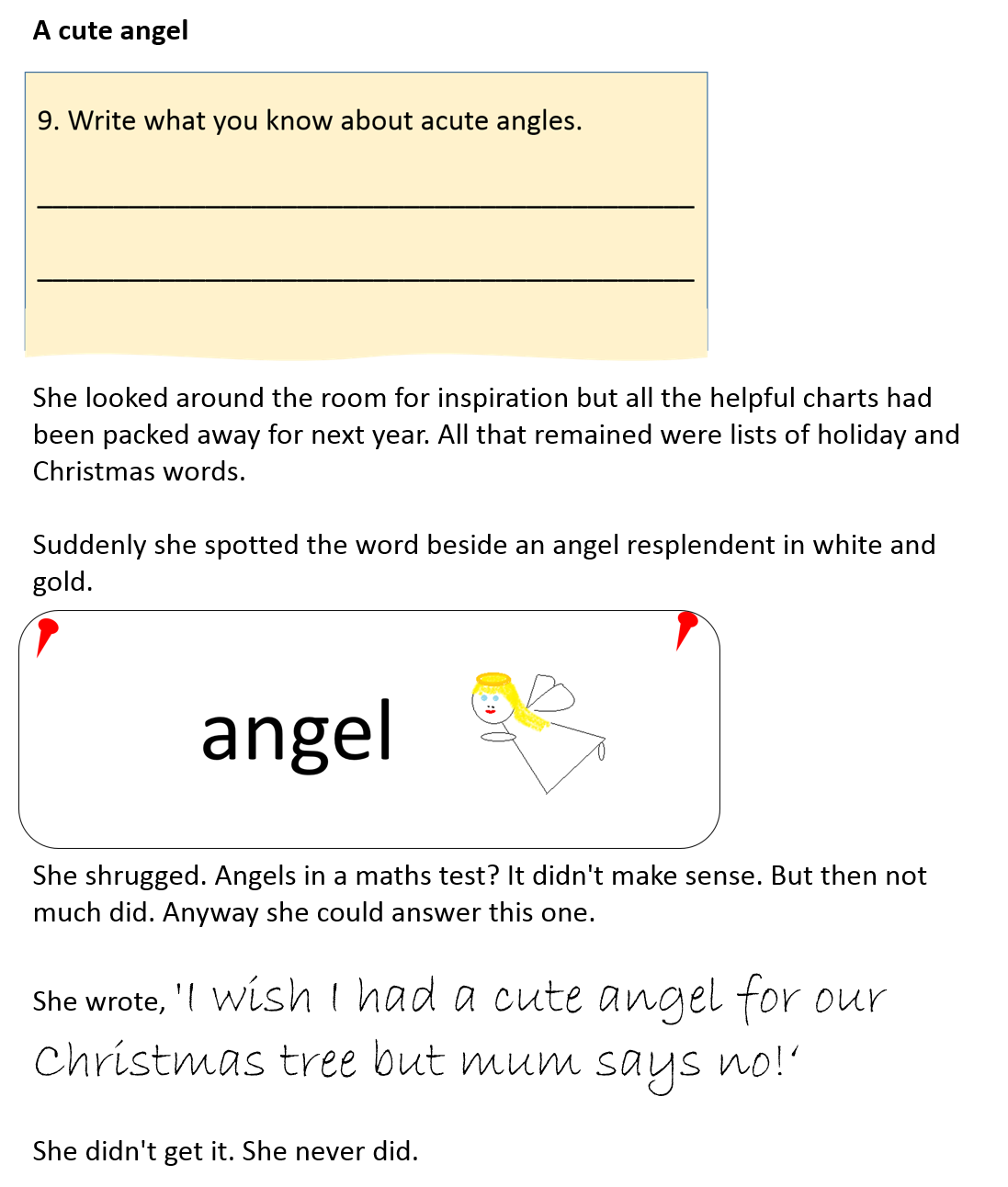
    A cute angel

    Thank you

    Thanks for reading. I appreciate your feedback. Please share your thoughts about this flash and what you consider its message to be.


  • I’m (not) dreaming of a white Christmas

    https://openclipart.org/image/800px/svg_to_png/59389/happy_sun_gm.png
    https://openclipart.org/image/800px/svg_to_png/59389/happy_sun_gm.png

    Last week the flash fiction prompt set by Charli Mills of the Carrot Ranch was to write a story using two objects, people or ideas that don’t go together. There was quite an assortment of responses, including mine. You can read them all here.

    This week Charli has continued in the same vein, challenging us to In 99 words (no more, no less) write a story that pairs something seasonal with something odd. 

    In Australia that’s easy. We’ve already got Christmas in summer. Most people around the world would say you can’t get much odder than that!

    www.openclipart.org
    http://www.openclipart.org

    But it is summertime in Australia and Christmas is just around the corner.

    While we enjoy warm days at the beach and in the pool, picnics in the park and barbecues in the back yard, hoping the big storm doesn’t get us this time (like the one that hit Brisbane on 27 November); those from whom we have inherited our Christmas traditions are cooling down in the Northern Hemisphere, many looking forward to a (not too) white Christmas.


    Shops here are playing traditional (northern) carols with snow, sleighbells and mistletoe; decorations are tinged with fake snow and cards show snowy scenes with families huddled around the fireplace.

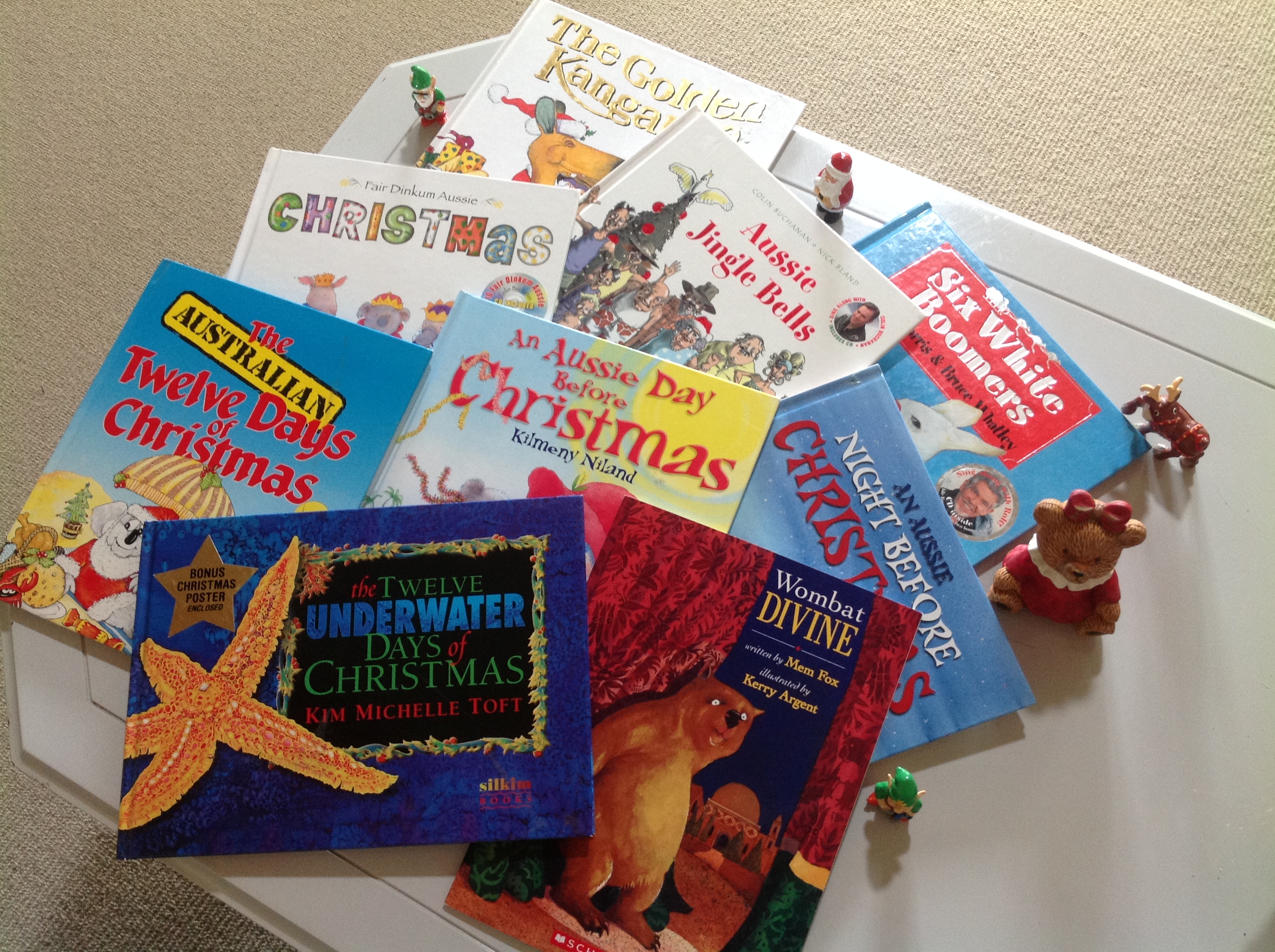
    While there is an increasing number of songs and books with an Australian flavour many are merely innovations on the traditional such, as “The Australian Twelve Days of Christmas”, “Aussie Jingle Bells” or “An Aussie Night before Christmas”.

    Some Australian Christmas picture books
    Some Australian Christmas picture books

    One innovation that I particularly like is The Twelve Underwater Days of Christmas by Kim Michelle Toft. Kim is an Australian who uses her talents as author and illustrator to educate children about the things she feels passionate about: ocean life and coastal habitats. Her illustrations, hand-painted on silk, are absolutely stunning.
    12 Underwater days

    In addition to the visual beauty of the book there is great value in the supporting information through which Kim explains the importance of conserving each of the creatures included in the book. While written by an Australian, the application of the book is not limited to our shores. Creatures from all over the world adorn the pages.  If you ever wished to own a book simply for the beauty of its illustrations, this is a great choice.

    One original song I enjoyed listening to on the radio as a child is “Six White Boomers”. Despite the reasons that make me reluctant to mention it this year, it is a delightful tale of a joey who rides on Santa’s sleigh, pulled by six huge white kangaroos, to be reunited with his mother on Christmas Day.

    Peter CombePeter Combe has written two albums of original, but with a traditional rather than specifically Australian flavour, Christmas songs for children, including this one:

    Some Christmas traditions popular with Australian communities are Nativity plays, carols by candlelight and Christmas parades. Many classes and schools perform their own end-of-year “break-up” concerts to which parents and the wider community are invited.

    Using the traditional Nativity play as the setting, Mem Fox created an original and fresh story in Wombat Divine. It is a delightful tale of Wombat who loved everything Christmas. When finally he was old enough to be in the Nativity Play he rushed along to the auditions. Unfortunately it was difficult to find a part that was just right for Wombat. Can you guess which part he got? You’ll have to read the book to find out! Children all over the world will identify with Wombat and his predicament and enjoy the heart-warming tale.

    Books are wonderful gifts to give or receive at any time. The titles I have mentioned here are perfect for giving, reading and sharing at this time of year. When I was growing up there was always a book for Christmas and birthdays, a tradition that I have continued with my extended family and friends. You can almost, but not always, guarantee that if it is a gift from Norah, it is a book.

    After my siblings and I had grown up and swelled the family numbers with partners and children of our own, my Mum used to say, “There’ll be no presents this year.” It wasn’t that she wasn’t a giving person, for she was. It was just that there were so many of us! When she passed away this year she had about fifteen grandchildren and eight grandchildren, in addition to her remaining nine children and their partners. (I’m saying ‘about’ for grandchildren and great-grandchildren in case I’ve missed some in the count!) You can imagine how daunting a task it would be to go shopping for all these people ranging in age from six months to sixty! However it was always surprising how frequently she did not follow her own rules and had a small something wrapped up to present to many of us.

    This year there will be no presents from Mum, and more sadly, we will be without her presence.

    Although I have borrowed my Mum’s words, “No presents” for both flash fiction pieces included in this post, the stories do not cast aspersions on her generosity. I have simply explored how the oddness of no presents or presence at Christmas time may have impacted Marnie, a character I have been developing in my flash fiction pieces, at different times in her life. At this stage of my writing I am still investigating her character, discovering a little more with each flash piece as her once indistinct figure begins to step out of the shadows and take shape.

    This first piece is written about a difficult time for teenager Marnie and a situation that may be the catalyst for her leaving home.


    No presents

    Marnie jerked backwards avoiding the predictable grope. In so doing she collided with her mother, sending her sprawling onto the tattered sofa.

    “Aargh!” her mother screamed. “Look what you’ve done!”

    Marnie watched the liquid from the upturned glass merge with the patchwork of stains collected in the carpet. If it was her blood it would not have mattered more.

    “I … I’m sorry,” she stammered. But her sorry was for all the years it had been like this.

    He smirked, raising his hand to strike, “No presents for you this year!”

    “That’s right!” She ducked. “No presence!”


    So as to not be too dismal at this time of year, I have written a second piece about a younger Marnie for whom there still seems a glimmer of hope.


    No presence

    With faces as bright as their Christmas wear, the children bubbled into the room, each carrying gifts for the Kindness tree, “for those less fortunate”.

    Parents fussed, removing smudges and replacing wayward hair before blowing kisses and hurrying off for the parade.

    And there was Marnie: no parent, no Christmas dress, no gift, no smoothed-down hair; no smile.

    One last chance.

    “Marnie!” I beckoned, and held out my Christmas cape and crown. “Will you be my special helper?”

    Our eyes locked communicating more than any words. Her smile was my reward.

    “I’m proud of you,” I whispered.

    Thank you

    Thank you for reading. I appreciate your feedback. Please share your thoughts about any aspect of this post or flash fiction pieces.

  • December reflections

    https://openclipart.org/image/800px/svg_to_png/194578/07-Juli-goin-on-a-summer-holiday.png
    https://openclipart.org/image/800px/svg_to_png/194578/07-Juli-goin-on-a-summer-holiday.png

    The end of the school year in Australia has approached swiftly and silently this year, for me at least. You see, now that I am not in the classroom I am not absorbed by all the things that the end of the school year brings.

    In Australia the school year coincides with the calendar year so November and early December are frantic for teachers completing the final assessment and reporting for the year, preparing their students (and themselves) for separation after spending so much of the year together, and making preparations to welcome a new class in the new year.

    The classroom remains busy with learning and curriculum matters until the last day. Both teachers and students begin to tire and the warming (hot, in most parts of Australia) days in classrooms without air-conditioning add to the fraying edges of all as they anticipate the long summer holidays.

    teacher beginning and end

    One thing I always enjoyed about the end of the year, that made all the extra work and the increasing heat tolerable, was the learning about family traditions and celebrations, including Christmas.

    Some Australian Christmas picture books
    Some Australian Christmas picture books

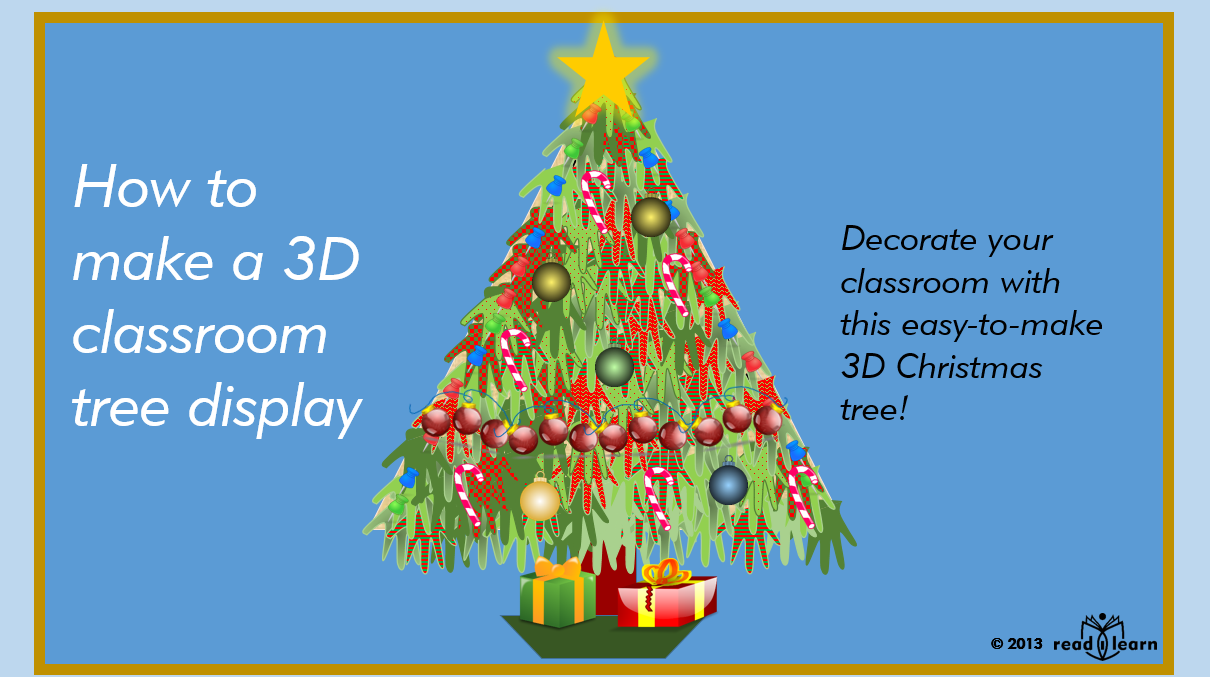
    Last year I wrote about some of the Christmas activities I did with my class, such as making friendship trees

    Friendship treeand a co-operative 3D display.

    3D Christmas tree display
    3D Christmas tree display

    I shared some suggestions for parents to support their children’s  reading, writing and maths development in fun ways during the holidays. (These and other items are available in my TeachersPayTeachers store.)

    I also provoked a lively discussion about whether Christmas should be included in a school program by suggesting tens reasons for its inclusion. Many readers joined in explaining their position either in support or against.

    I always enjoyed this special time of year. I loved hunting through discount stores for items with which children could make cards and gifts for their families and decorations for their home. Often we talked about “free” gifts they could give and made vouchers for things like a free car wash, breakfast in bed or unlimited smiles and hugs.

    https://openclipart.org/image/800px/svg_to_png/59389/happy_sun_gm.png
    https://openclipart.org/image/800px/svg_to_png/59389/happy_sun_gm.png

    As well as the gifts they made for each other in class, such as the friendship trees and Christmas crackers, I always gave each child a small gift, usually a book to read, a pencil and notebook for writing in; something to do over the holidays.

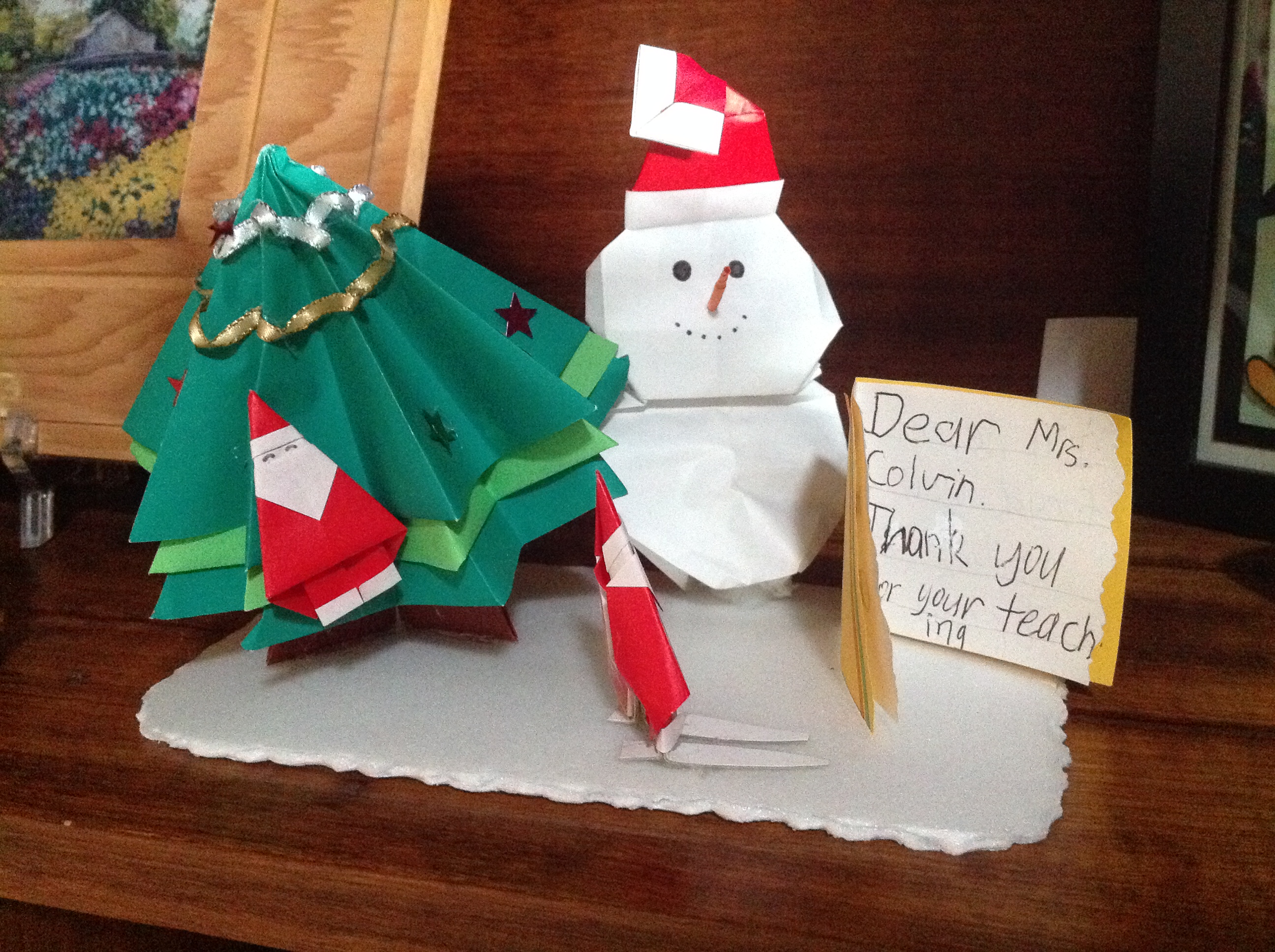
    While it was never expected, but always very much appreciated, many of the parents and children presented me with lovely ‘thank you’ cards, letters and gifts, some purchased, many home-made; all treasured. While the consumables were long ago enjoyed, many other items still adorn my shelves!

    A selection of gifts from over the yeats
    A selection of gifts from over the years

    Brian

    Sometimes it was difficult to know what to give as a gift to recognise a special teacher. This year Bec has come up with, what I think, is the perfect gift, though she didn’t design it for that purpose. It’s the apple cozy: a special little bag for carrying an apple safely, protecting it from bumps and bruises. They are available in her Made It and Etsy stores. An apple for the teacher in its own special bag: how cute!

    Apple Cozy // Joyce
    Apple Cozy // Joyce

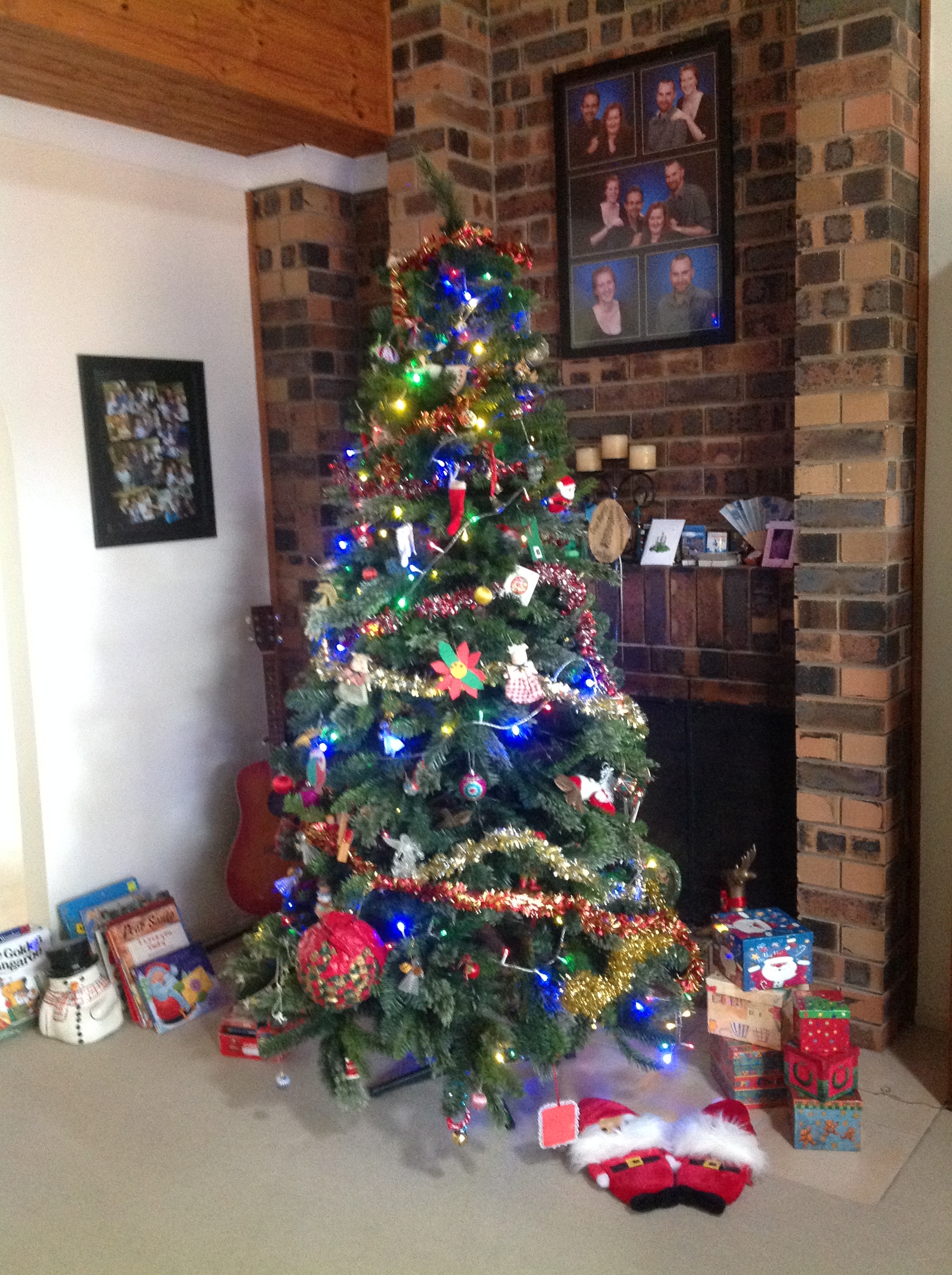
    Although there are no preparations for Christmas at work this year (except for Secret Santa) there is still much to do at home. The traditional time for putting up the tree and decorations is December 1, and I usually have mine up by the end of the first week in December. Now that both my children are grown and living in homes of their own, I thought I would have the lonely experience of decorating on my own this year (Hub says he helps by not helping, but actually he gets tree and decorations down from the roof space for me!)

    What a delightful surprise it was to have both my children and grandchildren (all two of each) visit on the day I was putting up the tree and help me out. The joy that the excitement of a 3- and a 5-year old bring to such activities cannot be matched. I think we did a pretty good job! When I look at it I relive the fun we had together.

    Christmas 2014
    Christmas 2014

    Although to most it would appear simply a Christmas tree, and some may consider many decorations to be ready for the discard pile, most decorations have a story to tell. For me it is a memory tree. It holds decorations made by my own children over the years, and now some by my grandchildren.  There are gifts from family and friends, and children I have taught. Each item, as it is placed on the tree, provides a time for reflecting upon the wonderful people whose lives have touched mine over the years. Each has its own story to tell of the joy that others’ kindnesses can bring. But it is more even that just a memory tree. It is a giving tree; a time for remembering and being grateful.

    What are you family traditions? What and how do you celebrate?

    Thank you


    Thank you for reading. I appreciate your feedback. Please share your thoughts about any aspect of this post.


  • Whose failure?

    I think about education. A lot. You could say it consumes me. It has been my lifelong passion, and although I am not currently in the classroom I don’t stop thinking and reading about how we learn and how learning can best be encouraged. My discontent with how schooling often is and my optimism for what it could be has been a recurring theme on my blog and a driving force in my life. You would not have to open too many posts to find at least one expressing that view.

    education-is-2

    My poem “Education Is” sums up the differences I see between education and schooling. Some schools do education really well. Some professing to be educational institutions school, very badly. What I consider to be one of the major differences is that education encourages a love of learning that lasts a lifetime; while schooling attempts to force-feed content in such a way that learning is neither enjoyed nor viewed as anything other than what one is forced to do in school.

    In traditional schools assessment often takes the form a test which requires students to regurgitate information that has been thrust upon them, whether they like it, or are interested in it, or not. This occurs across all subject areas. I have written about it before in relation to writing tasks in these three posts: Writing to order – done in a flash!  Writing woes – flash fiction  and Who tests the testers?

    I contrasted my choice of responding to Charli Mills’ flash fiction prompts to the lack of choice students have in state- or nation-wide writing tasks. In Writing woes – flash fiction  I suggested that it would be difficult for me, on a given day, with a restricted amount of time, under the watchful eyes of supervisors, to produce my best work in response to a prompt about which I may have little experience, knowledge or interest.

    www.openclipart.org http://goo.gl/Ep1vK6
    http://www.openclipart.org http://goo.gl/Ep1vK6

    In my flash fiction responses I introduced a unicorn as a symbol of escape from the confines of the classroom or other oppressive situation, into the space where one is free to truly be oneself. It wasn’t a deliberate or premeditated choice, simply a response to Charli’s prompt. However I am happy to adopt it in my flash fiction as a symbol of playfulness and imagination unleashed; the basis for all great inquiry and innovation. Thank you, Charli, for the prompt!

    I introduced the unicorn in the post Of rainbows and unicorns – Part 1 – Fantastic creatures and magical realms and used it again in What do you have in mind? , I’m too busy to be tired! And Reading is all it’s cracked up to be: 10 tips for an early childhood classroom

    I have returned to both these themes again in response to Charli’s most recent prompt to In 99 words (no more, no less) write a story inspired by your muse. I’m not certain who my muse is, but I am certain that it would be very difficult to call upon a muse to assist when writing in a test situation such as that expected of students in school.

    My piece is titled ‘Failure’, but this is the question I have for you: Who really deserves the “F”? Whose failure is it really?

    Failure

    She spluttered out the splinters of pencil: no longer tasty, never helpful. The assessor’s steely eyes pounced. She wiped the last vestiges from her mouth; staring blankly, as blank as the paper in front of her.

    Outside the sunlight danced like fairies on the leaves, beckoning. Below, in the shade, the unicorn pranced and called her name.

    “Why do I have to do this stuff? Who cares anyway!”

    She grasped the broken pencil and scored a large “F” on the page.

    Then she closed her eyes and was away, riding to freedom and joy on the unicorn’s back.

    What do you think?

    Thank you

    I appreciate your feedback. Please share your thoughts about any aspect of this post or my flash fiction writing.

    If you are interested in reading other of my flash fictions pieces, I have collected them all together on one page which you can access here or click on the Flash Fiction tab above.

  • Visioning a better school, a better way of educating

    school cropped

    I spent a good part of the 1990s working towards creating an alternative to traditional schooling for my own daughter and the children of similarly-minded parents. For an assortment of reasons, none of which had anything to do with education, we didn’t get the school operational. There is a big part of me that still longs for that alternative and I am always interested to hear of situations which espouse similar beliefs and attitudes to mine. When I do, my heart starts to race and I want to holler and jump for joy, shouting from the rooftops, “See it can be done! This is how it should be! This is what children need!” I want to be in there with them, a part of it all, learning from and with them, and perhaps even adding a little to their learning, should I be that impudent to suggest it possible.

    Yesterday was one such occasion. I popped over to Tara Smith’s A Teaching Life blog and read her post “Preparing for a student teacher”. I always enjoy reading Tara’s blog and could identify with much of what she was feeling while preparing to welcome a student teacher into her classroom. But what got me most excited was a video of a talk given by Chris Lehmann at the 2013 MassCue (Massachusetts Computer Using Educators) conference.

    Chris Lehmann is the founding principal of the inquiry-driven Science Leadership Academy (SLA) in Philadelphia. The achievements of both Chris and the SLA are rather impressive. You can read about them here, here and here. Chris is one excited, enthusiastic and inspiring educator.

    The video of Chris’s keynote address to the conference is rather long at almost 1 hour and 8 minutes (in comparison the mostly 15-minute TED talks that I often watch). I admit that when I saw how long it was I baulked, wondering if I had that amount of time to “spare”. Fortunately something in Tara’s words induced me to do so. After all I didn’t have to watch it all, did I? But watch it all I did. How could I not? His dream was my dream:

    I-had-this-dream-Chris Lehmann

    And then Chris added:

     ‘all these people showed up and breathed life into that dream’

    Here is his talk. If you don’t have time to listen to it all, I give you a few of my favourite quotes. (You may have already encountered some of these ideas before on my blog!) But who knows, he may have other thoughts that resonate with you.

    People-send-us-their Chris Lehmann

    Chris says that many people often ask why schools can have so many problems when there are so many passionate, dedicated teachers. He answer is simple: ‘We have a systemically screwed up system and if you put a good person in a bad system the system wins way too often.’ He says that ‘the factory model of education . . . no longer works for our children if it ever did.’

    Chris says that one of the biggest problems with many schools is that students are being repeatedly told to do stuff that they may never need or even care about. He says, ‘If we were to write a students’ bill of rights the first statement on it should be this question:

    www.openclipart.com
    http://www.openclipart.com


    ‘Why do I need to know this?’


    He then goes on to say that ‘They shouldn’t even need to ask it because the reason should be so apparent through the work that they are doing that is meaningful and relevant to their life right now.’

    https://openclipart.org/image/800px/svg_to_png/191354/Good_Grade.png
    https://openclipart.org/image/800px/svg_to_png/191354/Good_Grade.png

    He says that kids can do amazing things but that the sad thing is that unless it can answer a question on a state-wide test, no one will care! He says that using data from standardised tests is dangerous and that the best data comes from the work students are doing in class every day.

    He says that better questions to ask of schools would be:

    ‘What is your college persistence rate?

    How many of your graduates five years out are either in school or in a job where they are over the poverty level?

    What does a student survey of your school tell you about whether or not the students feel valued and feel that their education is valuable?’

     Personalised-instruction Chris Lehmann

    These are just some of the things that Chris Lehmann says schools should be:

    • Inquiry driven
    • Student centred
    • Teacher mentored
    • Community based
    • Places of collaboration and incredible passion with
    • Integrated learning
    • Project based

     High-school-should-not Chris Lehmann

    In traditional classrooms the assessment tool is a test. Chris talks not about tests but about projects. He says,

    “If you really want to see what a kid has learned it’s about the project, it’s about what they can do, what they can create, what they can transfer, what they can make, what they can do with their own head, heart and hands. A true project is when kids get to own it.’

    Every-moment-of-time-a Chris Lehmann

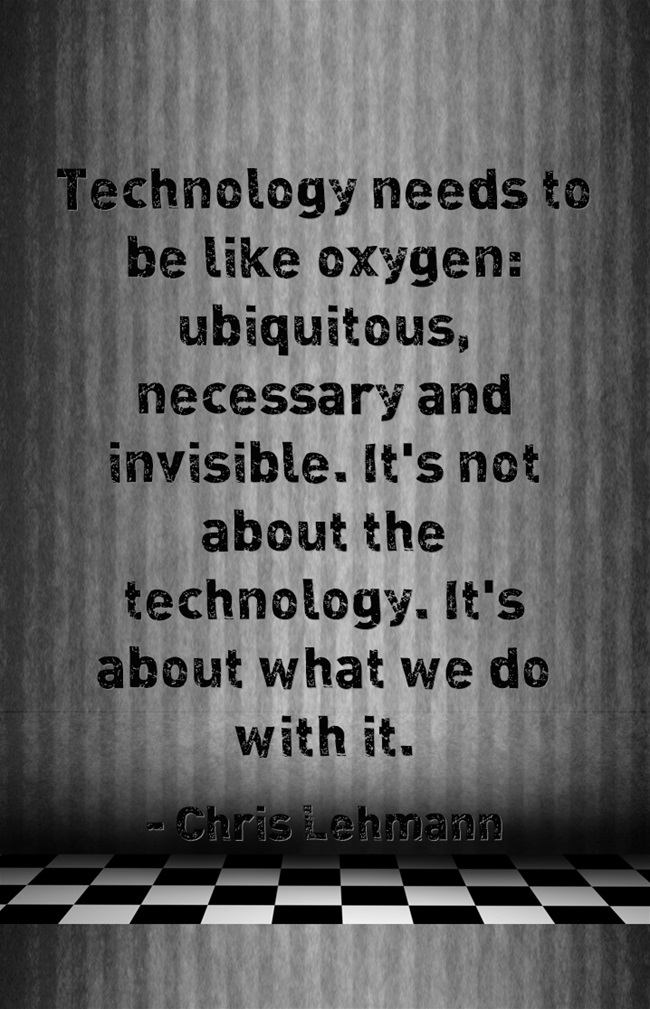
    Technology-needs-to-be Chris Lehmann

    His goal is to educate people to be ‘thoughtful, wise, passionate and kind’ and says that

    ‘ what were really trying to do is nothing less than trying to change the world.’

    This brings me back to my two previous posts How much of a meliorist are you? and Can you make a difference? which drew quite a debate (unintended) about whether we believe we can, or should, try to change (i.e. improve) the ‘world’. I think Caroline Lodge who blogs at book word sums it up quite nicely for educators, saying

    ‘ I am a meliorist. How can someone in education stay there if they are not? The kids improve their skills and understanding, the world turns, and sometimes (like this summer) seems on the way to hell in the proverbial handcart. But there are SO MANY people working to improve the world. Educators as special people in this.’

    For Chris,

    ‘The link between an inquiry-driven education and a care-driven education are three simple questions:

    What do you think?

    How do you feel?

    What do you need?’


    He says, ‘Everything you do should empower children.’ Thanks Chris. My words exactly!

    He says,

    ‘Kids can do real work. We have to dare them to do that, we’ve got to help them, we’ve got to facilitate the work and we’ve got to get out of the way.’

    The Science Leadership Academy is not the only ‘school’ of note. In response to previous posts, including Food for thought and Are you ready to embrace the future Charli Mills of the Carrot Ranch left comments and links to information about a school attended by her children, the Minneapolis’s School of Environmental Studies (SES). Charli linked to this article about the school and another on Edutopia that includes a 10-minute video that she says aptly describes what makes SES a learner-based school. She also provided a link to a very impressive student project developed by two of her daughter’s classmates, and a link to a video produced by students explaining the school. Overall, if I represent her views correctly, Charli was very happy with the education her children received at SES and the impact that project-based learning had on their lives.

    These are just two of the many wonderful schools out there empowering learners. If you know of others, I’d love to hear about them.

    Thank you

    I value your feedback. Please share your thoughts about any aspect of this post. I’m happy to follow the discussion wherever you lead.


  • It’s written in the stars

    https://openclipart.org/image/800px/svg_to_png/129913/lkjhgfds.png
    https://openclipart.org/image/800px/svg_to_png/129913/lkjhgfds.png

    An interest in star signs is worldwide. A google search of ‘star signs’ brought up 126 000 000 results in 0.15 seconds. You can find out what your star sign is, famous people who share your sign, get a description of your personality, find out who you are or are not compatible with, and what the future holds for you.

    But how accurate do you think your star sign is, and how accurate are the predictions?

    Are they any more accurate than a teacher’s predictions of a child’s future?

    https://openclipart.org/image/800px/svg_to_png/191354/Good_Grade.png
    https://openclipart.org/image/800px/svg_to_png/191354/Good_Grade.png

    Think back to your school days and the comments written by your teachers on your report cards. Have you lived up, or down, to their expectations?

    Comments sometimes described me as conscientious and said that I worked hard. At other times I needed to work harder, and was told that I could do better, that I needed to concentrate more on … (insert subject name – any will do). Comments in opposition, like the two sides of a coin or the twins of my star sign Gemini.

    https://openclipart.org/image/800px/svg_to_png/178912/tweedles.png
    https://openclipart.org/image/800px/svg_to_png/178912/tweedles.png

    However teachers do not always know, and cannot always predict future life journeys of their students.  Consider how inaccurate were teachers’ predictions for people as diverse as Einstein, Edison, Churchill, Darwin and Pasteur who showed little promise while at school. Disney was accused of lacking imagination, and Salvador Dali of daydreaming. John Lennon’s teachers were not impressed when he answered “happy” in response to the question, “What do you want to be when you grow up?” The list of successful people with unforeseen potential is long. I’m sure you know stories of many others from all walks of life. Maybe yours is one!

    Over at the Carrot Ranch this week, the flash fiction prompt by Charli Mills is to: In 99 words (no more, no less) focus on the personality traits of a character informed by the zodiac.

    Mine is not exactly about the zodiac, but about another form of prediction equally as accurate.

    As expected

    A lawyer, a doctor and a journalist walked into a bar, ‘Class of ’99’ emblazoned on their backs.  

    Talk flowed freely.

    When someone mentioned old ‘four-eyes’ Proffet, laughter erupted.

    “Thought he was a prophet,” they chorused.

    “Mark my stars,” the lawyer mimicked, wagging his finger. “You need to learn to be less argumentative.”

    The doctor peered over her glasses and giggled, “And you miss, will never amount to anything!”

    “Remember Prophet’s favourite, ‘most likely to succeed’?” said the journalist. “Saw Daniel last week, handing out horrorscopes, on corner of Main and Black. Hardly recognised him. Poor sod.”

    Thank you

    Thank you for reading. I appreciate your feedback. Please share your thoughts about any aspect of this post, including my flash fiction

    I’ll leave you with a song about a star someone was born under. Not my star, and not the zodiac either, but a popular song when I was growing up.

    I was born under a wandering star  sung by Lee Marvin in Paint Your Wagon

  • Imagine that!

    Imagine that!

    Recently Hope at Nanny Shecando sent me a tweet requesting some thoughts about imaginative play in a school setting. Sadly I would say that imaginative play has been just about pushed out in the ever-increasing content-driven and assessment focused curriculum. Seeing children as young as five spending much of their day sitting at desks filling in worksheets and parroting back isolated bits of information flashed at them in meaningless drill and practice sessions is about as far away from my thoughts about education as you could get. If it is difficult for early childhood teachers to squeeze time for imaginative play into their programs, imagine (there’s that word) how difficult it is for teachers of older children.

    However, whenever I hear the above quote by Thomas Edison, I am reminded of how an early childhood classroom should be: a place for imagination, exploration and discovery.  Parents may tire of the cardboard box creations that children regularly bring home, wondering where each one can be stored (or discreetly disposed of!), but the value to be had from the opportunity to create, imagine and play must not be understated.

    For imagination to flourish in an early childhood classroom, I suggest the following ingredients are essential:

    A recognition of the importance of play and imagination in the healthy development of children and the prioritisation of opportunities for imaginative play every day by providing:

    • Time – lengthy and uninterrupted, with the opportunity for created play areas to be left intact over a number of days or weeks
    • Space – both indoor and outdoor with a variety of larger and smaller spaces
    • Opportunities for self-selection of activity and self-direction
    • Books for story reading and play acting
    • Variety of props: things such as dress-up items including lengths of fabric that can be a kings robe, a princess’s dress, a magic carpet, an apron, a bed; hats and scarves; toys like cars, dolls, animal toys; building blocks and cardboard boxes; paper, cardboard scissors and pens for creating signs, posters and crowns; areas for quiet play with cushions; open spaces for creating larger ‘worlds’ . . . the items that can be used to inspire imagination are limitless.

    When children are showing interest in a particular topic, an observant teacher may gather up a variety of props and leave then in a box for children to discover and use as they decide.


    https://openclipart.org/image/800px/svg_to_png/30889/lampada_di_aladino_alad_01.png
    https://openclipart.org/image/800px/svg_to_png/30889/lampada_di_aladino_alad_01.png

    In an earlier post, Learning at its best: A classroom of magic, Hope herself described a school with an open space ‘where magic happens’. She described a friendship tree where ‘friendship and freedom of speech are fostered’; an area with a ‘magic carpet . . . plush beaded cushions and Middle Eastern style blankets . . . a place for imagination to prosper. Anything is possible when dreamed, imagined or conjured whilst on the magic carpet.’

    magic carpet

    She described an area for drama and the opportunity of being and expressing yourself. She described a creativity corner where young inventors could create anything they could imagine; and spaces to read, explore, share and dream. One could think this school was in Hope’s dreams, her imagination of what is possible. But it is a real school educating real children in very positive ways that will have a very different effect that the scenario I described above. However it is not a typical school. There is not one like it in every suburb. In Hope’s words, it is a ‘very select private school’. But don’t all children deserve learning opportunities such as these?

    After re-reading Hope’s post, I’m not entirely certain why she invited me to share my thoughts about imaginative play in a school setting. I think she has described a wonderful example of imagination in practice. The design of the school and the aspects of the program described above, show the value of imagination, not only of the students but of the school designers, administrators and teachers.

    In a recent post Just imagine . . . the power of imagination I talked about the power of imagination to drive creativity and innovation, and suggested that much of what we now accept as commonplace was once only in someone’s imagination. Einstein said that,

    ‘Imagination is more important than knowledge. For knowledge is limited to all we now know and understand, while imagination embraces the entire world, and all there ever will be to know and understand.’

    Maria Montessori is attributed with the idea that Play is child’s work’. In this article Thinking about Children’s Play David Elkind, refutes that idea citing works by both Freud and Piaget, a psychologist whose work greatly influenced thinking about child development and learning. Elkind, himself a professor of child development and of author of books such as The Hurried Child, The Power of Play  and Miseducation, says that ‘Although Montessori has made many important and lasting contributions to early childhood education, her identification of work and play in young children was unfortunate.’ He says that, in play, children are not preparing for life, they are living life.

    Early-instruction - David Elkind

    Elkind does not favour the imposition of formal learning situations upon children of increasingly younger ages.  The following excerpt from Miseducation, shared in Commentary: The ‘Miseducation’ of Young Children Elkind says, ‘When we instruct children in academic subjects, or in swimming, gymnastics, or ballet, at too early an age, we miseducate them; we put them at risk for short-term stress and long-term personality damage for no useful purpose. There is no evidence that such early instruction has lasting benefits, and considerable evidence that it can do lasting harm.’

    He continues, saying that ‘The most important thing is an excitement about and enthusiasm for learning. Skills are easily learned when the motivation is there.’ I agree wholeheartedly and have joined in with a discussion of motivation in a number of posts, most recently in Motivation – why we do the things we do.

    An-ounce-of-motivation David Elkind

    In another article Can we play? shared on The Greater Good in 2008, Elkind explains that imaginative play is important to academic as well as social and emotional development. Unbelievably, he said that ‘More than 30,000 schools in the United States have eliminated recess to make more time for academics.’ It is difficult to imagine how unwelcoming and uninspiring a school without recess would be. I wonder how much lunch time those who made these rules allow themselves.

    He says ‘Play is motivated by pleasure. It is instinctive and part of the maturational process. We cannot prevent children from self-initiated play; they will engage in it whenever they can. The problem is that we have curtailed the time and opportunities for such play.

    In the words of Cat Stevens (Yusuf Islam), ‘Where do the children play?’  I add ‘and when?’


    If you wish to read further, here are some links to get you started. I don’t agree with all the content. Some suggest a more structured approach than I would favour. However, as with everything, a broader knowledge helps one more clearly formulate one’s own position.

    Assessing and Scaffolding Make-Believe Play by Deborah J. Leong and Elena Bodrova

    Teachosaur thoughts ‘Play is the work of children’ … J. Piaget

    Tools of the Mind Supporting Make-Believe Play

    Psychology today The Need for Pretend Play in Child Development


    I value your feedback. Please join in the discussion by sharing your thoughts about any aspect of this post.

  • Motivation – why we do the things we do

    Over at the Carrot Ranch this week Charli Mills is talking about motivation, specifically the motivation of fictional characters to do the things they do. She explains that ‘motivation can be external–a desire to please, to be found attractive, to be accepted’ or ‘internal–a drive to succeed, a passion to experience adventure, a fear of failure’.

    Motivation is not a new concept to this blog and I have explored it in a number of previous posts.

    stars

    In What did you do that for? Rewards and motivation I discussed the use of extrinsic rewards (such as stickers, awards and cash incentives) for school students; and questioned the authenticity of intrinsic motivation, which ‘is usually related to something of one’s own choice through interest, challenge or purpose’, in an institution at which attendance is compulsory.  I suggested some strategies that teachers may employ to stimulate an intrinsic love of learning.

    why am I doing thiswhat's the point

    Continuing the consideration of the effect of compulsory schooling on a learner’s motivation, the post Why do I have to? explored the use of philosophy as a tool for making the goals of education explicit. All three philosophers: Peter Worley, Michael Hand and Stephen Boulter agreed that if students knew why they were expected to learn certain things, they would be more motivated to do so.

    the examined life

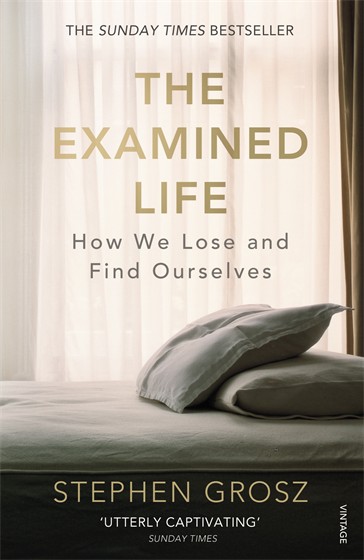
    A discussion of the impact of praise upon a learners’ motivation and achievement was stimulated by reading The Examined Life by Stephen Grosz, a book recommended by Anne Goodwin.  The Post Seeking praise – Stephen Grosz revisited explored Grosz’s suggestion that praise could cause a loss of competence, especially if children were being praised for being clever. Responses to the post, including a guest post by Anne Goodwin, added greater depth to the discussion.

    Other ideas about motivation abound.

    https://openclipart.org/image/800px/svg_to_png/59389/happy_sun_gm.png
    https://openclipart.org/image/800px/svg_to_png/59389/happy_sun_gm.png

    Shelley Wilson’s blog Live every day with intention,  which promises to inspire and motivate you (‘A motivational blog about living life to the full, writing, reading and feeling inspired to follow your dreams’) is the basis of her new book ‘How I changed my life’.

    In this TED talk The puzzle of motivation, Dan Pink explains that the value of intrinsic motivation is a scientific fact. While the focus of his talk is the business world, the findings are equally relevant to education. He says that external rewards may work in limited situations but that they often impede creativity. He says that ‘the secret to high performance isn’t rewards and punishments, but that unseen intrinsic drive – the drive to do things for their own sake. The drive to do things because they matter.

    Which brings me back to my motivation for writing this post and sharing these thoughts: Charli’s post, mentioned at the beginning of this article, was an introduction to her flash fiction prompt to In 99 words (no more, no less) show the underlying motivation of a character.

    My motivations for engaging with the flash fiction challenges set by Charli are both intrinsic and extrinsic:

    I enjoy:

    • the dual challenges of writing to a prompt with a clearly defined word count;
    • the opportunity of writing fiction;
    • exploring the application of Charli’s prompt, however tenuous, to education;
    • the camaraderie of the fellow writers and the opportunity to read and comment on their posts and flash fiction pieces; and

    I appreciate the feedback, support and encouragement I receive in response to my writing.

    In her prompt, Charli suggested that the character ‘may not even understand the motivation fully, but (that I should) let the reader grasp it.’ I have written two pieces in response to this prompt. I hope you enjoy them, and get an inkling of what motivates the characters.


    More than numbers

    The more he stared at the numbers the less sense they made.

    They swirled and blurred. He just didn’t get it.

    “Numbers don’t lie,” they’d admonished.

    “But they don’t tell either,” he’d thought.

    The hollowness left when all he knew had been extracted could not be filled with the smorgasbord of numbers loaded on the page.

    The richness of lives reduced to mere squiggles.

    “This is what’s important,” they’d said, fingers drumming tables of data.

    With heaviness of heart he closed the book and walked away.

    “They are not even numbers,” he thought. “If they were numbers, they’d count!”


    More than words

    “More!” they implored.

    She surveyed their eager faces then glanced at the clock.

    “Just one more?”

    “Okay. Just one more.”

    Before she could choose, a book landed in her lap.

    “This one,” he said.

    “Yes,” they chorused. “It’s a good one!”

    She smiled agreement, then started to read.

    They joined in, remembering, anticipating.

    She turned the page.

    “Wait!” he said. “Go back.”

    “Did you see that?” He pointed to the page.

    “But look what he’s doing,” someone else chimed in.

    They all laughed.

    The shared joy of a beloved book. Each time the same. Each time a little more.

    Thank_you_pinned_note

    Thank you for reading. I do appreciate your feedback. Please share your thoughts about any aspect of this post or my flash fiction pieces.