Live Love Laugh Learn … Create the possibilities

Tag: Reading

  • Learning fun for the holidays, without a slide in sight!


    Alanspeak, A slide for children to play on https://openclipart.org/detail/191139/childrens-slide
    Alanspeak, A slide for children to play on https://openclipart.org/detail/191139/childrens-slide

    A week or two ago my good friend Sarah Brentyn who blogs at Lemon Shark (Navigating the uncharted waters of parenting and life) raised the issue of students having required reading over the summer holidays. Sarah recalled that when she was at school she had lists of books to read, and book reports to complete as proof of having done so. She expressed concern that no holiday reading is currently required of her school-age sons.
    nlyl, reading man with glasses https://openclipart.org/detail/3133/reading-man-with-glasses
    nlyl, reading man with glasses https://openclipart.org/detail/3133/reading-man-with-glasses

    The basis for Sarah’s concern is what is known as “the summer slide”, the loss of skills, especially reading, if not practised over the long summer holidays.  Studies show what teachers observe: that students start a new school year with skills at lower levels than just a few months earlier. Revision and review of the previous year’s work must be factored in before new work can be commenced.

    Sarah wasn’t so much concerned for her sons who are avid readers and will read regardless of whether it is required or not. Knowing Sarah, her sons will also benefit from an environment enriched with a variety of other learning experiences. All children could benefit from the types of support and encouragement Sarah provides for her sons.

    Sarah’s concern was for children who don’t choose reading as a holiday activity. She believes children should continue to learn over the holidays, and does not understand why learning can’t be fun. I agree with Sarah. However I am a bit ambivalent about the requirement that particular books be read, and probably am not in favour of asking that book reports be submitted.

    CoD_fsfe_Books_icon

    There was never any set reading to be done over the holidays when I went to school, or when my children went to school, and I am not aware of any such requirement of children attending school currently in Australia. The fact that it is not a requirement doesn’t make it either right or wrong. It is simply a new concept to me.

    I would be reluctant to set homework for completion over the holiday period, especially the summer holidays for a number of reasons, including:

    • students will be moving to a new class and teacher, some even to a new school, after the holidays and that teacher may not view the set work in the same way
    • students have spent the school year reading, writing and performing other activities required of them, activities that may have little relevance or interest to them
    • students may spend the holiday period in alternate activities and then rush or “fudge” required tasks, seeing them simply as work that must completed, rather than something they want to do
    • I think children need time to follow their own pursuits and interests without having to fill in a worksheet to say what they have done
    • I think children and their families need some time together without the stress of completing set tasks
    • I think it is important for children to have time to wonder, imagine and create, to be comfortable in their own company, devising their own plans and schedules and activities, some of which may be just down time (the ability to relax in an ever-hurried world is very desirable).

    gardening

    But, like Sarah, I wouldn’t always be leaving children to their own devices, allowing them to wander the bush and beach from daylight till dusk as I did during the school holidays (when I wasn’t reading a book, playing games with siblings or friends or doing household chores). I would be mindful of their activities, ready to make suggestions, provide experiences or encourage other interests; but the direction would always be theirs and never forced or “required”.

    However I am equally as keen to avoid the occurrence of that “summer slide”. As my contribution towards its prevention while also promoting the notions that learning is fun and that opportunities for it abound, I link to three of my previous posts:

    20 suggestions for maintaining reading momentum during the school holidays

    Let the children write! 20 suggestions to get children writing during the school holidays

    Counting on the holidays!

    While I reproduce the suggestions from each post here, each set of suggestions is also available as a free downloadable PDF in my TEACHERS PAY TEACHERS store. For your convenience, I have provided a link to each in the headings below:

    https://openclipart.org/image/800px/svg_to_png/174860/bookworm_penguin.png
    https://openclipart.org/image/800px/svg_to_png/174860/bookworm_penguin.png

    Reading

    1.  Read to and with your child every day – continue the practice established throughout the year with special sharing times during the day or at bed-time — or both!
    2. Demonstrate that you value reading by making time for your own reading, or setting aside a special quiet time when everyone in the family reads.
    3. Visit the library and borrow to read, read, read!
    4. Read poetry books, song books, picture books, joke and riddle books, crossword books, information books, chapter books (these can be read to younger children, or with older children – taking turns to read a page or a chapter each) — what are your favourites?
    5. Trade books no longer read for others at a second-hand book store.
    6.  When dining out, have your children read the menu and choose their own meal.
    7. Include your child in holiday cooking and have them read the recipe – ingredients and method. Perhaps they could read the recipe book to select the meal for the day.
    8. Suggest your child read the TV guide to find when favourite programs are showing and establish a timetable for viewing, rather than haphazard watching with random flicking through channels.
    9. Provide your child with bookstore catalogues and encourage them to read book descriptions to guide their next selection.
    10. Bestow upon your child the title of ‘Family weather watcher’ and have them consult weather forecasts in the newspaper or online to select the most suitable days for planned outings and activities. 
    11. Include your child in making decisions about holiday activities. Give them the guide, or read the guide together and jointly choose the activities.
    12. Make the library, museums and art galleries high on the list of must-dos. Many of these offer a wonderful assortment of free holiday entertainment for children, and reading is an essential part of getting the most from each visit! 
    13. Engage your child in some craft activities which require them to follow written instructions. The ability to understand and follow procedures is empowering and requires the ability to read written, as well as visual, instructions.
    14. Encourage your child to ask questions about every day events and phenomena. Help them to research in books at home, in the library or on the internet. 
    15. Provide eBooks as well as books in print. Good ones bring a new dimension to the reading experience.
    16. When going out for the day, or journeying further away on a holiday, support your child in locating destinations on a map and in selecting an appropriate route. Engage your child in giving directions while en route. 
    17. Include your child when reading bus or train timetables.
    18. When doing the family grocery shop, give your child their own list of items to look for. 
    19. Listen to recorded books on long car journeys, or have books for listening to or reading along with in bed.
    20. Make the most of every reading opportunity that occurs throughout the day!


    https://openclipart.org http://goo.gl/ZvsCFc
    https://openclipart.org
    http://goo.gl/ZvsCFc

    Writing

    1. Use adhesive notepaper to write messages to your child and encourage your child to write a message back.
    2. Encourage children to write letters or emails, cards or postcards to grandparents, aunties, uncles and friends. These can be to inform them of the holiday or the year’s activities, or to thank them for a visit or gift.
    3. Demonstrate that you value writing by making time for your own writing, e.g. keeping a diary, writing letters and cards to family or friends, writing a shopping list.
    4. Display a message board prominently in the home and list important events, reminders and messages. Encourage your child to add their own messages to the board.
    5. Provide a calendar or diary and ask your child to note family birthdays, holidays and events for future reference.
    6. Encourage your child to keep a diary in which important events and feelings are noted.
    7. Play word games e.g. Scrabble and other crossword games; Boggle or ‘hangman’. (If you don’t like the connotation of ‘hangman’, give each player ten counters to start with. Each time an incorrect guess is made, they give away a counter. If all counters are used then they miss that word.)
    8. Write poems and songs together.
    9. Encourage children to write and perform ‘plays’ for the family.
    10. Take photos of events during the day and use them to make a photo book. This can be done instantly on a computer with photos taken using a phone or tablet and emailed with accompanying text.
    11. Insert photos from a phone, digital camera or tablet into a slideshow program such as PowerPoint, then add text to create a digital story or record. With one click these can be saved as an automatic show or MP 4 video.
    12. Involve children in planning the weekly meals by selecting recipes for a menu they write, and for which they create a shopping list of required ingredients.
    13. Write rebus messages to your children and ask them to write a rebus message back, e.g.                 I think you are great
    14. Invite your child to create lists e.g. activities they would like to do over the holidays, movies they would like to see or friends they would like to invite to a sleep over.
    15. Encourage your children to write the step-by-step instructions for making a craft item they have just designed, or to write down the rules for a game so that everybody is sure how to play.
    16. Suggest that your child write down questions they would like answered, and then write the information discovered during research (by interviewing or asking people, reading books or internet search).
    17. Suggest to children that they make a storybook for a younger sibling or friend.
    18. When going out for the day, or journeying further away on a holiday, children could be asked to write directions for the journey as discovered by consulting paper or online maps.
    19. Help children to set up and maintain a blog to create a record of activities and events to be shared with family and friends. The posts could be regular e.g. daily or weekly, or follow particular activities.
    20. Make the most of every writing opportunity that occurs throughout the day!

    Moini, sleuth penguin https://openclipart.org/detail/221475/sleuth-penguin
    Moini, sleuth penguin https://openclipart.org/detail/221475/sleuth-penguin

    Maths

    Number and place value

    1. Count items e.g. birds in the sky, shells collected from the beach, people for lunch, steps in a staircase, windows on a house, seats in a bus . . .
    2. Count out the cutlery required for each person at dinner
    3. Include your child in shopping activities by helping them to:
    • Recognise the coins and notes
    • Count the value of coins and notes
    • Predict whether they have enough money to purchase an item, and whether there will be change
    • Tender the money in payment for an item

    4. When your child is sharing e.g. the biscuits, balloons or slices of fruit, ask them to:

    • Predict if there will be enough for everyone to have one, or more than one each
    • Share out the items, allocating the same number to each
    • Determine if there are any left over and what to do with them

    5. Use terms like half and quarter correctly, e.g. when cutting apples, oranges, sandwiches, pizza, to indicate pieces of equal size

    6. Play games that involve counting, e.g. counting the number of skips, balls in hoops, pins knocked down or dice games like snakes and ladders that require adding as well as number recognition and counting

    7. Make up number stories e.g. “We had five apples in the bowl. I ate one, and you ate one, how many are left?”

    8. Read books with number concepts e.g. Pat Hutchins The Doorbell Rang, Eric Carle Rooster’s off to see the world  or Kim Michelle Toft One Less Fish

    Patterns and algebra

    1. Use items to make patterns e.g. sort and create a pattern from shells collected at the beach, building blocks or toy cars
    2. Look for patterns in the environment e.g. fences, tiles, walls and window, zebra crossings
    3. Decorate cards and drawings with a patterned frame
    4. Make gift wrapping paper by decorating with potato prints or stamp patterns

    Measurement and geometry

    1. Include your child in cooking activities and allow or support them to:
    • measure the ingredients
    • set the temperature on the oven
    • work out the cooking finish time
    1.  A child’s understanding of volume and capacity can be developed when they:
    • pour glasses of water from the jug and discuss terms such as enough, full, empty, half or part full, more, less
    • pour from one container into another of a different shape to compare which holds more and which holds less
    1.  Scales can be used to compare the mass of different items or quantities e.g. compare an apple and an orange, measure the mass of butter required for a recipe
    2.  Measuring length can be included by:
    • measuring and comparing height
    • cutting a length of string to tie a package
    • measuring who is closest to the jack in a backyard game of lawn bowls
    1.  Use the calendar to
    • Learn the names and sequence of days in the week or months in the year
    • count the passing days or the number of days until an event
    1.  Identify shapes in the home and environment e.g.
    • 2D shapes: tiles on floor and walls, shapes of windows, sections of footpath
    • 3D shapes: cereal boxes (rectangular prism), balls (sphere), bottles or cans (cylinder), dice (cube)
    1.  Play games that involve shapes e.g. jigsaw puzzles, tangrams
    2.  Talk about directions e.g. left, right, forwards, backwards and follow directions on a grid
    3.  Play games that involve directions and movement in space e.g. battleship,Hokey Pokey,Simon Says, snakes and ladders, ludo
    4.  Read and discuss books that include measurement concepts e.g. Pamela Allen:Who Sank the Boat?(volume); Eric Carle: The Very Hungry Caterpillar (days of the week) and The Bad Tempered Ladybird (time); Penny Matthews and Andrew McLean A Year on our Farm (months and seasons); and for looking at places on a map Mem Fox Sail Away The ballad of Skip and Nell or Annette Langen & Constanza Droop Letters from Felix

    Probability and statistics

    1. When discussing the weather or desired activities include the language of probability e.g. possible, certain, likely, unlikely, impossible
    2. Encourage children to collect data about family or friends by asking yes/no questions e.g. do you like swimming, or making a graph of the family’s favourite colour or meal.
    3. Play games with spinners and dice and talk about the likelihood of spinning or throwing a particular number.


    I hope these activities demonstrate how easy it is to maintain learning while having fun over the holidays. I’m sure you will have many more favourites of your own.

    Thank you

    I appreciate your feedback. Please share your thoughts about any aspect of this post.

  • Five Photos Five Stories – Day one

    For the love of books

    This week I was surprised to be nominated by, writer extraordinaire, Geoff Le Pard in a Five Photos Five Stories challenge. Geoff blogs at TanGental where he shares numerous and beautiful photos of his garden, family, travels and adventures. He writes an eclectic assortment of prose and poetry, memoir and fiction, with content both challenging and humorous. He also posts at the speed of light with at least one post each day. I can understand why the challenge would appeal to Geoff.

    I’m not like that. I tend to stick to my routine of two posts each week and write mainly expository text about education with a response to a flash fiction prompt by Charli Mills thrown in. I rarely write explanations of or stories about photos and mostly use photos to support and add interest to the page. Why would Geoff nominate me?

    Well it seems Geoff must have known something about me that I didn’t, as I have decided to throw caution to the wind and join in the challenge.

    The rules of the Five Photos, Five Stories Challenge are:

    1) Post a photo each day for five consecutive days.
    2) Attach a story to the photo. It can be fiction, non-fiction, poetry, or a short paragraph. It’s entirely up to the individual.
    3) Nominate another blogger to carry on the challenge. Your nominee is free to accept or decline the invitation. This is fun, not a command performance!

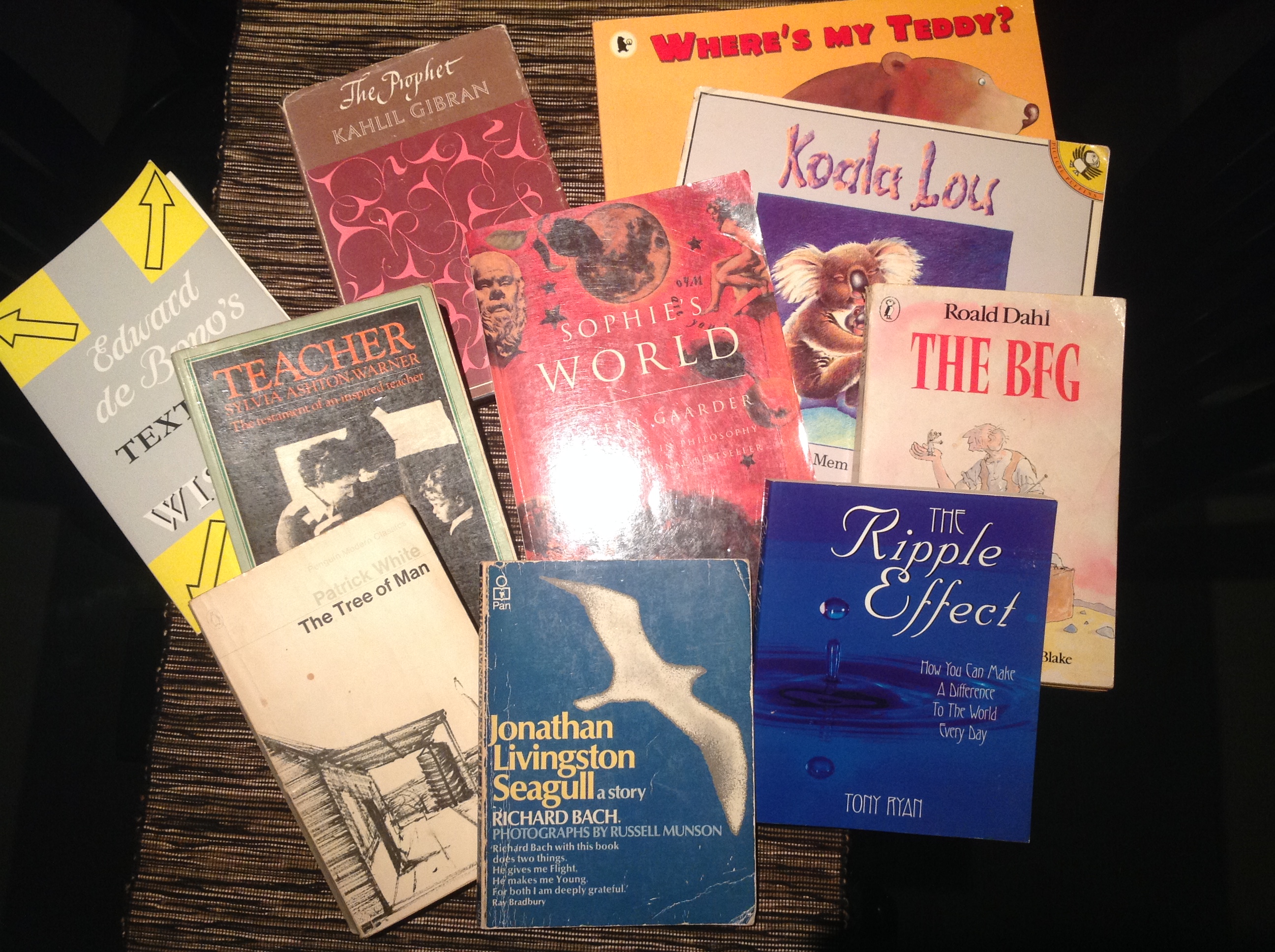
    For my first photo I have chosen, and you won’t be surprised, books:

    books

    These are just a few of my favourites. As you can see I have chosen a range including picture books and chapter books for children and both fiction and non-fiction titles for adults. There are others that should have been there but I could not fit my entire collection into one photo!

    Books have always been an important part of my life and I think a love of reading is one of life’s greatest pleasures. My love of books and reading is one of the reasons, if not THE reason I feel so passionately about education and the teaching of literacy. Sharing a learner’s excitement at becoming literate is both an honour and a joy. I have been privileged to share that excitement with many children during my teaching career, and of course with my own two children who both learned to read well before starting school.

    I have written about the importance of reading many times before, including here, here, and here.

    For this post, and for this photo, I will share ten totally random recollections of books and reading from my younger years.

    I remember:

    • books as gifts for Christmas and birthdays
    • an expedition to the council library, a six-kilometre walk there and back, each Saturday afternoon for an armful of books to read during the week
    • being deaf to the world when totally absorbed in a book for hours on end (particularly so when there were jobs to be done)
    • the eagerness of wanting to get to the end of a book and the sadness and reaching the last page
    • the excitement of finding the next book in a series or by a favourite author
    • marvelling at words and phrases for the imagery or feelings they evoked
    • enjoying an author’s style and trying to emulate it by writing and writing and writing, and wishing to one day be an author too
    • the smell of new books
    • tracing the embossed lettering on the hardcover when the jacket was removed
    • being fiercely protective of my books and having a great dislike of seeing them torn or marked
    • the joy of ownership

    And now I nominate the lovely Michelle James who blogs at Book Chat to take up this challenge if she so wishes. Her love of books is at least as great as my own!

    Thank you


    Thank you for reading. I appreciate your feedback. Please share your thoughts about any aspect of this post.
  • Not the ‘R’ word!

    the older you get

    For the past few years people have often asked me when I will retire. Some people think I already have. Some think I am too young to be thinking about it (they are either very kind or very blind), and others think I should have done it long ago.

    I have preferred to ignore the word ‘retire’ for the negative connotations I thought it embodied and the implication that I would have to admit to things like:

    • I’m getting old
    • I have nothing left to contribute
    • I am passed my use-by date and can’t keep up with modern trends and developments
    • I am ready for ‘God’s waiting room’. (I ‘m not even sure I’d be able to find the right room, and he’d probably keep me waiting for ever anyway!)

    Even this morning I heard an ad on the radio that put together the concepts of retirement, having more time on one’s hands, retirement village and nursing home.  If that’s what retirement means, it’s not for me.

    https://openclipart.org/image/800px/svg_to_png/154735/faltige_frau.png
    https://openclipart.org/image/800px/svg_to_png/154735/faltige_frau.png

    When I was fifty-ish and working part-time, I awoke one morning to the realisation that, if I was going to retire at sixty, I had only ten years of working life left. With that in mind I returned to full-time work in order to earn as much as I could so that I could save enough to support myself in retirement. (I think I should have had the epiphany many years earlier!)

    When the ten years of teaching full-time as a year one teacher were done, I was still not ready to consider the ‘R’ word. However just at that time an opportunity to be involved in writing curriculum support materials was offered. A short break from the classroom to refresh and re-energise was a welcome idea and I accepted the position.

    After eighteen months in the role I reverted to working part-time in order to devote more time to my own writing while establishing a website for peddling said writing. I didn’t consider it retirement, transition to retirement, or anything to do with retirement. For me, the working week was simply a combination of paid work and working for myself. It was not time off.

    mystica_Coins_(Money)

    Now another eighteen months has past and I am indeed counting down the ‘paid’ working days until ‘retirement’. In my head and heart I still don’t consider it retirement, perhaps a re-alignment of priorities, but others do. I am breaking ties with my long-term on-and-off employer for the fourth and last time. This time there will be no going back. Even though I may have said that on each of the three previous occasions I resigned and still went back; this time I am very doubtful of that occurring. This time it is ‘officially’ retirement, and I accept that if I have more time on my hands to do my own work, then that is a good thing!

    It is the enthusiasm that others have for me and hearing them excitedly question, “What are you going to do?”  that has helped my change of heart and I am beginning to accept their use of the ‘R’ word. Denial would be another unwinnable battle. So what if I intend to spend the days of my retirement at the computer? Getting a website up and running might be just an expensive hobby, but not as expensive as others I could think of, like boating or flying! And definitely more fun for me.

    https://openclipart.org http://goo.gl/ZvsCFc
    https://openclipart.org
    http://goo.gl/ZvsCFc

    The changing view of self as transitioning through working full-time, part-time, being semi-retired, or retired is not unique to me. While some embrace the change, eager to accept every opportunity that freedom from employer demands and schedules has to offer; others like me sidestep in, with a similar appreciation of the freedom from outside expectations but an ever-increasing expectation of self.

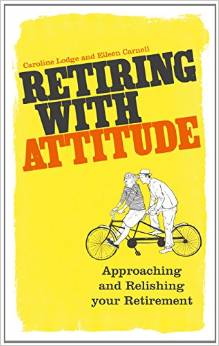
    retiring with attitude

    Last year “Retiring with Attitude”, written by one of my favourite bloggers Caroline Lodge and her colleague Eileen Carnell, was published. I found the title quite intriguing and thought it may apply to me, though I wasn’t sure to which attitude they were referring. However the subtitle “Approaching and Relishing your Retirement” gave a few clues and I knew I had to read it. Were they serious?

    In the introduction the authors explain that retirement should be viewed as “a time of further exciting possibilities”. They set out their goals which include convincing readers that the “old” view of retirement (they say “previous”) is no longer applicable; that possibilities abound; that outdated views of ageism and sexism should be challenged; and that “Learning is the most powerful means to handle changes and transitions” that occur in the retirement phase of life.

    Retiring with Attitude” is an easy and enjoyable read which I recommend to anyone approaching (from near or far) or already in retirement. The authors have drawn upon their own experiences and many years of research from which to explain options and make suggestions for every aspect of life. While “Chapter 11: This is Your Rainy Day: Relationships with Money” does discuss finances, the book raises many other issues including seeking and accepting support as well as ways to ensure you are not over-committed to fulfilling others needs and requests.

    The authors emphasize that there is no one way for everyone to do retirement but that learning and good communication are the key. They say that retirement can be the time of one’s life and that

    As an older person you can develop a new identity and redefine your life.

    I think that’s the ‘R’ word for me: Redefine. I’ll get to do those things I always wanted to do but didn’t have time for when my focus was elsewhere.

    Thank you

    Thank you for reading. I appreciate your feedback. Please share your thoughts.


  • Spelling tests – How well do you score?

    ABC

    Familiar to most will be the weekly spelling test held on a Friday morning after a week’s practice at learning a list of words. Some will have dreaded the test fearing they may forget the “i before e”, “silent” letter or double letter rules, for example, their inadequacies made all too obvious by the large red crosses. Others would have relished the experience, requiring little effort to learn words they already knew, seemingly by osmosis, with the expectation of large red ticks and 10/10.

    Spelling test

    I dare say that most of you reading this blog are of the 10/10 variety. Just to be sure this is so, I have set you a little spelling test to do before you read any further. Please get your pen and paper, finger and notebook, or keyboard ready, then press PLAY to take the test.

    So how did you go?

    I hope you could see from that exercise that knowing how to spell has a lot to do with meaning. In fact the spelling of many of our words in English has more to do with morphology than with sound, and although sound can be helpful there are often many different letters or letter combinations that can be used to represent the same sound, for example:

    eye

    According to the Bullock Report, published in 1975:

    “For 6092 two-syllable words among the 9000 words in the ‘comprehension vocabularies’ of a group of 6-9 year olds, 211 different spellings of the phonemes were needed – and these spellings required 166 rules to govern their use! Even at that, 10% of the words had to be left aside as ‘exceptions’; which means that ‘even if a young child memorised these rules while learning to read he would still encounter hundreds of words not governed by them.’”

    Lists of words, such as spelling lists, provide little support for learners, rarely providing context or meaning which might help them remember the words, or choose the correct meaning and therefore spelling, as shown by the spelling test exercise given above.

    Alphabetical

    In his book “Alphabetical: How Every Letter Tells a Story”, Michael Rosen explains that transmitting meaning is the reason for writing, for having an alphabet.

    Rosen describes the alphabet as “a stunningly brilliant invention. We could call it a ‘cunning code’ or a ‘system of signs’ whereby we use some symbols (letters) to indicate some of the sounds of a language. … Though it is wonderful, there are some snags for users …” including:

    • letters and letter combinations do not represent the same sound each time they are used (e.g. ‘c’ in ‘cat’ and ‘city’)
    • letters represents different sounds according to regional accents
    • a particular sound is not always represented by the same letters (see the ‘eye’ example above)

    He says that “Becoming or being a reader of English involves absorbing all these variations and then forgetting that they exist.”

    a phonic's teacher's lament

    He explains that the alphabet is more than a system of sounds and syllables and that “Our forebears devised alphabets so that they could store and retrieve meaning … over time and/or space”.

    While not speaking specifically about learning spelling words, in his book “Why Don’t Students Like School? A Cognitive Scientist Answers Questions About How The Mind Works and What It Means For Your Classroom” (referred to in a previous post here), Daniel T. Willingham consistently refers to the importance of meaning when acquiring knowledge. He says,

    “Teachers should not take the importance of knowledge to mean they should create lists of facts . . . some benefit may might accrue, but it would be small. Knowledge pays off when it is conceptual and when the facts are related to one another, and that is not true of list learning. Also … such drilling would do far more harm by making students miserable and by encouraging the belief that school is a place of boredom and drudgery, not excitement and discovery.”

    When a child scores poorly in a spelling tests and their errors are marked in red they see themselves as bad spellers, lose confidence in their ability and have a defeatist attitude before they even try.

    Why is spelling important?

    Standard spelling is essential to ensure the meaning of the message is transmitted correctly from writer to reader. While readers may very quickly notice spelling errors in text they are reading, these few errors, when embedded in meaningful text, rarely inhibit the transmission of meaning. However if the bulk of the text is in nonstandard spelling, the message would be virtually indecipherable.

    How do we learn to spell?

    The most effective way most of us use to learn to spell is reading. While reading we are exposed to a large number of correctly spelled works in context. If we read often enough, we see words frequently and learn to recognise them. We notice when they are misspelled and so recognise how they are spelled.

    The importance of spelling correctly is relevant to and a tool for our writing. The learning of particular words is best done in the context of writing.

    These are some strategies that can be used with beginning writers:

    • Model writing for them, let them see you write for real purposes, think out loud so they can see what you are doing, for example: “I going to write a . . . I’m going to start … I need to write … ”
    • Encourage them to write for self-expression, to share ideas, to tell a story . . . sustained and uninterrupted writing without the fear of a red pen anywhere.
    • Encourage them to listen to the sounds in the words and write any of the letters they know (Beginners usually start with the initial consonant, then perhaps the initial and final consonant. Vowel sounds are the most difficult to hear and differentiate and are irregular in how they are represented.)
    • Respond to their writing with written comments to their messages, modelling the correct form, for example: If the child writes “I wet to the bich on the weced” you could reply with “Did you have fun when you went to the beach on the weekend?” This enables the child to see the importance of writing for communication, demonstrates the correct spelling without being “corrected” and provides a model which can be used in future writing.
    • Encourage children to proofread their own writing by circling words they weren’t sure how to spell. Don’t always expect them to discover the correct spelling. Being able to recognise when a word is or is not spelled correctly is a first step in developing competence.
    • Notice and comment on any development that can be seen in the child’s spelling ability, for example: “You have written the word ‘kitten’. You have written the ‘k’, you know that it begins with ‘k’; you have written the ‘t’ you can hear in the middle and the ‘n’ at the end. You have listened very well to the sounds in the word.”  
    • If you want to give a child a list of words to learn, use words that have been misspelled in independent writing. Independent writing provides you with information about what the child wants to write about.
    • As they begin using technology for writing, show them how to use the tools available for checking their spelling.

    bee 5

    As a final note, in the Conversation this week was an article by Nathaniel Swain, entitled Spelling bees don’t teach kids literacy, or much else. The article discusses a soon-to-be aired television show that pits nine to thirteen year old children against each other in a spelling competition.

    Swain says,

    “How would you go spelling feuilleton, stichomythia, cymotrichous, or appoggiatura? More importantly, do you know the meaning of these words, and could you use them in a sentence?

    Challenging and insightful, or obscure and essentially pointless? Spelling bees encourage endless memorisation of complex but low-frequency words – and are a distraction from the core of literacy education.”

    Thank you

    Thank you for reading. I appreciate your feedback. Please share your thoughts about any aspect of this post.


  • Why do you read?

    CoD_fsfe_Books_icon

    I read every day.

    I read:

    • Blog posts
    • Emails
    • Tweets
    • Articles
    • News reports
    • Notifications
    • Comments on blogs
    • Road signs
    • Menus
    • Labels on products
    • Receipts
    • Bills
    • Bank statements
    • Letters
    • Instructions

    The list could go on …

    At the moment my reading of full-length books is limited, though recently I read a novel (Dead Flies and Sherry Trifle by Geoff Le Pard) and a memoir (On Hearing of My Mother’s Death Six Years after it Happened by Lori Schafer), both of which I read as ebooks. I also read a non-fiction paper book (Retiring with Attitude by Caroline Lodge and Eileen Carnell) and am part-way through a number of other non-fiction titles.

    Most of the full-length book reading I currently do is in audiobook format. My in-car time on the way to work is usually from about 45-60 minutes and I use this time to listen to audiobooks. During the past year I have listened to quite a variety including both fiction and non-fiction. I particularly enjoy it when the author reads the book, as with my current “read” Alphabetical: How Every Letter Tells a Story by Michael Rosen.

    Blog posts are probably my number one source of reading material at the moment. I read a variety of blogs; some about writing for writers, some about teaching for teachers, some with a variety of information about a range of subjects, lots about books! Picture books, young adult novels, fiction and non-fiction. I am always on the lookout for something new to read or to give as a gift for someone else to read.

    I always enjoy Anne Goodwin’s reviews on her blog Annecdotal. Not all of the books that Anne reviews appeal to me, and few of them will I read. Last year I did read one of her suggestions (The Examined Life by Stephen Grosz) and we had quite a discussion about his chapter on praise. I also read Stephen Pinker’s Better Angels of Our Nature, that was recommended to me by Geoff Le Pard, and Stephen King’s On Writing that was recommended by Lisa Reiter.

    Sometimes when I read reviews or think of all the wonderful books I could be reading, I chastise myself for the little “reading” I do. But then I remind myself that the reading I choose/need to do at the moment is different. One day soon I’ll be back to more fiction rather than informational texts.

    I was reminded of this when I re-read an article written by Charlotte Zolotow and published in The Horn Book: Writing for the Very Young: An Emotional Déjà Vu.

    In the article Zolotow says,

    “I have so much left to read and reread and so little time left in which to do it that I want to select what fills my emotional needs — needs which are often different from, or unknown to, even my closest friends.”

    Zolotow goes on to explain that

    “It was not this way when I was an adolescent or in my middle years, when I had a wide, all encompassing, devouring, greedy desire to read everything. But if I think back, I do remember as a child wanting certain books over and over again and others not at all. Very young children, like older people, want to read or hear read books that help them sort out their own most acute needs, their own inquiries about life.”

    I thought how true it is. Throughout life our reading habits and choices change. I have always been a reader. As a child and teenager I read fiction, and lots of it. Even as a young adult I continued to read fiction and poetry, but my reading of non-fiction, mainly but not exclusively to do with education, began to exceed those choices. At that time there were only paper books, and I loved them, thinking that nothing could come between me and my books.

    How wrong I was and how times change. Now I read online, ebooks and audiobooks. There is a much greater variety of material available for readers and, I think, the demands are greater. In days gone by if you weren’t reading books you weren’t reading. Now the distinction is not so clear. Because I am not reading full-length paper books as frequently as before, I think of myself as a non-reader. But that is unfair and untrue. I spend most of my day reading, and when I am not reading, I am writing. But these days reading is a huge part of my writing. I am constantly researching and reading online to give extra credence or support to what I am writing.

    What about you? How do you view yourself as a reader? Does one need to read books to be considered a reader?

    Thank you

    Thank you for reading. I appreciate your feedback. Please share your thoughts.

  • “If you want intelligent children, give them a book …”

    If-you-want-intelligent children

    These words piqued* my interest as they wafted to my ears from the TV set in the other room.

    Who is that?” I called out.

    Jackie French,” he replied.

    I jumped up, eager to see and hear more.

    Jackie French is a well-known Australian author and advocate for literacy and the environment. She is currently the Australian Children’s Laureate with the task of promoting “the importance and transformational power of reading, creativity and story in the lives of young Australians”.

    I was delighted to find that Jackie’s speech was in acceptance of an Australian of the Year Award.

    The media announcement released by the Minister for Social Services explains that Jackie was recognised for her “long and distinguished career as a beloved children’s writer, earning more than 60 literary prizes for her books.”

     “Jackie embodies this commitment (to changing lives in our community) and I’d like thank her for the work she continues to do sharing the power of reading and story-telling for young Australians, and her work in conservation.” 

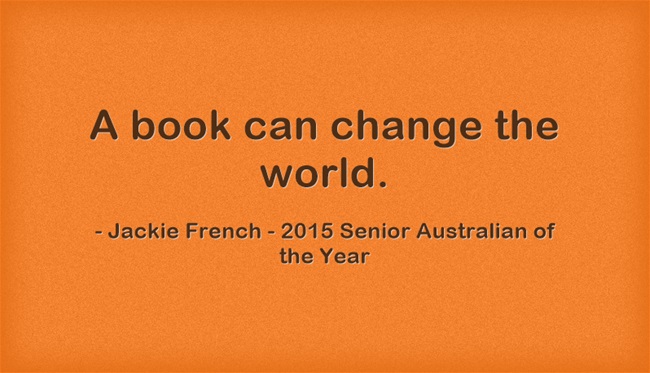
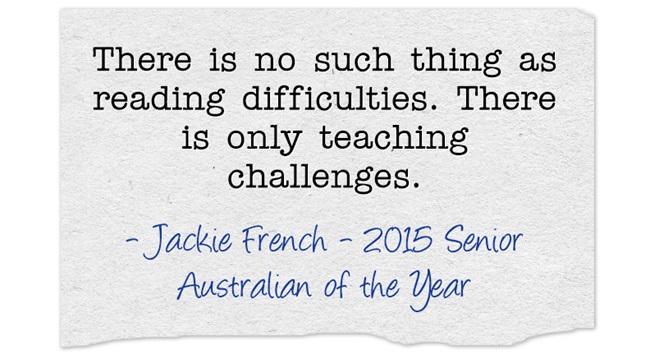
    Here is Jackie, Senior Australian of the Year 2015, accepting her award.

    Failure-is-not-an-optionA-book-can-change-theThere-is-no-such-thing


    In this next video Jackie talks about her book “Hitler’s Daughter”. You don’t have to have read the book to glean much of interest from the interview. In the discussion Jackie shares her thoughts about reading and writing. She questions how the ‘world’ in which one is, influences thoughts about good and evil and decisions that are made. She discusses how the need for evil to be resolved in a work of fiction differs between children and adults. She talks about whether it is necessary for a child to apologise for the sins of the previous generation, and how still controversial issues can be dealt with in an historical situation. It is worth listening to if you simply want something to ponder over.

    Being an early childhood teacher I am more familiar with Jackie’s picture books such as

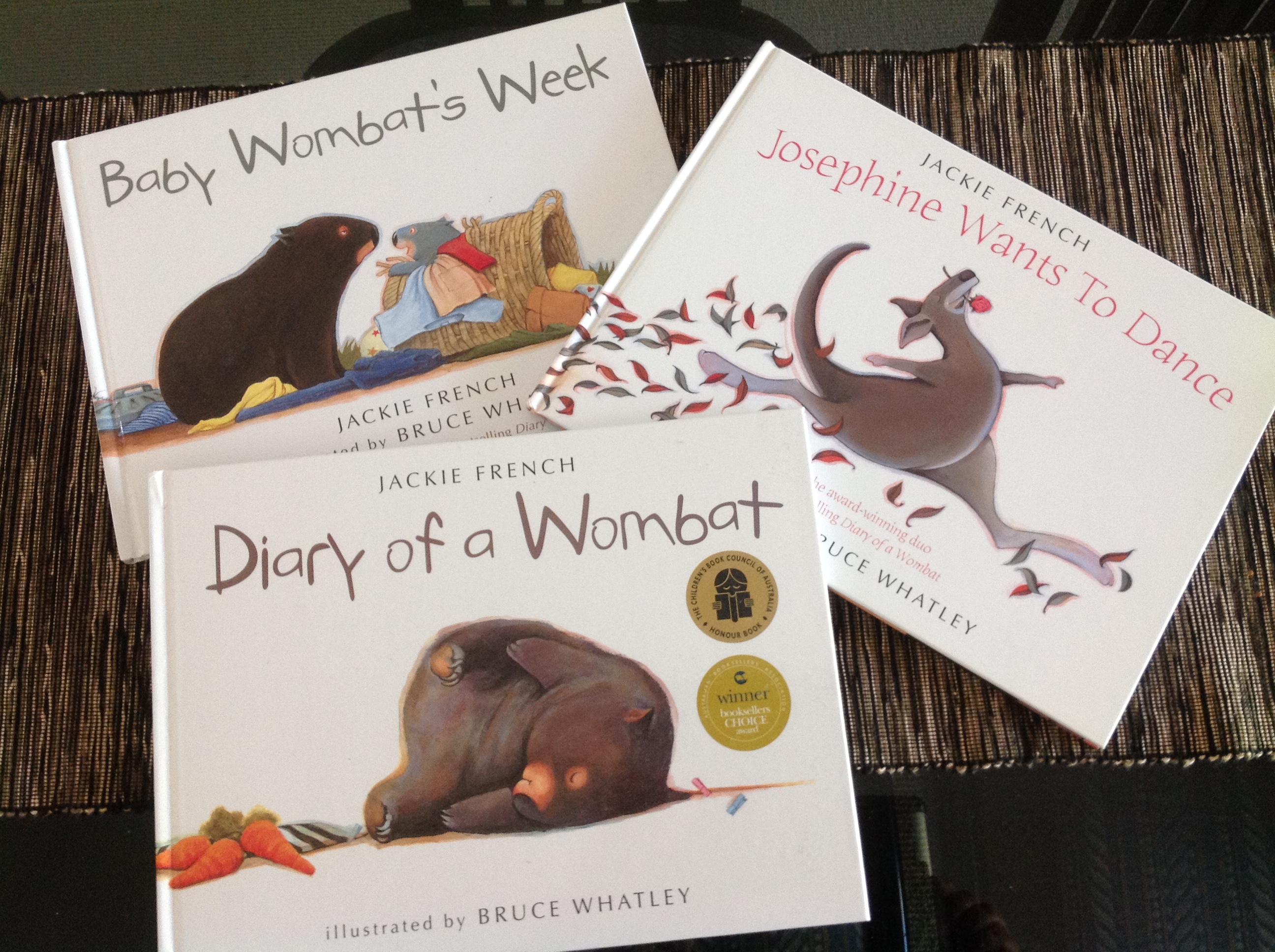
    Diary of a Wombat, Baby Wombat’s Week, and Josephine Wants to Dance, which are delightful.

    IMG_4302

    Here is a video of Jackie reading Diary of a Wombat.

    I have just discovered that Hitler’s Daughter is available as an audiobook, so it is going onto my list!

    https://openclipart.org/image/800px/svg_to_png/148843/1310261210.png
    https://openclipart.org/image/800px/svg_to_png/148843/1310261210.png


    I congratulate Jackie on her award and thank her for the contribution she is making to the lives of so many and the future of our planet.


    *piqued

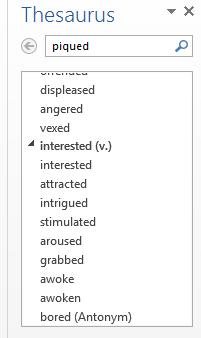
    In this sentence, I am using the word “piqued” to mean “stimulated or aroused my interest”.

    How can one word be used to express opposite meanings? I don’t know how anyone is expected to learn or understand the nuances of this language we call English!

    When I checked with my thesaurus to ensure I had chosen the correct word, this is what I found:

    piqued 1         piqued 2

    How many other words do you know that could almost be listed as its antonym?

    Thank you

    Thank you for reading. I appreciate your feedback. Please share your thoughts about any aspect of this post.
  • Reading is out of this world!

    Space-Sketched

    Reading is a wonderful pastime. Since you are reading this blog I am sure you will agree.

    People read for many different reasons, including:

    • for information e.g. about world events or something of interest, to find out what’s on offer, how to do something, or the time and place to catch a bus,
    • to be challenged e.g. by philosophical or ethical arguments and viewpoints
    • to stay in touch e.g. through letters, emails, blogs, Twitter, Facebook and other social media
    • to be enthralled by a story or delighted by poetic words and imagery
    • to escape the everyday.

    I am certain you could add to the list in breadth and specificity without too much trouble.

    Robert 2

    Developing a lifelong habit, if not love, of reading is important to fully function in society. The “bug” is more easily caught in early childhood but can be developed at any stage throughout life when its rewards become apparent.

    Nor and Bec readingI have previously shared ideas about the importance of talking with and reading to young children, including here and here.

    Another highly influential factor in creating readers is for children to see adults engaged in reading for real purposes, for information and pleasure; and having the opportunity to discuss the purposes of, and ways of reading, different material e.g. the way we read a menu is different from the way we read a story or a newspaper.

    peole_computer

    Additionally, it is useful for children to realise that the importance of reading extends beyond the home. There may be opportunities for them to observe people reading in the workplace or to discuss the need for reading in different roles.

    The Very Hungry Caterpillar

    Another important aspect of reading that I have previously discussed, using ”The Very Hungry Caterpillar” by Eric Carle as an example here, is critical literacy, the ability to interrogate the veracity of the information, its source and author.

    I recently read discussions about difficulty experienced incorporating non-fiction material, especially science information, into classroom reading programs. I was a bit blown away by this because I believe that children will be interested in anything and everything if it is presented in an interesting way.

    An information book doesn’t have to be read all at once, from cover to cover in any particular order. It can be dipped into, pored over, or explored bit by bit.

    Sometimes information can be found in a work of fiction, but it is important, as cautioned with “The Very Hungry Caterpillar”, to check the source and the “facts”.

    So to tie together the elements discussed above, these are important elements for motivating children to read:

    • Talking with them about things of interest to them
    • Reading to them
    • Modelling and discussing positive reading habits
    • Demonstrating the importance of reading
    • Discussing the importance of not believing everything that is read and of evaluating the source of the information and the intent of the author

    In my exploration this week of one of my favourite educational websites, edutopia, I discovered through a post written by Ben Johnson and called When Astronauts Read Aloud Children’s Stories – From Space! a site that met many of the above criteria: Story Time From Space

    Story Time From Space features astronauts on the space station reading story books to children. At the moment there is one story available, but more are planned, as are teaching suggestions and activities, including experiments.

    The story, Max Goes to the International Space Station is the first of a series of five stories written by Dr. Jeffrey Bennett who describes himself as “an astronomer by training and a teacher by trade, but currently spend most of my time as a writer.”

    In his post, Johnson expands on that, describing Bennett as “a research associate at the University of Colorado Center for Astrophysics and Space Astronomy, … (who) has worked at the California Institute of Technology Jet Propulsion Laboratories and NASA Headquarters in Washington, D.C.” He goes on to say that “Dr. Bennett strives to write books that are factually correct, fun, and interesting for students to read.” The experiments that the astronauts do will correspond to those in the books.

    roto-spacesuit-mkiii-clean-new


    While parts of the Story Time From Space site are still “coming”, I think this project has great potential for motivating children to read and for inspiring an interest in the world and beyond. Being read a story by an astronaut isn’t something that happens every day!

    Thank you

    Thank you for reading. I appreciate your feedback. Please share your thoughts about any aspect of this post.
  • How much of a meliorist are you?

    https://openclipart.org/image/800px/svg_to_png/103549/old_man01.png
    https://openclipart.org/image/800px/svg_to_png/103549/old_man01.png

    Recently I was sent a link to an article titled Cheer up, it’s not all doom and gloom published by the Australian Broadcasting Commission’s The Drum.

    This article mentioned a book by Steven Pinker called Better Angels of Our Nature which had been recommended to me by Geoff Le Pard in a comment on my post about childhood illness. The premise of this book is that humanity, over the ages, has become less violent. After to listening to Pinker’s history of violence, I’m pleased that I live these relatively peaceful times.


    The article also introduced me to a new term ‘meliorism’ which means having a belief that the world can be improved by the actions of humans. While the term may have been unfamiliar to me, the attitude is not and I attest that I am a meliorist.

    I have a very strong belief in the power of education to improve the world. Education empowers individuals, and educated individuals empower societies to build improved futures. It becomes very difficult to sustain negative practices in the face of overwhelming evidence and information.

    What better place is there for education to begin than in the home?

    In a recent post I referred to a new book by Michael Rosen called Good Ideas: How to Be Your Child’s (And Your Own) Best Teacher. At the time I had not read the book but now I can say, with great delight, that I have listened to most of it. With messages such as those contained in Michael’s book, it is easy to be a meliorist.

    I think Rosen’s book should be available to, perhaps compulsory reading for, every parent; I consider its message to be that important. In fact, I am off to the shops today to purchase copies to give to parents of young children I know.  It will become part of my gift to new parents that also includes Reading Magic by Mem Fox and a selection of picture books. I have previously blogged about that here and here.

    The “Good Ideas” contained in Rosen’s book, if implemented, will keep alive the natural curiosity of one’s children and oneself. They will encourage the development of thought, creativity and responsiveness.

    In the next few weeks I will post a more detailed review of the book and some of Michael’s ideas for stimulating curiosity, whoever and wherever you are.

    What about you? Are you a meliorist?

    I welcome your feedback. Please share your thoughts about any aspect of this post.
    Thank you

  • Reading is all it’s cracked up to be: 10 tips for an early childhood classroom!

    This post almost didn’t get published. It almost fell through a crack into the never-never. But just in time the safety net sprang into action and saved it from obscurity.

    That may matter more to me than it does to you, but as an educator I hear too often about children who ‘fall through the cracks’, who fail to thrive in the school system, who miss out on the inspiration and timely support that would empower them on their journey to life-long learning.

    Like those children, this post was an also-ran. It didn’t quite get it, didn’t quite reach the expectations. But then I read something that confirmed for me the importance of sharing my message.

    You see, the love of reading is contagious. It can be caught from anyone, anytime.

    However, it can just as easily be extinguished; and the danger of that happening seems to be lurking in school systems packed too tight with lists of must do, must learn and must achieve expectations.

    I consider it imperative that teachers prioritize time for children to develop a love of literature and reading that will expand their horizons and create a worthwhile companion on the journey of their lifetime.

    https://openclipart.org/image/800px/svg_to_png/174860/bookworm_penguin.png
    https://openclipart.org/image/800px/svg_to_png/174860/bookworm_penguin.png
    Here are 10 easy tips for keeping the love of books alive in an early childhood classroom:
    1. Read aloud to children every day, ensuring that a variety of books and genres are being read and shared.
    2. Have a great supply and variety of children’s books available: picture books, fiction and non-fiction, collections of poetry, beginning chapter books, funny books, sad books, books about animals, space, people . . .
    3. Display books with covers facing out and give them pride of place. Make a display of ‘favourite reads’.
    4. “Sell” books to children (you won’t have time to read them all) by showing the cover and some illustrations; by telling what they are about, what happens, and what the children will enjoy about them.
    5. Make a reading corner with carpet, pillows and bean bags that invites children to get comfy while they read.
    6. Provide time for children to choose and read independently.
      • This can occur during quiet times set aside on a daily basis in which everyone, including the teacher, reads for 10 – 15 minutes. e.g. D.E.A.R. (drop everything and read) or U.S.S.R. (uninterrupted silent sustained reading).
      • It can also be integrated into reading group or literacy centre activities.
    7. Share the enthusiasm for books by providing time for children to excite each other about the books they are reading in a sharing circle.
    8. Display books written by the children and allow access to them for independent choice. Include them in the sharing and ‘selling’ sessions also.
    9. Make a time to visit the school library for reading and borrowing.
    10. Invite other adults to the class to read to the children e.g. teacher-librarian, administrators, support personnel, parents and grandparents.

    Let me know in the comment box a favourite tip of yours.

    This week I have read some fabulous posts by teachers who are making sure there is time for joy and independent choice in their literacy classrooms. I will share these with you below.

    The article that convinced me to share my thoughts was one that was not so joyful.

    Written by Alexander Nazaryan, a first-year teacher, the article appeared in the Opinion Pages of the New York Times on July 6, 2014. He talked about not being able to meet the needs of his students and explained that it was not the fault of the students though, the fault was that they were mostly of poor and immigrant families.

    He felt that asking these students to write about their own experiences did not have ‘the pedagogical value of a deep dive into sentence structure or a plain old vocab quiz.’

    I was immediately struck by the similarity of a statement made to me by my son’s teacher thirty years ago. At the time I was leading an in-service workshop about teaching writing. I would have been talking about ways of engaging students in the writing process by giving them opportunities to write at length about things of interest to them; by encouraging the writing of a first draft to get the ideas down; by providing opportunities for redrafting, rewriting and editing; and opportunities for feedback by sharing their writing with peers; and by making the most of teachable moments through individual conferences with each student.

    This teacher exclaimed that there was no way the children would be able to write anything of length as not one knew what a paragraph was, or indeed what a sentence was. The students were ten years of age and in their fifth year of school. I believe the statement to be more an indictment of the teacher’s inability to appreciate what the children could do, rather than an accurate estimation of their abilities. I knew for a fact that at least one student was more than capable of writing at length with a variety of sentence structures and correct paragraphing. I was certain he wasn’t the only one.

    I am inclined to agree with Nazaryan that ‘Expecting children to independently discover the rules of written language is like expecting them to independently discover the rules of differential calculus.’

    However trying to teach the skills of literacy through a barrage of meaningless drill and practice exercises in a joyless classroom is doomed to failure, and the children, sadly, will fall through the cracks.

    What the children need, in my opinion and unlike that of Nazaryan, is a balanced approach. The skills of literacy need to be taught in a meaningful context.

    That article and others, like this one from HuffPostParents about a year one girl who had to sit on the floor for weeks while her classmates sat at desks make me want to cry.

    However it is not all bad, and there are some wonderful things happening.

    Below are links to posts by or about teachers who are being far more inspirational to their students and other teachers on a daily basis.

    very inspiring blogger

    Tracking back to my post of July 9 The Very Inspiring Blogger Award (nominated by Geoff le Pard) I hereby nominate them for A Very Inspiring Blogger Award:

    Vicki Vinton, blogging at To Make a Prairie

    Matt Renwick at Reading By Example

    This article by Brett Vogelsinger and posted on the Nerdy Book Club

    Steven Peterson at Inside the Dog

    Julianne at To Read To Write To Be

    Carrie Gelson at There’s a Book for That

    Used Books in Class

    Three Teachers Talk


    This brings me back to the reason that got me thinking about cracks, and children falling through the cracks in the first place. This week’s flash fiction prompt set by Charli Mills at Carrot Ranch Communications was to In 99 words (no more, no less) write a story that involves a crack. 

    Here’s my response:

    The Crack

    She willed the earth to open up and swallow her whole. But it didn’t. She just stood there trembling, attempting to hold back the deluge that threatened to engulf her.

    She strained to remember, knocking her head with her fist. Quick. Try. Try. What’s the rule: i? e?  

    She stammered an answer.  Wrong again!  Too many rules! Stupid rules! Broken – just like her.

    She fled, eyes stinging, mouth twitching; and as she passed, with one hand grasped the confiscated unicorn sitting askew the teacher’s desk.

    Away they flew, the assault of mocking laughter fading far below.


    Thanks for reading. I appreciate your feedback. Please share your thoughts about any aspect of this post, including my flash piece.


  • Four fabulous female educators

    In a previous post I wrote about 3 inspiring educators. In no way did I wish to indicate that the number of inspiring educators was limited to those three or that all inspiring educators are male. The list of inspiring educators is far greater than that and includes both male and female representatives.

    The purpose of this post is to both honour, and share the wisdom of, other educators who have positively impacted my life and thinking as an educator and the lives and education of many others. The list doesn’t end here. There will be more to follow.

    Maria Montessori (1870 – 1952)

    Maria Montessori’s name is known worldwide as the founder of the Montessori Schools. However her influence is not restricted to those schools. Many educational practices implemented, especially in the early childhood setting were influenced by Maria Montessori.

    Maria resisted the gender-stereotyping conservative views of Italy where she lived in the late nineteenth century. She developed her interest in maths and sciences, especially biology, and became the first female doctor in Italy.

    As a doctor Maria worked with children from poor and working class families. She developed the belief that every child had an intrinsic intelligence. She studied child development and education extensively and developed methods of implementing her theories. She traveled Europe sharing her ideas and advocating women’s and children’s rights. Her success with disabled students led to implementation of her methods with ‘normal’ children.

    Montessori’s methods put the child’s interests at the front of the program. The teacher was to ‘follow the lead’ of the child.

    Practices now seen as standard that were initiated or influenced by Maria Montessori:

    • incorporation of children’s interests, putting their interests first
    • recognising the development of the individual and making education appropriate to it
    • use of child-sized furniture and shelving
    • practical activities such as sweeping and cleaning up
    • environmental activities such as gardening
    • health and hygiene practices, such as washing hands, sharing morning tea, cooking
    • indoor/outdoor areas that children move about freely
    • opportunities to work independently
    • respecting the child as an individual

    She valued independence and saw it as the aim of education, with the teacher as observer/guide of children’s development.

    This video explains  a little of her work.

    Sylvia Ashton-Warner (1908 – 1984)

    Sylvia Ashton-Warner is a New Zealand writer, poet and teacher whose educational work I became familiar with in the 1980s through her books Teacher and Spinster, the latter of which was also made into a movie.

    Sylvia, who in the interview below states emphatically that she is not a teacher, that she hates teaching and can’t stand education, has been very influential on teachers around the world.

    i was unable to embed the video. Click on the image to go to the original site.
    i was unable to embed the video. Click on the image to go to the original site.

    Sylvia says,

    “There’s a formula for all my teaching. It’s quite simple. I supply the conditions where life can come in the door . . . where both our teacher and our child can be themselves.”

    Children-and-even-adults - Sylvia Ashton-Warner

    Working with Maori children from poor and dysfunctional families and using organic reading, she developed what is called the ‘Key Vocabulary’; those words holding most meaning and interest to the child. The child asks for a word, the teacher writes it on a card. The child reads the word and copies it to write. The words requested are usually nouns and hold a lot of meaning for the child.

    I implemented her ‘Key Vocabulary’ for many years and found it to be a successful tool for developing readers and writers.


    Marie Clay (1926 – 2007)

    Marie Clay is another New Zealand educator best known for her work with literacy education and the Reading Recovery program which was developed to support students whose reading skills were delayed. She believed that early intervention was the key to improving literacy skills.

    I first came across her work in her book Reading: The Patterning of Complex Behaviour in 1979. Her 1983 publication Record of Oral Language provided teachers with methods of observing and recording children’s development in literacy.

    The Reading Recovery program, based on Marie Clay’s work and developed in the early 1980s, provides one-on-one support for students who are experiencing difficulty with reading in the first years of school. The teachers undergo training which develops their understanding of the reading process and how to support a student’s development. The training is more intensive and thorough with methods specific to this purpose, than generalised teacher education. However knowledge of her research, innovations and methodologies are also of benefit to generalist teachers and have been incorporated into many teacher education programs.

    I was very disappointed, as were many other classroom teachers, when this successful program was discontinued in our region earlier this century.

    Barbara Arrowsmith-Young (1951 – )

    I first heard about Barbara Arrowsmith-Young in Norman Doidge’s book The Brain that Changes Itself.

    I couldn’t put this book down. My thinking about the brain and learning was being challenged but excited at the prospect of overcoming learning problems experienced by many students.

    For years I watched helplessly as scores of struggling learners were pummelled with repetition of the same boring and meaningless methods that created (or at least contributed to) their problems in the first place; of seeing them humiliated by having to repeat a year at school, or being considered ‘dumb’ because they couldn’t do what the other kids could do. Now here was a book that suggested this need not be so. If only those making the decisions and delivering the programs could be influenced.

    One of the most memorable stories from the book was that of Barbara Arrowsmith-Young. Barbara suffered from severe learning disabilities throughout her childhood and early adult years. Every known method of compensating for the disabilities was tried without success. Barbara felt humiliated and a failure.

    Her life changed dramatically when she heard about neuroplasticity of the brain (the ability of the brain to change in physiology and functionality) and created exercises for her brain, teaching herself to do things she had never done before.

    Her story is an inspiring one of courage, strength, and persistence. Barbara has changed her life. After turning her life around, Barbara has developed programs for others with disabilities to engage with. She started the  Arrowsmith School in  Toronto in 1978. The Arrowsmith Program is now used in schools in the US and Australia as well as Canada.

    Barbara’s “vision is of a world that we create in which no child has to live with the ongoing struggle and pain of a learning disability. . . that cognitive exercises become just a normal part of curriculum. . . that school becomes a place that we go to strengthen our brains to become really efficient and effective learners engaged in a learning process where not only, as learners, can we dare to dream, but we can realize our dream . . . This is the perfect marriage between neuroscience and education.”

    You can read her story in The Woman Who Changed her Brain, and listen to her speak in this video:

    She travels the world sharing her message so you may even have an opportunity of meeting her in person. I saw her last year at the Brisbane Writers’ Festival. Magic!


    You may have noticed some unifying threads with each of these educators:

    A focus on the child, the child’s interests and life

    A recognition of the child’s ability to learn

    An optimism in the child’s ability to learn, for success and the future

    All educators worked with students from disadvantaged backgrounds or with disabilities or both; and all achieved success.


    I welcome your feedback. Please share your thoughts about any aspect of this article.