Live Love Laugh Learn … Create the possibilities

Tag: poetry

  • Listen to the sounds

    Charli's picture

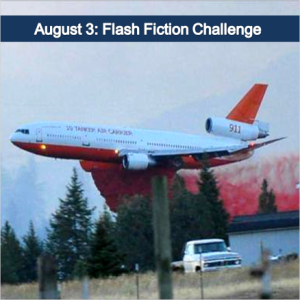
    This week at the Carrot Ranch, Charli Mills is talking about sound, and has challenged writers to

    In 99 words (no more, no less) write a story that includes the sense of sound. It can be an onomatopoeia, a swearing session with sound alike substitutes, lyrical prose or a description of a sound. Go where you hear the prompt calling.

    I thought it was quite timely for me as I had just written a piece about audiobooks. However, I have decided to keep that for posting another day and have instead decided to look at picture books. Regular readers may not be surprised.

    Picture books are often a child’s first introduction to stories, poems, fantasy and other worlds. The language of picture books is immensely important and must captivate the ear as the illustrations engage the eye. Through picture books children are learning the sounds of the language: its rhythms and intonations; its accents and pronunciations; its beauty and its meaning.

    Many picture books are written in rhythmic, rhyming language and we are quick to note when the timing is a little off or the rhyme not quite right. Successful picture book authors write and rewrite until they get the sound of the language just right for a read aloud experience. Though the words may be few, the task may be difficult. Children, their parents, and teachers are a discerning audience.

    As onomatopoeia (a word that phonetically imitates, resembles or suggests the source of the sound that it describes) features in many children’s songs and picture books, it is the focus of this post.
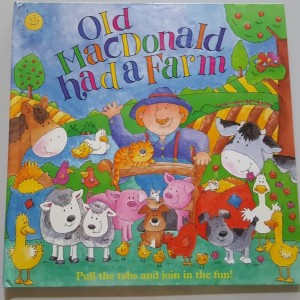
    Old MacDonald had a Farm

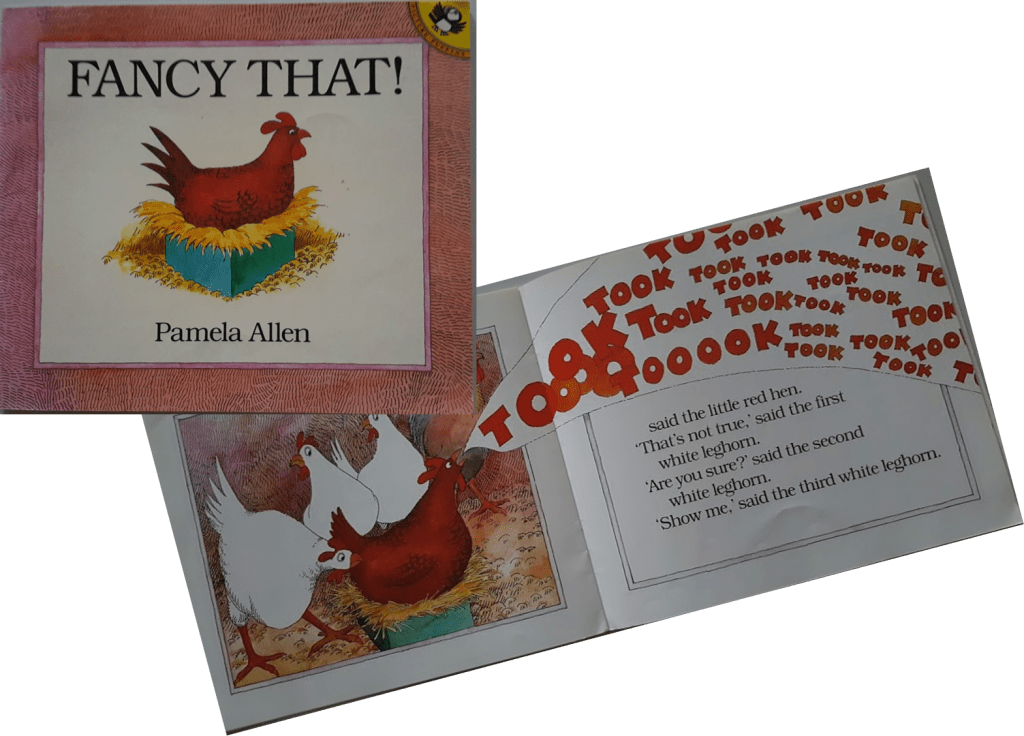
    Animal sounds, familiar through songs such as Old MacDonald Had a Farm, frequently occur in picture books, including Hattie and the Fox and Fancy That!
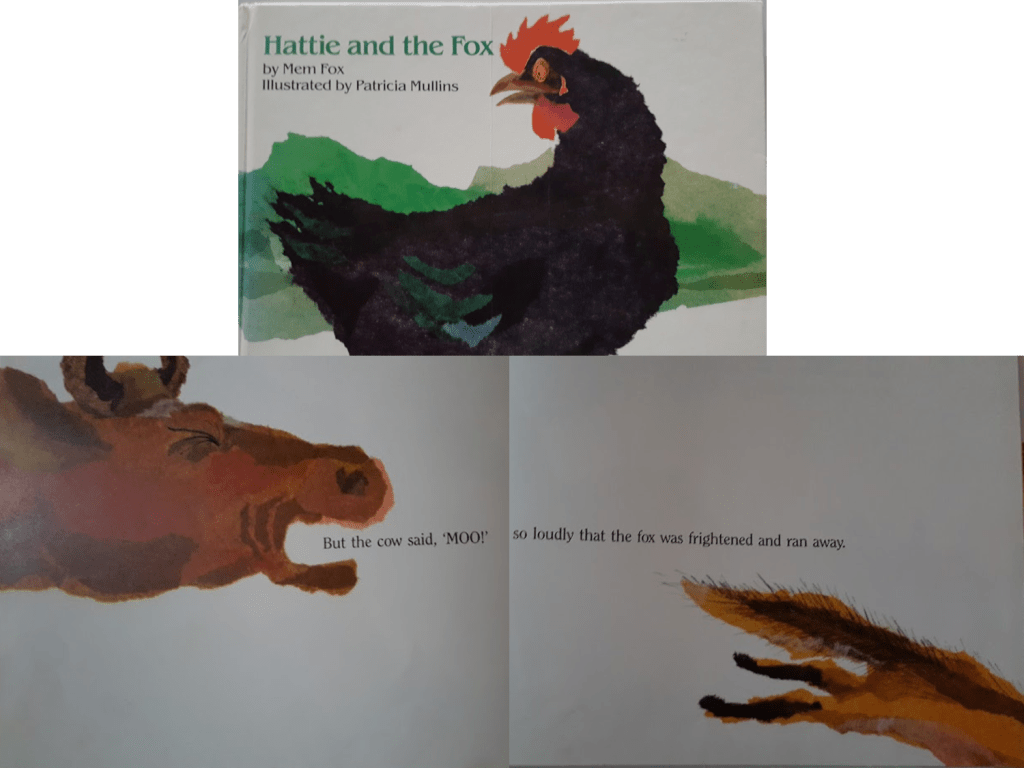
    Hattie and the Fox

    Fancy That

    The sounds of machines are also popular. Some of you may recall the song about The Marvellous Toy that “went zip when it moved, and bop when it stopped, and whirr when it stood still.”

    the Train to Timbuctu

    The repetitive rhythmic sound of a train’s motion is frequently portrayed, as in The Train to Timbuctu that went
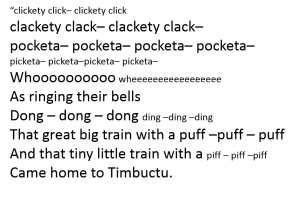
    Timbuctu rhyme

    the Little Engine that Could

    and The Little Engine that Could with its

    “I think I can – I think I can – I think I can – I think I can – I think I can – I think I can – I think I can – I think I can – I think I can.”

    followed by

    “I thought I could. I thought I could. I thought I could. I thought I could. I thought I could. I thought I could.”

    A great demonstration of a growth mindset.

    Bertie and the Bear

    There are also the sounds of musical instruments as in Bertie and the Bear.

    An Old Witch Song

    There are the sounds associated with actions, like the swish of the broomstick and the plop of the hop toad in Old Old Witch;
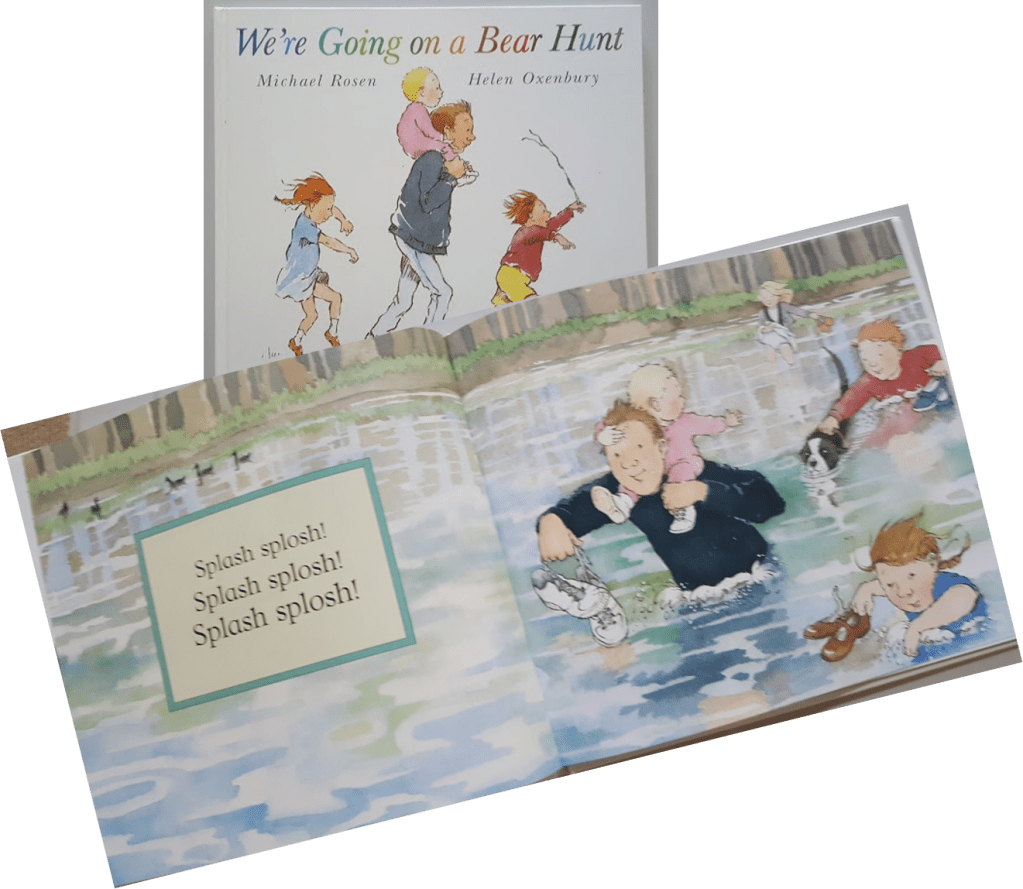
    Going on a bear hunt

    and those from Going on a Bear Hunt with its swishy swashy of moving through grass, splash splosh of wading through water, and squelch squelch of walking in mud.
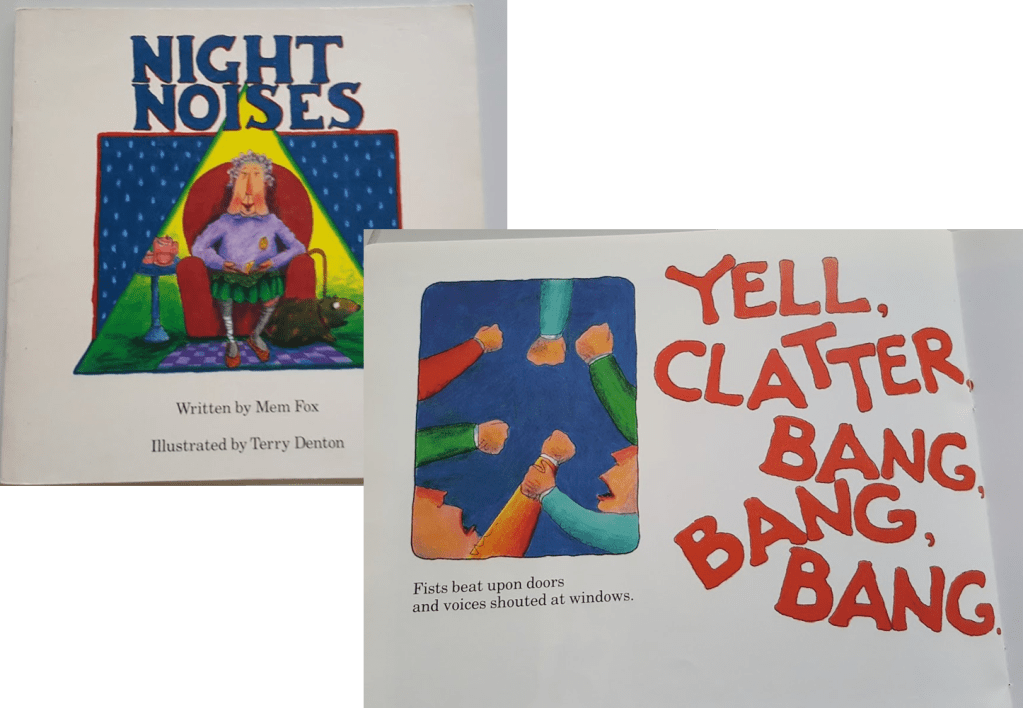
    Night Noises

    Some stories introduce a variety of onomatopoeic words. Night Noises, about a surprise party for Lillie Laceby who was nearly ninety, includes the click clack of car doors opening and closing, the crinch crunch of feet tip-toeing on a garden path, the murmur and mutter of voices whispering, the creak crack of knees, and the snick snack of bolts on the door.
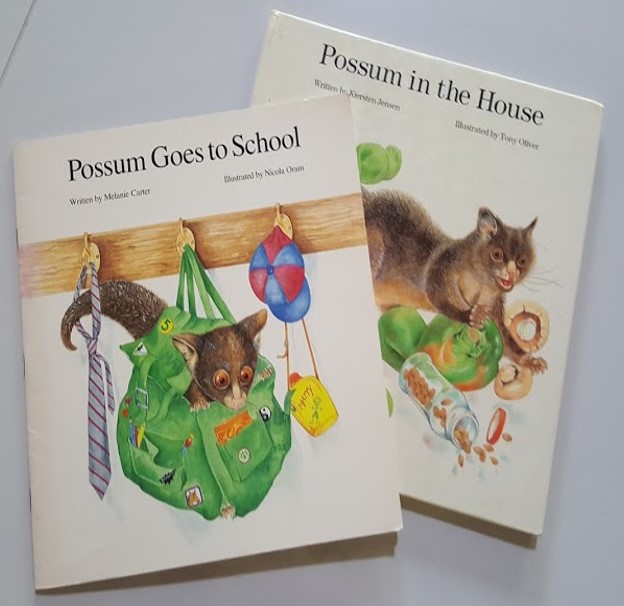
    Possum goes to school

    When there’s a Possum in the House or Possum Goes to School, there is nothing but trouble, with possum making a mess at every opportunity.

    At home, in the pantry the cornflakes go crunch crunch, in the kitchen the saucepans go clatter clatter, and in the study the pages go rustle rustle. Each time the possum’s whereabouts is discovered, it goes screech screech and runs off to another room to create yet more mess.

    The same occurs at school with paints going drip drip in the art room, claws going scratch scratch in the staff room, and the goldfish going splash splash in the science room.

    Burping Baby

    Then of course, there are also the body noises that children seem to take delight in, like those from Burping Baby.

    I recently discovered Lauri Fortino’s Frog on a [B]log, a blog celebrating picture books. Lauri has a delightful picture book of her own The Peddler’s Bed, illustrated by Bong Redila. Lauri recently shared a reading of the story on her blog. Since we are talking about sounds, if you have a few spare minutes, pop over and have a listen.  You will also find an example of onomatopoeia in her story with the repetition of squeak squeak squeak.

    Onomatopoeic words are often presented in fonts of different size or colour, or even different type. Children are fascinated by them, pointing to, asking about, maybe even recognising them, long before they are able to recognise any other words. You can help to get them started by pointing to the words and inviting them to join in the hullabaloo. What a great introduction to the world of reading.

    Now that I have reminded you of these types of onomatopoeia and provided you with these wonderful examples, I wonder what I was thinking. How can I match them in my flash? I need a flash of inspiration, or maybe a flash of lightning to begin my story about a mother and child hurrying to make it home before the storm hits. I hope you enjoy it.

    The eye of the storm

    “Storm’s coming!”

    Pit pitter-patter Pat pitter-patter hasten four feet.

    Lightning and thunder boom down the street.

    “H-h-h-hurry.” Mum urges. “Home – nearly there.”

    Pit scuffle-scuffle Pat scuffle-scuffle “Straight up the stair.”

    Clink-chink-fumble-fumble “No need to knock.”

    Scritch-scratch “I’ve managed – the key’s in the lock.”

    Whoosh! chortles wind, as it rushes inside.

    Damn! cusses chair chucked onto its side.

    P-u-sh!  The door bangs! Avoid pellets of ice

    Smashing and tumbling like millions of dice.

    Rat-a-tat raindrops, another crash-boom!

    Shuffle and scurry. “Straight to the safe room.”

    Huddled together, hardly daring to breathe,

    Listening and waiting for the monster to leave.

    Then sudden quiet, the child whispers hope

    “Is it all over?” Mum answers, “Nope.”


    The first fifteen lines meet Charli’s 99 work criteria. I added the last two because I was thinking of the eye of a storm that brings a quiet calm but not the end of the storm –  there’s still more to come. I’d love to know what you think.

    Thank you

    Thank you for reading. I appreciate your feedback. Please share your thoughts.

  • Writing poetry with children

    Horses go galloping

    This week at the Carrot Ranch Charli Mills has challenged writers to write about galloping. What keeps replaying in my head is the phrase “The horses go galloping, galloping, galloping” interspersed with the lines from “The Highwayman” by Alfred Noyes, a poem I learned at school.

    The Highwayman came riding, riding, riding,

    The Highwayman came riding, up to the old inn-door.

    tomas_arad_heart

    Learning poems at school was a joy. I love poetry and, in younger years, used to read a lot of it, less currently. Perhaps I should say I loved poetry, but that would unfair, just as it would be unfair to say that I no longer love an old friend that I haven’t seen for years, for at the moment we meet up again the connection is just as strong as ever, the ties never broken.

    Oftentimes when I read Charli’s challenges I know how I will respond immediately. Other times I need to massage the idea until I hit just the right spot. This time the horse has bolted and the paddock is left empty without a horse in sight. All I’m left with are my thoughts of poetry.

    Fortunately, as an early childhood teacher with a love of picture books, recent years haven’t been completely devoid of the poetic form. While not necessarily written in what might be considered “poetic language”, many are written in rhythmic rhyming verse. Others contain verses within the story, such as the refrain in The Gingerbread Man or the song in Love You Forever by Robert Munsch.

    The gingerbread man

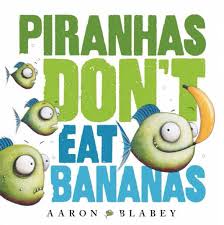
    A title recently added to my list of favourites, through repeated readings and recitations by my grandchildren, is Piranhas Don’t Eat Bananas by Australian author Aaron Blabey. Its rhythm, rhyme and sense of fun is an absolute joy. We laughed together at every reading by G1, and every recitation by G2. It begs to be read and re-read, recited and recited again. Sadly, I got to read it aloud only once, and even then not all the way through! “Hey,” I protested in vain. “I like to read picture books too!

    piranhas don't eat bananas

    Of course there are also many books of poems and rhymes written for children, including Nursery Rhymes, though many of those weren’t written with children in mind. There are also some that fit into a horsey theme such as

    In addition to reading poems and stories to my class I also enjoyed writing poems with them. At this early childhood stage the poems would be more rhythmical verse, sometimes rhyming and sometimes not, with only the hint of an introduction to poetic language.  I have previously written about writing our versions of I Love the Mountains, a traditional camping song.

    I have also written some resources for supporting teachers when Writing Christmas poems with early childhood students. These are available in my Teachers Pay Teachers store and soon to be included in readilearn resources. With easy-to-follow structures, writing these poems give children immediate boosts to their writing confidence.

    I had been thinking for a while that I should write some new versions suited to other times of the year, but hadn’t prioritised it. However, when I read Rowena Dreamer’s post Mr’s Poem: Through My Window on her blog beyondtheflow, another idea sprang to mind. Rowena discussed the writing of a poem “Through my window” that had been set as homework for her son.  I immediately thought of the sound poems that I had taught my students and wondered if the structure could be adapted for sight poems.

    The structure of a sound poem

    This is what I came up with:

    I saw as I looked through my window

    You’ll notice that I haven’t exactly maintained the structure. This is what happens, particularly when young children are writing their versions. It is to be expected and accepted. The purpose of the structure is to support, not restrict.

    I then wondered if it could be used with the other senses and, at the same time, realised that four verses, four senses, would just about reach the target of Charli’s challenge to In 99 words (no more, no less) write a story about galloping. With no other ideas galloping into view, how could I resist giving it a go?

    Disappointingly, I found the structure less accommodating for smell and taste, and had difficulty in conjuring different words to use for each. For example, I wanted to smell and taste the freshness of bread and the sweetness of apples. I had thought touch would be more difficult but have realised that’s not the case. The repetition of the word “felt” for both touch and emotion is perhaps not ideal though.

    I would love to say more here about the necessity for teachers to experiment before setting tasks for children, and of the value of learning from the process rather than the product, but I think I’ve probably said enough in this post.  I will just share what I’ve written which, though responding to Charli’s challenge, doesn’t actually fit the criteria of flash fiction. However, if you’d be kind enough, I’d still love to know what you think.

    Market Day

    I heard

    as I sat curled with a book

    the thundering of hooves

    the snorting of nostrils

    the jangle of stirrups.

    I felt anxious.

    I saw

    as I looked through the window

    the horse at the gate

    the rider on the path

    the bag in his hand.

    I felt excited.

    I smelled

    As I opened the bag

    The freshness of bread

    The sweetness of apples

    The promise of coffee.

    I felt famished.

    I felt

    As I savoured my lunch

    The crunchiness of crusts

    The crispness of apple

    The warming of coffee.

    I felt satisfied.

    Yum! Fresh produce.

    Thank you

    Thank you for reading. I appreciate your feedback. Please share your thoughts.


  • Water wise

    https://openclipart.org/image/800px/svg_to_png/9353/egonpin_Paisaje_3.png
    https://openclipart.org/image/800px/svg_to_png/9353/egonpin_Paisaje_3.png

    My first thought when reading this week’s flash fiction prompt set by Charli Mills at the Carrot Ranch: in 99 words (no more, no less) write a story about water, was of the street on which I had hoped to open an alternative to school twenty years ago. I thought I could write about the property which, located on the corner of Water and Love Streets, seemed ideal. I thought I could write about the vision of our group “The Centre of Learning Opportunities” with its focus on the children’s program “Kids First” and how our centre would cater for children and families. I thought I could write about how we would implement our motto “Create the possibilities” which I have also adopted for my blog. But just like the centre itself, it didn’t eventuate.
    https://openclipart.org/image/800px/svg_to_png/169893/1336367663.png
    https://openclipart.org/image/800px/svg_to_png/169893/1336367663.png

    Instead I thought a little deeper, considering how water is the substance of life, how fortunate we are in developed countries to be able to turn on a tap and access clean water whenever we want. According to the UN almost 8 million people do not have access to clean water and more than 2 million do not have adequate sanitation. Millions of people die each year from diseases related to water. The projections of water availability and access are quite alarming.

    I thought about the use and misuse that is made of water in our rivers and streams and of a local issue that was reported quite recently.

    I decided to write a poem about the journey of a river, from its beginnings high up in the mountains down to the sea; how it starts out crystal clear but picks up toxins as it wends it was down. You can probably guess that my next thought was of education; of how children begin full of wonderment and creativity but, as they are subjected to years of schooling, collect toxic thoughts and attitudes.

    That may seem a bit harsh I know, and I have written a poem before comparing what I consider Education is to what I think schooling is.

    education-is-2

    However I thought I’d try to write a poem as an allegory of the schooling process; likening the way we are polluting our waterways to the way we are polluting and muddying the minds of our children. I’m not very happy with my first (fifth!) attempt, but I have met the word requirement and Charli’s ‘deadline’ is fast approaching.

    Let me know what you think.


    Water

    It started way up

    In the highest of hills     

    So crystal-clear pure

    With a life to fulfill


    It babbled through forests

    And danced in the streams

    Marveling  at wonders

    Before never seen


    It passed through the valleys

    Irrigated the farms

    Taking the runoff

    And doing no harm


    Down past the villages

    Watered them too

    Acquiring their discards

    Now murky like stew


    Passing by factories

    Spewing out waste

    Picked up their burden

    And left without haste


    Weaving its brown trail

    Way down to the sea

    From its mouth vomited out

    A poisonous mix

    Deceiving all living things

    Expecting a gift

    However I don’t want to leave you on a negative note. I’d rather acknowledge that there are many wonderful things happening in schools around the world. There must be, or we couldn’t be making the advancements we do.

    https://openclipart.org/image/800px/svg_to_png/59389/happy_sun_gm.png
    https://openclipart.org/image/800px/svg_to_png/59389/happy_sun_gm.png


    I have shared many great things with you before like some of these great articles on edutopia.org. Just last week I shared information about a prize for innovation in inclusive curricula being awarded for a program, Big Questions teaching philosophy to children. Listen to any TED talk to be amazed at advancements and innovations.

    I value your feedback. Please share your thoughts about any aspect of the article or my flash ‘poetic’ fiction piece.


  • Going on a treasure hunt!

    we're going on a bear hunt

    A few weeks ago I had the great pleasure of taking my two gorgeous grandchildren to a performance of Michael Rosen’s “We’re Going on a Bear Hunt”. To say we enjoyed it would be an understatement. We had a rollicking good time.

    The performance involved a lot of audience participation including spraying the entire audience with water from the “deep cold river”; an event which left everyone slightly wet, screaming with anticipation and laughter, and genuinely having a wonderful time interacting with this fabulous text.

    We were already familiar with the text, of course, and had read it, recited it, acted it out and played a board game which has been made to accompany the text. None of this really prepared us for the delightful stage performance; but these pale in comparison with a telling by the master storyteller himself, Michael Rosen.

    Michael Rosen’s website is a veritable treasure chest with much to explore and delight.  From his home page you can visit his blog which he describes a as a place where he’ll

    “post up some thoughts and ideas – especially on literature in education, children’s literature in general, poetry, reading, writing, teaching and thoughts on current affairs.”

    You can also check out a full list of his publications. He’s very prolific!

    After attending the performance of “We’re Going on a Bear Hunt” I shared with my grandchildren the video of Michael Rosen performing the story, which is also available from his home page. They loved it and we watched it “Again!”

    Then I showed them the video of Rosen performing his fabulous poem Chocolate Cake. We watched it four times! Artie, who is four (and a half) was joining in with the telling the second time, and by the fourth time was copying many of Michael’s actions as well as facial and vocal expressions. Artie laughed along with the story and excitedly called other members of the family to watch it with him.

    The next time Artie came to visit he was performing his own version, “Lollipop”, with similar actions and both facial and vocal expressions. His younger sister also had to have her turn telling the story. It was delightful and convinced me, though I needed no convincing, of the power of a great performer to turn children onto the fun of language, of playing with words, of performing, and of composing writing of their own. Creativity ignited!

    If you haven’t yet watched Michael perform Chocolate Cake, I urge you to do so. You are in for a treat. I’m certain you will not be able to watch it without a smile on your face.

    Michael is so passionate about making poetry come alive for children, he has made many videos on his website freely available to teachers for use in their classrooms.

    In his article “Teachers write to me saying, ‘What about poetry?’”, Michael begins by saying,

    The-best-thing-you-can

    He then goes on to present many fun ways of engaging children with poetry, none of which involve word study or comprehension exercises. He makes suggestions for performing, writing and talking about poems; and says that

    “The best and most important thing you can do with any poem that a child writes is either get it performed or ‘published.”

    and offers suggestions of how to do just that.

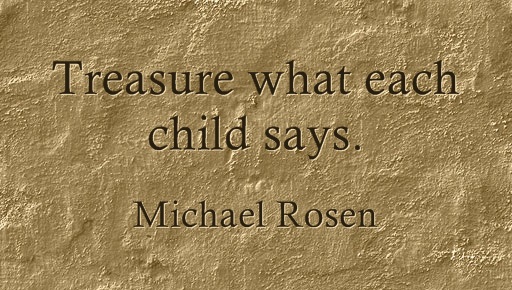
    Another thing he says in that article, which was the inspiration for the title of this post, is

    Treasure-what-each-child

    I couldn’t agree more.

    This is just a brief sample of the riches to be found on the Michael Rosen website. There are so many videos of Michael’s performances available that I have not yet watched them all. Please let me know your favourites and I will make sure I watch those too.

    Thanks Michael Rosen. We can learn so much from you while we are having fun!

  • Whose idea is it anyway?

    Whose idea is it anyway?

    First of all, let me say, there is nothing scientific in this article.

    The notions, unless otherwise attributed, are just my thoughts and ideas.

    Or are they?

    Have you ever had an idea just ‘pop’ into your head?

    What about an entire poem or song? Maybe even a story?

    Have you ever had an idea; only to find out that another has had almost the exact idea at roughly the same time as you with no chance of collaboration or leak?

    Where have these ideas come from?

    Do you really think you have thought them up when they have come fully-formed and unbidden?

    Sometimes I am not so sure.

    ryanlerch_thinkingboy_outline
    http://www.openclipart.org

    Sometimes an idea pops into my head; an idea with no connection to any current thought. It may take me by surprise and make me think: Why didn’t I think of that before? Or rather, why did I think of that at all?

    I can’t explain the force that at times propels my hand across the page, fervently trying to keep pace with and capture the words as they spill forth, lest they escape to a region from which they would never be retrieved.

    Sometimes I’ve written stories, which I may, or may not, have submitted to a publisher, only to find another very similar in print not long after. How can this be? There was definitely no collusion. My story had been written before the other was in print; and the other would have been underway by another publisher before mine had been submitted.

    Have you ever noticed that often two movies on a similar topic or theme are released almost simultaneously? Is this coincidence or planned?

    I know that sometimes songs are very similar, and in fact, there have been court cases over certain bars and riffs. I am surprised this doesn’t happen more often. How can new combinations of notes still be arranged? How difficult it can be to get a melody out of one’s head. How much more difficult it must be to be certain whether that melody is one of your own creation or one that your ears have captured.

    image courtesy of openclipart.org
    image courtesy of openclipart.org

    I remember hearing someone suggest, many years ago, that there are many ideas out there (floating around somewhere in the universe?) ready to be picked. Sometimes they are picked simultaneously by different people in different places around the world.

    I wasn’t too sure about that, but it did provide an explanation, of sorts, for the duplication of ideas.

    A few months ago, I listened to a fascinating TED talk by Elizabeth Gilbert: Your elusive creative genius.

    The focus of Elizabeth’s talk is a little different from my own, but she did offer some thoughts on this topic also.

    I was particularly interested to hear that in ancient Greece and Rome

    people did not happen to believe that creativity came from human beings . . . People believed that creativity was this divine attendant spirit that came to human beings from some distant and unknowable source, for distant and unknowable reasons.

    The Romans called this entity a “genius”. A genius was not a clever individual. It was the spirit that would help shape the artist’s work. The artist did not need to take full credit or responsibility for the work, as the work was that of the “genius’ working through the artist.

    Now that seems to support the notion of ideas arriving fully-formed, as does this next one:

    Elizabeth went on to talk about the American poet, Ruth Stone, who described how “she would feel and hear a poem coming at her from over the landscape” and she would have to run back to house in order to “collect it and grab it on the page” before it thundered on to another poet. I won’t quote the whole story here. Please follow the link to read the rest. It may surprise you as much as it surprised me!

    Looking for a little more content for this article, I came across this blog post by Amanda CraigSynchronicity, or when writers have the same idea

    Amanda writes,

    “Synchronicity is when two or more people have the idea at the same time. Science is littered with examples of this. Darwin only published his Origin of the Species because a fellow biologist had also deduced the concept of natural selection, and sent him his own book in manuscript; several people can claim to have invented the computer, and so on. So, too, in literature. I still remember a Spectator Diary Susan Hill wrote when she found out that Beryl Bainbridge was working on a novel about Scott’s doomed expedition to the Antarctic. She had to abandon it. Rival biographies of the same person are commissioned simultaneously, and sometimes even films (like the two versions of Les Liasons Dangereuses).”

    Now, is that just what I’ve been talking about?

    Follow the link to her entire article to find out what she thinks about synchronicity.

    Still eager for more, this article about Multiple discovery explains that scientists, also, are similarly burdened and, according to Robert K. Merton

    Sometimes the discoveries are simultaneous or almost so; sometimes a scientist will make a new discovery which, unknown to him, somebody else has made years before.

    So where is all this leading me?

    It is simply to introduce the poem,  “A leaf floated down” which came to me as I was preparing for my day. The thoughts were not connected to any others of the moment; the first verses simply wrote themselves, and the parts that I am least happy with, are the parts I laboured to bring forth. I hope it is my own!

    I’d love to know what you think about this synchronicity that we, as creatives, often experience. Please share your thoughts!

  • Dinosaur party

    My gorgeous little grandson is four years old tomorrow.

    He is captivated by dinosaurs and engages all members of the family in playing dinosaur games.

    To celebrate his birthday this week, I decided to make this little book about a dinosaur game with his family members (little sister Anna, parents, an aunt and uncle, and two sets of grandparents).

    I hope you enjoy it too!

    There are 2 choices of format: read it by yourself or read-along with me.

    Read it by yourself:

    You have three choice of arrows to use to page through the book : on the book itself, below the book, or on your keyboard.

    Click on the full screenbelow the image to view in full screen.

    Read-along with me:

    Click on the arrow to hear a reading of the story.

    Related article:

    Play. Dinosaur party (antlersandoctopus.com)


  • Making friends with exercise

    Making friends with exercise

    Exercise and I have never been friends.

    Okay. Maybe “never” is an exaggeration, but our relationship has been quite frosty for most of my adult life with only occasional attempts at reigniting the friendship.

    As a child I played on the beach, swam in the sea, climbed the cliffs and played in the bush near where I lived.

    beachtrees

    As a teenager I played tennis in a school team and for fun with family and friends in outside of school hours.

    papapishu_tennis_player

    At college I played on a basketball team and went out dancing at least once, and sometimes up to three times, a week.NBA_Court_Sports2010

    But always my preferred activity was to be lying on my bed engrossed in a good read or scribbling ideas in a notebook.

    bookworm

    Then came adulthood, work and parenthood; a life brimming with activity but no scheduled “exercise”.

    motherbaby

    All too soon middle age, with its stealthy creep, could hide no longer; and my youthful fitness, feeling the dejection of being taken for granted, promptly left.

    eacousineau_Woman_Jogging

    I know. I know. Exercise is important; not only for body but also for mind.

    I always made sure that my own children and the children I was teaching got plenty of opportunities for exercise. But my own body, that’s a different story.

    johnny_automatic_Jumping_ropesport_aerobica

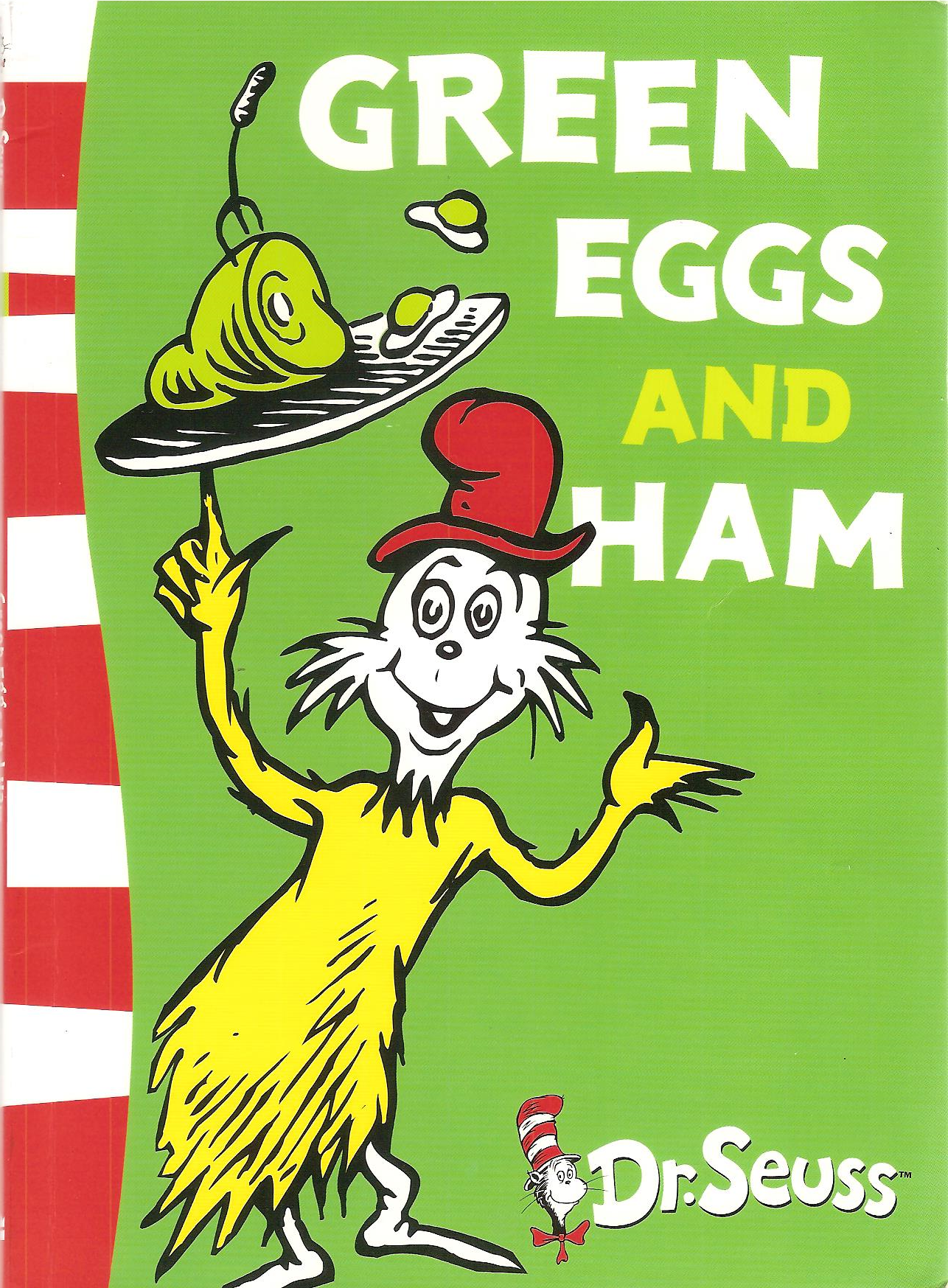
    There were already too many other things I wanted to do. How could I possibly fit in something that I didn’t want to do?Green Eggs and Ham

    With apologies to Dr Seuss’s “Green Eggs and Ham”, I offer the following:

    Ode to exercise

    Exercise. Exercise.

    I do not like that exercise.

    7271-Stick-Figures-Woman2-1-webI do not like the time it takes.

    I do not like the effort it makes.

    I do not like being sweaty and hot.

    I just don’t like it. I do not.

    I do not like it with a trainer.SteveLambert_Woman_on_Exercise_Bike

    I do not like the circuit strainer.

    I do not like it in the gym,

    I do not like a vigorous swim.

    7273-Stick-Figures-Woman2-1-webI do not like the heating sun.

    I do not like an outdoor run.

    I do not like it on a bike.

    There’s very little I would like.

    Would you like it on TV?exercise TV

    Would you, could you with a Wii?

    Okay. I’ll try it on TV.

    Okay. I’ll try it with a Wii.

    7285-Stick-Figures-Woman2-1-webOh I love it.  Yes I do.

    This exercise is good for you!

    I could do it every day.

    I would do it, step this way.

    I would do it on the floor. 7266-Stick-Figures-Woman2-1-web

    I would do it right indoor.

    Exercising with the Wii,

    I have found the one for Mii!

    Computer and video games had been a source of much fun for me since the days of Atari and others in the 80s. When the Wii Fit came out, I thought that if anything could get me to exercise, this would be it.

    Although I still don’t manage to incorporate it into my routine every day, I am doing a lot more than I would without it.

    These are the top 10 reasons I love my Wii Fit:

    10.  I can do it in the privacy of my own home.

    9.  I can spend the amount of time doing it that I choose.

    8.  I am sheltered from the outdoor weather – it’s always a beautiful day on the island.

    7.  It gives me positive feedback and tells me that I am years younger than I really am! (Who can argue with that?)

    6.  If I get lost (which has happened) I don’t have to find my way back; I can just stop and I’m home.

    5.  It notices if we haven’t seen each other for a few days and tells me I’ve been missed.

    4.  I can choose from a wide variety of activities including juggling, tightrope walking and flying as well as step, jogging and cycling.

    3.  I see and have the support of family and friends who “accompany” me through their Mii characters.

    2.  I can listen to audiobooks or Ted talks while I am jogging or cycling — good for my mind as well as my body. The especially great thing about listening to Ted talks, is that most of them are of about 15 minutes’ duration: just how long it takes me to jog or cycle around the island; and because I am listening and learning

    1.  I don’t even notice that I’m exercising.

    SteveLambert_Aerobic_Dancer

    If this sounds like a sales pitch for Will, it probably is, because I am sold on it.

    If you are one of those lucky people who enjoy exercise, then good on you, I say. So many times I have been told, “You’ll feel better after you do it” – something to do with endorphins, I believe.

    I wish. I’m yet to experience that exercise glow. It would make it all so much easier.

    A little while ago Talli Roland wrote a post for Women Writers about “how to avoid writer’s arse”. I think I’ll have to become even better friends with my Wii Fit in the future to stop this becoming a big problem for me, now that I am spending a lot more time sitting on my posterior, writing for posterity.

    7297-Stick-Figures-Woman2-1-web

    Just in case you are wondering what other “exercise” I dabble in from time to time:

    • On work days I include a 10 – 15 minute walk from car to office and back again
    • In summer I do a very gentle swim-ercise in my very private backyard pool
    • I take frequent walks from my desk to the kitchen and back again throughout the writing day
    • I participate in active play with grandchildren (but only when a book won’t do!)

    What about you? Are you one of the lucky ones to whom exercise is a pleasure?

    Or, like me, do you always find there are 1001 other things you would rather be doing, and struggle to find the time and energy?

    Images from open clipart and eLearning Brothers.