Recently I was sent a link to an article titled Cheer up, it’s not all doom and gloom published by the Australian Broadcasting Commission’s The Drum.
This article mentioned a book by Steven Pinker called Better Angels of Our Nature which had been recommended to me by Geoff Le Pard in a comment on my post about childhood illness. The premise of this book is that humanity, over the ages, has become less violent. After to listening to Pinker’s history of violence, I’m pleased that I live these relatively peaceful times.
The article also introduced me to a new term ‘meliorism’ which means having a belief that the world can be improved by the actions of humans. While the term may have been unfamiliar to me, the attitude is not and I attest that I am a meliorist.
I have a very strong belief in the power of education to improve the world. Education empowers individuals, and educated individuals empower societies to build improved futures. It becomes very difficult to sustain negative practices in the face of overwhelming evidence and information.
What better place is there for education to begin than in the home?
In a recent post I referred to a new book by Michael Rosen called Good Ideas: How to Be Your Child’s (And Your Own) Best Teacher. At the time I had not read the book but now I can say, with great delight, that I have listened to most of it. With messages such as those contained in Michael’s book, it is easy to be a meliorist.
I think Rosen’s book should be available to, perhaps compulsory reading for, every parent; I consider its message to be that important. In fact, I am off to the shops today to purchase copies to give to parents of young children I know. It will become part of my gift to new parents that also includes Reading Magic by Mem Fox and a selection of picture books. I have previously blogged about that here and here.
The “Good Ideas” contained in Rosen’s book, if implemented, will keep alive the natural curiosity of one’s children and oneself. They will encourage the development of thought, creativity and responsiveness.
In the next few weeks I will post a more detailed review of the book and some of Michael’s ideas for stimulating curiosity, whoever and wherever you are.
What about you? Are you a meliorist?
I welcome your feedback. Please share your thoughts about any aspect of this post.
A recurring theme on this blog has been the inappropriateness of, and the difficulty faced by children sitting, large-scale external exams which require an immediate response to a stimulus that may have little relevance or interest to them. I have written about it here and here.
Making a judgment about student progress or achievement from one piece of writing, particularly one completed under conditions not necessarily conducive to encouraging one’s best work, is problematic.
It would be unrealistic of me to expect that everyone would agree with me, (though who wouldn’t want everyone to agree with them?) but it is always affirming to find that others share similar views. Maybe if enough people voice their concerns, change may occur.
Recently I read an article in our local newspaper that had me nodding in agreement. The article NAPLAN writers have trouble writing a writing testby Mary-Rose MacColl explained that a good part of the reason students didn’t do well on the NAPLAN writing task this year, is that the task itself wasn’t well written!
MacColl said that the task was wordy and the standards themselves (the criteria against which the writing is marked) poorly written. She pointed out how ludicrous it was for the ACARA CEO to write a letter explaining to parents that students should not view the test as ‘pass or fail’ when many children were experiencing extreme anxiety in the lead up to the test and parents were withdrawing their children from the tests in increasing numbers.
In addition to writing newspaper columns, MacColl is also a writer of fiction. She is pleased that the focus of NAPLAN is on persuasive rather than narrative writing, and goes on to describe some wonderful writing that is going on her son’s class.
Many teachers are doing wonderful things helping students develop a love of writing. Unfortunately, those setting external assessment tasks aren’t listening to the professionals.
I have given only a brief indication of what Mary-Rose MacColl had to say. Please read her article to fully understand her views.
Thank you for reading. I value your feedback. Please share your thoughts about any aspect of this post.
Over at the Carrot Ranch this week Charli Mills is talking about motivation, specifically the motivation of fictional characters to do the things they do. She explains that ‘motivation can be external–a desire to please, to be found attractive, to be accepted’ or ‘internal–a drive to succeed, a passion to experience adventure, a fear of failure’.
Motivation is not a new concept to this blog and I have explored it in a number of previous posts.
In What did you do that for? Rewards and motivation I discussed the use of extrinsic rewards (such as stickers, awards and cash incentives) for school students; and questioned the authenticity of intrinsic motivation, which ‘is usually related to something of one’s own choice through interest, challenge or purpose’, in an institution at which attendance is compulsory. I suggested some strategies that teachers may employ to stimulate an intrinsic love of learning.
Continuing the consideration of the effect of compulsory schooling on a learner’s motivation, the post Why do I have to? explored the use of philosophy as a tool for making the goals of education explicit. All three philosophers: Peter Worley, Michael Hand and Stephen Boulter agreed that if students knew why they were expected to learn certain things, they would be more motivated to do so.
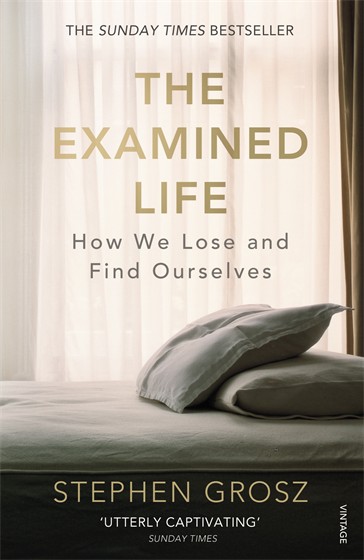
A discussion of the impact of praise upon a learners’ motivation and achievement was stimulated by reading The Examined Life by Stephen Grosz, a book recommended by Anne Goodwin. The Post Seeking praise – Stephen Grosz revisited explored Grosz’s suggestion that praise could cause a loss of competence, especially if children were being praised for being clever. Responses to the post, including a guest post by Anne Goodwin, added greater depth to the discussion.
Shelley Wilson’s blog Live every day with intention, which promises to inspire and motivate you (‘A motivational blog about living life to the full, writing, reading and feeling inspired to follow your dreams’) is the basis of her new book ‘How I changed my life’.
In this TED talk The puzzle of motivation, Dan Pink explains that the value of intrinsic motivation is a scientific fact. While the focus of his talk is the business world, the findings are equally relevant to education. He says that external rewards may work in limited situations but that they often impede creativity. He says that ‘the secret to high performance isn’t rewards and punishments, but that unseen intrinsic drive – the drive to do things for their own sake. The drive to do things because they matter.’
My motivations for engaging with the flash fiction challenges set by Charli are both intrinsic and extrinsic:
I enjoy:
the dual challenges of writing to a prompt with a clearly defined word count;
the opportunity of writing fiction;
exploring the application of Charli’s prompt, however tenuous, to education;
the camaraderie of the fellow writers and the opportunity to read and comment on their posts and flash fiction pieces; and
I appreciate the feedback, support and encouragement I receive in response to my writing.
In her prompt, Charli suggested that the character ‘may not even understand the motivation fully, but (that I should) let the reader grasp it.’ I have written two pieces in response to this prompt. I hope you enjoy them, and get an inkling of what motivates the characters.
More than numbers
The more he stared at the numbers the less sense they made.
They swirled and blurred. He just didn’t get it.
“Numbers don’t lie,” they’d admonished.
“But they don’t tell either,” he’d thought.
The hollowness left when all he knew had been extracted could not be filled with the smorgasbord of numbers loaded on the page.
The richness of lives reduced to mere squiggles.
“This is what’s important,” they’d said, fingers drumming tables of data.
With heaviness of heart he closed the book and walked away.
“They are not even numbers,” he thought. “If they were numbers, they’d count!”
More than words
“More!” they implored.
She surveyed their eager faces then glanced at the clock.
“Just one more?”
“Okay. Just one more.”
Before she could choose, a book landed in her lap.
“This one,” he said.
“Yes,” they chorused. “It’s a good one!”
She smiled agreement, then started to read.
They joined in, remembering, anticipating.
She turned the page.
“Wait!” he said. “Go back.”
“Did you see that?” He pointed to the page.
“But look what he’s doing,” someone else chimed in.
They all laughed.
The shared joy of a beloved book. Each time the same. Each time a little more.
Thank you for reading. I do appreciate your feedback. Please share your thoughts about any aspect of this post or my flash fiction pieces.
This post almost didn’t get published. It almost fell through a crack into the never-never. But just in time the safety net sprang into action and saved it from obscurity.
That may matter more to me than it does to you, but as an educator I hear too often about children who ‘fall through the cracks’, who fail to thrive in the school system, who miss out on the inspiration and timely support that would empower them on their journey to life-long learning.
Like those children, this post was an also-ran. It didn’t quite get it, didn’t quite reach the expectations. But then I read something that confirmed for me the importance of sharing my message.
You see, the love of reading is contagious. It can be caught from anyone, anytime.
However, it can just as easily be extinguished; and the danger of that happening seems to be lurking in school systems packed too tight with lists of must do, must learn and must achieve expectations.
I consider it imperative that teachers prioritize time for children to develop a love of literature and reading that will expand their horizons and create a worthwhile companion on the journey of their lifetime.
Here are 10 easy tips for keeping the love of books alive in an early childhood classroom:
Read aloud to children every day, ensuring that a variety of books and genres are being read and shared.
Have a great supply and variety of children’s books available: picture books, fiction and non-fiction, collections of poetry, beginning chapter books, funny books, sad books, books about animals, space, people . . .
Display books with covers facing out and give them pride of place. Make a display of ‘favourite reads’.
“Sell” books to children (you won’t have time to read them all) by showing the cover and some illustrations; by telling what they are about, what happens, and what the children will enjoy about them.
Make a reading corner with carpet, pillows and bean bags that invites children to get comfy while they read.
Provide time for children to choose and read independently.
This can occur during quiet times set aside on a daily basis in which everyone, including the teacher, reads for 10 – 15 minutes. e.g. D.E.A.R. (drop everything and read) or U.S.S.R. (uninterrupted silent sustained reading).
It can also be integrated into reading group or literacy centre activities.
Share the enthusiasm for books by providing time for children to excite each other about the books they are reading in a sharing circle.
Display books written by the children and allow access to them for independent choice. Include them in the sharing and ‘selling’ sessions also.
Make a time to visit the school library for reading and borrowing.
Invite other adults to the class to read to the children e.g. teacher-librarian, administrators, support personnel, parents and grandparents.
Let me know in the comment box a favourite tip of yours.
This week I have read some fabulous posts by teachers who are making sure there is time for joy and independent choice in their literacy classrooms. I will share these with you below.
The article that convinced me to share my thoughts was one that was not so joyful.
Written by Alexander Nazaryan, a first-year teacher, the article appeared in the Opinion Pages of the New York Times on July 6, 2014. He talked about not being able to meet the needs of his students and explained that it was not the fault of the students though, the fault was that they were mostly of poor and immigrant families.
He felt that asking these students to write about their own experiences did not have ‘the pedagogical value of a deep dive into sentence structure or a plain old vocab quiz.’
I was immediately struck by the similarity of a statement made to me by my son’s teacher thirty years ago. At the time I was leading an in-service workshop about teaching writing. I would have been talking about ways of engaging students in the writing process by giving them opportunities to write at length about things of interest to them; by encouraging the writing of a first draft to get the ideas down; by providing opportunities for redrafting, rewriting and editing; and opportunities for feedback by sharing their writing with peers; and by making the most of teachable moments through individual conferences with each student.
This teacher exclaimed that there was no way the children would be able to write anything of length as not one knew what a paragraph was, or indeed what a sentence was. The students were ten years of age and in their fifth year of school. I believe the statement to be more an indictment of the teacher’s inability to appreciate what the children could do, rather than an accurate estimation of their abilities. I knew for a fact that at least one student was more than capable of writing at length with a variety of sentence structures and correct paragraphing. I was certain he wasn’t the only one.
I am inclined to agree with Nazaryan that ‘Expecting children to independently discover the rules of written language is like expecting them to independently discover the rules of differential calculus.’
However trying to teach the skills of literacy through a barrage of meaningless drill and practice exercises in a joyless classroom is doomed to failure, and the children, sadly, will fall through the cracks.
What the children need, in my opinion and unlike that of Nazaryan, is a balanced approach. The skills of literacy need to be taught in a meaningful context.
She willed the earth to open up and swallow her whole. But it didn’t. She just stood there trembling, attempting to hold back the deluge that threatened to engulf her.
She strained to remember, knocking her head with her fist. Quick. Try. Try. What’s the rule: i? e?
She stammered an answer. Wrong again! Too many rules! Stupid rules! Broken – just like her.
She fled, eyes stinging, mouth twitching; and as she passed, with one hand grasped the confiscated unicorn sitting askew the teacher’s desk.
Away they flew, the assault of mocking laughter fading far below.
Thanks for reading. I appreciate your feedback. Please share your thoughts about any aspect of this post, including my flash piece.
In a previous post I wrote about 3 inspiring educators. In no way did I wish to indicate that the number of inspiring educators was limited to those three or that all inspiring educators are male. The list of inspiring educators is far greater than that and includes both male and female representatives.
The purpose of this post is to both honour, and share the wisdom of, other educators who have positively impacted my life and thinking as an educator and the lives and education of many others. The list doesn’t end here. There will be more to follow.
Maria Montessori’s name is known worldwide as the founder of the Montessori Schools. However her influence is not restricted to those schools. Many educational practices implemented, especially in the early childhood setting were influenced by Maria Montessori.
Maria resisted the gender-stereotyping conservative views of Italy where she lived in the late nineteenth century. She developed her interest in maths and sciences, especially biology, and became the first female doctor in Italy.
As a doctor Maria worked with children from poor and working class families. She developed the belief that every child had an intrinsic intelligence. She studied child development and education extensively and developed methods of implementing her theories. She traveled Europe sharing her ideas and advocating women’s and children’s rights. Her success with disabled students led to implementation of her methods with ‘normal’ children.
Montessori’s methods put the child’s interests at the front of the program. The teacher was to ‘follow the lead’ of the child.
Practices now seen as standard that were initiated or influenced by Maria Montessori:
incorporation of children’s interests, putting their interests first
recognising the development of the individual and making education appropriate to it
use of child-sized furniture and shelving
practical activities such as sweeping and cleaning up
environmental activities such as gardening
health and hygiene practices, such as washing hands, sharing morning tea, cooking
indoor/outdoor areas that children move about freely
opportunities to work independently
respecting the child as an individual
She valued independence and saw it as the aim of education, with the teacher as observer/guide of children’s development.
Sylvia Ashton-Warneris a New Zealand writer, poet and teacher whose educational work I became familiar with in the 1980s through her books Teacher and Spinster, the latter of which was also made into a movie.
Sylvia, who in the interview below states emphatically that she is not a teacher, that she hates teaching and can’t stand education, has been very influential on teachers around the world.
i was unable to embed the video. Click on the image to go to the original site.
Sylvia says,
“There’s a formula for all my teaching. It’s quite simple. I supply the conditions where life can come in the door . . . where both our teacher and our child can be themselves.”
Working with Maori children from poor and dysfunctional families and using organic reading, she developed what is called the ‘Key Vocabulary’; those words holding most meaning and interest to the child. The child asks for a word, the teacher writes it on a card. The child reads the word and copies it to write. The words requested are usually nouns and hold a lot of meaning for the child.
I implemented her ‘Key Vocabulary’ for many years and found it to be a successful tool for developing readers and writers.
Marie Clay is another New Zealand educator best known for her work with literacy education and the Reading Recovery program which was developed to support students whose reading skills were delayed. She believed that early intervention was the key to improving literacy skills.
I first came across her work in her book Reading: The Patterning of Complex Behaviour in 1979. Her 1983 publication Record of Oral Language provided teachers with methods of observing and recording children’s development in literacy.
The Reading Recoveryprogram, based on Marie Clay’s work and developed in the early 1980s, provides one-on-one support for students who are experiencing difficulty with reading in the first years of school. The teachers undergo training which develops their understanding of the reading process and how to support a student’s development. The training is more intensive and thorough with methods specific to this purpose, than generalised teacher education. However knowledge of her research, innovations and methodologies are also of benefit to generalist teachers and have been incorporated into many teacher education programs.
I was very disappointed, as were many other classroom teachers, when this successful program was discontinued in our region earlier this century.
I couldn’t put this book down. My thinking about the brain and learning was being challenged but excited at the prospect of overcoming learning problems experienced by many students.
For years I watched helplessly as scores of struggling learners were pummelled with repetition of the same boring and meaningless methods that created (or at least contributed to) their problems in the first place; of seeing them humiliated by having to repeat a year at school, or being considered ‘dumb’ because they couldn’t do what the other kids could do. Now here was a book that suggested this need not be so. If only those making the decisions and delivering the programs could be influenced.
One of the most memorable stories from the book was that of Barbara Arrowsmith-Young. Barbara suffered from severe learning disabilities throughout her childhood and early adult years. Every known method of compensating for the disabilities was tried without success. Barbara felt humiliated and a failure.
Her life changed dramatically when she heard about neuroplasticityof the brain (the ability of the brain to change in physiology and functionality) and created exercises for her brain, teaching herself to do things she had never done before.
Her story is an inspiring one of courage, strength, and persistence. Barbara has changed her life. After turning her life around, Barbara has developed programs for others with disabilities to engage with. She started the Arrowsmith School in Toronto in 1978. The Arrowsmith Program is now used in schools in the US and Australia as well as Canada.
Barbara’s “vision is of a world that we create in which no child has to live with the ongoing struggle and pain of a learning disability. . . that cognitive exercises become just a normal part of curriculum. . . that school becomes a place that we go to strengthen our brains to become really efficient and effective learners engaged in a learning process where not only, as learners, can we dare to dream, but we can realize our dream . . . This is the perfect marriage between neuroscience and education.”
She travels the world sharing her message so you may even have an opportunity of meeting her in person. I saw her last year at the Brisbane Writers’ Festival. Magic!
You may have noticed some unifying threads with each of these educators:
A focus on the child, the child’s interests and life
A recognition of the child’s ability to learn
An optimism in the child’s ability to learn, for success and the future
All educators worked with students from disadvantaged backgrounds or with disabilities or both; and all achieved success.
I welcome your feedback. Please share your thoughts about any aspect of this article.
Brian is an amazing literacy educator from whom I had the extreme good fortune of learning many years ago. I have written about him before here and here.
Brian’s work focused on the conditions necessary for literacy development. His influence has spread beyond the classroom with the application of the conditions to learning in the workforce demonstrated.
Tony is an amazing educator who does his best to be the change he wants to see in the world. He talks about future-proofing and using innovative thinking to solve problems of both local and global importance.
Anyone who believes ‘that education is the most important profession on the planet’ and does everything in his power to support teachers to be outstanding, as does Tony; must be pretty good in my books.
One of Tony’s books The Ripple Effect is particularly apt for mention in this post. Tony says,
“you must believe in your personal power to create ripples that spread out and change the world. In fact, if it is not you who is going to do it, then who else do you think is likely to make the effort? Remember that every change on this planet begins with a human being somewhere, somehow. It may as well be you.”
This year Tony has started a new project called The Earth Movers Foundationwhich ‘helps young teenagers to create solutions to local and global issues. And they get to choose their own project. No adults will be telling them what project to do. They decide for themselves.’ Sounds pretty good to me.
Ken is another amazing educator. I fell in love with his ideas when I listened to his TED talk Do schools kill creativity? which I have also shared before here.
The statement on his website declares that
“Imagination is the source of all human achievement”.
I could not argue with that.
Ken introduces this short video The writing spirit which presents quotes from artists, thinkers, writers, innovators and snippets of interviews with writers. Just incidentally, and exciting for me, Richard Bach is included. Richard is the author of Jonathan Livingston Seagull, one of my favourite books for its inspirational message.
It is more than likely that these educators have no idea how they have influenced my life (and others as a result).
How wonderful might it be to know of the positive influence you have had on someone, and to have the opportunity of letting others know that they have positively impacted your life?
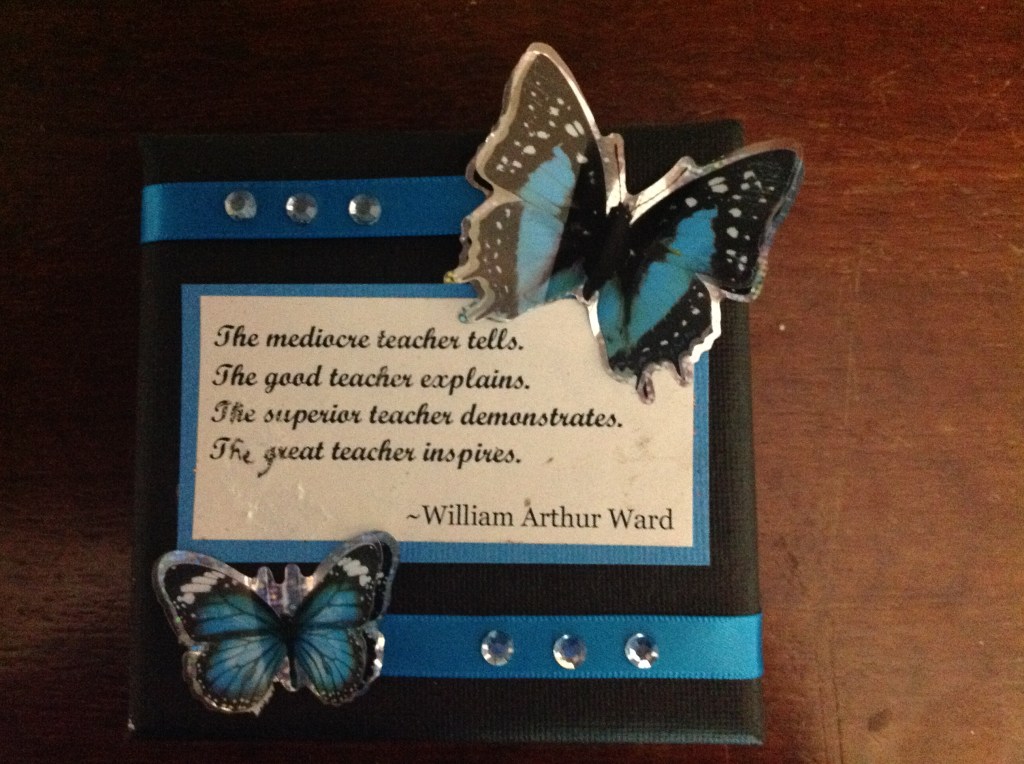
This is the purpose of The Butterfly Light Award which was bestowed upon me my Lisa Reiter, a lovely lady who is herself inspirational for her courage and her positive attitude which she shares with others through her blog Sharing the story. Thank you, Lisa. I am honoured and accept with pleasure.
As with any award, it comes with conditions:
You should write an acceptance post, making sure you link back to the blogger who awarded you and thank them. You MAY NOT lump this award in with a batch of other awards.
You must individually name and re-award to a minimum of 1 and a maximum of 9999999 bloggers. You must let them know either personally with a comment on their blog OR a pingback.
As I have been writing about educators, I am going to stick with that theme. A quick visit to these blogs will explain why I have selected them.
You must write a short paragraph entitled either “How I’m Spreading Light” OR “How I’m A Positive Influence” (what Lisa calls ‘the squirmy bit’).
Done! See beginning of article.
5. Display Belinda’s lovely “Butterfly Light Award” badge on your blog.
Thank you, Belinda. It’s a pleasure! We can never have too many butterflies!
Note: The beautiful framed quote, pictured at the top of this post, was made for me by a wonderful lady, the mother of two of my students. They all share my love of butterflies! I thank them for sharing their appreciation of my positive influence.
I welcome your feedback. Please share your thoughts about any aspect of the article.
I have many discussions with parents about whether they should read fairy tales and stories with magical elements to their children. These parents raise a number of issues, for example:
Horrible things happen – Hansel and Gretel are abandoned in the woods (by their parents) and are captured by a wicked witch – the wolf tries to trick the seven little kids left at home alone
Parents are often dead or absent – Cinderella, Beauty and the Beast, Rapunzel, Red Riding Hood, Jack and the Beanstalk
Stepmothers are mean – Cinderella, Snow White
Sexism, especially the need for a female to be rescued by a handsome prince – Cinderella, Sleeping Beauty
They contain “magical” creatures such as fairy godmothers (Cinderella, Sleeping Beauty), witches (Snow White), giants (Jack and the Beanstalk), trolls (Three Billy Goats)
Myth of happily ever after
Stereotypes – beauty is good, ugly is bad
The presence of magic – good magic of fairies and bad magic of witches – Sleeping Beauty; magical bean seeds and geese (Jack and the Beanstalk)
“many of the older tales incorporated rather dark themes devoted to death, suffering and children being murdered. But then there is also a second incorporation that has to do with later Disney movies of these fairy tales and them being too happy and can result in parents thinking their child will be deluded with ideas that the world will just work for them and things will be good.”
While I acknowledge these elements occur, I am not prepared to abandon fairy tales because of it.
While I may consider a diet of only fairy tales problematic, I think something would be lacking if a child was refused access to the richness of their stories and tradition. Like most fiction, they offer an avenue for escapism. In addition, the stories can be used as a tool for initiating non-threatening discussions of the issues listed above.
“Stories are just one way that we are able to sharpen our own character in order to prepare for the narratives we will one day find ourselves in as the story of our life unfolds before, around and within us.”
Following a comment by Richard Dawkins, a recent discussion on The Guardian considered whether fairy tales are harmful to children. So far the consensus seems to be that they are not.
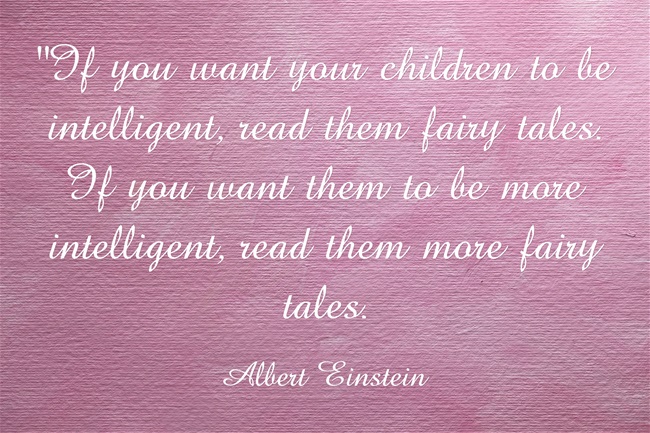
Albert Einstein was a supporter of fairy tales and is often attributed with the following quote, discussed in more detail by Maria Popova on brain pickings.
“In an increasingly complicated world, we more than ever want our children to be able to think with clarity, rather than lead lives hampered or derailed by all those false assumptions and unexamined prejudices that seem as easily inherited as freckles or brown eyes.
How can we go about teaching them to peel back the surface of their first thoughts on a matter, or even their strongest beliefs, and look at them with more care? . . . fiction has always fostered the moral, intellectual and emotional development of the growing child. (‘Should she have done that?’ ‘Would I?’ ‘What else could have been done?’ ‘How would it feel?’) Good stories highlight the sheer complexity of things. They furnish a far greater understanding of the world and everyone in it. For most of us, fiction has always been the earliest – and many would argue the best – instrument we have had for ethical enquiry.”
Think of the ethical inquiry that could occur when discussing Goldilocks and her break and enter, Jack’s theft of the giant’s belongings and the constant portrayal of the wolf as the bad guy; just to get you started.
I am not a reader of adult fantasy novels. I have never read Lord of the Rings, The Hobbit or Watership Down. I just couldn’t buy into it. I’m sorry I have to admit it – it is true.
However, I don’t mind a bit of fantasy in children’s books and, in fact, really enjoy it. I didn’t mind the rats’ use of language in Robert C. O’Brien’s The Rats of Nimh while I couldn’t handle the talking rabbits in Watership Down by Richard Adams. I cannot explain why my response is different but I’m sure it has something to do with the ability to suspend disbelief. I am obviously more able to do that when encountering fantasy in children’s stories than in adult fiction.
As both parent and teacher (and now grandparent) I love sharing stories with children. In addition to all the good things I know it is doing for them, it is doing lots of good things for me as well. Reading children’s stories written by masterful authors is one of life’s greatest pleasures and I love having excuses for doing so.
This week the flash challenge issued by Charli Mills at the Carrot Ranch was to
I am taking the opportunity of sharing with you some of my favourite fantastic creatures and magical realms from children’s stories. Each of these stories is wonderful to read aloud and share with children.
Charli mentioned rainbows, unicorns and the phoenix.
I thought of The Iron Man by Ted Hughes (a story in five nights, suitable for children from age 5 – 104)
“Taller than a house, the Iron Man stood at the top of the cliff, on the very brink, in the darkness.
The wind sang through his iron fingers. His great iron head, shaped like a dustbin but as big as a bedroom, slowly turned to the right, slowly turned to the left. His iron ears turned, this way, that way. He was hearing the sea. His eyes, like headlamps, glowed white, then red, then infra-red, searching the sea. Never before had the Iron Man seen the sea.
He swayed in the strong wind that pressed against his back. He swayed forward, on the brink of the high cliff.
And his right foot, his enormous iron right foot, lifted – up, out, into space, and the Iron Man stepped forward, off the cliff, into nothingness.”
and The BFG by Roald Dahl. (a longer tale for school age, and older, children)
“It wasn’t a human. It couldn’t be. It was four times as tall as the tallest human. It was so tall its head was higher than the upstairs windows of the houses. Sophie opened her mouth to scream, but no sound came out. Her throat, like her whole body, was frozen with fright.
This was the witching hour all right.
The tall black figure was coming her way. It was keeping very close to the houses across the street, hiding in the shadowy places where there was no moonlight.
On and on it came, nearer and nearer. But it was moving in spurts. It would stop, then it would move on, then it would stop again.
But what on earth was it doing?”
I thought of Joan Aiken’s wonderful collections of fairy tales like A Necklace of Raindrops (for children in early years of schooling)
“And when she had nine raindrops Laura found that she could make the rain stop, by clapping her hands. So there were many, many sunny days by the sea. But Laura did not always clap her hands when it rained, for she loved to see the silver drops come sliding out of the sky.
Now it was time for Laura to go to school. You can guess how the other children loved her! They would call, “Laura, Laura, make it stop raining, please, so that we can go out to play.”
And Laura always made the rain stop for them.
But there was a girl called Meg who said to herself, “It isn’t fair. Why should Laura have that lovely necklace and be able to stop the rain? Why shouldn’t I have it?”
and The Kingdom Under the Sea (for children approx. 8 -12), each beautifully illustrated by Jan Pienkowski adding another element of wonder to the tales.
Charli suggested that we “think of how (we) can use the fantastical to enrich realities” and I thought of the mouse who invented The Gruffalo in Julia Donaldson’s story and showed how imagination could be used to solve problems that arise. (The Gruffalo is suitable for children in pre-school and early years of schooling)
While the above excerpts are short, like flash fiction, each demonstrates the skill of the author in choice of words and sentence structure. In his book On WritingStephen King refers to these as forming the top level of the tool box. But these excerpts show a depth greater than that also. They create a connection, forming a relationship with and a need in the reader to know what happens.
It is the ability of the author that sweeps us away, as if on a magic carpet, to other places and other lives. It is the ability of the reader to suspend disbelief that allows the journey to occur.
I thought about how we, as either child or adult, use fantasy to escape realities that we may not wish, or not feel strong enough, to face. This brought me back to Charli’s unicorn.
And now I offer my own bit of flash, which is not suitable for reading to children of any age.
While I did eventually produce a piece in response to the prompt and received some very generous comments (thank you readers), the difficulty I was experiencing made me think of all the school children who have ever been set a topic and told to write about it, sometimes without an opportunity for discussion, reflection or planning, and often without any consideration of interests or experiences. I was feeling particularly sympathetic that week as children in Australia were, at that time, sitting the NAPLAN (National Assessment Program – Literacy and Numeracy) writing test.
While I have not yet read the entire paper, the abstract itself is quite interesting.
Behizadeh begins by saying
“The dangers of a single story in current U.S. large-scale writing assessment are that assessment practice does not align with theory and this practice has negative effects on instruction and students.”
As shown in my previous article, large-scale writing assessment also occurs in Australian schools and, I believe, in the Education systems of many other countries as well.
It is interesting to see that the practice, while widely implemented, is not, according to Behizadeh, supported by theory. One would have to wonder why. Oftentimes teachers lament that those making decisions about educational practices are bureaucrats with little or no training or experience in education. (Pardon me, we all went to school didn’t we?)
In our data driven world where information can be collected on spreadsheets, compared in a wide variety of graphs and tables, and stored indefinitely, emphasis moves from qualitative to quantitative assessment. I believe that this trend towards valuing only that which can be scored numerically is having a negative effect upon children’s learning and their enjoyment of learning. It discourages creativity and imagination and forces everyone to squeeze into the same sized and shaped hole. Some manage to fit more easily and more comfortably than others, but I question the cost to all.
Behizadeh goes on to propose
“A new vision of large-scale sociocultural writing portfolios in K–12 education . . . that builds on the practices of past large-scale portfolio assessment … (and) also encourages students to write in multiple languages/dialects and modes for multiple purposes.”
I love the idea of portfolios for assessment, rather than a one-off test. I would think most professional writers have a portfolio consisting of work at various stages: some as ideas jotted on slips of paper, some in planning stages, others in draft form, others completed and waiting for the next step, and others in publication.
A portfolio allows a writer to work on different pieces at different times and at different rates. Rarely is it imperative for a piece to be completed in an hour or two. (Unless you’re a journalist I suppose.) You can dip in, leave to rest, go back, redraft, edit, start again, and not be required to churn something out for a reader, let alone assessment, more or less on the spot.
As a teacher, too, I loved my children having portfolios of work. They would write a draft of many different pieces and store them in a folder. They would edit and “publish” those only they wished (which was usually most!).
I would conference with them about their pieces, firstly about the content be it story, poem, letter or information discussing what they wanted to say, who they were writing it for and how they wanted the reader to think and feel. When they were happy with their message we might talk about choices of words and language structures. Finally, when they were ready to publish, we would look at the surface features of spelling and punctuation. No teacher’s red pen was ever used to mark their work. The children were engaged with the entire process of writing (we called it “process writing” back then) and had ownership of their work.
We published by sharing our work with classmates, other classes, teachers and parents. We displayed writing on classroom walls, in the hallways and in the school foyer. Each term I would print booklets of the children’s writing for them to take home and share with their families. Many took pride of place on the family bookshelves.
This type of portfolio clearly demonstrates a student’s ability to write in a variety of genres, to develop an idea, to express oneself grammatically, to use editing skills and to proofread for spelling and punctuation correctness. What better than that could be used to assess a child’s writing development?
The two main points I am making in this article are:
a one-off writing assessment task does not give students an opportunity to show their best work and puts pressure on them to perform
a portfolio of work collected over time provides a clear picture of student ability, development, and next steps for learning
While I began this article by expressing how I was feeling about responding to the flash fiction prompt, I am in no way suggesting that the flash fiction challenge has any similarity to the national writing assessment tasks that are set for children, for it does not.
With flash fiction:
I choose whether to participate or not
I choose the genre in which I will respond
I hone my writing skills, paring away unimportant words to get to the heart of the story
I share my writing with willing readers
I receive lots of encouraging and supportive feedback on my writing
I have a sense of belonging to a community of other writers.
I have spent a lot of time thinking about this one, making various starts and writing some drafts but the twist in this one is, I haven’t been able to come up with something I am happy with sharing. But that’s okay because, unlike the children sitting the one-off national assessment, I can choose not to contribute this time, a low-ranking score won’t be collected and placed against my name for all time, and I can get to participate next time, if I choose.
Although I am not contributing a piece this time, I have still learned a lot by the process of trying different things, even if I haven’t found a way to make them work, yet
… and it provided me an opportunity of sharing some of my thoughts about writing with children. There will be more to come!
I’d love to know what you think!
PS Make sure you pop over to the Carrot Ranch to see how others have responded to the prompt.
For the past couple of months, Charli Mills has been posting a flash fiction challenge on her site Carrot Ranch Communications.
I have been really enjoying the challenges as I hadn’t tried writing fiction in such brevity before. I do like having a go at various genres but the main focus of my writing is education and literacy learning. I am currently developing resources for children, parents and teachers which I plan to make available on a future website.
Having many years’ experience in writing these types of resources, I sometimes think I would be willing to develop any resource requested by an early childhood teacher. Participating in the Flash Fiction Challenge was a way of proving to myself that I could attempt any topic and genre.
I am not a fan of horror (real or imagined) and I haven’t done enough travel to have experienced a horror story (thankfully) but I was still keen to have a go and keep up my good participation record.
The difficulty I was experiencing with this writing task made me think about writing tasks that are set for children in school. How many children have ever returned from holiday and been set the task of writing about “My Holiday”?
Maybe that’s not so bad, they have all experienced it. But what about other topics that are of little interest to them.
This week across Australia students in years 3, 5, 7 and 9 are sitting NAPLAN (National Assessment Program – Literacy and Numeracy) tests.
Students in those year levels are set the samewriting task . They are given “a ‘prompt’ – an idea or topic – and asked to write a response of a particular text type”
Information on the acara (Australian Curriculum Assessment and Reporting Authority) webstite explains that
“In 2014, as in previous years, the Writing task will be a single common task for all students. The 2014 Writing test will require students to respond to either a persuasive or narrative Writing prompt. However, the genre of the prompt will not be disclosed prior to the test period.”
It goes on further to say that
“The provision of a rich and broad curriculum is the best preparation for NAPLAN, including the Writing task.”
I think I have a fairly rich and broad educational background with a reasonable level of literacy skills; but I am not convinced that, on any given day, in a restricted amount of time, under the watchful eyes of supervisors I would produce my best work in response to a prompt about which I may have little experience, knowledge or interest.
What about you? How do you think you would go?
Below is my response to Charli’s horror travel prompt. I don’t think it is my best work.
Travel woes
She willed the doors shut forever, knowing that open they must, or she’d be left behind.
She mentally checked and re-checked required items. Surely there was something she had missed?
Dread gripped her ankles, threatening her balance.
Fear squeezed her chest, constricting her breath.
Heights and enclosed spaces were not her thing.
She straightened, attempting to hide the tremble from fellow travellers.
“Don’t be crowded. I need space, air to breathe.”
The doors opened. She was swept inside.
They closed, encasing her. No escape now.
Would she make the distance, mind intact?
Ding!
Floor 35. Here already.
The NAPLAN writing tasks are marked against a rubric of 10 criteria. I wonder what the criteria for flash fiction would be and how I would score.



















 Norah Colvin