Live Love Laugh Learn … Create the possibilities

Tag: Literacy

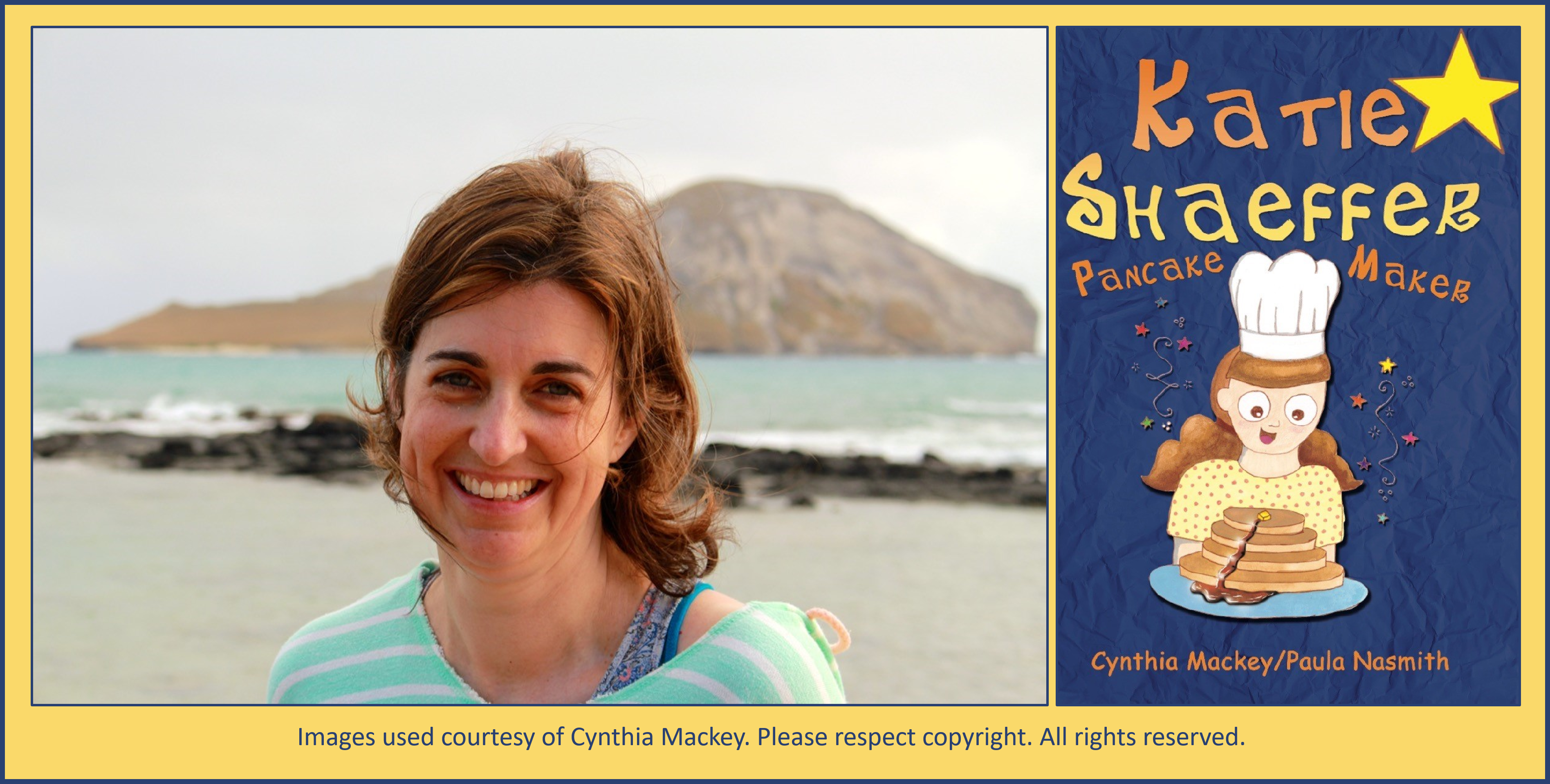
  • Introducing author Cynthia Mackey – Readilearn

    This month I am pleased to welcome first time author Cynthia Mackey to the readilearn blog.

    Cynthia has always loved children’s literature.  After years of teaching preschool and kindergarten, she is proud to have written her first children’s book, Katie Shaeffer Pancake Maker.  Cynthia writes in her spare time and has plans to publish more picture books for children.  She lives on the west coast of British Columbia, Canada with her family and her piano where she faithfully continues her weekend pancake tradition.

    Synopsis: In Katie Shaeffer Pancake Maker, Katie is too young to use the stove so she dreams of making her very own pancakes. Join Katie and her friend Baxter in this fun story as they use a passion

    for collecting and building to find a way to realize Katie’s pancake dream!  This upbeat energetic tale with great potential for reading aloud will appeal to adults and young children alike.  The book includes a predictable rhyme that will have children chiming in as the story unfolds.  Children will celebrate with Katie and Baxter as their pancake dream becomes reality!

    Welcome to readilearn, Cynthia. We are looking forward to getting to know you a little better.

    Thanks for inviting me!

    Cynthia, when did you know you wanted to be a writer?

    Continue reading: Introducing author Cynthia Mackey – Readilearn

  • Celebrating Mums – Readilearn

    Six early years activities for celebrating Mother’s Day. Develop literacy skills while making a personalised and special gift for Mums.

    Mother’s Day is celebrated on the second Sunday in May in many countries, including Australia, the United States, and Canada. With the celebration little more than a week away, I thought I’d share some suggestions that are low on cost but packed with learning opportunities to incorporate into your class literacy and art programs.

    Encouraging children to create and give a gift from the heart demonstrates that not all gifts need come from a shop. It allows children from even the poorest families to give their Mums a special Mother’s Day gift. It helps develop their creativity and teaches them skills that they can apply in future gift-giving situations. It shows how thoughtfulness and imagination can combine to make a unique gift that will be treasured.

    A gift of love lasts longer than many store-bought gifts.

    1. Read picture books featuring mothers

    A few of my favourites are:

    Continue reading: Celebrating Mums – Readilearn

  • I love poems – Readilearn

    I love poems. Children do too. Poetry is a great way of introducing children to the joy of language, as well as to features such as rhythm, rhyme, alliteration, similes and metaphors. What is taught through poetry can be as simple or as complex as required by the ages of the children or your teaching purpose.

    One of the great benefits of teaching young children through poetry is the fun aspect. It’s enjoyable for teachers and students alike and, when children innovate on poems to create poems of their own, very motivating.

    With St Valentine’s Day not far away it is timely to read and write love poems. One of my favourite poems for writing with young children is based on the traditional camping song I love the mountains. I was taught the poem by the amazing literacy educator Bill Martin Jr at a reading conference in the 1980s, and used it with every group of children I taught thereafter. I have previously written about that on my other blog here.

    The repetitive structure and easy melody invites children to join in and is easy for children to use in writing poems of their own, whether they are emergent, beginning, or advanced writers.  The poems can be completed using pictures or words.

    This is one of my favourite versions of the song.

    Continue reading: I love poems – Readilearn

  • Reading across the curriculum – Readilearn

    The importance of reading cannot be overstated. It is an essential skill, integral to almost everything we do. Teaching children to read is one of the most important, and most rewarding, aspects of our role as early childhood educators.

    Some children come to school already reading. Others come not yet reading, but with a love of books and an expectation that they will learn to read. They understand that reading involves making sense of the squiggles on the page. These children usually learn to read effortlessly regardless of what we do.

    Other children come to school with little experience of books and reading. For them, learning to read is a mystery and a greater challenge. For these children especially, it is important that we provide an environment rich in language and book experiences. We need to excite them about books and reading, interest them in words and language, and show them that books can be both a source of enjoyment and information.

    I often hear teachers lament that there’s just not enough time in the crowded curriculum to read to children any more. But reading aloud to children, especially early childhood children, should be non-negotiable and a priority every day. How can we excite them about books, and interest them in reading, if we don’t read to them?

    It is impossible to turn children onto books in one isolated reading lesson each day. In fact, reading lessons as such probably don’t turn children onto reading at all. That is not their purpose. Their purpose is to teach skills. But those skills should always be taught in context, and never in isolation. Nor should they be confined to lessons timetabled for English. Reading must occur across the curriculum and for a multitude of purposes throughout the day, from noting who is at school, interpreting the job roster and group allocations, to understanding connected text in various subject areas.

    Many readilearn resources are designed to provide children with opportunities for reading across the curriculum. Even those designed specifically to develop reading skills have application in other subject areas.

    Continue reading at: Reading across the curriculum – Readilearn

  • Getting to know you – Readilearn

    getting-to-know-you-2

    The beginning of the year is a great time for getting to know each other. Children will feel comfortable and friendly towards each other in a welcoming classroom environment that values and respects individuals; and in which appreciation for our diversity, as well as our commonality, is nurtured.

    When children feel safe to be who they are, they are more accepting of others.

    While it is important to establish a welcoming environment at the beginning of the school year, it is equally important to maintain the supportive environment throughout the year. It is not something we do to pretty the room and then forget about it. It is a part of who we are, and comes from a firm belief in the value of each individual, of community, of humanity, and of our world.

    Source: Getting to know you – Readilearn

  • Preparing for holidays – Readilearn

    At this time of the year, people around the world are preparing to celebrate a variety of holidays. Christmas, celebrated by almost half of the world’s population, is perhaps the biggest holiday of the year. While traditionally a Christian celebration, its focus for many is now more secular than religious and is celebrated by both Christians and non-Christians. Even within the Christian community, there are many ways in which the festival is observed.

    In addition to Christmas, children in Australia are preparing for the end of the school year and their long summer holidays from approximately mid-December to late January. While not as long as that of some of our northern cousins, the six-week break challenges parents in thinking of ways to keep the children occupied, while ensuring that the achievements of the year are not lost before the new school year begins.

    In this post, I share some suggestions and readilearn resources to assist in preparation for both.

    Click here to read the original: Preparing for holidays – Readilearn

  • What’s the procedure?

    This post is republished from the readilearn blog.

    sift

    Reading and following procedures is a part of everyday life. We need to follow a procedure to make a cake, take medicine, repair a bicycle, treat head lice, assemble a DIY bookcase, or install an app on a digital device. The list in inexhaustible.

    Sometimes procedures are presented as text, sometimes as illustrations or diagrams, and sometimes as a combination of both. They work best when each step of the sequence is accurately described and illustrated.

    However, not all procedural texts are created equal. Sometimes the language may be inappropriate and unclear. Sometimes steps are omitted or sequenced incorrectly. Sometimes diagrams have little resemblance to what is required and confuse, rather than clarify, the process.

    Trying to figure out what to do can cause a great deal of frustration in such circumstances.  The more practised we are with following procedures, the more adept we are at interpreting inadequate instructions to achieve a good outcome.

    It is never too soon for children to learn to read and follow procedures. The inclusion of procedural texts in a classroom literacy program has many benefits.

    Following a procedure provides a context and purpose for reading.  It requires children to interpret instructions through a combination of text and visual representation. It generally implies that children are doing or making something, which engages their interest and encourages participation. It develops an essential real-life skill that is transferrable to a range of situations. The sense of achievement in successfully completing a project is both affirming and empowering and often requires no other feedback.

    Procedural texts can be easily incorporated into a class reading program as an independent or group reading activity. An assistant to support, encourage and oversee can be invaluable.

    Features of procedural texts

    The reading of a procedural texts differs from reading fiction or non-fiction texts.

    • The title, and sometimes a short description, tells what will be done or made.
    • There is generally a list of requirements.
    • The body of the procedure is written as a sequential series of commands.
    • The verb, telling the action to be performed, occurs at the beginning of the sentence.
    • The sentence is directed to the reader, and means, “You do this.”
    • Each sentence is generally short with one action to be performed in each step.

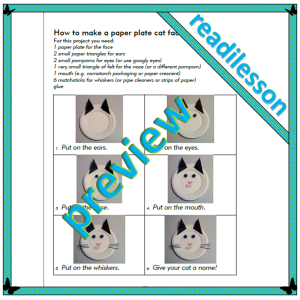
    There is a range of readilearn resources to involve children in reading and following procedural texts. Many of the procedures are provided in different formats for use with the whole class or with small groups or by individuals. Some are supported by additional resources, and How to make a paper plate cat face is presented with two levels of text.

    These include:

    How to make a paper plate cat face

    how-to-make-a-paper-plate-cat-face-level-1

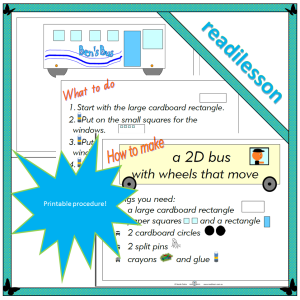
    How to make a 2D bus with wheels that move

    how-to-make-a-2d-bus

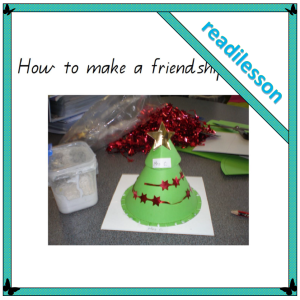
    How to make a friendship tree

    how-to-make-a-friendship-tree-readilesson

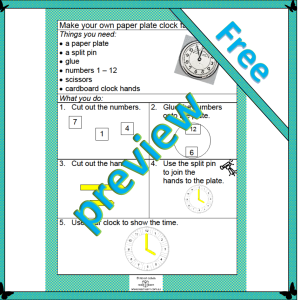
    Make your own paper plate clock face

    make-your-own-paper-plate-clock-face-free-preview

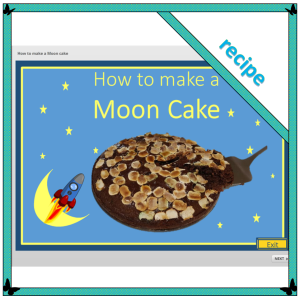
    How to make moon cake

    how-to-make-a-moon-cake-sl

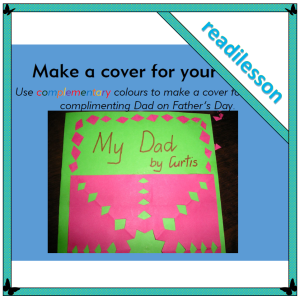
    How to make a book cover

    how-to-make-a-book-cover-readilesson

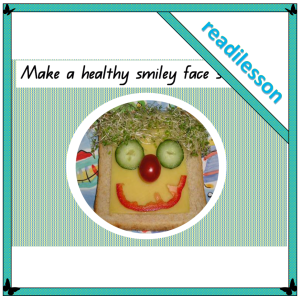
    How to make a healthy smiley face sandwich

    make-a-healthy-smiley-face-sandwich-readilesson

    I hope you and your children enjoy using these resources. They were always enjoyed in my own classroom, and have been the most popular resources in my Teachers Pay Teachers store.

    Please contact me if you have any questions. I welcome your feedback, especially suggestions for improvements to existing resources and ideas for new ones.

    Remember, if you haven’t yet subscribed, an introductory discount of 20% is available to all who subscribe this year. Just use the coupon code welcome2 at the checkout to receive your discount.

    I’ll see you next week. In the meantime, enjoy the weekend.

    Thank you

    Thank you for reading.

    Happy teaching and learning,

    Norah


    You can contact me:

    via email hello@readilearn.com.au

    via the Contact page

    on Twitter @readilearn or @NorahColvin

    on Facebook @readilearnteachingresources

    on my other blog NorahColvin.com

    I invite you to rate and review any resources you use, and to share information about readilearn on social media.


  • Listen to the sounds

    Charli's picture

    This week at the Carrot Ranch, Charli Mills is talking about sound, and has challenged writers to

    In 99 words (no more, no less) write a story that includes the sense of sound. It can be an onomatopoeia, a swearing session with sound alike substitutes, lyrical prose or a description of a sound. Go where you hear the prompt calling.

    I thought it was quite timely for me as I had just written a piece about audiobooks. However, I have decided to keep that for posting another day and have instead decided to look at picture books. Regular readers may not be surprised.

    Picture books are often a child’s first introduction to stories, poems, fantasy and other worlds. The language of picture books is immensely important and must captivate the ear as the illustrations engage the eye. Through picture books children are learning the sounds of the language: its rhythms and intonations; its accents and pronunciations; its beauty and its meaning.

    Many picture books are written in rhythmic, rhyming language and we are quick to note when the timing is a little off or the rhyme not quite right. Successful picture book authors write and rewrite until they get the sound of the language just right for a read aloud experience. Though the words may be few, the task may be difficult. Children, their parents, and teachers are a discerning audience.

    As onomatopoeia (a word that phonetically imitates, resembles or suggests the source of the sound that it describes) features in many children’s songs and picture books, it is the focus of this post.

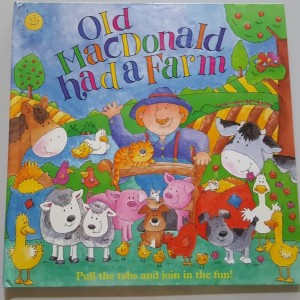
    Old MacDonald had a Farm

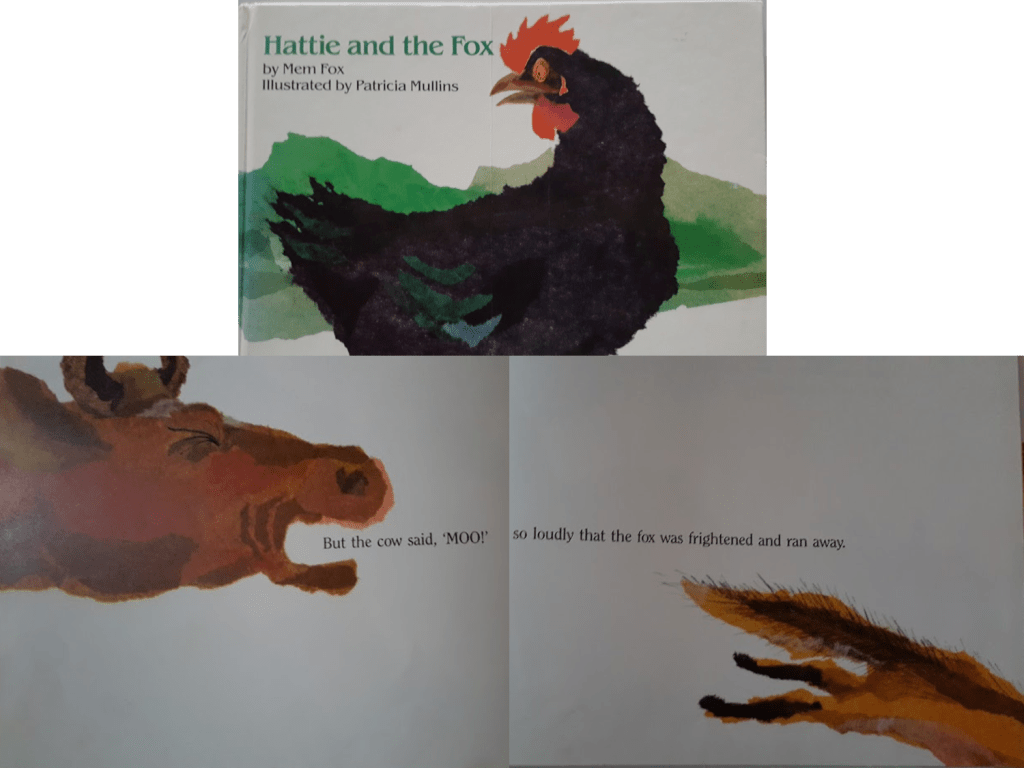
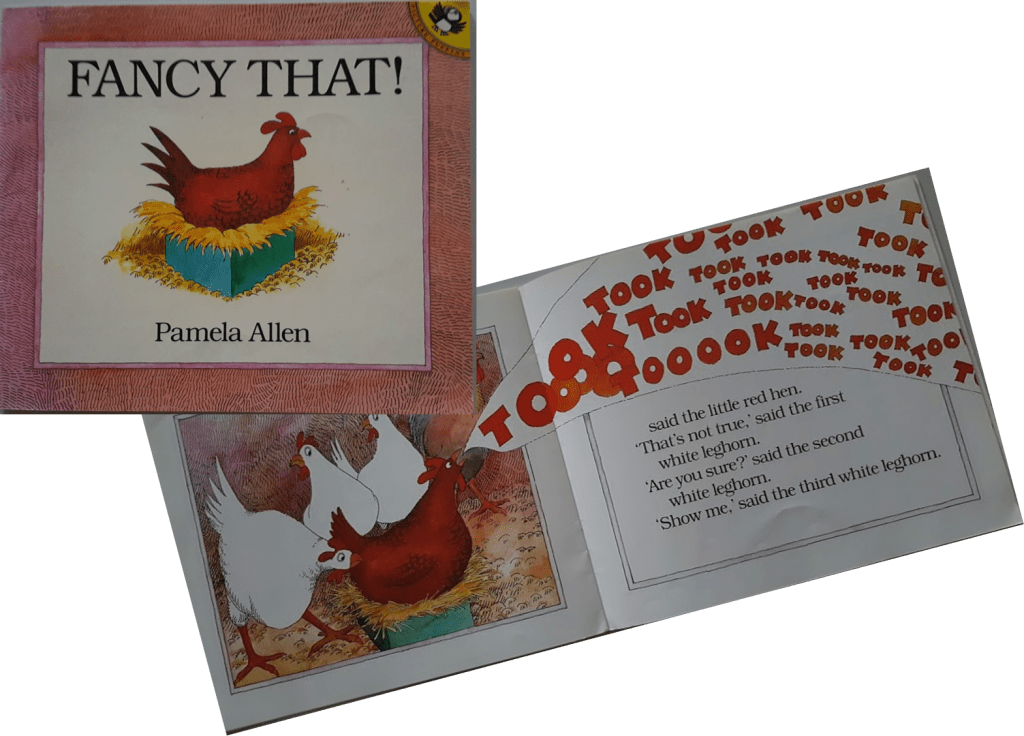
    Animal sounds, familiar through songs such as Old MacDonald Had a Farm, frequently occur in picture books, including Hattie and the Fox and Fancy That!

    Hattie and the Fox

    Fancy That

    The sounds of machines are also popular. Some of you may recall the song about The Marvellous Toy that “went zip when it moved, and bop when it stopped, and whirr when it stood still.”

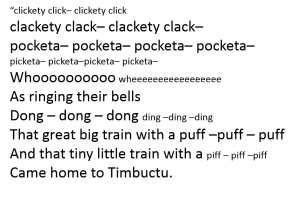
    the Train to Timbuctu

    The repetitive rhythmic sound of a train’s motion is frequently portrayed, as in The Train to Timbuctu that went

    Timbuctu rhyme

    the Little Engine that Could

    and The Little Engine that Could with its

    “I think I can – I think I can – I think I can – I think I can – I think I can – I think I can – I think I can – I think I can – I think I can.”

    followed by

    “I thought I could. I thought I could. I thought I could. I thought I could. I thought I could. I thought I could.”

    A great demonstration of a growth mindset.

    Bertie and the Bear

    There are also the sounds of musical instruments as in Bertie and the Bear.

    An Old Witch Song

    There are the sounds associated with actions, like the swish of the broomstick and the plop of the hop toad in Old Old Witch;

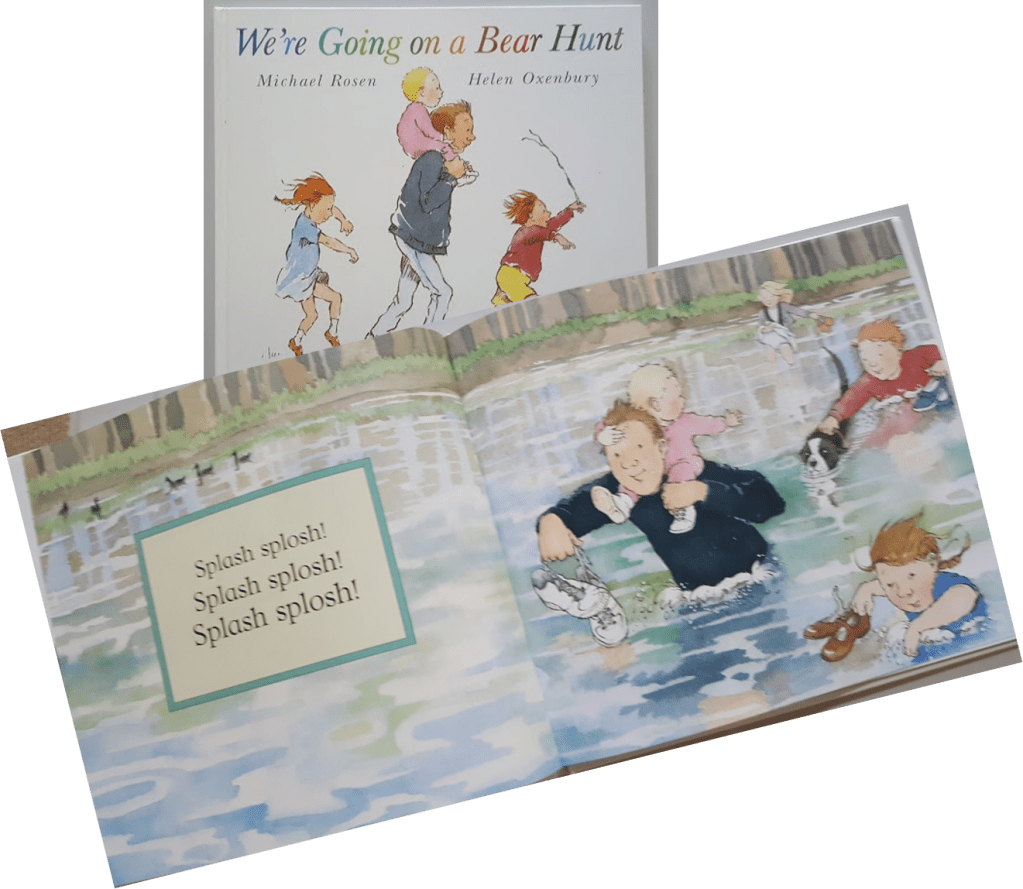
    Going on a bear hunt

    and those from Going on a Bear Hunt with its swishy swashy of moving through grass, splash splosh of wading through water, and squelch squelch of walking in mud.

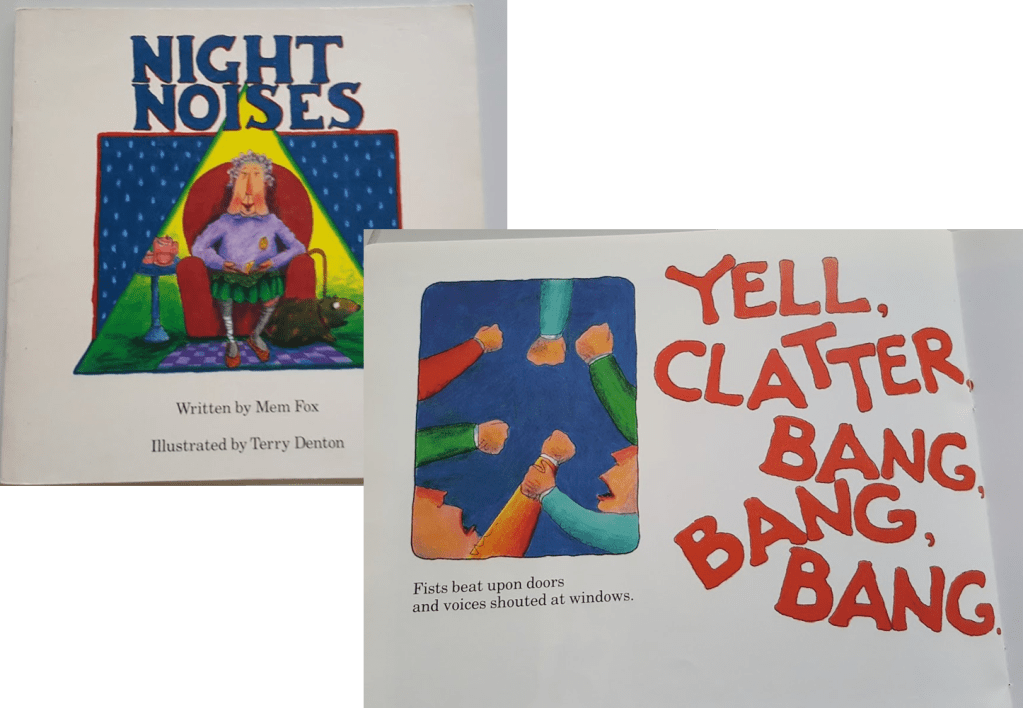
    Night Noises

    Some stories introduce a variety of onomatopoeic words. Night Noises, about a surprise party for Lillie Laceby who was nearly ninety, includes the click clack of car doors opening and closing, the crinch crunch of feet tip-toeing on a garden path, the murmur and mutter of voices whispering, the creak crack of knees, and the snick snack of bolts on the door.

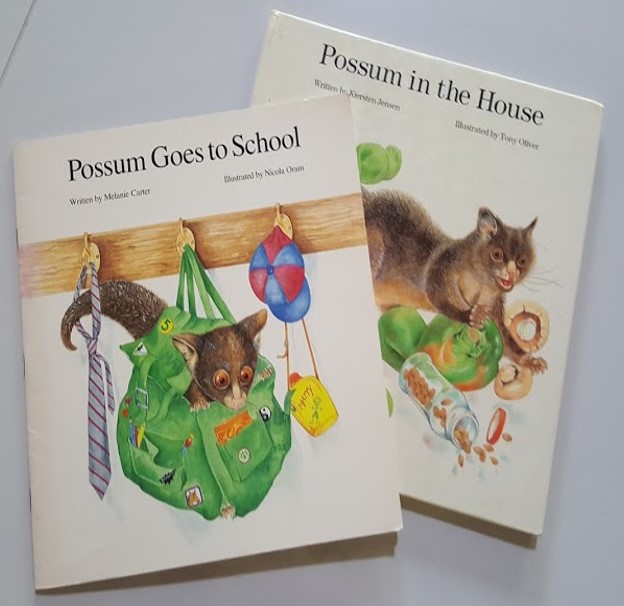
    Possum goes to school

    When there’s a Possum in the House or Possum Goes to School, there is nothing but trouble, with possum making a mess at every opportunity.

    At home, in the pantry the cornflakes go crunch crunch, in the kitchen the saucepans go clatter clatter, and in the study the pages go rustle rustle. Each time the possum’s whereabouts is discovered, it goes screech screech and runs off to another room to create yet more mess.

    The same occurs at school with paints going drip drip in the art room, claws going scratch scratch in the staff room, and the goldfish going splash splash in the science room.

    Burping Baby

    Then of course, there are also the body noises that children seem to take delight in, like those from Burping Baby.

    I recently discovered Lauri Fortino’s Frog on a [B]log, a blog celebrating picture books. Lauri has a delightful picture book of her own The Peddler’s Bed, illustrated by Bong Redila. Lauri recently shared a reading of the story on her blog. Since we are talking about sounds, if you have a few spare minutes, pop over and have a listen.  You will also find an example of onomatopoeia in her story with the repetition of squeak squeak squeak.

    Onomatopoeic words are often presented in fonts of different size or colour, or even different type. Children are fascinated by them, pointing to, asking about, maybe even recognising them, long before they are able to recognise any other words. You can help to get them started by pointing to the words and inviting them to join in the hullabaloo. What a great introduction to the world of reading.

    Now that I have reminded you of these types of onomatopoeia and provided you with these wonderful examples, I wonder what I was thinking. How can I match them in my flash? I need a flash of inspiration, or maybe a flash of lightning to begin my story about a mother and child hurrying to make it home before the storm hits. I hope you enjoy it.

    The eye of the storm

    “Storm’s coming!”

    Pit pitter-patter Pat pitter-patter hasten four feet.

    Lightning and thunder boom down the street.

    “H-h-h-hurry.” Mum urges. “Home – nearly there.”

    Pit scuffle-scuffle Pat scuffle-scuffle “Straight up the stair.”

    Clink-chink-fumble-fumble “No need to knock.”

    Scritch-scratch “I’ve managed – the key’s in the lock.”

    Whoosh! chortles wind, as it rushes inside.

    Damn! cusses chair chucked onto its side.

    P-u-sh!  The door bangs! Avoid pellets of ice

    Smashing and tumbling like millions of dice.

    Rat-a-tat raindrops, another crash-boom!

    Shuffle and scurry. “Straight to the safe room.”

    Huddled together, hardly daring to breathe,

    Listening and waiting for the monster to leave.

    Then sudden quiet, the child whispers hope

    “Is it all over?” Mum answers, “Nope.”


    The first fifteen lines meet Charli’s 99 work criteria. I added the last two because I was thinking of the eye of a storm that brings a quiet calm but not the end of the storm –  there’s still more to come. I’d love to know what you think.

    Thank you

    Thank you for reading. I appreciate your feedback. Please share your thoughts.

  • How should reading be taught in schools?

    The ability to read is empowering and a fundamental right. Sadly, many children leave school either unable to read or disinterested in reading. There are many reasons for this. Unfortunately, for many children, it is a learned disability. There are almost as many opinions about how how reading should be taught as there are people willing to give them. I don’t always agree with those opinions, but I do with this one by Misty Adoniou, which first appeared in The Conversation on June 21, 2016.
    Thank you
    As always, thank your for reading. I appreciate your feedback. Please share your thoughts.

    How should reading be taught in schools?

    Misty Adoniou, University of Canberra

    When my son was nine years old, he put aside the large Harry Potter novel he had been slowly, but enthusiastically, reading each evening and instead began ploughing through lots of fairly uninspiring books that he brought home from school each day.

    It turned out the Year 4 teachers had devised a competition at his school – whichever class read the most books would be rewarded with an end of term pizza party.

    The aim, I presume, was to motivate the children to read. It is ironic then that the effect was that my son stopped reading for pleasure and instead began reading for the numbers.

    Reading is now increasingly being reduced to a numbers game in schools.

    What level is your child at?

    At pick up time, parents quiz each other about what reading level their child is on. Inside the school staff room, teachers are directed to have children on level 15, 20 or 30 by the end of the school year.

    Six year olds are deciding whether they are good readers or not based on how many books they have ticked off on their take home reader sheet.

    These levels are based on algorithms that calculate the ratio of syllables to sentences, or measure word frequency and sentence length.

    The rationale is that these formulae can be applied to rank books on a scale of readability and thus guide teachers to match books with children’s reading ability.

    There are two key problems with this numbers approach to reading. First, the algorithms are faulty. Second, publishers misuse them.

    What makes a book hard or easy to read?

    The missing variables in readability algorithms are the authors’ intentions, the readers’ motivations and the teachers’ instruction.

    These are key omissions, and they seriously reduce the usability of the algorithms and the credibility of the reading levels they produce.

    Fictional stories often use familiar and high frequency vocabulary, and many authors use relatively simple sentence structures.

    However the use of literary tools like allegory and metaphor, along with challenging text themes, increases the difficulty of works of fiction in ways that are not captured in readability algorithms.

    For example, readability formulae give Hemmingway’s “The Old Man and the Sea” a reading level suitable for primary school students. They may be able to decode the words on the page but comprehension of the book is less likely.

    The same formulae may rank a non-fiction book on dinosaurs, for example, as only suitable for high school students because of its uncommon vocabulary, lengthy sentences and multi-syllabic words.

    Yet a child’s interest and familiarity with the topic, or a teacher or parent’s support and instruction, can make that non-fiction book very readable for younger children.

    Reading schemes

    As readability formulae are not always a good fit for books, the solution has been, instead, to write books which fit the formulae. And publishers have been very keen to supply those books.

    These are the books that our children take home each evening. They are written according to the numbers – numbers of high frequency words, numbers of syllables, numbers of words in a sentence.

    What is missing in those books is author intention and craft, reader engagement and interest, and teacher support and instruction.

    Essentially, then, what is missing in these books is the very essence of reading.

    What books should children read?

    We have been using the reading scheme system for decades and we still have children struggling to read.

    When we use these quasi books to teach reading, we are not adequately preparing them for real reading.

    These books, written to fit algorithms, don’t build broad vocabularies in our children. They don’t teach our children how to read complex sentence structures or deal with literary language or read between the lines. In many cases, they turn children off reading altogether.

    Children learn to read by reading a book that is a little beyond what they can already read. The gap between what they can read and what they could read is reduced when the child:

    • is highly motivated by the content of the book;
    • has existing background knowledge about that content;
    • is receiving good instruction from a teacher.

    We don’t need books arranged in coloured boxes labelled with level numbers to teach a child to read.

    Beautifully written pieces of children’s literature will do the job.

    Books full of carefully crafted writing by authors whose intentions are to engage, entertain and inform.

    Books that teachers can work with in the classroom showing how sounds work in words, and how words work in sentences to make us feel, see or think new things.

    Beautiful books that parents can also buy and delight in reading with their children.

    Why it matters

    The way we teach children to read will fundamentally influence what they understand the purpose of reading to be.

    When we teach children to read through schemes that tally their books, we teach them that reading is simply about quantity. If reading is about getting a reward of a pizza, then children are less likely to read for intrinsic rewards.

    The claims made for well-written children’s literature are many and varied.

    Reading books to your children brings you closer to them, can teach them philosophy and about world issues.

    But they can do something else. They can teach our children to read.

    The Conversation

    Misty Adoniou, Associate Professor in Language, Literacy and TESL, University of Canberra

    This article was originally published on The Conversation. Read the original article.

  • 3 + 2 = 5 Let me count the ways!

    Billboards

    That we live in a print-rich environment is undisputed. Even in country areas one cannot travel far without being bombarded by print. In addition to road signs there is a plethora of billboards advertising the best places to sleep, eat, or play that can be found just ahead.

    Environmental print is the genre with which many children first engage successfully with reading.  Ask any parent who’s detoured around fast food outlets, hidden shopping catalogues, or camouflaged cheaper brand names of identical products.

    That we are immersed in mathematics in our daily lives is just as evident but doesn’t always receive the same recognition. I think this may in part be because people often think of mathematics as abstract algorithms and theorems that we (they try to get us to) learn in school; and that have no apparent application to our lives beyond the walls of the classroom.

    algebra

    However, even the examples mentioned above are just as rich in mathematics are they are in print. They include distances, and perhaps time, to the destination, cost of items, opening hours, and number of attractions. Anyone travelling a distance with young children will have answered questions such as “Are we there yet?”, “How much further?”, and “What time is it?

    As I say in my statement about mathematics on my readilearn site,

    “Mathematics is all around us. We use it every day for a huge range of purposes from deciding on the sequence in which we dress ourselves, to calculating how much time we have available for an activity.”

    mathematics readilearn

    One of the resources suggests 25 ways for parents to keep their children thinking mathematically over the school holidays. I have shared these ideas previously in Counting on the holidays.

    25 ways to think mathematically

    Recently I was at the gardens with my two grandchildren (G1 and G2, aged 6 and 4), their mother, and my Hub. The children consulted a map and signposted paths to follow the Children’s Trail which had various sculptures along the way. I am undecided about the value of distracting children from the trees and plants, as if the vegetation itself would not be interesting enough. However, the children enjoyed locating the sculptures in the sequence numbered on the map, and reading the accompanying information. They were engaged in purposeful reading and mathematical thinking in context: real life learning!

     © Norah Colvin 2016
    Pandas on the Children’s Trail © Norah Colvin 2016

    As we headed back, G2 made a comment that showed she was engaged in mathematical thinking of her own. She observed that there were two children and three adults, which made five of us all together.

    “That’s right,” I confirmed. “There are five’. I thought for a little while, then added, “And do you know what? As well as two children and three adults, there are two boys and three girls.” The children looked at the group and confirmed that I was right. They laughed – a different interpretation.

    This gave me an idea for a thinking game: how many other arrangements of three and two could there be?  I wondered if the children would like to play along. I had never attempted this before and had no idea if there’d be more, or if we had already exhausted all options.

    I looked at the group. I noticed our shoes: three had closed shoes and two had open shoes. I thought about our names: three shared one surname, two another. Then we were on. Everyone was thinking of ways we could be arranged into groups of two and three.

    Sometimes we sorted according to different characteristics, as in the previous examples. Others times we used a simple yes or no sorting, such as two have hats with brims and three don’t have hats with brims. This is the easiest sorting to do, and the first that children learn.

    G2 made many suggestions of this type of sorting for one and four.  One has the characteristic, the others don’t. This was age appropriate for her, and it was great to see her joining in confidently and contributing to the discussion. G1 was able to engage in the more complex thinking required for the groupings of three and two.

     I was amazed at the number of different combinations we came up with, and that each of us was combined with others in many different ways.

    These are some of the ways we arranged ourselves into groups of two and three (not physically, just in our discussion).

    Arranging ourselves 3 + 2

    This seemingly mundane activity has potential for developing thinking and learning by encouraging:

    • thinking about things in new and different ways
    • looking for similarities and differences
    • observing detail
    • sorting according to different characteristics – which is important to both maths and science (think animal and plant classification)
    • having fun with maths
    • having fun with family

    But wait, there’s more: When we left for home, two went in one car and three in the other!

    I think this would be a great activity to do with young children learning about number. It may be a challenge for teachers in Australia where children wear uniforms to school but I’m already thinking of how it could be done with toys or illustrations. It’s not quite the same as doing it with the children themselves, but it could be fun. What do you think?

    teddy bear sorting

    You won’t be surprised to discover that I have prepared a readilearn resource for sorting as well!

    Thank you

    Thank you for reading. I appreciate your feedback. Please share your thoughts.