How is cooking like writing?
One’s a feast for the body, the other a feast for the mind. For some great flash fiction to get your teeth into (including one of mine!) read on:
And the third of the contests has begun!
How’s your poetry? Ever written a septolet? I haven’t. Know what one is? I didn’t.
But I’m about to change both those answers. Are you?
Contests are free to enter and the winner receives a $25 prize!
Today I am honoured, and very excited to be leading the very first of the Carrot Ranch Flash Fiction Rodeo events. My challenge is the first of eight to be held each Tuesday and Thursday throughout the month of October. Each challenge is different, with a different leader and different rules of participation. Participation is free, but the winner of each challenge scores a US$25 prize! I do hope you will join in. Pop over to the Carrot Ranch for full details including how to submit, and information about other contests.
Usually at this time on a Tuesday evening (my time) I am posting a flash fiction response to the prompt by Charli Mills at the Carrot Ranch. But not tonight, and for good reason.
The usual weekly Carrot Ranch flash fiction prompt is on hold during the month of October, replaced by the Flash Fiction Rodeo which kicks off today. There are many prizes for both writers and readers. Check out the post for details of how you can win.
My contest runs first with a prompt about childhood ambitions. It will go live at the Ranch, and again here, on Thursday. I do hope you will join in.
You may have read my contribution to the We Are The World Blogfest with the story I posted on the weekend, #WATWB The Teacher Helping Hurricane Harvey’s Youngest Victims – And How You Can Help / A Mighty Girl | A Mighty Girl The story tells of a teacher from Texas who created the online Hurricane Harvey Book Club. The Club involves children recording videos of themselves reading books to share with children who, as a result of the devastation of Hurricane Harvey, have no access to books. Hundreds of videos were uploaded to Facebook, and the Club is also raising money to help restock classrooms devastated by the storm.
Hurricane Harvey was just the first. More was yet to come with Irma and Maria following close behind. Fellow Blogger and Rough Writer at the Carrot RanchSarah Brentyn, who blogs at Lemon Sharkhas extended a helping hand to those in need with her own flash fiction challenge #Flash4Storms.
For each flash fiction response to her prompt “Help”, Sarah will donate $1 to hurricane relief. Check out Sarah’s post to find out how you can join in and lend a helping hand. Let Sarah know in the comments that I sent you, and I’ll add another dollar to Sarah’s donation.
Here’s my response to Sarah’s challenge for a story of 50 words or less on the theme ‘Help’.
Kindness repaid
He was proud, never asking for or accepting help. If he couldn’t do it, it wasn’t worth doing. He’d always be first to help others though. Never too much trouble, there was little he couldn’t do. But, one day, when his world came tumbling down, they eagerly repaid his generosity.
Thank you for reading. I appreciate your feedback. Please share your thoughts.
Gardeners understand that effort is required to create a garden that provides the desired outcome. The same is true for raising children, with the adage “we reap what we sow” appropriate in both instances.
A school principal surmised once, after observing my interactions with children, that I must have a beautiful garden. But such was not so. The time that may have been spent nurturing plants, I turned instead to nurturing minds, including my own.
While the sowing is important, so too is the nurturing. Just as there is more to raising a seed than simply sowing one, there is more to raising a child than simply having one. The amount of care required depends on the stage of growth. How they are nurtured in the beginning stages sets the foundation for future growth and determines the harvest.
“A good time to plant – seeds of whatever kind – love, patience, kindness, joy are a few that come to mind – anything that blossoms in receptive and fertile soil.”
With the International Day of Peace and its 2017 theme Together for Peace: Respect, Safety and Dignity for All falling just a few days ago on 21 September, it all seems very timely.
Jennie Fitzkee, a remarkable early childhood teacher who blogs at A Teacher’s Reflections, shared her, and her students’, thoughts about peace on the International Day of Peace. Jennie is a wonderful role model for peace and is passionate about nurturing young children. She says,
“peace is about the heart, thinking and doing the right thing. The little things are the most important of all, because they’re the foundation for the big things. By teaching children’s heart they come to understand peace.”
“You never know what seeds you plant will grow; if they will keep growing; who will take them and tend them. But there is one thing I have learned in my 62 years: keep planting seeds.
Never think: I am 62 and still have not achieved world peace, universal tolerance and justice, or even an Australia where every single child is given the chance to learn to read.
Change is never fast enough for any person of goodwill.
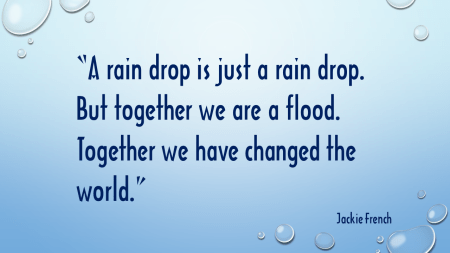
A rain drop is just a rain drop. But together we are a flood. Together we have changed the world.”
She concludes her speech with these words:
“Let us give our children role models who do not, will not despair, no matter how long it takes to change the world. And let us never surrender, no matter how tired we are, or how long it takes. Because with these weapons we shape the future of our planet.”
I also employed the garden analogy in a post entitled The classroom garden. Responding to Charli’s prompt to write about “fruit”, I included the word “harvest”. Rather than simply repeat that story, which would be pleasingly easy but teach me little, I’ve gone in a different direction this time.
In her post, Charli talks about harvesting peas; peas in a pod. It doesn’t take much imagination to turn this into “Peace in a pod.”
Wouldn’t that be wonderful, to plant a seed of peace with “respect, safety, and dignity for all”; “love, patience, kindness, joy”; and “universal tolerance and justice”; nurture it, watch it grow, and then harvest the bountiful rewards. It’s not only the role of teachers and parents, it’s the responsibility of society at large.
Here’s my story. I hope you like it:
Peace in a pod
“The Peace Prize goes to …”
The applause was deafening. It took minutes to realise it was their life’s work being recognised. Who’d have thought? Against a long-range solar-powered superstealth aircraft with adaptive camouflage, how would a peace capsule stand a chance? They stumbled to the stage, minds a-tumble with words, phrases, and blank spaces. In their years of preparation, of tweaking combinations of ingredients, they’d never prepared for this. The standing ovation relieved them of the necessity, drowning each word. Finally, peace pods were ready for harvest and distribution. With mass inoculation, peace was now a real possibility.
After writing the story, I realised that such a pill may not be the panacea I was initially contemplating. Any pill that controls the thoughts and behaviour of the masses could be just as easily used for evil as for good. I may have to send those two back to the lab for further tweaking.
Thank you for reading. I appreciate your feedback. Please share your thoughts.
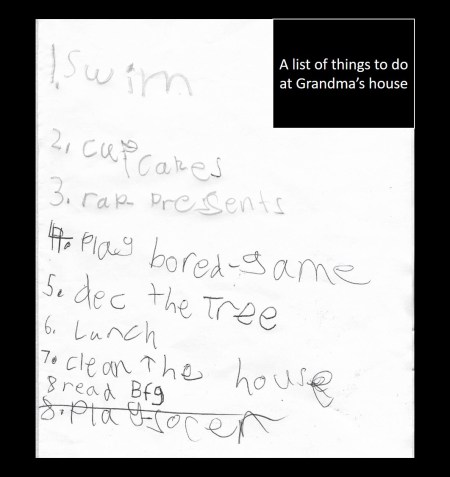
One thing I love about working with beginning literacy learners is their use of invented spellings. To avoid inhibiting the flow of ideas, children are encouraged to “have a go”. This invention involves an interaction of
knowledge of letter sound correspondence
recall of familiar words, such as basic sight words
memory of words previously encountered including words of interest or meaning to them,
in conjunction with available resources such as classroom word walls or lists.
The purpose is to encourage them to write, to express their ideas. There’s plenty of time for attention to the finer details later.
We early childhood teachers become experts at reading children’s writing. Like all effective readers, we use a combination of letter-sound knowledge, syntax, and meaning. If we are ever unable to decode a message, the writer is always happy to read the work to us, and may never realise the request stemmed from our reading disability.
As children’s knowledge of written language develops, their spellings more closely approximate the conventional. The comparison of writing samples taken over time informs teachers of the child’s progress. Consonants, especially beginning consonants, usually appear first; then a combination of first and last consonants. Vowels may be the last to be included.
It is not surprising that vowels are the last to appear. They are more difficult to hear and distinguish, and not only may they be represented in more than one way (think of the long ī sound from my recent post A piece of pie), their pronunciation may (does) vary from locale to locale. Not only that, they are less important to reading than consonants. Think of text messages on the phone, or check out this article A World Without Vowels.
Or maybe now with predictive text available on phones, you are less likely to use the abbreviated form of words and allow your phone to predict what you want to write. That tends to work less than perfectly for me. It doesn’t always predict what I’m thinking and is just as likely to accept gobbledegook as any real word, let alone the correct one. Give me children’s invented spellings any day. At least I can use meaning and prior knowledge to help me unlock the message.
As a literacy educator, I am particularly interested in written language and fascinated by children’s development. I enjoyed the opportunity to write about children’s writing in a guest post on the Carrot Ranch A Class of Raw Literature earlier this year. I previously shared thoughts about spelling tests and the difficulty of knowing how to spell a word if its meaning is unknown. A variety of resources for teaching writing also appear in the readilearn collection.
To signal the occurrence of something (usual disastrous)
Can I include all four?
Here goes.
MISSPELLING SPELLING DISASTER AVERTED: NEW SPELL RELEASES OLD FOR A SPELL
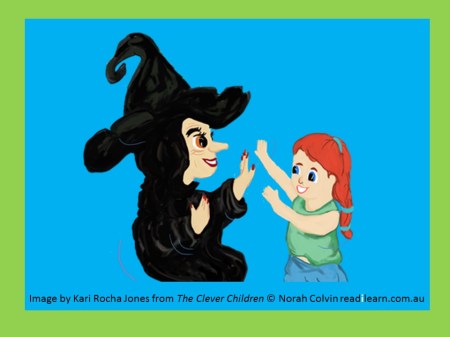
Chatter erupted as assessment commenced. A pass would grant membership to the Spellnovators, but the best would replace Imara, who, for her final duty, mixed their potions and tested their spells. She praised ingenuity as stars exploded, flowers blossomed, and extinct animals reappeared. Choosing her replacement would be difficult. Suddenly her glare in Ruby’s direction spelled trouble. The chatter ceased. “What’s this?” she demanded. “Mix in happy witches!?” Ruby’s lip quivered. “Wishes. I meant to spell wishes.” Voices united in wishes. Instantaneously, everywhere, hearts opened with love. Goodwill rained down, filling all with hope. Imara would spell in peace.
Thank you for reading. I appreciate your feedback. Please share your thoughts.
We sometimes think of reading as a form of escapism. But many stories, including those in picture books, feature an escape as part of the complication or resolution.
It doesn’t require much thought to create a list. Here are just a few to start:
#6 Traditional stories
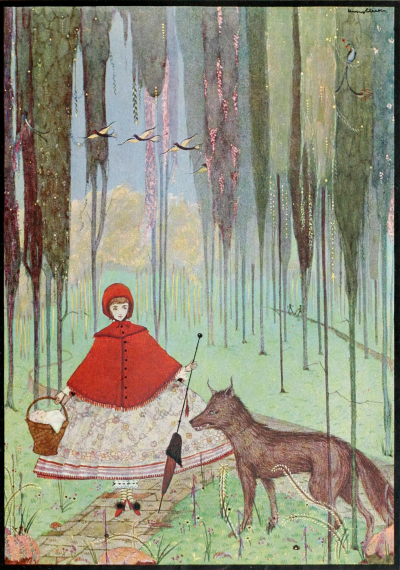
By Charles Perrault, Harry Clarke (ill.) [Public domain], via Wikimedia CommonsJack and the Beanstalk– Jack escapes from the giant
Hansel and Gretel – the children escape from the witch
Snow White– escapes death ordered by the jealous queen
The Three Pigs – escape from the Big Bad Wolf
The Lion and the Mouse – the mouse helps the lion escape the hunter’s trap
The Gingerbread Man – escapes from the oven and those who pursue him
I had a little more difficulty in finding modern tales involving an escape, but here are a few:
#6 Modern tales
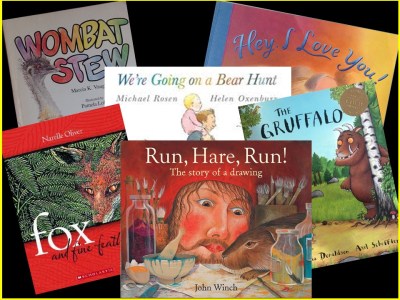
Hey, I Love You!by Ian Whybrow – father and son mouse escape the claws of the cat
The Gruffalo by Julia Donaldson – the mouse uses his wiles to escape being eaten
Wombat Stew by Marcia Vaughan – Wombat’s friends help him escape being Dingo’s dinner
Fox and Fine Feathers by Narelle Oliver – with the help of the nightjar the birds escape being a feast for fox
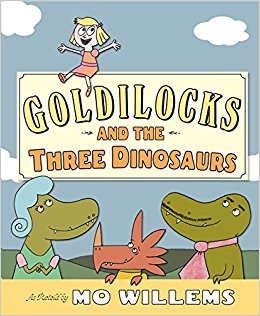
This Mo Willems story is an innovation on the traditional tale of Goldilocks escaping from the three bears. In Goldilocks and the Three Dinosaurs, Goldilocks has a lucky escape out the back door just as the dinosaurs return home through the front door. Willems concludes his story with two morals, one for the dinosaurs:
Lock the back door!
And one for Goldilocks:
If you ever find yourself in the wrong story: leave.
What a great philosophy that we could perhaps employ more often. If we don’t like where we’re at, just leave. Life’s decisions are not always that easy though.
I rather like the idea of characters appearing in the wrong story. What a great topic for discussion with children and a wonderful stimulus for their writing.
What if the Big Bad Wolf knocked on the Giant’s door?
What if the Three Pigs chased the Gingerbread Man?
What if Goldilocks came to the house of Red Riding Hood’s grandma?
What if?
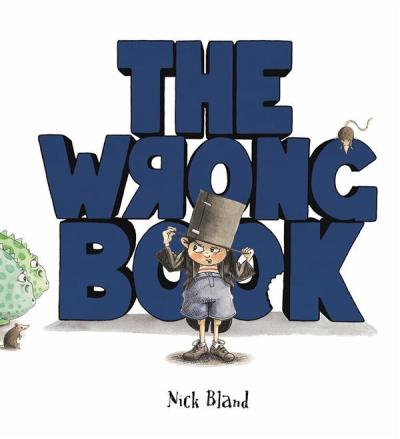
In fact, Nick Bland has written a story that utilises this concept. In The Wrong Book, Nicholas Ickle tries to tell his story but keeps getting interrupted by other characters such as an elephant, monsters, a queen and a pirate. Nicholas tells them that they are in the wrong book and to go away. By the time they leave, we get to the end of the book and there is no time for him to tell his story.
But what if the story characters didn’t want to be in the book at all, and decide to escape? How would they escape? What would the writers do if their characters revolted and walked off the job?
Where could I escape to if not picture books? Here’s my contribution. I hope you like it.
Let’s get out of here
Delaying the inevitable, she was picking wildflowers when she heard sobbing. She gasped to see him cowering behind the bushes but ignored instructions to avoid strangers.
“What’s wrong?”
“I can’t do it anymore. Every day: first the pigs; then your grandma. They’ve painted me bad. I’m not. I’m –“
A giant with a goose crash-landed beside them.
“I’ll not let that nasty boy steal my goose, again. And he says I’m bad.”
A diverse troupe in T-shirts emblazoned “Freedom for princesses” appeared.
“We want out,” they all chanted.
A witch magicked a rocket from a pinecone and everyone disappeared.
Thank you for reading. I appreciate your feedback. Please share your thoughts.
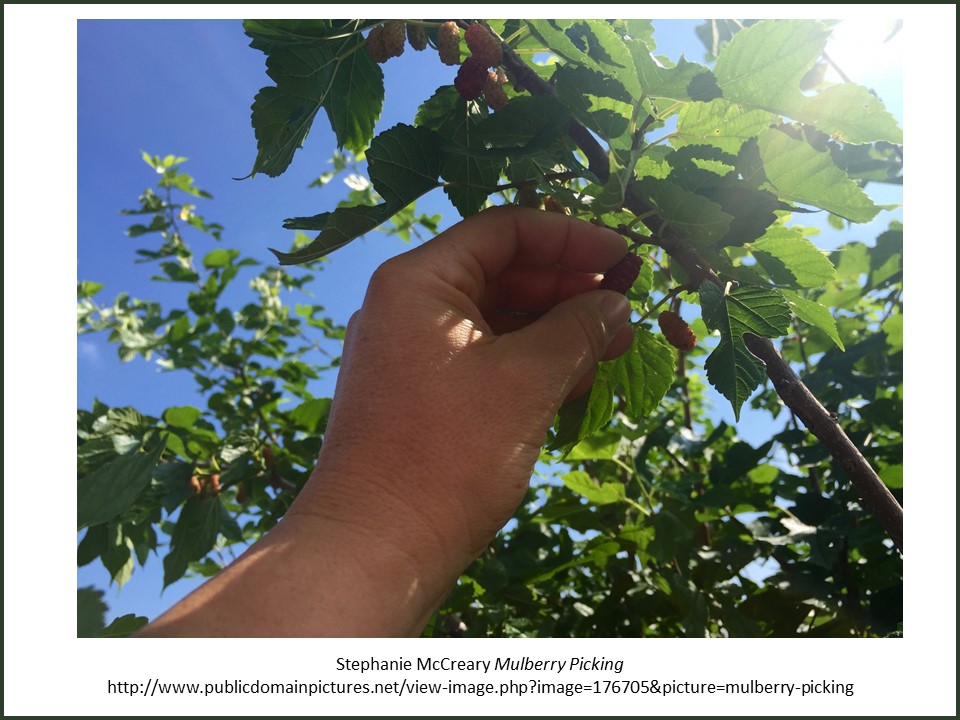
When I was a child, there was a huge mulberry tree growing in the backyard of one of our neighbours who was kind enough to allow access to the multitude of children in our family. Each summer the tree would be laden with fruit and we would pull at its branches to gather as much as we could into buckets and bowls. We would go home stained with purple on our bodies and our clothes and, mostly, around our mouths. We couldn’t wait to eat and there were plenty to go around. Mum would bake mulberry pies and fill jars with mulberry jam that was delicious on our buttered bread for breakfast or lunch.
Since then, I have encountered few mulberries trees, only occasionally sourcing their leaves to feed voracious silkworm caterpillars. The berries themselves seem not to be harvested for store sales. However, I was recently reminded of Mum’s mulberry jam when I spotted some on a shelf at the Jamworks gourmet deli. I must admit though, while I resisted the mulberry jam, I couldn’t resist the fig and ginger variety.
The other berry that was most familiar to me as a child, but never since seen, was what we called the gooseberry. There were gooseberry plants growing by our back fence. I remember picking the berries, peeling back the outer leaves and eating the small fruit, which I think had quite a tart flavour. As I recall, Mum would also make jam, but not pies, with these.
(c) Norah Colvin
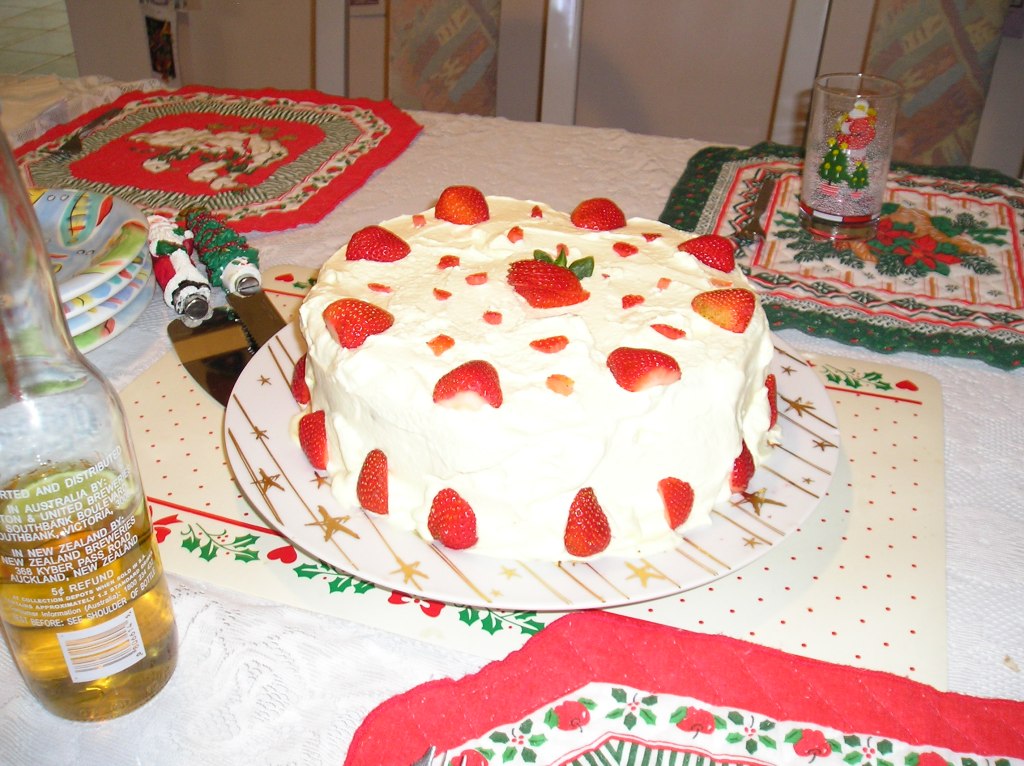
I recall that, even as a young adult, a serving of strawberries and cream had seemed a very luxurious and decadent dessert. Now strawberries are more affordable and readily available all year round. They are a favourite of my granddaughter. So much so that I need to have at least one punnet in the fridge for her when she visits. A strawberry torte is my family’s pick for special occasions such as birthdays and Christmas. I wrote about it and included the recipe here.
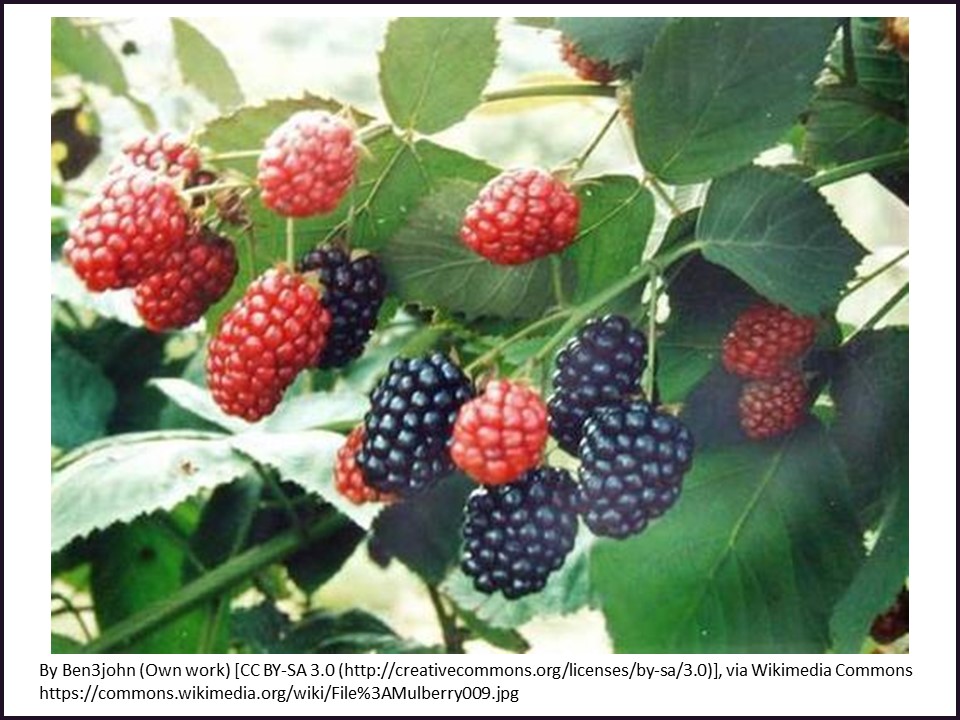
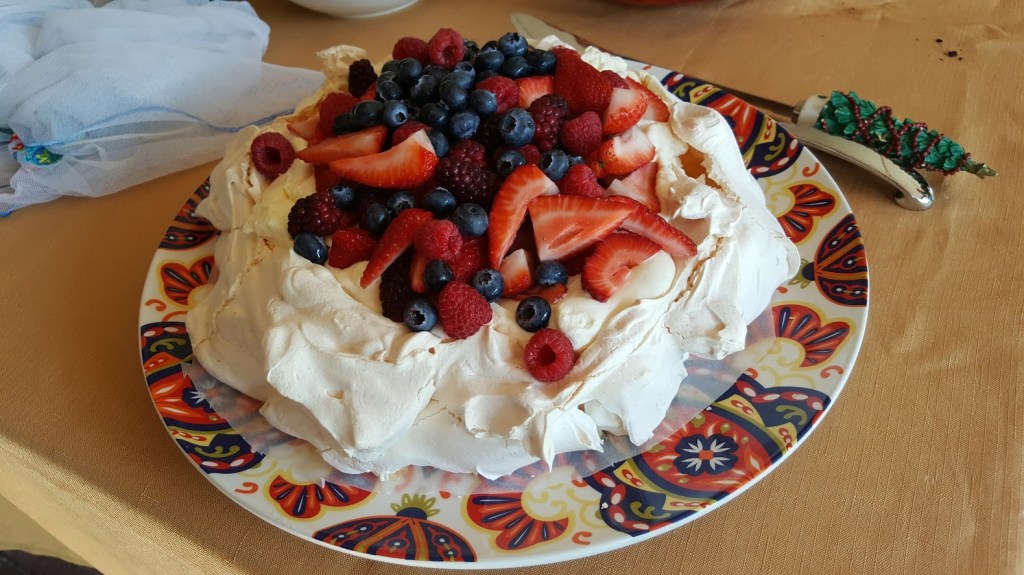
In addition to strawberries, stores now have a variety available all year round; including blueberries, blackberries, raspberries and cranberries. The berries make a wonderful filling for the other family favourite, pavlova.
(c) Norah Colvin
But do you know what a berry is?
I checked with Wikipedia for the definition of a berry, and found that it is “a fleshy fruit without a stone produced from a single flower containing one ovary”.
Botanically, the following fruits (and vegetables) are berries:
Grapes
Currants
Tomatoes
Cucumbers
Eggplants
Bananas
Kiwi fruit
Blueberries
Cranberries
Coffee beans
Pumpkin
Watermelon
and these, commonly called berries, are not:
Strawberries
Raspberries
Mulberry
Blackberry
Do you need to change you answers to my initial questions:
What is your favourite berry?
Which berries make your taste buds sing?
Or are you happy to go with common usage? If I write about mulberries, will I be fulfilling the requirements of Charli’s prompt? Perhaps I should write about picking watermelons instead.
Mulberry Stew
Branches hung heavy with berries in reach of even the youngest child. They ate more than they bucketed; but there were plenty, including for birds singing in higher branches. Mum had forbidden them. “Mrs Wilson’s poorly. Don’t disturb her.” But they couldn’t resist. They scampered the instant she called.
“Where have you been?” She eyed the purple stains.
“We …” the youngest began to sing.
“Nowhere,” they shushed with hands concealed.
“What were you doing?”
“Nothing.”
Her lips twitched. “Hand them over.”
Later they pondered together how she knew.
When Dad got home, they’d have to face the music.
Thank you for reading. I appreciate your feedback. Please share your thoughts.











 Norah Colvin