Live Love Laugh Learn … Create the possibilities

Tag: Flash fiction

  • A case of the unexpected

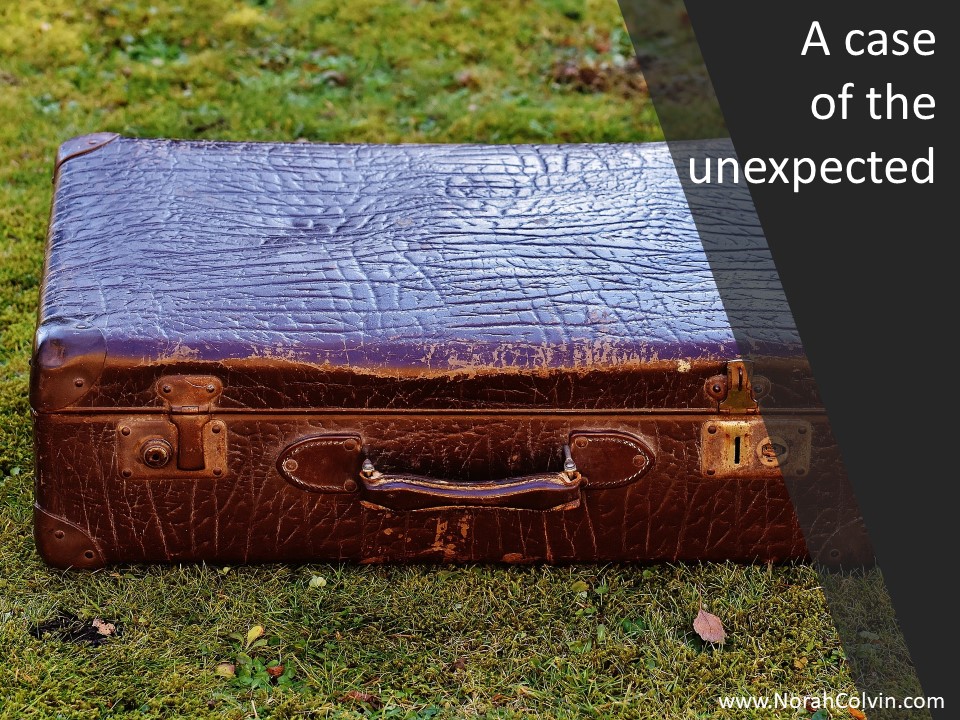
    A case of the unexpected

    Do they still do Greek myths in school? I know I read some in my primary school days, but I never read any to my students when teaching.

    The two stories I remember most from school were of King Midas and Pandora’s Box. Both carry strong cautionary messages which had a big impact on me.

    King Midas was greedy and when offered a wish, wished that all he touched turned to gold. He was saddened and regretted his wish when even his beloved daughter turned to gold. Lesson: Don’t be greedy. However, I was more horrified at the thought of that young girl trapped in a body of gold. Surely that would be worse than a straitjacket, the thought of which is terrifying enough.

    Pandora was presented with a box which she was instructed to not open. What more effective an invitation could there be to a curious soul? Of course, Pandora opened the box. Who wouldn’t? Unfortunately, in doing so, she released all the ills of the world. It is her, so the story goes, we have to thank for illness, plagues, wars, famines and so the list goes on. Lesson: Do what you’re told and don’t be curious. I’m not sure that I learned the lesson from the tale. I’d already had the message firmly installed prior to encountering it.

    As I matured I realised that the lessons from stories such as these didn’t always apply and I am now an advocate for curiosity if not for greed. Where would we humans be without curiosity, wonder, and imagination?

    flash fiction prompt stranded suitcase

    This week at the Carrot Ranch, Charli Mills challenged writers to In 99 words (no more, no less) write a story about what happens next to a stranded suitcase. Go where the prompt leads you, but consider the different perspectives you can take to tell the tale.

    The five W questions that we often teach children to use when interrogating a text or preparing to write spring to mind: Who, What, Where, When and Why.

    • Who abandoned the suitcase?
    • What is in the suitcase?
    • Where was the suitcase abandoned?
    • When was it abandoned?
    • Why was it abandoned?
    • Who found the suitcase?
    • What did they do?
    • Why?

    In bygone days, had I come across an abandoned suitcase, I may have investigated it to discover:

    • Did it have any value?
    • Was it discarded or lost?
    • Was there anything of value in it?
    • Could I find the owner and return it?

    I remember as a child going along with my older brother’s suggestion to create a fake package, tie some fishing line to it, place it in the middle of the road and wait for a curious and unsuspecting pedestrian to come along. (Traffic was infrequent back in those days.) When the pedestrian bent to investigate the package, my brother would pull on the line and the package would move out of reach. We found the response of the pedestrians hilarious and our laughter soon gave away the plot from the bush or fence behind which we lay in wait. Fortunately, they all laughed too when they realised what we were up to.

    Nowadays, with warnings about the possibilities of abandoned bags and packages containing terrorist bombs, people may be less inclined to investigate, concerned that the result may be more similar to what Pandora discovered.

    For my response to Charli’s prompt, I’ve decided to go with a more innocent age when two children playing in the bush find an abandoned suitcase.

    A Case of the Unexpected

    “I wonder what’s inside,” said Jamie.

    “D’ya think we should open it?” Nicky asked.

    They looked around. No one anywhere.

    Jamie shrugged. “I guess.”

    “Looks old,” said Nicky.

    “Probably been here for years.”

    “So dirty.”

    The rusty catches were unyielding.

    “Might be locked,” said Nicky, hopefully.

    “Let’s see,” said Jamie.

    They pried with sticks, battered with stones and willed with all their might. When the catches finally snapped open, they hesitated.

    “Go on,” said Nicky.

    “No, you.”

    “Both.”

    “Okay. One, two, three … open!”

    The children’s eyes widened.

    “What is it?” asked Nicky.

    “Dunno,” said Jamie. “Looks like …”

    What do you think was inside?

    Thank you blog post

    Thank you for reading. I appreciate your feedback. Please share your thoughts.

  • Mending fences

    Mending fences

    What time is it when an elephant sits on the fence?

    Time to get a new one!

    Mending fences #flash fiction prompt from Charli Mills at the Carrot Ranch

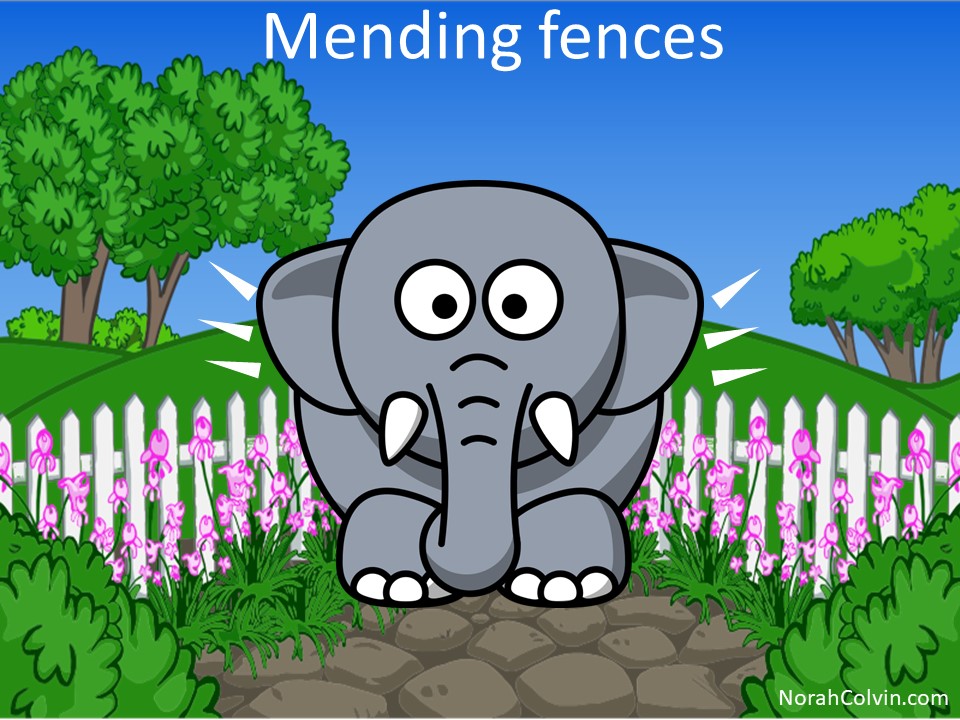
    This week, when Charli Mills at the Carrot Ranch challenged writers to In 99 words (no more, no less) write a story about a broken fence. You can mend it, leave it, or explain its place in a story. Go where the prompt leads, I spent quite a bit of time fence sitting, undecided about which fence story to choose.

    As you know, there are many types of fences: literal, metaphorical, even imagined. Fences are usually built to contain things, to keep people or things on one side or the other, or to define a boundary and possibly restrict passage. But the term “mending broken fences” has a different nuance of meaning. In this use, it means to repair a broken relationship as opposed to improving boundary security.

    But which fence should I choose?

    Should I share some history?

    Rabbit-Proof Fence

    This year marks the one-hundredth anniversary of my family (grandfather, grandmother and their young family – my father, the fifth of nine, was born three years later) taking up residence on a property owned by the Rabbit Board. My grandfather was a boundary rider until 1955, repairing the fence built to protect farming and grazing lands from the destructive introduced species. His youngest son replaced him, continuing until the role terminated in 1957. My uncle purchased the property from the Rabbit Board and lived there with his family until his death this year not long after the anniversary celebrations.

    or perhaps reminisce?

    The Cow Jumped Over the Fence

    Until I was six, my parents were small crop farmers. The farm didn’t generate much income and there were more bad years than good. To help feed the growing family (there were six of us by then) Mum and Dad invested in chickens for both eggs and meat and a milking cow. The first cow knocked down the fence and escaped to freedom. Dad repaired it and bought another cow, which squeezed under the fence. After a third cow jumped the fence, Mum and Dad decided milk deliveries were a better option and we kids never learned to milk.

    Note: I did write about this incident, a little differently, here.

    Should I plan a lesson?

    Teaching positional prepositions with The Elephant’s Fence

    Make a fence from pop sticks.

    Make an elephant using different-sized pom poms for body and head; pipe cleaners for legs, trunk and tail; paper or felt for ears; and googly eyes.

    Place your elephant according to these instructions:

    • Beside the fence
    • In front of the fence
    • Behind the fence
    • Under the fence
    • Between the palings
    • Next to the fence
    • Above the fence
    • Below the fence
    • On the fence.

    Now choose a place for your elephant to be. Tell your elephant’s story:

    • Why is it there?
    • How did it get there?
    • What is it doing?
    • What will happen next?

    or attempt a story?

    Sometimes it is the imaginary fences that can be more limiting. Sometimes it’s better to leave things that aren’t broken in the first place.

    Broken with intent

    The fence was too high to jump or even see over, no footholds to climb, and palings too close to squeeze or even peer through. It hugged the soil too compacted to dig. It seemed impenetrable, and so intrigued. He stacked boxes for makeshift steps—not high enough. Finally, he hatched a plan—balloons! He blew them big and tied them tight, attached some string, and waited. And waited. Then a gust of wind lifted him high, over the fence, where another, just like him, smiled and said, “Should’ve used the gate; latch is broken—always open to friends.”

    Thank you blog post

    Thank you for reading. I appreciate your feedback. Pleasure share your thoughts.

  • Cute as buttons

    Cute as buttons

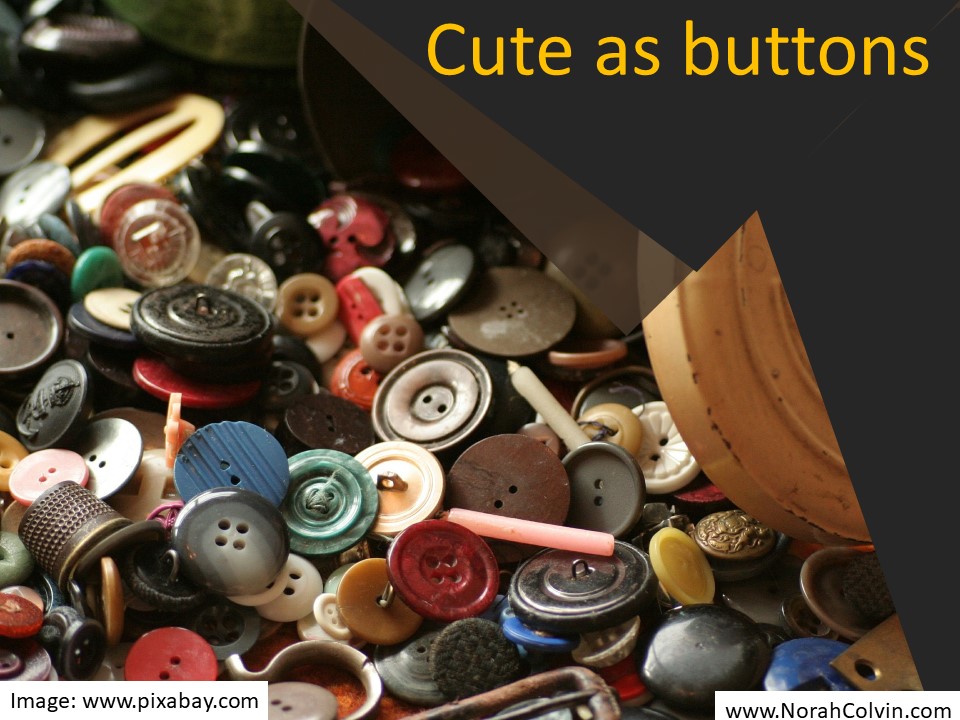
    This week at the Carrot Ranch, Charli Mills challenged writers to In 99 words (no more, no less) write a story that includes buttons. You can use the word plural or singular in different expressions, or focus on how buttons relate to a story. Go where the prompt leads.

    This is my response. I hope you enjoy it.

    Precious as Gold

    Too lads, reviewing the previous evening’s campfire conversation, dug stones from the bank, inspected each and competed to land one further in the creek.

    “D’ya reckon there’s still gold here?”

    “Dad says. Reckons someone found one this big.”

    “But that’s ages ago.”

    “So. Might be more.”

    “What’d you do if you found some?”

    “Easy. Buy a car, a yacht and a jet. How ‘bout you?”

    He contemplated silently—a house of their own first, then for other homeless people too.

    “Whoa. Look!”

    “Gold!”

    They sprinted back to camp.

    “You struck gold all right—a gold button,” the adults laughed.

    Thank you blog post

    Thank you for reading. I appreciate your feedback. Please share your thoughts.
  • Sketchy Perceptions

    Sketchy Perceptions

    Carrot Ranch Flash Fiction prompt sketches

    This week at the Carrot Ranch, Charli Mills challenged writers to In 99 words (no more, no less) write a story that is a sketch or about a sketch. It can be “A Sketch of a Romance” or “The Sketch of Aunt Tillie.” Go where the prompt leads you to scribble.

    My thoughts were a bit sketchy. This is what I came up with. I’d be interested to know your perception.

    Sketchy Perceptions

    He sketched the outline with chalk then filled in the details, outside-in. Curious passers-by gathered as the image emerged. Was the artist a paid entertainer or busker earning a buck? Some pushed coins into children’s hands to add to the chalk-drawn cap. When satisfied with his work, the artist stood in its centre and tossed the cap and contents high. As they fell, he spread his arms and disappeared into the painting. Perplexed on-lookers reported different perceptions. Many said he plummeted into darkness. Some said he flew on gold-tipped wings. Others described him simply as absorbed by his art.

    It is easy to make snap judgements about others and situations from sketchy information, even at first sight. We do it all the time as we try to make sense of what we perceive, evaluating it against our existing knowledge and beliefs.

    I have strong beliefs about education and how children learn so can quickly judge whether I will agree with the content of articles or not. However, I don’t confine my reading to articles that I know will support my beliefs. I read articles from a variety of viewpoints to gain some understanding of others’ positions. If I don’t know what they think, how can I interrogate those thoughts and evaluate them against my own, perhaps even reassess my beliefs? I would rather be informed than base my ideas upon sketchy information.

    This week, I had the pleasure of reading two articles in popular media which reiterate things I have written about a number of times previously.

    The title of an article by Angela Mollard in my local Courier-Mail intrigued me: We should be ashamed of how we treat teachers. The media is often quick to criticise teachers, blaming them for almost all of society’s ills, it sometimes seems. I wondered at the intent of this article. Mollard wrote that, although she is the daughter of a teacher, sister-in-law of a teacher, and friends with many teachers, she had no idea of a teacher’s life until she read the book Teacher by Gabbie Stroud. I am yet to read this memoir, but it is now high on my TBR list.

    Mollard says, “She (Stroud) writes of the sacred bond between teacher and pupil, of advocating exhaustively for their needs, of loving them even when they were abusive and damaged and victims of the most heartbreaking of family circumstances.”

    Mollard follows this by telling us that “Ultimately, Stroud gives up being a teacher. She’s broken by the profession but she maintains that she didn’t leave teaching, it left her”, and describes her book as “a clarion call to educators to change a system that values standardisation over creativity, curiosity, progress, self-belief and autonomy.”

    Oh, yes! I applaud. I know many teachers who feel the same way.

    Mollard then goes on to say that if parents want inspirational teachers for their children, they must be inspirational too, that they must stand beside and support teachers and do what they can to lighten their workload so more help can be given where it is truly needed. If you are a parent, please read the article for her suggestions. I have sketched out just a few of her ideas here.

    If you can do only one thing for your children, it should be shared reading is the title of an article by Ameneh Shahaeian and Cen Wang in The Conversation. To any regular readers of my blog, the idea behind the title will be very familiar. It gladdens me when I see others promoting such good advice for parents.

    However, in the article Shahaeian and Wang surprised me with the question, “is it really book reading that’s beneficial or is it because parents who read more to their children also provide a lot of other resources, and engage in a range of other activities with their children?

    Does the question intrigue you as much as it did me? Shahaeian and Wang share the results of a longitudinal study they carried out to find an answer. Please read the article for their conclusions and suggestions for parents.

    I’ve provided you with just the sketchy outlines of both these articles. If you are interested enough to read them, I’d love to know what you think.

    Thank you blog post

    Thank you for reading. I appreciate your feedback. Please share your thoughts.
     

  • Days like this

    Days like this

    Not the End of the World

    Ever have one of those days? You know—it seems the world is against you, and everything you do goes wrong. Maybe you oversleep and in your rush, you fumble, make mistakes and get even later. You hurry to the stop as your bus pulls away. You flop down reviewing life’s punishments, and some jackass walks by telling you to “Smile, it’s not the end of the world.” What would he know? You open your phone and scroll: trivial drivel. Then this one story blows your insignificancies away. You phone your appointment, apologise and reschedule. All is not lost.

    All is not lost Carrot Ranch flash fiction challenge

    I wrote this in response to the challenge that Charli Mills of the Carrot Ranch set for writers this week, to In 99 words (no more, no less) write a story about “not all is lost.” It can include recovery from disaster, an unexpected insight after a fall, or however the phrase moves you. Go where the prompt leads.

    In her post, Charli tells of her friend Cynthia who normally sleeps outside in a tent, even in the snow, but not on the night of June 16. As Charli explains, “In a few hours, the thunderstorm stalled over the lower Keweenaw and dumped 7 inches of rain. Cynthia, who usually sleeps where a mountain slammed into her house, slept inside that night. She and her daughter woke up when her refrigerator tumbled over. Water filled her stairwell to the bedrooms on the second floor and pushed against their doors in a torrent, preventing escape.”

    Though much was lost during that storm and its aftermath, Cynthia did not lose her spirit or her optimism. As she looked around at the devastation, she had thoughts other than loss (as quoted in Charli’s post):

    “This is what I saw: beloved neighbors talking with selfless helpers and eating something finally as they gazed over tge work of some long days, people still digging and puzzling in the waterway, laughter ringing, dogs barking, a moon rising… and I was so pleased, so happy, so fulfilled. This is life, this is who we are capable of being. This is who we are. It was such a beautiful scene. It is our new reality. Blessed be.”

    All around the world, there are tragedies of enormous proportion: wars, floods, fires, droughts, volcanic eruptions, illness. The list goes on.

    What I attempted to show through my flash is that it can be easy to get caught up in the trivialities of our daily lives and forget to look from afar and see how small they are. When our problems seem overwhelming, we don’t need to look too far to see someone in a worse position. For those of you who are truly suffering, I apologise, I in no way intend to trivialise your concerns.

    I also intended it as a reminder that we don’t always know what someone else is going through and an off-hand remark to tell them to “cheer up” may not helpful.

    It is the same for children in our schools, in our classes. We don’t know what bumps they may be experiencing to make them withdrawn, moody, hostile or aggressive.

    To truly understand another’s position we need to listen, put ourselves in their shoes and consider how we would feel. We need to accept that the world doesn’t always work in the way or timeframe we wish.

    If we could lend a helping hand, a listening ear, kind words, and an open heart what a more beautiful world it would be.

    Just as Cynthia chose to see beauty in the scene around her, it is important to remember there’ll be days like this, that all is not lost.

    Thank you blog post

    Thank you for reading. I appreciate your feedback. Please share your thoughts.

  • A bouquet of wishes

    A bouquet of wishes

    Do you celebrate your birthday? I do. I love to mark each one. I don’t even mind that the numbers are getting big now, though not quite as big as my grandchildren tease (he says 150, she says 954). I wouldn’t mind a few additional years to accomplish even more, or at least try. But I know I am lucky to have had so many. Not everyone is as fortunate. And we never know how many days or years we will get. For this reason, I think we must enjoy every day and treat it as a gift. That’s why today is called the present, after all.

    yesterday is history, tomorrow is a mystery, today is the present

    This week at the Carrot Ranch, Charli Mills challenged writers to In 99 words (no more, no less) write a story that includes a bouquet. You can explore the meaning of the word or gather a bunch of flowers. Go where the prompt leads.

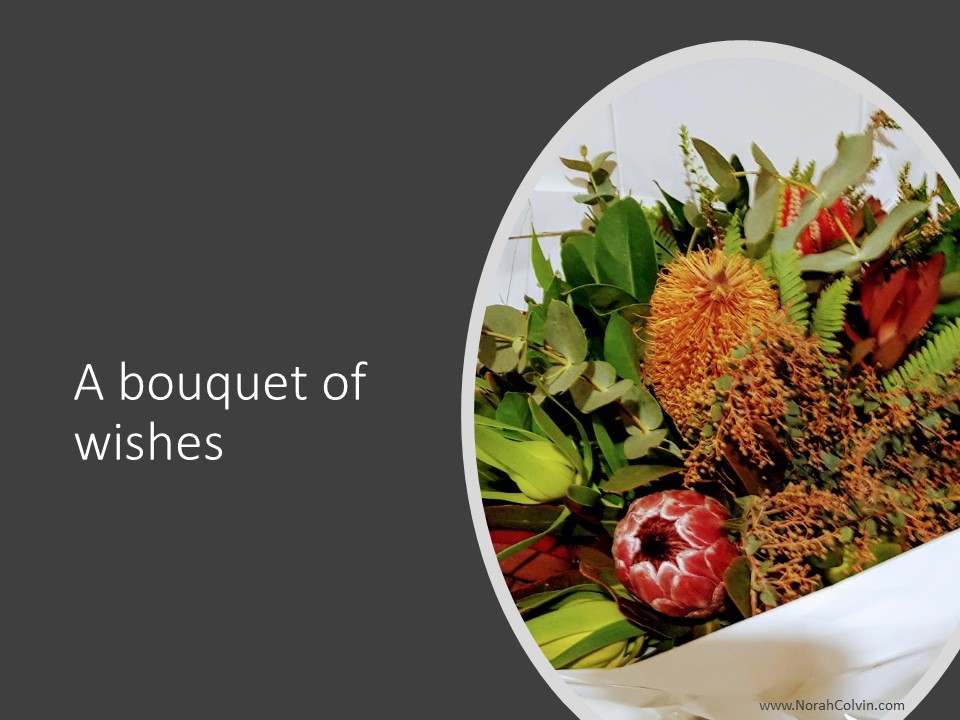
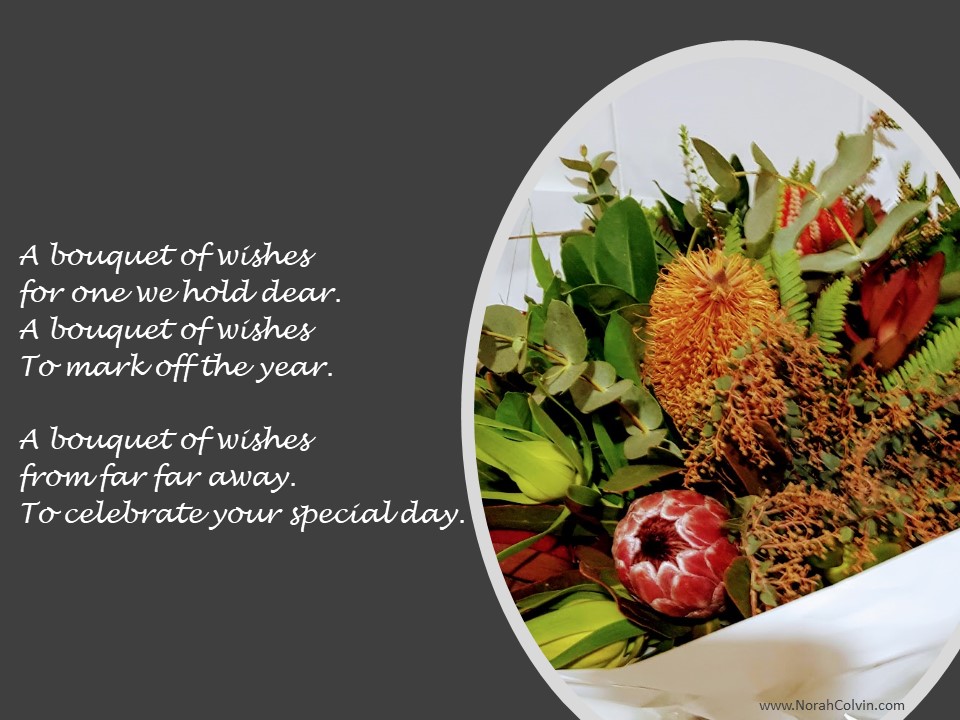
    You could say that the prompt was beautifully timed to coincide with my birthday, although I hadn’t considered the connection and was struggling for a response until I received these beautiful flowers from my daughter and her partner.

    a bouquet of wishes to make your day

    It made me think of all the times in our lives when bouquets of flowers are given and received: to share love in both joyous and sorrowful times, or to simply say, “I’m thinking of you.” We are often urged to, regardless of the occasion, “Say it with flowers”. Flowers, chocolate and wine are always well-received. (I was going to say “go down well”, but I thought you might think I eat the flowers too. I don’t.)

    I tried to “find” a story of a young boy gathering wildflowers for his teacher on the way to school, but he wasn’t willing to cooperate. Instead, I’ve gone for a BOTS, except for the ending. I hope you enjoy it.

    Carrot Ranch flash fiction challenge - write about a bouquet

    A Special Bouquet

    As expected, they found her in her garden with a bouquet of fresh-picked flowers: daisies, forget-me-nots, peonies, zinnias, sprays of bleeding hearts and honeysuckle, a bottlebrush or two, a bunch of gumnuts and some greenery—to make each colour shine.

    Her garden was her sanctuary, her confidante, her joy. She said families were like gardens, with beauty in variety. Every special day—birth, birthday, wedding, or funeral—she arranged a meaningful bouquet. In ninety-five years, she’d seen lives come and go. The last of nine, no doubt now who’d be next. How could she know this was her day?

    Thank you blog post

    Thank you for reading. I appreciate your feedback. Please share your thoughts.
  • Add a sprinkle of glitter to make your day sparkle

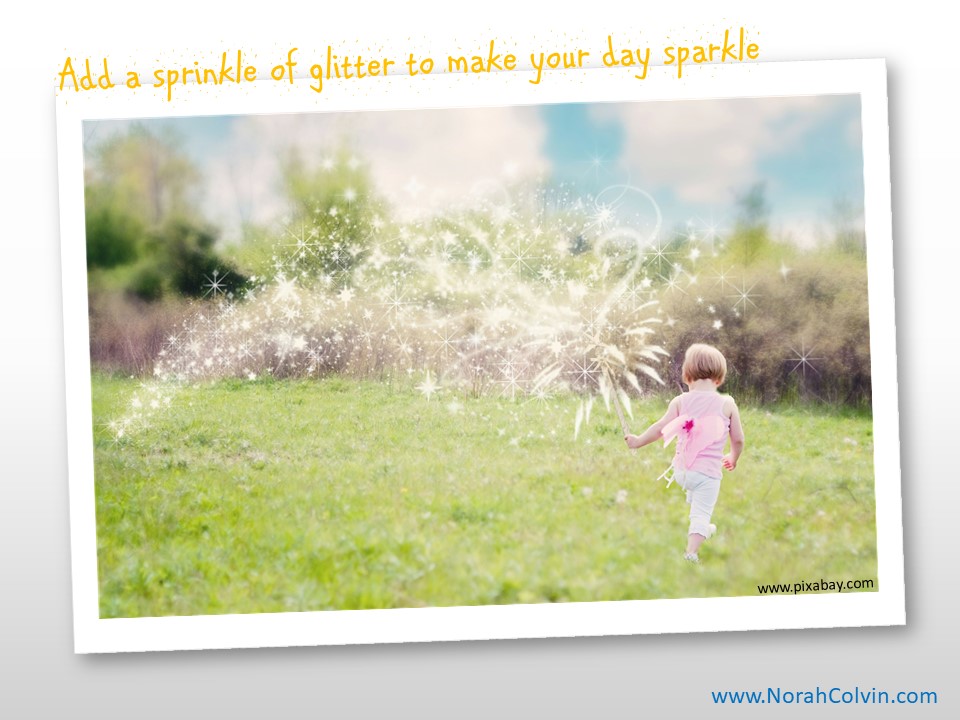
    Add a sprinkle of glitter to make your day sparkle

    Children love to create artworks using pencils, crayons, paints and anything they can stick to a surface using glue. With access to a variety of materials, they can be absorbed for hours creating their masterpieces.

    While they might select from the materials offered, I found the one thing that few children could resist was glitter—and the more of it, the better.

    There is nothing like glitter to add a bit of sparkle to the day. The only trouble is, glitter is so light and so small, that it goes everywhere—on the artwork, on the table, on the chair and on the floor. It sticks to the hands and is smeared on the face and takes forever to remove from the hair. But everyone loves it nonetheless, and it adds a little brightness to the day.

    Smiles are like glitter in that they also spread easily and brighten the day. However, they are not nearly so messy, cost nothing, and require no cleaning up at all.

    I think smiles are the glitter we should add to the artwork that is everyday life. And if there’s one thing about smiles, the more you give, the more you receive. Smiles come from a bottomless well, from a source that never dries up. A sprinkle of smiles will make anyone’s day sparkle, and who knows what difference a smile can make to another’s life.

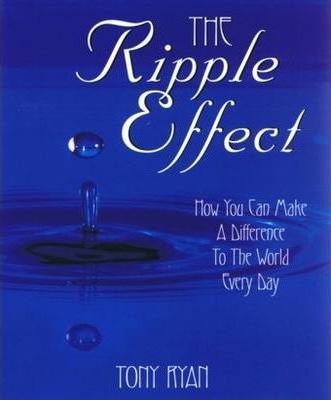
    The Ripple Effect by Tony Ryan

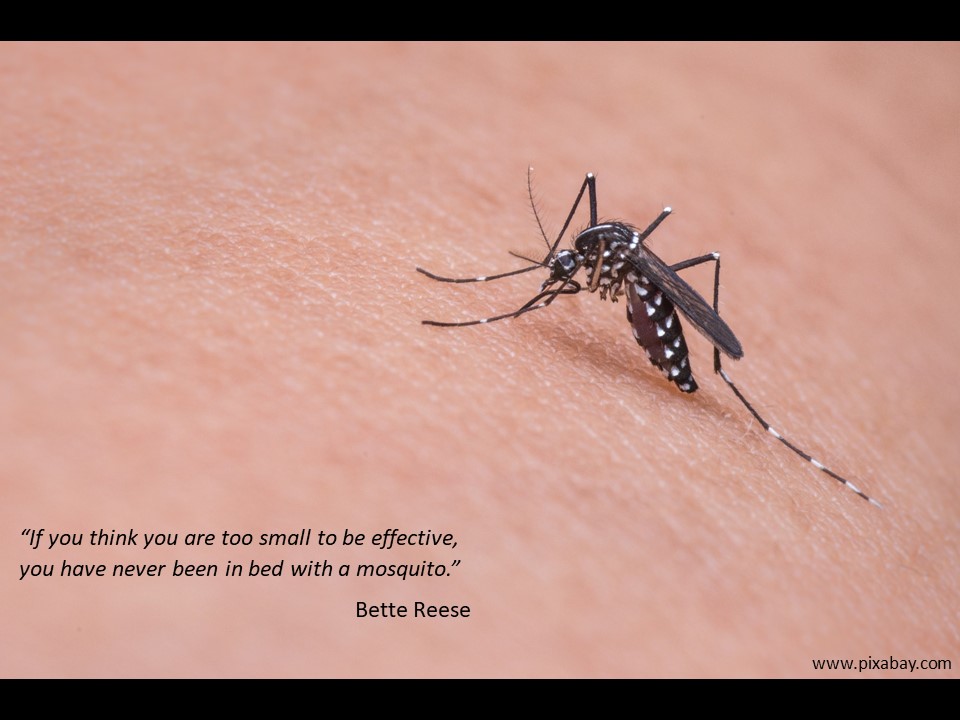
    I often think of The Ripple Effect, written by Tony Ryan, and its inspirational stories. I especially enjoy this quote by Bette Reese included in the book: “If you think you are too small to be effective, you have never been in bed with a mosquito.”

    quote about effectiveness and size by Bette Reese

    One of Tony’s stories describes the following scenario:

    “As you enter the freeway, you discover that the traffic is heavier than usual, and is moving quite slowly. You then notice that the young driver in the car beside you is trying to enter your lane, because her exit is coming up. No-one is letting her in, and she is becoming tense and upset.”

    Tony then describes the turning point in her day:

    “You stop, and wave her in front of you with a flourish and a smile.”

    and the ripple effect:

    • “she returns your smile, acknowledges your thoughtful action, and drives on
    • her tension dissipates, and she arrives at her company office feeling buoyed by your little effort
    • as the main receptionist, she is the first to greet the hundreds of people who enter the office each day
    • with her positive greeting, she decides to brighten up the life of every person she meets throughout that day
    • because of her efforts, many others in the business district are inspired to focus on their own positive efforts.”

    Like glitter, we can never know how far the effects of our smiles might travel. There can never be too many smiles in any one day, especially in a classroom filled with children.

    man glisten a flash fiction challenge by Charli Mills at the Carrot Ranch

    This week at the Carrot Ranch, Charli Mills challenged writers to In 99 words (no more, no less) write a story about man glisten. It was a fun term coined by two men with glitter in their beards. What more could it embrace? Look to the unexpected and embrace a playful approach. Go where the prompt leads.

    I’d only come across the word “glisten” before in the Christmas carol, Walking in a Winter Wonderland.

    But Charli’s prompt reminded me of an incident in my childhood that had absolutely nothing to do with glitter or glisten (I don’t even remember glitter in my childhood) but loads to do with smiles. I’ve rewritten the incident to include glitter and other alternative facts. I hope it gives you a smile.

    Glitter smiles glisten

    Relentless rain meant no beach for the country cousins. They spent eternity on the verandah, making artworks, playing games, and bickering.

    On the last day, when Mum said to clear space for their mattresses, they fought over who’d do what. Toys and games ended up in a haphazard tower with the glitter bucket balanced on top.

    When Dad bent for goodnight kisses, he stumbled and demolished the tower. Glitter went everywhere—including all over Dad. The children gasped.

    “Your hair glistens, Dad,” smiled the littlest.

    Dad smiled too, then everybody laughed.

    Dad wore a hat to work that week.

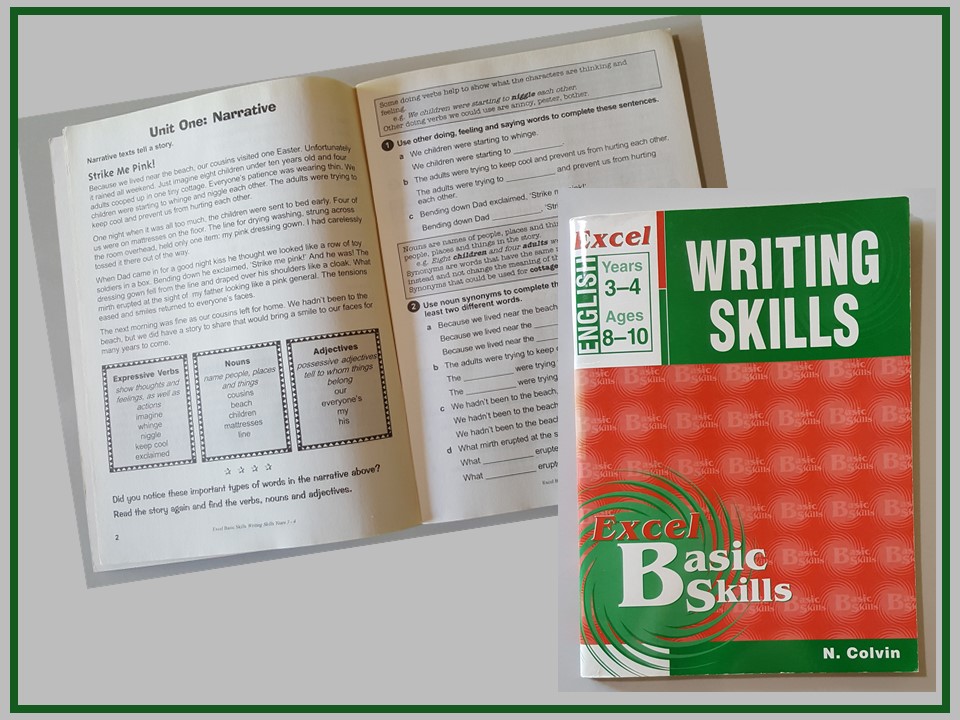
    Writing Skills workbook with Strike Me Pink

    I previously wrote about this incident for inclusion in a Writing Skills Homework Book published by Pascal Press. Workbooks such as this are very different from the teaching resources I now share on readilearn, but: it was paid work.

    This version is closer to the truth.

    Strike Me Pink!

    Because we lived near the beach, our cousins visited one Easter. Unfortunately, it rained all weekend. Just imagine eight children under ten years old and four adults cooped up in one tiny cottage. Everyone’s patience was wearing thin. We children were starting to whinge and niggle each other. The adults were trying to keep cool and prevent us from hurting each other.

    One night when it was all too much, the children were sent to bed early. Four of us were on mattresses on the floor. The line for drying washing, strung across the room overhead, held only one item: my pink dressing gown. I had carelessly tossed it there out of the way.

    When Dad came in for a goodnight kiss he thought we looked like a row of toy soldiers in a box. Bending down he exclaimed, “Strike me pink!” And he was! The dressing gown fell from the line and draped over his shoulders like a cloak. What mirth erupted at the sight of my father looking like a pink general. The tensions eased and smiles returned to everyone’s faces.

    The next morning was fine as our cousins left for home. We hadn’t been to the beach, but we did have a story to share that would bring a smile to our faces for many years to come.

    Note: I don’t know how many others used the term, but my Dad often said, “Strike me pink” to express surprise.

    Thank you blog post

    Thank you for reading. I appreciate your feedback. Please share your thoughts.


  • Warrior Woman

    Warrior Woman

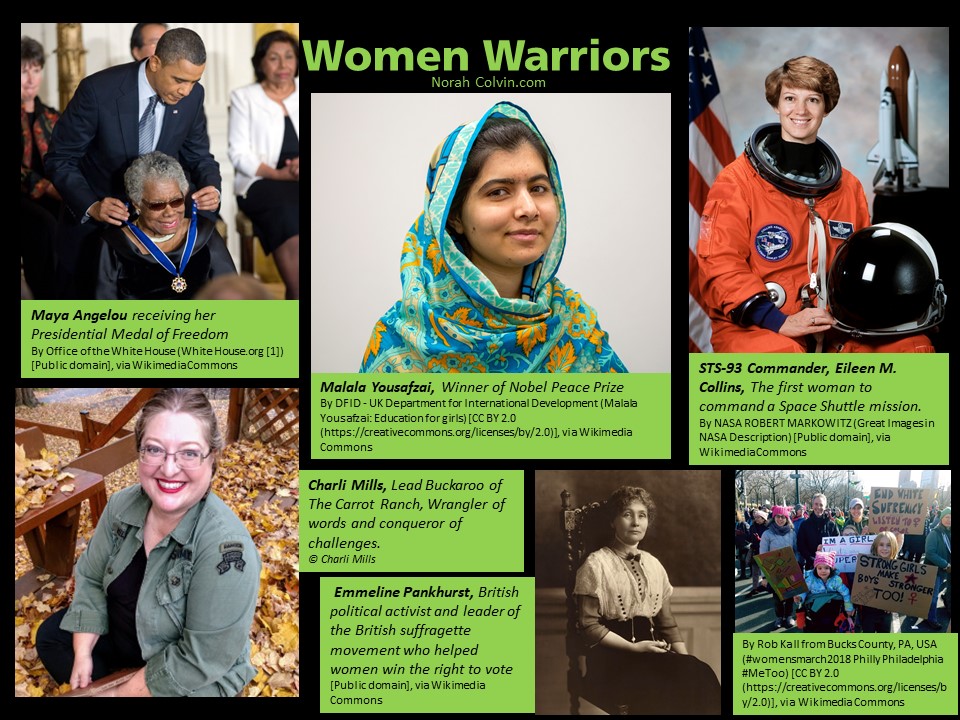
    This week at the Carrot Ranch Charli Mills has challenged writers to In 99 words (no more, no less) write a story about warrior women. It can be myth or everyday mothers and wives. Go where the prompt leads.

    Warrior Women flash fiction challenge from the Carrot Ranch

    A warrior is defined as a brave and experienced fighter, a soldier perhaps. While most of us will never be called upon to face the enemy on a battlefield, many will struggle to overcome obstacles of different kinds in their personal lives.

    From a young age, children must be encouraged to find their inner strength, to overcome challenges large and small, to be resilient when faced with setbacks, to be confident to try again and to persist even when the going gets tough.

    This is as true for boys as it is for girls, but sometimes it feels easier to encourage boys to be adventurous and girls to be sweet and demure. That this is changing is a good thing.

    In response to Charli’s prompt, I looked for a warrior a little closer to home. I hope you like it.

    Gertrude the Invincible

    With flaming hair streaming and eyes blazing, Gertrude stood at the apex surveying the land, her land.  With one hand on a hip and the other raised high, she hurled her words into the wind.

    I did it. I am the conqueror. You,” she pointed expansively with her spear, “are now my subjects. You do my bidding.”

    The minions bowed before her.

    “I am in-vinc-i-ble!”

    “Gertie! Pick up your toys and come inside now. It’s dinner-time,” called Dad from the door.

    Gertie complied. Even warriors need to eat. There’d be more conquests and enemies for Gertrude to vanquish tomorrow.

    Note: Gertrude is a German name meaning spear and strength. As long as she is encouraged, I think this Gertrude will have little difficulty living up to her name (minus the spear).

    Thank you blog post

    Thank you for reading. I appreciate your feedback. Please share your thoughts.
  • Is the value of property more than money?

    Is the value of property more than money?

    Charli Mills at the Carrot Ranch flash fiction prompt property values

    This week at the Carrot Ranch Charli Mills has challenged writers to In 99 words (no more, no less) write a story about property values. Perhaps its a home, business or pencil museum. What makes them go up or down? Go where the prompt leads.

    In my response, I’m adding a little more to Marnie’s story. As soon as she could, Marnie disappeared from her abusive family. It was years after her parents had died that the authorities found her. Though she’d travelled back to view the house in which she’d spent her early years, it held no fond memories and she instructed the solicitors to sell. In doing so she thought she’d closed the door on that chapter of her life.

    This event occurs some months later and suggests that perhaps property values, as beauty is, are often in the eyes of the beholder.

    Property values

    The letter lay unopened for weeks. She had no more interest in its contents than she had in the house. She’d finished with all that when she told them to sell. Why were they contacting her now?

    When a second envelope arrived bearing the same logo she thought to bin them both, but hesitated, and opened the first.

    A cheque? She squinted at the numbers, then held it to the light. She counted the zeros, again. Really? How could a property that held so little value for her hold so much for someone else?

    The second letter explained — developers.

    Thank you blog post

    Thank you for reading. I appreciate your feedback. Please share your thoughts.
  • Cranes – That’s stretching it!

    Cranes – That’s stretching it!

    This week at the Carrot Ranch, Charli Mills wrote about the different species of crane that inhabit North America and included an image of the stunning crowned grey crane.

    crowned crane as part of the Carrot Ranch flash fiction challenge

    I was fascinated by the story of an ornithologist and a crane and, when she challenged writers to In 99 words (no more, no less) write a story defining “the charisma of cranes”, I wondered why my mind drew a blank. I struggled to recall ever seeing a crane.

    Charli’s additional information that “For centuries, cranes have inspired art and philosophy” and her suggestion that, “You can write a crane story or create something new out of the phrase. Go where the prompt leads”, didn’t make it any easier.

    I consulted my favourite book of Birds of Australia. It listed only two cranes. One I knew of as the Brolga. The other, the Sarus Crane, I hadn’t heard of.

    An online check confirmed the two species. The Brolga is famous for its dance and features in many Aboriginal legends and dances. At over 1 m tall and with a wingspan of 2.4 m, it is one of Australia’s largest flying birds. The Sarus Crane is rare and lesser known.

    To my embarrassment, I also discovered that the Brolga is the bird emblem of my home state Queensland and appears on its Coat of Arms. Information about the Coat of Arms tells me that the Brolga is one of Queensland’s most distinctive birds and “symbolises the native population”.

    Follow this link for information about the importance of the Brolga to Indigenous Australians and a video of an Aboriginal story.

    More familiar to me are the cranes that dot the ever-changing city skyline as new buildings creep skywards.

    For my response to Charli’s prompt, I’ve avoided the birds and employed two other meanings of crane. It might be stretching it a bit, but I hope you like it.

    Living the nightmare

    The shaft of light reflecting from the mirror jolted her awake.

    “What time is it?” She fumbled for her phone. “Hell!” All night she’d craved sleep, then slept through. She pulled on yesterday’s clothes, ruffled her hair and charged out.

    People packed the square so tight she couldn’t squeeze through. She craned her neck but, even on tiptoes, couldn’t see. She pushed into the tiniest gap on a ledge, only to be elbowed off. But she’d spotted a cherry picker. She climbed in, pushed a button and up she went; just as the crowd dispersed. She’d missed out again.

    Thank you blog post

    Thank you for reading. I appreciate your feedback. Please share your thoughts.