
Finalists for the TUFFest Ride have been chosen. Are you included?
Tag: Flash fiction
-

All You Need to Know to Rodeo
Are you saddled up ready to write in the Carrot Ranch Flash Fiction Rodeo 2018? The contests get underway this week and continue throughout October with plenty of opportunities to join in and the chance of winning a prize.
Who will be among the TUFF 5 writers? Did you enter? Could one be you.? Or maybe me? Charli reveals all on 1 October. Not long to wait!Share this:
-
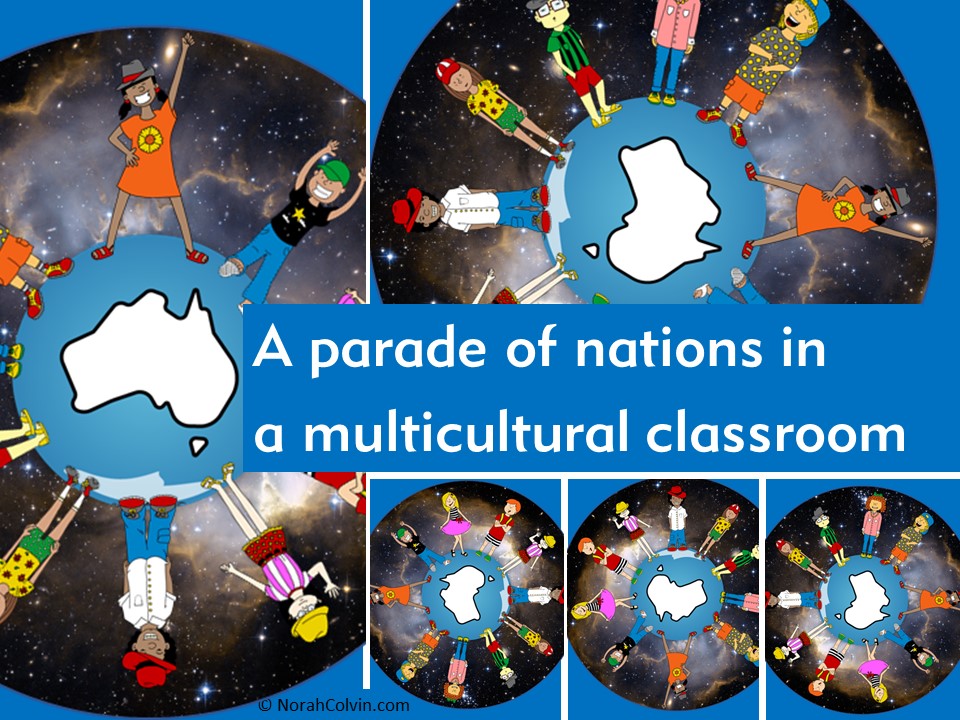
A parade of nations in a multicultural classroom
This week at the Carrot Ranch, Charli Mills has challenged writers to In 99 words (no more, no less) write a story about a parade of nations. It can be literal, or it can be a phrase that you use to describe a situation. Explore what it could be. Go where the prompt leads.
One need look no further than a classroom of children to find a parade of nations. Below is my response to Charli’s prompt, but please read on for information about Multicultural Children’s Book Day, International Day of Peace, and suggestions of books to read.
A parade of nations
The children listened intently, eager to learn. Each family’s wish was for a better life. The group was a parade of nations; with Dragos from Serbia, Duy from Vietnam, Melino from Tonga, Ervine from Scotland, Rongo from New Zealand, Jung from Korea, Sanhitha from Sri Lanka, and Jawara from Senegal; and these were only the new arrivals. Others were first and second generation with but a few who could count back further than three, except for Kinta whose ancestors were the first to arrive. The wall map, dotted with pins to show each one’s heritage, was their proudest display.
While I have taught classes with children from each of these countries, and many more, for the purpose of my story I used the Baby Name Finder at Mom Junction to locate names with friendly, peaceful meanings. It is a very helpful resource.

It was my experience in such multi-cultural classrooms that prompted me to make a resource to facilitate learning about our own and each other’s cultural traditions and celebrations. The resource is now available on readilearn.

Used courtesy of Multicultural Children’s Book Day Thinking about the diversity that exists in our classrooms, our cities, our countries and our world is a perfect time to bring to your awareness Multicultural Children’s Book Day, the focus of which is on “bringing attention to all of the amazing children’s books available that celebrate diversity.”
The co-creators of the event Valarie Budayr and Mia Wenjen define multicultural books as those that
- include characters of colour or that represent a minority point of view
- share ideas, stories, and information about cultures, race, religion, language, and traditions
- embrace our world and offer children new ways to connect to a diverse and richer world.
On the Multicultural Children’s Book Day website, teachers can find a collection of helpful resources; including a classroom kindness kit and a classroom empathy kit. Authors and publishers of multicultural books are also invited to sponsor Multicultural Children’s Book Day through a range of sponsorship options already open for 2019. Interest in the day has increased in the six years since its inception and that growth can only continue. While it is wonderful to see the greater number of books with multicultural and diverse themes now available, more are still needed.

One of my long-time favourites is Whoever You Are written by Mem Fox and illustrated by Leslie Staub. I have read it to many groups of children, every one of whom has loved its powerful message: that underneath it all, we are just the same.
You can read about, listen to Mem read, or purchase the book here.

A newer favourite is another by Mem Fox —I’m Australian Too. This one is illustrated by Ronojoy Ghosh.
This book is a celebration of all cultures and heritages that are represented in the Australian population and together make our country what it is.
You can read about, listen to Mem read, or purchase the book here.

An even newer favourite is All are Welcome written by Alexandra Penfold and illustrated by Suzanne Kaufman.
I first heard about this book from the wonderful Patricia Tilton who blogs at Children’s Books Heal. Patricia’s aim with her blog is to “share books on a wide range of topics that have a healing impact on children who are facing challenges in their lives.” I have purchased many lovely books recommended by Patricia and never been disappointed.
Just as I was completing a draft of this post, I received notification of a new post by Patricia. You won’t believe it, but Patricia wrote about the book again for the International Day of Peace on 21 September. How perfect. Please pop over to Patricia’s post for more details about this beautiful book.
Once, long ago, there used to be a recording of Bill Martin Jr. singing I am Freedom’s Child on his website. I loved singing along to it with my class. The words were especially meaningful in our multicultural classes. We sang, “As I learn to like the differences in me, I learn to like the differences in you.” What a wonderful thought that, with acceptance of ourselves, comes acceptance of others. If we could just do that, we would indeed, all be freedom’s children.
Thank you for reading. I appreciate your feedback. Please share your thoughts.
Share this:
-
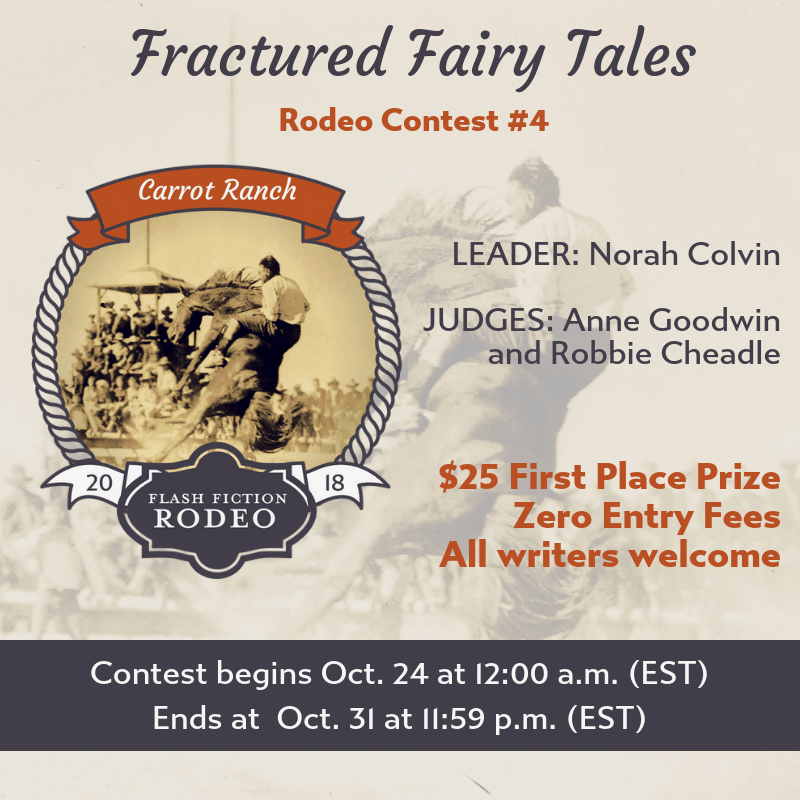
Once Upon a Rodeo Time
As promised, here’s some information to start your thinking in preparation for the fractured fairy tale flash fiction contest in the Carrot Ranch Rodeo next month. (Try saying that five times real fast!)
Please note: The correct date is Oct 24, not Oct 17 as shown below.
Share this:
-
When you’re on a theme, stick to it
Education is my theme. It’s my passion. Sometimes I think I should get another interest, but I’m stuck with this one. Sometimes I get stuck with a theme within a theme too. That’s happening at the moment.
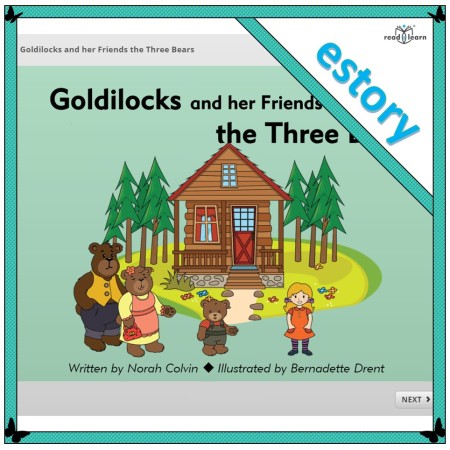
A couple of weeks ago, I uploaded an innovation on the traditional story of Goldilocks to readilearn, a collection of teaching resources for the first three years of school. I also added some suggestions for using the resource to teach reading and writing, including sight words in context. I have other supporting resources in progress to be added to the collection soon.
While my story Goldilocks and her Friends the Three Bears is not really a fractured fairy tale, it’s simply a retelling with an alternative ending; I’ve also been thinking of fractured fairy tales for my Carrot Ranch Rodeo Contest coming up next month. (Look for further details to be published at the Ranch this week.)
So stuck on this theme am I, that I wrote a 297 (3 x 99) word story as a response to Charli’s Tuff prompt “Papa’s Bar”. While this Free-Write contest is now closed (writers have only twenty-four hours to respond to the prompt), there will be four more chances to enter the TUFFest Ride event with the next one scheduled for September 19. Be sure to look out for it if you want to be in it.
Note: I’m not sure where or what the Papa’s bar is that Charli alluded to, but I am sure that it’s not what I wrote my story about. In Australia, when we play tiggy, that you might know as tag or tig, or some other name, we might allocate a certain spot as ‘bar’. This means that you are safe and cannot be tagged when on or touching that spot. Sometimes, players will attempt to allocate a spot as bar just as they arrive at it in order to avoid being tagged.
While I have no thoughts that I may win any of the TUFF contests, it is fun having a go. This is what I wrote in response to the Papa’s Bar prompt. I hope you enjoy it.

Papa’s Bar
Out in the woods lived a family of bears; Papa Bear, Mama Bear and baby bears five. All summer long, Papa Bear toiled, ensuring his family were contentedly fuelled, ready to sleep through the winter’s long dark. They filled up their bellies with berries hung low, with fish in abundance in streams flowing clear, and hives’ full bounty of gold. Mama and babies had no need to complain, every meal Papa made, a sumptuous feast. When autumn arrived, and food became scarce, Papa Bear said, ‘Now’s time for bed. Close your eyes little ones, dream sweet dreams until spring.’
The babies were restless, not ready for sleep.
‘We need a story,’ a little one said. ‘Tell us about life when you were a cub. What did you eat? Where did you play?’
‘Just one story — then sleep.’
‘We need a drink first,’ said the cubs.
‘Okay, but lickety-split.’
They had just settled back when another voice said, ‘I’m hungry.’
‘Me too,’ chimed the others.
‘Can’t be,’ said Papa Bear. ‘No food until spring.’
‘Awh,’ they chorused.
‘I could make some porridge,’ yawned Mama Bear.
‘Yay! Porridge!’ said the baby bears.
‘But then you must sleep,’ said Papa Bear.
But they didn’t. Before his story was through, Papa Bear was snoring with Mama Bear nestled beside him.
‘Let’s play tag,’ smirked one.
‘I’m It,’ said another.
They took turns to run and catch, and through it all, the parent bears slept.
At last, the littlest bear yawned. No more running and catching, he was ready for sleep. He scrambled over Papa Bear, escaping the tagger’s clutches with a warning, ‘Can’t get me. Papa’s bar.’
His eyes closed and then, one by one, they snuggled into a big bear hug, murmuring ‘Papa’s bar’ as they drifted off to sleep.
When Charli Mills of the Carrot Ranch posted this week’s flash fiction prompt, challenging writers to In 99 words (no more, no less) write a story that includes pasta. It can be spaghetti, macaroni and cheese, or any variety. It can be a meal or a work of art. Go where the prompt leads, how could I not get the bears in on the act again.
This is my response. I hope you enjoy it too.
Pasta for Breakfast
Papa Bear pushed back his chair. “Not this muck again.”
Mama Bear stopped mid-ladle. “It’s Baby Bear’s favourite. I— I thought it was yours too.”
Baby Bear’s lip quivered.
“Pfft! Sometimes a bear needs real food.” He grabbed his hat. “I’m going for a walk.”
“Papa!” Baby Bear went after him.
Mama Bear dumped the porridge, pot and all, into the bin, grabbed her hat and followed.
“Where are we going?” asked Baby Bear.
“Somewhere nice for breakfast. It is spring after all.”
Papa Bear paused outside BreakFasta Pasta, then went in.
Mama Bear smiled; pasta was her favourite.
Thank you for reading. I appreciate your feedback. Please share your thoughts.
Share this:
-

How important is classroom decoration?
For a relative newcomer, in my terms anyway, Pinterest has made quite an impact on the world, particularly on the world of the classroom.
If you’re in doubt, just Google ‘Pinterest classroom’. Your search will bring up hundreds, indeed thousands, of ‘best’ classroom décor ideas.
Decorating classrooms seems to be the thing of the moment. It would be easy to believe that an elaborately decorated classroom is of greatest importance to teachers today. While we always did it (decorated our classrooms), we didn’t share and compare on social media. How could we? Social media didn’t exist. Oh, horrors! Really? Really. Pinterest is not only new to this century. It’s new to this decade, and the sharing phenomenon isn’t exclusive to Pinterest.
Concerns about harmful effects of social media messages on young, and not-so-young, people’s body image are often expressed. I wonder if there may be similar harmful effects of these classroom images. If teachers compare their classroom décor with that of others, perhaps in very different situations, will they constantly come up short? If they spend copious amounts of time, and money, on decorating their room, how much will they have left for professional reading and planning? As with body image, are these images sending the wrong message?
While I agree with the importance of setting up a bright, welcoming classroom, I also believe that space must be left for the display of children’s work. While I don’t believe in the bare wall theory as proposed by some, if there is too much on the walls, and particularly if they didn’t contribute to it, children may either ignore it or simply find it distracting.
What do you think? Do you remember the walls of your childhood classroom? Mine were mostly bare. I don’t remember anything other than a Crucifix (I went to a Catholic school), a photo of the Queen, and a flip book of large cloth charts.
What about your children’s classrooms, or your own (if you are a teacher)? How are they decorated? I’d love to know your thoughts.

While I had been contemplating a post about Pinterest classrooms for a while, this week seemed the perfect time, even if this isn’t the post I had been planning. You see, Charli Mills at the Carrot Ranch challenged writers to In 99 words (no more, no less) write about an epic workplace. It can be real or imagined. Go where the prompt leads.
Most of my working life (and all of my school days, which together equate to most of my life 😊) has taken place in a classroom. I had brief tilts at other minor roles, but overall, the classroom has been my workplace. With a career spanning five decades (but not fifty years – yet), I think it could be categorised as epic.
However, rather than tackle my career, I realised that Pinterest-Inspired Classrooms fitted neatly into the EPIC acronym. as long as I could find that exceptional ‘e’ word. This is my response. I’d love to know what you think.
It’s EPIC
Roll up! Roll up! Come one, come all. This new attraction will have you enthralled. Bring parents, bring partners, siblings and friends. No one’s excluded. It’s Earth’s latest trend. Your eyes won’t believe. Your ears won’t deceive. It’s a sensory explosion, for all to explore. It’s entertaining, electrifying, edifying too. It’s a universe first, and it happened on Earth. It’s empowering, engrossing. There’s so much to see. With no space left empty, it’s elaborate, exciting, extols energy. With exquisite exhibits and enlightening exposures, it’s the most, enticing, enriching, educational environment, established on Earth. It’s EPIC, the Exceptional Pinterest-Inspired Classroom.
Thank you for reading. I appreciate your feedback. Please share your thoughts.
Share this:
-
Lemons, Limes and Other Mysteries
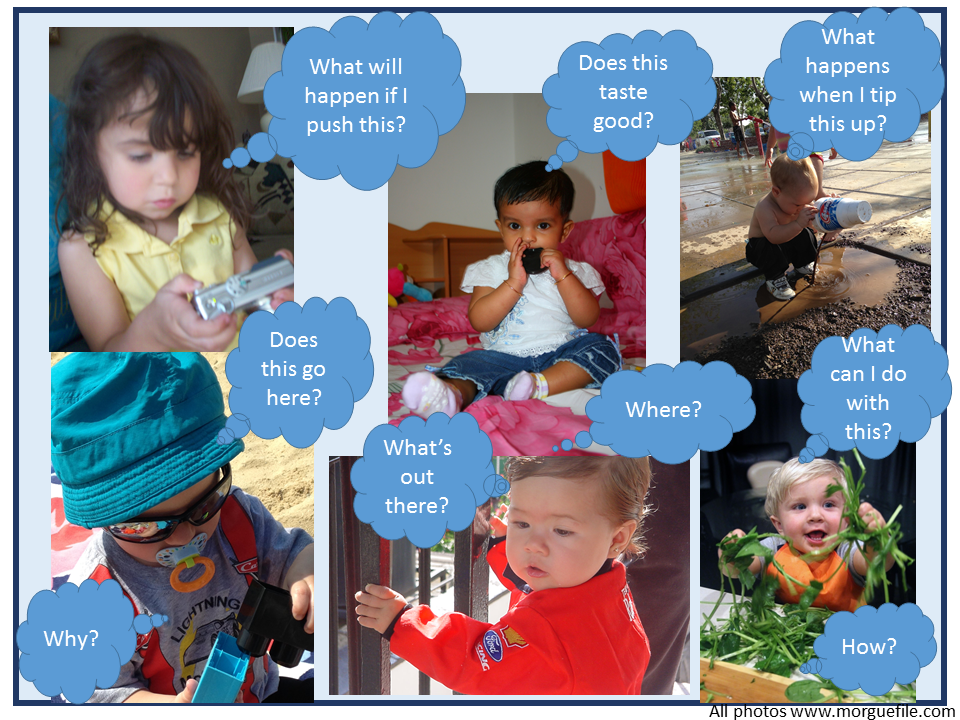
Children are question machines, churning out question after question: why is it? how does it? Their mission is to find out about the world and everything in it, not to drive their parents crazy, as many believe.
Of course, the best response to children’s questions is to help them find the answers, unlike in this scenario.

Unknown source. Apologies. Happy to attribute if informed. I always love the story of David Attenborough shared by Michael Rosen in his wonderful book Good Ideas: How to Be Your Child’s (and Your Own) Best Teacher. Rosen says that, as a child, David took an interest in bones and if he was out walking and found some he would take them home and ask his father (a GP so would probably know) about them.
But his father didn’t just tell him. Wanting his son to be curious and interested in finding things out for himself, he responded, for example: “I wonder if we can work it out . . .” They would then look through books about zoology and anatomy and try to identify the bone’s origin.
I would like to have been a parent like David Attenborough’s father, perhaps more often than I was. But sometimes the situation is not conducive to an immediate quest for answers, and oftentimes we don’t have a satisfactory one to give.
Our language, with multiple meanings for the same word, and an abundance of phrases that can’t only be taken literally, is not the easiest to learn. I often marvel at how well our children learn it and wonder even more about the complexity our language has for learners of English as another language.

This week at the Carrot Ranch, Charli Mills challenged writers to In 99 words (no more, no less) write a story about a bottleneck. You can be literal or use the term to describe congestion. Go where the prompt leads.
Bottleneck is one of those words that can’t always be taken literally. I’ve used my response to Charli’s prompt to honour parents who are under constant scrutiny and bombardment with questions from their little ones. Sometimes it feels more like a battleground and they do well to maintain a peaceful composure. I hope you enjoy it.
Lemons, Limes and Other Mysteries
She hit the brakes and thumped the steering wheel.
“Mummy swore.”
“Didn’t.”
“I heard.”
“Why we stopped, Mummy?”
“There’s a traffic jam.”
“Jam? I love stawbrey jam sammich.”
“Not that jam — must be a bottleneck up ahead.” Please be a merge, not an accident.
“We learned ‘bout bottlenecks today.”
“What?”
“Live in the ocean. Maminals, like us. Where’s bottleneck, Mummy?”
“Not bottleneck, Jamie, bottlenose.”
“You said bottleneck.”
“I meant — aargh!”
Finally, they were home.
“You look frazzled, hon.”
She rolled her eyes and took the beer.
“Why lemon is in your bottle neck?” asked Jamie.
“Because it’s not lime.”

Photo via Good Free Photos Why do they put that lemon or lime in a Corona? Do you know?

Thank you for reading. I appreciate your feedback. Please share your thoughts.
Share this:
-

Wishing on a comet

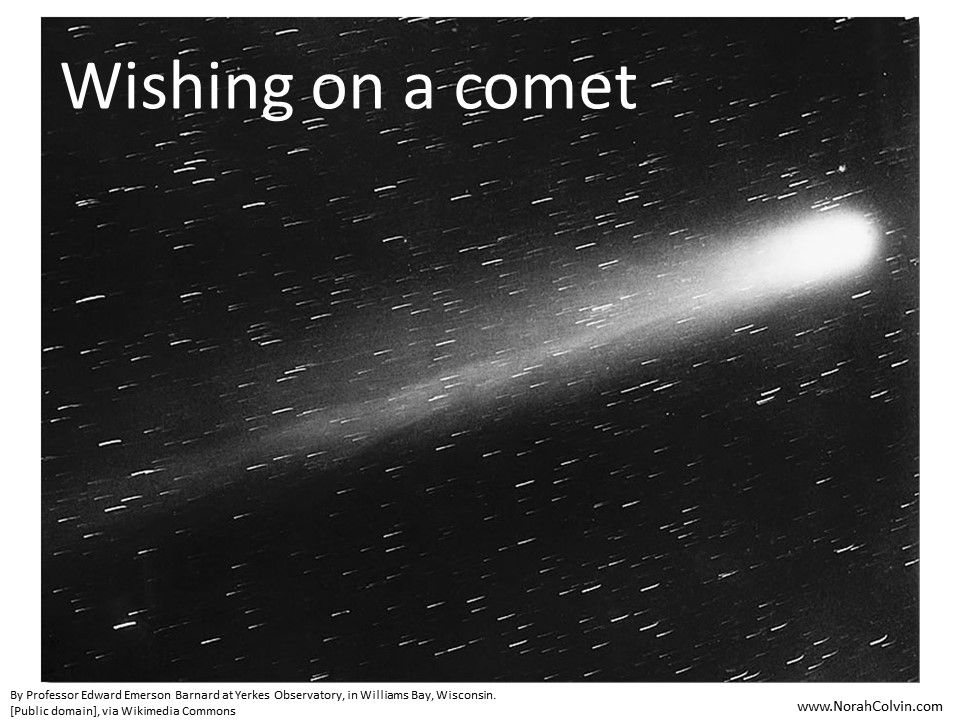
This week at the Carrot Ranch, Charli Mills challenged writers to In 99 words (no more, no less) write a story about a comet. You can consider how it features into a story, influences a character, or creates a mood. Go where the prompt leads.
When I think of comets, I think of Halley’s Comet which passed by in 1986. At the time my son was twelve, my daughter was not yet born, and I was teaching a class of seven to nine-year-olds. My son and the children I taught may be lucky enough to see the comet for a second time when it returns in 2061. I wonder how many will still have the time capsule we made that year, and if they have it, think to open it. They will all be in their eighties.
It wasn’t an elaborate time capsule; really just a large envelope with stories and information about us, and I’m not sure what else. I was recently in contact with one of the girls from that class and she remembers the night we had a sleepover at school to look at the comet, and she still has the time capsule she made. I think that’s pretty cool. How special to create these shared memories that last.
My response to Charli’s prompt is about creating shared memories.
You may recall my previous two flash stories, the first of which was my first attempt at writing romance. He invited her to go camping. She was reluctant but gave in when she ran out of excuses. When she arrived at the campgrounds she saw the words “Marry me” spelled out with solar fairy lights. But he was nowhere to be seen.
It got such a good response that I continued the story the following week, leaving the conclusion open-ended. This too received a great response, thank you, and encouragement for me to continue the story along with lots of suggestions and ideas of how to do so. You were undecided about his intentions – were they honourable or not? At the end of the episode, she pushes back the tent flap and screams. But at what? It’s at this moment that I pick up the story, guided by Charli’s prompt. I hope you enjoy it.
An Imperfect Proposal
“What the…?”
He scrambled through bushes, slipping and sliding on twigs and gravel in haste to his love. When he reached her, she was doubled over holding her belly.
“What happened?”
She shook her head.
“What’s wrong?”
“I thought…” Her body shook.
“What?” he soothed, wiping away tears.
“Snake… I thought…” She pointed.
On the bed lay the strap of his telescope bag coiled neatly.
“You’re laughing?”
She nodded.
——
Camping became their family tradition, but their children’s favourite story was of the “snake” that frightened Mum, not of the comet that graced the sky the night that he proposed.
Thank you for reading. I appreciate your feedback. Please share your thoughts.
Share this:
-

Peering from the bushes
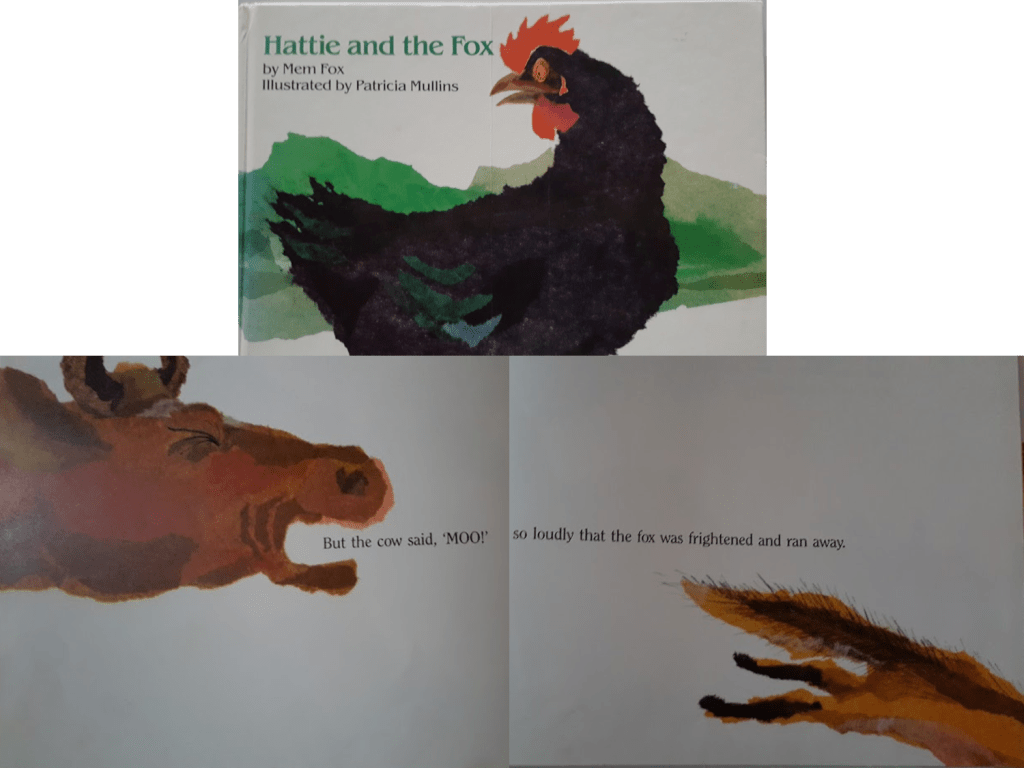
One of the multitude of my favourite picture books is Hattie and the Fox, written by Mem Fox and illustrated by Patricia Mullins.
I am allowed a multitude of favourites, aren’t I?
Like children, it’s too hard to choose just one. I don’t mean just biological children, I mean the children I teach. They all become ‘my’ children the moment they enter my classroom and remain that way forevermore. How could I choose a favourite?
Hattie and the Fox is a fun story for reading aloud. The children love to join in, especially with the dialogue, and even enjoy acting it out. The cumulative and repetitive features of the story, along with the rhythmic text, support beginning readers who beg to read the story again and again.
While my daughter never liked it when I ‘put on voices’ to read, the children in my class did. Somehow they didn’t think it was me putting on voices. They became involved in the story and thought it was the characters speaking. I used to smile to myself when they’d say things like, “That cow, she’s so funny.” And mimic my reading. Although I am no Mem Fox (you can listen to her read the story here), they enjoyed it anyway.
In the story, Hattie the hen announces that she can see a nose in the bushes. The other animals show little interest. Even when Hattie announces that she can see two eyes, two legs, a body, four legs and a tail, they are not concerned. Only when she realises and announces that it’s a fox peering from the bushes, do the others respond.

I couldn’t help but think of Hattie and the eyes peering at her from the bushes when Charli Mills challenged writers to In 99 words (no more, no less) write a story that includes an act of “peering from the woods.” Go where the prompt leads.
We don’t have “the woods” in Australia. We have “the bush”. There could be any number of things peering at us from the bushes such as possums, koalas, kangaroos, drop bears, bunyips, or a great variety of birds. Most are fairly harmless. It was deer peering from the woods in Charli’s story.
While deer are not native to Australia, some were imported for hunting and farming purposes. Many of those escaped to freedom. Some roam the suburbs destroying vegetation and creating hazards for unsuspecting motorists. We’ve occasionally come across a group of them in the middle of the road when we come home late at night. At Christmas time the road signs warning of deer are decorated with tinsel and red pompom noses to add to the festive mood.

Last week, in response to Charli’s ‘yellow tent’ prompt, I attempted a romantic story which was rather well received. I decided to continue the story. You may remember that a reluctant camper, unable to find any further excuses, finally agreed to join her boyfriend. When she arrived, the campsite was deserted except for one yellow tent lit by solar fairy lights spelling the words, “Marry me,” and her fears melted. But should she have dropped her guard?
Surprise!
She parked her car beside his and grabbed her bag. As she locked the car, she looked around. Where was he? He said he’d be watching for her. Cicadas buzzed louder than her footsteps crunched the gravel. A bird startled as it squawked and flapped overhead. Where was he? He must know she’d arrived. Even with the fairy lights, it was darker than she liked. Peering from the bushes, he willed her to be brave, to open the tent, to find what he’d made for her. Finally, tentatively, she pushed aside the flap. Her screams silenced the night chorus.
Is that what he expected? What do you think was in the tent? Why was he peering from the bushes? What happens now?
Thank you for reading. I appreciate your feedback. Please share your thoughts.
Share this:
-

Intent on yellow tents
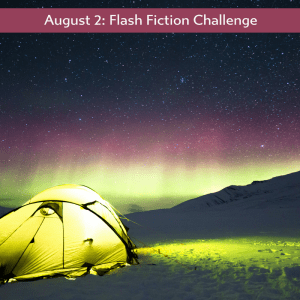
This week at the Carrot Ranch, Charli Mills has challenged writers to In 99 words (no more, no less) write a story that includes a yellow tent. Where is it and who does it belong to? Think of how the color adds to the story. Go where the prompt leads.
I am not a camper. I had no experience of camping as a child and only two as an adult. The first, I finally succumbed to pressure from friends who assured me I’d love it. How could I not? They did. I didn’t.
The second I only vaguely recall though I am assured it did really happen. I think I’ve obliterated it from my memory. Sadly for my children, they also missed out on the camping experience though they did attend school camps (not in tents) and occasionally go camping now that they make their own choices.
My best experience of camping was at school with my year ones. One of the families was keen on camping and the father was a wonderful volunteer in the classroom. His shift work as a firefighter meant that he was often available to help us out. When we were reading books about camping, we had a ‘camping day’. This wonderful dad came in and set up a tent in the playground, made a little campfire, and cooked us all a camp lunch. We spent the day in the playground getting the full camping experience. It was great fun, especially for the children who didn’t get those experiences with their families, and a good way to build background knowledge and vocabulary. I enjoyed it because I got to go home to my nice comfy bed to sleep in. 😊
Of course, children love to play camping too, building tents over furniture in bedrooms and living rooms and with whatever they can find in the back yard. It is a wonderful activity for imagination. The construction itself can take a bit of working out and involves spatial thinking, collaboration, persistence, resilience and the ability to try new methods. I believe setting up a real tent may require some of those skills as well.
For my response to Charli’s prompt, I couldn’t resist writing about children and their imaginative play, but I also thought I’d try my hand at a romantic piece, which is almost as rare for me as camping, so I have done two. I’d love to know which you prefer.
With Intent I
They dragged the upended chairs into position, stacked boxes in the middle and positioned the quoits hob on top.
“Now a cover,” said one.
“I know,” said the other. They raced inside.
“What are you doing?” asked Mum.
“Nothin’,” said one.
“Just playin’,” said the other.
“Don’t make a mess,” said Mum.
“We won’t.”
The yellow sheet refused to hide as they returned outdoors. Mum smiled.
After some realignment of chairs and adjustments to boxes and sheet, they stood back to admire their work.
“Lunchtime,” said Mum.
“Can we eat in the tent?”
“Only if I can join you.”
With Intent II
“I have to work.” She feigned disappointment.
“That’s okay. Come after work.”
“But I’m working late. It’ll be dark.”
“It’s well-lit all the way.”
“But I don’t know the way.”
“That’s okay.” He punched the address into her navigation device. “Just follow the directions.”
“How will I find you when I get there?”
“I’ll be watching for you.”
Conjuring no more excuses, she wasn’t yet ready to explain her attraction to him didn’t include camping.
Later, when entering the campgrounds, deserted but for one yellow tent lit by solar fairy lights spelling the words, “Marry me,” her fears melted.
Thank you for reading. I appreciate your feedback. Please share your thoughts.
Share this:





 Norah Colvin