Live Love Laugh Learn … Create the possibilities

Tag: early childhood

  • Talking the way out

    https://openclipart.org/image/800px/svg_to_png/100009/Coffee-by-netalloy
    https://openclipart.org/image/800px/svg_to_png/100009/Coffee-by-netalloy

    Recently I met up with some teacher friends and, as always happens with teachers, the discussion turned to school, teaching and children. There was talk about the crowdedness and inappropriateness of many aspects of the curriculum, of resources that were ambiguous and poorly written, of time spent practising and preparing for tests, of (other) teachers who were ill-equipped to teach and not interested in professional learning.

    It made me sad. It has always made me sad. Sad and frustrated with the inappropriateness of so much that happens in schools and the effect it has on diminishing our most precious resource: the ability to think, learn, innovate and create.

    The fact that I am unable to do anything about this situation at times overwhelms me and I just want to curl up in a ball in the corner and cry. That I have spent almost my entire adult life swimming against the tide trying, through a variety of means, to make a positive difference through education with an effect as insignificant as a grain of salt in the ocean, makes my efforts seem futile and worthless. A waste of time and energy. I should just give up.

    But, foolishly maybe, I haven’t and don’t. Here I am writing a blog about education. One more way to try; with a website on the way as well. What effect will they have? Probably very little, but at least I am doing something that is important to me; something that gives my life meaning; even if it has no real value beyond that.

    I have been out of the classroom now for three years. I escaped before the introduction of new programs which I would have found philosophically and pedagogically impossible to implement. It had always been a balancing act, doing what my employer expected of me and what I believed to be best for the children and their learning. (Of course there is no saying that what I thought was better. The value of my thinking may well have been just in my head!)

    Five times before I had left the classroom, only twice for reasons unrelated to dissatisfaction (the birth of children). But I could never shake off my belief that education delivery could be improved. I read widely, seeking alternative ways of making a positive difference but, although I had vowed at each departure to never return, something always drew me back.

    Man-resigning
    https://openclipart.org/detail/211086/man-resigning.-by-doodleguy-211086

    Rather than allowing the situation to overwhelm me by accepting that there was nothing I could do; rather than throwing my hands in the air, walking away and admitting that it’s all too hard, I didn’t let go. Perhaps it was foolhardy. Maybe I should. Maybe one day I will. But not yet.

    Instead I choose to focus on the good things I see happening; the parents, teachers, nannies and child care workers who strive to make a positive difference. We know we can’t change the whole world. We can’t rid it of all the injustices, inequalities, violence and other wrongdoings against humanity and the Earth. But we can make a difference in our own little corner; and my own little corner has always been my focus. If I can make a difference with something as simple as a smile or sharing a positive thought then I will do it. If I can do more than that then I will, but I will focus on what I can rather than what I can’t.

    So for my little bit of positivity today, I am sharing some of what I think are great things that are happening, making a positive contribution to education and children’s lives; some things that make my heart sing and confirm my belief that if we want to, we can make a difference.

    marshmallow 5

    I have previously shared some thoughts that stimulated great discussion about the famous Marshmallow Test conducted by Professor Walter Mischel.

    On All Our Words I recently read a report of an address made by Mischel to the team at All Our Kin.

    In that address, Mischel is quoted as saying,

    “When a child grows up in a high-poverty, extremely unpredictable environment – in which anything can happen, in which danger is constantly present, in which chaos is always possible – it affects him at a biological level. Those experiences turn into chronic stress, or toxic stress, and they actually change his brain. They limit the potential of the cool system to make long-term plans and be patient and work for a distant goal.”

    The author of the article, Christina Nelson writes

    “Fighting against the biology of disadvantage requires a sustained effort that begins at birth, or even earlier, which is why creating high quality early care and education is so important for vulnerable children.”

    Mischel’s address further supports that view and congratulates the team at All our Kin for their work, saying

    “By providing a sense of trust, a sense that the rewards are attainable, that promises will be kept, that life doesn’t have to be chaotic and unpredictable, you folks are providing exactly the basis for the development of the cool system, and for the regulation of the hot system. The kids who have that when they are two years old are the same kids who are successful at the marshmallow test at five.”

    The praise from Mischel would not have been given lightly. I’m impressed with what I have read about All Our Kin, including this from their mission statement:

    “. . . children, regardless of where they live, their racial or ethnic background, or how much money their parents earn, will begin their lives with all the advantages, tools, and experiences that we, as a society, are capable of giving them.”

    family1

    The Talking is Teaching program, which was launched by Hillary Clinton as part of the Too Small to Fail initiative, in Oakland aims to reduce educational (and life) disadvantages by teaching parents the importance of talking to their children from birth.

    Thanks to my friend Anne Goodwin and daughter Bec I was also alerted to an article in the New Yorker The Talking Cure which described a program in Providence that also encourages low-income parents to talk more with their children.

    The author of the article, Margaret Talbot says that “The way you converse with your child is one of the most intimate aspects of parenting, shaped both by your personality and by cultural habits so deep that they can feel automatic. Changing how low-income parents interact with their children is a delicate matter”. The aim of the program is to support parents in non-threatening ways to support their children.

    I have previously mentioned a recent publication by Michael Rosen entitled Good Ideas: How to Be Your Child’s (and Your Own) Best Teacher. This book provides wonderful support for parents of children of any age. In very readable, accessible language, Rosen’s book is packed full of simple, inexpensive, fun and powerful ways for parents to support their children’s learning, effectively but unobtrusively, in their everyday lives. I think this book should be supplied to all parents on the birth of their children.

    Closer to home here in Australia are Community Hubs  and other programs such as Learning for Life run by the Smith Family and Acting Early, Changing Lives by the Benevolent Society.

    These are but a few of the good things that are happening. I have focussed on community programs rather than individuals (except for Michael Rosen’s book) in this post. I know there are many more great programs, and individual teachers doing amazing work. I’d love to hear about some that you admire.

    Thank you

    Thank you for reading. I value your feedback. Please share your thoughts about any aspect of this post.


  • Finding meaning

    Always look on the bright side of life’ is a philosophy to which I aspire. Many think I have achieved it but they don’t know how hard I struggle. I do try to find the good in people and situations, but it’s not always my first and instinctive reaction. When I realise I’ve reacted negatively I try to change or hide my negative thoughts and replace them with positive ones. But it’s not always easy to convince myself, regardless of whether I convince anyone else or not.

    It reminds me of a quote on a laundry bag which has stayed with me in eight different homes in three different states and for well more than thirty years. After all this support I have finally thought to seek out the source of the wisdom and found it to be UK poet and playwright Christopher Fry.

    bag

    I feel the quote represents me quite well; doing what I can to hold it all together and keeping those negative instincts in check by ‘nipping them in the bud’, all the while fearful of one day just losing it and letting it all out in one mighty swoosh. I guess the expectation of fewer years remaining in which I will need to keep myself contained makes me a little optimistic. (Always look on the bright side!)

    I like to think I’m more of a hopeful realist than either a Pollyanna or a negative realistic. A discussion about optimism and pessimism followed a previous post in which I asked How much of a meliorist are you?  But meliorism is more a belief that the world can be improved by the actions of humans than an optimistic or pessimistic expectation of the outcome.

    I believe that humans have an amazing potential for improving our world (i.e. every aspect of it). That makes me a meliorist. Recognising what is happening in the world now makes me a realist. A belief that human actions will make improvements in the future makes me an optimist, but not one without some pessimistic fears. While stories of terrorism, climate change and violence fuel the fears, stories like this TED talk by Tasso Azevedo show that improvements can be, and are being, made.

    I am an education meliorist. I believe that education is a powerful agent for change and has an enormous potential for improving lives. My optimism that education will impact positively upon individual lives as well as the collective human situation outweighs my pessimism about the outcomes I see in current systemic trends and leads me to seek out educators, like Ken Robinson, Chris Lehmann , Michael Rosen, Barbara Arrowsmith-Young and Rita Pierson who share my vision of what could be.

    A quest to improve my own life and the lives of others through education has been a long time passion. Ensuring that my own children experienced the benefits of learnacy, though I hadn’t heard of the term at the time, as well as literacy and numeracy was of great importance to me. I encouraged them to question, to create, to think critically, to read, to learn, to wonder . . .  There is so much we teach our children the list goes on. It is very rewarding for me to see that they have a love of learning and are passing that same love on to the next generation.

    Having, sharing and fostering a lifelong love of learning perhaps in some ways contributes to giving meaning to my life. But it also leads me to question life and its purpose in ways that many others don’t.  This questioning can lead to a sense of unease, of lacking fulfilment, of needing to do and achieve more. I know others who better accept the way things are, accept each day as it comes, and are content in their existence. Sometimes I envy their complacency.  Other times I want to shake them and make them realise that there is more to life than this.

    But am I wrong? Is there actually less to life than this? It is sometimes said that there is no point in accumulating wealth and possessions as you can’t take them with you when you go. But is there any point in accumulating a lot of learning and knowledge? After all, you can’t take it with you when you go either; but like wealth and possessions, you can leave it behind for future generations. If we lived only for what we could take with us, would there be a point?

    I guess what matters is what helps each of us reach that level of contentment, of being here and now in the present moment because, after all, it is all we ever have.

    I often think about life, existence, why we are here and the purpose of it all, constantly wavering between seeing a point and not. A recent discussion with a friend about her feelings of emptiness and needing to find more purpose and meaning in life disturbed my approaching, but elusive, equilibrium again. Will I ever reach that blissful and enviable state of contentment: knowing and accepting who I am, where I am, where I am going and how I am going to get there? Who knows? But I can have fun figuring it out. I am determined to enjoy the journey. I don’t think there will be much joy at the end!

    Which is all very timely with the current flash fiction prompt set by Charli Mills at the Carrot Ranch who talks about actions that we take to reach our goals and challenges writers to In 99 words (no more, no less) write a story that describes a moment of being.

    I hope you enjoy my response.

    Being, positive

    “It’s positive,” he said.

    She smiled. She knew. She only needed official confirmation.

    He wanted dates. She supplied.

    But she knew the very moment an unexpected but welcome spark enlivened her being with its playful announcement, “Surprise! I’m here!”

    She’d carried the secret joy within her for weeks, never letting on, keeping it to herself, waiting. No one would have believed her without proof. But with her whole being she knew.

    Finally, after nine inseparable months, she held the child, distinct and individual. She marvelled at the tiny creation whose existence breathed purpose and meaning into hers.

    Thank you

    Thank you for reading. I appreciate your feedback. Please share your thoughts about any aspect of this post and flash fiction.

  • The Power of Not Yet by @TeacherToolkit

    The Power of Not Yet by @TeacherToolkit

    Some of my most popular posts of 2014 were those that discussed praise, growth mindset, assessment and failure.
    My final post for the year included thoughts about failure and the need to reflect and refine to move forward.
    It is fitting to begin 2015 with a post that revisits and extends those themes. I’m sharing a post about The Power of Not Yet I read on @TeacherToolkit’s blog. The post includes a video of Carol Dweck explaining that

    “if (students) didn’t pass a course, they got the grade “Not Yet.” And I thought that was fantastic, because if you get a failing grade, you think, I’m nothing, I’m nowhere. But if you get the grade “Not Yet” you understand that you’re on a learning curve. It gives you a path into the future.”

    I would much rather consider that I have not yet achieved my writing goals, than think I failed to achieve them in 2014. Not yet means I am making progress, and will continue to do so in 2015 and beyond.
    In the video Dweck shares research showing a difference that having a growth ‘not yet’ mindset can make to student effort and achievement.
    For me, her most powerful statement is that at the end of the talk:

    “Once we know that abilities are capable of such growth it becomes a basic human right for children, all children, to live in places that create that growth, to live in places filled with yet.”

    It’s a bit like learning to ride a bike. There is no failure, just stages of growth in ability.

    I hope you enjoy the article, and especially, Carol Dweck’s video.

    Thank you

    Thank you for reading. I value your feedback. Please share your thoughts about any aspect of this post.

  • It’s not fiction

    Most of my current writing is non-fiction with a strong focus on education. The two blog posts I publish each week generally address educational issues or share my thoughts about learning.

    In my ongoing work-for-self I develop educational materials and resources for parents, teachers and children. Some of these are available in my Teachers Pay Teachers store, and are listed on the Teaching and learning resources page of this blog.  My goal is to set up my own website on which all the resources I produce will be available.

    During my work-for-pay hours I am also involved in writing resources for teachers. Most of my published material, listed on the Writing – interest and publications page, is also educational.

    That is not to say that I am not interested in writing fiction. Over the years I have enjoyed writing in a variety of other genres including stories for children, short stories and poetry; and still do. They are just not my main focus at the moment. That may change in the future. Or it may not.

    One opportunity for writing fiction that I am very much enjoying at the moment is the weekly 99 word flash fiction challenge  set by Charli Mills at the Carrot Ranch.

    Initially my responses to Charli’s prompts were unsystematic. However it was not long before I was incorporating them into longer posts which maintained the educational focus of my blog. A recurrent theme is the importance for schooling to target the particular needs of individual children.

    Soon a character emerged: Marnie — a young girl, from a dysfunctional family, for whom school would be a threatening and meaningless experience without the support of a passionate and caring teacher. Sometimes, as with this week’s, the prompt inspires immediately and I write a story in which I hope that the message is strong enough for it to stand alone, without the support of a lengthier post explaining my thinking background.

    Here is this week’s response to Charlie’s prompt: In 99 words (no more, no less) write a story about rare gems. I’d love to know how successful you think I have been.


    glitch, trophy gem http://goo.gl/VEQVxM
    glitch, trophy gem http://goo.gl/VEQVxM

    Uncut gem

    She examined the new arrival, assessing the possible effects of integration into the existing collective. Would the group be enhanced or would this newcomer disrupt the established harmony?

    From every angle the edges were rough and uneven. The years of obvious neglect obscured the potential from any but a trained eye.

    Fortunately her eyes were keen. A bit of encouragement here, a little adjustment there, an opportunity to sparkle and display unique and positive attributes.

    She smiled. Experience had shown what could be achieved with a little polish and care.

    “Welcome to our class, Marnie,” she said.


    Thank you

    Thank you for reading. I value your feedback. Please share your thoughts about this post and flash fiction story.

  • A cute angel

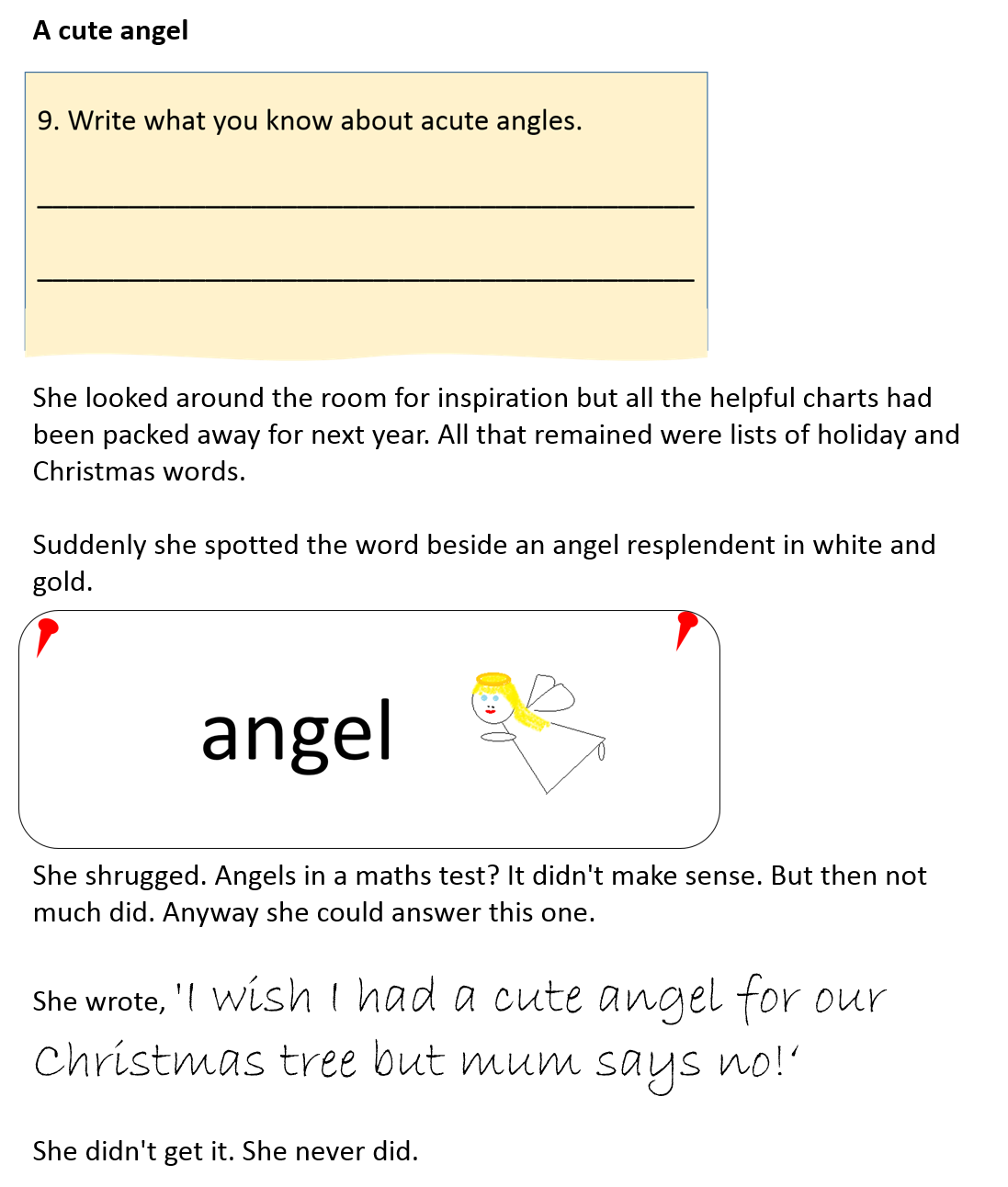
    This week at the Carrot Ranch Charli Mills has set an angel prompt: In 99 words (no more, no less) write a story that features an angel.

    Usually I include my responses to Charli’s prompts in longer posts sharing some thoughts about education.

    This week I’m going to leave it as a stand-alone, without the padding I usually provide. I am hopeful that the educational issues I have alluded to will be as obvious to you as they are to me. I’d love to know what you think.

    A cute angel

    Thank you

    Thanks for reading. I appreciate your feedback. Please share your thoughts about this flash and what you consider its message to be.


  • How do you connect?

     Many of you may recognise this song from Sesame Street: One of these things is not like the other.

    Finding the one that doesn’t belong sounds like a simple activity, but which one did you choose? And why? Did you choose the rubber boot? I didn’t. I chose the shoe with laces. Does that make me wrong?

    The items had some obvious similarities: they were designed for wearing on the feet, and they were similar colours. Differences in size and style were also obvious.  Just what made the rubber boot “not belong” any more than any of the others, I’m not sure. Does that mean I am not as smart as a pre-schooler?

    Rather than simply providing children with an answer as happens in this video, I would prefer children were provided opportunities to explore and discuss similarities and differences and would invite children to explain why a particular shoe might be selected.  I think there are valid reasons for each to not belong, and there are also many reasons for them to be grouped together.

    The ability to make connections between new and established information, including by identifying similarities and distinguishing differences, is an important contribution to learning. Adults can aid in the learning process by making explicit the ways in which objects are similar and by discussing ways in which they are dissimilar.

    Young children very quickly learn to notice obvious similarities between e.g. different breeds of dogs, a variety of drinking glasses and cups, or construction items. However adults can assist and challenge children to think creatively and in new and innovative ways by encouraging them to make connections between seemingly disparate objects.

    Many innovations have been developed as a result of creative thinkers making links that didn’t previously exist between apparently dissimilar objects or situations. George de Mestral’s invention of Velcro, involving the application of an observed phenomena to a very different situation, is perhaps one such example.

    Playing games is a good way of encouraging children to think creatively. It is not necessary to purchase pre-packaged games. Many games can be played with items from around the house or in the toy box, or using picture cards from early childhood games like ‘snap’, printed clipart, or cut from magazines. Here are just a few suggestions around which you can construct your own ways of taking turns, playing and having fun:

    https://openclipart.org/image/800px/svg_to_png/178912/tweedles.png
    https://openclipart.org/image/800px/svg_to_png/178912/tweedles.png

     What’s the same?

    Display two pictures e.g. a duck and dog, a bus and a boat. How many ways are they the same?

     How are they different?

    Display two pictures and explain how the items are different. The differences could be obvious e.g. a duck and a dog, or more subtle e.g. two different breeds of dogs, or a male and female bird.

    Which one does not belong?

    Display three or four pictures. Discuss similarities and differences, and then decide which one doesn’t belong, providing reasons.

    Sorting

    Provide children with a larger number of items e.g. construction blocks in different sizes, styles and colours or pictures of a variety of objects or animals. In the beginning it is easiest to sort by one feature e.g. is yellow/is not yellow. Encourage children to look for similarities between particular items e.g. colour or shape and ask them to group all items with that characteristic. They will then have two groups, one with the feature and one without.

    Once children can confidently sort in this way they may be able to sort by two characteristics e.g. size and colour. They may even begin to make decision about how to deal with items that fit into two groups.

    What else?

    Show children a common everyday object and discuss its use. Encourage them to think of alternate uses for the same object e.g. a pencil could be used as a flagstick, a mast on a toy boat or to identify where seeds were planted in a garden.

    Link the story

    Display pictures of any two items e.g. a beach ball and a pencil. Ask children to create a story that involves both items. I immediately think of a family making plans for a holiday at the beach. The child wants a ball to play with at the beach and uses a pencil to add “beach ball” to the list of items to take. Your thoughts are probably very different. I’m sure someone will have the beach ball impaled on the pencil!

    Making up stories like this can be just as much fun for adults as it is for children. Charli Mills at the Carrot Ranch has challenged us to make it so this week with her flash fiction prompt to:  In 99 words (no more, no less) write a story using two objects, people or ideas that don’t go together. Charli allowed us to choose the two items. I decided to explore a little more of my tormented Marnie and her unicorn. I’d be pleased to know what you think.

    Unicorns and coffee

    People crammed in, around and in front of the small sidewalk cafe, reminding her of the fairy-tale pageant that had bypassed her radar. She couldn’t move now. Her coffee fix, too hot to sip, had just been served. So, as always, she retreated within.

    Cocooned in thoughts flittering across years and experiences, she barely noticed the cacophony of the crowd or passing parade.

    The sudden shout of “Unicorn!” penetrated, startling her.

    She was six again, cowering with her unicorn, avoiding mocking stares.

    But this time pitying and unbelieving stares watched the spreading stain of scalding coffee.

    Thank you

    Thank you for reading. I appreciate your feedback. Please share your thoughts about any aspect of this post or flash fiction.

  • Talking interviews

    BITE SIZE MEMOIR

    Lisa Reiter is writing her memoir and sharing her stories on her blog. She also invites others to join in and share their memories through her Bite Size Memoir prompt. Her prompt of the moment is “Interviews”.

    In my role of teacher over the years, I have conducted many parent-teacher interviews, each with varying degrees of pleasure and stress. And that’s just for me! I have also sat on the other side of the desk attending interviews to find out about the progress of my own two children.

    I mostly worked with children in their first year of school.

    When conducting interviews with parents, particularly at the beginning of the year but at any time, I always invited them to talk first; to tell me their impression of how their child was going, to raise any concerns they had and to ask any questions they wanted answered.

    There are a variety of purposes for beginning an interview in this way:

    • It gives the parents a voice and acknowledges their importance in the child’s life and education.
    • It ensures that any concerns parents have are raised and discussed first, and not left until the end or even missed out in the short time allocated to each interview scheduled on a parent-teacher night.
    • It provides an insight into the child’s life and how the attitudes of the parents may affect, or be reflected in, the child’s attitude to school and learning.

    Often times I have found that parents share my concerns, and discussing them is easier when raised by the parent. One of the most difficult things is raising and discussing an issue of which the parent is unaware.

    Over the years I have found that what parents most want to know is:

    Is my child happy?

    Is my child well-behaved?

    Does my child have friends?

    How does my child’s progress compare to that of others?

    Prior to the interviews I would make a checklist of things I wished to discuss with each parent, including responses to the queries listed above and any other issues I wished to raise or anecdotes I wished to share, ensuring the positives always outweighed the concerns. I would gather samples of the child’s work to show and have at hand suggestions for ways the parents could continue to help with their children’s learning at home, which generally meant reading to them, talking with them, playing games together and possibly involving them in daily activities such as setting the table, writing shopping lists etc.

    But I digress. My purpose in writing this post wasn’t really to talk about parent-teacher interviews, it was to list 10 memories about interviews in response to Lisa’s prompt. Like the parent-teacher interviews, many of them have a link to education.

    www.openclipart.com http://goo.gl/EY7z5L
    http://www.openclipart.com http://goo.gl/EY7z5L

    I remember interviews

    15073-Briana-web

    School days

    • I remember brushing up on my conversational French for an interview as part of my final exam. I remember the interviewer laughing at something “funny” I said. I’m not really sure if he was laughing at what I meant to say, or at what I did say!

    Employment

    • I remember not having an interview for my first teaching position. I was awarded a three-year teaching scholarship which, in return for my training and a small living allowance, “bonded” me to the Education Department for three years.
    • I remember agonising for hours over written responses to selection criteria but being unsuccessful in the interviews; and going without preparation to other interviews and scoring the job!

      bad taste party
      Would you employ this woman? Bad taste fundraising function at school.

    Police

    • I remember being interviewed by a policeman after hitting a pedestrian on my way to work one morning. I was horrified to see the teenage girl bounce off the bonnet of my car. Fortunately she wasn’t hurt as I had only just pulled away from traffic lights, but we were both rather shaken up. She was only a few metres from a pedestrian crossing (also with lights) and the policeman said if anyone was to be charged it would be her. I wish she hadn’t been so impatient. I still worry about the unpredictability of pedestrians on the side of the road.
    • I remember being interviewed by police after our car was stolen. I was so upset I couldn’t remember the registration number. After it was stolen a second time, we got rid of it!

      stolen car
      Our beautiful car – stripped!
    • I remember being interviewed by the police after our house was burgled and giving them a list of items that had been stolen. The most surprising one was a big screen TV. Big in 1999 is not the same as big in 2014. It went as far out the back as it did across and weighed a ton. How they got it out of the house and down the steep driveway without being seen I’ll never know; or even why they did, as newer technology  was on its way and it wouldn’t have been worth much to resell.

    The media (Note: You are neither expected nor required to watch any of the videos included in this section. They are simply for my amusement and learning.)

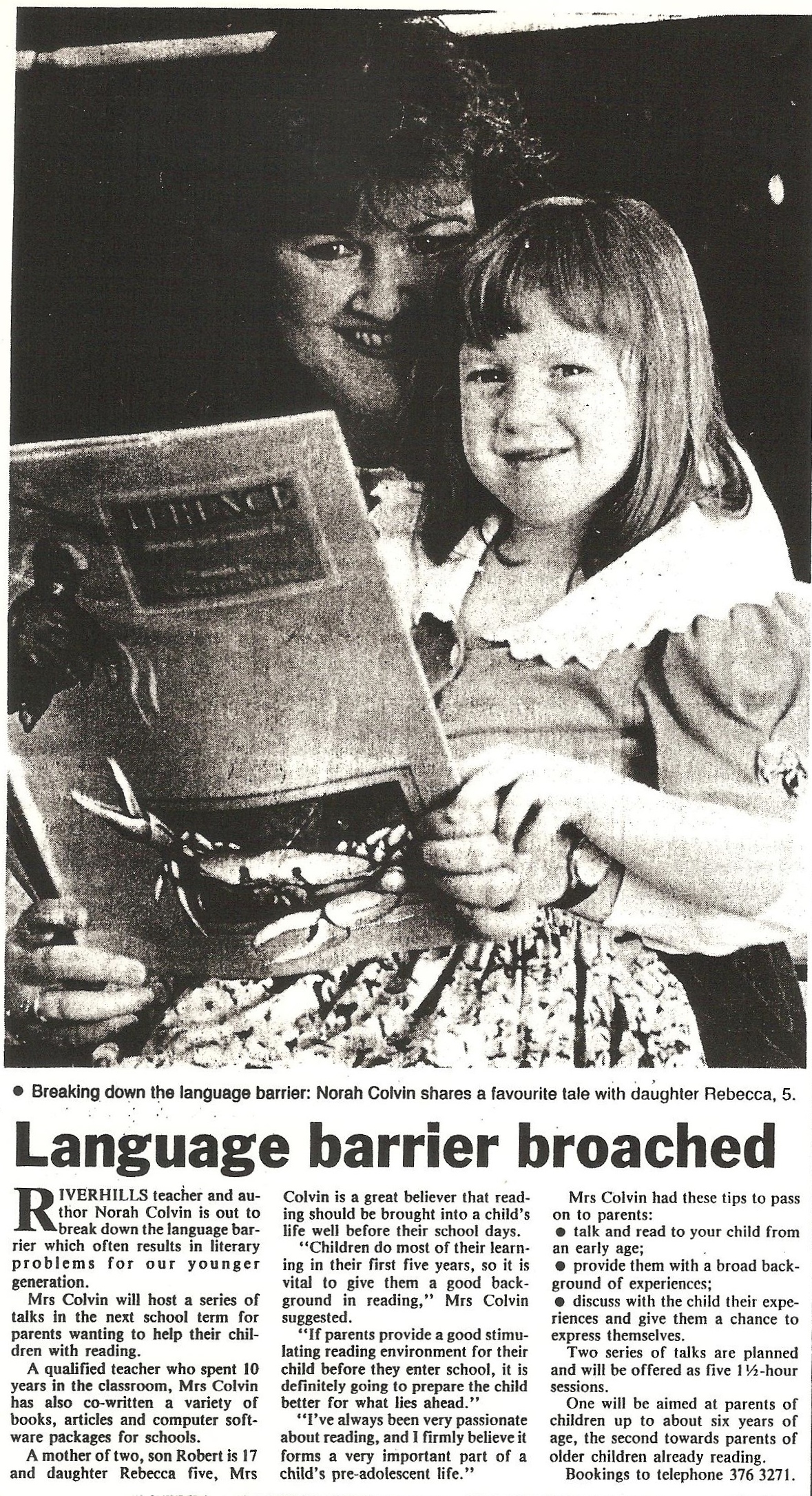
    • I remember being interviewed by the local paper when offering sessions to assist parents help their children read.

    Satelitte 17.06.92 (2)

    • I remember being interviewed on Radio on the morning of the Family Day Picnic for the year of the family in 1994.
    • I remember being interviewed on a local community television station. I was invited to talk about the alternative school I was setting up. (I haven’t found the footage yet, but below is a response given to a question about self-esteem at a publicity meeting. Apologies for the amateur quality.)
    • I remember being interviewed at school about keeping butterflies in the classroom, twice: each time for different programs and different television studios.


    Just as an aside, at about the same time that I was being interviewed about butterflies for the program “Totally Wild”, Bec was also being interviewed at school for the same program. She is proud to say that the times she appeared on that program numbered three to my one! Not long afterwards she appeared on the news a couple of in anti-war rallies!

    Bec on "Totally Wild"
    Bec and friend Elise talking about heating on “Totally Wild”

    Of course, not all interviews occur face-to-face. Interviews can take place online too. During the 15 months that I have been blogging I have passed on a number of awards asking people to answer questions. This post is a compilation of the answers given to my interview questions by my first nominees.

    Thanks, Lisa, for this opportunity to take a walk down memory lane.

    Thank you

    Thank you readers. I appreciate your feedback. Please share your thoughts about any aspect of this post.

  • Who’s the best teacher?

    Two recurring themes, amongst others on my blog, are ways of encouraging a love of literacy and of questioning in young children.

    If you read my post Going on a treasure hunt! you will know that I greatly admire the work of Michael Rosen and its contribution to literacy development. You may have followed the links and checked out the riches in store on his website.

    My post Child’s play – the science of asking questions introduces my thoughts about ensuring that children’s inborn curiosity is maintained through the encouragement of their questions.

    You can imagine my delight, then, when I read a review of new book by Michael Rosen. (Thank you, Anne Goodwin, for alerting me to it.) The review, posted by Sabine Durrant in The Guardian on 6 September 2014, discusses Rosen’s new book How to be Your Child’s (and Your Own) Best Teacher. I confess that I have not read the book but I am very excited to see that it is now available as an audiobook, so it is next on my listening list. So much about the book appeals to me.

    Rather than review the review I will simply leave with you the links to the review:

    Michael Rosen: Why curiosity is the key to life

    and Michael’s website.

    I’m sure you will find much to enjoy.

    Thanks for reading.

    Thank you

  • Imagine that!

    Imagine that!

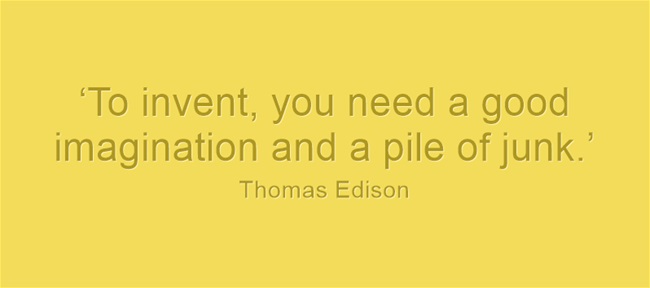
    Recently Hope at Nanny Shecando sent me a tweet requesting some thoughts about imaginative play in a school setting. Sadly I would say that imaginative play has been just about pushed out in the ever-increasing content-driven and assessment focused curriculum. Seeing children as young as five spending much of their day sitting at desks filling in worksheets and parroting back isolated bits of information flashed at them in meaningless drill and practice sessions is about as far away from my thoughts about education as you could get. If it is difficult for early childhood teachers to squeeze time for imaginative play into their programs, imagine (there’s that word) how difficult it is for teachers of older children.

    However, whenever I hear the above quote by Thomas Edison, I am reminded of how an early childhood classroom should be: a place for imagination, exploration and discovery.  Parents may tire of the cardboard box creations that children regularly bring home, wondering where each one can be stored (or discreetly disposed of!), but the value to be had from the opportunity to create, imagine and play must not be understated.

    For imagination to flourish in an early childhood classroom, I suggest the following ingredients are essential:

    A recognition of the importance of play and imagination in the healthy development of children and the prioritisation of opportunities for imaginative play every day by providing:

    • Time – lengthy and uninterrupted, with the opportunity for created play areas to be left intact over a number of days or weeks
    • Space – both indoor and outdoor with a variety of larger and smaller spaces
    • Opportunities for self-selection of activity and self-direction
    • Books for story reading and play acting
    • Variety of props: things such as dress-up items including lengths of fabric that can be a kings robe, a princess’s dress, a magic carpet, an apron, a bed; hats and scarves; toys like cars, dolls, animal toys; building blocks and cardboard boxes; paper, cardboard scissors and pens for creating signs, posters and crowns; areas for quiet play with cushions; open spaces for creating larger ‘worlds’ . . . the items that can be used to inspire imagination are limitless.

    When children are showing interest in a particular topic, an observant teacher may gather up a variety of props and leave then in a box for children to discover and use as they decide.


    https://openclipart.org/image/800px/svg_to_png/30889/lampada_di_aladino_alad_01.png
    https://openclipart.org/image/800px/svg_to_png/30889/lampada_di_aladino_alad_01.png

    In an earlier post, Learning at its best: A classroom of magic, Hope herself described a school with an open space ‘where magic happens’. She described a friendship tree where ‘friendship and freedom of speech are fostered’; an area with a ‘magic carpet . . . plush beaded cushions and Middle Eastern style blankets . . . a place for imagination to prosper. Anything is possible when dreamed, imagined or conjured whilst on the magic carpet.’

    magic carpet

    She described an area for drama and the opportunity of being and expressing yourself. She described a creativity corner where young inventors could create anything they could imagine; and spaces to read, explore, share and dream. One could think this school was in Hope’s dreams, her imagination of what is possible. But it is a real school educating real children in very positive ways that will have a very different effect that the scenario I described above. However it is not a typical school. There is not one like it in every suburb. In Hope’s words, it is a ‘very select private school’. But don’t all children deserve learning opportunities such as these?

    After re-reading Hope’s post, I’m not entirely certain why she invited me to share my thoughts about imaginative play in a school setting. I think she has described a wonderful example of imagination in practice. The design of the school and the aspects of the program described above, show the value of imagination, not only of the students but of the school designers, administrators and teachers.

    In a recent post Just imagine . . . the power of imagination I talked about the power of imagination to drive creativity and innovation, and suggested that much of what we now accept as commonplace was once only in someone’s imagination. Einstein said that,

    ‘Imagination is more important than knowledge. For knowledge is limited to all we now know and understand, while imagination embraces the entire world, and all there ever will be to know and understand.’

    Maria Montessori is attributed with the idea that Play is child’s work’. In this article Thinking about Children’s Play David Elkind, refutes that idea citing works by both Freud and Piaget, a psychologist whose work greatly influenced thinking about child development and learning. Elkind, himself a professor of child development and of author of books such as The Hurried Child, The Power of Play  and Miseducation, says that ‘Although Montessori has made many important and lasting contributions to early childhood education, her identification of work and play in young children was unfortunate.’ He says that, in play, children are not preparing for life, they are living life.

    Early-instruction - David Elkind

    Elkind does not favour the imposition of formal learning situations upon children of increasingly younger ages.  The following excerpt from Miseducation, shared in Commentary: The ‘Miseducation’ of Young Children Elkind says, ‘When we instruct children in academic subjects, or in swimming, gymnastics, or ballet, at too early an age, we miseducate them; we put them at risk for short-term stress and long-term personality damage for no useful purpose. There is no evidence that such early instruction has lasting benefits, and considerable evidence that it can do lasting harm.’

    He continues, saying that ‘The most important thing is an excitement about and enthusiasm for learning. Skills are easily learned when the motivation is there.’ I agree wholeheartedly and have joined in with a discussion of motivation in a number of posts, most recently in Motivation – why we do the things we do.

    An-ounce-of-motivation David Elkind

    In another article Can we play? shared on The Greater Good in 2008, Elkind explains that imaginative play is important to academic as well as social and emotional development. Unbelievably, he said that ‘More than 30,000 schools in the United States have eliminated recess to make more time for academics.’ It is difficult to imagine how unwelcoming and uninspiring a school without recess would be. I wonder how much lunch time those who made these rules allow themselves.

    He says ‘Play is motivated by pleasure. It is instinctive and part of the maturational process. We cannot prevent children from self-initiated play; they will engage in it whenever they can. The problem is that we have curtailed the time and opportunities for such play.

    In the words of Cat Stevens (Yusuf Islam), ‘Where do the children play?’  I add ‘and when?’


    If you wish to read further, here are some links to get you started. I don’t agree with all the content. Some suggest a more structured approach than I would favour. However, as with everything, a broader knowledge helps one more clearly formulate one’s own position.

    Assessing and Scaffolding Make-Believe Play by Deborah J. Leong and Elena Bodrova

    Teachosaur thoughts ‘Play is the work of children’ … J. Piaget

    Tools of the Mind Supporting Make-Believe Play

    Psychology today The Need for Pretend Play in Child Development


    I value your feedback. Please join in the discussion by sharing your thoughts about any aspect of this post.

  • Will you be my friend?

    Having friends, people you connect with, is an essential part of life.

    Children, whether at the park, the shops, kindy, school or anywhere else are always looking for someone to engage with or play.

    Often when children come home from their first day at school or other activity, a parent will ask (if the information isn’t volunteered) “Did you meet a new friend today?”

    https://openclipart.org/image/800px/svg_to_png/192642/Children_holding_hands.png
    https://openclipart.org/image/800px/svg_to_png/192642/Children_holding_hands.png

    Children of before school age are often happy to play alongside whomever happens to be around; everyone is their ‘friend’. As they get older interactions with others of similar interests become more important and they begin to form stronger friendships with individual or small groups of children.

    If children have an unhappy day at school it is often because they have had no one to play with. Maybe their best friend was absent or chose to play with someone else; or they may have had a disagreement with a friend or group of friends.

    A few years ago I was engaged to construct and implement a friendships skills program with early childhood classes. Through discussion, stories, song, role play and cooperative games, the program taught children strategies for initiating and maintaining friendships.

    applications-internet

    The need for friendship is just as important on the internet playground of social media as it is in the school playground. People seek out others with similar interests and form online communities collecting followers, favourites, friends and likes. Just as in the playground, there are certain strategies which should be followed online to maintain those friendships.

    The home page of each platform is a good place to start for ‘rules’ of engagement. In addition, many bloggers offer recommendations for friendly behaviour. Some that I have found useful include:

    I’m sure you are aware of, or will find, many others offering similar advice.

    The one thing they all agree on is being friendly and polite, engaging in conversation and not making it all ‘me, me, me’. Just as one-sided in-person relationships have a limited life span, so too do one-sided friendships on social media.

    In the ‘real’ world, people belong to different groups and organisations which are quite distinct in their goals and purposes. It is not always desirable to have these ‘worlds collide’ in a way that would provide information about oneself not previously revealed to a particular group; for example one may not wish to mix neighbourhood friends with work colleagues.

    The same situation may also exist online with people publishing, or participating in groups that publish, very different material. The use of a pseudonym is sometimes suggested as a way of masking one’s identity or to keep separate two distinct styles of authorship.

    While neighbourhood friendships are important to both children and adults and may be easier to maintain, the planning that is required to engage with like-minded friends who live further away is usually worth the effort.

    https://openclipart.org/image/800px/svg_to_png/148843/1310261210.png
    https://openclipart.org/image/800px/svg_to_png/148843/1310261210.png

    The same is true online. Because I blog, and am already signed in, at WordPress, it is very easy for me to engage with (by following, commenting, liking and sharing) others who also blog at WordPress. Notifications of others’ posts are received in my everyday email inbox as well as my WordPress reader. Additionally, when I link to them in my posts, pingbacks are automatic.

    Engaging with those using hosts other than WordPress requires effort, some more than others. It can often be difficult to leave a comment because doing so requires signing in using a platform to which I don’t already belong. Frustratingly, sometimes lengthy and well-thought out comments disappear if a mistake is made signing in or copying a captcha.  Oftentimes a like or share button can be impossible to find, and following can also be difficult as I miss notifications sent to an infrequently used email address. There are particular blog hosts that are so problematic that I now ignore them, regardless of how interesting I think the posts might be.

    sad
    https://openclipart.org/image/800px/svg_to_png/178504/sad.png

    While following WordPress bloggers may be easier, I don’t follow all or only WordPress bloggers. Those I follow must meet my criteria for interest and engagement. The extra effort required to follow non-WordPress bloggers is worth it when we have interests in common and engage in conversations which expand my horizons and thinking. (I am thinking particularly of Anne Goodwin and Caroline Lodge, both non-WordPress users.)

    I have talked about maintaining real-world friendships, the need to belong to different groups, and the desire to achieve separation between some of those groups. I have also discussed a similar situation with regards to online friendships.

    Warnings about the dangers of forming online ‘friendships’ with unscrupulous people are publicised almost daily with their accompanying stories of tragic events. I agree that these are very real and very present dangers and one must practise extreme caution when forming any friendships, online as well as off. Of less interest to the media, but probably of greater magnitude, are the number of real friendships forged as a result of online communication.

    So what do you think about mixing real-world with online friendships?

    If the adage, ‘strangers are only friends that haven’t met’ is true, should one maintain separation from one’s online friends, or take the risk of meeting in person should the opportunity arise?

    What is your experience? Which of your online friends would you like to meet in person?

    I value your feedback. Please share your thoughts about any aspect of this post.

    Here are two more of my favourite songs about friendship (just to help your thinking):