With the commencement of the Australian school year still two weeks away, it might seem a bit early to be thinking about the 100th day. Let me assure you it’s not. It’s great to be ready to start counting from day one. However, if you miss the start, you can always go back and count the days on a calendar. For those of you in the US and UK, the one hundredth day will be coming up soon in February.
In Australia there are 200 school days in a year. So, once you have counted up to 100 days, you are half way through and can then count down the number of days remaining. The US and UK have fewer school days: 180 in the US and 190 in the UK; so they are more than half-way through by the time they reach their 100th days.
Whatever their year level, children are always excited to count the days to this milestone, and it provides wonderful opportunities for learning about number.
Several readilearn resources support you and your students as you count up to and celebrate one hundred days, including:
The interactive digital resource Busy Bees 100 chart is great for all your usual number board activities, and can be used to keep a count of how many days you’ve been at school. Simply display the resource at the beginning of each day and move the bee to the next number.
Just this week, I have uploaded a short video explaining how to use the resource. I am also including it here. I’d love to know what you think.
The beginning of the year is a great time for getting to know each other. Children will feel comfortable and friendly towards each other in a welcoming classroom environment that values and respects individuals; and in which appreciation for our diversity, as well as our commonality, is nurtured.
When children feel safe to be who they are, they are more accepting of others.
While it is important to establish a welcoming environment at the beginning of the school year, it is equally important to maintain the supportive environment throughout the year. It is not something we do to pretty the room and then forget about it. It is a part of who we are, and comes from a firm belief in the value of each individual, of community, of humanity, and of our world.
I am one of ten children, though none of us are children any more. The youngest has turned 50, and the oldest is nearing 70 (but don’t tell her that).
My mother sometimes had difficulty retrieving the correct name and often went through a list before hitting on the child she wanted. I know what it’s like. Sometimes it is difficult enough when there are only two or three to choose from! Maybe you’ve experienced it too. There’s probably a name for this phenomenon, but if there is, I’m not aware of it.
One day, when wanting to give me a direction, she rattled off a few names, but not mine. Finally, exasperated, she said, “Well, you know who you are.” It has become a family joke. It’s mostly true that I do know who I am. However, sometimes I’m not so sure! I must say that Mum had a wonderful memory until the day she passed just a few weeks before her 91st birthday.
This week at the Carrot Ranch, Charli Mills is talking about the importance of being able to name things and experiences. She says, “Names are such a human attribute,” and asks, “What is in a name?”
The ability to name things is important and a young child’s vocabulary often begins with the names of people and objects in the environment; for example, Mum, Dad, dog, car, cookie, juice.
I read once that children don’t really become aware of an object until they are able to apply a name to it. This doesn’t mean they must be able to say the name, just recognise it by name. Unfortunately I don’t remember the source and was unable to verify it with a Google search; but there is no denying that a well-developed vocabulary is a definite advantage to learning.
Children also quickly learn to recognise their own names. Choosing names for children can be a difficult process for parents, with much to consider; for example:
The name’s meaning
Whether anyone else in the family has the name
How it is spelled
What the initials will be
How the first and last names sound together
Teachers always have the extra burden of being influenced by the names of children they have taught.
Although this blog simply bears my name, choosing a name for my website was a more involved process. Years ago, I ran a home business called Create-a-Way. I chose the name as I thought it expressed the purpose of my business perfectly: children were encouraged to be creative, and it created a way for me to work with children in the way I wanted. I hoped to reuse the name for my website. Unfortunately, the domain names were not available, and I had to think even more creatively.
I eventually settled on the name readilearn as I love reading, and I love learning, and the ‘i’ in the centre puts the focus on the individual learner. I wanted the name of my website to show the importance of reading and learning to an individual’s growth and empowerment. However, when I say the name, I pronounce it “ready learn”. This refers to an individual’s innate readiness to learn, as well as to the resources which are ready for teachers to use in their support of learners.
One of the most important things for a teacher is to get to know the children. I used to pride myself on knowing the children’s names before morning tea on the first day. Of course, I had many strategies in place to help me with that. I have written about some of these strategies before, and there are readilearn resources to support teachers with that as well. In fact, writing this post has stimulated ideas for new resources to create, including resources that help children get to know each other. (Thanks, Charli!)
I have always found it fun to notice when people’s names are a good match for their profession; for example, Matt Dry the weather forecaster.
The community hall was abuzz. Everyone was outtalking the other, except Ms Penn who quietly recorded everything.
“I’m pretty cut up about it,” complained Mr Carver.
“He fired me,” moaned Mr Burns.
“Said I was just loafing around,” grumbled Mr Leaven.
“Could’ve floored me,” griped Mr Lay.
“He was fishing for something,” remarked Ms Salmon.
“Said he’d top me,” sprouted Ms Bean.
“Another nail in his coffin,” whined Mr Chips.
Ms Chalk took the stand. “It’s not just black or white. He knows why you all avoid him like, well … Give him a chance. He’s not his name.”
Did you recognise them all: the journalist, the butcher, the fireman, the baker, the tiler, the fishmonger, the greengrocer, the carpenter, the teacher; and, of course, the one they’re all talking about: the new doctor.
Thank you for reading. I appreciate your feedback. Please share your thoughts.
As the school year in Australia comes to a close, teachers are busy preparing ways to say “Thank you” to their classroom aides and volunteers, organising gifts for their students (remember to add a 9 square Christmas puzzle), and gifts their students can make for their parents (a poem makes a great gift).
With all that going on, one would think it impossible for teachers to think ahead to the new school year, but they do; and are already making preparations to ensure the beginning of the year goes smoothly.
If students and teachers are fortunate enough to know to which class they will be allocated in the following year, things can be much easier.
One school made the transition from one year to the next more efficient than most with which I’d been involved.
The process of allocating children to new classes can be daunting
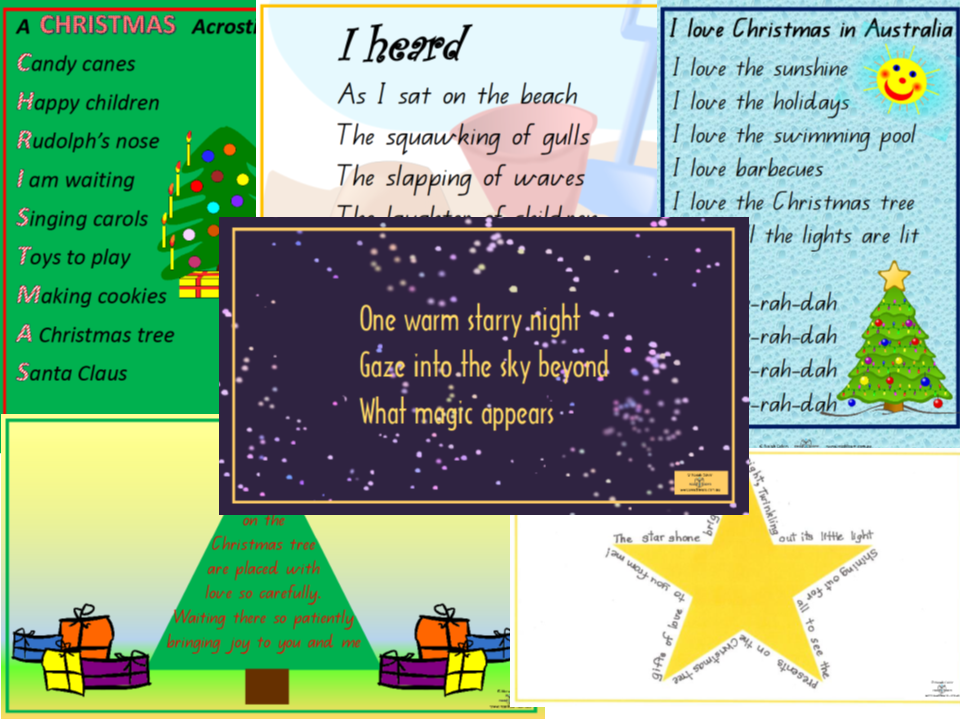
Giving young children a simple structure or a repetitive pattern to start from gets them thinking about words, how they sound, what they mean, the number of syllables and letters. All the while they are having fun, playing with words and sounds, and learning about language.
Five easy poems to write with children are:
Acrostic poems
Sound poems
Haiku
“I love” poems, and
Shape poems
Acrostic poems are one of the easiest. They don’t need to rhyme or follow a set rhythmic pattern.
The latest post from readilearn explains resources for a new board game to play at Halloween.
The game is great for literacy and maths groups, to play with buddies or in family groups. It links literacy, maths and physical activity. Players collect treats and perform actions as they move
On the readilearn blog this week there are 20 quick suggestions for teaching and learning about space in an early childhood classroom, as well as a bookmark that can be printed and given as a gift to a special teacher.
Since its inauguration in 1999, World Space Week has been celebrated each year from 4 to 10 October. Its purpose is to celebrate the “contributions of space science and technology to the betterment of the human condition”. The dates were chosen to commemorate the launch of Sputnik 1 on 4 October 1957 and the Outer Space Treaty signed on 10 October 1967.
This year’s theme is “Remote Sensing: Enabling Our Future” which focuses on the contribution of observations from space to our knowledge of the world, including our ability to
monitor changes in the environment, and
understand and predict weather patterns,
which in turn assists planning for agriculture and helps to prepare for weather events.
World Space Week has a free downloadable Teacher Activity Guide for classes from K – 12. While many of the activities are more suited to older students, there are some that can be adapted for the early grades.
There are no particular requirements for participation. You choose how to involve yourself and your students. Or, better still, introduce the topic to the children and see where their questions and suggestions lead. Contemplating the skies and what lies beyond has excited imaginations since the beginning of human time. Why not give your children the opportunity to wonder, imagine, and create?
If you have neither the flexibility nor the time to explore “space’ in depth, here are a few suggestions for incorporating learning about space in your busy program:
Cover a large display board or wall with dark blue paper. (Each child could paint a piece of A3 paper to contribute to the background.) Add the children’s wonderings, questions, ideas, suggestions, pictures, and writing to the display.
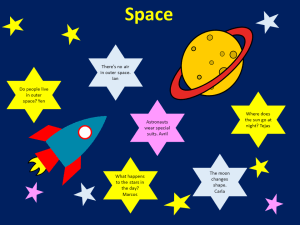
Ask children what they wonder about space, and record their wonderings. Many of their wonderings will match those of philosophers and scientists throughout history; for example, “Yen wonders if people live in outer space. Jan wonders what Earth looks like from space. Margot wonders how long it would take to get to the sun.” This is not a time for answers. It is a time for questions. If children are writers, you could supply them with (star-shaped) sticky notes on which to write their wonderings, one per note. Display the wonderings.
Record what children want to know about space. This is also a time for questions, and not for answers. There will be time for answers later. It is important for children to know that their questions are both valid and valued; for example, “Marcos wants to know what happens to the stars during the day. Tejas wants to know where the sun goes at night.”
Record what children already know, or think they know, about space, space exploration,
Responses to a previous post on the importance of feedback suggested that I trial republishing readilearn posts here. As the suggestion came from a number of people I considered it sound advice and worth trying. As always, I will be interested to hear what you think.
The first day of September marks the first day of spring in Australia. It is also recognised throughout Australia as Wattle Day. The golden wattle is our national floral emblem. Its colours give the recognisable green and gold to our sporting teams.
Like the people of our land, it is a plant that shows both diversity and resilience. There are hundreds of species of wattle growing in many different habitats across Australia. They may be seen growing wild in bush areas and national parks, and cultivated in botanic gardens, on footpaths and in home gardens.
I have three varieties of wattle growing in my garden. Last year, when the plants were one-year-old, they flowered abundantly and were home to ladybirds. It was wonderful to watch each stage of the ladybird’s growth, from egg to adult. This year, the trees were more heavily laden with blossoms, but there were no ladybirds. I was disappointed as I was looking forward to seeing the ladybirds again. However, it has been suggested that the absence of ladybirds may indicate the tree is healthier this year. I don’t know.
In Australia we generally refer to seasons as occurring in particular months:
Spring in September, October, and November
Summer in December, January, and February
Autumn in March, April, and May
Winter in June, July, and August.
However, it is not as simple as that. Australia is a land of extremes, with different climate zones and types of weather experienced across the country. It can be cooler in the summers of southern areas than it is the months called winter in the north. For example, the average January (summer) daytime temperature in Hobart is 21.7⁰C, and the average July (winter) daytime temperature for Darwin is 30.5⁰C.
Spring is a great time for exploring the garden and it’s inhabitants. What is spring like where you are?
Getting to know readilearn resources
Also coinciding with the beginning of spring is the Australian Father’s Day, celebrated on the first Sunday in September. It is a day not just for dads, but for grandfathers, stepfathers, and other male carers and role models. It is a day to let them know how much they are appreciated.
One great way of providing children with a purpose and targeted audience for writing is to get them to make a book for their father figure. I have provided some ideas to get the writing started in the resource How to make a book cover. The resource itself provides step by step instructions for making a cover for a book using complementary colours. The instructions can be displayed on the white board for children to read and follow.
Suggestions for writing include:
A list of statements about their Dad e.g. My Dad goes to work. My Dad makes my breakfast. My Dad has curly hair and a bushy beard. Children write and illustrate one statement on each page.
A recount or memoir about a favourite holiday or activity they do with their Dad.
A series of things about fathers e.g. Some fathers ride motorbikes. Some fathers ride horses. Children finish with a statement about their own dads, for example; But my father rides a skateboard.
A list of things that Dad likes, one to each page.
Five Fabulous books to read for Father’s Day
Guess How Much I Love You by Sam McBratney, illustrated by Anita Jeram
My Dad by Anthony Browne
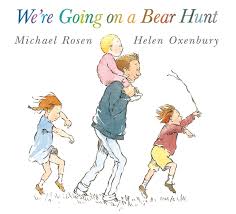
We’re Going on a Bear Hunt by Michael Rosen, illustrated by Helen Oxenbury
Just Me and My Dad by Mercer Mayer
Hey, I Love You by Ian Whybrow, illustrated by Rosie Reeve
Of course, there are many more too.
The readilearn estory The Ice Cream Shop also features an outing with Dad. However, before reading it with your children, decide if you wish to use the interactive covered cloze version with them. If desired, for most effective teaching and learning, the covered cloze should be used prior to any other familiarisation with the story. (You can find information about covered cloze as a teaching strategy here.)
Please contact me if you have any questions. I welcome your feedback, especially suggestions for improvements to existing resources or ideas for new ones.
Remember to use your coupon codes at the checkout to activate your discount. If you can’t see where to enter the coupon code, select “View basket“.
Thank you for reading. I appreciate your feedback. Please share your thoughts.
I have written a few posts recently about requesting help and the difficulty many of us experience in doing so. It’s a topic that is oft repeated. Not only do many have difficulty in asking for help, we are often unsure about when to offer help, how to help, and whether any assistance will be beneficial.
In a comment on one of those posts Anne Goodwin, who blogs at Annecdotal, said that the way our first cries for help are responded to in infancy influences our attitudes to asking for help later in life. I suggest that the way we are responded to when offering to help in those early years also influences our attitudes later.
“Little ones love to help and hate to be helped in almost equal measure. “Let me do it!” and “I can do it myself!” are two frequently heard phrases in households with little ones. Opportunities for both are essential for their developing sense of self, independence and confidence. Both require a great deal of patience on the part of parents and a larger allocation of time than one would normally feel necessary.”
Sometimes, when young children ask, “Can I help?”, parents are reluctant to involve them because of the additional time required, and often the extra effort it takes to clean up the mess that may also be created. However, I recommend that the time and energy expended are more than compensated for by the benefits to the parent-child relationship, as well as to the child’s development of knowledge and skills.
Just as time to play together and read together is factored into the family routine, it is important to set aside time for tasks such as cooking and cleaning that help to develop independence and life skills.
With cleaning, as with other tasks, it is important to provide guidance and encouragement, and to accept the result. Don’t expect the child’s efforts to match yours. You can always finish off the task later, if you must, when the child is out of sight. Expecting too high a standard or being too critical will discourage a child’s willingness to try again.
As at home, in the classroom children can take responsibility for cleaning up after themselves and working together to keep the room organised and tidy on a daily basis. It may take a little longer to establish good habits initially, but the benefits are reaped throughout the year.
When I was in the classroom I provided children with a number of strategies to help them develop organisation skills.
At the beginning of the year I showed them how to organise their belongings in their tidy trays so that they could easily find what they were looking for. I made a photo display to provide visual as well as verbal reminders.
Throughout the day I would play music or transition games to help them move from one activity to another, and to indicate how much time remained until they were to be ready for the next activity.
We had a wonderful programme called You Can Do it! which helped children develop personal and social skills, one of which is organisation. We had a great set of songs to support development of the skills. At the end of each day when it was time to pack up, I would play the organisation song. The children would happily sing along and have the room neat and tidy and themselves ready for home by the time the song ended.
These simple strategies helped the day run smoothly and required a minimum of instructions and reminders.
Cooking, or more specifically food preparation not necessarily requiring heat, in the classroom requires additional planning which will be influenced by the facilities and support available. Whenever possible I organised cooking experiences for small groups with the assistance of an aide or parent volunteer. This gave children more opportunities for discussion and involvement.
Cutting up fruit and making fruit kebabs is suitable for small groups too. Children can be asked to bring in a serve of fruit to contribute to the choices. We used to have a daily mid-morning fruit snack so it did not require any extra effort on the part of parents, just scheduling on my part.
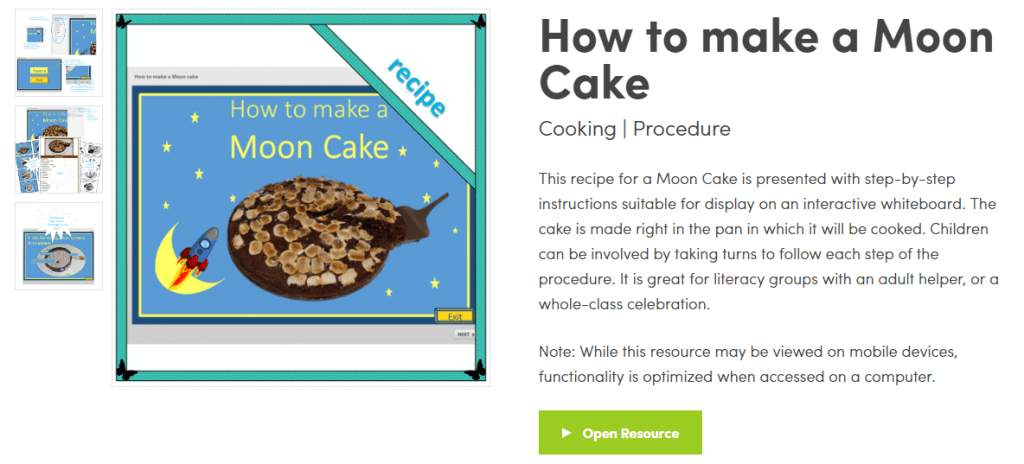
One of my favourite cakes to cook with children is a moon cake. It is both fun to make and delicious to eat, and provides many opportunities for discussion. It is just as suitable for making in the classroom as it is for home. I have prepared a guided recipe which will be available on my readilearn website.
I recently made the recipe with my grandchildren. They were eager to help and took turns to add and mix the ingredients. There are sufficient things to do to give everyone in a small group an opportunity of being involved. However, it is also suitable to do with the whole class observing while individual children do different tasks.
Making the cake provides great opportunities for observing, turn taking, vocabulary development, curiosity, and development of science knowledge. All of these contribute to life skills and experiences. And then there’s the treat at the end!
Although involving children in tasks like cooking and cleaning at home or at school involves extra organisation and time, it is well worth it for the long-term, as well as immediate, benefits.
Do you have any recollections of helping with tasks at home or at school? How did you feel about it? How has it influenced your current attitudes?
Thank you for reading. I appreciate your feedback. Please share your thoughts.
In my previous post Not lost but found I discussed the notion of adopting the title “Founder” when describing my relationship to readilearn my soon-to-launch website of early childhood teaching resources. The title both bemused and amused me at first but I have now accepted its appropriateness. In fact, I realise that readilearn is not the first thing I have founded.
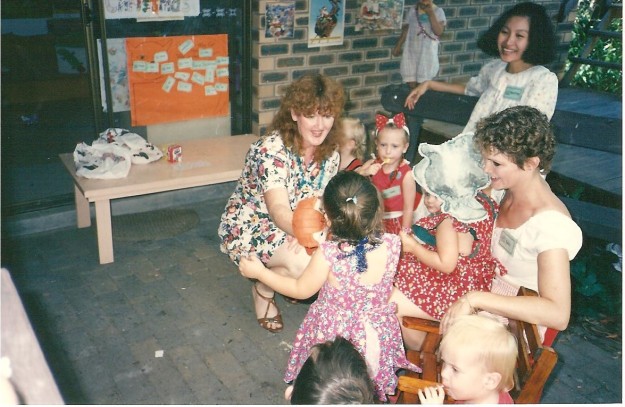
Create-a-Way was perhaps the first that I founded. It was a home-based business offering educational sessions for children of before school-age and their parents. The impetuses for founding Create-a-Way included:
The decision, made before Bec was born, that I would parent and educate her (The alternative to keep teaching the children of others while entrusting her education to another didn’t make sense to me.)
A dissatisfaction with playgroups that were simply bitch and coffee mornings for mums and squabble sessions for children left to their own devices
A realisation that parents didn’t stimulate or foster their children’s intellectual growth because they didn’t know how, not because they didn’t care
I saw a niche that would honour:
My passion for education and need to be doing something in that area
My firm belief in the importance of early years learning
My appreciation of children’s innate curiosity and need to learn coupled with the joy of sharing their sense of wonder and creativity
My certainty in the power of reading and education to improve the lives of individuals and society
A conviction that there are better ways of educating than simply accepting the status quo.
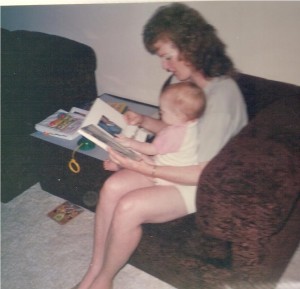
And best of all, I could do it with Bec! (Although she is not in this photo.)
Guiding parents in play sessions for parents and children.
I express this passion and these basic beliefs repeatedly. They are what make me. They are my driving force; the threads that weave their way through everything I do, holding them and me together. They were the basis for my attempt at founding an alternative school; they guided my classroom pedagogy and now the preparation of resources for readilearn.
It’s funny looking back now at the documents I wrote, it seems almost a lifetime ago (well almost all of Bec’s lifetime and more than half of mine), on an Apple IIE computer. I’m still proud of what I offered and truly believe in the value of sessions such as these. However, I can see that, while there has been little change to my passion and beliefs over the years, if I were to do the same thing now I may update some statements to more closely match my current understanding of a growth mindset.
The thought of doing the same again now is not far from my imaginings. The format of Create-A-Way sessions forms the model of another project I would love to found The Early Learning Caravan. Maybe Steven’s suggestion of crowdfunding would be appropriate for getting it started, but that’s not a project for the immediate future.
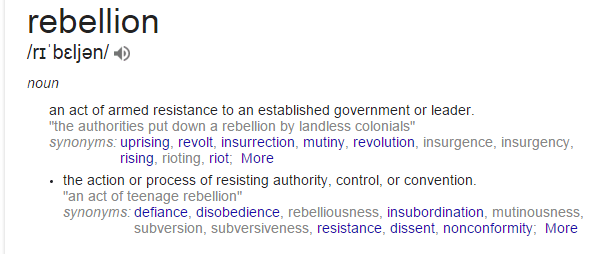
The rebellions of which Charli writes are of a larger scale, more in keeping with the first definition.
In this TED Talk Ken Robinson urges us to Bring on the Learning Revolution making “the case for a radical shift from standardized schools to personalized learning — creating conditions where kids’ natural talents can flourish.” I’m proud to be a rebel fighting in the same revolution as Sir Ken.
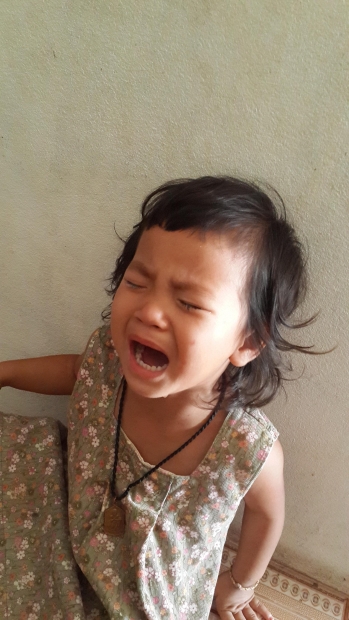
In addition to these larger scale rebellions and revolutions there are many that take place on an individual and daily basis in our families and classrooms, and on our streets. Some of the battles, such as teenage rebellion are fought for justice, independence and identity, a natural and necessary part of growing up. But the need to establish one’s individuality, one’s separateness as a person begins years before that, as anyone who has ever had anything to do with a two-year old can testify.
Sometimes the same battles are played out over and over and parents wonder why the children just don’t accept that they need to clean their teeth, wash their hands, put on their shoes or whatever, rather than battle over it each and every time. It is this early childhood rebellion that has inspired my flash fiction response to Charli’s challenge this week. I hope you enjoy it.
You’re not the boss of me!
Eyes blazed defiance, daring a struggle which could end only in tears and frustration, or a standoff with no real winner. She was ready to flee the moment there was a hint of movement. Our eyes met. I contemplated my options. Did we have to do this now?
Again the challenge: “You’re not the boss of me!”
I pretended to read.
Another volley, quieter: “You’re not the boss of me.”
No response.
Soon she was snuggling beside, pointing to pictures.
I read aloud.
We laughed at the antics.
As I closed the book I said, “Ready? Let’s do this.”
Thank you for reading. I appreciate your feedback. Please share your thoughts.


























 Norah Colvin