The celebration of special occasions such as Easter may bring interruptions to the usual class program with preparation for special events and performances such as Easter Hat Parades. It may also signal time to inject some fun into the program. But involving children in Easter activities doesn’t mean the learning has to stop.
In this post, I explain how using readilearn early childhood teaching resources keeps the children thinking and learning while having fun with Easter-themed resources across curriculum areas. (Note: All readilearn Easter-themed resources can be found here.)
Cultural studies
An inclusive classroom acknowledges all traditions celebrated by its children.
Find out whether Easter is one of the traditions celebrated by the families of children in the class and discuss how it is celebrated.
Providing children with fun and purposeful activities for writing is one of the best ways to encourage a love of writing, to replace the drear with enthusiasm.
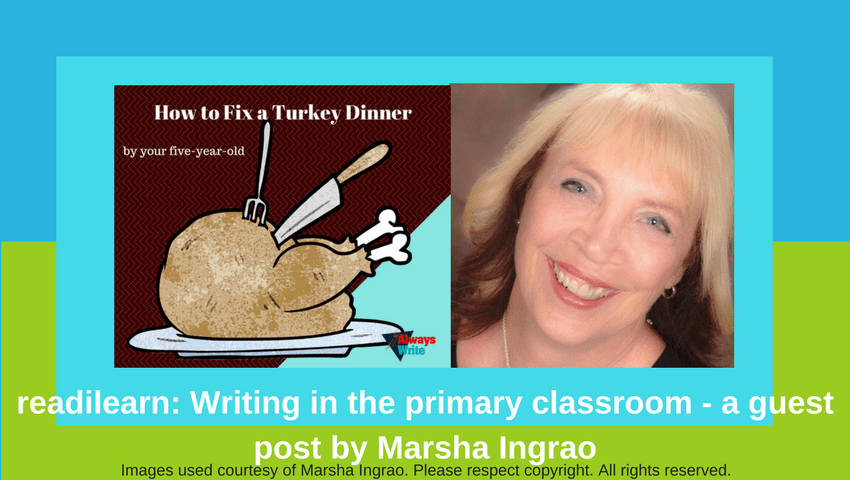
In this post, I introduce guest author Marsha Ingrao who shares suggestions for bringing joy to your writing lessons through the Language Experience Approach.
“The Language Experience Approach (LEA) is a literacy development method that has long been used for early reading development with first language learners…It combines all four language skills: listening, speaking, reading, and writing.”
Although Marsha retired from public education in 2012, her passion for education remains and she continues to educate through blogging, speaking engagements and volunteering for Kiwanis and the Chamber of Commerce. Her classroom experience ranged from teaching kindergarten to fourth grade. She left the classroom to work as a consultant for the county office of education first in math, working with migrant education, then in history and language arts. She is author of Images of America Woodlake, a history of her local Woodlake area, published by Arcadia Press.
Welcome to readilearn, Marsha. Over to you.
Because LEA employs all four branches of language arts, listening, speaking, reading and writing, it is perfect for teaching writing to pre-school and primary students as well. With the thrust in the United States for non-fiction reading, the language experience approach becomes the perfect avenue for teaching writing to young children.
To make the language experience approach applicable to all young students, adult assistance is required.
The “How To” Essay
Beginning in pre-school, we tackled one of the hardest types of writing, the “how to” essay. Holiday traditions are the perfect avenue for this
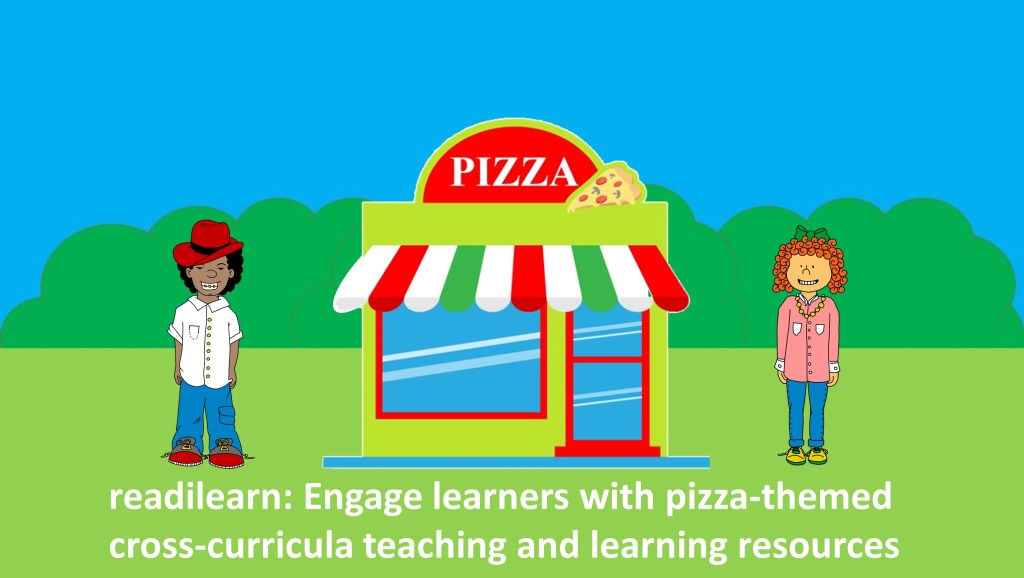
Pizza is a popular food in many countries around the world and is often a children’s favourite. Why not capitalize on children’s interests to make learning fun and meaningful?
This week I have uploaded six new pizza-themed resources with suggestions for learning across the curriculum; including literacy, mathematics, and science.
The new interactive resource What’s on your pizza is a great stimulus for engaging children. Children help Andy and Paige make their own pizza by choosing the toppings and working out the different combinations of toppings that are available. The resource can be used as a springboard for discussion, writing, mathematical investigations, science explorations and talking about healthy food choices.
In this post, I outline some ways pizza-themed learning can be incorporated across the curriculum. I anticipate the suggestions will inspire ideas of your own with relevance to your own group of children.
Literacy
Oral Language
Discussion is one of the best ways of developing children’s language. Starting with topics already familiar to and of interest to children facilities discussion into which new vocabulary and concepts can be added. Discussion could centre around; for example: who likes pizza, types of pizza, when children have pizza and their favourite pizzas.
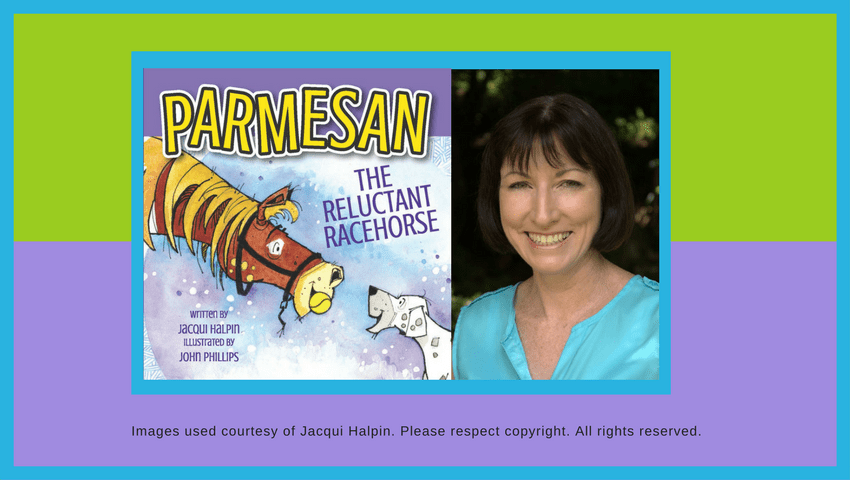
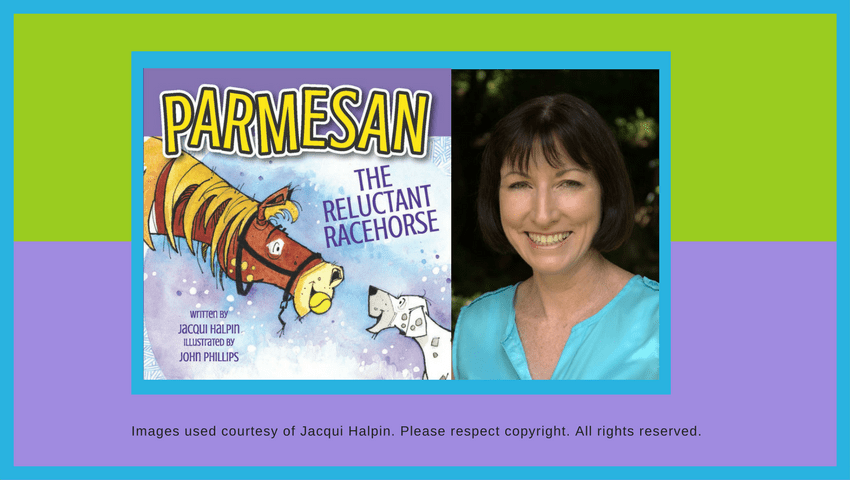
This week, it is my pleasure to introduce you to Jacqui Halpin – author, founding member of Write Links (a local group of published and unpublished authors and illustrators of children’s books), a former nurse and tuckshop convenor.
Jacqui grew up in Brisbane where she still lives with her husband, one of her three adult children, and a cat called Loki. While writing and editing, Jacqui likes to sip tea from fine china and eat copious amounts of chocolate. She says she should never be allowed in a bookshop with a credit card in her possession.
Jacqui writes picture books and short stories, some of which appear in anthologies by Stringybark Publishing and Creative Kids’ Tales. She co-wrote and independently published her elderly father’s memoir, A Long Way from Misery.
Today Jacqui is talking with us about her first picture book Parmesan The Reluctant Racehorse, humorously illustrated by John Phillips and published by Little Pink Dog Books in October 2017. Jacqui’s second picture book, Where’s Lucky?, based on an orphaned swamp wallaby joey at a wildlife shelter, will be published in mid-2019.
Parmesan is a delightful story of a thoroughbred racehorse who should be winning races and earning lots of money for his owner. However, Parmesan thinks he’s a dog. Instead of training with the other horses, he’s off with his doggy friends doing doggy things like playing fetch. His owner is not happy. If Parmesan isn’t ready to run in the Spring Carnival, he’s getting rid of him. Parmesan’s trainer is worried. He knows Parmesan won’t be ready, but as they arrive at the Spring Carnival, he thinks of a brilliant way to get Parmesan to run around the track. Parmesan’s triumph proves you can be a winner and stay true to who you are.
Welcome to readilearn, Jacqui, we are looking forward to getting to know you better.
Thanks for inviting me.
Jacqui, when did you know you wanted to be a writer?
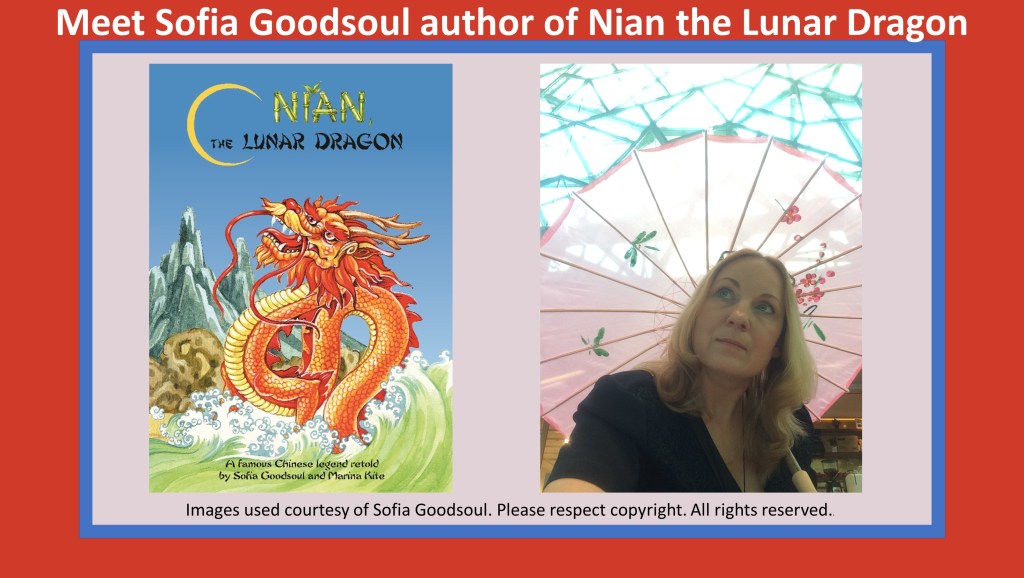
This week I am very excited to be interviewing Australian author Sofia Goodsoul about her picture book Nian the Lunar Dragon, illustrated by Marina Kite. With Multicultural Children’s Book Day coming up on 27 January (see previous post I am Australian) and Chinese New Year on 16 February, the time is just right.
Before we begin the interview, let me provide you with a little information about Sofia.
Sofia Goodsoul is an author, emergency kindergarten teacher and indie-publisher. Her poetry writing has grown from a hobby into a great passion. Now she can’t live a day without writing poems, riddles and stories for young children. The children give themes and inspiration for her books.
Sofia lives in Melbourne with her family and pets. She loves going to Zumba classes and taking long walks with her husband and family dog Mack. Sofia dedicates all her spare time to her writing and publishing career.
Nian the Lunar Dragon, an entertaining and beautifully illustrated rhyming narrative for young readers, is Sofia’s second picture book in collaboration with Marina Kite. The book is about the legend behind the traditions and celebrations of Chinese New Year, sometimes called Lunar New Year. According to the lunar calendar, Chinese New Year commences with the new moon at the beginning of spring.
A long time ago, the dragon named Nian lived in the deep ocean to the east of China. Nian was a strong and ferocious dragon, which no creature could defeat. Once a year, Nian climbed ashore to hunt for cattle and human prey. The people of the nearby villages and towns lived in terror, and each New Year’s Eve they had to leave their homes to save themselves. One day, a monk came to the village. He knew a well-kept secret about how to scare Nian away and free the Chinese people from the danger and their fear.
Welcome to readilearn, Sofia. We are looking forward to getting to know you a little better.
Thanks for inviting me!
Sofia, when did you know you wanted to be a writer?
I don’t remember capturing that specific moment, but my grandmother was a children’s book illustrator and I often stayed with her
Telling stories to and with young children has many benefits. Including other things, it helps to develop:
relationships with the storyteller and other listeners
language – vocabulary, language structure, imagery
understanding of narrative structure as it applies to fiction and non-fiction accounts
curiosity about one’s family, the immediate environment, and other places
empathy for others
interest in books and reading
imagination
There is something very special about telling, as opposed to reading, stories. The telling can be more fluid, more interactive, and change with the mood and with input from teller and listener. The distinction between teller and listener can blur and roles can change as the story flows.
Sometimes it is the routine and the relationships that are more important and more memorable than any one story. For example, a parent telling stories as part of the bedtime ritual, stories told by a visiting grandparent, aunt or uncle, or even stories told in the classroom. Jennie Fitzkee often tells us about the magic effect of her storytelling sessions in her preschool classroom on her blog A Teacher’s Reflections.
What were the dinosaurs like?
Story telling doesn’t require any special talents, or even an especially exciting story. When my daughter was young she would often ask for a story about my childhood. (She loved hearing about the dinosaurs!) Stories such as these can occur at any time during the day, though storytelling times may need to be scheduled in a school day. A special treat for me as a young child was when, after dinner, Dad would sing us the story song asking, “Who made Little Boy Blue?”
I immediately thought of a Grandmother, a storytelling expert, whose boots signified when a magical storytelling session was about to begin. I hope you like where the story leads. In fact, it can lead wherever you wish–
Grandma’s boots
Jess peered out, waiting, hoping, to glimpse Grandma arrive. Rainbow stars exploded outside her window just as the doorbell chimed–missed it again. Disappointment faded as she flung herself into Grandma’s enveloping arms. Grandma’s soft kisses promised secrets through scents of far-off places and unfamiliar things. Grandma’s boots sparkled, announcing story time. Jess and Grandma snuggled into their special chair. Clasping hands, they whispered their story-time chant. The chair shuddered and lifted off the floor. The roof opened and, quick as a wink, Jess and Grandma were whooshing across the sky to somewhere, “Once upon a time and faraway…”
Thank you for reading. I appreciate your feedback. Please share your thoughts.
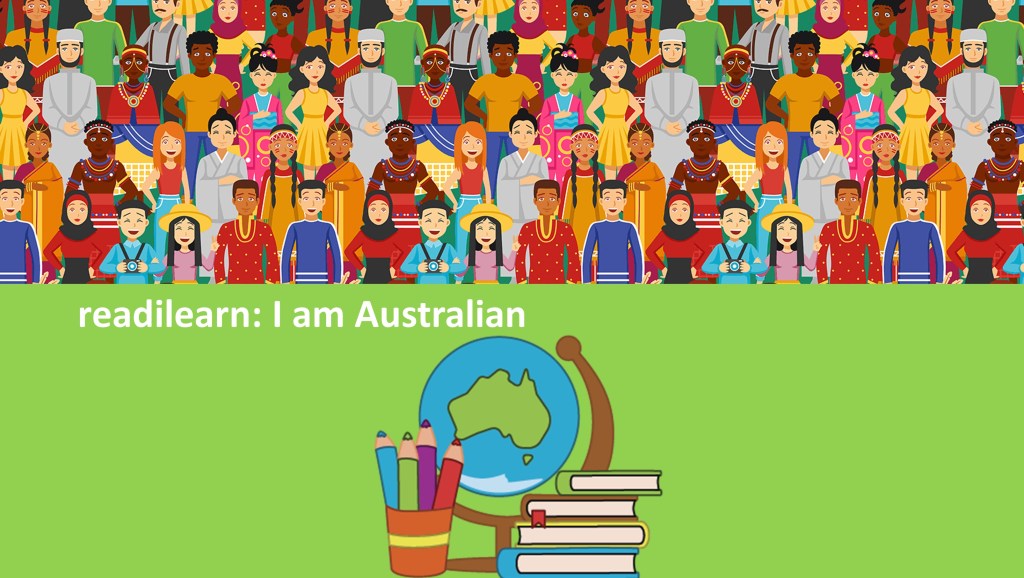
Australia is a continent populated mostly by immigrants or their descendants. According to the Australian Bureau of Statistics, in 2016, the number of Aboriginal and Torres Strait Islander peoples living in Australia was less than 3 per cent of the population. This means that over 97 have ancestors who were born elsewhere, though most will feel the influence of no more than two previous generations and consider themselves firmly Australian. In fact, the number of Australians born overseas is still increasing and was over 28 per cent in 2016.
What this means for teachers in Australia, is that the composition of their classes will include children from a great diversity of cultural backgrounds. Possibly it is the same for you.
This proxy Australian anthem I Am Australian, written by Bruce Woodley and Dobe Newton, is a moving song that honours the diversity of cultures in Australia, from the First Australians to more recent immigrants. It is often sung in schools to help develop an understanding of and appreciation for the richness of the Australian peoples.
It is important to teach children acceptance of and appreciation for each other and their traditions. A supportive classroom will value each child’s contribution and heritage. Getting to know each other at the beginning of a school year provides the perfect opportunity for learning about the traditions of others. However, it can be done at any time of the year.
readilearn resources that assist you do this are: Continue reading.
Establishing a supportive classroom environment from day one builds a strong foundation of positive relationships and attitudes to school and learning. It is important to begin the year as you wish it to continue, and a welcoming classroom helps children and families feel valued. Having an organised classroom is just a part of it.
Many existing readilearn resources support the establishment of a supportive classroom environment.
In many of the schools in which I have worked, children are expected to bring their own set of supplies – books, pencils, scissors, glue, paint shirts, even tissues. I recognise that not all schools have this requirement, so ignore any suggestions that are not relevant to your situation.
Whether children are required to bring their own supplies or not, it is useful to have spares
I loved the addition of the interactive whiteboard to my classroom about ten years ago. I embraced the use of computer technology from when I bought my first home computer in 1985 and first used computers in my classroom in 1986. The interactive whiteboard was a way of making use of the technology inclusive. Instead of one or two children taking a turn on the computer while the rest of the class were engaged in other things, we could all be involved at the same time, if desired.
I used the interactive whiteboard with the whole class for introducing topics, brainstorming ideas and explaining concepts. It was great for modelled writing lessons and collaborative reading. I found it particularly useful for demonstrating the processes to follow in the computer lab.
I used some purchased software, but also spent a lot of time creating activities to teach or practice particular concepts or skills. Versions of many of these lessons are now available here on readilearn.
I’m honoured to once again be featured among Sally Cronin’s Smorgasbord Archive Posts. This time it’s about including Christmas in the classroom. Thank you, Sally. 🙂















 Norah Colvin