Live Love Laugh Learn … Create the possibilities

Tag: Early childhood education

  • What is failure?

    rough-writers-web-comp

    Regular readers of my blog know that for the last eighteen months I have been participating in the flash fiction challenges set by Charli Mills at the Carrot Ranch. Each week Charli posts a prompt and invites readers to submit a response in exactly 99 words. I have participated since the first prompt and have missed only a few, maybe one or two.

    I enjoy the way the prompt stretches both my thinking and my writing. I appreciate the opportunity to engage in fiction as a diversion from the mainly expository writing (and reading) I do; and to engage in a supportive and encouraging group of Rough Writers.

    Since education is the focus of my blog I have given myself the added challenge of targeting an aspect of education in my response to Charli’s prompt. Mostly I have succeeded, though sometimes the posts may be a bit convoluted and the links rather tenuous, but nevertheless, I have been mostly pleased with my ability to find a link.

    This time I didn’t think I was going to do it. While I grappled for a suitable link, none was forthcoming and I thought it was going to be an F, a no-show, this time.

    F

    You see, this week Charli is talking about the destruction caused by forest fires and other catastrophic weather events. Though Australia suffers its share of natural disasters, I am fortunate that I have never been more than inconvenienced by them. I haven’t suffered the loss of family, property and livelihood that others have; nor have I worked in a school where loss was experienced on a large scale. You could say I have lived a sheltered life, and I am grateful for it.

    So without a personal experience to share, my next thoughts were to the curriculum. But I am an early childhood teacher, and young children don’t learn about catastrophic events unless they have a personal experience of them. The Australian Curriculum introduces learning about natural disasters in year six.

    Another dead end. The F was looming. Would it engulf me?

    warszawianka, tango face crying https://openclipart.org/detail/30295/tango-face-crying
    warszawianka, tango face crying https://openclipart.org/detail/30295/tango-face-crying

    Then inspiration! I remembered watching a video in which the possibility of an F being the new A was mooted.  I’m sure you’ve all heard about 60 being the new 40, for example; generally put forward by the 60s rather than the 40s I conjecture. But this was a new twist.

    The article on Mind/Shift How we will learn entitled When Educators Make Space For Play and Passion, Students Develop Purpose introduced me to a Harvard education specialist named Tony Wagner who, like Ken Robinson, advocates for a reinvention of the education system.

    In the video Wagner says that “What the world cares about is not what you know, but what you can do with what you know.” Content is now available through a quick internet search. We don’t need to have instant recall of numerous facts.

    Instead of content, Wagner lists a set of core competencies he considers important. He says that to be lifelong learners and active and informed citizens, the following abilities are required:

    1. To ask questions through critical thinking and problem solving
    2. To work collaboratively
    3. To be flexible and adaptable
    4. To show initiative and be entrepreneurial
    5. To communicate effectively in both oral and written modalities
    6. To access and analyse information
    7. To be curious and imaginative

    I agree that each of these attributes is important. I think I have mentioned many of them in previous posts.

    Wagner goes on to say that what is needed is innovation: the ability to generate new and better ideas that can be used to solve the problems facing us today. He questions whether America’s reputation as a leader in innovation is as a result of or despite the education system. He then asks the audience to identify what the following four people have in common.

    Bill Gates (Microsoft)

    Edwin Land (Polaroid camera)

    Mark Zuckerberg (Facebook)

    Bonnie Raitt (folk singer)

    Did you, like the audience, think them to be dropouts? Wagner identified them as not just dropouts; they were Harvard College dropouts! Steve Jobs (Apple) and Michael Dell (Dell computers) were dropouts.

    This fact about innovative dropouts inspired Wagner to investigate conditions that encourage the development of innovators. He interviewed many young innovators, asking if there had been an influential teacher or mentor in their lives. While not many could name one, those identified were outliers, engaging students in teamwork and interdisciplinary work involving problem solving and risk taking.

    Wagner also interviewed people from innovative organisations such as IDEO, whose motto he quoted: “Fail early and fail often.” (“That’s because there is no innovation without trial and error.”) It was from a think tank at Stanford that the idea that an “F is the new A” came.

    F is the new A

    There are iterations, not failure, Wagner says, and he questions the way parents and teachers try to protect children from making mistakes saying that real self-confidence was only to be gained from learning that you could recover and learn from mistakes.

    Tony Wagner - iterations

    So perhaps in thinking about failure, I haven’t really failed. I’m learning. It is only to be hoped that the failures in fire management that Charli talks about in her post lead to improved management practices in the future.

    For my response to Charli’s prompt, to  in 99 words (no more, no less) write a story about the need for help in an extreme weather event, I have chosen a weaker BOTS (based on a true story) from my childhood. The link may be tenuous but hopefully not entirely non-existent. I hope you enjoy it.

    Storm

    A big storm was coming. Two older ones were put in charge of two younger ones. They sat at the fence, watching. Soon other neighbourhood kids gathered, sharing storm stories, waiting.

    Green clouds swirled as dark clouds played leapfrog races above. The children watched the storm rush closer; mesmerised by its beauty, mindful of its power.

    Soon the winds whipped up, chasing the other kids home. The older two called to the younger, but they were nowhere to be seen. Mortified they hurried inside to alert their parents.

    What relief. They were already in, telling of the storm’s approach.

    Thank you

    Thank you for reading. I appreciate your feedback. Please share your thoughts about any aspect of this post or flash fiction.

  • The expectation of labels


    1 (5)

    In some circles labels can be used as an attempt to define who you are, either to yourself or to others; for example the car you drive, the clothes you wear, the foods you eat, the technology you use, even the books you read. The use of labels can lead to stereotyping and expectations based upon particular characteristics while other, and equally salient, qualities specific to the individual are ignored.

    Applying labels to children can serve similar purposes: to define and explain particular behaviours or characteristics. Labels can range from an informal “naughty” through to medical diagnoses such as ADHD (Attention Deficit Hyperactivity Disorder) or ODD (Oppositional Defiant Disorder).

    Whether the result of an informal observation or a professional assessment, labels can have a profound effect upon a child and family members. The label sets up expectations that may limit the way the child is viewed; so that only those characteristics specific to the label are noticed and responded to. The child is viewed as being “the label” rather than an individual who displays those particular behaviours or characteristics, at this moment.

    People tend to see what they want to see and ignore evidence that doesn’t support their thinking. So if a child is labelled disruptive, it is the disruptive behaviour which is noticed and acted upon. Similar behaviour in a child not bearing the label may be overlooked or excused. While the focus is on one, usually negative or limiting, behaviour other positive characteristics and strengths may be ignored.

    pygmalion effect

    Unfortunately, once a label is applied it is often difficult to remove and it may be used as an excuse for a child’s failure to learn or progress; after all the “fault” is considered to be with the child, not with any methods used or not used. Sadly too, labels can be misapplied or not fully understood. This may accentuate differences that are non-existent or less serious than the label implies.

    However not all effects are negative. There are many positive effects of labelling a child’s condition or behaviour; including:

    • increased opportunities for the child, family and teachers to receive support through funding of programs, assistance of trained personnel and professional development
    • enhanced understanding through discussions using a common language with specific meanings and applications
    • increased awareness in the community with further opportunities for advocacy as well as greater acceptance and tolerance
    • the development of programs aimed specifically to support individuals with the condition.
    rg 1024, gift https://openclipart.org/detail/31159/gift
    rg 1024, gift https://openclipart.org/detail/31159/gift

    But are all labels negative? What about giftedness?

    Previously on this blog there has been some discussion about praise and the effects of different types of praise. The discussions were initiated in response to The Examined Life by Stephen Grosz and can be found here and here. Grosz suggested that praising a child could cause a loss of competence. Why would you continue to try if you were already “the best”?

    Claudia M. Mueller and Carol S. Dweck support the notion that Praise for Intelligence Can Undermine Children’s Motivation and Performance. They suggest that labels such as “smart”, “clever” and “intelligent” can be just as damaging as those with deficit connotations.

    Dweck explains her ideas more fully in Mindset: The New Psychology of Success, my current audiobook “read”. I have previously mentioned Dweck’s theory of ‘yethere and here.

    In the book Dweck talks about how praise creates mindset. If one is praised for being smart or clever, then one develops a fixed mindset: “I am smart. I can achieve because I am smart.” If effort is required then one is not smart. Those with a fixed mindset avoid challenges that might jeopardise the view of themselves as smart.

    On the other hand, praise for effort encourages a ‘yet’ or growth mindset: if I try it again, try harder, try it a different way, then I will do better. “I can learn”. There is no risk of becoming ‘not clever’. A growth mindset recognises the importance of effort, persistence and motivation.

    fixed - growth mindset

    Dweck says “don’t praise the genius – praise the process”.

    Giftedness” is a label that was once applied after achieving a high result on an intelligence test, and was just as sticky as any other: there for life.  Giftedness was considered stable and unchangeable. It is obvious that many “gifted” students could fall into the fixed mindset trap. Thanks to Dweck’s work on mindset, attitudes to IQ scores and the concept of “giftedness” are now changing.

    Teachers with a growth mindset appreciate the incremental

    Students can be encouraged to develop a growth mindset by learning about how the brain works. When they understand that labels aren’t fixed and that learning can be improved, they will become more confident and may find more enjoyment in some of the challenges that school offers. Encouraging students to recognise how they view themselves as learners and to substitute “growth” for “fixed” thinking will have a remarkable effect upon their confidence and success.

    Encouraging this growth mindset may be one way we can look out for each other, one way of “getting your back”.

    To write a story (in 99 words, no more no less) about a character who is called to have the back of another was the challenge set by Charli Mills at the Carrot Ranch this week. In her post Charli is talking about labels of another kind, labels that can be just as damaging or just as useful. She talks about having another’s back, being there to offer support when needed.  A parent, a teacher, a friend can be there at any time to offer support for a learner on their path to discovery. My response captures one such moment.

    Growth: a mindset

    Marnie propped her head on one hand while the pencil in the other faintly scratched the paper. She hoped it wasn’t too obvious that she didn’t get it. But she didn’t get it. She didn’t get last year, or the year before. Why should she get it now? What was the point? Her brain just didn’t work that way. She was dumb. They had always said she was dumb. No point in trying.

    Then the teacher was there, encouraging, supporting, accepting. “Let me help you,” she said. “You can do this. Let’s break it down into steps. First …”

    Thank you

    Thank you for reading. I appreciate your feedback. Please share your thoughts about any aspect of this post or flash fiction.

  • Hear ye! Hear ye! Read all about it!

    asco Soares, Jornal News, https://openclipart.org/detail/183225/jornal-news
    asco Soares, Jornal News, https://openclipart.org/detail/183225/jornal-news

    This week over at the Carrot Ranch Charli Mills challenged writers to In 99 words (no more, no less) write a story that is ripped from the headlines. Look at local, regional or global news.

    Now if there is one thing I have noticed about “the news” over the years, it’s that the news reported in the media is generally bad. Often the stories are meant to alarm or frighten. I think it must be easier to control a population through fear. A little scaremongering may go a long way.

    Although the song is called It’s Good News Week, it doesn’t have much good news to tell.

    I selected a few headlines (expressly for my purpose) from a recent Conversation:

    • The role of water in Australia’s uncertain future
    • The scariest part of climate change isn’t what we know, but what we don’t
    • Stop, go back, the NDIS board shake-up is going the wrong way
    • We’re overdosing on medicine – it’s time to embrace life’s uncertainty
    • Australians less likely to survive home ownership than Britons

    “They” can do it with Education too:

    • Is your child less likely to be bullied in a private school?
    • Uni drop-out rates show need for more support, not capped enrolments
    • The slide of academic standards in Australia: a cautionary tale
    • The absurdity of English spelling and why we’re stuck with it

    F

    All of these headlines state the existence of a situation or condition as irrefutable, like falling standards and failing students. I’m sure most of you will be familiar with headlines such as this one from the Conversation nearly two years ago:

    Lost for words: why the best literacy approaches are not reaching the classroom

    In this article Misty Adoniou attributes the failure of some Australian children on national and international literacy tests to their lack of exposure and experience with standard English – they do not speak standard or “school” English at home. Adoniou says that is up to teachers to improve the language used by students and to make their understanding of correct usage explicit. However she says that many teachers do not have an explicit understanding of English and, as a result, are unable to teach it to their students.


    SnipsandClips, Teacher and Child https://openclipart.org/detail/205589/teacher-and-child
    SnipsandClips, Teacher and Child https://openclipart.org/detail/205589/teacher-and-child

    I’m not sure how true that statement is. However, what I do like about this article is the advice Adoniou gives about teaching. She says that “all our teaching about language must be done in context and in the course of achieving real outcomes.” I couldn’t agree more.

    Daily news – learning in context

    In fact, from their first weeks of school I was explicitly teaching students about language and literacy using a strategy I borrowed and developed from the ubiquitous “show and tell”. I called this strategy simply “News”, and found it to be a powerful tool for teaching the skills of both reading and writing.

    Its strength came from the familiar context, the connection to children’s lives and the importance it placed upon them. The teaching could be adjusted to suit different stages of development, to reinforce learning for some and extend the learning of others. For me, as teacher, it was a powerful learning tool. I was able to gauge children’s developing strategies, understand their needs and identify next steps for learning.

    How it worked

    Talk

    A few children each day would have the opportunity to share their item of interest or “news” with the class. Class mates could ask for additional information or clarification if they wished.

    Compose

    We (teacher and children) would collaboratively compose a report, initially just one or two sentences, of what had been shared.

    Write

    I would model the composition and the writing process, rehearsing what to write while involving children in thinking about what to write and how to write it. How much they were involved, and the detail of language and skills discussed could be easily adjusted to suit their development.  There was always ample practice and repetition, in a meaningful context, for children who needed more time; and discussion of strategies and ideas to extend the most advanced students.

    Some of the writing strategies children were learning include:

    • Composition or rehearsal before writing
    • Directionality of writing
    • Translating conversational language into written language
    • Changing first person spoken text into third person written text
    • Identifying letters used to spell the sounds of language
    • Awareness of punctuation
    • Tenses, past and future, depending on what the children shared
    • Rereading to ensure message is correct and what to write next
    • Proofreading and editing
    • Identifying the main idea through choosing a suitable headline

    Read

    After the news was written, we would read it together to ensure it was correct and the child was happy with the way the news had been reported.

    The text could then be used for developing a number of reading skills, for example:

    • Recognising words by sight
    • Noticing similarities in spellings, or differences in spelling of words with similar sounds
    • Punctuation and its effect on reading
    • Comprehension and grammar: who, what, where, when, and (sometimes) why
    • Reading with expression

    Share

    Each day I would print up the news for the children to take home to share with their family. It was a great first reading experience – about them, their friends and their families.

    While this is only a brief overview of the strategy, the learning that can take place using children’s own language is obvious. Used as one small part of a rich literacy focused and literature-based classroom environment it is a powerful teaching tool. One day I will explain the strategy in detail so that others can use it too.

    Flash fiction

    But back to the headlines and Charli’s challenge.

    Over recent years I have noticed an increased use of ambiguity in headlines and the introduction of (attempted) literary expressions into the body of articles. I have drawn on that for my flash. I hope it works.


    Bridge plans in jeopardy

    She scrolled through the headlines, searching …

    Minister passes over bridge in favour of tunnel

    Minister fails to dig himself out of tunnel fiasco

    searching …

    Minister reveals hand on bridge impasse

    Minister’s tunnel vision blocks bridge improvement

    searching …

    Minister jumps from bridge over tunnel plans

    Talks with Minister over bridge collapse

    searching …

    Bridge closure forces Minister’s hand

    She was sure she had heard something … it must be here … why couldn’t she see it?

    Scrolling … scrolling …

    “Finally,” she sighed.

    Bridge players wanted, Tunnel Street Community Hall, Wednesdays 10 am!


    A Day in the Life

    Thank you

    Thank you for reading. I appreciate your feedback. Please share your thoughts about any aspect of this post or flash fiction.

  • Experiential learning – what’s good and what’s hot

    farm

    I am a proponent of learning by experience, of learning through one’s own explorations and making one’s own discoveries. In early childhood centres it is sometimes called ‘hands on’ learning. The recommendation is to provide opportunities for children to learn by doing rather than simply by listening to someone tell about it or by reading information in a book. For example, experiencing the sights, smells and sounds of a farm create an enriched understanding of farm life that is not possible simply from looking at pictures of farm animals in a caption book. Activities like mixing and making with modelling dough, or building and creating with construction sets provide opportunities for developing numerous skills and understandings.

    That’s not to say that experiential learning is best in every situation or that learning from the explanations of others, including reading information in a book, is less worthy. Indeed there is a place for each and it is important to get the balance, timing and application right. You would not need to view many posts on my blog (for example here and here) to realise that I am a proponent of reading also and believe that instilling a love of reading is one of the greatest gifts a parent can give a child.

    In their book A New Culture of Learning: Cultivating the Imagination for a World of Constant Change, Douglas Thomas and John Seely Brown discuss the differences between explicit knowledge and tacit knowledge.  This chart shows my understanding of some of the differences.

    Explicit and tacit learning


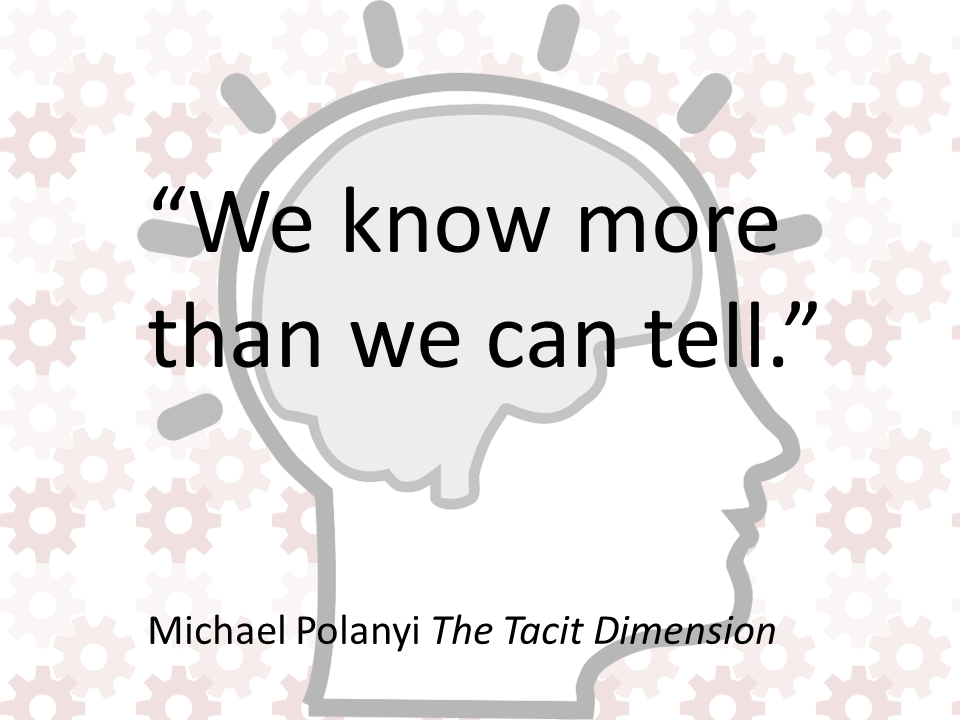
    Michael Polanyi  The Tacit Dimension

    I think it would be undisputed that there is knowledge best learned through explicit instruction and other best learned through experience. I am sure you can think of many examples in your own life, like riding a bicycle, learning a foreign language or playing a musical instrument.

    netalloy, glossy flame https://openclipart.org/detail/91951/glossy-flame
    netalloy, glossy flame https://openclipart.org/detail/91951/glossy-flame

    But what about teaching young children about heat? It is not far into the life of any young child that they are cautioned about the heat of an oven or stove, heater or barbecue plate. But what is “hot” if you have never experienced it?

    Thomas and Brown say that “when a parent first tells a child not to touch a flame because it is hot, the child will almost always put out her hand and get burned” because the child has only been given the explicit part of the information, the part that could be articulated: that “Fire is hot”. When the child is burned much more information is learned by the body: that it hurts and is unpleasant. The child is then able to make connections with other similar “hot” things and situations.

    I think neither of the authors nor any parent would suggest a child be burned “for educational purposes” but the power of experience can be seen in this example. Perhaps it also helps to explain why young children need constant reminders to stay away, or precautions need to be taken to protect them, from hot things. Without the burning sensation they have not formed a true understanding.

    thomas and brown - learning

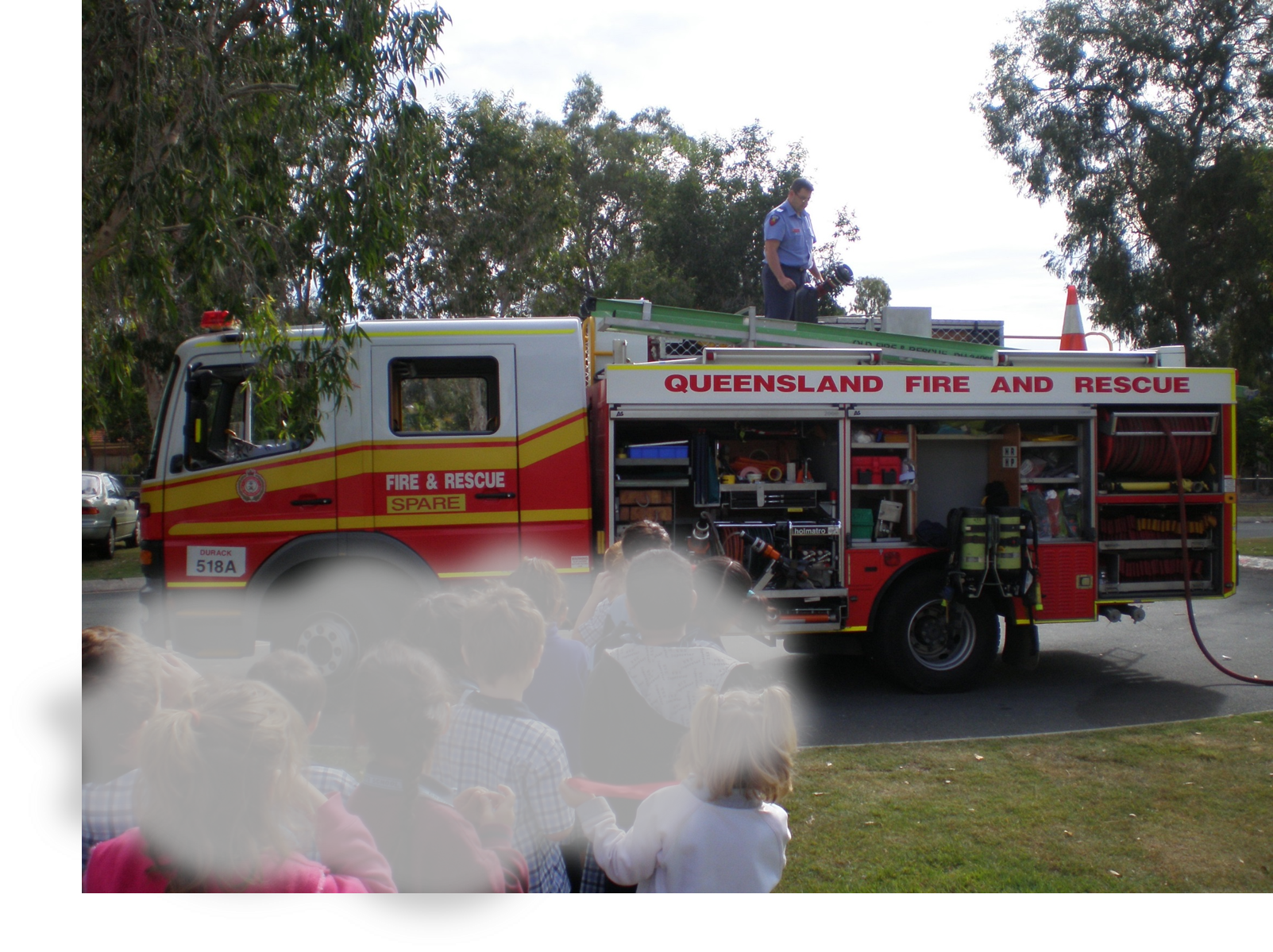
    At my previous school our year one classes were always visited by the local fire fighters who talked about fire safety, explaining the difference between “good” fires (like birthday candles, barbecues and campfires) and “bad” fires, while warning that even good fires could quickly become bad  if not monitored correctly.

    They talked about the need for smoke alarms in the home and the importance of having escape routes and meeting places planned and practised. They ensured students knew their full name and address and the procedure for calling emergency (000 in Australia) if the need should arise. These are things that all young children should know.

    firetruck

    The children were always excited about the firefighters’ visit as they got to look at the firetruck close up, maybe even sit in it or, if they were lucky, see how high they could spray water with the large hose. The tacit knowledge learned through this type of experience, combined with explicit knowledge provides a context that allows children to learn the realities of fire danger and the importance of safety. It wasn’t unusual for the crew to receive a call and rush away during one of their visits, adding further to the overall experience for the children.

    rg1924, unexpected frog in my tea    https://openclipart.org/detail/21079/unexpected-frog-in-my-tea
    rg1924, unexpected frog in my tea https://openclipart.org/detail/21079/unexpected-frog-in-my-tea

    Thinking about heat and education, and the hold that explicit knowledge and its testing has on current practice makes me think of the story about a frog in a pot of hot water.

    The story says that if you were to put a frog into a pot of hot water, it would jump out immediately; but that if you were to put the frog into a pot of cold water which is warmed slowly, the gradual increase in temperature wouldn’t be noticed and the frog would be boiled alive.

    Perhaps this is why some educational practices are accepted without question. People have become so used to them, with small incremental changes seeming insignificant and unworthy of comment. However the cumulative effects over time can be enormous. By the time they are realised, making amends would require so great a change, possibly a total restructuring, that it would defy plausibility.

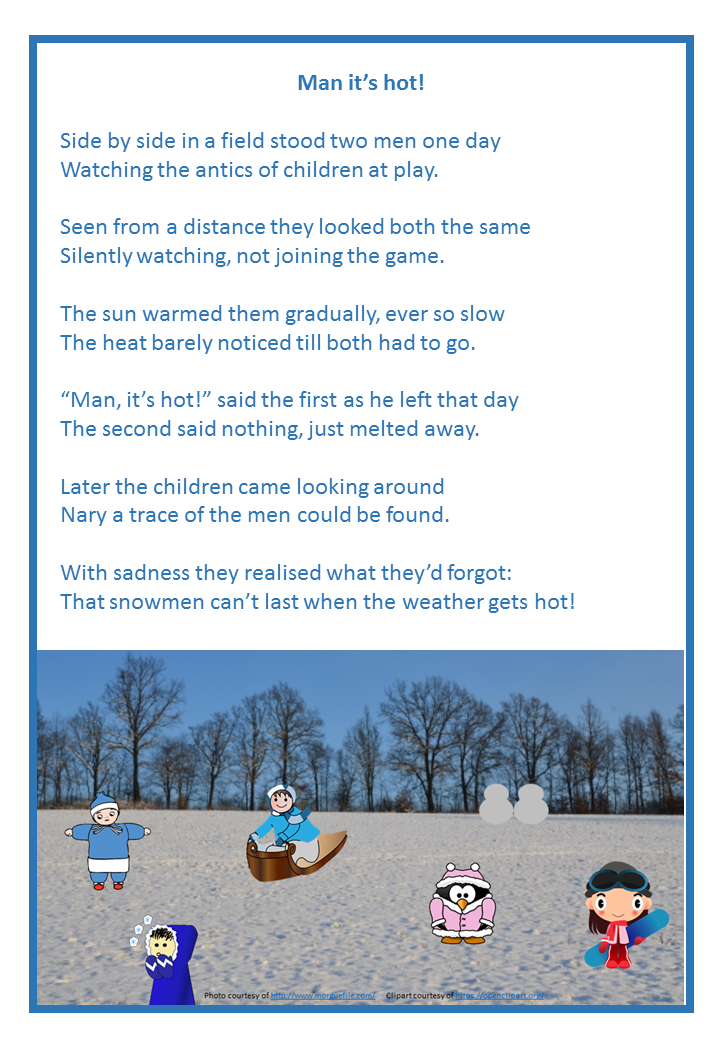
    It is this thinking that has led to me my flash response to the challenge set by Charli Mills at the Carrot Ranch this week to In 99 words (no more, no less) write a story that includes the phrase, “Man, it’s a hot one.” I hope my contribution is a little more environmentally friendly and suitable for young children than boiling frogs.

    Man it's hot

    Thank you

    Thank you for reading. I appreciate your feedback. Please share your thoughts about any aspect of this post or flash fiction.


  • Five Photos Five Stories — Day four

    Back to Day one (books) and introduction to the challenge

    Back to Day two (writing)

    Back to Day three (Break out)

    My retirement jetski

    My retirement jetski
    My retirement jetski

    Geoff Le Pard threw me a challenge to post five photos and five stories over five days. He is probably just as surprised as I am that I took him up on it, especially as this week is particularly busy and significant.

    Tomorrow I finally break up with a relationship that has been on-again-off-again for over forty years. Tomorrow is my last day working for Education Queensland. While I then become “officially” retired, some of you may know that I am not very fond of that “R” word and prefer to think of my life as taking a redirection.

    In a couple of weeks’ time I commence another part-time job at the University of Queensland with the exact number of hours for me to remain “officially” retired, but nominally “working part-time”. The remainder of the week I will continue to write and work towards fulfilling my goal of establishing an online store of educational resources. This is where the jetski comes in.

    There are many expenses involved with preparing content for the website including getting work illustrated, having the website designed and, hopefully, if I can figure out a way, having interactivity added to some resources. Deciding how much cost is acceptable is difficult when there is no guarantee of ever getting any return, and often the time I spend tapping away on my computer keyboard when I could be doing other things comes into question.

    The fact is I love tapping away on my computer keyboard writing works of my choosing, and the expenses involved are necessary in order to make my “creations” available to others through a website. If I were to choose a jetski, a sports car or an around the world cruise as a retirement gift for myself, as many do, and spend hours each day riding the waves or the roads, no one would question my choice of activity or the cost of the initial purchase or ongoing maintenance. They would be pleased that I was having fun, enjoying my later years. Well, for the moment at least, writing is my pleasure and I (try to) justify the expense by calling it my “jetski”.

    As my work targets an early childhood market, illustrations are an essential accompaniment to my work. When I first registered my business and domain name, my (graphic designer) niece designed my logo and beautiful banner, which you see at the top of my blog, and produced illustrations for some stories. Recently I have had other illustrations done by artists from 99designs so I am starting to make headway in that direction.

    Kari Jones (ArtbyJonz), who did the S.M.A.G. badge has produced illustrations for two stories. Here is a sneak peek at one illustration from each:

    ArtbyJonz ©Norah Colvin 2015
    ArtbyJonz ©Norah Colvin 2015
    ArtbyJonz ©Norah Colvin 2015
    ArtbyJonz ©Norah Colvin 2015


    and sneak peeks of illustrations for stories by Sketcherlady, Goetia and Tyohermawan, to whom I awarded the first contest.

    sketcherlady ©Norah Colvin 2015
    sketcherlady ©Norah Colvin 2015
    Goetia ©Norah Colvin 2015
    Goetia ©Norah Colvin 2015
    tyohermawan ©Norah Colvin 2015
    tyohermawan ©Norah Colvin 2015

    I have been very happy working with each of these designers. They have all been very helpful and accommodating and worked hard to produce illustrations to match my requests. I am happy to recommend any of them if you are looking at getting some work illustrated.

    The next step is to speak with a web designer. I must say I’m a bit fearful of the cost, but hey, it’s my jetski.

    What seems to be more problematic at the moment is adding interactivity to some resources. PowerPoint has some facility but not enough. I looked at another program recently which promised any interactivity I could imagine. But unfortunately the program designers had not imagined what I had! I discussed some of my requirements with a friend who is learning to code and he thought it would even be difficult to code what I want. Since these open-ended interactions are to be a point of difference for me, if I can’t have them, I may need to trade-in my jetski on something completely different. Maybe a novel? (That must be pretty easy, eh Geoff?) I’m not sure I’m ready for that. If you have any suggestions about adding interactivity to resources I’d love to receive them please.

    I nominate my lovely fellow local Queensland bloggers to take up this Five Photos Five Stories challenge should they so wish:

    Irene Waters who writes memoir and blogs at Reflections and Nightmares and already shares many beautiful photos and stories;

    Desley Jane, a girl with a camera who blogs at Musings of a Frequent Flying Scientist; and

    Marigold Dicer who blogs at Versus Blurb but who has popped off the scene temporarily while she completes what used to be called “prac” teaching when I went to college.

    Please be aware that your participation is completely voluntary. I know each of you already post frequent photo stories. However if you choose to participate, I hope you enjoy the challenge as much as I have. 🙂

    The “rules” of the Five Photos, Five Stories Challenge are:

    1) Post a photo each day for five consecutive days.
    2) Attach a story to the photo. It can be fiction, non-fiction, poetry, or a short paragraph. It’s entirely up to the individual.
    3) Nominate another blogger to carry on the challenge. Your nominee is free to accept or decline the invitation. This is fun, not a command performance!

    Thank you

    Thank you for reading. I appreciate your feedback. Please share your thoughts.


  • Revisiting The Very Hungry Caterpillar

    Recently, in a post introducing the idea of S.M.A.G. (Society of Mutual Admiration and Gratitude), I reflected upon my blogging journey and the gradual growth of readership and development of a S.M.A.G. over time. With this reflection came the realisation that many have missed earlier posts. That realisation, along with a comment by Sarah Brentyn, prompted me to share a few of my favourites.

    The Very Hungry Caterpillar

    The first posts I will revisit are from a series about using Eric Carle’s picture book The Very Hungry Caterpillar for educational purposes in an early childhood setting.

    The series of four posts;

    • explores benefits of reading picture books to children
    • questions the place of factual information in fictional texts, and
    • suggests the importance of teaching critical literacy from a young age.

    Nor and Bec reading

    I will provide a brief overview of each post. I would be delighted to have you  follow the links to read the posts in full.

    Searching for meaning in a picture book — Part A

    In this post I explained that sharing picture books with children has many benefits, including:

    At home:

    • It can help strengthen the parent-child bond, becoming a special time of togetherness and of sharing stories and ideas.
    • It has a very positive effect upon their learning, helping them develop language, knowledge of print and books, and exposes them to new ideas and concepts.

    8-12-2013 7-38-33 PM

    In early childhood classrooms, The Very Hungry Caterpillar provides opportunities for work in many subject areas including:

    • Literature appreciation
    • Reading
    • Maths
    • Visual arts, and
    • Philosophical inquiry, but not Science (as I will explain later)


    Searching for purpose in a picture book – Part B

    In this post I discuss some purposes for using picture books and raise some questions about their content.

    A sampling of purposes:

    • encourages a love of reading and books
    • develops vocabulary and knowledge of language
    • provides a link between the language of home and the language used in the wider community and in education
    • supports beginning readers
    • inspires imagination
    • provides opportunities to discuss feelings, emotions, ideas, responses
    • develops feelings of empathy, identification, recognition, hope
    • instils an appreciation of art

    spiderswirl2

    Some questions:

    Do fictional picture books have a role, and do picture book authors have a responsibility, in imparting factual information in their books?

    Does it matter:

    • that, although lions don’t live in jungles, they are often referred to as “King of the jungle” and appears in that setting in many stories?
    • if animals that don’t co-exist, for example penguins and polar bears, appear in stories together?
    • if the portrayal of animals in stories is not anatomically correct, for example spiders shown with legs joined to their abdomens rather than cephalothoraxes?

    Do errors such as these influence children’s understanding of the world?

    How should adults handle the misinformation when sharing books with children?


    Searching for truth in a picture book – Part C

    In this post I refer specifically to inaccuracies in The Very Hungry Caterpillar and the pervasiveness of the misconceptions, if not totally attributable to the book, then at least in part. I suggest how acknowledging the inaccuracy can help develop critical literacy.

    In his book Eric Carle writes that

    “He (the caterpillar) built a small house, called a cocoon, around himself. He stayed inside for more than two weeks. Then he nibbled a hole in the cocoon, pushed his way out and . . . he was a beautiful butterfly!”

    Monarch butterfly

    However, as this (hopefully correct) information from the Australian Museum shows, butterflies do not spin cocoons around themselves. Moths do. Some butterflies and skippers do form a silken shelter, but not a cocoon as in Carle’s picture book.

    Unfortunately many articles found in an internet search share the same misinformation. I wonder how many adults grew up believing what Carle shared through his picture books. Even teachers have been surprised to learn that butterfly caterpillars do not spin cocoons.

    In the original post I share some lovely videos related to butterfly and moth metamorphosis. It is worth taking a peek at them.

    Does it matter if children (and adults) think that butterflies hatch out of cocoons? Eric Carle didn’t seem to think so. Do you?

    Finding power in a picture book – the main event

    In this post I argue that The Very Hungry Caterpillar has no place in a science lesson because of the misinformation contained therein: caterpillars do not eat many different foods and butterflies do not come out of cocoons.

    ryanlerch_thinkingboy_outline

    The greatest value of the book is as a tool for teaching critical literacy; for teaching children that just because something is in print, doesn’t make it true. It is also important to realise that misinformation is not restricted to picture books, and that they need to question all sources of information for the author’s credentials and purpose in writing.

    I suggest that teachers and parents:

    • point out inaccuracies and inconsistencies
    • encourage children to evaluate what they are reading and hearing against what they already know
    • support children to verify the source of the information and to check it against other more authoritative/reliable sources
    • help children to recognise that every author has a purpose and to identify that purpose
    • invite children to ask questions about what they are reading and to interrogate the content
    • encourage them to question, question, question.

    Eric Carle says “If we can accept giants tied down by dwarfs, genies in bottles, and knights who attack windmills, why can’t a caterpillar (sic) come out of a cocoon?”


    What do you think? Do picture book authors have a responsibility to be accurate? Is a butterfly coming out of a cocoon in the same realm as giants tied down by dwarfs? Would we accept a child hatching out of an egg? What parts of a story should be based in reality and which parts can be imagined?

     “Why can’t a butterfly come out of a cocoon?” asks Eric.

    Well, Eric, they just don’t.

    Thank you

    Thank you for reading. I appreciate your feedback. Please share your thoughts about any of issues I have raised in these posts.


  • Playing with possibilities

    127

    Creating an environment which nurtures children’s learning and development is as important as creating an environment that nourishes and encourages the growth of plants in a garden. The link between the two was first recognised by Froebel in the early 19th century when he coined the term “kindergarten” which translates to “garden for children” (kinder meaning child and garten meaning garden), and created the first educational toys.

    Froebel “devoted his life to educating children and developing methods to maximize human potential”. He was the first to recognise the importance of a child’s early years (birth to three) and considered creativity to be something in all of us.

    Froebel’s kindergartens were the first “formal” education for young children and his work greatly influenced that of other educators such as Maria Montessori and Rudolf Steiner. His beliefs, for example that children have both unique needs and capabilities are still influential today. He believed in the importance of play and some of his toys were favourites of people such as Buckminster Fuller and Albert Einstein.

    I have touched on the topics of play, creativity and children’s uniqueness in previous posts. A respectful, encouraging, nurturing and stimulating environment underpins all that I value in education; as does a belief in the power of play to develop understandings of self, of others and relationships, of the world and how things work, and to inspire thoughts of what could be, to imagine possibilities never before imagined.

    The poem Education is expresses my beliefs about education and has informed my decision making every step of the way.

    In documents prepared for introducing myself to other educators or potential employers I explained it this way:

    Statement of values:

    I value individuality over group consensus

    I value creativity over conformity

    I value self-discipline over imposed order

    I value ingenuity over “one right way”

    I value choice over restriction

    I value questioning over silence

    I value independence over dependence

    I value self-confidence over submission

    I respect children as people in and with their own rights. I provide an environment which is rich, stimulating, open and caring, and in which the characteristics I value can flourish.

    At the time of writing it I believed it to be a true reflection of my values and the environment I provided in my “Create-A-Way” sessions, and would provide in the independent/alternative school I was working towards establishing.

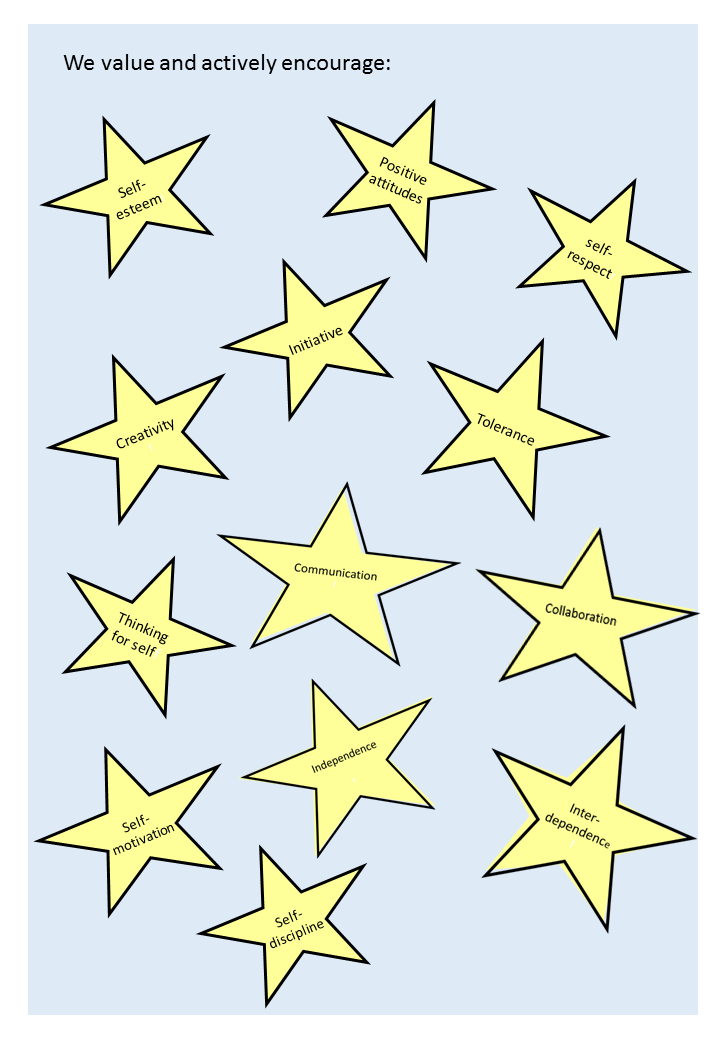
    The values of the “school” I was setting up were stated this way:

    Colo Values

    Just as it is important for gardeners to learn from the wisdom collected by other gardeners, it is important for teachers to learn from the wisdom collected by other educators.

    56


    Without a set of guiding principles it is easy to be blown off-course by the winds prevailing at the time. While I acknowledge that I may have fallen far short of the values espoused, that they guided my direction, decisions and choices could not be questioned. The current climate makes it difficult, but I am yet to read of a time that could be considered a golden age of education.

    36

    This week at the Carrot Ranch Charli Mills is talking about roses; roses that grow in gardens and roses as symbols of life’s pleasures and joys. She challenged writers to In 99 words (no more, no less) write a story that includes a rose.

    Because my blog has an educational focus, I always like to give Charli’s prompt an educational twist. Over recent months I have enjoyed the additional challenge of finding a way of applying the prompt to the life of Marnie, a character whose story I have been developing.

    Marnie is from a dysfunctional family and suffers many disadvantages. Fortunately she has found an ally in an art teacher who helps her develop self-respect and hope for a better future. A few weeks ago (in response to a different prompt) we learned that she had lived under a different name after leaving home. Could it perhaps be Rose, a name inspired by this interaction with her adored teacher?

    99

    Still life

    Marnie observed the roses Miss R. had arranged for class, carefully assessing the colours and studying the lines while sketching them on the canvas, striving to match their perfection. Oblivious to all but Miss R. and the roses, for one hour nothing else mattered.

    As other students streamed out Marnie hung back to chat with Miss R.

    Miss R. handed her a rose from the vase saying, “You are that rose. You may be surrounded by thorns, but the beauty of the rose is inside you. Remember that always. A rose by any other name would smell as sweet.

    Thank you

    Thank you for reading. I appreciate your feedback. Please share your thoughts about any aspect of this post or flash fiction.

  • Understanding family relationships

    At the Carrot Ranch this week Charli Mills is talking about cold cases and challenges writers to, In 99 words (no more, no less) write about an old mystery in the current time. Is it a discovery? Is it solved? Does it no longer matter, or does it impact innocent generations in between?

    My thoughts immediately turned to a mystery that occurred in my family over one hundred years ago when the two-year old brother of my grandfather disappeared and was never seen again.

    http://www.clker.com/clipart-10083.html
    http://www.clker.com/clipart-10083.html

    Most families do have a skeleton or two in the closet. Not all families like it to be known. Many Australian families who can trace the arrival of ancestors back to before the end of convict transportation in 1868 can find a convict in their ancestry. I have two; one on each side of the family. Generally the reasons for transportation were rather minor so I am not too concerned about sharing that information. In fact, many Australians are delighted to find a convict in the past as it adds a little interest and colour to their family tree.

    Children generally love to hear stories of their own lives and families. I have written about that before here. However young children probably have no need for or interest in delving as far back into family history as the three stories I have mentioned above. An interest in ancestors further back than living relatives (grandparents and great-grandparents) usually develops later, if at all.

    A great place to start thinking about history in early childhood classrooms is sharing stories about the families of children in the class. Most classes in Australia are comprised of children from variety of backgrounds so sharing those stories helps to develop an appreciation for each other as well as knowledge of the world. I developed a unit called Getting to know you for use in early childhood classroom which aims to develop discussion about family histories.

    But children can start learning about family relationships even earlier than that by discussions of who’s who in the family and explanations of the words and relationships; for example father/daughter; brother/sister; aunt/niece; grandmother/granddaughter. Here is a picture of some pages of a book I made for Bec when she was just a little tot, just to give you the idea.

    family book

    Photo books of family members are much easier to make these days with digital photos and programs such as PowerPoint, as well as glossy books you can make and order online.

    I am very proud of my two grandchildren, as any grandparent would be, and am pleased to say that they have a good understanding of who is in their family and their relationships to each other. It is a frequent topic of discussion. However I was very tickled when my three year old granddaughter proceeded to tell me, with some excitement, that her Daddy and her Aunty Bec were brother and sister in real life; in REAL life, she emphasized.

    Regular readers of my blog may be familiar with a character I have been developing in response to Charli’s flash fiction challenges: Marnie. Her story is not real life but, sadly, aspects of it could be, for others. There was a period of about twenty years when, after escaping her dysfunctional family, Marnie was untraceable, living without any connection to her family and past, a mystery. It took authorities five years after both parents had passed to track her down with the ‘news’. This episode takes up there.

    Found

    The officers looked friendly enough but still she tried to hide the tremble in her soul and tremor in her voice behind the blankness of her stare.

    She’d opened the door just a crack, as far as the chain would allow.

    “Marnie Dobson?” they asked. She shook her head. She’d not . . . ; not since . . . ; no longer. She shook again.

    They asked her to step outside. With no other option she reluctantly unlocked and emerged into the glare of daylight.

    “Marnie Dobson,” one said, “We are here to inform you . . .”

    Thank you

    Thank you for reading. I appreciate your feedback. Please share your thoughts about any aspect of this post or flash fiction.


  • All aboard the early learning caravan!

    school cropped

    This week at the Carrot Ranch Charli Mills described a century old schoolhouse which adjoins her property. She is hoping that someone will buy it and make it a meeting place for the community, recognising the role it had to play in the education of generations past as well as its contribution to the history of the area. Her thoughts about the schoolhouse led her to thinking of community engagement and neighbourly relationships which, in turn, inspired her flash fiction challenge for this week, to In 99 words (no more, no less) write a story about nurturing a neighborly relationship.

    I would have loved the little schoolhouse at Elmira Pond as the base for the alternative school I hoped to establish at the end of last century. The schoolhouse has a nice community feel to it, unlike many of the large brick, concrete jungle-type schools into which one can almost dissolve in a sea of sameness. Charli’s schoolhouse/community centre would also be a great meeting place for parents with their young children; a friendly early learning centre for both.

    8-12-2013 7-38-33 PM


    Based on my beliefs that:

    • parents are a child’s first and most important teachers;
    • the most important years of a child’s development are the years before school;
    • children who enter school with rich vocabularies, an interest in the world around them, and a love of books are primed to succeed;
    • children without those experiences are disadvantaged in their learning right from the start and face an enormous challenge in catching up;
    • waiting until children enter school is too late;
    • the best way to minimise or eliminate the disadvantage is by educating parents through programs that model effective parenting behaviours and support them in their interactions with their children;
    • parenting programs offering those types of support would be most effective if begun before birth of the children and continued at least until the child enters school, maybe beyond;
    • most parents want to do the best for their children, many just don’t know how to go about it.

    There are any number of birthing classes, but not many that aim to support parents in nurturing their child’s development. In my opinion, investing time and money into developing programs such as these would have enormous benefit, not only to individual children and their parents, but to society as a whole.

    I am not talking about programs that place children of increasingly (or should that be decreasingly) younger years into structured and formal “teaching and learning” situations. I am not talking about one-off talks or series of lectures to parents.

    Many of the parents of children who begin school with the types of disadvantage I have mentioned are themselves products of similar disadvantage. In a previous post I discussed the roles of “nature” and “nurture” in a child’s development. In these cases especially, it can be difficult to tease out the differences. Many of these parents would not have positive feelings towards schools or any other public institution and may feel threatened, or reluctant for other reasons, to attend sessions in public halls or government offices.

    What I am talking about is a program that:

    • goes to the parents and children in their neighbourhoods, meeting in a local park or community greenspace, on regular weekly occasions;
    • invites parents to talk with, read to and play with their children using provided books, games and toys;
    • models positive parenting behaviour, explaining to parents the benefits to their children of engaging with them in activities and discussions;
    • provides suggestions for inexpensive and easy activities to do at home;
    • encourages borrowing from a book and toy library.
    Guiding parents in play sessions for parents and children.
    Guiding parents in play sessions for parents and children.

    I envision the program being delivered by an early children trained educator who is sympathetic to the situations and demands of people from diverse backgrounds, who is warm and supportive with good interpersonal skills with both adults and children, who drives a mobile early learning centre fully-equipped with books, toys, games, paper, pens and craft materials, including items for borrowing and distribution for activities to be done at home.

    I see the centre as a brightly painted caravan with doors that open wide to display a colourful and engaging assortment of resources to delight the interests and eyes of young children and their parents.  As the caravan travels into each neighbourhood it would play music to signal its arrival (think of the old icecream vans!) inviting parents and children to come, investigate, and join in.

    caravan

    Thinking about the excitement that such a program may stimulate in a neighbourhood, and the sense of community and belonging it may encourage, led me to write about it for my response to Charli’s prompt.

    I hope you enjoy it.

    www.openclipart.com
    http://www.openclipart.com

    The caravan

    Children waited anxiously at windows and front garden fences.

    Mothers and fathers hurried to complete the last of their chores.

    Others, already at the park, were unable to wait.

    Ears strained, listening for music signalling, “It’s time!

    Suddenly “Girls and boys come out to play!” announced the arrival of the brightly painted caravan.

    “Come on!” urged children, tugging at skirts, trousers and hairy legs.

    “Come on!” chimed parents, downing cloths and brooms. Clasping small hands they whisked them out.

    Everyone watched as the doors of the caravan opened; ready for fun: stories, games and much to explore!

    Thank you

    Thank you for reading. I appreciate your feedback. Please share your thoughts about any aspect of this post or flash fiction.

  • Happy being me

    Self-esteem

    One of the most precious but fragile qualities of a person is their sense of self and self-esteem.

    A positive word of encouragement can reinforce the strength of one’s self-image.

    Machovka_Happy_fish
    image courtesy of http://www.openclipart.org

    But that image can be shattered all too easily through a sigh, a grimace, an ill-chosen word or careless remark.

    image courtesy of www.openclipart.org
    image courtesy of http://www.openclipart.org

    Our self-esteem flourishes when we are happy and wilts when we are sad. It is much easier to boost someone when they are up, and to hit them when they are down. Maintaining a healthy self-image requires just the right amount of self-knowledge and confidence to be resilient when faced with negative feedback and to not adopt an inflated sense of importance when receiving false, or genuine, positive input.

    Fostering self-esteem in the classroom

    image courtesy of www.openclipart.org
    image courtesy of http://www.openclipart.org

    As a teacher I have always considered it to be equally or more important to strengthen a child’s self-image as it is to extend their thinking and learning abilities.

    My primary aim has always been to cultivate a group of happy children, with strong senses of self, confident in what they could do and willing to have a go to extend their learning. I believe that these qualities are necessary in order for children to learn efficiently.

    A child who lacks confidence and is fearful of having a go lest a mistake be made, will make slow progress, finding it difficult to move out of the “comfort zone” into the unknown.

    Because children have no choice in whether to be in school or not, despite whether they like it or not, then, I believe, it must be a happy place, a place where they want to be and look forward to coming. How powerless must they feel if they are compelled to attend every day in a situation which gives them no pleasure.

    www.openclipart.org
    image courtesy of http://www.openclipart.org

    Sometimes the response to this remark is, “It’s life. They just have to get used to it.”

    But really, when you think of it, adults, no matter how trapped they may feel in certain situations, do have a choice. The choices may be no more palatable than the one they are in, but they are able to make that choice. My point is: children don’t make this choice. The choice is made for them. We are lucky that most children accept, and most rather willingly, indeed with enjoyment, this institution of childhood.

    Start each day with a song

    image courtesy of openclipart.org
    image courtesy of openclipart.org

    Because these beliefs and values guided the choices I made as a teacher, I started every day with at least a song or two, and always one of affirmation. It is almost impossible to frown when singing, and almost as impossible to not join in when everyone around is singing too.
    There were mornings when it was just as important for me to sing the songs as it was for the children. As for them, it gave me time to forget the problem that had occurred outside the classroom, the difficulty getting something to work the required way, or the disagreement that had taken place some time earlier. As for them, it gave me a quiet time to reflect and reassure myself, “I’m okay. I can do this. Let’s get on with our day.”

    I noticed, too, that when parent volunteers or other visitors were with us for our song, they also joined in with our singing and invariably followed up with a spontaneous comment about how much they appreciated, and needed, the song as well. Many times I received comments from passers-by about how the class’s happy singing had helped them start their day.

    image courtesy of www.openclipart.org
    image courtesy of http://www.openclipart.org

    I took every possible opportunity to remind parents of how wonderful their children were and we always shared at least one of these songs with parents during end-of-term celebrations of work. I believe the songs help to model, for parents as well as teachers, a way of sharing positive feedback and affirmations with their children.

    Affirmation songs

    Some of the songs we sang regularly in the mornings were from Anne Infante’s “Special as I can be” CD, the title song of which is my favourite and always the first I introduce to the children.

    Anne Infante (image courtesy of Anne)
    Anne Infante (image courtesy of Anne)

    Image courtesy of Anne

    Click here to find out more about Anne and her songs.

    I always wrote the songs out on charts so that, from the first day of school, we could follow along with the words as Anne sang them, even before most of the children could recognise any of them. The melody and repetitive structure of each verse invited the children to join in:

    Nobody else is just like me. 

    I’m as unique as I can be.

    I am beautiful, wonderful and

    beautiful, special as I can be.”

    The following verses substituted things such as “Nobody’s face, nobody’s smile, nobody’s eyes.” I simply told them, before the verse started, the words that changed each time.

    It wasn’t long before the children were joining in with the singing and recognising some of the words repeated in the songs e.g. “I” and “beautiful”.

    If ever I was called away during the song, they took great delight in being the one to point to the words for the rest of the class to follow.

    As the children became confident with one song, I would introduce another; and as our repertoire built, we would sing a different one each day. Sometimes the children would change the chart I had selected for another of their choosing for that particular day.

    The children loved these songs, and often during the day, while they were working on another task, someone would start quietly singing a song, and before long everyone would be joining in with joyful affirmation. I loved it when they left the classroom in the afternoon singing another of Anne’s songs, “Today I’m feeling happy. I am, I am, I am.”

    image courtesy of www.openclipart.org
    image courtesy of http://www.openclipart.org

    Singing an affirmation song is a little “happiness pill” you can take every day without any side effects.

    Happy being me

    Affirmation songs provide benefits in many ways:

    • Share the joy of being alive and happiness with self
    • Put a smile on everyone’s face
    • Invite everyone to participate
    • Encourage acceptance of and respect for self and others
    • Reinforce self-esteem
    • Insulate the classroom from outside troubles
    • Quiet the mind and settle the body in preparation for the day’s work
    • Provide words to express feelings
    • Give musical pleasure
    • Are an avenue for literacy learning.

    Please feel welcome to share your thoughts.

    If you enjoyed this post please subscribe.