Live Love Laugh Learn … Create the possibilities

Tag: Carrot Ranch flash fiction

  • Everything you always wanted to know about unicorns

    Everything you always wanted to know about unicorns

    What do you know about unicorns?

    • mythical creatures
    • look similar to horses
    • usually white
    • have a single horn protruding from the forehead.

    What else is there to know?

    It appears there could be much more to learn by engaging in philosophical discussions, especially with young children, about the existence of unicorns and their features.

    For many years I have been a fan of Philosophy for Children (P4C), a pedagogical approach for teaching children to think critically, to wonder, question and reason. The approach is “taught” through student-led discussion in which the teacher is present to offer support, rather than leadership. Students are presented with a stimulus, about which they initially ask questions. When there are no more questions to ask, children discuss their thoughts and responses.

    I knew unicorns would be a great starting point for philosophical discussions with children, so wasn’t surprised to find suggestions for conducting an enquiry into Unicorn Horns – Thinking about Things that Don’t Exist by The Philosophy Foundation.

    The suggested discussion centres around fictional characters, including the more controversial ones such as Santa Claus and the Tooth Fairy which I’ve previously discussed here and here.

    What intrigued me most in the article was

    “The problem (is) characterized in this statement ‘The Tooth Fairy does not exist’, which seems to say ‘there is something that does not exist’, but then if it does not exist then how can it be anything?”

    Or another way of putting it,

    “‘If there is anything that can’t exist, then it exists, so there can’t be anything that can’t exist.’”

    Totally confused?

    Me too! Please pop over to the article for greater clarity. Then maybe you can explain it to me.

    The article continued with suggestions of other questions about unicorns that could be discussed; for example:

    • Are unicorns real?
    • If something doesn’t exist, can it have any special features?
    • How many horns does a unicorn have?
    • What if a unicorn is born without a horn, is it still a unicorn?
    • What if a horse is born with a horn, would it be a unicorn?
    • Since ‘uni’ means one, is any animal with one horn a unicorn?
    • What about a narwhal? Is it a unicorn?

    My thoughts of unicorns this week were instigated by the flash fiction prompt by Charli Mills at the Carrot Ranch to In 99 words (no more, no less) write a story about a unicorn. It can be realistic or fantastical. Go where the prompt leads.

    Now, I have written about unicorns before, here, here and here.

    In a post about security comforters, I explained that a toy unicorn was of comfort to Marnie when she was feeling particularly vulnerable. Her need for it continued into her early school years and its appearance was an indicator to teachers that things were going badly for her again. When, as a confident adult, she returned to her childhood home, she found she had long outgrown the unicorn that had given her comfort as a child.

    In some of Marnie’s stories, she was teased and bullied, mainly by a boy named Brucie. Fortunately, she had a good friend in Jasmine who was often there to offer her support.

    In my response to Charli’s unicorn prompt, I revisit Marnie and Brucie and attempt to add a little philosophy to their discussion. I hope you like it.

    Unicorns aren’t real

    “What’s that supposed to be?” sneered Brucie.

    Marnie bit her lip.

    “Doesn’t look like anything to me,” he scoffed, inviting an audience.

    “A unicorn,” she whispered.

    “Miss said, ‘Draw your favourite animal.’ A unicorn can’t be your favourite animal–it’s not even real.”

    Marnie continued drawing.

    “Anyway, doesn’t look like a unicorn with those four horns.”

    “They’re not horns.”

    “Marnie’s unicorn’s got four horns,” laughed Brucie, a little too loudly.

    Miss investigated.

    “He said my unicorn’s got four horns. He said unicorns aren’t real.”

    “How can unicorns have four horns if they’re not real?” asked Miss.

    Brucie was silent.
    Thank you blog post

    Thank you for reading. I appreciate your feedback. Please share your thoughts.

  • Rough Writer Tour stops in Canada with Ann Edall-Robson

    This week the Carrot Ranch Round the World Tour stops at Alberta in Canada with Ann Edall-Robson, celebrating Family Day, no less.

    Read how Ann became one of the Rough Writers and how writing flash fiction adds to her writing process.

    Find out what she writes about this beautiful little cottage.

    Thanks, Ann. It’s a pleasure to ride the Ranch with you.

    Salute to the Congress of Rough Writers Flash Fiction Anthology Vol 1

    Source: Ann Edall-Robson’s – Ann Edall-Robson

  • Out of the fire comes hope

    Out of the fire comes hope

    fireweed Charli Mills Carrot Ranch flash fiction

    This week at the Carrot Ranch, Charli Mills wrote about fireweed. She describes it thus:

    “the purple and pink flower that grows like a tall spear in a tribe of flower warriors. After a forest fire, mining reclamation, road grading or any kind of soil disturbance, fireweed grows back first from seeds born of despair. It’s a phoenix flower, a soil nourisher, a defier of the odds when life is bleakest.”

    She then went on to challenge writers to In 99 words (no more, no less) write a story that includes fireweed. You can use it as the plant, a flower, a metaphor or as the name of someone or something. Go where the prompt leads. Burn bright when you write.

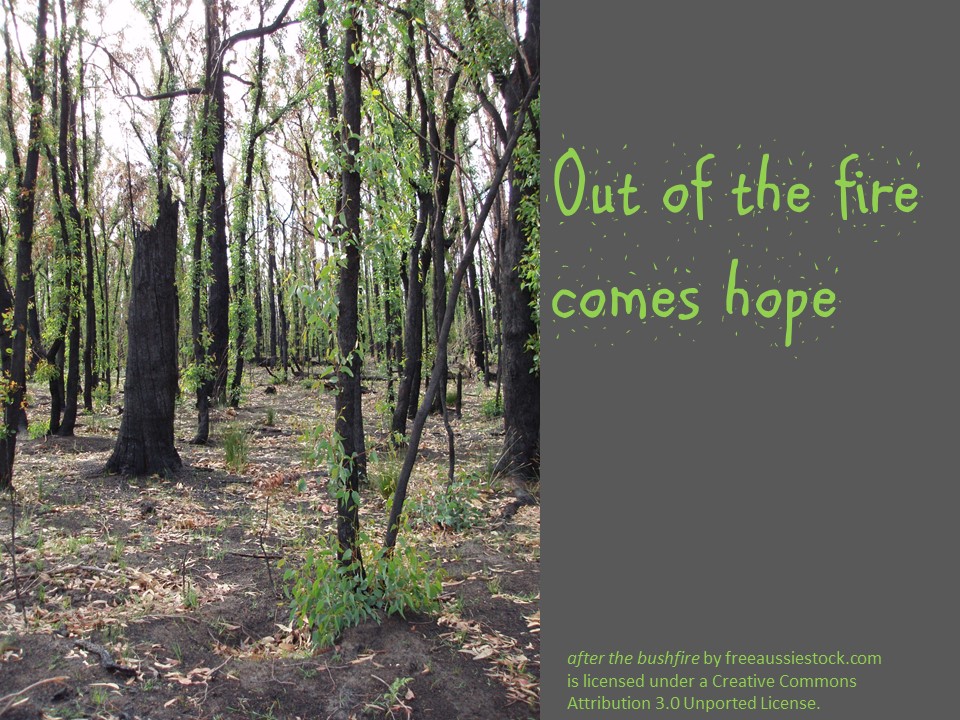
    I don’t know of Charli’s fireweed, but I do know that Australia is home to a great variety of plants that are dependent on fire for regeneration. While large tracts of land destroyed by bushfires is devastating, a return to traditional land management practices of the indigenous peoples may see an  improved system.

    There is an oft-repeated quote by German philosopher, Friedrich Nietzsche.

    “What doesn’t kill you, makes you stronger.”

    While that may be true of Charli’s fireweed and much of Australia’s flora, I’m never convinced of the applicability of the saying to every situation, or of its power to lift one up when feeling personally devastated. What does not kill may require a good dose of determination and strength for it not to annihilate the spirit.

    While thoughts of how to approach Charli’s challenge were swirling around in my head, notification of a new post by The Wordy Wizard popped into my inbox. At the top of the post was this quote by  J.K. Rowling from Harry Potter and the Goblet of Fire:

     “Understanding is the first step to acceptance, and only with acceptance can there be recovery.”

    The addition of these words of J.K. Rowling to those of Friedrich Nietzsche, for me, complete the thought. Without acceptance there is denial and an inability to move on, with acceptance we can begin to repair and renew.

    Intermittently, over the past four years while I have been responding to Charli’s flash challenges, I have written about Marnie, an abused child who was able, with determination and support of caring others, to overcome the impact of her dysfunctional upbringing and make a better life for herself.

    Just as we look for green shoots of hope in the blackness of a bushfire’s destruction, we must look for signs of hope and renewal in those who have suffered.

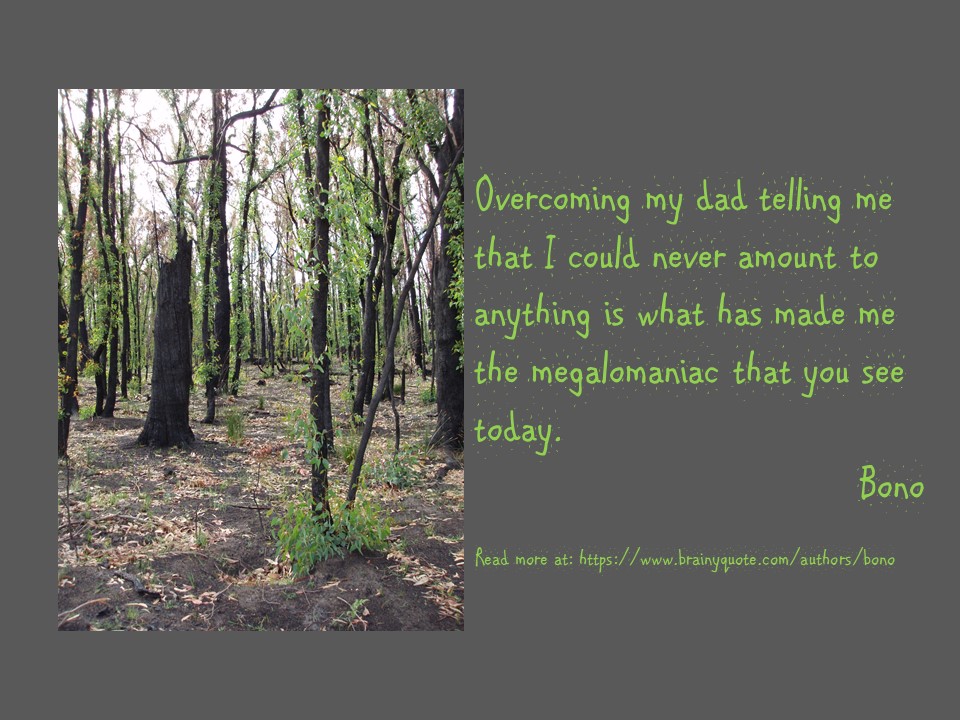
    Bono quote about why he's a megalomaniac

    While at times the negatives of children “burnt” by dysfunctional home lives, poverty, poor nutrition, lack of mental stimulation, and other factors that appear to obliterate potential can seem overwhelming and insurmountable, it is important to see within every child that seed of unlimited possibility and hope that needs to be nurtured.

    Marnie’s teacher Miss R. saw it in her. In one story, “Miss R. handed her a rose from the vase saying, “You are that rose. You may be surrounded by thorns, but the beauty of the rose is inside you. Remember that always. A rose by any other name would smell as sweet.

    Perhaps it would be just as apt to describe her as fireweed, “a defier of the odds when life is bleakest”. This is where Charli’s challenge took me this time:

    Burning with hope

    Miss R. avoided the staffroom’s negativity, popping in, like today, only if necessary. When she glanced over instinctively on hearing her name, regret flooded immediately.

    “Annette, we were just talking about you and that weed–from that noxious family–you know, Marnie-“

    She bristled, failing to withhold the words that exploded, singeing all with their ferocity.

    “Just look at yourselves. If Marnie’s a weed, she’s fireweed. Better than you will ever be. She’ll beat her odds and succeed, despite your belittling words and unhelpful opinions.”

    She left the silenced room, believing in her heart that her words were true.

    Thank you blog post

    Thank you for reading. I appreciate your feedback. Please share your thoughts.

    Note: The feature image after the bushfire by freeaussiestock.com is licensed under a Creative Commons Attribution 3.0 Unported License.


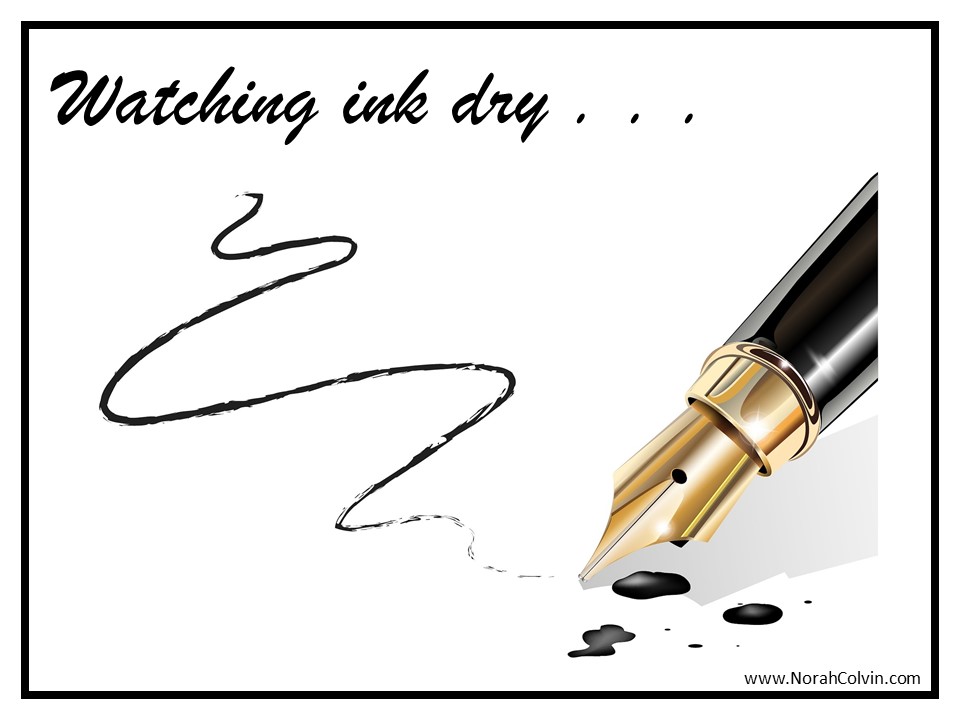
  • Watching ink dry

    Watching ink dry

    Sometimes we think change occurs at an incredible pace. Other times it’s too slow–like watching paint dry. But what about watching ink dry?

    This week at the Carrot Ranch, Charli Mills challenged writers to In 99 words (no more, no less) write a story about wet ink. It can be artistic, writerly or something completely off-the-wall. Go where the prompt leads.

    Where would I go? To school–where else?

    In my first year of school we wrote on slates (no, not on stone tablets as my children may tease).

    In subsequent years, we wrote in exercise books and special handwriting books with lead pencils (which contain graphite rather than lead).

    As we moved up through the grades, we still used pencils for most work, but were also introduced to pens with nibs which we dipped into inkwells recessed in our desks for handwriting or “copybook” lessons. It was important to get just the right amount of ink on the nib–too little and the nib would scratch but not sufficiently to make a readable mark–too much and the ink would run, blot and smudge.

    In upper primary, we graduated to fountain pens for our copybook work. It was just as difficult to get the right amount of ink, even with the cartridge variety. Should we err and make a blot on our copybook, it was treated as a most serious offence. Luckily, our trusty blotting paper was at the ready to soak up any excess. We always had to begin writing at the top and continue down the page. There was no going back and inserting or altering something at the top, unless we were absolutely certain the ink was dry, lest we smudge the writing with our hand.

    Although ball point pens, commonly called biros in my circles, had been invented–as early as 1888 according to this history, would you believe–we were not allowed to use them in school for fear our handwriting skills would deteriorate. They had their own set of ink issues too–some would fail to write, other would supply too much thick ink. Others would leave ink all over hands, or leak in pockets or bags.

    Over the years, ballpoint pens improved in quality and have now replaced dip nib pens except for specialist writing, and fountain pens are considered more a luxury item. Now the concern is that the use of digital devices; such as, computers, tablets and phones will have a harmful effect upon children’s handwriting skills. I wonder were there similar concerns when papyrus replaced stone tablets; and what those concerns will be in the future, should handwriting have a future.

    I didn’t wish to “blot my copybook” by responding to Charli’s prompt with a story unrelated to education or children. I hope you enjoy it.

    A blot on whose copybook?

    Ever so carefully, she dipped the nib in and out of the inkwell. Her tongue protruded, guiding the pen as she copied the black squiggly lines dancing across the page.

    “Start at the top. Go across; then down. Lift, dip…,“ the teacher droned.

    “Start at the top!” The cane stung her knuckles, sending the nib skidding across the page.

    “Now look what you’ve done!” The teacher grasped the book and held it aloft, sending ink in rivulets down the page. Her thumb intercepted one, smearing another opportunity for humiliation across the page.

    “Girls, this is what not to do!”

    Thank you blog post

    Thank you for reading. I appreciate your feedback. Please share your thoughts.

  • Spend a copper penny

    Spend a copper penny

    This week at the Carrot Ranch, Charli Millis challenged writers to In 99 words (no more, no less) write a story about Copper Country. It can be any place, fictional, historical, or on another planet. Go where the copper leads.

    It may not be a country, but it seems as far away and foreign as any country might be–the country of my childhood, when:

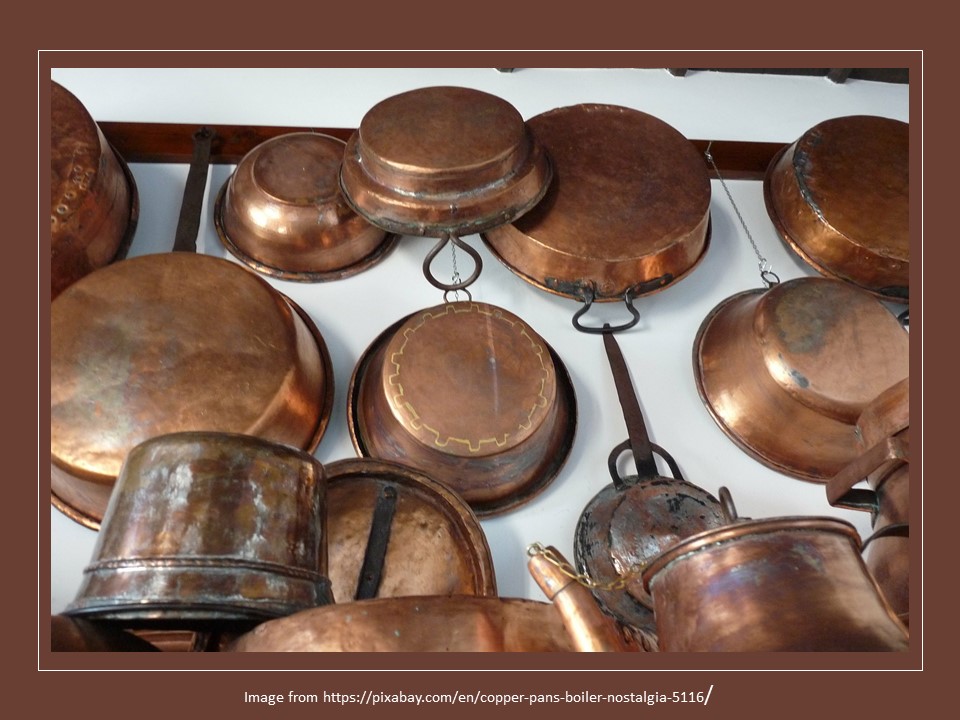
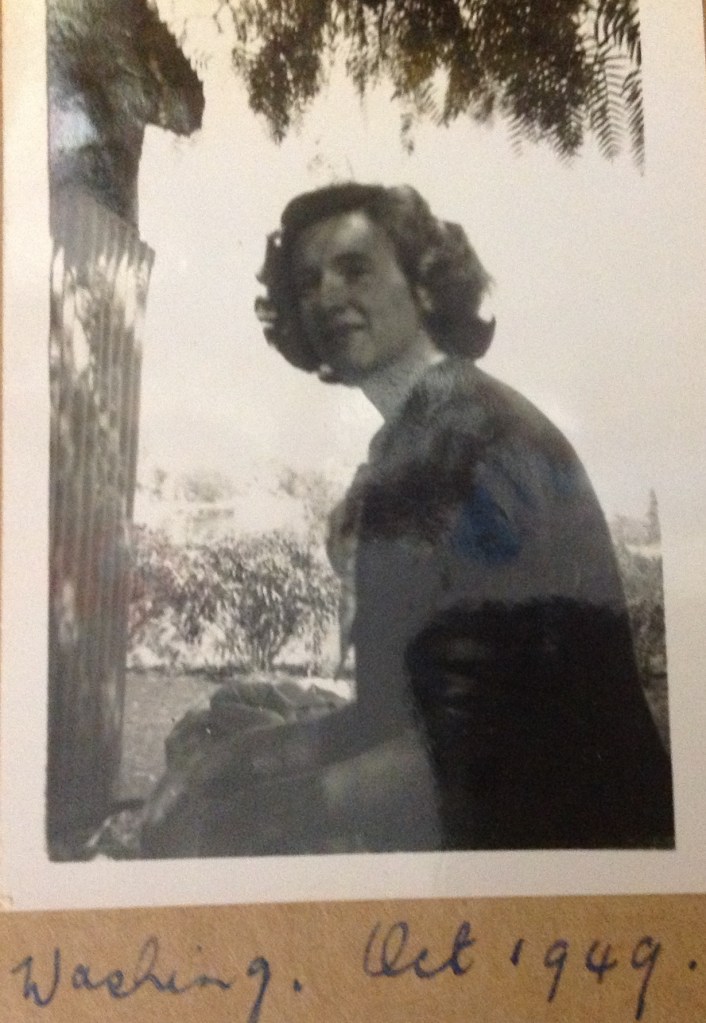
    Mum washing in copper

    • My mum did the laundry in a big copper pot heated over burning logs. She’d fill the pot and heat the water then use a long wooden stick to swirl around the sheets or clothes before hanging them over the line to dry in the sun. I wrote about this in a previous flash (nearly four years ago!): Washing Day.

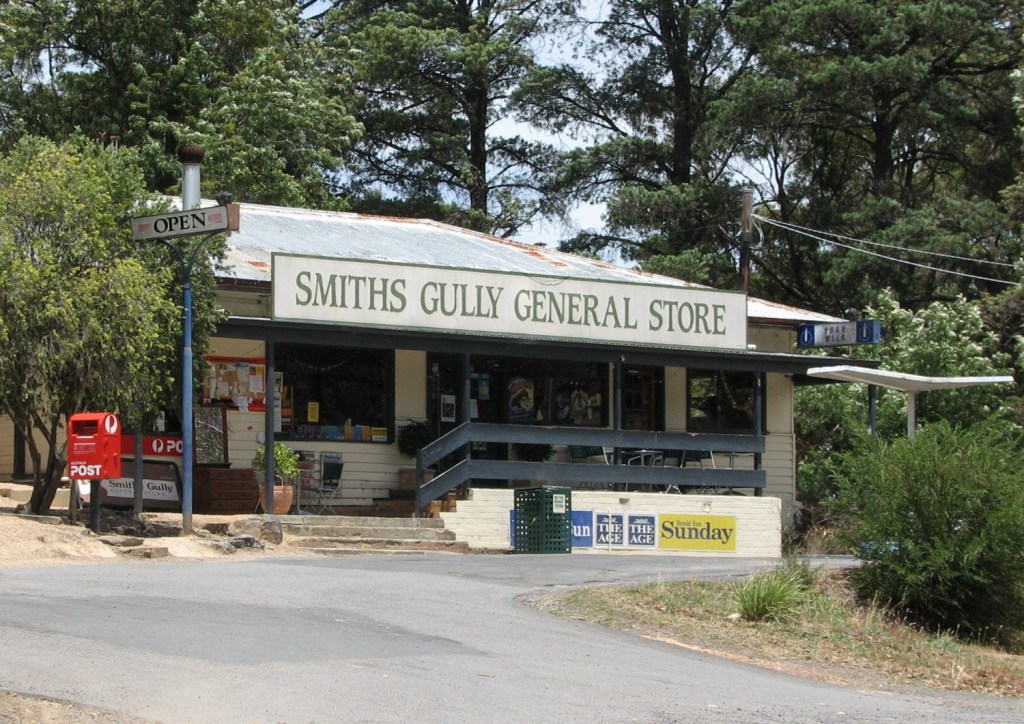
    general store Australia

    • Items were bought from a general store in exchange for coins or notes. There were no supermarkets, credit cards, pay pass or online shopping. Storekeepers were friendly and knew each member of the family by name.

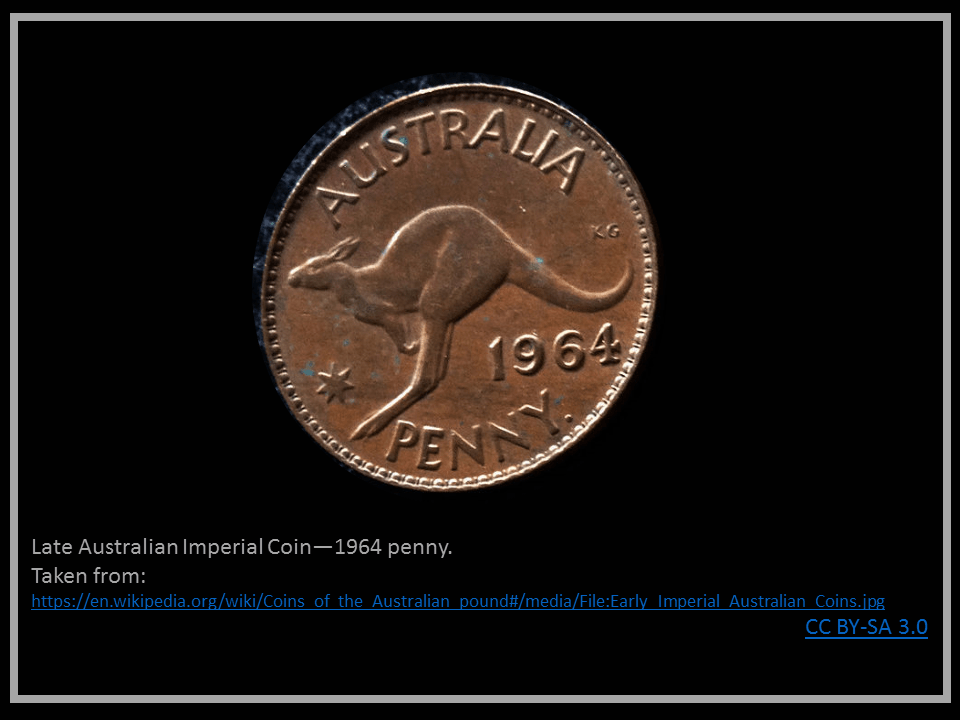
    My favourite coin was the penny with the Queen on the head, and a kangaroo on the tail. Though made from a bronze alloy and only 97% copper, we called it copper nonetheless.

    • Almost all water pipes, hot and cold, were made of copper. Most still are, but some have been replaced by plastic which is initially cheaper but not as long-lasting. I remember the colourful pipes leading to the concrete wash tubs when we moved to suburbia and Mum got a real washing machine. The hot water pipes were wrapped in asbestos.

    police and robber

    • Policemen (I don’t recall too many policewomen back then) were respected, and we had fun playing cops and robbers. There was always a debate over who was going to be the copper and who was going to be the robber, but it went without saying that the copper always won.

    Coppertone girl

    • I was a (naturally) copper-haired child, one of four in a family of ten. With our very fair skin, the sun wasn’t kind to us and our skin had no resemblance to that of the Coppertone girl who started to appear on billboards a little later.
    • We would “spend a penny” to use public facilities, sometimes handing our coin to an attendant, or even putting it into a slot in the door!
    • Days were long, and time and possibilities were infinite. Life was black and white, and we children had not a care in the world as parents knew everything and took care of everything.

    It’s to this childhood country of laid back times, when the whole world was open to us and copper pennies could buy happiness, that I have returned–it may not be the real world of my childhood, but rather one of my dreams.  I hope you like it.

    Spend a penny or two

    Coins jingled in his pocket as bare feet squeaked out every step along the sandy road. Every so often, he’d finger them–such big coins. In his mind, he spent and re-spent them: a dress for Mum, a hat for Dad, a pull-a-long toy for Baby–nothing for himself.

    He watched the boy place the copper on the counter. He followed the hopeful gaze, shook his head and pointed to lolly jars. The boy held up four fingers; he held up one. The boy hesitated, then shoved the coins back in his pocket–to spend another day.

    “Hold on…”

    Thank you blog post

    Thank you for reading. I appreciate your feedback. Please share your thoughts.

  • Only in Australia

    Only in Australia - Australian Coat of Arms

    This week at the Carrot Ranch, Charli Mills challenges writers to In 99 words (no more, no less) write a story using the phrase “only in…” It can be used to tell a story about a profession, a place or situation. Go were the prompt leads you.

    This is my response. I hope you enjoy it. (Composed in the pool this morning.)

    Only in Australia

    The carollers woke her Christmas morning. After the preparation whirlwind, she’d collapsed into bed, only to continuously toss and turn, re-making each list and checking it twice. She groaned – please, just a few minutes more. The carollers insisted. She tumbled out of bed and stumbled to the door. They eagerly accepted her gifts. Breathing in the day’s freshness, she had to decide – bed? Nah – the pool! As each stroke soothed and each lap refreshed, she welcomed the day’s events. When a cockatoo’s shriek punctuated the chorus, the kookaburras laughed. “Only in Australia,” she thought. “It’s good to be home.”

    And now for a little more, if you so choose:

    Note: I’ve been kindly shown that some of my ‘only in Australia‘ statements are not quite correct. As I am not one for spreading falsehoods, I have added, in pink, corrections of which I have become aware. Thanks especially to Pauline King and Debby Gies for getting the ball rolling.

    Only in Australia do you see people wearing thongs and singlets in winter (“thongs” are flip-flops worn on feet, singlets are sleeveless shirts). (I now know Canadians also refer to flip-flops as thongs.)

    Only in Australia are there mammals that lay eggs (the monotremes – echidna and platypus. One species of echidna is found in New Guinea).

    Only in Australia are the emblem animals eaten (the meat of kangaroo and emu – both on the Australian Coat of Arms – is available in supermarkets and from restaurant menus). The animals were chosen for the coat of arms as neither can walk backwards – a symbol of a forward-moving nation.

    Only in Australia can you see these biggest things:

    The world’s largest living organism The Great Barrier Reef. Hopefully it will remain that way for generations to come.

    The world’s largest monolith – Uluru.

    The world’s longest fence – the dingo fence, built to keep dingoes out of the fertile farming areas on the eastern coast,  over 5 500 km.

    Only in Australia will you find the world’s oldest living culture.

    Only in Australia could you visit a different beach every day of the year and still have more to see.

    Only in Australia could you attend a cockroach race, a cane toad race and a boat race on a dry river bed.

    Only in Australia would you not see an active volcano. (Australia, the world’s largest island or smallest continent, is the only continent without an active volcano, though there are many dormant and extinct volcanoes.)

    Only in Australia do you have to travel overseas to travel internationally. (This is definitely not true – of course overseas and international travel are synonymous for any island nation, of which there are many, including New Zealand.)

    Only in Australia will you hear “Fair dinkum” and “True Blue”.

    Only in Australia, do we abbreviate everything, including names (is that why our years pass so fast – we abbreviate them too?) (Apparently, this habit is also prevalent across the ditch in New Zealand.)


    And if you still want more, check out these 88 Crazy Things You Probably Didn’t Know About Australia.

    And watch this video:

    Or come for a visit!

    Thank you blog post

    Thank you for reading. I hope you enjoyed finding out a little more about Australia. I appreciate your feedback. Please share your thoughts.
     

  • Winner of Flash Fiction Contest #5

    Congratulations to everyone who entered Contest #5 Twitter Flash Fiction, but huge congratulations to D. Avery winner! What a challenge! Check out her entry and others over at the Carrot Ranch.

  • The art of choosing – self-care

    This week, Charli Mills challenged the Carrot Ranch Literary Community to In 99 words (no more, no less) write a story that includes self-care. Does the character need it? What does the character do? Think about how you can use this action to deepen a character or move a story. Go where the prompt leads. She talks about being easy on ourselves and taking time to celebrate our progress and avoid being shackled by the imposter syndrome that masquerades as our harshest critic.

    Dr. Andrea Dinardo is also talking about self-care this week on her blog Thriving Under Pressure. Her post urges us to Work hard. Rest. Repeat, and recommends

    “If you get tired, learn to rest not quit.”

    Resting can be difficult when there is much we want to do and achieve, both personally and professionally; but sometimes, if we don’t rest by choice, we have it thrust upon us.

    This week, when I’m already masquerading as an overposter, as a mini-rest, an exercise in self-care, and care for you too, I’m presenting my flash response without the padding of a post. Here it is. I hope you like it.

    Rest. In. Peace.

    “You really should take a break,” they suggested.

    “I can’t. Too much to do.”

    “You need time off,” they said.

    “I know. Soon.”

    Eventually, “I’m taking a break,” she said.

    The afternoon sun warmed as the sand caressed her aching body. Her eyes closed. Only an occasional seagull’s squawk interrupted the repetitive swoo-oosh of the waves that jumbled with the office cacophony looping incessantly.

    “What? What happened?” they asked.

    He scrolled quickly, searching for details.

    “Sleeping. On beach. Seagull – ha!– dropped a baby turtle – landed on her head – died instantly.”

    “And we thought work would kill her!”

    Thank you blog post

    Thank you for reading. I appreciate your feedback. Please share your thoughts.


  • Mr Potato Head

    Carrot Ranch Flash Fiction Five a DayEvery week at the Carrot Ranch, Charli Mills challenges writers to respond to a prompt with 99-word flash fiction. The prompts provide an opportunity to practice craft while having a little fun in a supportive writing community. Although participation is voluntary and never prescribed, the benefits to mind and spirit equal the benefits to physical health by the five-a-day servings of fruit and vegetables recommended by many health departments around the world.


    This week, Charli challenged writers to in 99 words (no more, no less) write a story about Five a Day. It does not have to be five servings of fruits and vegetables. What is needed five times a day? Have fun with what pops to mind for the prompt.

    It’s a good thing Charli not only allows, but encourages, writers to “Go where the prompt leads”, as I’m not always satisfied with the obvious, literal interpretation. My mind jumps about like a rabbit in a vegetable patch, trying out different thoughts and ideas.

    While Charli was talking about the five serves of fruit and vegetables as day for our physical health, I wondered about essentials for mental health that help us navigate each day.

    sweet hearts

    Mental health

    How about a daily dose of these?

    • Self-worth – a sense of being valued, of having the right to occupy space in the world
    • Confidence – a willingness to approach tasks and face what life brings
    • Trust – an ability to trust others and feel safe in one’s environment
    • Empathy – making connections with others on a deep level
    • Compassion – giving and accepting kindness, contributing to a positive community and environment

    What would you add?

    I also wondered about the essentials for nurturing children’s growth and development. What would those five servings a day be?

    girl child dancing

    Children’s needs

    First and foremost, children need to be loved and to have their physical needs met; for example food, water and warmth. They are givens.

    Then to have their minds stimulated, every day, they need adults to:

    • Talk with them
    • Read to them
    • Sing songs with them
    • Play with them, and
    • Laugh with them.

    What would you add?

    world earth map

    The world’s needs

    And what about for the world, what do we all need?

    • Friendship
    • Understanding
    • Tolerance
    • Empathy
    • Peace

    What would you add?

    Why don’t children like vegetables?

    But let’s get back to Charli’s five, and children. Sometimes getting children to eat their five serves of fruit and vegetables a day can be difficult. While fruit is often enjoyed, vegetables are frequently rejected. Researchers have investigated reasons for children’s refusal to eat vegetables and found these reasons (reported here and here):

    • Children burn lots of energy and need foods that are high in calories – vegetables aren’t.
    • Children are generally more sensitive to bitter tastes, which are often nature’s warning of toxicity.
    • Children have not yet learned through repeated taste tests and observations that vegetables are safe to eat.
    • Children associate vegetables with unpleasant situations (parental nagging) and associate other “treats” with more pleasant situations.

    vegetables

    How to get your children to eat vegetables

    Suggestions include:

    • Reduce the natural bitterness by adding salt, sugar and other flavours
    • Serve small amounts of vegetables with other foods familiar to children
    • Present vegetables in different ways and repeated times
    • Avoid using food as reward or punishment and don’t nag

    Of course, there are the old camouflage tricks – dress them up like a funny face – or play games like the “aeroplane” spoon trying to land food in the mouth.

    What works for you?

    Thanks Pixabay!

    Thinking about the relevance of bitterness to toxicity and food refusal in children got me thinking about dementia patients who refuse food, believing it to be poisoned. I did a quick internet search (not very thorough) but could see only articles in which food refusal was linked to paranoia.

    I wonder, with their changing realities and sensitivities, could they become more sensitive to certain tastes? Could taste contribute as much as the paranoia. Many would find it no easier to express than children. I’m certainly no expert, and it’s an uneducated thought, but it’s the thought that’s led me to my flash fiction response. I hope you enjoy it.

    Mr Potato Head

    Jamie’s head shook, and his bottom lip protruded as tears pooled.

    Mum sighed.

    “But you love Mr Potato Head,” coaxed Dad.

    Jamie lowered his eyes and pushed the plate away. This was not Mr Potato – just a stupid face made from yukky stuff.

    Dad moved it back. “Just a little try,” he urged. Mum watched.

    Jamie refused.

    Jamie visited at meal time. Mum was in tears. “He won’t eat anything.”

    Jamie considered the unappetising mush. “Who would?” he thought, as he replaced the cover and opened dessert.

    “May as well enjoy what you can,” he said. Dad smiled.

    Thank you for reading. I appreciate your feedback. Please share your thoughts.
     

  • Never Too Many Cooks:  Literary Recipes in a Flash

    Never Too Many Cooks: Literary Recipes in a Flash

    How is cooking like writing?
    One’s a feast for the body, the other a feast for the mind. For some great flash fiction to get your teeth into (including one of mine!) read on: