Can Song Bird STOP the bully, save her sister, the bees and the environment?Karen is an award-winning author who writes books to empower kids (and adults) and help them live strong and be resilient. After many years of classroom teaching experience, she continues to educate through sharing her own story of resilience as a survivor of bullying, through her words on the page, and through her workshops for adults that deal with writing, marketing, and funding, in addition to empowerment.
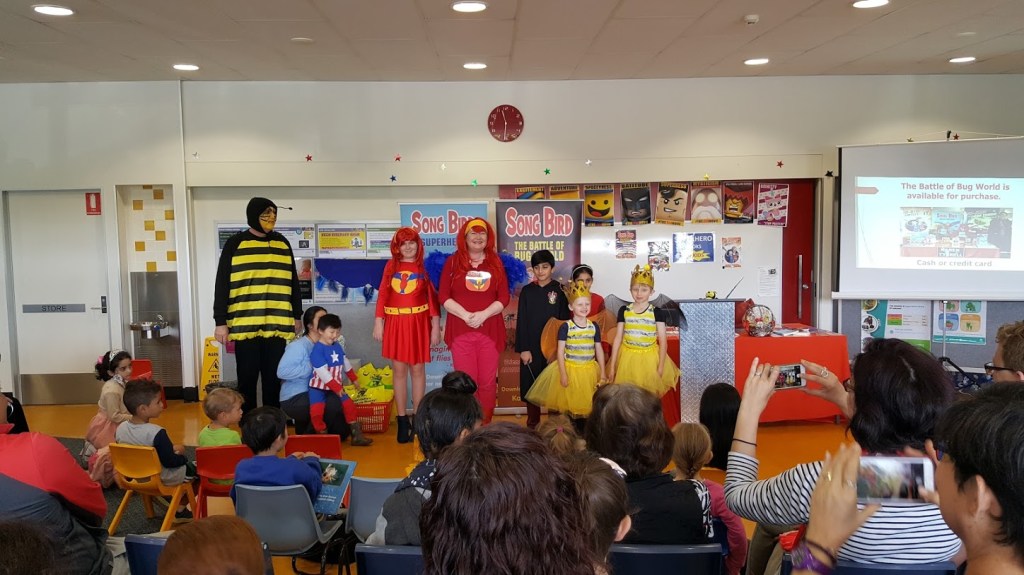
Karen presents workshops for children in schools, libraries, and other creative spaces. With her flair for costuming and performance, she conducts entertaining sessions with a splash of fun staring in her own scripted pantomimes. As I was lucky enough to attend the launch of her latest book The Battle of Bug World on Saturday, I can testify to the enjoyment that was shared by all attendees.
The Battle of Bug World is a fast-paced and action-packed story that children won’t want to put down until they find out if, and how, Song Bird can save her sister, her friends, and the environment from her evil neighbour Frank Furter.
I previously had the pleasure of interviewing Karen on readilearn about her first book in the series Song Bird Superhero, and am delighted to be a part of Karen’s blog tour celebrating the launch of this sequel, which even surpasses the first.
Please pop over to readilearn on Friday to read my post in the blog tour. Read other posts in the tour by following the links below. Leave a comment on any post for a chance to win great prizes including signed books, signed artwork, and a book critique (Comment on more posts for more chances to win!)
Just leave a comment on any of the posts in the blog tour, to win a copy of The Battle of Bug World (Song Bird 2). Add initials SB2
FREE Children’s Book Assessment!
Win a free children’s book assessment (up to 10 pages) by the author Karen Tyrrell. Just comment on any of the posts in the blog tour and add the initials CBA
FREE Artwork!
Win signed artwork by illustrator Trevor Salter. Add initials AW
Remember the more you comment, the more chances you have to win prizes for The Battle of Bug World Blog Tour. Good luck 😊
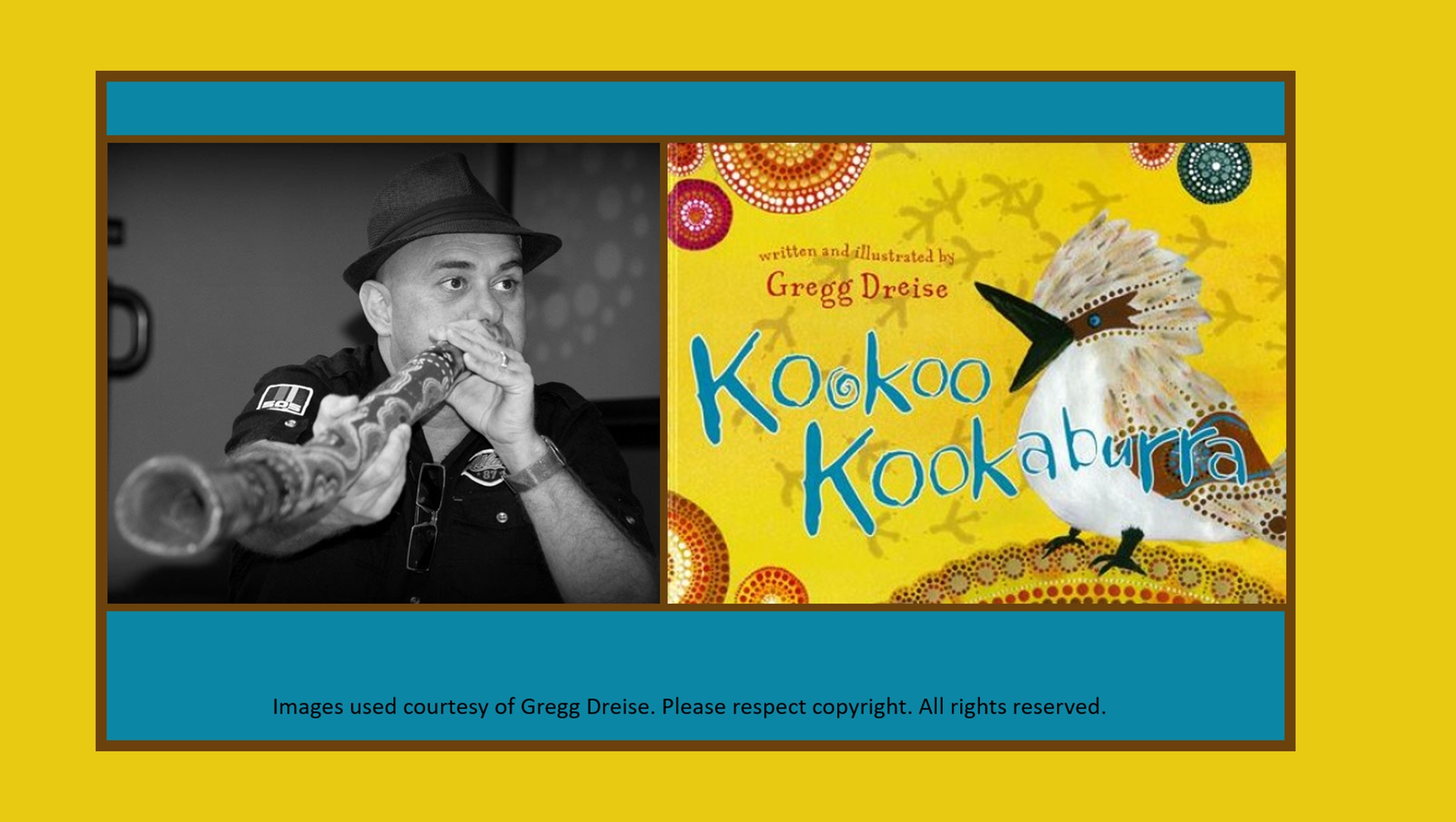
This month it is my pleasure to introduce you to Gregg Dreise, gifted artist, storyteller and musician. Gregg is a descendant of the Kamilaroi and Yuwalayaay people of south-west Queensland and north-west New South Wales. He is a proud ex-student of St George State School. When he visits schools and is involved in festivals, he features the didgeridoo and guitar in his performances.
Gregg is author and illustrator of three award-winning books Silly Birds, Kookoo Kookaburra and Mad Magpie. A fourth book Why are you Smiling is to be released soon. All four stories are about teaching morals. They address friendship, kindness, tempers and bullying.
Gregg also illustrated Di Irving’s retelling of the classic story Tiddalik the Frog, and Elaine Ousten’s second megafauna picture book Megal the Massive Megalania.
In this post, I am talking with Gregg about his award-winning book, Kookoo Kookaburra.
Oh, here he is now!
Yarma – hello, I’m Gregg Dreise the author and sillystrator of Kookoo Kookaburra. This is a story about
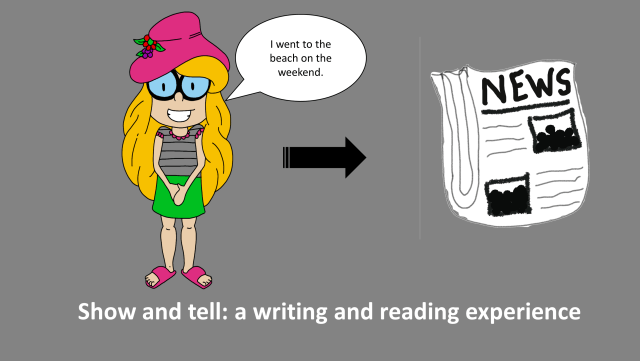
A “Show and tell” sharing session is a tradition familiar to many early childhood classrooms across the world. Children take turns to tell their classmates about an item they have brought in to show, or to relate a recent event in their lives. While the practice introduces children to public speaking, helps to develop confidence and oral communication skills, and encourages them to listen attentively, I consider the learning achieved compared to the time spent to be of dubious value.
Children tend to fidget, rather than listen and, with their minds elsewhere, are generally more interested in talking about themselves than in learning about others. This is a trait not exclusive to children though, and can be noticed in people of all ages.
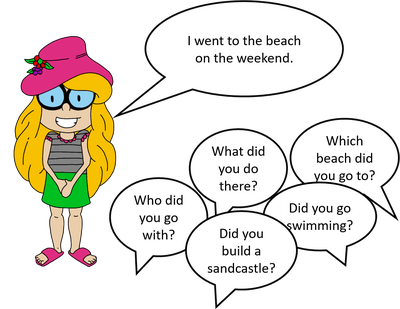
Although encouraged to ask questions at the conclusion of each talk, children’s questions are often standard, repetitive, and lacking in thought. They may be unrelated to anything the speaker said, or may request information already supplied. The asking is seen more as an opportunity of talking and of being seen to ask (that is; doing the right thing), than to know more or to participate in genuine discourse.
Believing in the session’s greater potential, I innovated on the basic routine to make it a focussed literacy teaching episode. By incorporating features of approaches such as language experience, modelled writing, and shared book, the session became an avenue for teaching and learning in both reading and writing.
From the first days of school, we wrote our Class News; creating meaningful texts which valued and connected with children’s lives. The jointly constructed texts became our first reading material; richer in interest, content, language, and vocabulary than any first reader. (Though these have their place and were also used.)
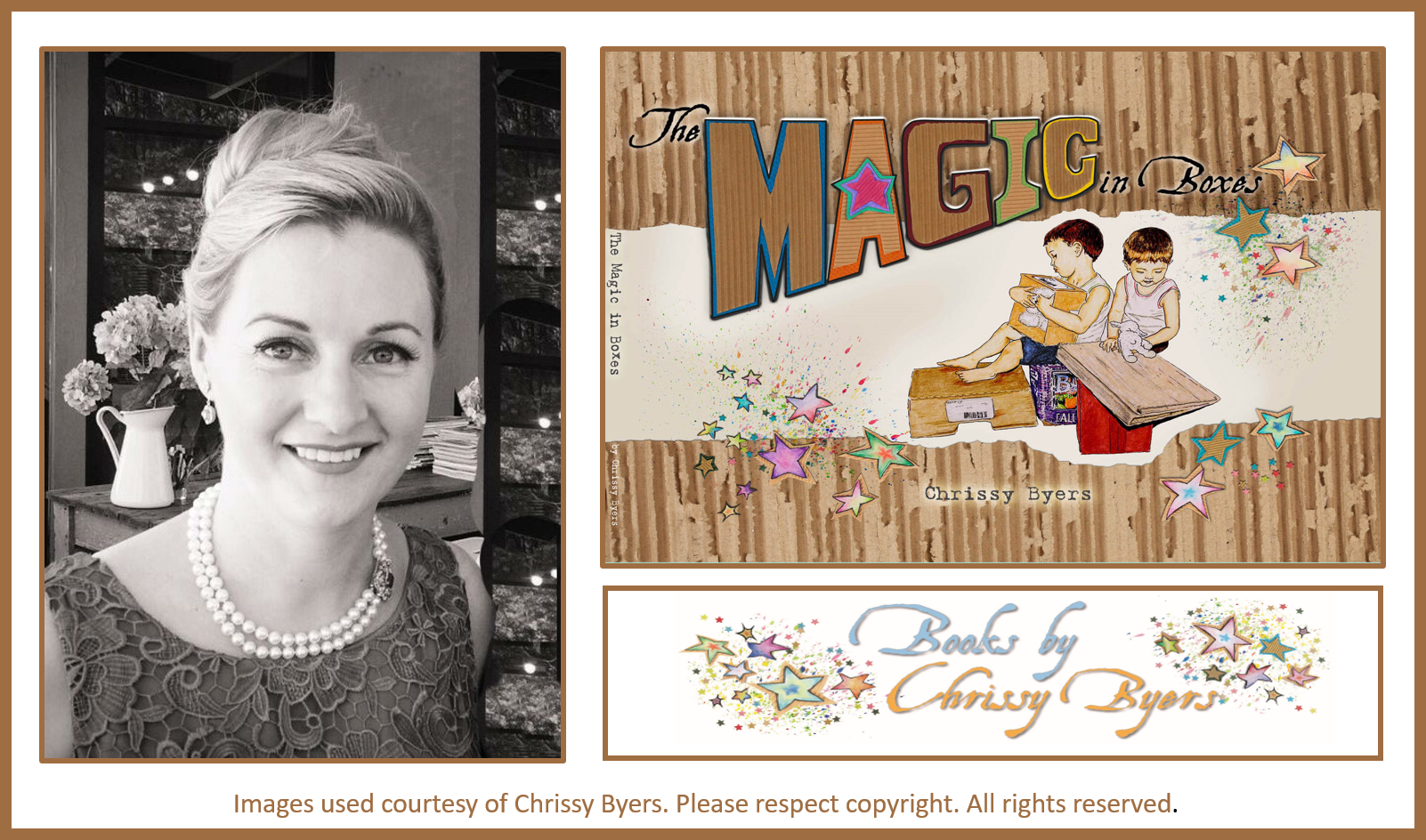
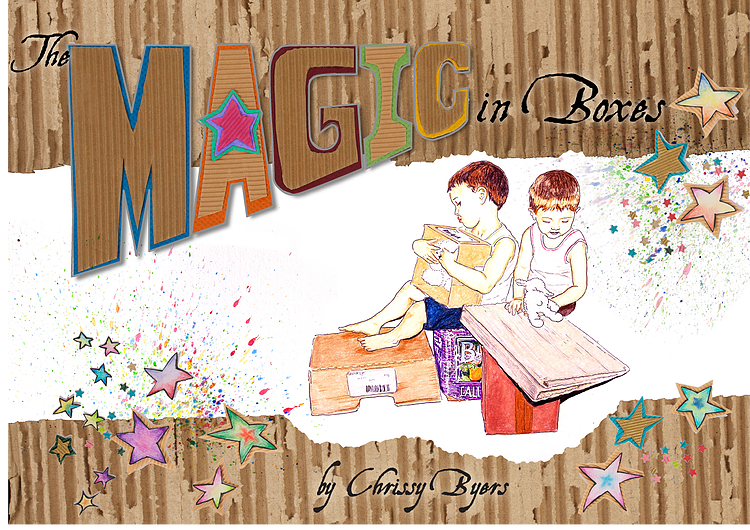
This month it is my pleasure to introduce you to Chrissy Byers – author, illustrator, and early childhood educator. It was only after many years in the classroom and becoming a parent herself that Chrissy was able to fulfil her lifelong dream of being an author and illustrator. With the success of her first book The Magic in Boxes, and another on its way, Chrissy shows us that dreams can come true.
Chrissy, what was your motivation for writing this book?
As an experienced early years class teacher, I had noticed that, with the rise in technology there was a decline in the amount of time children spent engaging in imaginative play. I was compelled to write and illustrate a children’s book which would remind parents, and inspire children, to see the magic in everyday household junk.
Unlike a traditional children’s book, I felt that the recount genre would suit my intentions better than a narrative. I saw this as being an additional bonus for primary teachers, as there are very few examples of recount picture books.
The repetitive text elements encourage pre-reading children to join in a shared reading experience. It also provides opportunity to incorporate hand gestures when reading, which helps focus young minds and occupy little hands during carpet time. The rhyming couplets assist in reading prediction and keep the beat of a fast-moving text.
Do you think of yourself more as a writer or an illustrator?
Type of blog: NorahColvin: education focus; readilearn: early childhood education teaching ideas and resources
Where in the world? Australia
Blogging since when? Norah Colvin August 2013; readilearn August 2016
What’s your story? When I started thinking about self-publishing stories and teaching resources, I did a lot of online research and attended many writing seminars. The collective intelligence promoted blogging as the primary avenue for writers to make connections and establish audience, and insisted on the importance of doing so prior to publication. Social media was also important, but secondary to blogging. At that time, I didn’t know much about social media and had no idea about blogging. Some of the course presenters suggested bloggers to follow, so I quickly got started and developed an understanding of what blogging was about. I was then keen to get…
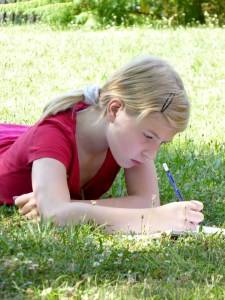
I have always considered audience important for children’s writing. Too often in school, writing is done simply for the teacher, to complete an exercise. It is read and marked (corrected) without any real concern for the writer and the writer’s purpose. That’s if, in fact, there was a purpose other than to complete the task set by the teacher.
However, it is possible to give children in school a sense of audience. They can write for the class as an audience, “publishing” their work to place in the book corner for independent self-selected reading. They can write for parents or other relatives and friends to mark special occasions such as Mother’s Day and Father’s Day, Christmas and Easter. They can write for younger siblings or buddies. Letters can be written to residents in nursing homes, characters in books, the principal, politicians, and the local newspaper. Diaries can be written and shared with teachers. Audiences can be found everywhere.
But an audience is not essential for every piece of writing. Sometimes we write just for ourselves. Sometimes even we are not an audience for our writing; when it is simply the act of writing, of expressing our thoughts that is important. Express, understand, release. That can be all there is.
While I think this is less so for young children, as they move towards double figures they may like to have a private lockable diary in which to confide. As you would wish your privacy to be respected, so should theirs. This is not true for their online communication though.
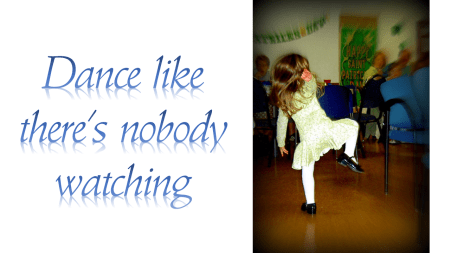
There is the lovely saying that includes the words “Dance like there’s nobody watching” and “Sing like there’s nobody listening”. The words are meant to be encouraging: “It doesn’t matter if you suck at it, just do it anyway.” I wonder why it doesn’t include the words: “Write like there’s nobody reading.” Would you? Do you?
Recently I admired and envied my 5-year-old granddaughter’s uninhibited self-expression as she sang and danced her way through the shopping centre. She didn’t care if anyone was watching or not. She was in the moment, in flow, sharing her joy in simply being. This is not a characteristic unique to my granddaughter. I have observed the same exuberance in other children.
Most often the children’s behaviour draws smiles from passing adults; but what would the reaction be if it were an adult singing and dancing through the shopping centre? The occurrence, at least with such enthusiasm, is much less common. Breaking into song and dance may seem normal in musicals but doesn’t generally happen in real life.
How would you respond? Would you smile, ignore, or hasten away?
I was fascinated by some videos I came across when I Googled “Dance like nobody’s watching”. Here’s one:
Children seem to vacillate through stages of “Watch me!” and “Don’t look at me!”, from pride to embarrassment.
I think it is that embarrassment that kicks in with writing, as it does with most other things. We learn to compare ourselves with others, and generally find ourselves lacking, If only we realised those “more confident” others probably feel the same.
“Recognizing that people’s reactions don’t belong to you is the only sane way to create. If people enjoy what you’ve created, terrific. If people ignore what you’ve created, too bad. If people misunderstand what you’ve created, don’t sweat it. And what if people absolutely hate what you’ve created? What if people attack you with savage vitriol, and insult your intelligence, and malign your motives, and drag your good name through the mud? Just smile sweetly and suggest – as politely as you possibly can – that they go make their own fucking art. Then stubbornly continue making yours.”
Gilbert says that we shouldn’t take “art” too seriously and quotes Tom Waits who once told her:
“You know, artists—we take it so seriously. And we get so freaked out about it, and we think that what we’re doing is so deadly important. But really, as a songwriter, the only thing I do is make jewelry for the inside of people’s minds. That’s it.”
I shared Elizabeth Gilbert’s TED Talk Your elusive creative genius in a previous post Whose idea is it anyway? over three years ago, but it is worth sharing again. With over 12 million views, I know I’m not the only one to find it worthy.
So, I’ve gone from audience to creativity. But what is creativity for, if not for audience? If your writing or artwork is not created to share with an audience; is the lack of an audience still uppermost in your mind as you create? Audience or no audience, self or other, how does it influence the process and product? Can you sing or dance without an audience, at least of self?
For my flash story, I’m going back to the carefree days of childhood when life was fun and there was not a care in the world, and you danced and sang, whether anyone was watching or not. Really?
The joy of childhood
The cool grass teased her toes and the breeze tugged at her skirt, begging her to dance. She flung wide her arms to embrace the world as she lifted her face to the skies. They smiled approval and she began to sway. Her fingertips tingled with expectation as her gentle hum intensified, summoning the music of the spheres to play for her. And play they did. She twirled and swirled to their rhythm singing her own melody in perfect harmony. Suddenly she was done. She clapped her hands to silence the orchestra and went back to her sandpit friends.
Thank you for being my audience. I appreciate your feedback. Please share your thoughts.
Yesterday, 2 March was Dr Seuss’s birthday. How did you celebrate? Did you read a favourite Dr Seuss story – maybe even more than just one or two? Which is your favourite?
Children love the rhythmic, rhyming stories written by Theodor Seuss Geisel who was born in 1904. (A question for your children – how old would he be if he was still alive today?)
Having fun with rhyme is a great way for children to learn about the sounds of language.
In the beginning, the rhymes can be real or nonsense words, as are many employed by Dr Seuss, training the ear to hear. Children are delighted when they discover pairs of words that rhyme. It is great when parents and teachers share their excitement of discovery too.
Like those of Dr Seuss, many stories and poems for young children are written in rhyme. The rhyme is pleasant to the ear, and encourages children to join in with the reading or telling, using meaning and sound to predict the next rhyming word.
When children are ready, familiar rhyming texts are often the first they read independently, using a combination of memory and print. How many children do you know who first started reading with a Dr Seuss book; such as The Cat in the Hat, Fox in Socks, One Fish Two Fish, Ten Apples Up On Top, or any other favourite.
For my part in the celebration, I joined in with a challenge extended by Vivian Kirkfield to write a story in 50 words. The reason behind the 50 word challenge is that, although the total word count of Green Eggs and Ham is over 700, only 50 unique words were used. (Some of your children may like to check if that is so. How could they do it?)
I decided to write a rhyming nonsense story in exactly 50 words (title not included). I hope you and your children enjoy it.
This week at the Carrot RanchCharli Mills is talking about rocks; rock formations in the landscape and rocks in the middle of the road, literally and figuratively.
She talks about the mesas in Zion National Park near to where she is living in Utah.
She describes it as 250 million years old with sandstone cliffs reaching ¾ mile, or 1207 m, high.
Of course, I can’t think of large sandstone rocks without thinking of Australia’s Uluru/Ayers Rock, the world’s largest sandstone inselberg or “island mountain”, which I was lucky enough to visit a couple of years ago.
We’re not going into competition here, but Uluru is estimated to be about 600 million years old. Reaching (only) 348 metres high, it is not as high as Zion’s cliffs. However, it goes deeper under the ground than above.
While indigenous peoples of Australia have lived near Uluru for at least 10 000 years, it was only “discovered” by European explorers in the mid-nineteenth century. They named it Ayers Rock after the then Chief Secretary of South Australia Sir Henry Ayers. Since 1993 it has borne the dual name Uluru/Ayers Rock.
I couldn’t imagine what it must have been like for those first European explorers when they came across the enormous rock which reaches further below ground than it does above, though I guess they didn’t know that at the time. There are also many other hazards to negotiate in Central Australia.
With Charli’s challenge to write about a rock, I was tempted to innovate on Michael Rosen’s Going on a Bear Hunt.
“Oh-oh, a rock.
A big red rock.
Can’t go over it.
Can’t go under it.
Oh no! We’ve got to go around it.
Huff-puff. Huff-puff.”
But Charli moves on from the literal to the figurative as she describes challenges; the ones, unlike sand that is easy to sweep away; as “rocks in the road”, rocks that “cannot be ignored . . . (that) call us to change or be changed.”
Sometimes the rocks have been placed by someone or something else. Sometimes they are of own making. Sometimes they reside only in our heads. Often the rock’s size and our ability to move it depends on our attitude.
There is a rock in my path at the moment; small but, like a pebble in a shoe, bothersome. I have tried many alternatives but not yet found the solution. There is a popular saying that “When the student is ready, the teacher appears.” I’m ready and waiting.
Sometimes I feel that my attempts are a bit like those Sisyphus moving his rock, but without the physical effort. Sometimes I just think I’ve got rocks in my head. Most people don’t understand why I bother; but how can I not?
Edison said,
“I’ve not failed. I’ve just found 10 000 ways that won’t work.”
I don’t think I’m quite to 10 000 yet, but the number is growing.
As Charli says, those rocks call us to change; they give us an opportunity for new learning. I’m never against learning something new. I’ve combined these ideas in my story.
But before I take you there, I want to tell you about Charli. She has been squeezed between a rock and a hard place since she was kicked out of her beautiful home over six months ago. You can only admire her tenacity in remaining positive. With all the rocks that have been pelted at her, she still takes up the broom to sweep away the rocks that fall in others’ paths. Please check out her post and read of the J-Family, who have finally found a home after months of homelessness. Charli is hosting a Amazon Housewarming party to help them acquire basic household items. The seven-year old boy would also love some books to read. If you can help, please visit Charli’s post for details.
The newcomer was intrigued. Every morning she’d be there, filling a battered barrow with rocks from the road. You’d think that, after a day or two, she’d have removed them all. But, every morning, even earlier, a quarry truck would rumble by, spilling more.
Longer-term residents shrugged indifferently, “She’s got rocks in her head.”
When he asked her one day, she replied, “Come and see.”
He followed into her back garden, and watched. She stood at the edge of a pit and threw in the rocks. After each she listened, hopeful of a sound, of one day filling it.
Thank you for reading. I appreciate your feedback. Please share your thoughts.
I love poems. Children do too. Poetry is a great way of introducing children to the joy of language, as well as to features such as rhythm, rhyme, alliteration, similes and metaphors. What is taught through poetry can be as simple or as complex as required by the ages of the children or your teaching purpose.
One of the great benefits of teaching young children through poetry is the fun aspect. It’s enjoyable for teachers and students alike and, when children innovate on poems to create poems of their own, very motivating.
With St Valentine’s Day not far away it is timely to read and write love poems. One of my favourite poems for writing with young children is based on the traditional camping song I love the mountains. I was taught the poem by the amazing literacy educator Bill Martin Jr at a reading conference in the 1980s, and used it with every group of children I taught thereafter. I have previously written about that on my other blog here.
The repetitive structure and easy melody invites children to join in and is easy for children to use in writing poems of their own, whether they are emergent, beginning, or advanced writers. The poems can be completed using pictures or words.
I am a fan of creativity. I like to develop my own creativity, and I like to encourage the development of creativity in others.
One thing I always loved about teaching was the opportunity it gave me to be creative: writing stories, units of work, and lessons plans to interest and excite the children about learning. It is this love that drives me to write my blog posts each week, and to create new early childhood teaching resources for readilearn nearly every week.
Just as exciting was the opportunity to support the development of children’s thinking, imagination, and creativity. I am more in favour of treating children as individuals, than as one of a homogeneous group from which any difference is considered an aberration. After all, imagination and creative thinking are what inspire and drive improvement, innovation and progress.
I affirm my belief in the power of creativity in my tagline: ‘Create the possibilities . . .’, a tagline I previously used for an independent school I was establishing.
Preceding both was my first independent undertaking: Create-A-Way. Create-A-Way provided a richer educational and social setting for my young daughter than what was generally available, allowed me to share my educational philosophy and knowledge, and provided the same rich learning opportunities for other children and their parents. The development of imagination and creativity was a focus.
Guiding parents in play sessions for parents and children.
One of the things I love most about responding to the weekly flash fiction challenges set by Charli Mills at the Carrot Ranch is the additional opportunity to engage in something creative and to hone my writing skills. The supportive environment of a welcoming community makes it a safe and enjoyable experience. There is something affirming about belonging to a community of other creatives, online or in -person.
On Saturday I, along with a whole bunch of other women creatives, attended an excellent Book Marketing Masterclass conducted by authorpreneur Karen Tyrrell. (I am looking forward to interviewing Karen for the Author Spotlight series on readilearn in March.) The class was attended by writers of a variety of genres; including memoir, romance, science fiction, fantasy, YA, and picture books.
One of the attendees Chrissy Byers has created a lovely picture book The Magic in Boxes which “aims to capture the imagination of young readers and inspire creative play.”
Not only does the book suggest ways of stimulating creativity using recycled materials such as cardboard boxes, the book is made from recycled paper. I think that’s pretty awesome. It’s a beautiful book with a wonderful aim.
For a little more on creativity; in a previous post, Are you a lemon or a grapefruit? I shared ten articles about creativity. They are still relevant and worthy of a read if you haven’t yet done so.
I also shared one of my favourite TED talks by Sir Ken RobinsonHow schools kill creativity. If yours is not yet one of the over 41 million views, I urge you to watch it. As well as sharing a very important message, Ken is hugely entertaining.

 Karen is an award-winning author who writes books to empower kids (and adults) and help them live strong and be resilient. After many years of classroom teaching experience, she continues to educate through sharing her own story of resilience as a survivor of bullying, through her words on the page, and through her workshops for adults that deal with writing, marketing, and funding, in addition to empowerment.
 The Battle of Bug World is a fast-paced and action-packed story that children won’t want to put down until they find out if, and how, Song Bird can save her sister, her friends, and the environment from her evil neighbour Frank Furter.















 Norah Colvin