Establishing a supportive classroom environment from day one builds a strong foundation of positive relationships and attitudes to school and learning. It is important to begin the year as you wish it to continue, and a welcoming classroom helps children and families feel valued. Having an organised classroom is just a part of it.
Many existing readilearn resources support the establishment of a supportive classroom environment.
In many of the schools in which I have worked, children are expected to bring their own set of supplies – books, pencils, scissors, glue, paint shirts, even tissues. I recognise that not all schools have this requirement, so ignore any suggestions that are not relevant to your situation.
Whether children are required to bring their own supplies or not, it is useful to have spares
The love of reading is one of the greatest gifts a parent can give a child.
Reading is empowering, and a book is a gift that continues to give, long after the occasion has past. It’s effects cannot always be measured.
To help you decide which books to give to whom for Christmas, I thought I’d make your task a little easier by reminding you of the lovely books I shared throughout the year in interviews with their authors and illustrators.
Below you will find a list the books and their authors and illustrators. I also include links to
the interview on the blog
the interview in the Author or Illustrator Spotlight
the creative’s website
a place where the book may be purchased.
Many of these authors and illustrators have more than one book, some for readers in other age groups, including adult, so please check out their websites for additional information.
At the conclusion of the post, I list other books read and enjoyed. Sadly, there’s just not enough time for all the interviews I’d love to do.
Of course, the list is not exhaustive. These are just a few suggestions to get you started. Enjoy!
I’m so delighted to share this post on Sally Cronin’s lovely Smorgasbord – Variety is the spice of life blog. It allowed me to see my thoughts from a completely different angle. Please pop over to read and let me know what you think.
As December draws nigh, thoughts all over the world turn to celebrations of Christmas, a time for spreading joy through sharing acts of friendship and kindness to others.
Those of us in the Southern Hemisphere are also thinking about finalising the school year and taking a much-deserved long summer break.
Before we do, we look for ways of celebrating Christmas in the classroom while maintaining children’s focus and keeping them engaged in meaningful learning until the final moments of the school year.
While there are a variety of readilearn resources already existing to help you do that, this week I have uploaded four more, all of which support use of the popular interactive digital story Who’s hiding at Christmas?
The Who’s hiding at Christmas -template is a printable resource with both template and instructions for children to make their own Who’s Hiding at Christmas book based upon the original. Children love to share their own Who am I? puzzles, and, as well as providing ongoing practise with both reading and writing skills, the booklets make a lovely gift for sibling or parent.
I have the very great honour of being featured among the lovely Smorgasbord Posts from Your Archives series on Sally’s Cronin‘s blog. Sally has graciously shared one of my earlier posts What you don’t know.
Thank you, Sally, I am delighted to be featured on your blog.
Have you ever had that moment of inspiration when two ideas mesh and you know you’ve found the answer? I’m certain you have. It’s creativity. It’s energising. It’s like bubbles in a can, popping all over the place, bursting with exuberance, needing to express; and there’s no keeping it in.
Writing is like that for me. Writing or teaching. Writing and teaching!
Except for when it’s not.
I can think and think and think and struggle to find an idea. But as soon as the two (or more) right ideas come together, there’s an explosion, and I just can’t wait to get it down, or try it out.
It’s what I love about creating teaching resources. I think: how can I best explain this concept, what will children enjoy most, how will they best learn? Fizz! And I’ve just got to do it. I love the creative outlet. Without it, life’s just, well – dull.
I like to think that what I write is different; that my teaching resources differ from the millions of repetitive worksheets that are written to keep children busily unengaged in the learning process. I imagine myself using them, and having fun with my class. I like to think of other teachers using them to encourage children to think creatively, critically, logically, imaginatively, and learning through discussion with their teachers and peers. But do they? I like to think.
Do you hear that self-doubt? Like so many creatives, I find self-promotion difficult. I struggle to put my work out there for fear it might not be good enough. Each new step requires blinkered determination, focus, and practice, practice, practice to strengthen self- belief that wavers at the first hint of a breeze.
But did you see that? I called myself a creative. Should I? Do I have the right? I always say that one thing I loved about teaching was the opportunity it gave me to be creative. Though I may think I was creative, does my thinking allow me the label?
A few years ago, I gave myself some good talking-tos, took some deep breaths, and attended a writer’s group. Sure, they were the creative types – picture book writers and junior fiction writers. And me. Well, I was aspirational, but had a number of educational publications behind me and was working on my own collection of teaching resources.
In turn, around the circle, we were required to introduce ourselves to the group, sharing what writing we were working on. I could have said I was working on picture books and junior fiction. I have several stuck away in drawers for future development, many with rejection slips to prove I was aspiring. I’d been collecting rejection slips since long before many of these writers were born. I must admit that none of them were recent though, as I’d been more involved in other things, including educational writing.
When it was my turn, I took a deep breath, and stated that I was involved in educational writing at the moment. “Oh,” said the leader. “Educational writing. That’s so formulaic.” And she quickly turned to the next person. Well, if that didn’t burst my bubble. The confidence I’d struggled to muster to even attend the meeting was felled in one swoop.
Not only was she wrong, (well, I believe she was wrong), her attitude was wrong, and her response to an aspiring writer was wrong. She asked no questions, gave no opportunity to discuss why my work may be considered creative, or what other more creative writing I might engage in. She obviously considered I had no business being there among the “real” creatives.
Similar difficulties can be experienced by children in school. People are quick to judge, assess and dismiss on perceptions of background, ability and potential. It can be difficult to stay strong and persistent when the brush of other’s biases paints you inadequate. Without a strong framework and inner fortitude, the will may crack and crumble at the first sign of tension.
Surely, one purpose of education must be to build those strong foundations in order to avoid wreckage in the future. Just as for buildings, we start from the bottom, building on a strong base, adding more to each layer. There’s no starting at the top, or even the middle. Each new layer must mesh with the one before.
I immediately thought of the mesh that is embedded in concrete to give it inner strength, to hold it together when under pressure, to prevent it cracking and crumbling. What a great analogy for both personal core strength and a foundation of a great education. How could I resist?
Here’s my story. I hope you enjoy it.
Strong foundations
Jamie heard the vehicles; the doors slam; then men’s voices. He looked to his mum. She smiled and nodded. Dad was already there, giving instructions.
“Watch, but don’t get in the way,” he’d said.
Clara arrived, breathless. “What’s happenin’?”
“Carport. Pourin’ the slab,” he answered. “That’s the frame. Keeps it in shape.”
Beep. Beep. Beep. The concrete truck backed into position.
The men quickly spread the mix, then lifted the mesh into place.
“Makes it strong,” said Jamie.
Another load of mix was spread.
“All done,” said Jamie.
Later, in the sandpit, the children experimented with strengthening their structures.
Thank you for reading. I appreciate your feedback. Please share your thoughts.
P.S. If you are a teacher of children of about 5 to 7 years of age in their first three years of school, I’d love your feedback on readilearn, my collection of early childhood teaching resources. Please complete the survey here and share this post with other early childhood educators you know. I am keen to receive honest feedback about the site’s visual appeal and usability, as well as suitability of resources. Thank you. 🙂
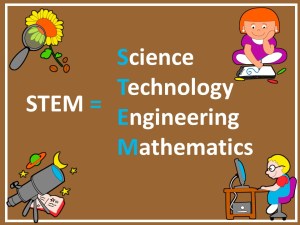
Making space for STEM in early childhood classrooms is easy; or should be.
Children are naturally curious about the world. They want to know:
Why is it so?
How does it work?
What will happen if?
How can I?
It is important to harness their curiosity, explore their questions, engage their interests and inspire their imaginations.
Provide them with opportunities to investigate objects and phenomena in the world around them. Don’t always be in a rush to provide answers to their questions. Help them explore ways of finding the answer for themselves, if possible, or conduct the research with them.
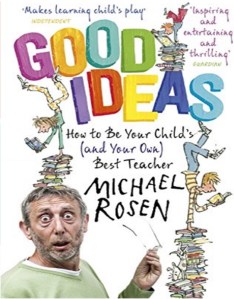
A story reported by Michael Rosen in his book Good Ideas: How to Be Your Child’s (and Your Own) Best Teacher inspires me. The story explains that, as a child, David Attenborough took an interest in bones. If he was out walking and found some bones, he would take them home and ask his father about them.
His father, who was a GP and would have known, didn’t just tell him. Wanting his son to be curious and interested in finding things out for himself, he responded, for example: “I wonder if we can work it out . . .” They would then look through books about zoology and anatomy and try to identify the bone’s origin.
However, the answers don’t always have to be found in a book or on the internet. Some answers can be discovered through explorations and experimentation. Experts can also be consulted.
In a stimulating early childhood classroom where children have access to a range of resources and opportunities
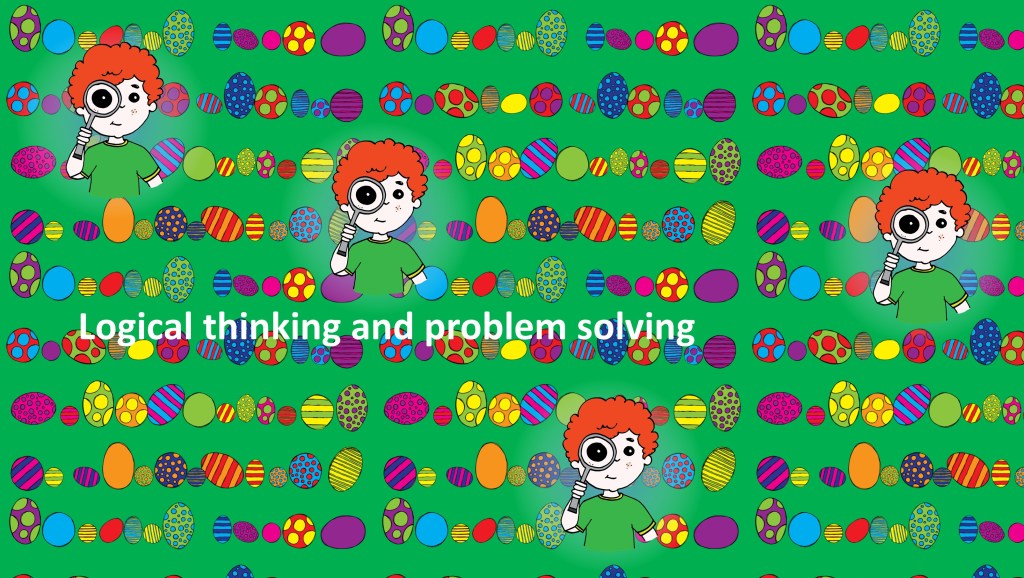
Logical thinking and problem solving are important skills for children of all ages to develop, including those in early childhood classrooms. We employ thinking skills each day, in many situations, from deciding the order in which to dress ourselves, complete simple tasks, collect items for dinner or set the table; through to more complex problems such as assembling furniture, writing work programs, juggling timetables, and organising class groupings for activities.
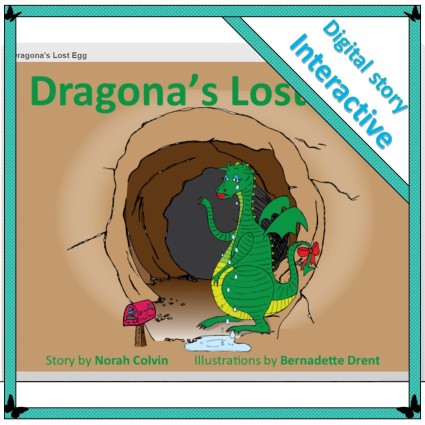
This week I am excited to upload a new interactive digital story that encourages children to use logical thinking to solve a problem.
Dragona has lost her egg and turns to her friend Artie, owner of a Lost and Found store, for help. Artie is confident of helping her as he has many eggs on his shelves. He asks Dragona to describe features of her egg, including size, shape, pattern and colour. He uses a process of elimination to identify which egg might be Dragona’s. Children join in the process by choosing eggs with the characteristic described.
What is Dragona’s egg really like, and will Artie be able to help her find it?
You’ll have to read the story to find out.
The process of writing this story also required a problem to be solved; and I love nothing better than a good problem to solve.
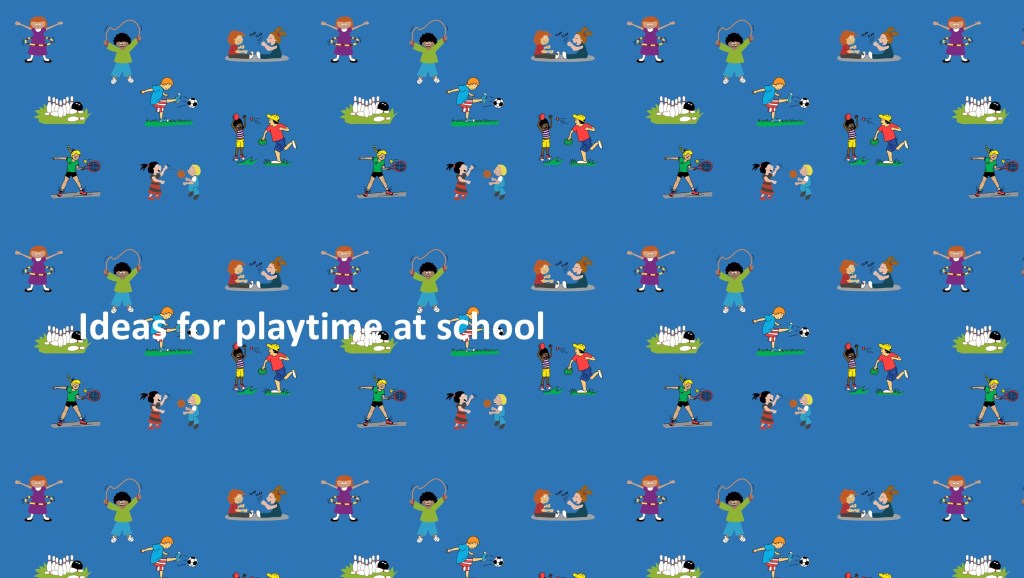
We generally think of recess as fun time for children. But it is not always so for those who find socialising difficult or for those who have trouble thinking of something to do.
Incorporating social and friendship skills into the daily class program has enormous benefits in preventing unhappy times in the playground.
Happy and peaceful playgrounds can be cultivated by:
providing children with strategies for friendly play, including how to join in, participate, and allow others to join in;
teaching children activities and games to play alone or with others;
offering equipment to support those activities and games.
Peaceful playgrounds filled with happy active children contribute to a healthier, happier community more able to focus on learning during class time.
Being active contributes to children’s overall physical development, including gross and fine motor skills and eye-hand coordination, and fitness.
Opportunities for introducing activities and games can be seized in many areas of the curriculum. In addition to the obvious; physical education, they can be slotted into
Charli writes about our fear of change, fear of the unknown, and of the need for guides “to bring us in to a new harbor, a light to show us the rocky shoals.” She suggests that “Perhaps blogging, writing, are mediums of light that shine a path to bridge cultural differences.” but also acknowledges that, “Instead of looking for a way, some people have backed out of the water and barricaded themselves on the beach.”
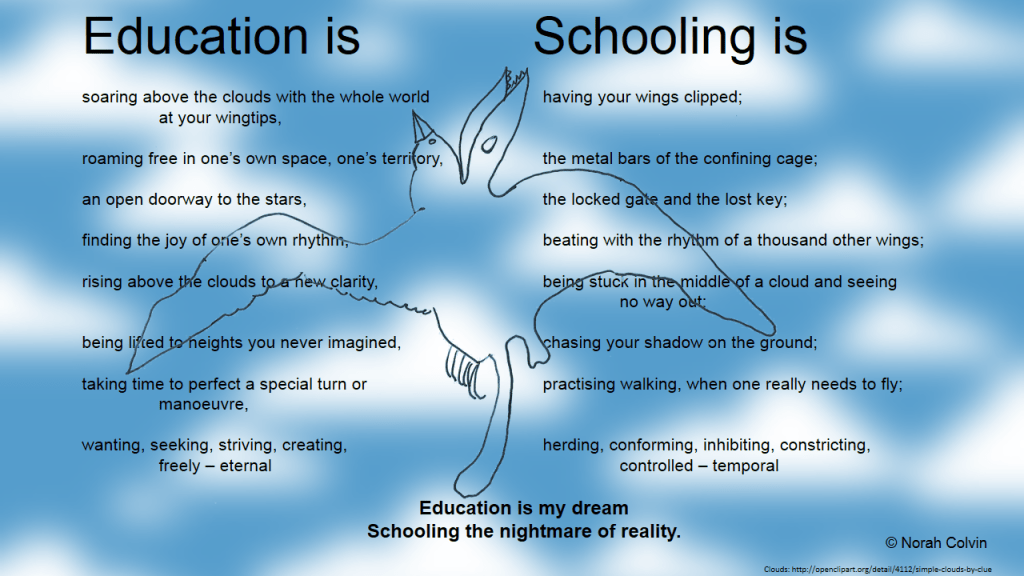
I see education as the way that will bring us to a “new harbour”, the light that will “shine a path to bridge cultural differences”. Sadly, as I say in my poem about education, there is far too much emphasis on schooling and not enough on education, too much desire to keep the masses down by the insistence on conformity and ignorance rather than the encouragement of creativity.
I was well-schooled as a child, but have spent my adulthood exploring what it means to be educated and promoting the benefits of a learner-centred education as opposed to other-directed schooling. I read of a book about “teaching backward”, beginning with what the student needs to know and working backwards. (Needs as determined by others, not the student.) I’d rather teach forwards, beginning with what the student wants to know and going from there.
When my earliest teaching experiences fell short of my expectations, I searched for the beacons to guide my way out of the murkiness in which I found myself. I devoured books by John Holt, A. S. Neill,Ivan Illich, Paolo Freire, and others, with ideas about education and schooling that were as challenging as they were exciting. I read of innovative educators such as John Dewey, Maria Montessori, and Rudolf Steiner.
The ideas challenged what I’d been taught but blended comfortably what I had learned through observation of children, including my own young child, and relating it to my own experiences. The pieces began to fit.
At about the same time, I undertook further studies in literacy learning and was fortunate to work with a team of inspired educators led by Brian Cambourne, whose work and guidance placed the piece that helped the puzzle take shape, and guided my learning journey.
Beacons, or shining lights, that guide and inspire us, are as essential to our growth as sunlight is for plants. Educators such as those mentioned, and more recently, Ken Robinson, Rita Pierson, and many others, are such beacons. We are constantly told of the success of the Finnish school system and I wonder why it is that those holding the power in other school systems fail to see their light. We need at least one to rise above the fog of number crunching and data collecting to see the bright lights shining on the hill.
Is it fear, as Charli suggests, that keeps them out of the water? I watched the movie Monsters Inc on the weekend. It seems to deal with the issue of controlling the masses with falsehoods and fear quite well. It is also a great laugh – one of the most entertaining movies I’ve seen for a while. If you haven’t seen it yet, I recommend it.
I’ve attempted a similar situation with my response to Charli’s challenge. I hope it works.
Let there be light
Eyes squinted in the dim light under low ceilings. Immobilised by never-ending paperwork, the menials dared not look up. Flickering numbers on data scoreboards mesmerised supervisors. Inconsistencies meant remonstrations, even punishment, from above. Heads down, keep working, don’t ask questions. The system worked fine, until … Maxwell nodded off. His pencil fell, tapped first, then rolled away. Startled, Maxwell went after it. The room stilled. Sliding too fast, he slammed into the wall, activating a button that illuminated a set of stairs leading up. Everyone gasped. Maxwell hesitated, took one step, then another. Nothing happened. He continued. Everyone followed.
Thank you for reading. I appreciate your feedback. Please share your thoughts.

















 Norah Colvin