My first thought when reading this week’s flash fiction prompt set by Charli Mills at the Carrot Ranch: in 99 words (no more, no less) write a story about water, was of the street on which I had hoped to open an alternative to school twenty years ago. I thought I could write about the property which, located on the corner of Water and Love Streets, seemed ideal. I thought I could write about the vision of our group “The Centre of Learning Opportunities” with its focus on the children’s program “Kids First” and how our centre would cater for children and families. I thought I could write about how we would implement our motto “Create the possibilities” which I have also adopted for my blog. But just like the centre itself, it didn’t eventuate.
Instead I thought a little deeper, considering how water is the substance of life, how fortunate we are in developed countries to be able to turn on a tap and access clean water whenever we want. According to the UN almost 8 million people do not have access to clean water and more than 2 million do not have adequate sanitation. Millions of people die each year from diseases related to water. The projections of water availability and access are quite alarming.
I thought about the use and misuse that is made of water in our rivers and streams and of a local issue that was reported quite recently.
I decided to write a poem about the journey of a river, from its beginnings high up in the mountains down to the sea; how it starts out crystal clear but picks up toxins as it wends it was down. You can probably guess that my next thought was of education; of how children begin full of wonderment and creativity but, as they are subjected to years of schooling, collect toxic thoughts and attitudes.
That may seem a bit harsh I know, and I have written a poem before comparing what I consider Education is to what I think schooling is.
However I thought I’d try to write a poem as an allegory of the schooling process; likening the way we are polluting our waterways to the way we are polluting and muddying the minds of our children. I’m not very happy with my first (fifth!) attempt, but I have met the word requirement and Charli’s ‘deadline’ is fast approaching.
Let me know what you think.
Water
It started way up
In the highest of hills
So crystal-clear pure
With a life to fulfill
It babbled through forests
And danced in the streams
Marveling at wonders
Before never seen
It passed through the valleys
Irrigated the farms
Taking the runoff
And doing no harm
Down past the villages
Watered them too
Acquiring their discards
Now murky like stew
Passing by factories
Spewing out waste
Picked up their burden
And left without haste
Weaving its brown trail
Way down to the sea
From its mouth vomited out
A poisonous mix
Deceiving all living things
Expecting a gift
However I don’t want to leave you on a negative note. I’d rather acknowledge that there are many wonderful things happening in schools around the world. There must be, or we couldn’t be making the advancements we do.
I have shared many great things with you before like some of these great articles on edutopia.org. Just last week I shared information about a prize for innovation in inclusive curricula being awarded for a program, Big Questions teaching philosophy to children. Listen to any TED talk to be amazed at advancements and innovations.
I value your feedback. Please share your thoughts about any aspect of the article or my flash ‘poetic’ fiction piece.
In a previous post I wrote about 3 inspiring educators. In no way did I wish to indicate that the number of inspiring educators was limited to those three or that all inspiring educators are male. The list of inspiring educators is far greater than that and includes both male and female representatives.
The purpose of this post is to both honour, and share the wisdom of, other educators who have positively impacted my life and thinking as an educator and the lives and education of many others. The list doesn’t end here. There will be more to follow.
Maria Montessori’s name is known worldwide as the founder of the Montessori Schools. However her influence is not restricted to those schools. Many educational practices implemented, especially in the early childhood setting were influenced by Maria Montessori.
Maria resisted the gender-stereotyping conservative views of Italy where she lived in the late nineteenth century. She developed her interest in maths and sciences, especially biology, and became the first female doctor in Italy.
As a doctor Maria worked with children from poor and working class families. She developed the belief that every child had an intrinsic intelligence. She studied child development and education extensively and developed methods of implementing her theories. She traveled Europe sharing her ideas and advocating women’s and children’s rights. Her success with disabled students led to implementation of her methods with ‘normal’ children.
Montessori’s methods put the child’s interests at the front of the program. The teacher was to ‘follow the lead’ of the child.
Practices now seen as standard that were initiated or influenced by Maria Montessori:
incorporation of children’s interests, putting their interests first
recognising the development of the individual and making education appropriate to it
use of child-sized furniture and shelving
practical activities such as sweeping and cleaning up
environmental activities such as gardening
health and hygiene practices, such as washing hands, sharing morning tea, cooking
indoor/outdoor areas that children move about freely
opportunities to work independently
respecting the child as an individual
She valued independence and saw it as the aim of education, with the teacher as observer/guide of children’s development.
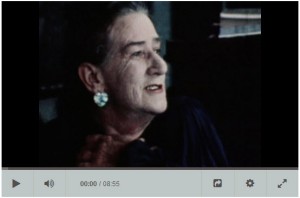
Sylvia Ashton-Warneris a New Zealand writer, poet and teacher whose educational work I became familiar with in the 1980s through her books Teacher and Spinster, the latter of which was also made into a movie.
Sylvia, who in the interview below states emphatically that she is not a teacher, that she hates teaching and can’t stand education, has been very influential on teachers around the world.
i was unable to embed the video. Click on the image to go to the original site.
Sylvia says,
“There’s a formula for all my teaching. It’s quite simple. I supply the conditions where life can come in the door . . . where both our teacher and our child can be themselves.”
Working with Maori children from poor and dysfunctional families and using organic reading, she developed what is called the ‘Key Vocabulary’; those words holding most meaning and interest to the child. The child asks for a word, the teacher writes it on a card. The child reads the word and copies it to write. The words requested are usually nouns and hold a lot of meaning for the child.
I implemented her ‘Key Vocabulary’ for many years and found it to be a successful tool for developing readers and writers.
Marie Clay is another New Zealand educator best known for her work with literacy education and the Reading Recovery program which was developed to support students whose reading skills were delayed. She believed that early intervention was the key to improving literacy skills.
I first came across her work in her book Reading: The Patterning of Complex Behaviour in 1979. Her 1983 publication Record of Oral Language provided teachers with methods of observing and recording children’s development in literacy.
The Reading Recoveryprogram, based on Marie Clay’s work and developed in the early 1980s, provides one-on-one support for students who are experiencing difficulty with reading in the first years of school. The teachers undergo training which develops their understanding of the reading process and how to support a student’s development. The training is more intensive and thorough with methods specific to this purpose, than generalised teacher education. However knowledge of her research, innovations and methodologies are also of benefit to generalist teachers and have been incorporated into many teacher education programs.
I was very disappointed, as were many other classroom teachers, when this successful program was discontinued in our region earlier this century.
I couldn’t put this book down. My thinking about the brain and learning was being challenged but excited at the prospect of overcoming learning problems experienced by many students.
For years I watched helplessly as scores of struggling learners were pummelled with repetition of the same boring and meaningless methods that created (or at least contributed to) their problems in the first place; of seeing them humiliated by having to repeat a year at school, or being considered ‘dumb’ because they couldn’t do what the other kids could do. Now here was a book that suggested this need not be so. If only those making the decisions and delivering the programs could be influenced.
One of the most memorable stories from the book was that of Barbara Arrowsmith-Young. Barbara suffered from severe learning disabilities throughout her childhood and early adult years. Every known method of compensating for the disabilities was tried without success. Barbara felt humiliated and a failure.
Her life changed dramatically when she heard about neuroplasticityof the brain (the ability of the brain to change in physiology and functionality) and created exercises for her brain, teaching herself to do things she had never done before.
Her story is an inspiring one of courage, strength, and persistence. Barbara has changed her life. After turning her life around, Barbara has developed programs for others with disabilities to engage with. She started the Arrowsmith School in Toronto in 1978. The Arrowsmith Program is now used in schools in the US and Australia as well as Canada.
Barbara’s “vision is of a world that we create in which no child has to live with the ongoing struggle and pain of a learning disability. . . that cognitive exercises become just a normal part of curriculum. . . that school becomes a place that we go to strengthen our brains to become really efficient and effective learners engaged in a learning process where not only, as learners, can we dare to dream, but we can realize our dream . . . This is the perfect marriage between neuroscience and education.”
She travels the world sharing her message so you may even have an opportunity of meeting her in person. I saw her last year at the Brisbane Writers’ Festival. Magic!
You may have noticed some unifying threads with each of these educators:
A focus on the child, the child’s interests and life
A recognition of the child’s ability to learn
An optimism in the child’s ability to learn, for success and the future
All educators worked with students from disadvantaged backgrounds or with disabilities or both; and all achieved success.
I welcome your feedback. Please share your thoughts about any aspect of this article.
Brian is an amazing literacy educator from whom I had the extreme good fortune of learning many years ago. I have written about him before here and here.
Brian’s work focused on the conditions necessary for literacy development. His influence has spread beyond the classroom with the application of the conditions to learning in the workforce demonstrated.
Tony is an amazing educator who does his best to be the change he wants to see in the world. He talks about future-proofing and using innovative thinking to solve problems of both local and global importance.
Anyone who believes ‘that education is the most important profession on the planet’ and does everything in his power to support teachers to be outstanding, as does Tony; must be pretty good in my books.
One of Tony’s books The Ripple Effect is particularly apt for mention in this post. Tony says,
“you must believe in your personal power to create ripples that spread out and change the world. In fact, if it is not you who is going to do it, then who else do you think is likely to make the effort? Remember that every change on this planet begins with a human being somewhere, somehow. It may as well be you.”
This year Tony has started a new project called The Earth Movers Foundationwhich ‘helps young teenagers to create solutions to local and global issues. And they get to choose their own project. No adults will be telling them what project to do. They decide for themselves.’ Sounds pretty good to me.
Ken is another amazing educator. I fell in love with his ideas when I listened to his TED talk Do schools kill creativity? which I have also shared before here.
The statement on his website declares that
“Imagination is the source of all human achievement”.
I could not argue with that.
Ken introduces this short video The writing spirit which presents quotes from artists, thinkers, writers, innovators and snippets of interviews with writers. Just incidentally, and exciting for me, Richard Bach is included. Richard is the author of Jonathan Livingston Seagull, one of my favourite books for its inspirational message.
It is more than likely that these educators have no idea how they have influenced my life (and others as a result).
How wonderful might it be to know of the positive influence you have had on someone, and to have the opportunity of letting others know that they have positively impacted your life?
This is the purpose of The Butterfly Light Award which was bestowed upon me my Lisa Reiter, a lovely lady who is herself inspirational for her courage and her positive attitude which she shares with others through her blog Sharing the story. Thank you, Lisa. I am honoured and accept with pleasure.
As with any award, it comes with conditions:
You should write an acceptance post, making sure you link back to the blogger who awarded you and thank them. You MAY NOT lump this award in with a batch of other awards.
You must individually name and re-award to a minimum of 1 and a maximum of 9999999 bloggers. You must let them know either personally with a comment on their blog OR a pingback.
As I have been writing about educators, I am going to stick with that theme. A quick visit to these blogs will explain why I have selected them.
You must write a short paragraph entitled either “How I’m Spreading Light” OR “How I’m A Positive Influence” (what Lisa calls ‘the squirmy bit’).
Done! See beginning of article.
5. Display Belinda’s lovely “Butterfly Light Award” badge on your blog.
Thank you, Belinda. It’s a pleasure! We can never have too many butterflies!
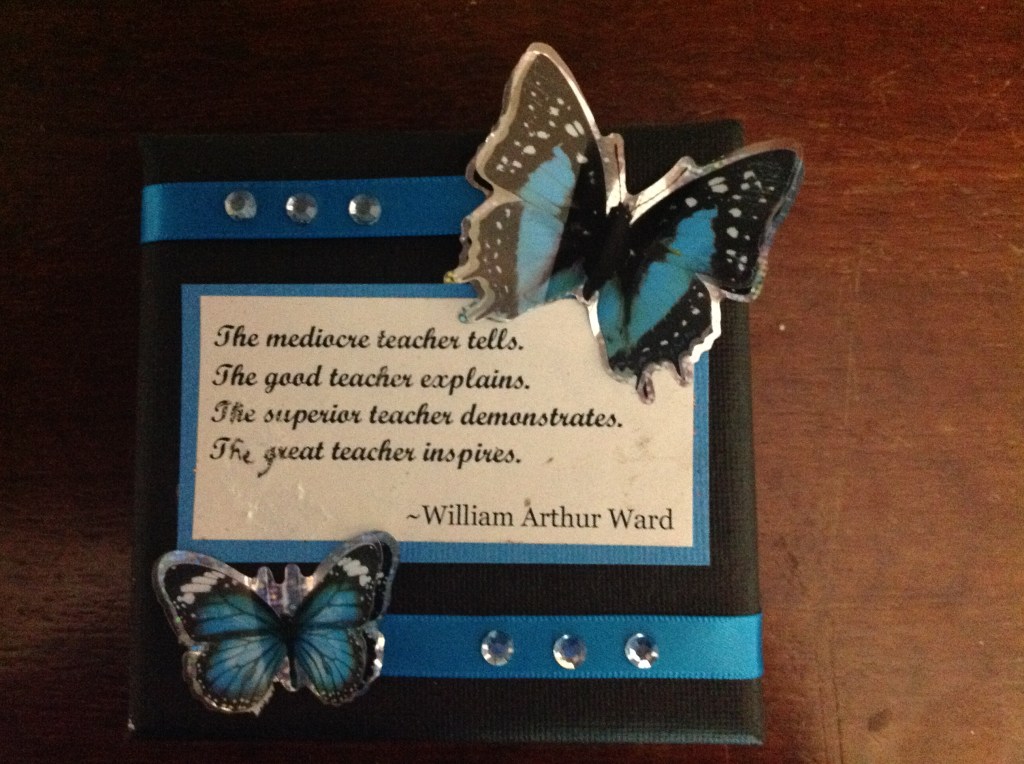
Note: The beautiful framed quote, pictured at the top of this post, was made for me by a wonderful lady, the mother of two of my students. They all share my love of butterflies! I thank them for sharing their appreciation of my positive influence.
I welcome your feedback. Please share your thoughts about any aspect of the article.
In my previous post Life: a choose your own adventure – how do you chooseI discussed the difficulties we may experience in prioritising options and choices, and the need to be self-regulatory in performing tasks and achieving goals.
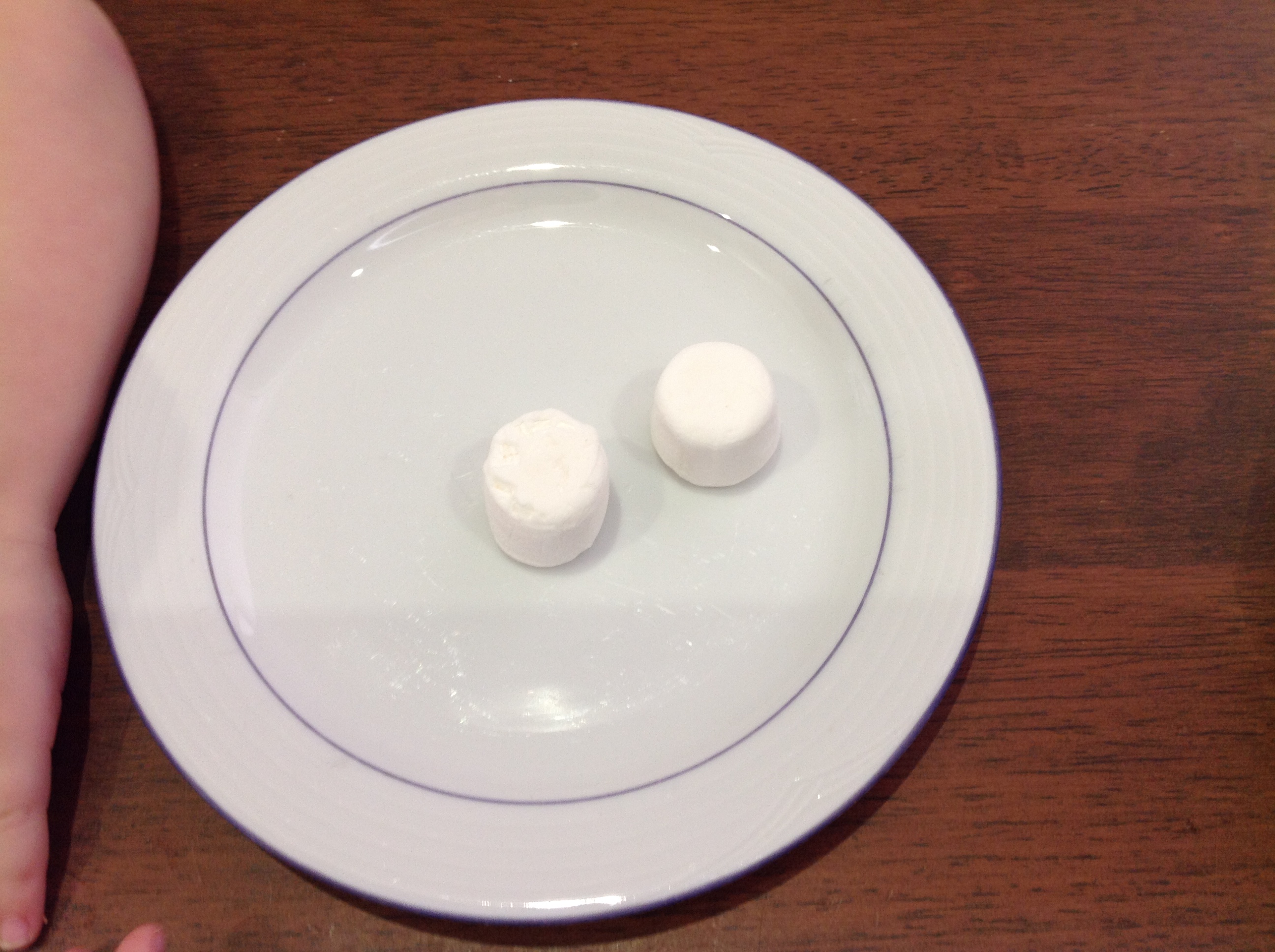
The discussion reminded me of the marshmallow test I had heard about from Daniel Goleman in his book “Emotional Intelligence”.
The marshmallow test was a study conducted in the 1960s by Walter Mischel .
As described by Daniel Goleman, “In this experiment four-year-olds from the Stanford University pre-school were brought to a room and sat in a chair in front of a juicy marshmallow on a table. The experimenter then told them they could eat it now, or get two if they were willing to wait until the experimenter came back from running an errand.“
You can watch a video demonstrating the experiment here:
Some children could not wait and ate the marshmallow as soon as the examiner left the room. Others toyed with the idea of waiting, but were unable to resist the temptation. Others were able to wait and scored two marshmallows when the examiner returned.
While this study revealed certain aspects of childhood behaviour, follow-up studies into the behaviour of these children when young adults and graduating from high school revealed that “Those who waited, compared to those who grabbed, were more popular with their peers, had less trouble delaying gratification, and scored far higher on achievement tests.”
A further study, conducted 40 years later, as reported by Sylvia R. Karasu writing for Psychology Today, found that “the ability to resist temptation is fairly stable over the lifecycle and predictive of behaviors 40 years later!”
Goleman talks about the important role of parents in supporting children to develop the ability to control impulses and choose behaviour. As children learn to internalise and choose the ‘no’ imposed by others, they learn to regulate impulsive behaviour. He calls it the ‘free won’t’, “the capacity to squelch an impulse.”
Karasu supports this by saying that “The researchers also suggested that a family environment where “self-imposed delay” is “encouraged and modeled” may give children “a distinct advantage” to deal with frustrations throughout life.”
Goleman says that the ability to curb dangerous impulses is an aspect of emotional intelligence, “which refers to how you handle your own feelings, how well you empathize and get along with other people. (He says it) is just a key human skill.”
He continues by saying that “it also turns out that kids who are better able to manage their emotions . . . can pay attention better, take in information better, and remember better. In other words, it helps you learn better.”
It sounds like emotional intelligence is something that all schools should be developing, don’t you think?
Goleman says that the “ability to delay gratification hinges on a cognitive skill: concentrating on the good feelings that will come from achieving a goal, and so ignoring tempting distractions. That ability also lets us keep going toward that goal despite frustrations, setbacks, and obstacles.”
Without that ability it may be difficult for any of us to achieve our goals. Saving for the future, studying towards a qualification, working harder now to have time off later; none of these would be possible without the ability to delay gratification.
But can emotional intelligence be taught? And should it be taught in schools?
It seems to me that if emotional intelligence is able to predict “success” in later life, then it is important to develop it as early as possible. This can begin in the home with parents helping their children learn to delay gratification, build resilience and develop empathy.
I believe it is important to make a place for programs that develop emotional intelligence in schools. Children need opportunities to internalise emotionally intelligent responses to a variety of situations. A very structured, force-fed, content driven, test based approach where almost every action is directed and monitored leaves little room for students to develop skills of self-regulation.
Discussions of whether emotional intelligence can, or importantly should, be taught in schools can be read here and here. The theory is that children can no more “pick up” emotional intelligence than they can “pick up” maths or English. To leave it to chance seems to be denying our children the opportunity to develop skills that will help them lead happy and successful lives.
What do you think? Would you have one marshmallow now, or double it later?
Please share your ideas.
You can read more of Daniel Goleman’s work at Edutopia, and hear his talks and conversations at More Than Sound.
If you enjoyed this post, you may enjoy others. Please click the button at the top on the right to receive future posts by email.
Unknown source. Apologies. Happy to attribute if informed.
I often say that children are born scientists. From the moment they are born they are actively finding ways of figuring out how the world works, and how they can get it to work for them.1
Some people say children are sponges. But I say they are more than that. They are creators. They don’t just copy what they see. They don’t just repeat what they hear. They find new ways of working things out, new ways of expressing ideas, and new ways of thinking about things. Parents often remark, when children exhibit new behaviours or cute new phrases or ways of expressing themselves, “Where did they get that from? Where did they learn that?” Often the source cannot be identified, for the source is within the child.
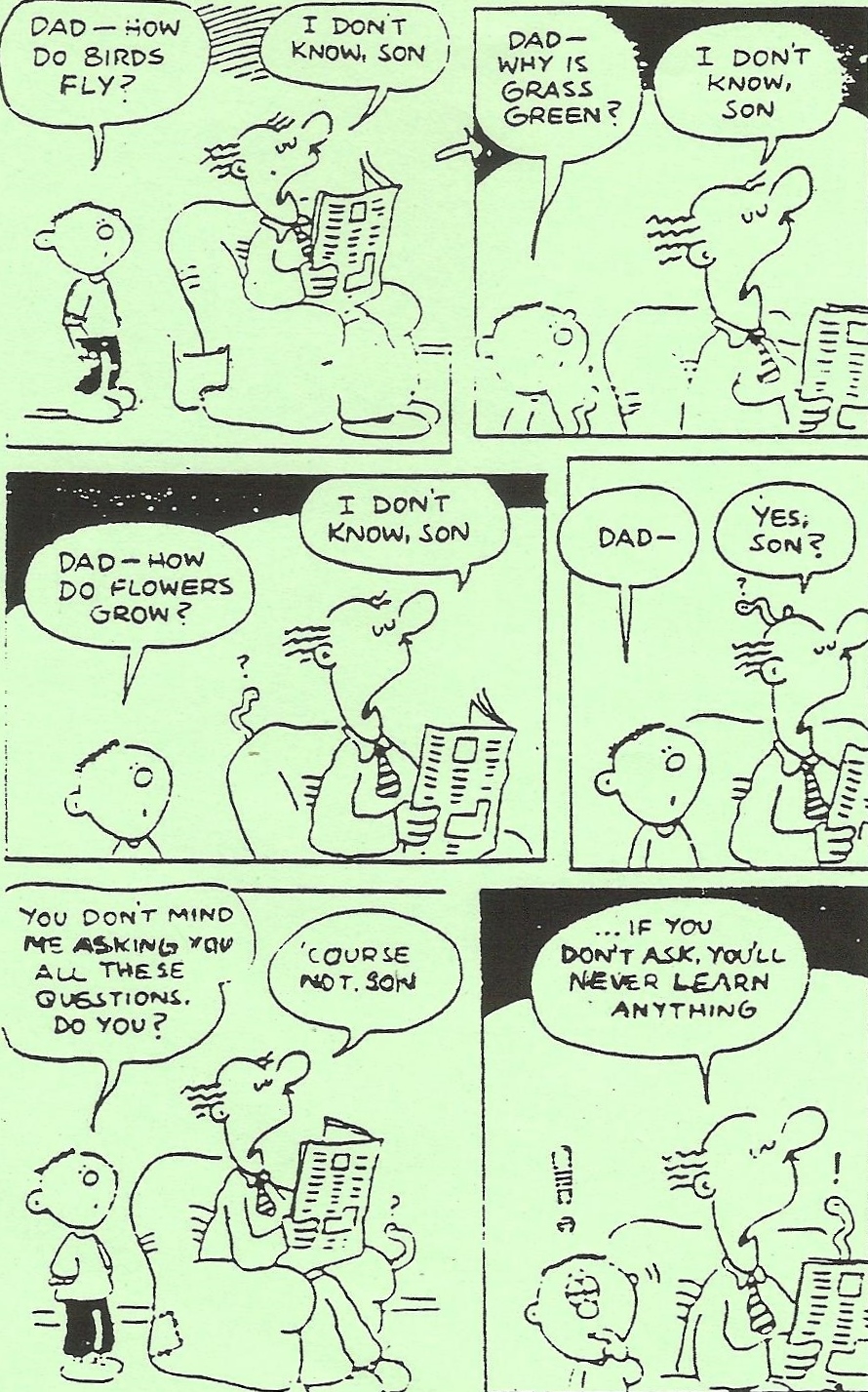
An important way to keep children creating their own understandings and ideas is to not only allow them to ask questions, but to actively encourage them to do so, and to help them seek answers to their questions. Adults can be quick to quiet children’s questions for a number of reasons including not knowing the answer, being too busy at the time to investigate an answer, or even considering the question unimportant or “dumb”.
Unknown source. Apologies. Happy to attribute if informed.
Remember, many things that adults may take for granted or that they may no longer question but simply accept (possibly as a result of not receiving appropriate answers or responses to their childhood questions) are new and unfamiliar to the child.
Sometimes it is easier to accept than to question for questioning means that something is unknown; and not knowing can lead to feelings of insecurity, doubt and instability. But it is these self-same feelings which drive innovation and progress. If everything was known, there would be no room for improvement, no need for anything new, no need for greater understanding.
This inspiring TED talk by Beau Lotto and Amy O’Toole, Science is for everyone, kids includedemphasizes the need for children to be given the opportunity of asking, and exploring answers to, questions.
Beau explains that what we see is based upon our experience, upon our expectations. But he asks,
“if perception is grounded in our history, . . . (and) we’re only ever responding according to what we’ve done before . . . how can we ever see differently?”
He goes on to explain that seeing things differently begins with a question and that questions lead to uncertainty. He says that
and explains that the answer to uncertainty is play. He says that play “is a way of being” and is important for five reasons:
Uncertainty is celebrated in play and makes play fun
Play is adaptable to change
Play is open to possibility
Play is cooperative
Play is intrinsically motivated
“Play is its own reward.”
Beau says that science, also, is a way of being; and that science experiments are like play.
He describes working with a group of 8-10 year old children, encouraging them to ask questions and involving them in an investigation of a question they posed.
Amy O’Toole, one of the children involved, joins Beau and describes the experiment which investigated the ability of bees to “adapt themselves to new situations using previously learned rules and conditions.”
The really exciting thing about the project, Amy says, was that they “had no idea whether it would work. It was completely new, and no one had done it before, including adults.”
The process of taking the findings of the project to publication, as Beau explains, was rather complex with a variety of complications, taking two years to achieve. The experiment itself took only four months! Publication of the paper made Amy and her friends the youngest ever published scientists.
Editor’s Choice in Science (a top science magazine)
the only paper forever freely accessible on Biology Letters and
the second-most downloaded paper from Biology Letters in 2011
Amy wraps up the talk by stating that
“This project was really exciting for me, because it brought the process of discovery to life, and it showed me that anyone, and I mean anyone, has the potential to discover something new, and that a small question can lead into a big discovery.”
She finishes by saying that
“science isn’t just a boring subject … anyone can discover something new.”
We might not all make those big scientific discoveries, but it is the questions we ask each day which lead to our own discoveries, no matter how small; it is our curiosity which keeps us learning.
What have you learnt today?
1 This is just my opinion formed from observations, discussions and reading. I am not supporting it with research references.
For the past couple of months, Charli Mills has been posting a flash fiction challenge on her site Carrot Ranch Communications.
I have been really enjoying the challenges as I hadn’t tried writing fiction in such brevity before. I do like having a go at various genres but the main focus of my writing is education and literacy learning. I am currently developing resources for children, parents and teachers which I plan to make available on a future website.
Having many years’ experience in writing these types of resources, I sometimes think I would be willing to develop any resource requested by an early childhood teacher. Participating in the Flash Fiction Challenge was a way of proving to myself that I could attempt any topic and genre.
I am not a fan of horror (real or imagined) and I haven’t done enough travel to have experienced a horror story (thankfully) but I was still keen to have a go and keep up my good participation record.
The difficulty I was experiencing with this writing task made me think about writing tasks that are set for children in school. How many children have ever returned from holiday and been set the task of writing about “My Holiday”?
Maybe that’s not so bad, they have all experienced it. But what about other topics that are of little interest to them.
This week across Australia students in years 3, 5, 7 and 9 are sitting NAPLAN (National Assessment Program – Literacy and Numeracy) tests.
Students in those year levels are set the samewriting task . They are given “a ‘prompt’ – an idea or topic – and asked to write a response of a particular text type”
Information on the acara (Australian Curriculum Assessment and Reporting Authority) webstite explains that
“In 2014, as in previous years, the Writing task will be a single common task for all students. The 2014 Writing test will require students to respond to either a persuasive or narrative Writing prompt. However, the genre of the prompt will not be disclosed prior to the test period.”
It goes on further to say that
“The provision of a rich and broad curriculum is the best preparation for NAPLAN, including the Writing task.”
I think I have a fairly rich and broad educational background with a reasonable level of literacy skills; but I am not convinced that, on any given day, in a restricted amount of time, under the watchful eyes of supervisors I would produce my best work in response to a prompt about which I may have little experience, knowledge or interest.
What about you? How do you think you would go?
Below is my response to Charli’s horror travel prompt. I don’t think it is my best work.
Travel woes
She willed the doors shut forever, knowing that open they must, or she’d be left behind.
She mentally checked and re-checked required items. Surely there was something she had missed?
Dread gripped her ankles, threatening her balance.
Fear squeezed her chest, constricting her breath.
Heights and enclosed spaces were not her thing.
She straightened, attempting to hide the tremble from fellow travellers.
“Don’t be crowded. I need space, air to breathe.”
The doors opened. She was swept inside.
They closed, encasing her. No escape now.
Would she make the distance, mind intact?
Ding!
Floor 35. Here already.
The NAPLAN writing tasks are marked against a rubric of 10 criteria. I wonder what the criteria for flash fiction would be and how I would score.
This week I am sharing a post published on Teachling earlier this year. Teachling introduces her post with a TED talk by Sir Ken Robinson, an international advisor on Education. Like Teachling, I very much admire his work and would love to see education systems implement his recommendations. I hope you will set aside the 19 minutes it will take to listen to what Ken has to say. You will be amused, entertained and educated. I intended providing a summary of important points from his talk, but found I was recording the talk in full! Teachling has provided a few notes but I would love you to listen to the entire talk and let me know what you think. How can we join the revolution that Ken says we need?
Let’s face it, children are basically all the same and should be taught in the same, tried and tested, chalk and talk, fashion. Teachers in schools should focus purely on the 3R’s – Reading, wRiting and aRithmetic – and leave that creative ‘fluff’ for kids to pursue in their own time. Children should be viewed as empty vessels and a teacher’s role is to fill them with enough knowledge to pass the test. Some kids are just lazy, hyperactive or incapable of learning, so teachers should let them be whilst focussing on the other kids that can and want to learn. Wait… What? Was there actually a time when people thought this way about education? I do hope that the opinions above are not felt by any person on this earth. My opinions are much more aligned with those articulated in Ken Robinson’s Ted Talk, “How to escape education’s death…
When I first stepped, rather tentatively, into the world of blogging and tweeting I had no idea of the pleasures I would find. I found a whole community of others who share my passion for education, learning, literacy and writing. I found a comfortable niche, discussion group, and a place for sharing ideas like I hadn’t for a long time. I’ve “come home” on the internet.
In these few short months I have come across some bloggers with very powerful messages that I wish everyone could read and act upon in the ways described. What a wonderful world we would have!
Over the coming months I will let you know about some articles I consider ‘must reads’.
Please let me know of others you think I should also be reading!
Thanks for sharing and supporting me on my learning journey thus far.
The story has just begun!
This first in the series is a lecture given by Neil Gaiman entitled “Reading and obligation”
“It’s important for people to tell you what side they are on and why, and whether they might be biased.”
If you have read any other articles on my blog, you will know that I am biased; biased towards a child-centered, hands-on, creative and innovative approach to education. I believe that children are capable of far more than a structured didactic approach to schooling gives them credit for; and that big changes in the way education is delivered are necessary if we are to make best use of our most valuable resource – human potential.
As a reader, writer and literacy educator I am biased towards approaches which foster a love of reading and writing. The pleasures to be gained from a literate existence are immeasurable. But more than that, being literate is not only personally empowering, it is a basic human right.
Obviously the articles on my must read list will be those that share my biases.
Please follow the link to watch the video or read the complete transcript of Neil’s lecture.
I offer a few teasers below to incite your interest.
“everything changes when we read”
Wow! How powerful is that statement!
“The simplest way to make sure that we raise literate children is to teach them to read, and to show them that reading is a pleasurable activity. And that means, at its simplest, finding books that they enjoy giving them access to those books and letting them read them.”
“Fiction has two uses. Firstly, it’s a gateway drug to reading. . .
And the second thing fiction does is to build empathy.”
“Fiction can show you a different world. It can take you somewhere you’ve never been. Once you’ve visited other worlds, like those who ate fairy fruit, you can never be entirely content with the world that you grew up in. Discontent is a good thing: people can modify and improve their worlds, leave them better, leave them different.”
Don’t you love that last statement? I do. If we are always “happy” with the way things are, why would we ever try to improve or change them? A little discontent can be a good thing!
“We need to read and write, we need global citizens who can read comfortably, comprehend what they are reading, understand nuance, and make themselves understood.”
Neil goes on to talk about our obligations as readers, writers and citizens of the world.
He lists the following (read or listen for his explanation)
Read for pleasure
Support libraries
Read aloud to our children
To use the language
We writers – and especially writers for children, but all writers – have an obligation to our readers: it’s the obligation to write true things, especially important when we are creating tales of people who do not exist in places that never were – to understand that truth is not in what happens but what it tells us about who we are. Fiction is the lie that tells the truth (underlining is mine)
not to bore our readers
not to preach, not to lecture, not to force
never, ever, under any circumstances, to write anything for children to read that we would not want to read ourselves.
to understand and to acknowledge that as writers for children we are doing important work,
to daydream We have an obligation to imagine. . . . individuals change their world over and over, individuals make the future, and they do it by imagining that things can be different.
to make things beautiful.
to tell our politicians what we want
Neil reminds us that
“Albert Einstein was asked once how we could make our children intelligent. His reply was both simple and wise.
“If you want your children to be intelligent,” he said, “read them fairy tales. If you want them to be more intelligent, read them more fairy tales.“
I couldn’t agree more.
What about you? What do you think of Neil’s list of obligations? Are there any you would omit, or any you would add?
One of my favourite talks about education is a TED talk given by Ken Robinson in 2006 “How schools kill creativity”.
His contention is that
“creativity . . . is as important in education as literacy, and we should treat it with the same status.”
Although the video has had more than 21 million views (while quite a few of them mine, nowhere near that number!) and drawn over 3 000 comments during the last 8 years, his views need to reach a wider audience still; an audience with the power to enact change.
One thing I had always loved about teaching was the opportunity to express myself creatively, and to encourage my students to do the same. Unfortunately the current emphasis on a content-driven, top-down approach where test results reign supreme has left little room for anyone’s creativity. I am not saying there was ever much opportunity for creativity in formal schooling, but creative teachers could always squeeze a bit it. Now the opportunities for creative “massage” are few.
My optimism for positive change in education is always raised when I read or hear of others who share similar views. I think if enough voices are heard chanting the same message that a change may come.
This post (and article in Saturday’s QWeekend magazine) by Mary-Rose Maccoll “Why Banff means the World” also proclaims the vision of Ken Robinson. Mary-Rose is another fan.
She says that
“Being at the Banff Centre (in Canada) has made me reflect on what we lose when we don’t foster art, when we don’t foster creativity. And what we lose is the world.”
She says that
“even as school education becomes increasingly narrow in its focus, we’re also seeing a decline in performance on the very outcomes that standardisation seeks to improve.”
She concludes by saying,
“As I sit in my room and watch the mountains, listening to the trail of a contraband sax down the hall (you’re supposed to play in the soundproofed studios in the forest), reading a piece by a Scottish writer, I am grateful for artists. In our 21st century world, we surely need them.”
I agree wholeheartedly as, I’m sure would Ken Robinson, along with Teachling whose post What is Education, anyway?Pt 1 I reblog for you here.
I agree with Teachling’s belief that
“many teachers would feel that – as well as their students’ innate talents and creativity being snuffed – their own talents and creativity don’t get much of a look-in. I believe most teachers are very restricted in terms of what they teach as well as how they teach it.”
I also agree with her when she states that
“that there’s very little teachers can do about it.
It’s the administrators and politicians that should take Robinson’s advice. It’s also the perceptions of a majority of parents that would need to vastly change if any rethinking of fundamental principles were to occur.”
Have a listen to Ken and read these other posts, then let me know what you think.
How can we make our voices be heard to ensure that creativity and innovation is not lost for the future?
Ken Robinson’s take on schools, and how they kill creativity…
You’re likely one of the 20,738,467 viewers of Ken Robinson’s “Schools Kill Creativity” 2006 TED Talk. Robinson’s assertion, and general gist of the talk, is that “all kids have tremendous talents, and we squander them; pretty ruthlessly”. The “we”, we can infer from the rest of his talk, are schools.
Let me pick out some key points:
• “My contention is that creativity, now, is as important in education as literacy, and we should treat it with the same status.”
• “We are educating people out of their creative capacities.” • “Every education system on Earth has the same hierarchy of subjects… At the top are Mathematics and Languages, then the Humanities and at the bottom are the Arts… And in pretty much every education system there’s a hierarchy within the Arts. Art and Music are normally given a higher…
At this time of the year children, parents and teachers in Australia are thinking about the return to school which is approaching with haste. For some those thoughts are of excitement and expectation. For others they are of anxiety and dread.
While children have enjoyed the break from imposed structure and the pressure of school days and homework, many look forward to seeing their friends again and the routine of having something to do after long, lazy summer days. Others may feel anxious about being in a new class with a new teacher and new yet-to-be-made friends. For those starting at a new school, or school for the first time, there may be a confusion of feelings and vacillation between excitement and fear.
Parents, too, have mixed feelings about their children starting or returning to school. They may look forward to a return to routine and a relief from the pressure of providing full-time entertainment or alternative care arrangements. They may also experience feelings of loss when they hand their children over to the care of a stranger for most of the day. However, I think what parents most want for their children when they return to school, or indeed at any time, is for them to be happy. Teachers experience a similar range and vacillation of feelings from excitement and expectation through to anxiety and dread. Even now many of those teachers are out fossicking through the cheap shops, scouring stationery and educational supply stores, looking for items for use in their classrooms. Others will be at home trawling the internet looking for resources, or making their own resources in preparation for the new school year.
One thing that is important to all is to begin the year positively and happily.
Strategies for parents
Some strategies parents can use to ensure their children begin the school year happily include:
Talk to children in positive and supportive ways that will strengthen their optimism about returning to school, allay any fears and settle anxieties.
Ensure children are aware of how they will travel to and from school, and of any arrangements that have been made for before or after school care.
Familiarize children with the route to and from school by travelling it as they will be expected to, whether by foot, cycle, bus or car. If necessary, point out landmarks along the way.
Make sure children know their first and last names, address and parents’ phone number/s.
Have children’s equipment ready with books covered and every item identified with the child’s name.
If possible, take the child to school on the first day and meet the teacher.
The positive feelings can be continued throughout the year by:
Daily conversations about the school day: learning, events and friends.
Volunteering in the class or school, or being involved with after school activities.
Maintaining open and positive communication with the class teacher.
Strategies for teachers
Some strategies teachers can utilize to ensure that children (and parents) begin the school year happily include:
Create a welcoming classroom with signs, posters, items of interest and inviting reading corners and activity nooks.
Greet children and parents with a friendly smile.
Engage children in activities that help you get to know them, and them to get to know each other.
Display children’s work to give them a sense of ownership and belonging.
Explain management and behaviour expectations and include children in composing a classroom management and behaviour plan.
Ensure children know the school timetable; when the breaks will occur and any lessons to be taken by specialist or other teachers.
Explain playground behaviour expectations, including showing areas where they may / may not play.
Take them on a walk around the school to show them the library, office, bathrooms and any other areas they may need to know.
Include singing during the day and send them home with a song and a reminder of what has been learned or engaged with during the day. (In a previous post Happy being me I wrote about Anne Infante’s songs of affirmation. Any of these are great ones to sing and help to create a positive environment.)
What other suggestions can you make?
What helped you as a child, parent or teacher prepare for the new school year?
Teachers, check out my new products on TEACHERSpayTEACHERS to help you set up your classroom and greet your new students with a Busy Bee theme. There are many resources to get you started, ready to download and print out.
Bee courtesy of Bernadette Drent, used with permission.


















 Norah Colvin


