Many crepuscular animals freeze when caught in the headlights of an oncoming vehicle. With vision more suited to dark than light, they are temporarily blinded by the brightness. They become confused and, not knowing which way to turn, freeze. Others, like the Australian kangaroo, may panic and move erratically with unpredictable changes in direction. Any large animal on the road puts itself and any unwary motorist in danger.
Freezing in fear is a reaction not exclusive to animals. Humans are just as likely to freeze in fear, or perhaps panic and behave erratically unsure of how to respond. Some people find being “put in the spotlight” quite unnerving and exhibit similar responses to animals caught in the headlights.
Glossophobia, or the fear of public speaking, is quite common. Many people suffer mild symptoms of reluctance, “butterflies” or sweaty palms. Others suffer more severe symptoms including total avoidance, panic attacks and other forms of physical distress.
Being called upon in class can be distressing for some students, particularly if they have been singled out or ridiculed for not knowing the correct answer in the past. Helping a student to overcome this fear requires patience and understanding. It may require an approach from many different angles and the support of a variety of personnel, as well as a desire by the student.
The student will require support to develop self- esteem and self-confidence as well as knowledge of the subject. A sensitive “not yet” approach by a teacher who offers support, and encourages other students to be supportive, will contribute greatly. It may take time for improvements to be noticeable as changing an established mindset, from “I’m a failure” to “I’m learning”, takes effort.
In her post Charli included a quote from the Tahoma Literary Review which included the suggestion that rescuing a deer and nursing it back to health may be used as a “metaphor for the protagonist’s desire to rescue his/her life by rescuing another’s.” It is not too big a stretch to think that, for some teachers, “rescuing” their students could enable them to “rescue” themselves; improving the lives of others improves their own through the ripple effect.
I have chosen this “rescue” as the theme of my response to Charli’s challenge: a breakthrough for Marniein the development of her confidence and willingness to have a go in a class where students are developing a growth mindset under the guidance of a sensitive teacher.
Like a deer in the headlights
Like a deer in the headlights she was immobile. She’d dreaded this moment. Although she’d tried to fade into the background, she knew she couldn’t hide forever. The room suddenly fell silent, all eyes on her. Would she fail?
“Marnie?” prompted the teacher.
Her chair scraped as she stood. She grasped the table with trembling hands attempting to still her wobbly legs. They waited.
Marnie squeaked. Some looked down, or away. Some sniggered. Jasmine smiled encouragingly. Marnie cleared her throat, then blurted the answer.
“That’s right!” congratulated the teacher.
The class erupted. Marnie smiled. Their efforts had paid off.
Thank you for reading. I appreciate your feedback. Please share your thoughts about any aspect of this post or flash fiction.
Many years ago I was employed to be an “agent of change” in a school. My job title was Resource/Remedial Teacherand my role was two-fold: to fix up the children who were “failing”, in reading especially, and to “teach” the teachers more effective strategies for teaching and learning. To say it was a difficult role is an understatement. Think of the old lightbulb jokes.
Teachers considered that one brief session each week in a small group of other children would not only be sufficient to “fix” a child’s learning difficulty, it would also fulfil any requirement to provide differentiated instruction for the learners in their classrooms. “He goes to remedial,” both explained the child’s lack of progress and released the teacher from the obligation to make any other concessions or attempts to support the child.
Improve teaching
It soon became obvious that the attitudes of teachers fitted into two opposing “camps”, with a smattering of differences along a continuum stretched between. There were those who focused on the children, what they knew, what they needed to know and how to help them learn. These teachers were creative and innovative in their approaches, trying out new ideas and constantly on the lookout for ways to engage, motivate and inspire children.
There were those who were focussed on what was to be taught, on their lesson plans, assessment and results. They expected the children to attend, respond and learn because that was what was expected of them. If the students failed to learn what was taught, the teachers questioned neither their methods nor the content for its suitability to student needs. Rather they found the fault to be with the students who were lacking in some way. Their view was of students as empty vessels to be filled, and if they did not fill from what they were offered, then it was the vessel, not the method of filling that was faulty.
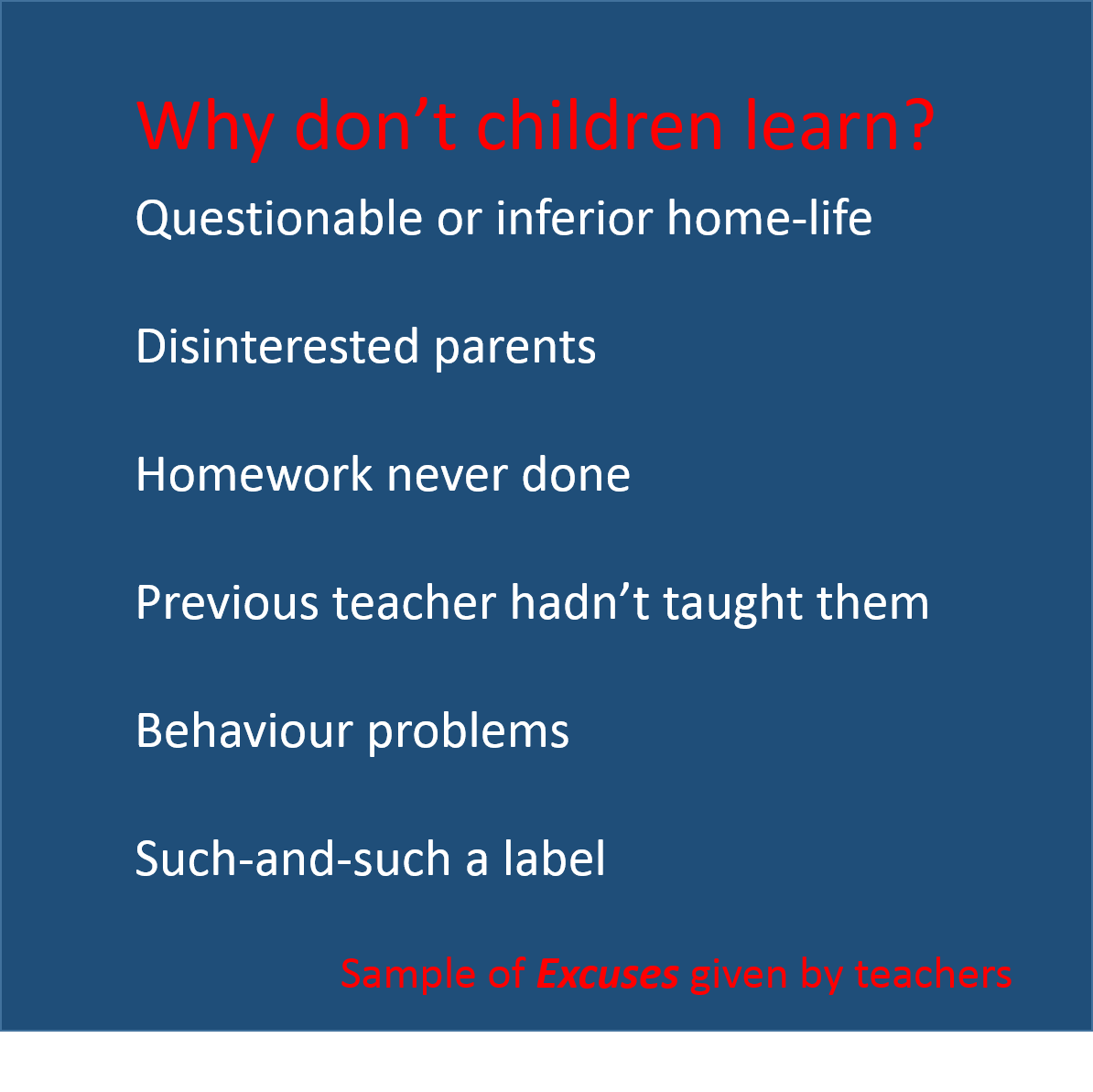
So many times the teachers would complain that they had “taught” the work but the students hadn’t learned it.
In “my world”, if there was no learning there had been no teaching; and I found this attitude difficult to comprehend or accept. Nonetheless I tried to be understanding, patient and supportive, listening to and restating their complaints to ensure them I had understood. I would then make gentle suggestions like “Have you tried?” “Have you thought about?” Rarely was I successful in getting them to reflect upon, interrogate or make adjustments to their practices. I guess if they saw no fault with their practices, why should they change?
A current focus in assessment driven school programs is what the students can and can’t do, with the main focus on the “can’t”. I much prefer changing perspective to the “not yet” thinking and growth mindset of Carol Dweck.
They slumped around the table, eyes transfixed on hands clasping coffee cups, bemoaning their lot, each desperate to outdo the other in frustration and despair.
“They just don’t get it.”
“I’ve tried everything.”
“They don’t listen —”
“They’re so rude —“
“In my day we wouldn’t dream —“
Outside
They welcomed the kiss of sun upon their cheeks, the freshness of air to their lungs; and breathed as one in wonder.
They found cloud-painted sky pictures, brightly coloured beetles in green grass stalks, claw-made scratches in the rough tree bark; and brimmed with wonder.
and dared to dream …
Thank you for reading. I appreciate your feedback. Please share your thoughts about any aspect of this post or flash fiction.
I am a proponent of learning by experience, of learning through one’s own explorations and making one’s own discoveries. In early childhood centres it is sometimes called ‘hands on’ learning. The recommendation is to provide opportunities for children to learn by doing rather than simply by listening to someone tell about it or by reading information in a book. For example, experiencing the sights, smells and sounds of a farm create an enriched understanding of farm life that is not possible simply from looking at pictures of farm animals in a caption book. Activities like mixing and making with modelling dough, or building and creating with construction sets provide opportunities for developing numerous skills and understandings.
That’s not to say that experiential learning is best in every situation or that learning from the explanations of others, including reading information in a book, is less worthy. Indeed there is a place for each and it is important to get the balance, timing and application right. You would not need to view many posts on my blog (for example here and here) to realise that I am a proponent of reading also and believe that instilling a love of reading is one of the greatest gifts a parent can give a child.
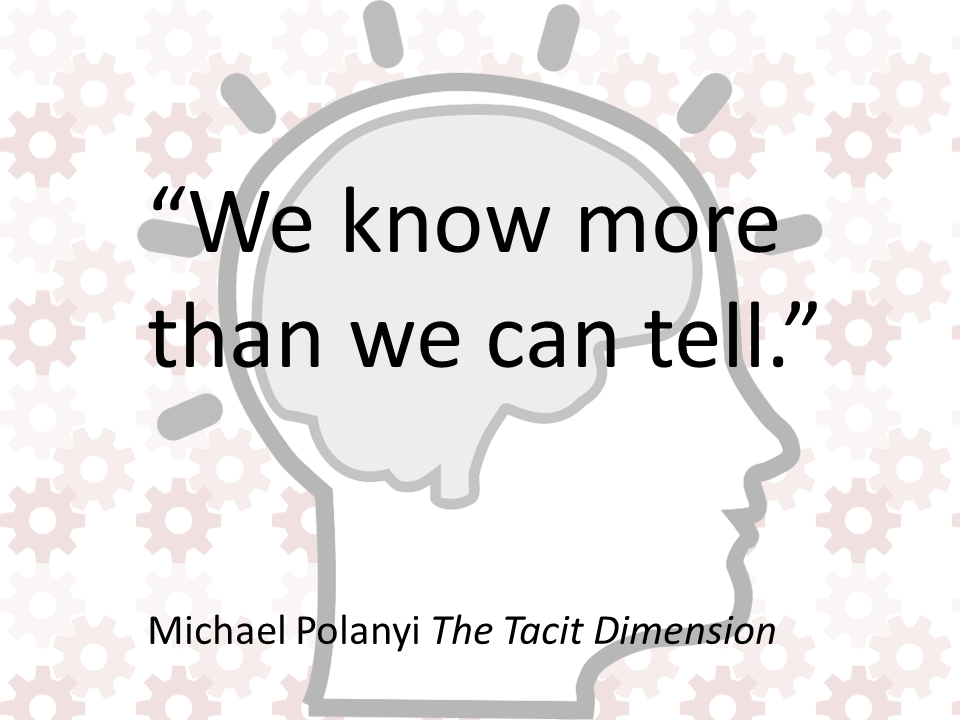
In their book A New Culture of Learning: Cultivating the Imagination for a World of Constant Change, Douglas Thomas and John Seely Brown discuss the differences between explicit knowledge and tacit knowledge. This chart shows my understanding of some of the differences.
I think it would be undisputed that there is knowledge best learned through explicit instruction and other best learned through experience. I am sure you can think of many examples in your own life, like riding a bicycle, learning a foreign language or playing a musical instrument.
But what about teaching young children about heat? It is not far into the life of any young child that they are cautioned about the heat of an oven or stove, heater or barbecue plate. But what is “hot” if you have never experienced it?
Thomasand Brown say that “when a parent first tells a child not to touch a flame because it is hot, the child will almost always put out her hand and get burned”because the child has only been given the explicit part of the information, the part that could be articulated: that “Fire is hot”. When the child is burned much more information is learned by the body: that it hurts and is unpleasant. The child is then able to make connections with other similar “hot” things and situations.
I think neither of the authors nor any parent would suggest a child be burned “for educational purposes” but the power of experience can be seen in this example. Perhaps it also helps to explain why young children need constant reminders to stay away, or precautions need to be taken to protect them, from hot things. Without the burning sensation they have not formed a true understanding.
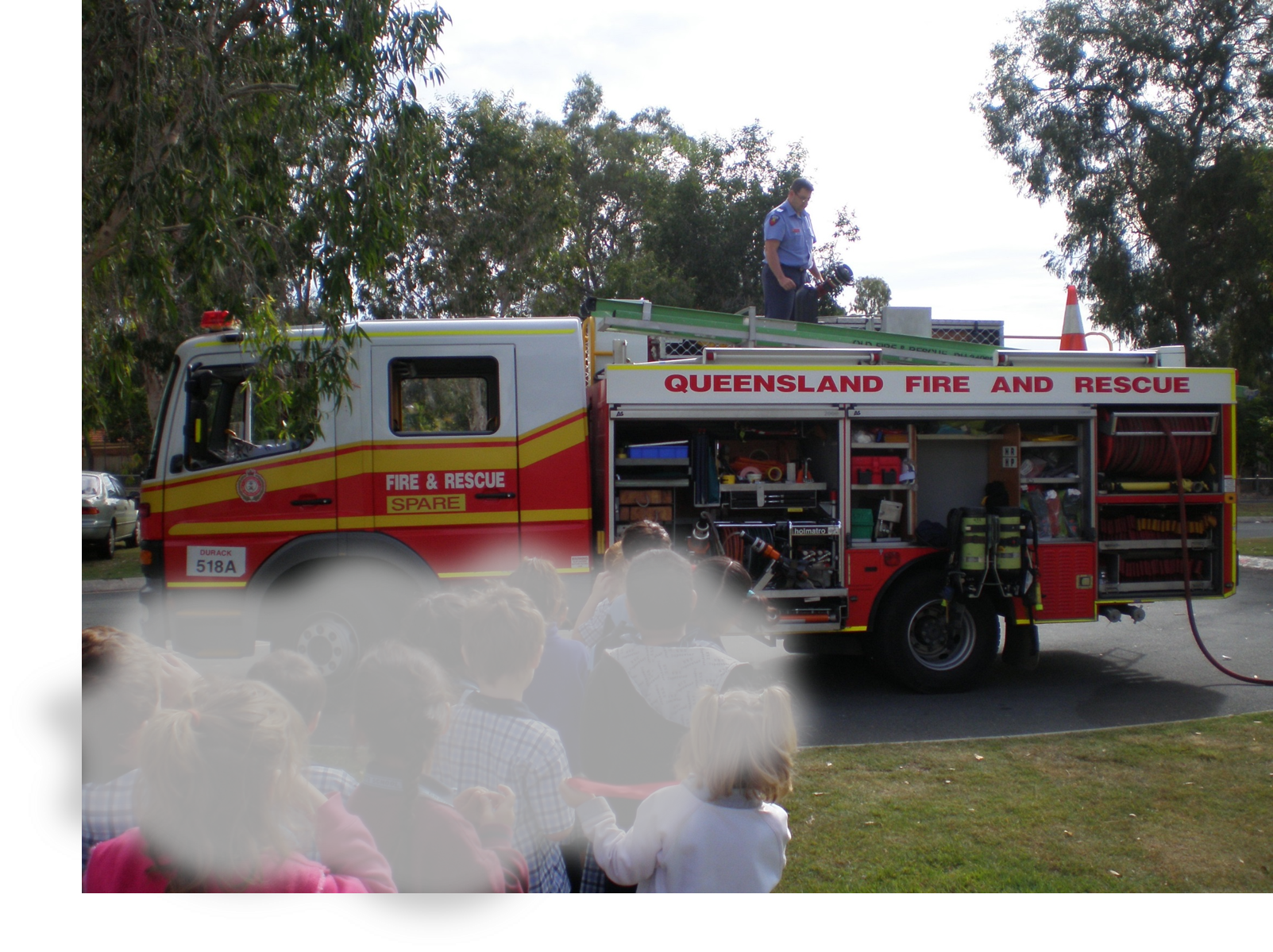
At my previous school our year one classes were always visited by the local fire fighters who talked about fire safety, explaining the difference between “good” fires (like birthday candles, barbecues and campfires) and “bad” fires, while warning that even good fires could quickly become bad if not monitored correctly.
They talked about the need for smoke alarms in the home and the importance of having escape routes and meeting places planned and practised. They ensured students knew their full name and address and the procedure for calling emergency (000 in Australia) if the need should arise. These are things that all young children should know.
The children were always excited about the firefighters’ visit as they got to look at the firetruck close up, maybe even sit in it or, if they were lucky, see how high they could spray water with the large hose. The tacit knowledge learned through this type of experience, combined with explicit knowledge provides a context that allows children to learn the realities of fire danger and the importance of safety. It wasn’t unusual for the crew to receive a call and rush away during one of their visits, adding further to the overall experience for the children.
Thinking about heat and education, and the hold that explicit knowledge and its testing has on current practice makes me think of the story about a frog in a pot of hot water.
The story says that if you were to put a frog into a pot of hot water, it would jump out immediately; but that if you were to put the frog into a pot of cold water which is warmed slowly, the gradual increase in temperature wouldn’t be noticed and the frog would be boiled alive.
Perhaps this is why some educational practices are accepted without question. People have become so used to them, with small incremental changes seeming insignificant and unworthy of comment. However the cumulative effects over time can be enormous. By the time they are realised, making amends would require so great a change, possibly a total restructuring, that it would defy plausibility.
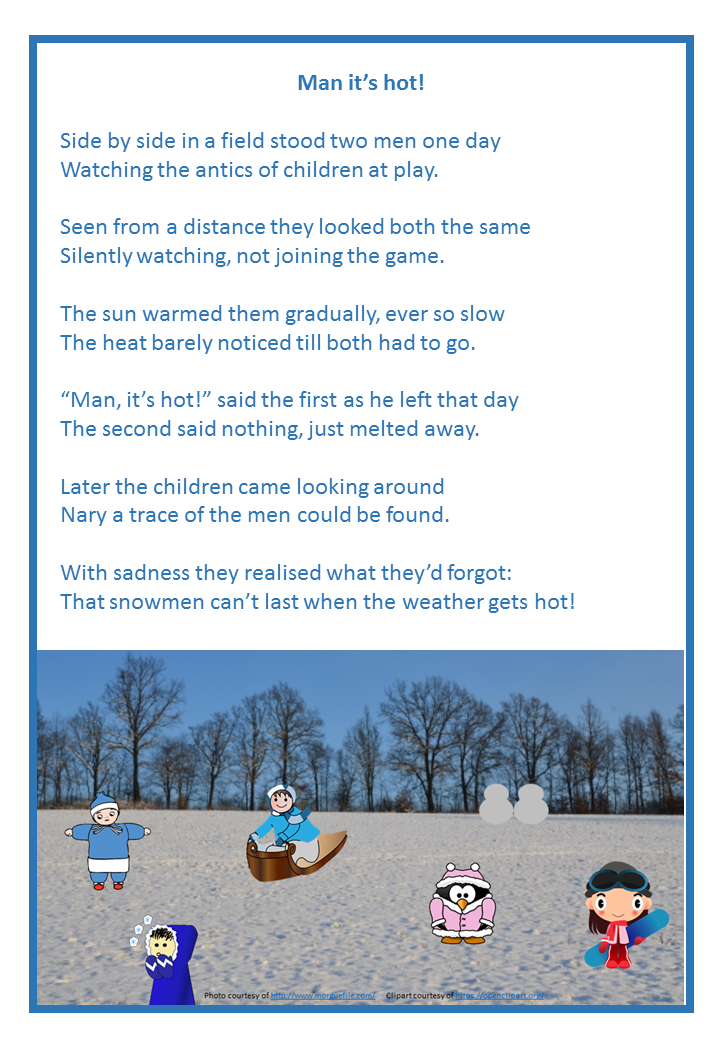
It is this thinking that has led to me my flash response to the challenge set by Charli Mills at the Carrot Ranch this week to In 99 words (no more, no less) write a story that includes the phrase, “Man, it’s a hot one.” I hope my contribution is a little more environmentally friendly and suitable for young children than boiling frogs.
Thank you for reading. I appreciate your feedback. Please share your thoughts about any aspect of this post or flash fiction.
A week or two ago my good friend Sarah Brentyn who blogs at Lemon Shark (Navigating the uncharted waters of parenting and life) raised the issue of students having required reading over the summer holidays. Sarah recalled that when she was at school she had lists of books to read, and book reports to complete as proof of having done so. She expressed concern that no holiday reading is currently required of her school-age sons.
The basis for Sarah’s concern is what is known as “the summer slide”, the loss of skills, especially reading, if not practised over the long summer holidays. Studies show what teachers observe: that students start a new school year with skills at lower levels than just a few months earlier. Revision and review of the previous year’s work must be factored in before new work can be commenced.
Sarah wasn’t so much concerned for her sons who are avid readers and will read regardless of whether it is required or not. Knowing Sarah, her sons will also benefit from an environment enriched with a variety of other learning experiences. All children could benefit from the types of support and encouragement Sarah provides for her sons.
Sarah’s concern was for children who don’t choose reading as a holiday activity. She believes children should continue to learn over the holidays, and does not understand why learning can’t be fun. I agree with Sarah. However I am a bit ambivalent about the requirement that particular books be read, and probably am not in favour of asking that book reports be submitted.
There was never any set reading to be done over the holidays when I went to school, or when my children went to school, and I am not aware of any such requirement of children attending school currently in Australia. The fact that it is not a requirement doesn’t make it either right or wrong. It is simply a new concept to me.
I would be reluctant to set homework for completion over the holiday period, especially the summer holidays for a number of reasons, including:
students will be moving to a new class and teacher, some even to a new school, after the holidays and that teacher may not view the set work in the same way
students have spent the school year reading, writing and performing other activities required of them, activities that may have little relevance or interest to them
students may spend the holiday period in alternate activities and then rush or “fudge” required tasks, seeing them simply as work that must completed, rather than something they want to do
I think children need time to follow their own pursuits and interests without having to fill in a worksheet to say what they have done
I think children and their families need some time together without the stress of completing set tasks
I think it is important for children to have time to wonder, imagine and create, to be comfortable in their own company, devising their own plans and schedules and activities, some of which may be just down time (the ability to relax in an ever-hurried world is very desirable).
But, like Sarah, I wouldn’t always be leaving children to their own devices, allowing them to wander the bush and beach from daylight till dusk as I did during the school holidays (when I wasn’t reading a book, playing games with siblings or friends or doing household chores). I would be mindful of their activities, ready to make suggestions, provide experiences or encourage other interests; but the direction would always be theirs and never forced or “required”.
However I am equally as keen to avoid the occurrence of that “summer slide”. As my contribution towards its prevention while also promoting the notions that learning is fun and that opportunities for it abound, I link to three of my previous posts:
While I reproduce the suggestions from each post here, each set of suggestions is also available as a free downloadable PDF in my TEACHERS PAY TEACHERS store. For your convenience, I have provided a link to each in the headings below:
Read to and with your child every day – continue the practice established throughout the year with special sharing times during the day or at bed-time — or both!
Demonstrate that you value reading by making time for your own reading, or setting aside a special quiet time when everyone in the family reads.
Visit the library and borrow to read, read, read!
Read poetry books, song books, picture books, joke and riddle books, crossword books, information books, chapter books (these can be read to younger children, or with older children – taking turns to read a page or a chapter each) — what are your favourites?
Trade books no longer read for others at a second-hand book store.
When dining out, have your children read the menu and choose their own meal.
Include your child in holiday cooking and have them read the recipe – ingredients and method. Perhaps they could read the recipe book to select the meal for the day.
Suggest your child read the TV guide to find when favourite programs are showing and establish a timetable for viewing, rather than haphazard watching with random flicking through channels.
Provide your child with bookstore catalogues and encourage them to read book descriptions to guide their next selection.
Bestow upon your child the title of ‘Family weather watcher’ and have them consult weather forecasts in the newspaper or online to select the most suitable days for planned outings and activities.
Include your child in making decisions about holiday activities. Give them the guide, or read the guide together and jointly choose the activities.
Make the library, museums and art galleries high on the list of must-dos. Many of these offer a wonderful assortment of free holiday entertainment for children, and reading is an essential part of getting the most from each visit!
Engage your child in some craft activities which require them to follow written instructions. The ability to understand and follow procedures is empowering and requires the ability to read written, as well as visual, instructions.
Encourage your child to ask questions about every day events and phenomena. Help them to research in books at home, in the library or on the internet.
Provide eBooks as well as books in print. Good ones bring a new dimension to the reading experience.
When going out for the day, or journeying further away on a holiday, support your child in locating destinations on a map and in selecting an appropriate route. Engage your child in giving directions while en route.
Include your child when reading bus or train timetables.
When doing the family grocery shop, give your child their own list of items to look for.
Listen to recorded books on long car journeys, or have books for listening to or reading along with in bed.
Make the most of every reading opportunity that occurs throughout the day!
Use adhesive notepaper to write messages to your child and encourage your child to write a message back.
Encourage children to write letters or emails, cards or postcards to grandparents, aunties, uncles and friends. These can be to inform them of the holiday or the year’s activities, or to thank them for a visit or gift.
Demonstrate that you value writing by making time for your own writing, e.g. keeping a diary, writing letters and cards to family or friends, writing a shopping list.
Display a message board prominently in the home and list important events, reminders and messages. Encourage your child to add their own messages to the board.
Provide a calendar or diary and ask your child to note family birthdays, holidays and events for future reference.
Encourage your child to keep a diary in which important events and feelings are noted.
Play word games e.g. Scrabble and other crossword games; Boggle or ‘hangman’. (If you don’t like the connotation of ‘hangman’, give each player ten counters to start with. Each time an incorrect guess is made, they give away a counter. If all counters are used then they miss that word.)
Write poems and songs together.
Encourage children to write and perform ‘plays’ for the family.
Take photos of events during the day and use them to make a photo book. This can be done instantly on a computer with photos taken using a phone or tablet and emailed with accompanying text.
Insert photos from a phone, digital camera or tablet into a slideshow program such as PowerPoint, then add text to create a digital story or record. With one click these can be saved as an automatic show or MP 4 video.
Involve children in planning the weekly meals by selecting recipes for a menu they write, and for which they create a shopping list of required ingredients.
Write rebus messages to your children and ask them to write a rebus message back, e.g.
Invite your child to create lists e.g. activities they would like to do over the holidays, movies they would like to see or friends they would like to invite to a sleep over.
Encourage your children to write the step-by-step instructions for making a craft item they have just designed, or to write down the rules for a game so that everybody is sure how to play.
Suggest that your child write down questions they would like answered, and then write the information discovered during research (by interviewing or asking people, reading books or internet search).
Suggest to children that they make a storybook for a younger sibling or friend.
When going out for the day, or journeying further away on a holiday, children could be asked to write directions for the journey as discovered by consulting paper or online maps.
Help children to set up and maintain a blog to create a record of activities and events to be shared with family and friends. The posts could be regular e.g. daily or weekly, or follow particular activities.
Make the most of every writing opportunity that occurs throughout the day!
Count items e.g. birds in the sky, shells collected from the beach, people for lunch, steps in a staircase, windows on a house, seats in a bus . . .
Count out the cutlery required for each person at dinner
Include your child in shopping activities by helping them to:
Recognise the coins and notes
Count the value of coins and notes
Predict whether they have enough money to purchase an item, and whether there will be change
Tender the money in payment for an item
4. When your child is sharing e.g. the biscuits, balloons or slices of fruit, ask them to:
Predict if there will be enough for everyone to have one, or more than one each
Share out the items, allocating the same number to each
Determine if there are any left over and what to do with them
5. Use terms like half and quarter correctly, e.g. when cutting apples, oranges, sandwiches, pizza, to indicate pieces of equal size
6. Play games that involve counting, e.g. counting the number of skips, balls in hoops, pins knocked down or dice games like snakes and ladders that require adding as well as number recognition and counting
7. Make up number stories e.g. “We had five apples in the bowl. I ate one, and you ate one, how many are left?”
8. Read books with number concepts e.g. Pat Hutchins The Doorbell Rang, Eric Carle Rooster’s off to see the world or Kim Michelle Toft One Less Fish
Patterns and algebra
Use items to make patterns e.g. sort and create a pattern from shells collected at the beach, building blocks or toy cars
Look for patterns in the environment e.g. fences, tiles, walls and window, zebra crossings
Decorate cards and drawings with a patterned frame
Make gift wrapping paper by decorating with potato prints or stamp patterns
Measurement and geometry
Include your child in cooking activities and allow or support them to:
measure the ingredients
set the temperature on the oven
work out the cooking finish time
A child’s understanding of volume and capacity can be developed when they:
pour glasses of water from the jug and discuss terms such as enough, full, empty, half or part full, more, less
pour from one container into another of a different shape to compare which holds more and which holds less
Scales can be used to compare the mass of different items or quantities e.g. compare an apple and an orange, measure the mass of butter required for a recipe
Measuring length can be included by:
measuring and comparing height
cutting a length of string to tie a package
measuring who is closest to the jack in a backyard game of lawn bowls
Use the calendar to
Learn the names and sequence of days in the week or months in the year
count the passing days or the number of days until an event
Identify shapes in the home and environment e.g.
2D shapes: tiles on floor and walls, shapes of windows, sections of footpath
3D shapes: cereal boxes (rectangular prism), balls (sphere), bottles or cans (cylinder), dice (cube)
Play games that involve shapes e.g. jigsaw puzzles, tangrams
Talk about directions e.g. left, right, forwards, backwards and follow directions on a grid
Play games that involve directions and movement in space e.g. battleship,Hokey Pokey,Simon Says, snakes and ladders, ludo
Read and discuss books that include measurement concepts e.g. Pamela Allen:Who Sank the Boat?(volume); Eric Carle: The Very Hungry Caterpillar (days of the week) and The Bad Tempered Ladybird (time); Penny Matthews and Andrew McLean A Year on our Farm (months and seasons); and for looking at places on a map Mem Fox Sail Away The ballad of Skip and Nell or Annette Langen & Constanza Droop Letters from Felix
Probability and statistics
When discussing the weather or desired activities include the language of probability e.g. possible, certain, likely, unlikely, impossible
Encourage children to collect data about family or friends by asking yes/no questions e.g. do you like swimming, or making a graph of the family’s favourite colour or meal.
Play games with spinners and dice and talk about the likelihood of spinning or throwing a particular number.
I hope these activities demonstrate how easy it is to maintain learning while having fun over the holidays. I’m sure you will have many more favourites of your own.
I appreciate your feedback. Please share your thoughts about any aspect of this post.
Creating an environment which nurtures children’s learning and development is as important as creating an environment that nourishes and encourages the growth of plants in a garden. The link between the two was first recognised by Froebel in the early 19th century when he coined the term “kindergarten” which translates to “garden for children” (kinder meaning child and garten meaning garden), and created the first educational toys.
Froebel’s kindergartens were the first “formal” education for young children and his work greatly influenced that of other educators such as Maria Montessoriand Rudolf Steiner. His beliefs, for example that children have both unique needs and capabilities are still influential today. He believed in the importance of play and some of his toys were favourites of people such as Buckminster Fuller and Albert Einstein.
I have touched on the topics of play, creativity and children’s uniqueness in previous posts. A respectful, encouraging, nurturing and stimulating environment underpins all that I value in education; as does a belief in the power of play to develop understandings of self, of others and relationships, of the world and how things work, and to inspire thoughts of what could be, to imagine possibilities never before imagined.
The poem Education is expresses my beliefs about education and has informed my decision making every step of the way.
In documents prepared for introducing myself to other educators or potential employers I explained it this way:
Statement of values:
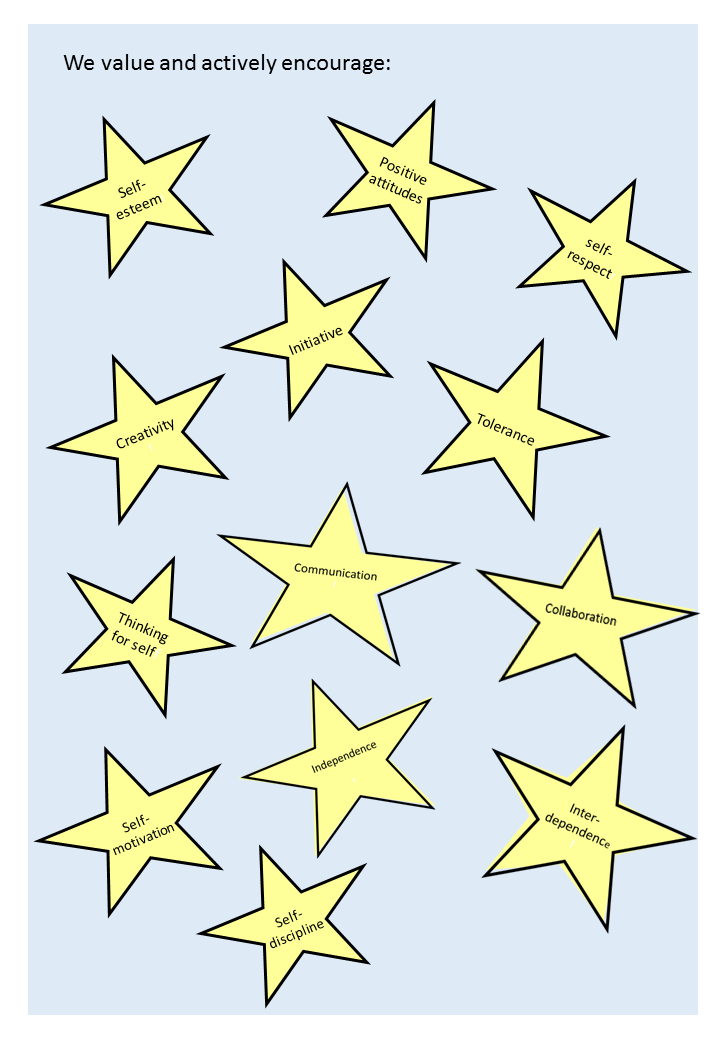
I value individuality over group consensus
I value creativity over conformity
I value self-discipline over imposed order
I value ingenuity over “one right way”
I value choice over restriction
I value questioning over silence
I value independence over dependence
I value self-confidence over submission
I respect children as people in and with their own rights. I provide an environment which is rich, stimulating, open and caring, and in which the characteristics I value can flourish.
At the time of writing it I believed it to be a true reflection of my values and the environment I provided in my “Create-A-Way” sessions, and would provide in the independent/alternative school I was working towards establishing.
The values of the “school” I was setting up were stated this way:
Just as it is important for gardeners to learn from the wisdom collected by other gardeners, it is important for teachers to learn from the wisdom collected by other educators.
Without a set of guiding principles it is easy to be blown off-course by the winds prevailing at the time. While I acknowledge that I may have fallen far short of the values espoused, that they guided my direction, decisions and choices could not be questioned. The current climate makes it difficult, but I am yet to read of a time that could be considered a golden age of education.
Because my blog has an educational focus, I always like to give Charli’s prompt an educational twist. Over recent months I have enjoyed the additional challenge of finding a way of applying the prompt to the life of Marnie, a character whose story I have been developing.
Marnie is from a dysfunctional family and suffers many disadvantages. Fortunately she has found an ally in an art teacher who helps her develop self-respect and hope for a better future. A few weeks ago (in response to a different prompt) we learned that she had lived under a different name after leaving home. Could it perhaps be Rose, a name inspired by this interaction with her adored teacher?
Still life
Marnie observed the roses Miss R. had arranged for class, carefully assessing the colours and studying the lines while sketching them on the canvas, striving to match their perfection. Oblivious to all but Miss R. and the roses, for one hour nothing else mattered.
As other students streamed out Marnie hung back to chat with Miss R.
Miss R. handed her a rose from the vase saying, “You are that rose. You may be surrounded by thorns, but the beauty of the rose is inside you. Remember that always. A rose by any other name would smell as sweet.”
Thank you for reading. I appreciate your feedback. Please share your thoughts about any aspect of this post or flash fiction.
The purposes of education are many; but perhaps one important purpose of “free” public schooling is to ensure that everyone is provided with the opportunity of being educated. While this goal is achieved to a certain extent, inequalities of opportunity still exist, many of which are related to socioeconomic status (SES).
While there is no doubt that a teacher can have a powerful effect upon the lives of students and any teacher would love to receive a letter such as that written by Albert Camus, socioeconomic status is often considered to be the most reliable predictor of success in school and, therefore, in life. There are many reasons for this, few of which have anything to do with intelligence.
According to Macquarie University the majority of students in tertiary education are of mid to high socioeconomic status. The parents of these students may have professional backgrounds and may have attended tertiary institutions themselves. Most have an appreciation of the benefits of higher education and are able to continue supporting their students, to some extent, while they study.
While students of lower SES are attending tertiary institutions in greater numbers they are disadvantaged in doing so by a number of factors, primarily financial in origin. Although Australia is supposedly free of class distinctions, attitudes towards those from lower SES areas are often demeaning and unsympathetic. Students from these areas may battle to develop the self-esteem that seems to be a birthright for others from more privileged backgrounds. The negativism with which they are viewed, and some come to view themselves, can become a self-fulfilling prophecy.
Ready for school – year 2
I was a fortunate one for, while I grew up in a family with low SES background, my parents saw the value in education and sacrificed much for their children to have the opportunities it provided. The high costs of tertiary education that are now incurred could not have been afforded, but I achieved well enough in school to obtain a scholarship to teachers’ college and a three-year bond (guaranteed employment) when that was finished.
Nowadays there is no such thing as guaranteed employment and few scholarships. Many families cannot afford to have post-secondary/adult students continue to live at home and not contribute to expenses while they undertake further study. This means that students have the additional burden of working while they are studying. Many opt out of study altogether to seek long term employment, often in low paying jobs with little opportunity for advancement. And so the cycle continues. The lack of permanent employment even for graduates makes deferring earnings less desirable again.
Of course the disadvantage doesn’t just begin when approaching final years of school. The impacts can be observed from the earliest age. (My suggestion for an early learning caravan addresses this in part.) Although education is provided “free” to students, there are many other associated costs that families may struggle to meet, such as books, equipment, and extra-curricular activities such as excursions and incursions.
In most Australian schools, the wearing of uniforms helps to minimize differences that may otherwise be obvious by choices of clothing and footwear. It also helps to reduce costs. Sometimes additional activities can be a drain on family expenses, and while many schools will fund expenses for those in need, not all families are willing to ask for that help.
Studies have shown that many children arrive at school without having eaten breakfast. While this phenomenon can occur in any family, it is more prevalent in low SES areas. Some schools are now providing a healthy breakfast for students when they arrive at school. I think this great as hungry children tend to have difficulty concentrating and learning, are often lethargic and may suffer from mood swings and negative attitudes. I know how irritated I become when I am hungry. My family “joke” about not getting in the way of me and my food! How much worse for children who come to school with empty bellies.
Of course these issues are compounded for children who live in dysfunctional families. As much as we may try to be inclusive and equitable in the way we treat them, these students are often the ones who notice their differences and inadequacies and become most self-critical. It can be a very difficult task to change the attitudes and habits of generations.
This week at the Carrot RanchCharli Mills talked about attending a garden party. The hosts and guests at this party had obviously enjoyed some of the finer things that life reserves for a few.
Well the photo is beautiful, but I couldn’t get away, I was stuck at the garden party. I thought it was a wonderful analogy for the rewards that can be had from an education; rewards that may be obvious and perhaps available to many, but rewards that may be out of reach to others because of circumstances over which they have no real control. I thought of Marnie who suffers the double disadvantage of a dysfunctional family in a low SES area; but who knows there is something better out there and wants it for herself.
Thanks to Charli for her prompt, here is another episode from Marnie’s life. I hope you enjoy it.
The garden party
Marnie’s face pressed into the bars of the tall white gate with amazement: white-covered tables laden with food; chairs with white bows; white streamers and balloons; and a band!
But the ladies had her spellbound with elegant dresses and high, high heels; flowers in their hair and bright painted lips.
A man in uniform opened the gate to guests arriving in limousines. Marnie followed.
“Not you, Miss,” said the uniformed man.
Marnie held out her invitation, “Jasmine . . .”
But he’d closed the gate and turned away.
Marnie looked down at her stained dress. What was she thinking?
Thank you for reading. I appreciate your feedback. Please share your thoughts about any aspect of this post or flash fiction.
Regular readers of my blog are aware of my attitude to didactic top-down, content and assessment driven methods of schooling students to become machines regurgitating meaningless facts on command. A bit of push and shove it in and belch it out. For those of you who weren’t aware – now you are!
I probably should apologise for my indecorous description as I’m usually a little more temperate in the way I express my views, but I won’t as that is how I am feeling about it at the moment. The authorities who have the power to make the changes necessary are so caught up in their own murky visions that they fail to see either effects or solutions. Every time I read another report of test scores or hear of another child damaged by a faulty system my frustration grows. It becomes one of those hysteria blossoming days.
As the title suggests, Vietnamese fifteen year old students did better than their US, UK and most other EU counterparts in the 2012 PISA tests, ranking 12th out of 76. What I found interesting about the article was not the results but the attitude of Vietnam’s Deputy Minister of Education and Training. His view that the tests don’t reflect students’ overall competence, reminded me of a letter, shared in my previous post, written by teachers to students sitting the national tests last week in Australia. (PISA are international tests).
In the article referred to by Ravitch, Dr Giap Van Duong was reported as making reference to UNESCO’s four pillars of learning: Learning to know, Learning to do, Learning to be and Learning to live together. His opined that PISA addresses only the first pillar, and in only a limited way. He said that while Vietnamese students did well on the tests, “many … students fail to land a job after graduation. (and that when) they study overseas, many have difficulties in meeting the requirements of advanced education systems like team-work, problem solving and creativity”. Perhaps they are not “out of basement ready” as described by Yong Zhao.
Duong said that the reason Vietnamese students do well on the tests is because the “The whole system operates to serve only one purpose: exams.”
Duong’s admission that Vietnamese students lack the ability to work in teams, to problem solve and to think creatively reiterates the fears of many teachers who are ruled by expectations of high test results and provided little opportunity to inspire learning, which surely remains the real (if neglected) purpose of education. Counterbalancing one’s philosophy with an employer’s expectations sometimes seems like being caught between a rock and a hard place.
It is connections that are most important in my two main roles in life: parent and teacher. Neither is easy and neither will result in much good without making connections. I often worry about things I have said and the affect they may have had on others. To be truthful, occasionally it even keeps me awake at night. While I would rather think of my words and actions creating a positive ripple, there is no guarantee that, even when delivered with my best intentions, they won’t do harm.
“teachers have (the power) to develop their students and shape their future lives. The power to turn them on or off academically, stimulate or dampen their minds and heighten or destroy their engagement and intellectual curiosity.”
Scary stuff!
At about the same time I read an article that said that the influence of teachers is not as great as one might think; that socio-economic status, amongst other things, is more important. While I am happy with the thought of having a positive effect, I definitely do not wish to ruin anyone’s life so am happy to know that my influence is not be the most important to the lives of my students.
For this challenge of Charli’s I am back thinking about Marnie’s art teacher and the hard place she found herself in when she saw the brown muddy mess that Marnie seemed to have made of her paints. That she must respond is a given; but how? Whatever she says will probably have a lasting impact so she must ensure that her response is appropriate. While her initial instinct is to express disappointment, she maintains her professional composure and delays commenting until she has thought it through.
Here is my response:
Brown.
She glanced at the child, usually so eager to please, and knew this was no ordinary day.
Downcast and avoiding eye contact, the child trembled. Her instinct was to reach out with comfort to soothe the hurt; but stopped. Any touch could end her career. What to say? Brown earth/brown rocks? would ignore and trivialise the pain. Any talk now would be insensitive with other ears listening. Any word could unravel the relationship built up over time. Nothing would harm more than doing nothing. Her steps moved her body away but her heart and mind stayed; feeling, thinking.
Thank you for reading. I appreciate your feedback. Please share your thoughts about any aspect of this post or flash fiction
This week, all across Australia, students in years 3, 5, 7 and 9 took part in the National Assessment Program NAPLAN.
In previous posts I have questioned the purpose of this type of assessment, the importance placed upon the results, and the undue stress caused to students, teachers and families. You can read some of my thoughts here, here and here for starters.
Of course I am not the only one questioning, and Australia is not the only country in which nation-wide testing is set, and questioned. The tests are no more popular in the US with many students opting out. Diane Ravitch does much to raise awareness of the issues on her blog. Concerns are also raised in the UK, and no doubt elsewhere.
However sometimes something good can arise where it is least expected. Out of the melee of the testing environment this week came a wonderful letter written to students by teachers who know that there is more to each one than the score on a test. A parent of one of the students posted the letter on Facebook and it went viral. The story was picked up by a variety of media outlets.
I congratulate the teachers for writing and distributing the letter. I couldn’t have said it better myself.
Check it out on Facebook here, or read some of the media reports:
A similar letter went viral in the UK last year, and according the ABC article, the letter was based on one written to students in the US a number of years ago. I don’t think the message can be repeated often enough.
Maybe it is one thing to tell the students, but how do we get the policy makers first to listen and then to act?
Perhaps they should have a listen to the discussion by Tim and Debbie, one of my favourite pieces from the 80’s.
Actually, in relation to the letter, I was looking for one of my favourite quotes by Tim but sadly couldn’t find it. He says, “My thoughts exactly. I would have said it if I’d thought of it!”
Thank you for reading.
I appreciate your feedback. Please share your thoughts.
When thinking about schooling and education there is always a lot of discussion about readiness and the things that must be done to have a child ready for school, ready for the next class, ready go to college or university . . .
While I agree that a learner must be ready to take the next step, to broaden understanding of a concept or to grasp the complexity of deeper issues; just what that readiness requires is often up for conjecture.
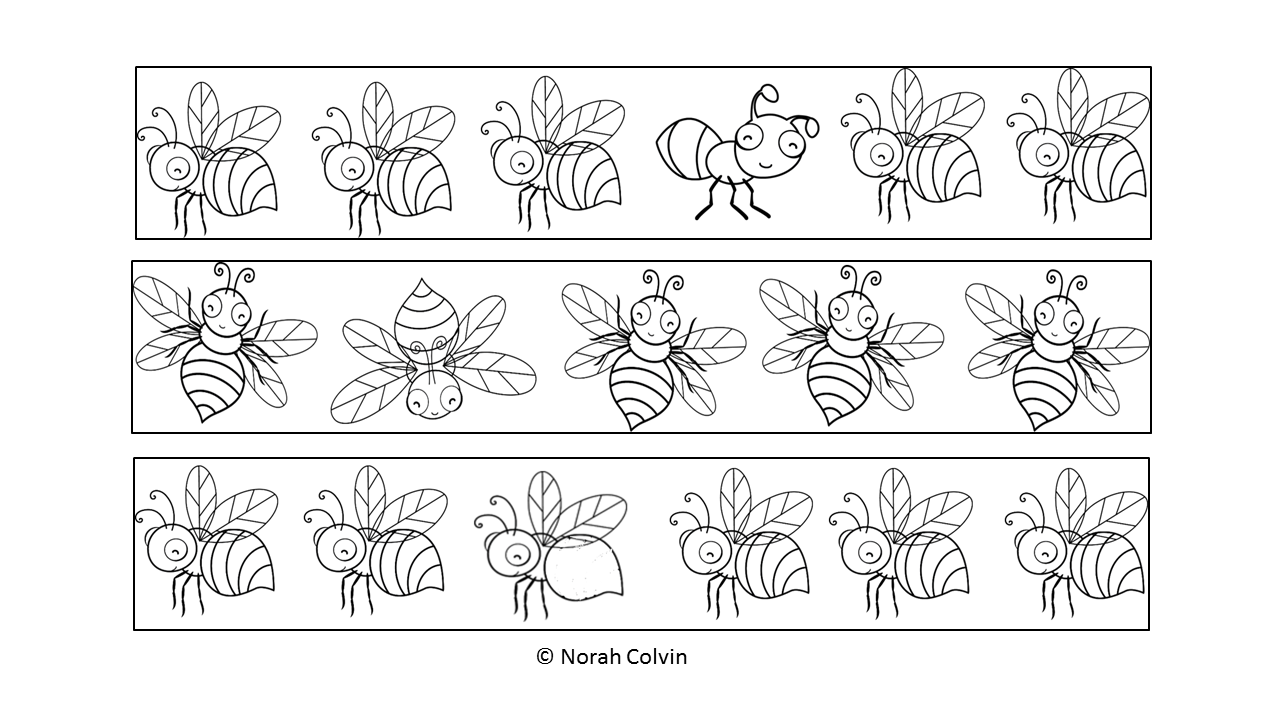
Back in the early days of my teaching experience workbooks of ‘reading readiness’ exercises were frequently used with students in their first year of school. These activities generally required children to identify the one that was different in a group of objects. The exercises, such as those shown below, progressed through various levels of difficulty with the aim of preparing children for reading.
Fortunately our understanding of how reading is learned has progressed since then and it is now recognised that exercises such as those did little to prepare children for learning to read. We now know that the best preparation for reading is to be immersed in language through conversations, with adults especially; to be read to frequently; and to develop a love of books and interest in print by sharing with others. The role of parents in preparing children for reading cannot be underestimated.
This week I watched a video of a presentation by Yong Zhao about a type of readiness he referred to as “Out of basement readiness”. I admit I hadn’t heard the term before but the concept is definitely familiar.
I do recommend you listen to Zhao’s talk. It is interesting, thought-provoking and humorous. I think I enjoyed listening to this talk as much as to Ken Robinson’s on How schools kill creativity which I have mentioned in previous posts here and here, amongst others. However at 55 minutes some of you may not be willing to commit the time. For me, it is 55 minutes of my life I’m very happy to not get back!
I will not attempt to share all the content of the talk; there is too much of value, but here are just a few snippets that resonated with me:
Zhao explains out of basement readiness this way:
Zhao says that students are being mis-educated, that they are being educated for something that doesn’t exist, and suggests that we should remove several phrases from the language we use to talk about education, especially
Under-performance
Evidence based
Data driven
His description of the traditional education paradigm will be familiar to any frequent readers of my blog. He says that it is “about forcing people to do what some other people prescribe them to do” and that we reduce it to just a few subjects that can be tested.
He talks about the “homogenisation” of schooling, and explained that homogenisation was the best way of getting rid of creative people and innovative thinkers.
He mentioned kindergarten readiness tests, and suggests that the only test should be whether the kindergarten was ready for the children and parents.
He recognises the uniqueness of every student, with different backgrounds, motivations and talents; and stresses the importance of effort. He says, “You cannot be born to be great. If you do not put effort into it you can never be good at it.” He explains it this way:
“If you put ten thousand hours into something you are good at, something you are interested in you get great talent. But if I force you to spend time on something you have no interest in, you hate and something you are not good at, you at best become mediocre.”
He says that countries that produce high test scores, score low on confidence and interest.
He says,
“Everyone is born to be creative, that’s a human being, that’s our gift: to be able to adapt, to learn and relearn and do new things. But school has typically tried to suppress it (with) . . . short term learning. . . Direct instruction may give the short-term gain but cause long term damages Studies show that if you teach children how to play with the toy, they lose creativity, lose curiosity and if you allow children to explore more they may not test very well but they maintain creativity and curiosity.”
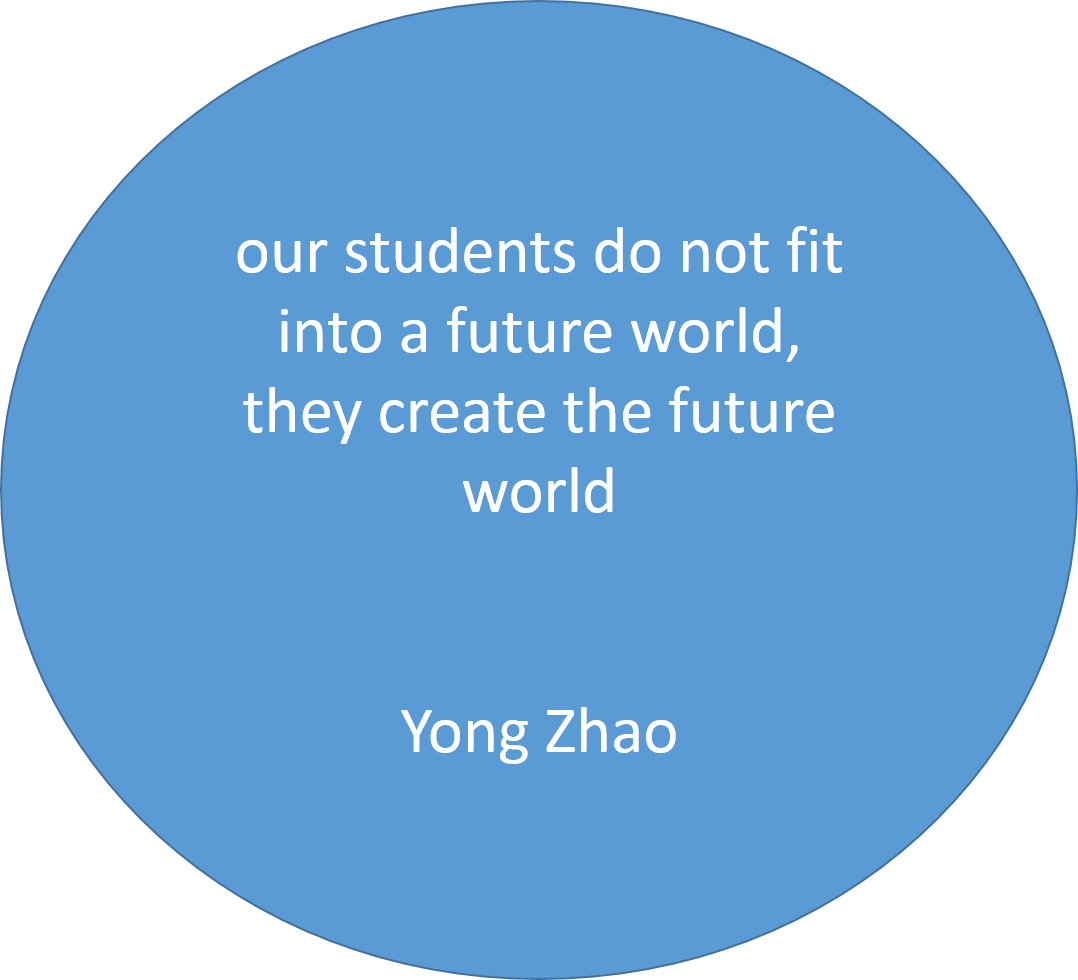
Zhao says that “our students do not fit into a future world, they create the future world. This is why we need a different type of education.” He says that “education is to create opportunities for every individual student, they are not an average, they are not a probability, they need to be improved as individual human beings.”
I couldn’t agree more. What do you think?
I was led to Zhao’s talk via Diane Ravitch’s blog which is about the education system and situation in the US. Much of what she writes has applications further afield and I recommend it to anyone wishing to stay informed of current issues in education.
Thank you for reading. I appreciate your feedback. Please share your thoughts on any aspect of this post.
I have often expressed concern about what I consider to be an over-emphasis on standardised and national testing and the pressure it puts on students to achieve. I explained some reasons for my misgivings here and here and here, for example.
As a parent and a teacher the most important thing I want for my children is for them to be happy. After that I wish for them to be healthy and successful. But what is success? In a recent post I referred to a seventy-five year study conducted by George Vaillant who came to the conclusion that success means leading a happy life and that “warmth of relationships throughout life have the greatest positive impact on ‘life satisfaction‘”.
Last week I wrote about spelling tests and spelling bees and the effect that doing well, or not, might have upon a learner’s self-esteem as well as attitude to self as a learner, attitude to school, and to learning in general. While writing it I was not aware of an article written by Kate Taylor and published in the New York Times on April 6 2015: At Success Academy Charter Schools, High Scores and Polarizing Tactics.
Taylor opens the article by describing how the struggles of students to learn are made public, for all to see; posted on charts in hallways and reproduced in class newsletters. To see one’s name at the bottom of the list in a red zone, clearly showing that year level expectations have not been reached seems to be rather harsh, and humiliating for the child. Perhaps even more so if the teacher considered the student was just not trying. The teacher, it is reported, had difficulty watching the child take the tests for fear she would be upset by his mistakes. Months later the child scored 90% and was warmly congratulated.
Taylor goes on to say that the school, which has mostly poor black and Hispanic students, outscores many students from more affluent areas with results much higher than average on the state wide tests. I know that everybody loves a winner and that we all want our students to succeed, but at what cost? The article describes the school as being very rigid with a competitive atmosphere that requires strict adherence to rules.
Last week in my post A sprinkling of semicolons I shared an article by Ron Berger who talks about regular students whose “teachers have helped them develop the skills and mindsets necessary to produce work of exceptional quality, and have built classroom and school cultures in which exceptional work is the norm.” He says that most of the work comes from students in low-income urban schools.
I suddenly became fearful. Were the students and schools described by Berger similar to those of the Success Academy schools as described in Taylor’s article?
In both cases the students were from poor areas and they achieved remarkable success with most attending college. Austin, as described by Berger, made six drafts of his butterfly drawing before it was considered to be “scientific” enough. I wondered how much, if any, duress he had been under.
The article described Berger as the Chief Program Office of Expeditionary Learning Schools. I followed the link to discover a little more about Expeditionary Schools, checked with Wikipedia and other sites that came up in a Google search, including Open World Learning which says that expeditionary learning (EL) “fosters curiosity about the world by creating learning situations that provide something important to think about, time to experiment, and time to make sense of what is observed.” It also says that EL schools “promote rigorous and engaging curriculum; active, inquiry-based pedagogy; and a school culture that demands and teaches compassion and good citizenship. EL schools are based on the Outward Bound model, which starts with the belief that we learn best through experience.”
This all sounds wonderful and praise-worthy, and I was feeling a little happier about what I had shared. However, if there’s one thing I have realised after a lifetime involvement in education is that the written statements of any educational institution sound wonderful and praise-worthy. It’s the way the principles are applied in practice that makes the difference.
I didn’t like what I had read about Success Academy Charter Schools in the New York Times, so I thought I’d better check out their website to discover what philosophy and principles guide them. First thing I spotted was a letter from a parent responding to the article in the New York Times! The parent, Polina Bulman, painted a very different picture of the school from that offered in the Times.
Bulman describes the decision-making process she went through in choosing the Success Academy for her five year old daughter. She shares what had concerned her and explains how those concerns had been answered. She describes her daughter’s happiness at school and the progress she is making in all areas of her learning. She has nothing but praise for the school, and concludes her letter, which she shared on Facebook, with these words:
“I was so touched by the warm and welcoming atmosphere. I had a chance to hang out in the hallways, listening to what teachers say to students as they pass by, and watching what teachers and staff members say to one another. I saw so much collaboration and kindness, so much teamwork. The best thing is that as a parent I feel like a part of this team and am proud of it!”
These words are in quite strong contrast to those of the New York Times.
The “Approach to Learning” statement of the Success Academy explains that students are engaged in only 80 minutes of direct instruction each day and that the rest of the time they are engaged in small group instruction and hands on learning.
So what does all this mean?
For one thing, just as you can’t judge a book by its cover, you can’t judge a school by its policy statement.
For another, you can’t believe everything you read, even when the source seems trustworthy, you must question the author’s credentials, viewpoint and purpose in writing, “What barrow are they pushing?” (I’m upfront about my biases!)
And mostly, question, question question.
These are important lessons for readers of any material and of all ages. I have talked about the importance of developing critical literacy in a series of posts about using “The Very Hungry Caterpillar” in the classroom. No, definitely not in science lessons, but in lessons to discuss those very points discussed above:
Don’t believe everything you read
Check an author’s credentials and purpose in writing
And question everything.
While I applaud the end result of Austin’s butterfly drawing, I question what the process may have been. We are not privy to that, though the supportive voices of students in the video do give us an inkling. I hope for the sake of all students that it was one of encouragement and support rather than pressure. Additionally I hope that the report in the New York Times got it all wrong. But if that is so, what is Taylor’s agenda and why would she attack these particular schools so fiercely?
Note: I wrote this article a couple of days ago and upon re-reading it now I have a couple of further thoughts re my advice to check an author’s credentials and purpose in writing. I have not followed my advice. I failed to check out the author of the NY Times article. However I think it is fair to say that Lloyd Lofthouse and Diane Ravitch are both anti the emphasis on standardised testing; and the Success Academy is probably reliant on the tests to measure its “success”.
There is no black and white truth. There are only shades of grey.
Thank you for reading. I appreciate your feedback. Please share your thoughts about any aspect of this post.





























 Norah Colvin

