Live Love Laugh Learn … Create the possibilities

Category: Teaching resources

  • Busy work

    What does being busy mean to you?

    This week at the Carrot Ranch Literary Community, Charli Mills asks readers to contemplate that question, wondering “Is it a danger or a joy to become so busy?”

    She then challenges writers to In 99 words (no more, no less) write a story about a busy character. It could be a busy beaver, gnawing birch trees endlessly or an executive on the go. Go where the prompt leads.

    What about a busy toddler? Toddlers are some of the busiest people I know. And they are generally quite joyous in their busyness, demonstrating the true meaning of being in the present moment.
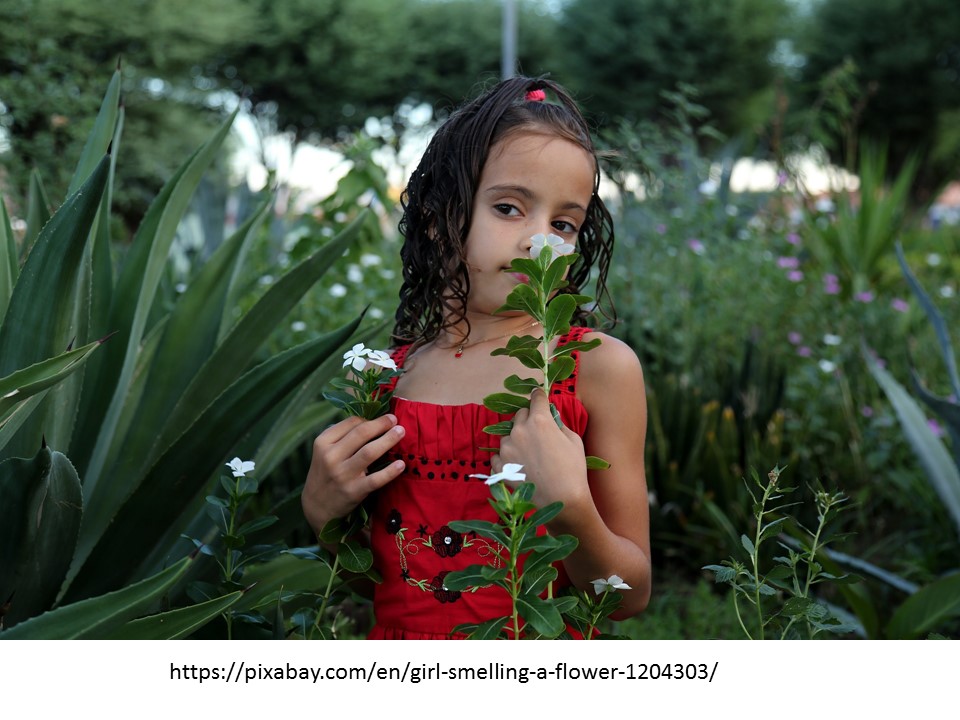
    girl smelling flowers

    For me, being busy is a joy when the activities are of my choice and for my purposes. I have no need to find things to keep me busy. There is more I wish to do than I will ever have time to complete. I resent tasks that keep me busy and away from what I’d rather be doing. But even in the busyness, there still must be time for fun.

    As a teacher, I was never in favour of setting children “busy work”, preferring instead to provide opportunities to progress learning. By busy work I refer to meaningless tasks with the sole purpose of keeping children quiet and busy. They may involve things such as copying a passage of text or completing a worksheet unrelated to either learning goals or needs; tasks that offer little to either interest or challenge children, and certainly no fun. Now, while there is nothing wrong with having some downtime in which to relax, daydream and imagine, keeping children busy with meaningless tasks has none of these benefits.
    busy bee of the week

    Having said that, I used to call my class The Busy Bees. We had a Busy Bees chant and Busy Bee awards. In fact, there are 20+ Busy Bee themed teaching resources available on readilearn. How the busy work of busy bees differs from classroom “busy work”, is that it is purposeful and productive, not busy for the sake of it, and whenever possible, lots of fun.

    For my response to Charli’s challenge, I thought I’d stick with a busy toddler.
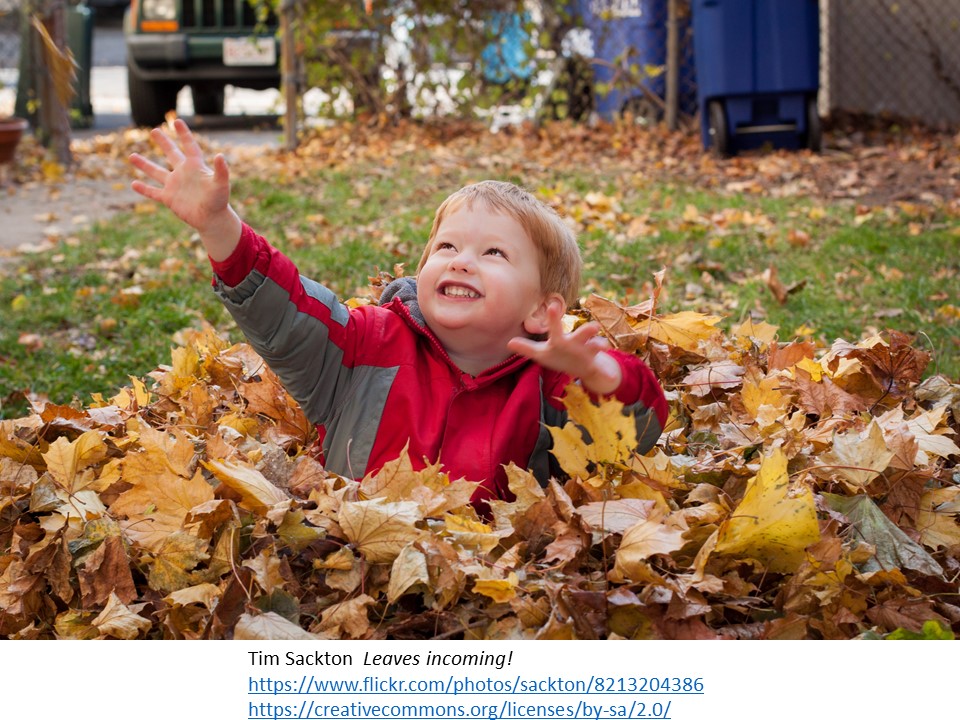
    leaves incoming

    Never too busy for fun

    After days of endless rain, the chorus of birds and bees urged them outdoors. Mum bustled about the garden; thinning weeds, pinching off dead flowers, trimming ragged edges, tidying fallen leaves, enjoying the sunshine. Jamie, with toddler-sized wheelbarrow and infinite determination, filled the barrow, again and again, adding to the growing piles of detritus. Back and forth, back and forth, he went. Until … leaves crackling underfoot and crunching under wheels, called him to play. Jamie giggled as armfuls scooped up swooshed into the air and fluttered to earth. Mum, about to reprimand, hesitated, then joined in the fun.

    Thank you for reading. I appreciate your feedback. Please share your thoughts.

  • Inspiring creativity – celebrating Dot Day – Readilearn

    inspiring creativity - dot day

    Next Friday 15 September is International Dot Day, a day for celebrating and promoting creativity, courage and collaboration.

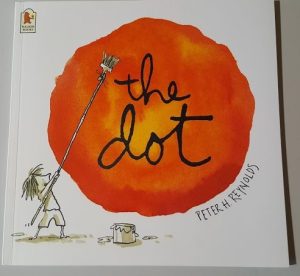
    Celebration of the day was initiated in 2009 with teacher Terry Shay introducing his class to the picture book The Dot by Peter H. Reynolds.

    The story is of Vashti and a teacher who encouraged her to make a mark and have a go. Lacking self-belief and courage, Vashti was reluctant to participate in art class. When the teacher framed and hung her signed painting of a tiny dot, Vashti was determined to do better. She painted all kinds of dots that wowed the people at the school art fair. What happened when one little boy admitted to Vashti that he wished he could draw will inspire children everywhere to be brave, have a go, and be creative.

    For a wealth of celebratory suggestions, visit the International Dot Day Get Started page and sign up to download a free Educator’s Handbook, which includes a lovely certificate of participation which can be printed and personalised for each child.

    I have included a link to the page in the new resource Getting creative with dots in which I suggest additional ideas to add to the celebration.

    getting creative with dots

    The suggestions, of which examples are shown below, can be used in conjunction with International Dot Day, or any day when you feel like going a little dotty.

    Continue reading: Inspiring creativity – celebrating Dot Day – Readilearn

  • The value of parent volunteers in the classroom – Readilearn

    value of parent volunteers

    I have always welcomed and appreciated parent volunteers in the classroom. The value they add to the classroom program and children’s learning is enormous. I always loved that we could do much more with the assistance of parent volunteers than we could without.

    But effective use of the parent volunteer’s time requires a certain amount of organisation and preparation. Just as there is little point in a parent volunteer turning up at a scheduled time if you are unprepared; there is also little value in a parent appearing at the door during class time and asking, “Can I help?”

    Parent volunteers can play a very important role in the classroom, especially with group work in literacy and maths, assisting with art lessons, outdoor activities and work in the computer lab. They may also help in administrative-type roles such as changing reading books and checking sight words. Perhaps they could read to groups or individual children, or listen to children read.

    utilising parent volunteers

    How their support is utilised will depend upon their availability and your class program.

    For a variety of reasons, not every parent is able to offer regular assistance in the classroom. Indeed, parent help should not be viewed as an expectation but appreciated as a gift of their precious time.

    when parents volunteer

    Sometimes parents welcome the opportunity to share a special skill or information related to their

    Continue reading: The value of parent volunteers in the classroom – Readilearn

  • Happy first birthday, readilearn! – Readilearn


    This week we celebrate readilearn’s first birthday. Last year we launched with just over one hundred resources to support early childhood teachers in their role. Now there are more than 250, and the number continues to grow with new resources uploaded nearly every week.

    Resources across most areas of the curriculum support teachers of children in their first three years of school. All resources are original and teacher-made, designed to lighten workloads by providing lessons and activities teachers would make themselves, if they only had time.

    The collection consists of digital stories, and interactive resources for use on the interactive whiteboard. There are printable activities, teaching suggestions, and notes for distribution to parents. If you can’t find what you’re looking for, let us know and we’ll do our best to support you.

    This week, in celebration of the milestone, I have uploaded two new free resources which can be personalised for individual children on their birthday.

    Continue reading: Happy first birthday, readilearn! – Readilearn

  • Meet Australian picture book author Aleesah Darlison – Readilearn

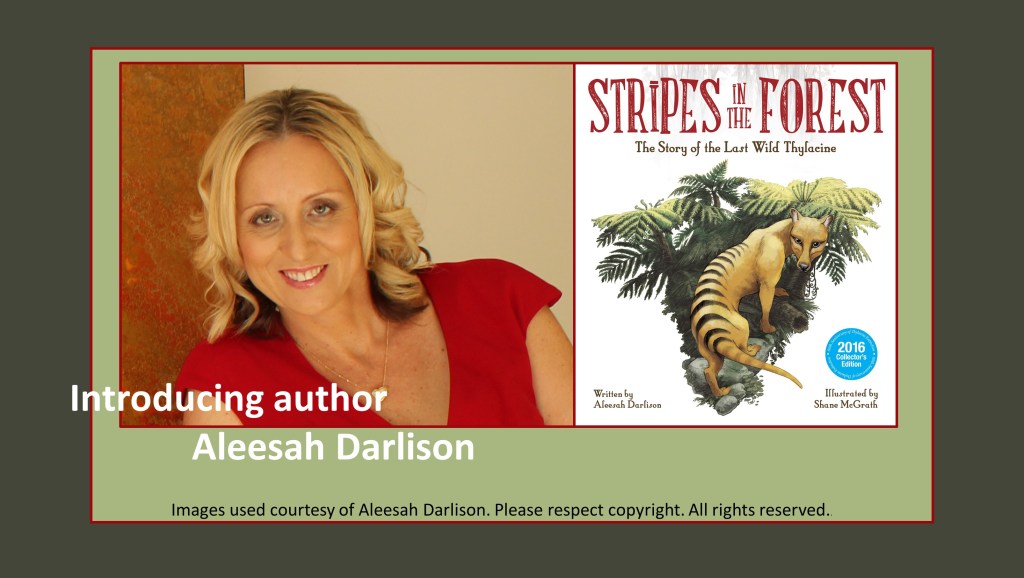
    Aleesah Darlison

    This month, it is my pleasure to introduce you to award-winning Australian author Aleesah Darlison. Aleesah writes picture books, chapter books and novels. Her much-loved stories promote courage, understanding, anti-bullying, self-belief, teamwork and environmental themes. In 2015, she won the Environment Award for Children’s Literature (Non-Fiction) for her picture book, Our Class Tiger. She has won numerous other awards for her writing.

    Aleesah has written over thirty-five books for children and in 2016, she set up Greenleaf Press, a business designed to provide critical support services to authors and illustrators. The company also acts as a booking agency for school and preschool visits.

    Today, Aleesah and I are talking about her picture book Stripes in the Forest. With National Threatened Species Day just a couple of weeks away on 7 September, it is a timely interview. Stripes in the Forest is the story of an iconic species lost.

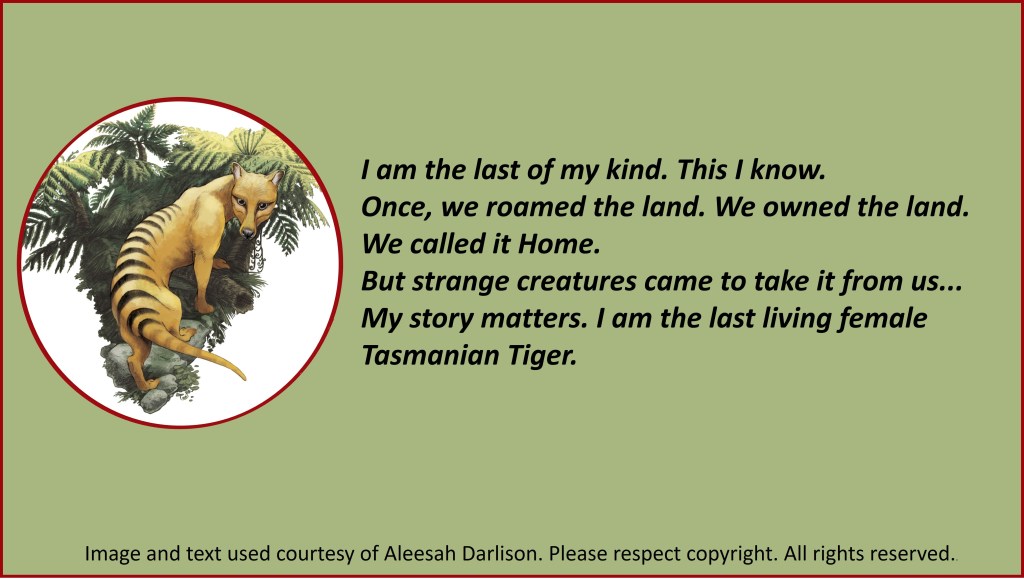
    Thylacine quote

    Told from the perspective of the last wild female thylacine, it provides readers with an insight into the rare beauty and uniqueness of these amazing animals, explains their fight for survival and provides important lessons for future generations.

    An emotive and moving story, children will connect with the solitary, stoic and courageous female thylacine who does all she can to protect her young – just as a human mother would do. The story takes readers to a place in the past, but also offers a twist that projects them

    Continue reading: Meet Australian picture book author Aleesah Darlison – Readilearn

  • Celebrating Father’s Day – Readilearn

    While many around the world celebrated Father’s Day in June, here in Australia Father’s Day is celebrated on the first Sunday in September. Since that is now just a few weeks away, I thought I’d get in early with some low-cost Father’s Day gift suggestions that can be incorporated into your literacy and art programs.

    A cautionary note

    However, before I share them, I’ll begin with a cautionary note.

    Be aware of the diversity of families in your class and the needs of individuals. Not all children have a father present in their lives, and not all fathers fit the perfect role model. While the day is not just for dads, but for grandfathers, stepfathers, and other male carers and role models too, a day to let them know how much they are appreciated; for some children, the day can be a painful reminder of someone missing. Be sure to adjust what you do to be inclusive of children’s circumstances, for example; “Celebrating a special adult in my life day”, or consider leaving any celebration to the children and their families.

    Most classrooms are peopled by children from a diversity of traditions and cultures. Learning about and appreciating the similarities and differences is an important part of establishing a supportive classroom environment and encourages acceptance of and respect for each family’s composition and heritage. Suggestions to support discussions are available in readilearn History resources. Conducting Getting to know you surveys about families and who children live with can also help identify suitability of the celebration with your class.

    Gifts from the heart on Father’s Day

    Encouraging children to create and give a gift from the heart demonstrates that not all gifts need come from a shop. It allows children from even the poorest families to give their Dads a special Father’s Day gift. It helps develop their creativity and teaches them skills that they can apply in future gift-giving situations. It shows how thoughtfulness and imagination can combine to make a unique gift that will be treasured.

    A gift of love lasts longer than any store-bought gift.

    Classroom activities

    1. Read picture books featuring fathers

    A few of my favourites are:


    Continue reading: Celebrating Father’s Day – Readilearn

  • Preserving the world’s oceans with Coral Sea Dreaming – Readilearn


    Preserve the oceans

    Coral Sea Dreaming

    Recently I had the great pleasure of attending the launch of Coral Sea Dreaming, the eleventh picture book by award-winning Australian author and illustrator Kim Michelle Toft.

    Like her other books, Coral Sea Dreaming focuses on the underwater world and the importance of preserving it. One can’t help but be filled with wonder by the magnificence and beauty of her silk paintings with which she illustrated it.

    Check out Kim’s home page for videos of her process of painting on silk, including this one of her painting the cover for Coral Sea Dreaming.

    Continue reading: Preserving the world’s oceans with Coral Sea Dreaming – Readilearn

  • Ideas for playtime at school – Readilearn

    We generally think of recess as fun time for children. But it is not always so for those who find socialising difficult or for those who have trouble thinking of something to do.

    Incorporating social and friendship skills into the daily class program has enormous benefits in preventing unhappy times in the playground.

    Happy and peaceful playgrounds can be cultivated by:

    • providing children with strategies for friendly play, including how to join in, participate, and allow others to join in;
    • teaching children activities and games to play alone or with others;
    • offering equipment to support those activities and games.

    Peaceful playgrounds filled with happy active children contribute to a healthier, happier community more able to focus on learning during class time.

    Being active contributes to children’s overall physical development, including gross and fine motor skills and eye-hand coordination, and fitness.

    Opportunities for introducing activities and games can be seized in many areas of the curriculum. In addition to the obvious; physical education, they can be slotted into

    Continue reading: Ideas for playtime at school – Readilearn

  • A piece of pie

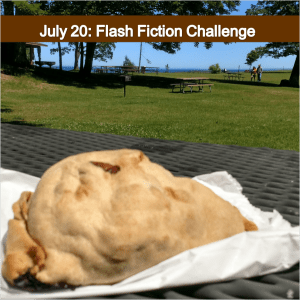
    This week at the Carrot Ranch Charli Mills has challenged writers to In 99 words (no more, no less) write a story that features a pie. You can make it any kind of pie, focus on filling or crust, or tell us about the pie-maker. How does pie set a tone in a story? Does it warm the hearth or bring disappointment?

    But which pie should I choose: meat, vegetable or fruit, with pastry that is short, flaky or puff? Perhaps a piece of pie for a correct answer in Trivial Pursuit?

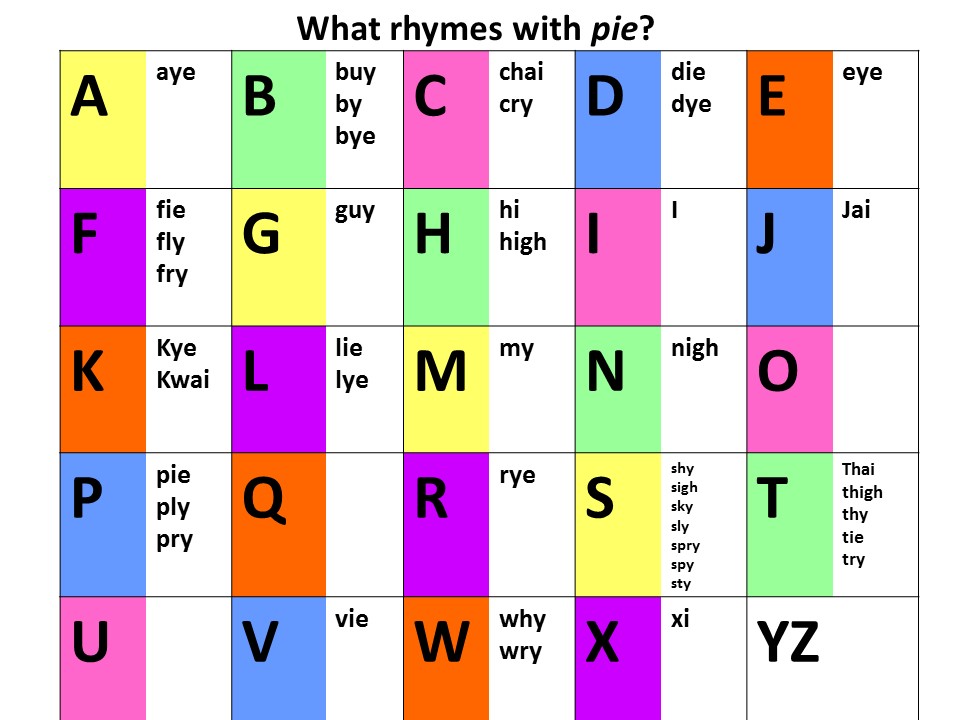
    I considered words that rhyme with pie, and what a list I made:

    what rhymes with pie

    Forty-three words!

    Maybe you can add even more.

    Did you notice the variety of ways we spell the long vowel ī, as in the word pie?

    There are eight:

    aye    uy    y     ye     ai     ie     igh    and     i!

    Isn’t it a wonder that any of us ever learned to read or spell.

    Did you notice there were two ‘pie’s in my title: A piece of pie?

    Did you notice that each time the three letters ‘pie’ were used, they represented different sounds?

    As mature readers and writers we have no difficulty with any of these vagaries of the English language, but for beginners, they can be a challenge.

    The challenge reminds me of “Old Lucy Lindy and the Pies” from Sounds of Laughter in the Sounds of Language Series by Bill Martin Jnr. In the story, Lucy Lindy loves to bake pies. She bakes all kinds of pies, including mince pies. Since all her pies looked the same with their delicious layer of pastry on the top, Lucy Lindy wanted to be sure she knew which pies were which when she took them out of the oven. She came up with a brilliant plan. She put the initials IM on the mince pies, for Is Mince. Then, on the pies that weren’t mince, she put the initials IM, for Isn’t Mince. Children laugh out loud when they realise it wasn’t such a clever plan after all.

    A Necklace of Raindrops

    Another lovely story for young children is “There’s some Sky in this Pie” from the collection A Necklace of Raindrops by Joan Aiken. The story has a cumulative structure similar to that of The Gingerbread Man, but with an additional sprinkle of creativity that could be used to ignite children’s own imaginative stories.

    When the old woman was making a pie for the old man, she looked outside at the snow “coming down so fast out of the white sky.

    “Then she went on rolling the pastry. But what do you think happened? A little corner of the sky that she had been looking at got caught in the pastry.”

    When the pie was cooked and the old woman opened the oven, the pie floated across the room. The woman and man and their cat jumped onto the pie to try to stop it, but they couldn’t, and they floated away on it. From time to time they met others who called out to them,

    “Old woman, old man, little puss, so high,

    Sailing along on your apple pie,

    Why are you floating across the sky?”

    They answered:

    “Because we can’t stop, that’s the reason why.”

    (Notice those different ways of spelling the long ī sound again – three spellings in that short extract.)

    Lucy Lindy and the Sky in the Pie are light-hearted and imaginative stories.

    Recipe for a Perfect Planet Pie

    Another favourite pie story is Recipe for Perfect Planet Pie by Kim Michelle Toft, an Australian author/illustrator and the only illustrator anywhere to illustrate all her stories with silk paintings.

    I have shared some of Kim’s work with you before here and here, and I’m certain to again as I attended the launch of her eleventh picture book Coral Sea Dreaming on the weekend and have scheduled a readilearn interview with her later in the year.

    Kim is passionate about conservation, especially of our marine environment and its inhabitants. In each of her books, she uses her stunning silk paintings to ignite a wonderment in the natural world and inspire a love of and caring for the environment. Recipe for Perfect Planet Pie continues these themes.

    The book reads like a recipe with a list of ingredients, a method, fourteen step-by-step instructions, and “Helpful hints” on each page. The recipe begins:

    1 To prepare the base. Sift the rich chocolate earth and crystallised minerals together. Make a well and pour in one cloud full of rain.”

    and concludes:

    “Serve pie immediately with a side of love and a slice of happiness.”

    At the end of the book, Kim includes information about the pie’s ingredients and the importance of each. She provides suggestions that we can implement to help create a happy, healthy planet and says,

    “Planet Earth is our only home and it is up to us to create change and put our knowledge into action.”

    I’m sure you’ll agree with that.

    For my response to Charli’s challenge I decided to go with a bit of nonsense and see how many of the rhyming words I could use to construct a pie story and still maintain some sort of sense. I wonder how successful you will think I’ve been. I managed to incorporate 28 and at least one from each of the spelling variants.

    A piece of pie

    Kye met Jai at the mall.

    Hi,” said Kye.

    “Nice day,” replied Jai. “Look at that sky. Wish I could fly.”

    “Time for a chai?”

    Aye. And maybe a pie. I’ll buy.”

    “What a great guy!”

    “I try!”

    “I’ll have toasted rye.”

    They sat high by the window and played “I spy.”

    “Oh my,” said Kye, rubbing his eye.

    “What? Why?

    Kye started to cry.

    “Don’t mean to pry.” Sigh.

    “It’s no lie. The end is nigh.”

    “Will we all fry? Will everyone die?”

    “No, just wish I had your piece of pie.”

    Fie! Wish I had Thai!”

    Bye.”

    Thank you for reading. I appreciate your feedback. Please share your thoughts.
  • Introducing illustrator Muza Ulasowski – Readilearn

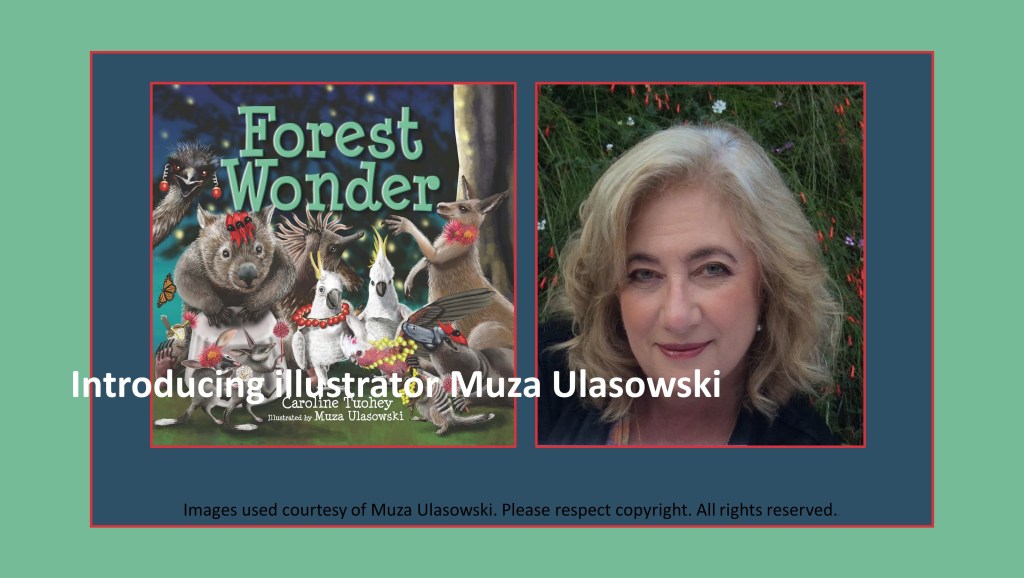
    This month I am delighted to introduce you to the very talented illustrator Muza Ulasowski. I’m certain you will find her illustrations to be quite remarkable.

    Although Muza has illustrated many books, I first came across her work in the beautiful picture book Forest Wonder, written by Caroline Tuohey. It is Forest Wonder, a winner of international awards, that Muza and I are discussing today. Before we get started on the interview, first let me tell you a little about Muza.

     Muza Ulasowski is a graphic designer and children’s book illustrator based in the leafy western suburb of Brookfield in Brisbane, Queensland. Australia. She is inspired and surrounded by a vast array of local birds and animals who tend to make their appearances in her book illustrations. She shares her life with her wonderfully patient husband, their charismatic bulldog called Charlie and a black magic cat named Basil.

    In 2010, she was invited to illustrate her first children’s picture book and enjoyed it so much, that

    Continue reading: Introducing illustrator Muza Ulasowski – Readilearn