Expecting every child in a class to respond to the same stimuli, develop at the same rate and achieve the same targets is like casting a handful of mixed seeds upon the soil and expecting them all to flourish.
Just as each seed has its own specific requirements of soil type, temperature, sunlight and water, so too does each child have its own needs, interests and learning requirements.
Differentiation is no less important in the classroom than it is the garden and tending to the learning and development needs of each child requires understanding of individual needs, appreciation of learning styles and a program that includes both a nurturing and expectation of individual growth with a sprinkling of well-timed instruction, support and attentive praise.
This week Charli Mills at Carrot Ranch Communications posted a flash fiction prompt that immediately conjured up an image of a classroom as a well-tended garden in which each individual is appreciated for its own value and receives whatever is appropriate to foster its development.
They love being read stories and beg for them to be read, over and over again.
Equally as much, if not more, they love being told stories, especially stories of their own lives. They beg for them to be told over and over, listening attentively and with wonder as their own stories (her story and his story) are being revealed. They commit these tales to memory so that eventually it is difficult to distinguish the genuine experiential memory from the telling. Even as adults they seem to not tire of hearing tales of the cute things they did when they were little, or of shared experiences.
They also love being told stories of their parents’ lives. These are the stories that help define them and their existence: how they came to be. The stories tell of times gone by, and of how things used to be. They marvel that their parents were once children and try to imagine how that might have been.
My daughter would often ask for stories about herself, her brother, myself or other family members. One day when she was about six, she asked again, ‘Tell me a story about when you were a little girl.’ Before I could respond she jumped in with, ‘What were the dinosaurs like?’ She was teasing, of course, and her comedic timing was perfect. A story was created, one that has been shared many times.
History is a story, though at school I never saw it as such. Had it been a story of lives, as its name implies, I may have been interested. But history at school was a list of wars and dates, and kings and queens to be memorised and regurgitated for a test at the end of the term. There was no story, no human emotion, no semblance to any narrative that may have lured me in.
I hope that today’s students of history are not required to commit sterile lists of facts to memory without the stories that would give them meaning and significance, some human element to help the information stick.
History, as a subject, had always been relegated to high school. It was not a discrete part of the primary school curriculum, though aspects were explored in other subject areas such as ‘Social Studies’ when I was at school, or more recently ‘Studies of Society and Environment’. With the introduction of the new Australian Curriculum, History is now a stand-alone subject.
As an early childhood teacher I was a bit terrified that young children would be required to memorise lists of seemingly random facts and dates. I’m pleased to say that, for the early years anyway, this is not so. Children in the early years start by exploring their own history and the history of their family, considering similarities and differences between their lives, the lives of their parents, and of their friends.
I applaud this as an excellent starting point. I believe, when working with children, connections must always be made with their lives and what they know. What better starting point than investigating the traditions of their own family and culture.
In Australia, as I am sure it is in many other places, a great diversity of cultures is represented in each classroom. Encouraging children to share similarities and differences of traditions with their classmates helps to develop understanding of each other’s traditions and beliefs, which in turn fosters respect and empathy. For this purpose, I developed some materials to make it easy for children to share their traditions. These are available in my Teachers Pay Teachers store.
Mem Fox has written a beautiful picture book Whoever you are that I love to share with children when discussing their cultures and traditions. It explains in a simple and beautiful way that although children around the world may live in different houses, wear different clothes, eat different foods, for example ‘inside, their hearts are just like yours.’ Mem Fox explains the story on her website.
I also like to sing I am Freedom’s Child by Bill Martin Jr.; and in Australia we have a great song that tells about our different beginnings, I am, you are, we are Australian by Bruce Woodley.
Heal the World by Michael Jackson is another great one for appreciating diversity and fostering inclusivity.
Her freckled, calloused hands were red and chaffed as they gripped the wooden stick and stirred Monday’s sheets in the large copper pot heating over burning blocks of wood.
The children played in the dirt nearby, scratching like chickens, hopeful of an interesting find.
The dirt embedded under her torn and splitting fingernails began to ease away in the warm sudsy water as she heaved the sodden sheets and plopped them onto the wooden mangles.
The children fought to turn the handle, smearing dirty handprints on the sheets.
She sighed, and hung them over the line. One chore done.
I welcome your feedback. Please share your thoughts about any aspect of the article or my flash fiction piece.
This is a perfect prompt for a teacher as a major focus of our work is in developing children’s strengths:
Strengths as in abilities; strength as in self-esteem and self-confidence; strength as in willingness to face setbacks and try, try again; strength as in keeping on going even when the going gets tough.
The picture book discussed in the article by Stacey Shubitz is The Most Magnificent Thing by Ashley Spires. Stacey suggests that the book is a great opener for discussions with children about the importance of a growth mindset.
According to Stacey, an understanding of ‘the power of having a growth mindset’ has been enabled by the work of Carol Dweck, a Stanford psychologist. It is grounded in a belief that
‘Someone can accomplish a lot more through hard work and dedication, rather than by relying on their smarts alone.’
I agree with Stacey that
‘Educators know the benefits of having a growth mindset, rather than having a fixed one. We learn from trial and error. There is value in failure.’
I will not quote Stacey’s article in its entirety, but suggest you pop over and read it for yourself. (If you do, and leave a comment prior to June 27th, you may win yourself a copy of The Most Magnificent Thing, if you live in the USA or Canada.)
Stacey says that “The girl in the story tries over ten times to build something and get it right. Through hard work and some help from her trust sidekick, her pug, she eventually succeeds.” As well as a starting point for discussing the growth mindset, Stacey suggests eight features of the book which are useful for teaching writing. The article also includes a brief, but informative, interview with the author/illustrator Ashley Spires.
In response to Stacey’s question about using The Most Magnificent Thing for discussing a growth mindset, Ashley responds:
‘The character is a perfectly capable girl with a great idea and the skill to make it, but she has to try, try and try again in order to succeed. Most kids (I was one of them) think that if it’s not perfect the first time, then they should move on to something that comes to them more easily. Working hard to succeed is what true success is.”
My flash fiction, told through the jottings of a classroom teacher over time, shows a growth mindset emerging from one that was previously crushed.
Progress
Day one
Timid. Needed help getting things out of bag to put in drawer. Sat towards back of group. Drew knees up under chin. Hunched over. Sucked thumb. Twisted long tangled hair under nose. Rocked.
Day twenty-six
Responded in roll call! Sat with ‘friend’. Legs crossed. Back straight. Smiled – briefly. Someone looked! Screamed, “Stop looking at me!” Dissolved in tears. Again. Retreated under desk. Again.
Day fifty-two
Initiated conversation!! Hair combed!! Nose not running!! Brought toy for show and tell. Responded with one- or two-word answers. Small, dirty, pink unicorn. B laughed. Erupted, but went to desk, not under!
I welcome your feedback. Please share your thoughts about any aspect of the article or my flash fiction piece.
Do I respond to the flash fiction prompt in isolation?
Neither of these alternatives appealed as I have been enjoying the camaraderie and support of the flash fiction tribe as well as the opportunity to experiment in a genre that, while not an immediate writing priority, I may move towards in the future. On the other hand, as my intent with this blog is to share ideas and thoughts primarily about education, I don’t want to become distracted from my focus.
As do many, the idea for this prompt attached itself to me when I wasn’t thinking about it. Ideas tend to pop into my head when I first awaken in the morning, when I am showering, or during any other moment when my thoughts are free to flit and fly without the constraints of achieving a particular outcome.
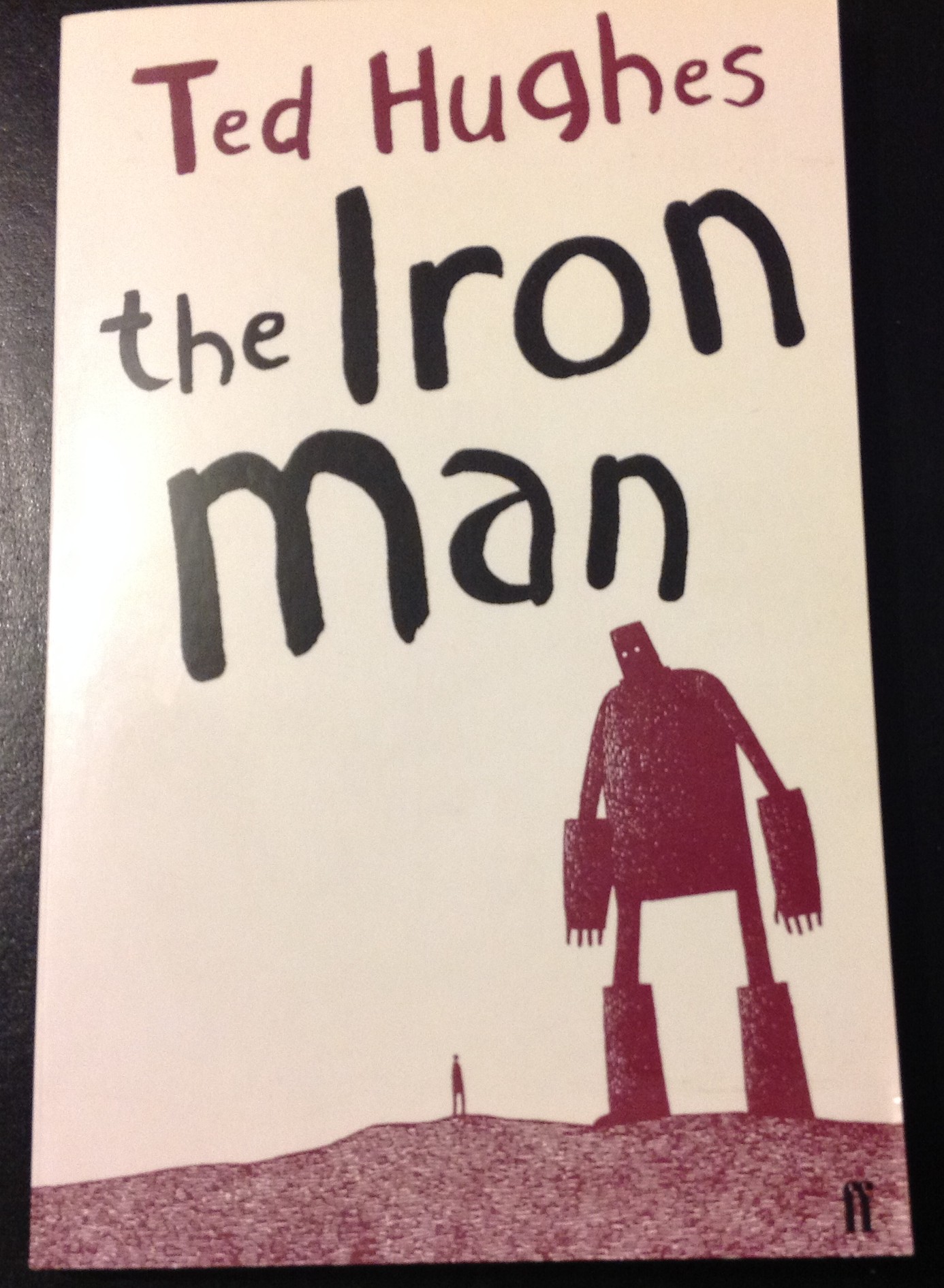
This one descended when I was out for a drive appreciating the beauty of the pure white clouds, like puffballs, on the bright blue sky of a glorious winter day. It plopped down, ‘Barrrump!’ just as the space-bat-angel-dragon from The Iron Man by Ted Hughes had plopped down on Australia.
As mentioned in a previous post, The Iron Man is one of my favourite books. It is a great story told in beautiful language. On the back of my copy a quote from the Observer declares that it is ‘Reckoned one of the greatest modern fairy tales.’ The rhythm and poetry of the language begs for it to be read aloud. Because it has just five short chapters, ‘a story in five nights’, it is perfect as a first chapter book to share with younger children, and can be read to a class in a week, a chapter a day.
The chapter I wish to share with you in this post is #4 ‘The Space-Being and the Iron Man’.
The previous chapter has seen The Iron Man happily ensconced in a huge scrap-metal yard. It could have finished there with a happily ever after ending. But no. It was only chapter 3. There were two more chapters to come! What excitement was in store?
The chapter begins
‘One day there came strange news. Everybody was talking about it. Round eyes, busy mouths, frightened voices – everybody was talking about it.
One of the stars of the night had begun to change.’
We are immediately reeled back into the story – What is going to happen? What will the Iron Man do? – and propelled along by the giant star that grew ‘not just bigger. But bigger and Bigger and BIGger’ as it came
‘rushing towards the world.
Faster than a bullet.
Faster than any rocket.
Faster even than a meteorite.’
Thankfully it stopped before it hit Earth. But wait – it’s not over yet, for ‘a dreadful silhouette, (came) flying out of the centre of that giant star, straight towards the earth.’
After several days it (‘a terrific dragon’) landed, with its body ‘covering the whole of Australia’ and it ‘wanted to be fed. And what it wanted to eat was – living things.’
‘The people of the world decided they would not feed this space-bat-angel-dragon … they would fight it.” But all the forces of the world were no match for the dragon.
As you may have guessed, this is where the heroic Iron Man devises his plan ‘to go out, as the champion of the earth, against this monster from space’. The dragon was very surprised to be challenged to a test of strength.
The Iron Man, you may remember, is taller than a house, but the space-bat-angel-dragon is bigger than Australia. The dragon thought that, when the Iron Man had finished, he’d ‘just lick him up.’ He didn’t figure on the ingenuity of the Iron Man. The Iron Man’s challenge was for the dragon to ‘go and lie on the sun till (he was) red-hot’. (The Iron Man was small enough to be made red-hot on Earth.)
After the second journey to the sun the dragon again ‘landed on Australia. This time the bump was so heavy, it knocked down certain sky-scrapers, sent tidal waves sweeping into harbours, and threw herds of cows on their backs. All over the world, anybody who happened to be riding a bicycle at that moment instantly fell off. The space-bat-angel-dragon landed so ponderously because he was exhausted.’
Have you ever felt that exhausted you just wanted to flop down and never move again? An article in my local newspaper1 recently declared that ‘We belong to the Spent Generation – the most overcommitted, overscheduled, overconnected, and therefore overtired, in modern times.’ The journalist Frances Whiting listed a number of professions including ‘doctors, scientists, social commentators (who) the statistics tell us (are) working longer, sleeping less, not resting enough and taking on too much.’
Teachers weren’t on this list, but they could have been at the top. Anyone who lives with, or has a friend who is, a teacher knows the long hours they work. Because it is a caring profession it is impossible to leave work at the gate and pick it up the following day. Content-driven curricula and unrealistic expectations imposed upon both teachers and learners place extra stress upon all stakeholders. Long before a school terms end teachers are tired, stressed and in need of time to recuperate and recharge in preparation for the next one.
At the moment most teachers in Australia are conducting assessments, evaluating their own work and student learning, preparing report cards and conducting teacher-parent interviews. This is in addition to their ongoing tasks of preparing and teaching lessons and is mostly expected to be completed in out-of-scheduled work hours.
When I was teaching I worked between 50 and 70 hours most weeks. I used to say that even with our ‘enviable’ holidays we were still owed time. In my current out-of-the-classroom role as writer of curriculum materials, I now feel the difference as I don’t have to think about it away from my desk.
I still get tired, but not the same heavy exhaustion that comes from giving all; physically, mentally and emotionally, to a class of 25 active learners while trying to stay afloat amidst ever increasing expectations.
So my flash this week recognises the teachers who, buried under a pile of paperwork and lost in a maze of data collecting spreadsheets, still struggle to be everything to everyone, endeavouring to make every child feel special and valued, while often feeling that their own work fails to achieve any real recognition. Enjoy the break, teachers. You deserve it!
A Unicorn at School
‘Miss. Marnie has a toy in her bag.’
‘Uh-uh,’ I responded.
‘You’re not allowed to have toys at school,’ he insisted.
‘Uh-uh.’
Trust him! Always dobbing.
‘Miss,’ he persisted, tugging my sleeve.
‘What is it?’ I sighed, dragging myself out of the confusion of marks and percentages that now seemed more important to telling a child’s story than their own words and actions.
I looked at the little fellow pleading for my attention. They were all so needy; so demanding; but time . . .
‘It’s a unicorn, Miss.’
‘Unicorn! Let’s see!’ I was back. A child in need!
I welcome your feedback. Please share your thoughts about any aspect of the article or my flash fiction piece.
I have many discussions with parents about whether they should read fairy tales and stories with magical elements to their children. These parents raise a number of issues, for example:
Horrible things happen – Hansel and Gretel are abandoned in the woods (by their parents) and are captured by a wicked witch – the wolf tries to trick the seven little kids left at home alone
Parents are often dead or absent – Cinderella, Beauty and the Beast, Rapunzel, Red Riding Hood, Jack and the Beanstalk
Stepmothers are mean – Cinderella, Snow White
Sexism, especially the need for a female to be rescued by a handsome prince – Cinderella, Sleeping Beauty
They contain “magical” creatures such as fairy godmothers (Cinderella, Sleeping Beauty), witches (Snow White), giants (Jack and the Beanstalk), trolls (Three Billy Goats)
Myth of happily ever after
Stereotypes – beauty is good, ugly is bad
The presence of magic – good magic of fairies and bad magic of witches – Sleeping Beauty; magical bean seeds and geese (Jack and the Beanstalk)
“many of the older tales incorporated rather dark themes devoted to death, suffering and children being murdered. But then there is also a second incorporation that has to do with later Disney movies of these fairy tales and them being too happy and can result in parents thinking their child will be deluded with ideas that the world will just work for them and things will be good.”
While I acknowledge these elements occur, I am not prepared to abandon fairy tales because of it.
While I may consider a diet of only fairy tales problematic, I think something would be lacking if a child was refused access to the richness of their stories and tradition. Like most fiction, they offer an avenue for escapism. In addition, the stories can be used as a tool for initiating non-threatening discussions of the issues listed above.
“Stories are just one way that we are able to sharpen our own character in order to prepare for the narratives we will one day find ourselves in as the story of our life unfolds before, around and within us.”
Following a comment by Richard Dawkins, a recent discussion on The Guardian considered whether fairy tales are harmful to children. So far the consensus seems to be that they are not.
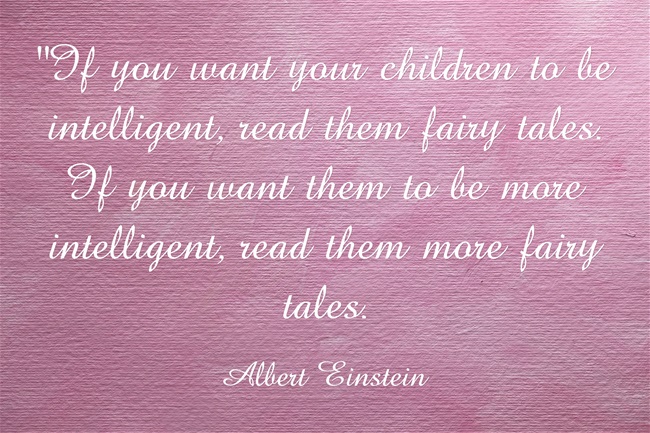
Albert Einstein was a supporter of fairy tales and is often attributed with the following quote, discussed in more detail by Maria Popova on brain pickings.
“In an increasingly complicated world, we more than ever want our children to be able to think with clarity, rather than lead lives hampered or derailed by all those false assumptions and unexamined prejudices that seem as easily inherited as freckles or brown eyes.
How can we go about teaching them to peel back the surface of their first thoughts on a matter, or even their strongest beliefs, and look at them with more care? . . . fiction has always fostered the moral, intellectual and emotional development of the growing child. (‘Should she have done that?’ ‘Would I?’ ‘What else could have been done?’ ‘How would it feel?’) Good stories highlight the sheer complexity of things. They furnish a far greater understanding of the world and everyone in it. For most of us, fiction has always been the earliest – and many would argue the best – instrument we have had for ethical enquiry.”
Think of the ethical inquiry that could occur when discussing Goldilocks and her break and enter, Jack’s theft of the giant’s belongings and the constant portrayal of the wolf as the bad guy; just to get you started.
I am not a reader of adult fantasy novels. I have never read Lord of the Rings, The Hobbit or Watership Down. I just couldn’t buy into it. I’m sorry I have to admit it – it is true.
However, I don’t mind a bit of fantasy in children’s books and, in fact, really enjoy it. I didn’t mind the rats’ use of language in Robert C. O’Brien’s The Rats of Nimh while I couldn’t handle the talking rabbits in Watership Down by Richard Adams. I cannot explain why my response is different but I’m sure it has something to do with the ability to suspend disbelief. I am obviously more able to do that when encountering fantasy in children’s stories than in adult fiction.
As both parent and teacher (and now grandparent) I love sharing stories with children. In addition to all the good things I know it is doing for them, it is doing lots of good things for me as well. Reading children’s stories written by masterful authors is one of life’s greatest pleasures and I love having excuses for doing so.
This week the flash challenge issued by Charli Mills at the Carrot Ranch was to
I am taking the opportunity of sharing with you some of my favourite fantastic creatures and magical realms from children’s stories. Each of these stories is wonderful to read aloud and share with children.
Charli mentioned rainbows, unicorns and the phoenix.
I thought of The Iron Man by Ted Hughes (a story in five nights, suitable for children from age 5 – 104)
“Taller than a house, the Iron Man stood at the top of the cliff, on the very brink, in the darkness.
The wind sang through his iron fingers. His great iron head, shaped like a dustbin but as big as a bedroom, slowly turned to the right, slowly turned to the left. His iron ears turned, this way, that way. He was hearing the sea. His eyes, like headlamps, glowed white, then red, then infra-red, searching the sea. Never before had the Iron Man seen the sea.
He swayed in the strong wind that pressed against his back. He swayed forward, on the brink of the high cliff.
And his right foot, his enormous iron right foot, lifted – up, out, into space, and the Iron Man stepped forward, off the cliff, into nothingness.”
and The BFG by Roald Dahl. (a longer tale for school age, and older, children)
“It wasn’t a human. It couldn’t be. It was four times as tall as the tallest human. It was so tall its head was higher than the upstairs windows of the houses. Sophie opened her mouth to scream, but no sound came out. Her throat, like her whole body, was frozen with fright.
This was the witching hour all right.
The tall black figure was coming her way. It was keeping very close to the houses across the street, hiding in the shadowy places where there was no moonlight.
On and on it came, nearer and nearer. But it was moving in spurts. It would stop, then it would move on, then it would stop again.
But what on earth was it doing?”
I thought of Joan Aiken’s wonderful collections of fairy tales like A Necklace of Raindrops (for children in early years of schooling)
“And when she had nine raindrops Laura found that she could make the rain stop, by clapping her hands. So there were many, many sunny days by the sea. But Laura did not always clap her hands when it rained, for she loved to see the silver drops come sliding out of the sky.
Now it was time for Laura to go to school. You can guess how the other children loved her! They would call, “Laura, Laura, make it stop raining, please, so that we can go out to play.”
And Laura always made the rain stop for them.
But there was a girl called Meg who said to herself, “It isn’t fair. Why should Laura have that lovely necklace and be able to stop the rain? Why shouldn’t I have it?”
and The Kingdom Under the Sea (for children approx. 8 -12), each beautifully illustrated by Jan Pienkowski adding another element of wonder to the tales.
Charli suggested that we “think of how (we) can use the fantastical to enrich realities” and I thought of the mouse who invented The Gruffalo in Julia Donaldson’s story and showed how imagination could be used to solve problems that arise. (The Gruffalo is suitable for children in pre-school and early years of schooling)
While the above excerpts are short, like flash fiction, each demonstrates the skill of the author in choice of words and sentence structure. In his book On WritingStephen King refers to these as forming the top level of the tool box. But these excerpts show a depth greater than that also. They create a connection, forming a relationship with and a need in the reader to know what happens.
It is the ability of the author that sweeps us away, as if on a magic carpet, to other places and other lives. It is the ability of the reader to suspend disbelief that allows the journey to occur.
I thought about how we, as either child or adult, use fantasy to escape realities that we may not wish, or not feel strong enough, to face. This brought me back to Charli’s unicorn.
And now I offer my own bit of flash, which is not suitable for reading to children of any age.
Hello, my name is Tiffany and I am a reader. Always have been and always will be. Reading is more than a hobby or a pleasurable activity. It is a true need in my life.
It all started early. I don’t remember learning to read. I clearly remember the day the words began to make sense to me. I was about five years old and sitting at the kitchen table with the Sunday comics. I got up to ask my mom to help me with a word and I never looked back.
From that day forward, I was unstoppable. Aided in large part by extremely supportive parents and grandparents, as well as key teachers and librarians, I became a voracious reader.
Books were my constant companion throughout my childhood. I received countless books as gifts. I haunted my public and school libraries. I would lose myself in stories, making new…
The challenge from Charli Mills at Carrot Ranch Communications on April 23, 2014 was to: In 99 words (no more, no less) describe the climate of a story as it changes to reflect a character’s mood or to create a sense of what is to come. This is my response to the challenge. I hope you enjoy it.
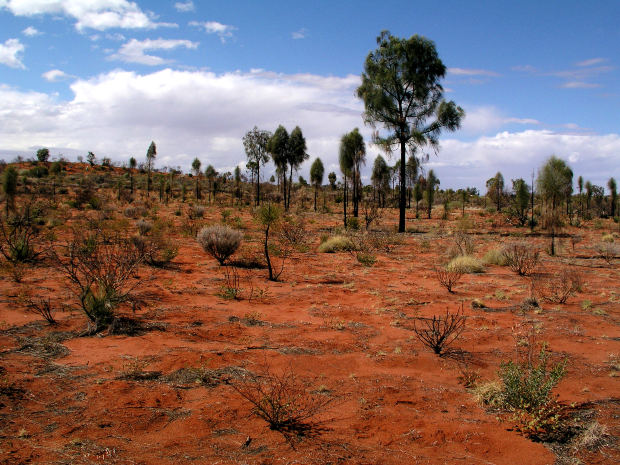
Her motivation and inspiration was as parched as the cracked red soil beneath her feet. The days were hot and lazy: nothing to do until the rains came. One long languid day followed another. With no work to be done on the land, time did not pressure creativity. Without pressure, there was no rush, no will. The bright blueness of the skies, usually joyous, now oppressive. An occasional cloud or flash on the horizon made empty promises. Finally the winds whipped the clouds into a frenzy, reigniting her creativity as the relentless soaking rains awakened the dormant earth.
A few weeks ago I had the great pleasure of taking my two gorgeous grandchildren to a performance of Michael Rosen’s “We’re Going on a Bear Hunt”. To say we enjoyed it would be an understatement. We had a rollicking good time.
The performance involved a lot of audience participation including spraying the entire audience with water from the “deep cold river”; an event which left everyone slightly wet, screaming with anticipation and laughter, and genuinely having a wonderful time interacting with this fabulous text.
We were already familiar with the text, of course, and had read it, recited it, acted it out and played a board game which has been made to accompany the text. None of this really prepared us for the delightful stage performance; but these pale in comparison with a telling by the master storyteller himself, Michael Rosen.
Michael Rosen’s website is a veritable treasure chest with much to explore and delight. From his home page you can visit his blog which he describes a as a place where he’ll
“post up some thoughts and ideas – especially on literature in education, children’s literature in general, poetry, reading, writing, teaching and thoughts on current affairs.”
After attending the performance of “We’re Going on a Bear Hunt” I shared with my grandchildren the video of Michael Rosen performing the story, which is also available from his home page. They loved it and we watched it “Again!”
Then I showed them the video of Rosen performing his fabulous poem Chocolate Cake. We watched it four times! Artie, who is four (and a half) was joining in with the telling the second time, and by the fourth time was copying many of Michael’s actions as well as facial and vocal expressions. Artie laughed along with the story and excitedly called other members of the family to watch it with him.
The next time Artie came to visit he was performing his own version, “Lollipop”, with similar actions and both facial and vocal expressions. His younger sister also had to have her turn telling the story. It was delightful and convinced me, though I needed no convincing, of the power of a great performer to turn children onto the fun of language, of playing with words, of performing, and of composing writing of their own. Creativity ignited!
If you haven’t yet watched Michael perform Chocolate Cake, I urge you to do so. You are in for a treat. I’m certain you will not be able to watch it without a smile on your face.
Michael is so passionate about making poetry come alive for children, he has made many videos on his website freely available to teachers for use in their classrooms.
He then goes on to present many fun ways of engaging children with poetry, none of which involve word study or comprehension exercises. He makes suggestions for performing, writing and talking about poems; and says that
“The best and most important thing you can do with any poem that a child writes is either get it performed or ‘published.”
and offers suggestions of how to do just that.
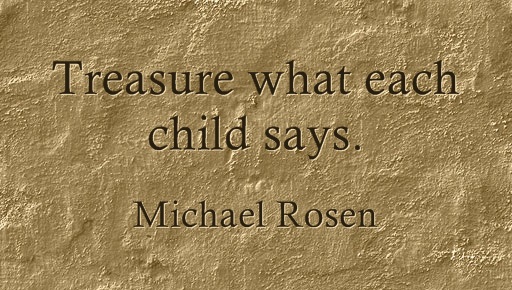
Another thing he says in that article, which was the inspiration for the title of this post, is
I couldn’t agree more.
This is just a brief sample of the riches to be found on the Michael Rosen website. There are so many videos of Michael’s performances available that I have not yet watched them all. Please let me know your favourites and I will make sure I watch those too.
Thanks Michael Rosen. We can learn so much from you while we are having fun!

















 Norah Colvin