The author in the spotlight this month is the wonderful Lauri Fortino, author of The Peddler’s Bed, illustrated by Bong Redila, published by Ripple Grove Press.
Please pop over to the readilearn blog to read all about Lauri’s writing process and her delightful picture book.
I am not a dog person. In fact, I am not a pet person at all. The only pets I ever owned were short-lived: goldfish, fighting fish, hermit crabs, and billabong bugs. I was successful at keeping caterpillars in the classroom and observing them grow, pupate, and emerge as butterflies. But they couldn’t really be classed as pets. I’ve written about this before here.
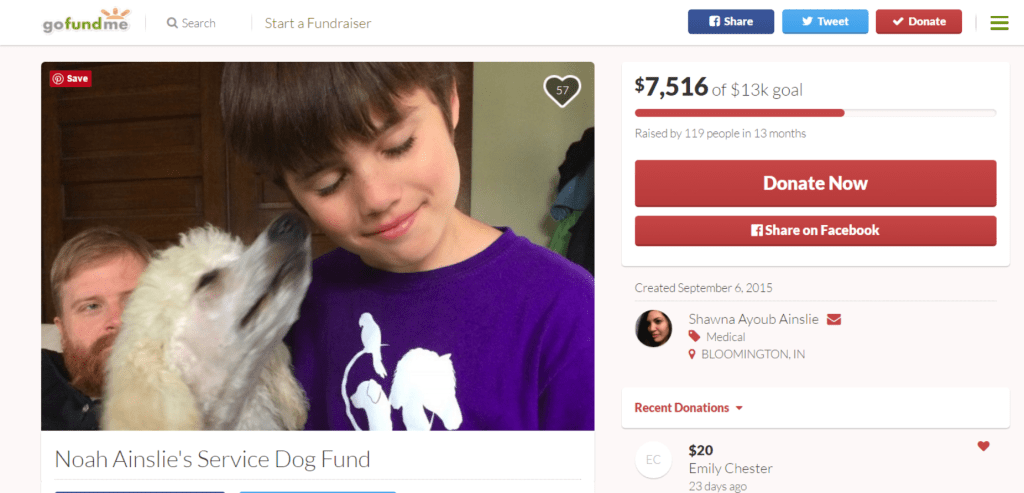
I know all the theories about pet ownership; especially for helping children develop a sense of responsibility and care for others. I know about the contribution of pets to the physical and psychological health of their owners of all ages through the companionship and unconditional love they offer. I am touched by the heart warming story of Noah Ainslie, a little boy suffering from autism, and the difference his service dog Appa has made to his life, and the lives of his family. Please help if you can.
It would not be unrealistic, with my focus on nurturing young children, to expect that I would be a pet owner. However, I’ve never been inclined to make the commitment required
My parents were both country people who moved to suburbia to raise their large family. There were never any pets. They said that dogs didn’t belong in towns. The dogs they were used to were working dogs, never pets. I guess there were enough mouths to feed without adding pets to the mix as well.
Unlike for some, lack of a pet as a child did not induce me to want one on reaching adulthood. Consequently, my children also missed out. Daughter had some mice, rats, and a guinea pig at various times; but nothing to compare to a “real” pet, like a cat or a dog. As soon as she moved into a house that allowed pets, she and partner went out and got themselves a dog.
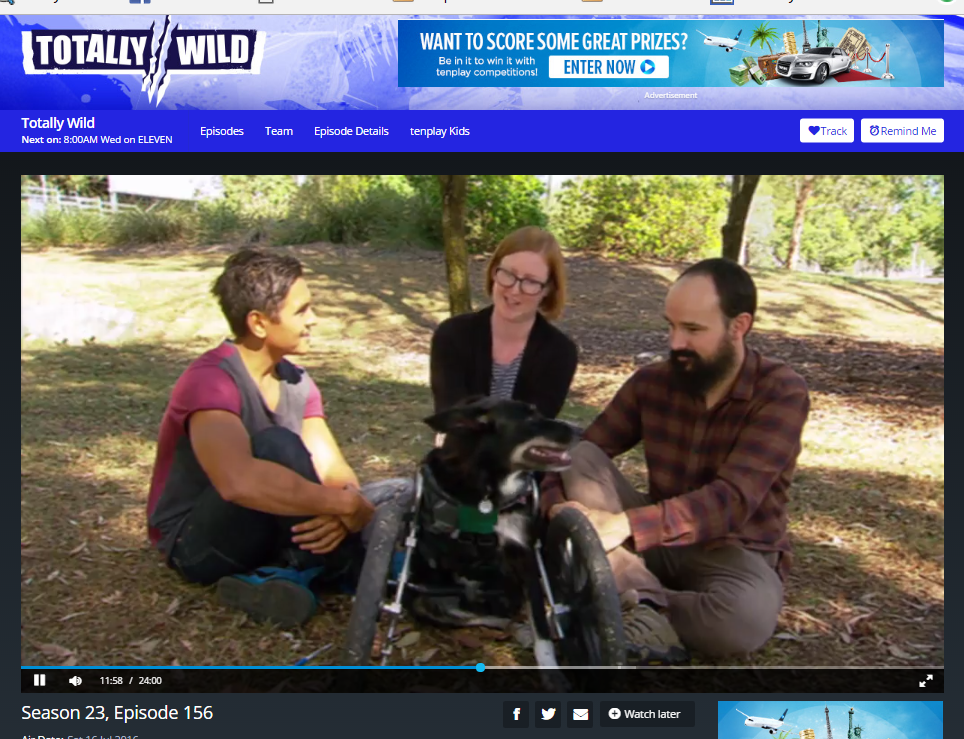
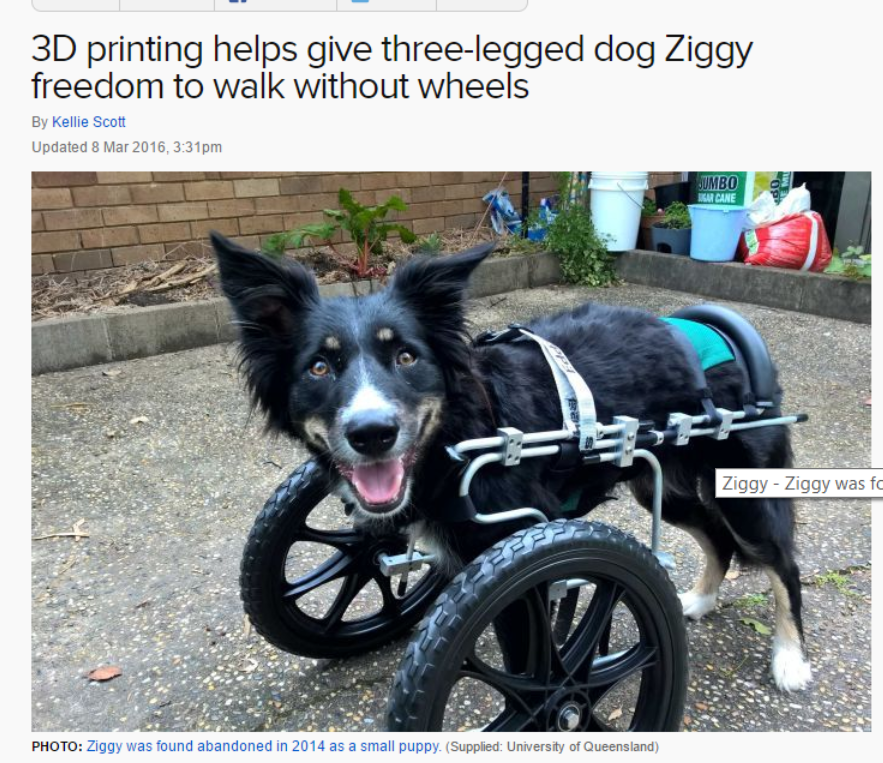
I must say, Ziggy is a gorgeous dog with a happy, friendly, easy-going nature. If I was going to have a dog, he’d be it. I’m beginning to get an inkling of the relationship between humans and their animal friends. There is definitely something very special about it. However, I’m still not interested in forming an attachment of my own.
Ziggy is a very special dog with very special owners. You can get to know the three of them in this video. (Watch from 11:.24 – 15:20.)
Unfortunately the video may not play for those residing outside Australia. Thanks to Anne Goodwin for alerting me to the fact.
Ziggy’s innovative surgery put him in the spotlight for a little while. His story was also featured on the Tripawds blog
The importance and depth of the human-pet relationship was reinforced for me this week when Charli Mills of the Carrot Ranch reported that her big brown canine friend Grenny was gone.
Charli was devastated by his unexpected passing and shared stories of his special abilities and the ways in which he added to their lives. Her post is a wonderful tribute to Grenny’s life and his contribution to theirs. Charli asked writers to share stories about big brown dogs this week.
Well, Charli knows that dogs aren’t my cup of tea. She also understands that, with no personal experience on which to draw, I feel inadequate to respond appropriately to her situation, other than offer my heartfelt sympathies. As for writing, I could come up with nothing other than nonsense which I don’t consider at all appropriate. Other writers have written beautiful brown dog stories for Charli.
Please follow the link to read Charli’s post, the lovely comments, and the beautiful stories.
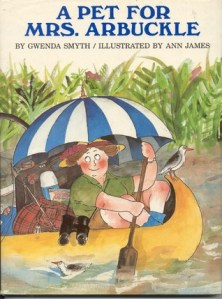
Instead of a flash, I’ll leave you with a few picture books about pets you might like to read:
Lifetimes by Bryan Mellonie is a beautiful book for explaining death to children. It’s great to read at any time to help children understand that every living thing has its own lifetime. It is also great to read when the death of a pet is imminent or occurs. Understanding that death is a part of life, helps with the grieving process.
Thank you for reading. I appreciate your feedback. Please share your thoughts.
Next Tuesday 11 October is International Day of the Girl Child. It is a day for recognising the need to empower all girls, for it “is good not only for girls, but also for families, communities and society at large”.
This post honours International Day of the Girl Child on 11 October. The day was established to “to recognize girls’ rights and the unique challenges girls face around the world.” The empowerment of girls is seen as “fundamental to breaking the intergenerational transmission of poverty, violence, exclusion and discrimination and to achieving equitable and sustainable development outcomes.”
This year theme is Girls’ Progress = Goals’ Progress: A Global Girl Data Movement.“While …recognize how girls’ progress is good not only for girls, but also for families, communities and society at large, we must also take this opportunity to consider how existing gaps in data on girls and young women, lack of systematic analysis, and limited use of existing data significantly constrain our ability to monitor and communicate the wellbeing and progress of nearly half of humanity.”
While recognising the gravity of situations faced by girls around the world, the focus of this post pales, but is significant nonetheless. Sometimes the changes we need to make start at home. Empowering our girls will enable them to empower others.
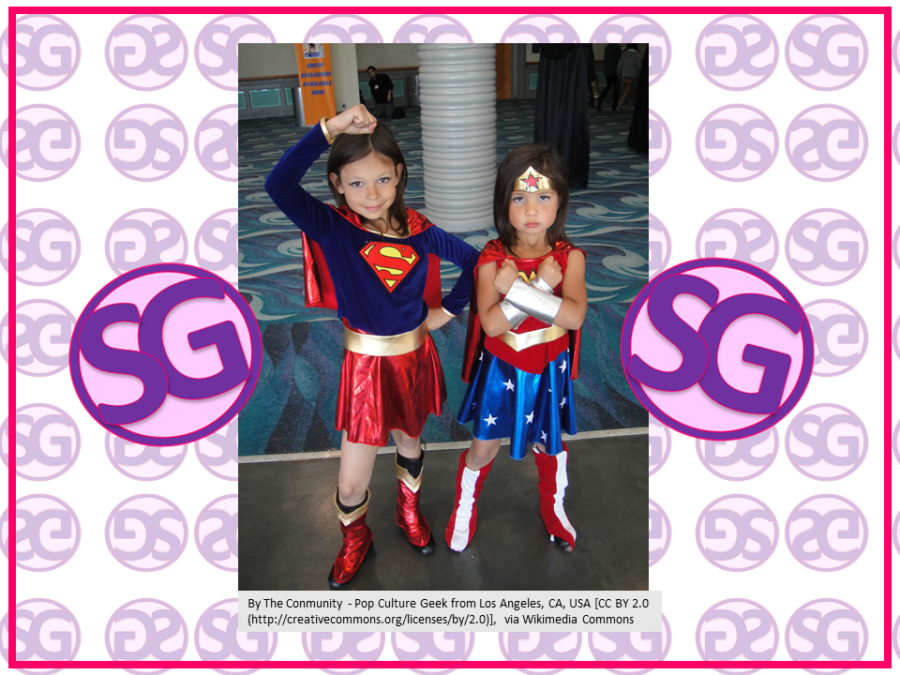
I recently listened to a TED talk Bring on the female superheroes by Christopher Bell, a media studies scholar and father to a 9-year-old daughter obsessed with Star Wars. If you have any concerns about gender stereotyping and gender equality, particularly with regards to toys and merchandising, have a listen. In less than the 16 minutes to view the video, Bell packs a powerful punch and takes a swipe at media corporations and merchandising for girls.
Hi, welcome to the readilearn blog and the first in our Author Spotlight series.
Spring is here and summer is on its way in Australia. The excitement of new life is everywhere as flowers bloom, birds sing, and insects abound. The excitement flows into the classroom as children observe and record the life stages of the amazing minibeasts that inhabit our world.
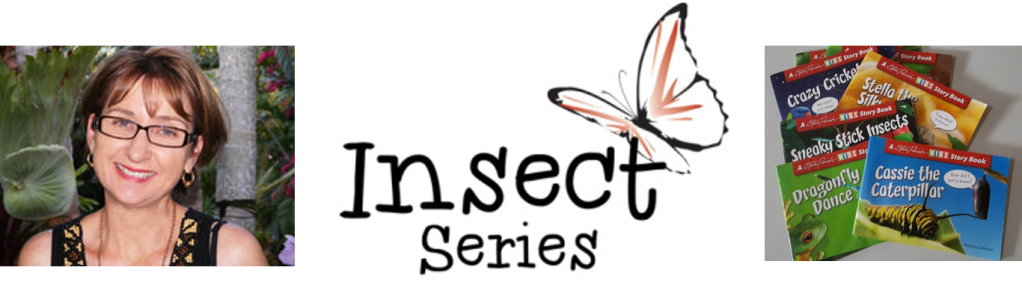
There is no better time than spring to introduce you to Brisbane author Rebecca Johnson and her Insect Series which was awarded the 2014 Whitley Certificate of Commendation for Best Educational Series.
Rebecca Johnson: award-winning author and primary school science teacher
Rebecca’s Insect Series of ten books focuses on metamorphosis, survival, adaptations, properties of natural materials and the usefulness of insects through fiction stories. The stories are accompanied by stunning close-up photos of insects of all kinds.
The books, which won the 2014 Whitley Award for Best Educational Series, have strong listed links to the Australian Curriculum for many year levels. They are a great resource for teaching and learning about insects. The fiction stories that accompany the facts make the learning even more fun. Two free blackline masters support the use of each book. The blackline masters can be accessed on the Blake Education Website.
While the books feature Australian insects and have links to the Australian curriculum, they are loved by children all over the world. I am happy to introduce you to Rebecca and her lovely series of books.
Welcome to readilearn, Rebecca. We are looking forward to getting to know you a little better.
Thanks for inviting me!
When did you know you wanted to be a writer?
When I was reading a lot of picture books to my very young children and could see how much they loved them.
Where do you write? Do you like to be by yourself in the quiet, or do you like to write in a noisy space?
I do most of my ‘writing’ in my head. I think about my stories for ages and pitch them verbally to victims until I am sure I have it all sorted in my head, then I sit to write in my lovely, quiet study overlooking my garden. I encourage children to tell their stories out loud before they write too, because, in my opinion, it is almost impossible to write a good story if you can’t tell one.
What do you use to write – pencil and paper or computer?
Head first. VERY few drafts, then I type it into the computer. I can type a 7000 word novel in a week that is publisher-ready, but I have thought about it and pitched it and sounded it out in my head for weeks beforehand. I hate sitting down all day, and I hate re-doing things over and over even more, so I do heaps of my drafting mentally whilst I do other (fun) stuff like gardening, then by the time I sit down to write, it’s like typing out a movie I know really well. People give you more honest feedback too, when you tell them a story. They feel less nervous about letting you know how they really feel about it. Try it some time.
When is the best time for you to write?
I do my best work from 5am when the house is really quiet. I’m always too tired at night (I still teach three days a week) for anything too creative.
When and where do you get your ideas?
From my life’s experiences as a mother, teacher, child and my own children. I think you have to write about what you know and love.
What gave you the idea for this series about insects?
I am a science teacher and I love insects, and I just couldn’t find the books I needed to succinctly and factually tell kids about the life-cycles and characteristics of insects in a fun way, so I wrote some.
What do you like best about the series?
Kids love them because they are funny and a bit silly, but they are still full of facts and information. I think they remember things better if it is presented in more appealing and humorous way.
What can you tell us about the photographs that illustrate the books?
My sister (Narinda Sandry) took most of them and it was hilarious. We didn’t want to harm any of the insects, so we had to put some, like the mealworms, in the fridge for a while to slow them down to get the shots. I will always smile as I recall the day we sat around a cow pat in a paddock trying to photograph dung beetles before they re-dug themselves in! The old farmer that had let us into the paddock stood to the side scratching his head in disbelief.
How did your feel when you wrote these stories?
I was really pleased when they came out because the photos are just gorgeous, and they were very well received by schools and parents. Winning the Whitley awards was really lovely recognition too.
How do you hope readers will feel?
Hopefully empowered with more information and knowledge, and perhaps inspired to look more closely at the wonderful world of insects and an appreciation of the benefits they bring.
How would you like teachers to present your books to children?
I’d love them to make them part of their science lesson, and even team them with some real insects (like mealworms) to make it all so much more engaging. There are two free blackline masters for each one too, that are designed to be able to be used independently by children in reading groups etc. There are heaps of facts inside the covers, and a glossary of terms, so plenty to learn in each one.
Are there any messages you would like them to discuss?
The main thing is that insects are so important and not just a good excuse to whack something!
Do you have any advice for teachers in their role as writing guides?
As I said earlier….talk before writing as much as you can. It is amazing how hard kids find it to describe something verbally and yet we ask them to do it in the written form all the time with disappointing results.
Do you have any advice for children as writers?
Tell, tell, tell, and don’t be too hard on yourself if it takes a long time to get it right. It took me five years to get my first book published.
What is your favourite picture book? What do you like about it?
I have so many favourites, but Bob Graham’s Greetings from Sandy Beach always makes me laugh out loud, and humour is really important to me in a book.
Who is your favourite children’s author? What do you like about his or her work?
The Lion the Witch and the Wardrobe (CS Lewis). He made me see a movie in my head. I could picture every scene, decades before there was a movie. I remember thinking that one day, I wanted to make a reader feel like that.
Thank you Rebecca Johnson for sharing these insights about your Insect Series and your writing process. We wish you success.
Thank you, and thanks for having me!
To find out more about Rebecca and her award winning books visit her website at rebeccajohnson.com.au. You can find out about and purchase her Insect Series and other books on her website.
This interview and information about Rebecca is available as a printable resource in a new subcategory in readilearnliteracy resources: Author Spotlight. The information may be displayed in your classroom or included in a class book about authors and illustrators.
The first goodbye between a parent and a child will elicit a range of emotions from each. The feelings, and responses, of both parent and child, are dependent upon a range of factors including who the child is being left with, how well the child and the substitute carer know each other, the feelings of all parties about each other, the circumstances, the environment, and the list goes on.
A parent who feels empowered by the decision, and views the child’s new situation positively, will accept and adjust to the change more easily. That’s not to say a parent won’t feel some sense of loss and anxiety as well, but it is important that the child is prepared with reassurance rather than the negativity of anxiety or concerns. A more confident and secure child will view the situation with positive expectations.
Anne Goodwin, on her blog Annecdotal, often refers to attachment theory, and the responses of children to real or imagined abandonment. In her post Compassion: Something we all need Anne shares the following video, explaining that
“Research psychologist Mary Ainsworth developed an ingenious method of assessing whether or not an infant has developed secure attachments. In the Strange Situation, babies play in a comfortable room until, at a given signal, the mother leaves. What distinguishes securely from insecurely attached infants, is not how they behave when the mother (or other primary carer) leaves, but whether they are able to settle on her return.”
She continues
“Research suggests that about two thirds of the population can be categorised as securely attached. That’s a whopping one third of us who aren’t.”
The research also suggests that how secure children feel in their infancy influences how secure they feel later in life. A sense of security influences one’s ability to adapt to change and new situations.
It is not unusual for children, or anyone, to feel a little apprehension in a new situation. A more secure individual generally accepts and adapts more easily. When carers drop their children at child care, kindy, or school, they may be advised to “drop and go”. Mostly the children are fine once the parents have disappeared and the children have time to settle.
If children experience more difficulty than most, or if it occurs for a prolonged period, causes may need to be investigated. Sometimes a child may suffer from anxiety. Sometimes the environment may not be welcoming or appropriate to the child’s needs. Happy, secure, confident children will always face new situations better than those who feel anxious and insecure.
Parents can help children prepare for that first day of kindy or school by:
Talking about what to expect and the fun things they will do
Having special items for the child to take or wear; for example, a back pack or lunch container, hat or shoes
Rehearsing the journey
Visiting the kindy or school, and meeting the carers or teachers if possible
Writing happy messages (in words or pictures) to be found in bags, or lunchboxes
Establishing routines, including the goodbye routine
While the routine doesn’t have to be as elaborate or serious as that in Ian Whybrow’s Hey, I Love You!, a signal that the parent is leaving is useful in making the break. It doesn’t have to be immediate. Depending on the practices established, parents may be able to accompany the child to the door, or into the room.
I always welcomed parents to come in with their children in the morning. The children could show their parents around and discuss work we were doing. Parents could help children organise their belongings, and talk to other parents and children. When it was time for work to begin, I would play music that would signal children to join the song or dance, and parents to take their leave.
This week at the Carrot RanchCharli Mills is talking about goodbyes. She is on the move from a place to which she felt attached, to a situation unfamiliar. She is sad at leaving but is able to view with hopefulness the situation to which she is moving. Charli has challenged writers to
Usually I post my response as the deadline draws close. However, as she is on the move, Charli has extended the submission period. If you would like to join in with a flash fiction “goodbye”, you have another week until September 13 to do so.
(Parent and child chant the verses together or take turns, changing the pronouns to suit. They begin by clapping their own, then each other’s’ hands. On the last three beats of each line, they clap each other’s hands. The pattern for each line is “Own, other’s, own other’s, own, other’s. other’s. other’s. On the last line they smile, wave, blow a kiss, and leave! It’s meant to be a bit of nonsense and a bit of fun establishing a goodbye routine.)
It’s time for you to go, go, go
I’ve lots to do and can’t be slow.
It’s time for me to fly, fly, fly
Upon my broom into the sky.
It’s time for you to leave, leave, leave
I will be happy, do not grieve.
It’s time for me to run, run, run
And jump so high I touch the sun
It’s time to say goodbye, bye, bye
You’ve work to do and so have I.
I’ll blow a kiss, and smile, smile, smile
I’ll see you in a little while.
Bye. Have a good day. Love you!
Thank you for reading. I appreciate your feedback. Please share your thoughts.
Responses to a previous post on the importance of feedback suggested that I trial republishing readilearn posts here. As the suggestion came from a number of people I considered it sound advice and worth trying. As always, I will be interested to hear what you think.
The first day of September marks the first day of spring in Australia. It is also recognised throughout Australia as Wattle Day. The golden wattle is our national floral emblem. Its colours give the recognisable green and gold to our sporting teams.
Like the people of our land, it is a plant that shows both diversity and resilience. There are hundreds of species of wattle growing in many different habitats across Australia. They may be seen growing wild in bush areas and national parks, and cultivated in botanic gardens, on footpaths and in home gardens.
I have three varieties of wattle growing in my garden. Last year, when the plants were one-year-old, they flowered abundantly and were home to ladybirds. It was wonderful to watch each stage of the ladybird’s growth, from egg to adult. This year, the trees were more heavily laden with blossoms, but there were no ladybirds. I was disappointed as I was looking forward to seeing the ladybirds again. However, it has been suggested that the absence of ladybirds may indicate the tree is healthier this year. I don’t know.
In Australia we generally refer to seasons as occurring in particular months:
Spring in September, October, and November
Summer in December, January, and February
Autumn in March, April, and May
Winter in June, July, and August.
However, it is not as simple as that. Australia is a land of extremes, with different climate zones and types of weather experienced across the country. It can be cooler in the summers of southern areas than it is the months called winter in the north. For example, the average January (summer) daytime temperature in Hobart is 21.7⁰C, and the average July (winter) daytime temperature for Darwin is 30.5⁰C.
Spring is a great time for exploring the garden and it’s inhabitants. What is spring like where you are?
Getting to know readilearn resources
Also coinciding with the beginning of spring is the Australian Father’s Day, celebrated on the first Sunday in September. It is a day not just for dads, but for grandfathers, stepfathers, and other male carers and role models. It is a day to let them know how much they are appreciated.
One great way of providing children with a purpose and targeted audience for writing is to get them to make a book for their father figure. I have provided some ideas to get the writing started in the resource How to make a book cover. The resource itself provides step by step instructions for making a cover for a book using complementary colours. The instructions can be displayed on the white board for children to read and follow.
Suggestions for writing include:
A list of statements about their Dad e.g. My Dad goes to work. My Dad makes my breakfast. My Dad has curly hair and a bushy beard. Children write and illustrate one statement on each page.
A recount or memoir about a favourite holiday or activity they do with their Dad.
A series of things about fathers e.g. Some fathers ride motorbikes. Some fathers ride horses. Children finish with a statement about their own dads, for example; But my father rides a skateboard.
A list of things that Dad likes, one to each page.
Five Fabulous books to read for Father’s Day
Guess How Much I Love You by Sam McBratney, illustrated by Anita Jeram
My Dad by Anthony Browne
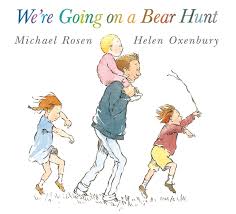
We’re Going on a Bear Hunt by Michael Rosen, illustrated by Helen Oxenbury
Just Me and My Dad by Mercer Mayer
Hey, I Love You by Ian Whybrow, illustrated by Rosie Reeve
Of course, there are many more too.
The readilearn estory The Ice Cream Shop also features an outing with Dad. However, before reading it with your children, decide if you wish to use the interactive covered cloze version with them. If desired, for most effective teaching and learning, the covered cloze should be used prior to any other familiarisation with the story. (You can find information about covered cloze as a teaching strategy here.)
Please contact me if you have any questions. I welcome your feedback, especially suggestions for improvements to existing resources or ideas for new ones.
Remember to use your coupon codes at the checkout to activate your discount. If you can’t see where to enter the coupon code, select “View basket“.
Thank you for reading. I appreciate your feedback. Please share your thoughts.
I thought it was quite timely for me as I had just written a piece about audiobooks. However, I have decided to keep that for posting another day and have instead decided to look at picture books. Regular readers may not be surprised.
Picture books are often a child’s first introduction to stories, poems, fantasy and other worlds. The language of picture books is immensely important and must captivate the ear as the illustrations engage the eye. Through picture books children are learning the sounds of the language: its rhythms and intonations; its accents and pronunciations; its beauty and its meaning.
Many picture books are written in rhythmic, rhyming language and we are quick to note when the timing is a little off or the rhyme not quite right. Successful picture book authors write and rewrite until they get the sound of the language just right for a read aloud experience. Though the words may be few, the task may be difficult. Children, their parents, and teachers are a discerning audience.
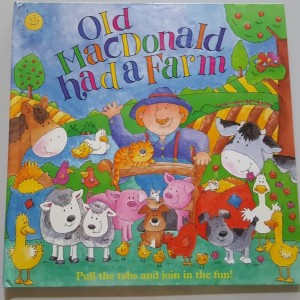
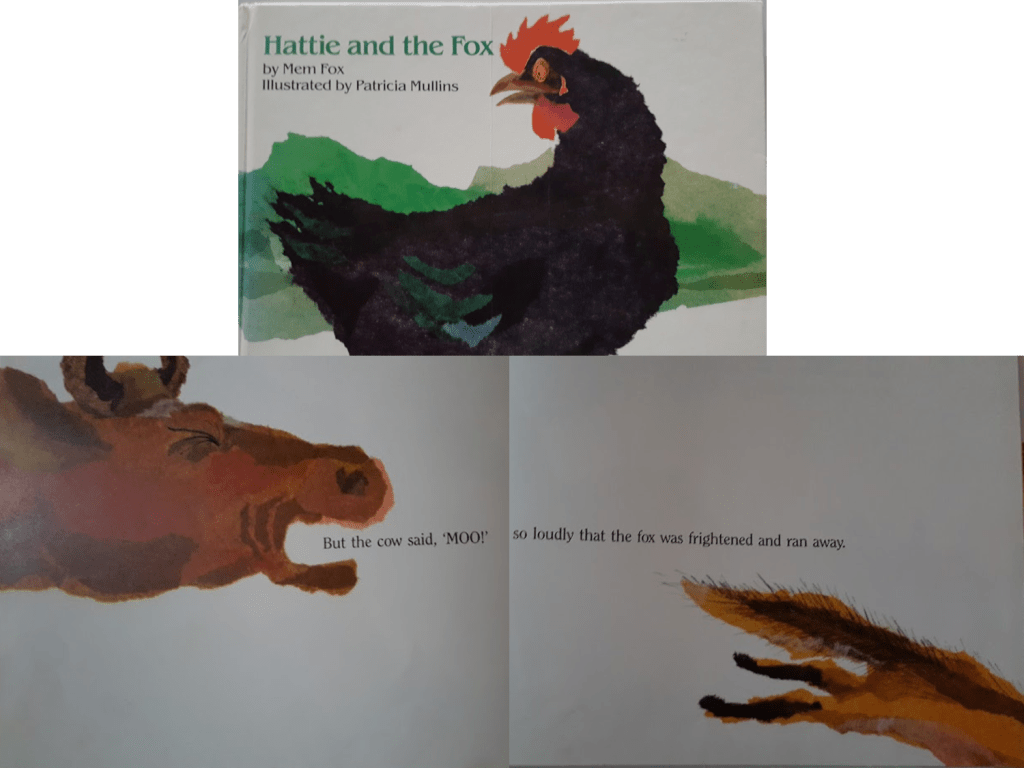
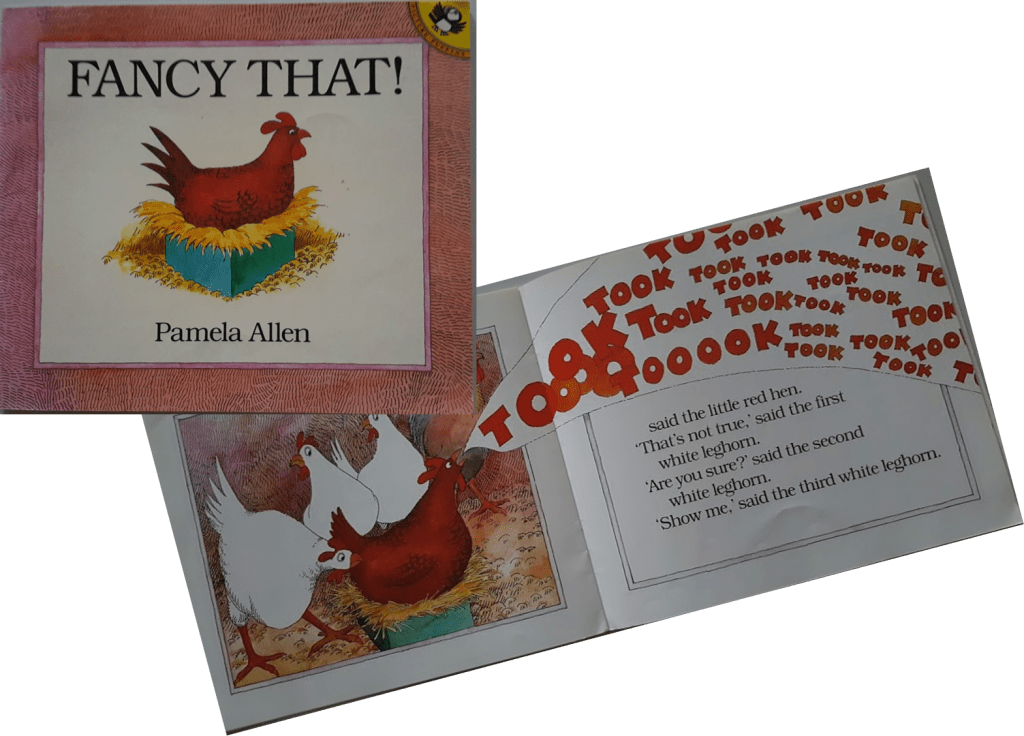
Animal sounds, familiar through songs such as Old MacDonald Had a Farm, frequently occur in picture books, including Hattie and the Fox and Fancy That!
The sounds of machines are also popular. Some of you may recall the song about The Marvellous Toy that “went zip when it moved, and bop when it stopped, and whirr when it stood still.”
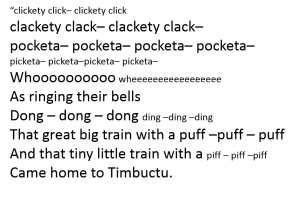
The repetitive rhythmic sound of a train’s motion is frequently portrayed, as in The Train to Timbuctu that went
and The Little Engine that Could with its
“I think I can – I think I can – I think I can – I think I can – I think I can – I think I can – I think I can – I think I can – I think I can.”
followed by
“I thought I could. I thought I could. I thought I could. I thought I could. I thought I could. I thought I could.”
A great demonstration of a growth mindset.
There are also the sounds of musical instruments as in Bertie and the Bear.
There are the sounds associated with actions, like the swish of the broomstick and the plop of the hop toad in Old Old Witch;
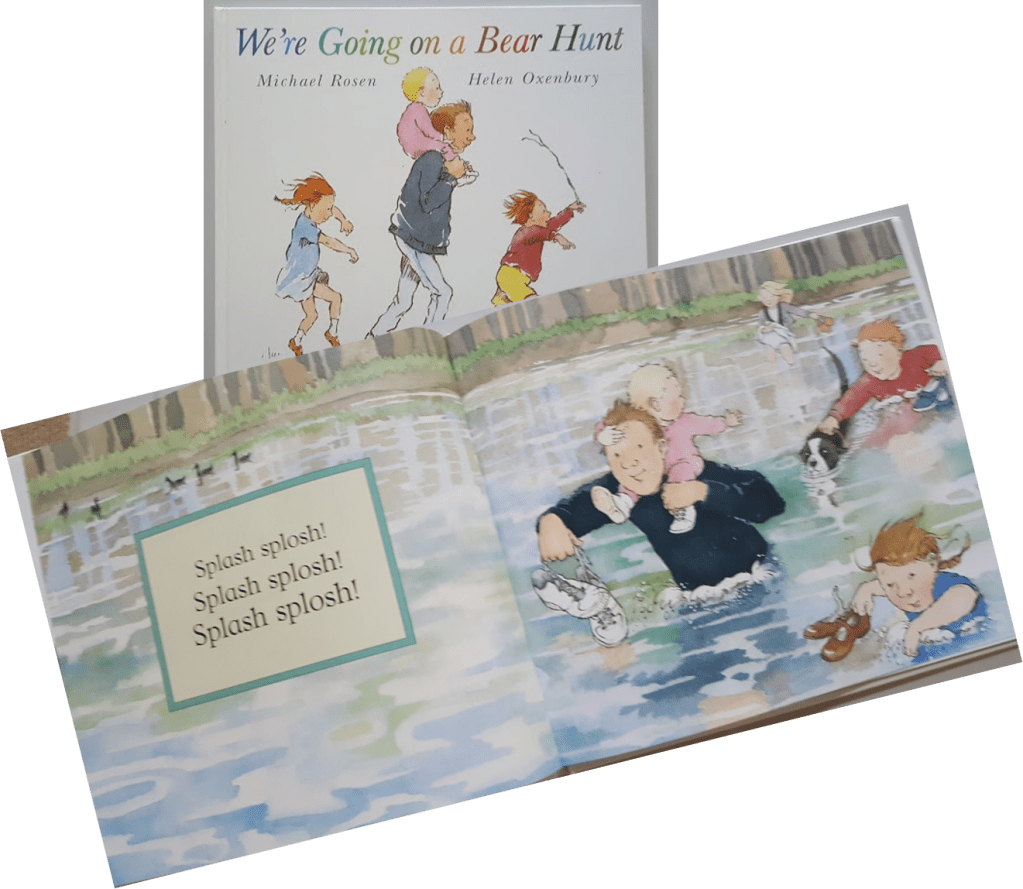
and those from Going on a Bear Hunt with its swishy swashy of moving through grass, splash splosh of wading through water, and squelch squelch of walking in mud.
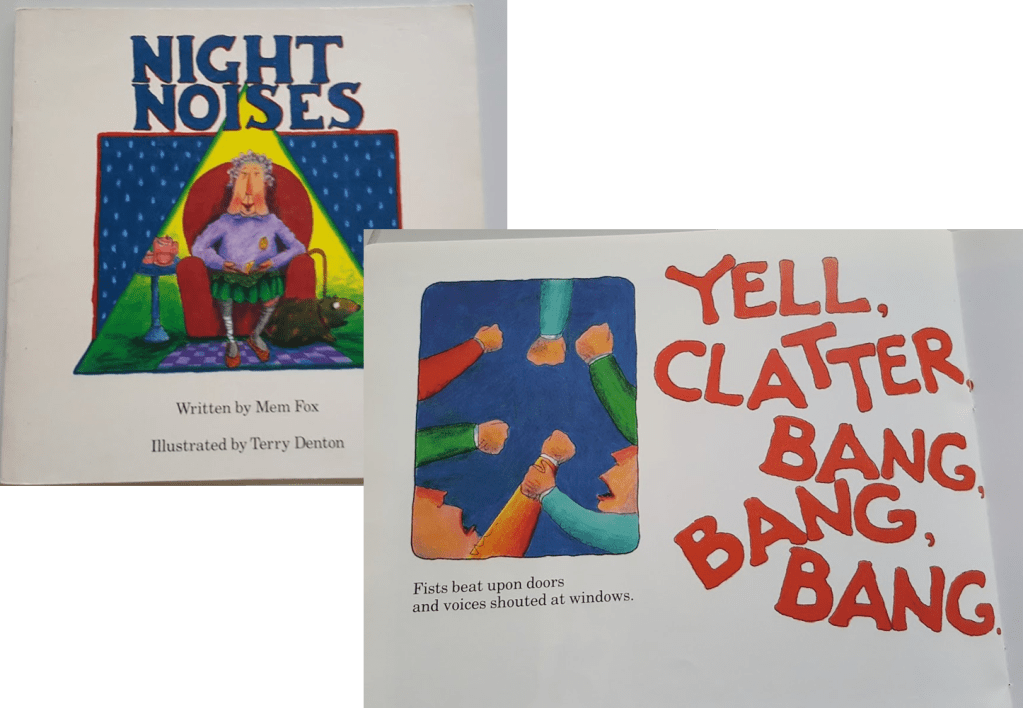
Some stories introduce a variety of onomatopoeic words. Night Noises, about a surprise party for Lillie Laceby who was nearly ninety, includes the click clack of car doors opening and closing, the crinch crunch of feet tip-toeing on a garden path, the murmur and mutter of voices whispering, the creak crack of knees, and the snick snack of bolts on the door.
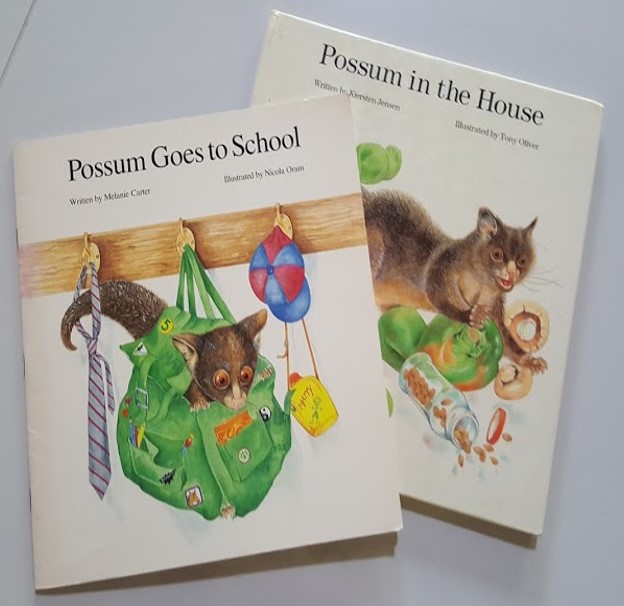
When there’s a Possum in the House or Possum Goes to School, there is nothing but trouble, with possum making a mess at every opportunity.
At home, in the pantry the cornflakes go crunch crunch, in the kitchen the saucepans go clatter clatter, and in the study the pages go rustle rustle. Each time the possum’s whereabouts is discovered, it goes screech screech and runs off to another room to create yet more mess.
The same occurs at school with paints going drip drip in the art room, claws going scratch scratch in the staff room, and the goldfish going splash splash in the science room.
Then of course, there are also the body noises that children seem to take delight in, like those from Burping Baby.
I recently discovered Lauri Fortino’s Frog on a [B]log, a blog celebrating picture books. Lauri has a delightful picture book of her own The Peddler’s Bed, illustrated by Bong Redila. Lauri recently shared a reading of the story on her blog. Since we are talking about sounds, if you have a few spare minutes, pop over and have a listen. You will also find an example of onomatopoeia in her story with the repetition of squeak squeak squeak.
Onomatopoeic words are often presented in fonts of different size or colour, or even different type. Children are fascinated by them, pointing to, asking about, maybe even recognising them, long before they are able to recognise any other words. You can help to get them started by pointing to the words and inviting them to join in the hullabaloo. What a great introduction to the world of reading.
Now that I have reminded you of these types of onomatopoeia and provided you with these wonderful examples, I wonder what I was thinking. How can I match them in my flash? I need a flash of inspiration, or maybe a flash of lightning to begin my story about a mother and child hurrying to make it home before the storm hits. I hope you enjoy it.
The eye of the storm
“Storm’s coming!”
Pit pitter-patter Pat pitter-patter hasten four feet.
Lightning and thunder boom down the street.
“H-h-h-hurry.” Mum urges. “Home – nearly there.”
Pit scuffle-scuffle Pat scuffle-scuffle “Straight up the stair.”
Clink-chink-fumble-fumble “No need to knock.”
Scritch-scratch “I’ve managed – the key’s in the lock.”
Whoosh! chortles wind, as it rushes inside.
Damn! cusses chair chucked onto its side.
P-u-sh! The door bangs! Avoid pellets of ice
Smashing and tumbling like millions of dice.
Rat-a-tat raindrops, another crash-boom!
Shuffle and scurry. “Straight to the safe room.”
Huddled together, hardly daring to breathe,
Listening and waiting for the monster to leave.
…
Then sudden quiet, the child whispers hope
“Is it all over?” Mum answers, “Nope.”
The first fifteen lines meet Charli’s 99 work criteria. I added the last two because I was thinking of the eye of a storm that brings a quiet calm but not the end of the storm – there’s still more to come. I’d love to know what you think.
Thank you for reading. I appreciate your feedback. Please share your thoughts.
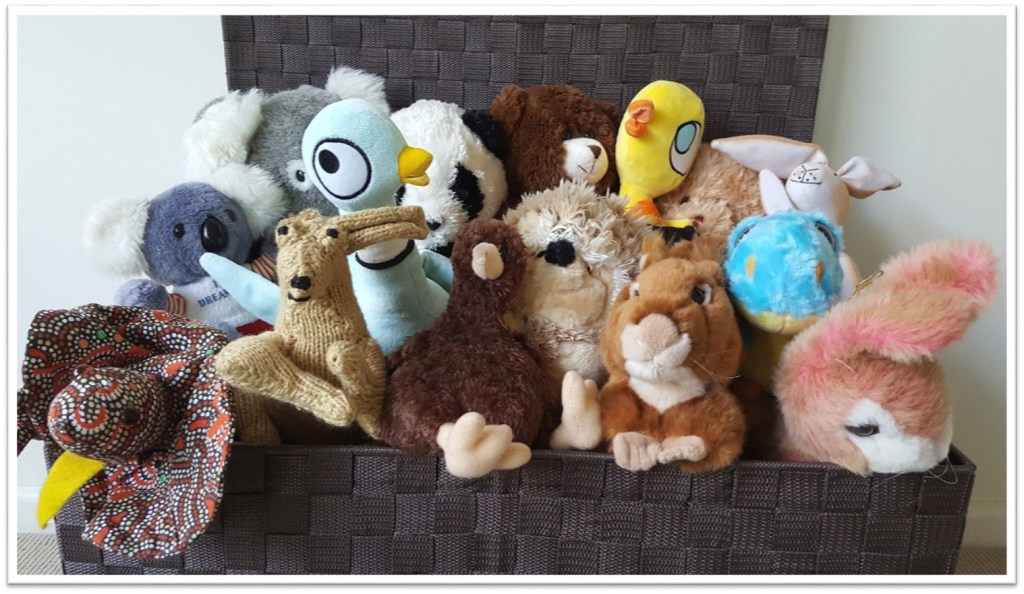
A little while ago I wrote about my (small) collection of international toys and the fact that I wished to add to it when I visited Los Angeles and New York with my grandchildren. I received a few suggestions:
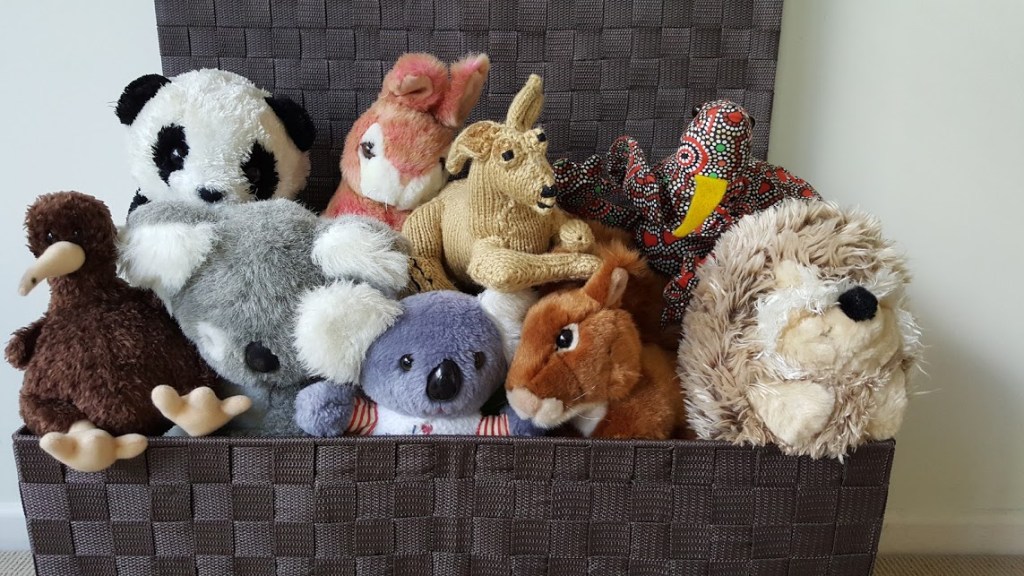
I have now returned from that quick visit to the US, and did indeed bring back a small collection of toys to add to my toy box. (Four-year-old granddaughter informs me that 2 can be a collection, 3 is even better, and 100 is definitely a collection!) I have three to add to the toy box. A fourth got confiscated along the way.
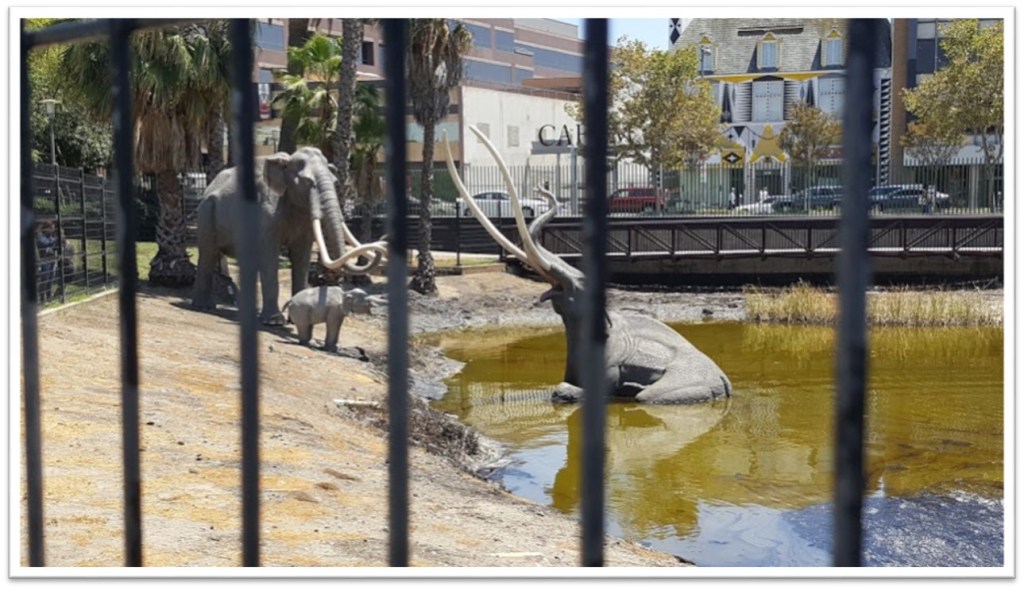
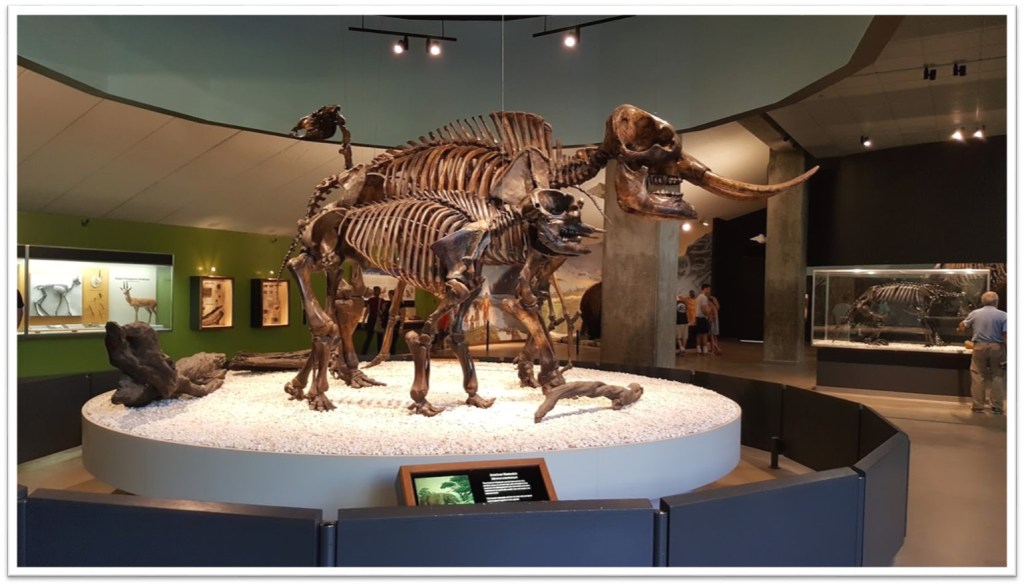
When we visited Los Angeles, we went to the La Brea Tar Pits, a fossil site with an active excavation and museum. For a family fascinated with prehistoric creatures, the museum was a must visit. We were not disappointed.
Outside the museum we saw life-size sculptures of a mammoth family succumbing to the sticky entrapment of the tar pit. You may wonder why the sculptures are fenced. The mammoths may not be real, but the tar pit is! We saw much tar oozing up through cracks around the site as well as in the pond.
Inside the museum we saw skeletons and depictions of many of the animals trapped in the tar pits. These are skeletons of a mother and baby mastodon who fell victim of the tar:
We also viewed a 3D movie that provided information about the Titans of the Ice Age, including stories to explain the fate of animals whose fossils were found in the tar.
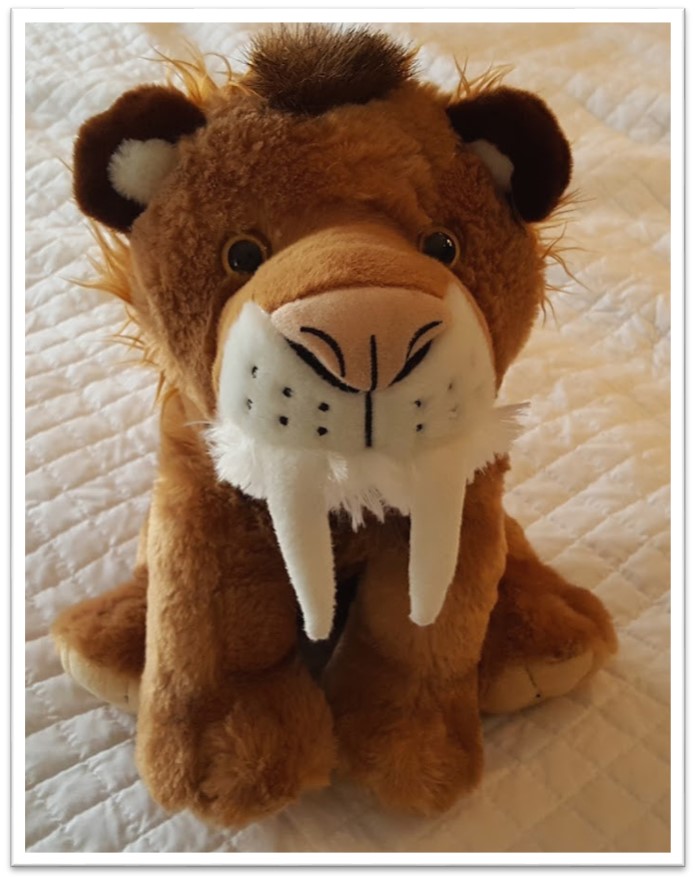
In this short of the movie, you may sight Smilodon, a sabre tooth cat.
Unfortunately, Smilodon was confiscated by my grandchildren and didn’t make it home with me. I am assured it is very happy at their place with its competitor Dire Wolf, also seen in the movie trailer.
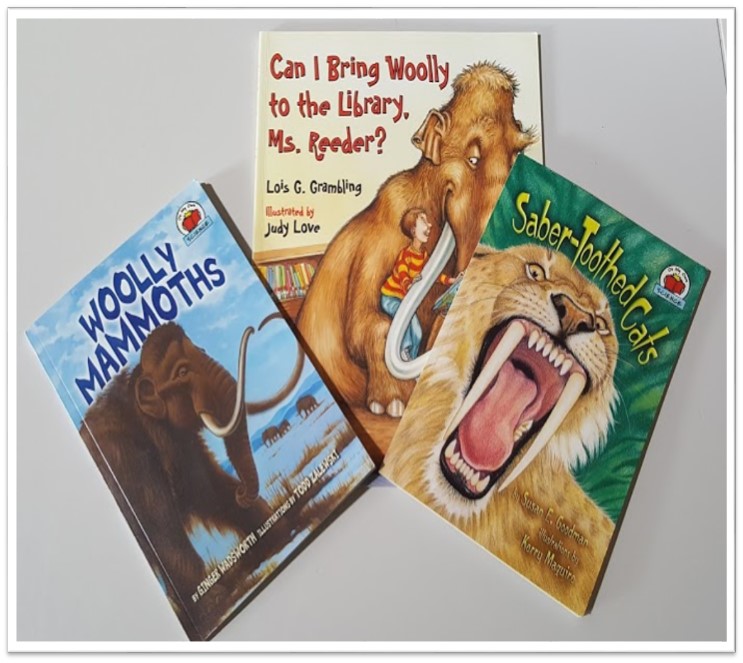
Of course, I couldn’t leave the store without some books as well.
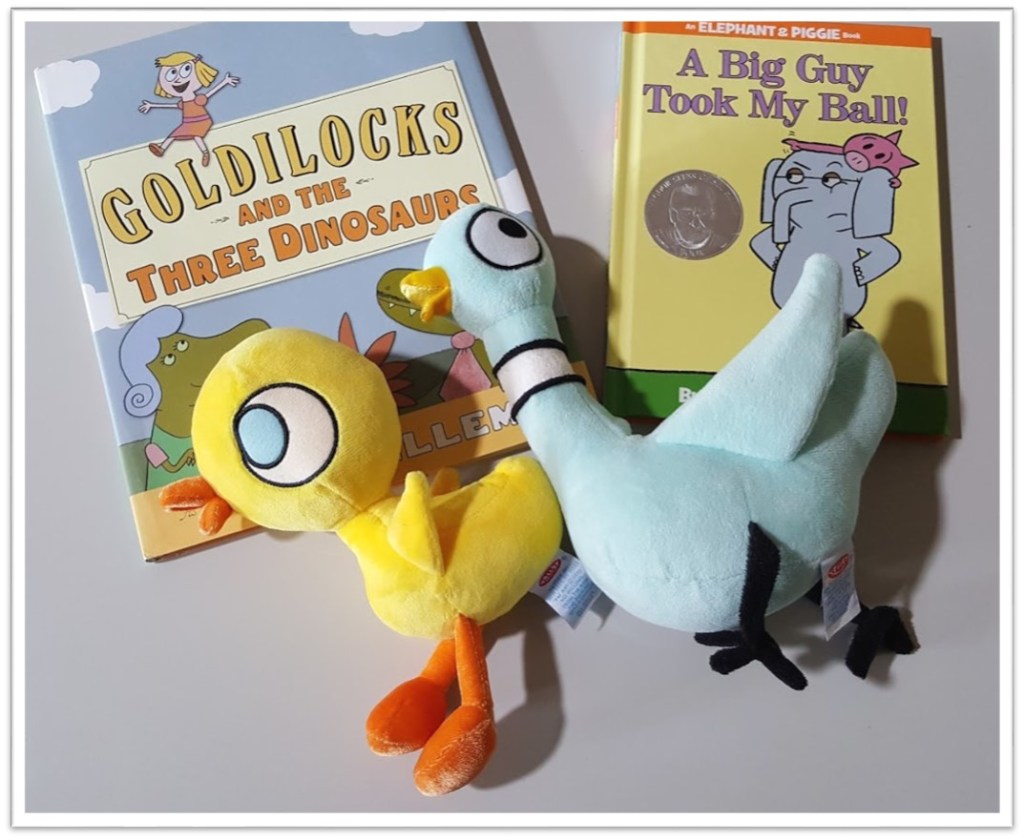
In New York my choices turned to fiction. I discovered that an exhibition of works by Mo Willems was being held at New York’s oldest museum, the New York Historical Society Museum and Library, not far from where we were staying. I have previously shared my delight in Willems’ books. His books are humorous, and his illustrations, with their seemingly simple line drawings, are very expressive. Of course, I had to go, and had to buy.
I came away with Pigeon and Duckling, and two of Willems’ books.
I thought I was done adding to my toy collection, but when we visited the American Museum of Natural History, granddaughter insisted that I purchase this T-Rex because it was my favourite colour. How could I resist?
They are settling in quite well, though everyone is complaining that it is becoming a bit squishy. However, I think they are rather pleased that Smilodon got waylaid along the way!
So I didn’t end up with any of the suggested choices. I hope you don’t mind.
Thank you for reading. I appreciate your feedback. Please share your thoughts.
That I have an appreciation of and fascination with insects is no secret as I have written about it many times previously.
Some of my earliest posts formed a series in which I suggested using Eric Carle‘s Very Hungry Caterpillar story for developing critical literary, encouraging children to question the authenticity of what they read and the qualifications and intentions of the author.
Carle’s purpose with the story was to entertain, not to teach, and he was therefore unconcerned about inaccuracies in the butterfly life cycle.
The book, popular for its bright colourful illustrations and inspiring story of an ordinary caterpillar who becomes a beautiful butterfly achieves the author’s goal to entertain.
In a more recent post Revisiting The Very Hungry Caterpillar I provided a summary of, and links to, each of the four original posts which explained my recommendation that this very popular book was more relevant to teaching critical literacy than science.
Acknowledging the importance of maintaining Wondering in the everyday and an attachment with nature in wild spaces, I described my excitement at being able to observe every stage of the ladybird’s life cycle up close in my own backyard; an excitement that had perhaps exceeded observing the butterfly life cycle in the classroom with our live butterfly kits which had allowed us to Breathe – a sense of wonder! I even shared a section of a television interview in this post about Talking Interviews.
I talked about some insect themed classroom and teaching resources in The comfort zone. Others are listed on my page Early Childhood Teaching Resources and are available in my Teachers Pay Teachers and Teach in a Box stores. These, and many more, will be available on my readilearn website when it launches later in the year. Here is a sneak peek at some that will be included:
But the truth is I don’t really love allinsects. I’m not too keen on cockroaches, though the native Australian giant burrowing cockroaches are pretty cool. And although I am aware of vital roles of insects in the environment
as a food source for many animals
as pollinators for flowering plants
as decomposers
and I know that without them we’d basically not have an environment, in fact, we wouldn’t be; I often wonder whether we would be all that worse off without disease-spreading mosquitoes and flies. However, it seems that they too are vital to the health of our planet, whether we like them or not. It’s a bit of a “can’t live with them and can’t live without them” situation.
It took just one, then the word was out. The streets were abuzz with the news – a triumph of social media.
“Kyle’s having a barbecue. Tell everyone. Don’t bring anything. There’s always plenty.”
The excitement was palpable as guests swarmed towards Kyle’s. Some, initially unsure, flapped about nervously. Others, more experienced, felt they were dancing on the ceiling. Eventually all were on their way. The waft of seared flesh left no doubt about the location.
Kyle was ready when they arrived. “Who invited you?” he grinned and waved, as he knocked them out with the can of spray.
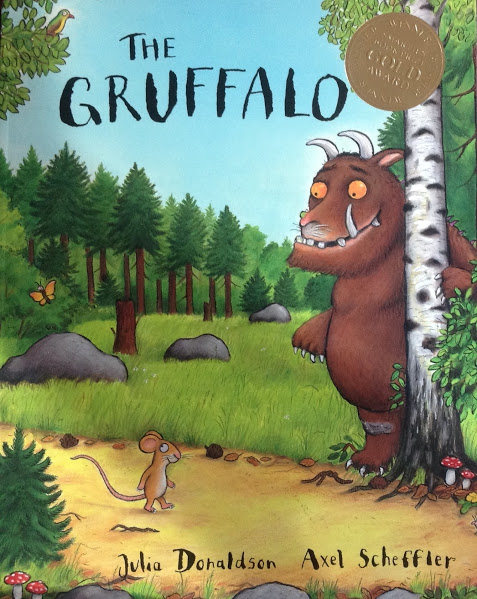
The Gruffalo is as fearsome as any monster you are likely to meet with its “terrible tusks, and terrible claws, And terrible teeth in his terrible jaws”; “a poisonous wart at the end of his nose” and “purple prickles all over his back”. The quick witted mouse, who imagines the Gruffalo into storybook “reality”, must find a way of ridding himself of the monster’s inherent danger and once again uses his ingenuity to escape.
I’m not sure if it was Donaldson’s intention, but I think this is a great analogy for the monsters we create for ourselves such as self-doubt, unrealistic expectations, and (you can add your own monster here). Not that I’d be sharing that thought with young children.
In this video Axel Scheffler explains his concept of the Gruffalo and even hints, a couple of times, that he too may be troubled by that all too common of personal monsters, self-doubt.
Throughout The Monster at the end of this BookGrover, from Sesame Street, pleads with the reader to not turn the page as there is a monster at the end of the book. You could almost say he is immobilised by this fear, or that he tries to immobilise the reader. Of course it is a lot of fun and provides much laughter. When we (reader and Grover) do get to the end of the book, he is rather embarrassed to find that he, “lovable, furry, old Grover” is the Monster. He tries to assure us that we, and not he, were the scared ones.
Of course Grover wasn’t the monster only at the end of the book. He was always the “lovable, furry” harmless monster. It was his fear that was the real monster. How often are we immobilised by our fear, and how often when we take that jump despite it, do we find our fears to be groundless? Sometimes I think, or is it only me, we are our own worst monsters setting ourselves impossible targets with too-high expectations that lead us only to disappointment if we don’t achieve them.
But if we view ourselves as works in progress, in the process of working out where we want to be and how to get there, we can find contentment in what we achieve along the way, in where we are and how far we have come, rather than ignoring those milestones and looking only at how much further we must (in our own minds) go.
It is all too easy to contribute to the development of children’s personal monsters by doing to them what we do to ourselves: setting unrealistic targets, expecting too much, insisting on error-free work, measuring them against external benchmarks … To avoid this, we need to view them also as works in progress and encourage them, through a growth mindset, to reach their own milestones and goals in the time that is right for them.
Like the mindset of the mouse in The Gruffalo who was able to think on his feet and overcome the obstacles, or that of Grover who realised there was really nothing to be worried about at all.
We need to be not afraid of the monsters under the bed or in the cupboard, most of which we have created in our imaginations and stuffed there, sometimes with the assistance of others, allowing them to multiply like wire coat hangers until there is no room left for anything good. I have taken the theme of internal monsters for my response to Charli’s challenge.
Open, close them, open anew
The picture was clear. Taken with wide open shutters and long exposure, then developed in black and white for extra clarity, the result was undeniable and exactly what would be expected.
“You’ll never amount to anything.”
“That’s rubbish.”
“Pathetic.”
“You’re always the troublemaker.”
“Because I said.”
“Shut up!”
“Stop asking questions.”
An existence devoid of value was drilled with reminders hurled unrelentingly from birth. Well-schooled in self-loathing, the lessons were regurgitated without effort or question. The monsters without had created the monster within. How could one escape from what was recognised only as truth?
And now for something a little lighter:
The Monster Mash
Thank you for reading. I appreciate your feedback. Please share your thoughts.

 The author in the spotlight this month is the wonderful Lauri Fortino, author of The Peddler’s Bed, illustrated by Bong Redila, published by Ripple Grove Press.
































 Norah Colvin