The latest post from readilearn explains resources for a new board game to play at Halloween.
The game is great for literacy and maths groups, to play with buddies or in family groups. It links literacy, maths and physical activity. Players collect treats and perform actions as they move
Australia is home to a great diversity of, and many unique animals. Most native Australians are not found anywhere beyond its territories. I guess that’s not surprising since it is the world largest island or smallest continent country with vast expanses of ocean between it and other continents.
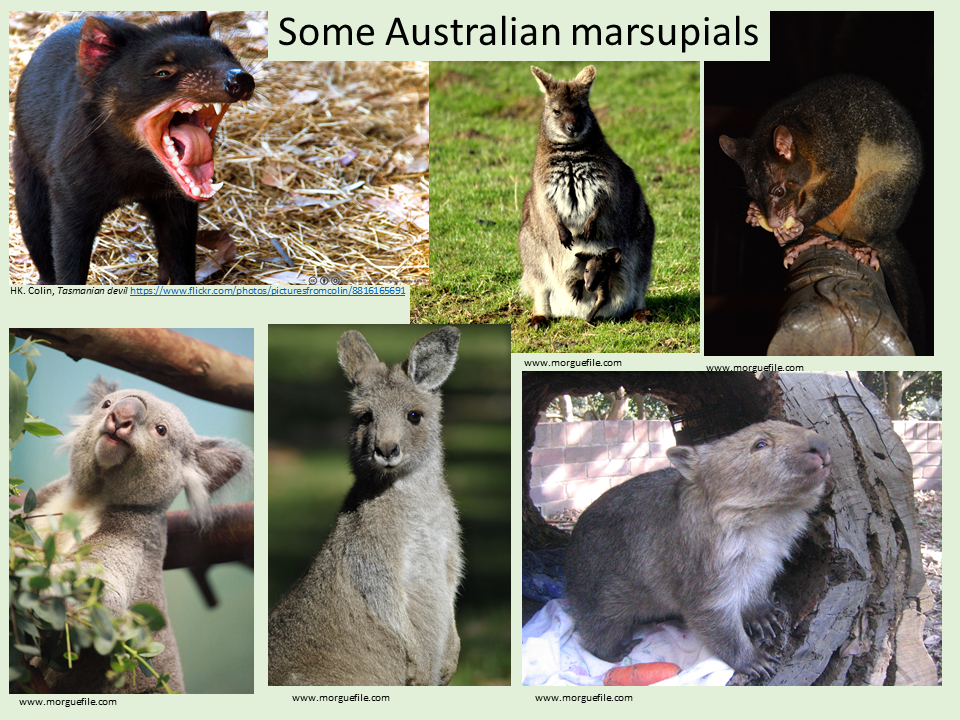
Australia is home to almost 70% of the world’s marsupials. Other marsupials are found in the Americas, mostly South America. Kangaroos, wallabies, koalas, possums, wombats, Tasmanian devils, numbats, bilbies, and quolls are among the species of marsupials found in Australia.
Marsupials are mammals that give birth to live young before they are fully developed. The young, usually referred to as joeys, continue to develop in the mother’s pouch for a number of months, suckling on their mother’s milk.
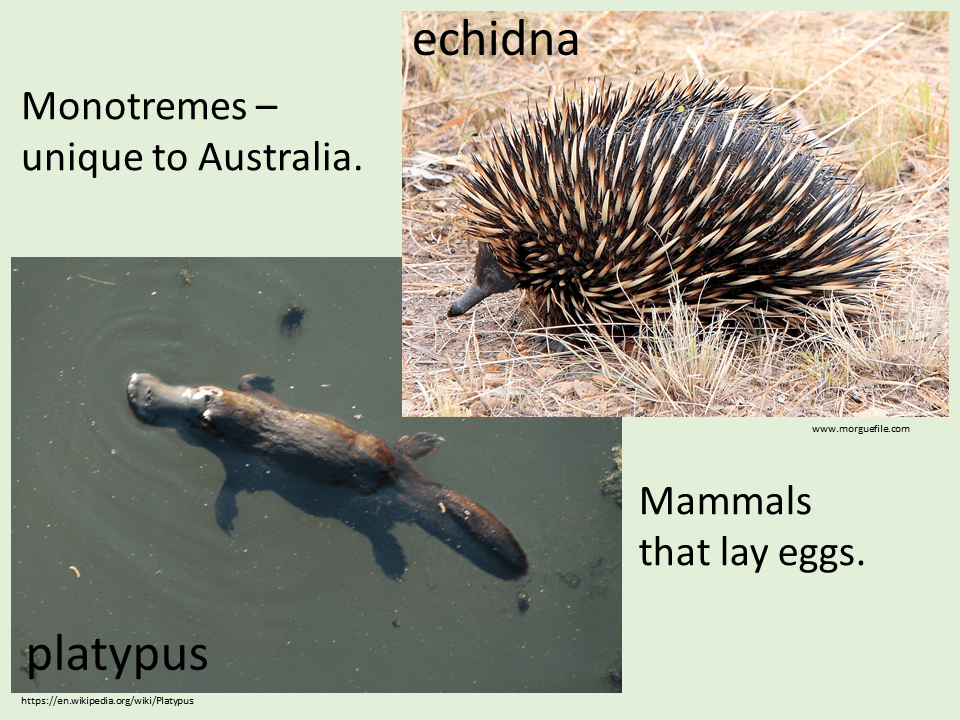
There is another group of even more unusual mammals: the monotremes. Monotremes are egg-laying mammals. The platypus and the echidna, the only existing species of monotremes, are unique to Australia.
The platypus
When Europeans first saw a platypus, they thought it was a hoax with its bill like a duck’s, tail like a beaver’s, and feet like an otter’s. It has fur like other mammals but, unlike other mammals, it lays eggs.
The platypus lives in burrows on the banks of freshwater streams and small rivers in eastern Australia, including Tasmania. It spends much of its time foraging in the muddy river beds for crayfish, worms and insect larvae.
Female platypus usually lay two eggs. When the young hatch, the mother releases milk from pores in her skin. The milk pools on her abdomen and is lapped up by the young for about three to four months. There is no special baby name for baby platypus. They are simply called ‘baby platypus’.
The male platypus, with a poisonous spur on its hind foot, is one of only a few venomous mammals.
Platypus predators include crocodiles, eagles, dingoes, and introduced animals such as foxes and feral cats.
The echidna
Echidnas, the oldest surviving mammals, live all over Australia in many different habitats. They usually live alone and are not territorial. Although it is rare to see an echidna in the wild, they are considered common. They generally hide away under vegetation, in logs, or in the burrows of other animals.
Echidnas eat termites and ants, and sometimes the larvae of other insects. They use their long snouts to forage in leaf litter, rotting logs, or ant mounds in search of food. Their long tongues are covered in sticky saliva for catching prey.
Echidnas are covered with spines along the head, back and tail. The spines are sharp and used for defence against predators.
Female echidnas usually lay one egg at a time. When the young, called a “puggle”, hatches, it makes its way to the mother’s pouch area to suckle milk. When the puggle starts to develop spines, at about 50 days, it is removed from the pouch. The mother continues to suckle it until it is about six to seven months old, at which time she deposits it at the entrance to the burrow, then walks away and abandons it.
Predators include goannas, Tasmanian devils, dingoes, eagles, and introduced animals such as foxes and feral cats. When threatened an echidna may run away or curl up in a ball.
Although all have spines, echidnas are not related to either hedgehogs or porcupines.
Here is a great article about these amazing echidnas.
If you are looking for books about Australian animals, check out the Steve Parish Storybook Collection by Rebecca Johnson, featured in last month’s Author Spotlight, which includes stories about both monotremes, many marsupials, and other fabulous creatures.
I was prompted to think about the diversity and uniqueness of these Australian animals, especially the echidna, by this week’s flash fiction challenge set by Charli Mills at Carrot Ranch Communications. She challenged writers to In 99 words (no more, no less) write a prickly story. I thought there was no better opportunity to share with you some of our amazing creatures, particularly since just last week I was lucky enough to see an echidna in the wild for the very first time.
The uniqueness and diversity of Australian animals reflects our own individual uniqueness and the diversity among us. We have much to learn about accepting difference, appreciating diversity, and acknowledging the unique characteristics each individual contributes to the enrichment of our collective humanity. Together we stand. Divided we fall.
Here is my response. I hope you enjoy it.
Stronger together
She bristled, warning platypus to stop. He didn’t.
“Feeling a little prickly, are we?”
Kookaburra, oblivious, laughed at the “joke”.
She smarted. Couldn’t he see the hurt in his words? Like a spur in her side, that last barb, really stung. Mocking difference pushed them apart.
The bush quietened. Not a breath of wind. Not a leaf’s rustle. Not a bird’s chirrup. Were all waiting for the victor to be decided?
Suddenly, out of the undergrowth, rushed a devil, hungry for blood.
Platypus turned to echidna. She contemplated leaving him. But stayed. Spur and spines together: a powerful defence.
Author’s note: Tasmanian devils have been known to eat echidnas, spines and all!
Thank you for reading. I appreciate your feedback. Please share your thoughts.
Hi, and welcome again to the readilearn blog. I hope you’ve had a good week.
Rarely, when the costs of education are being calculated, is the contribution made by teachers from their own pockets acknowledged. It is not very well publicised that many teachers spend a lot of their own money resourcing their classrooms, which would be far less interesting places if teachers refused to contribute in this way.
Today I demonstrate that not all resources need be expensive. A versatile, free, and readily available resource is the humble bottle cap or lid, which is often discarded, but can fulfill a number of functions in the classroom.
It doesn’t take long to gather an extensive collection of lids even on your own. But ask your children to bring in lids from home and the collection builds even quicker.
Lids have many uses.
Children can, for example:
Sort by colour or size
Order according to size – diameter or height
Make patterns – repeating or growing
Count – by ones, twos or fives
Learn to subitise, and discover conservation of number
Compare, add, substract and share
Measure length and mass
Use for collage or craft, or as tokens when playing games
These are just a few ideas. What other uses have you found for lids? Please share in the comments below.
What’s new – Uploaded this week!
These ideas and others are now available in a free maths resource Caps off for maths.
Getting to know readilearn resources
Snakes and Ladders is a popular game and great for maths groups. With some guidance from an adult, the game can be used to stimulate mathematical thinking alongside practice of computations. Thereadilearn resource Snakes and Ladders – An activity for maths groups provides suggestions that can be given to an assistant to maximise learning opportunities while playing the game.
Please contact me if you have any questions. I welcome your feedback, especially suggestions for improvements to existing resources and ideas for new ones.
Remember, if you haven’t yet subscribed, an introductory discount of 20% is available to all who subscribe during 2016. Just use the coupon code welcome1 at the checkout to receive your discount.
I’ll see you next week. In the meantime, enjoy the weekend.
Hi, and welcome again to the readilearn blog. I hope you’ve had a good week. Thank you for your interest in readilearn. I apologise to those who have experienced difficulty in applying the discount coupon codes at the checkout. Know that I will honour the coupon offer with a PayPal discount refund if your subscription goes through with payment in full. I appreciate your persistence and patience while we improve flow with the payment system. Please contact me if you experience any difficulties.
Getting to know readilearn resources
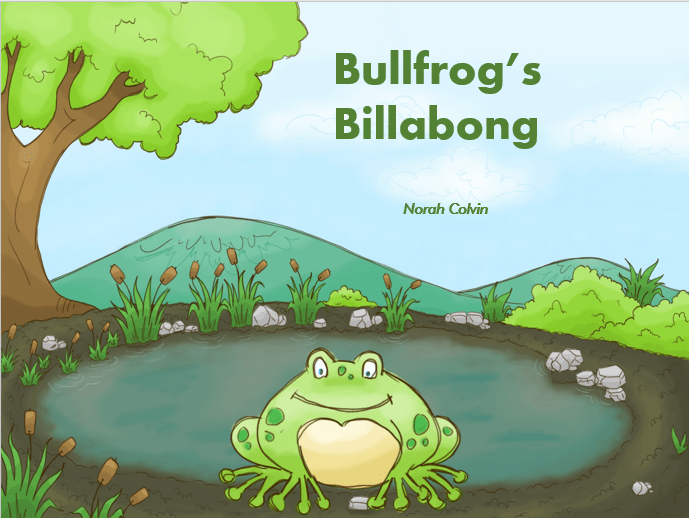
In this post I discuss the Bullfrog’s Billabong suite of resources.
Bullfrog’s Billabong is a cumulative story which takes place at a fictitious Australian Billabong. Bullfrog is the first to arrive at the billabong. He decides it would be a great place to live and makes it his home. Each day, more animals arrive at the billabong. They too think it would be a good home and, after asking permission, decide to stay. Unfortunately, as the billabong becomes more and more crowded, the animals have difficulty in getting along. Their racket attracts another visitor who also sees the potential of the billabong as a home.
The story includes mathematical concepts including counting, growing patterns and days of the week.
The repetitive structure supports children’s reading and encourages them to make predictions based upon obvious patterns involving counting and days of the week. Their knowledge of narrative structure encourages prediction of possible events and conclusion. The end may surprise some children and they may or may not approve of the author’s choice. A discussion of alternative ways to conclude the story could lead to some interesting writing, and an understanding that what happens in stories is a choice made by the author.
While the animals will be familiar to Australian children, the story provides a great opportunity for children from other countries to find out about them too.
I hope you and your children enjoy reading the story and using the resources.
Bullfrog’s Billabong – Covered cloze (This interactive resource for use on the whiteboard is great for teaching effective reading strategies. For best effect, it should be used before any other Bullfrog’s Billabong resources.)
I have been working on new resources to support and complement the existing Bullfrog’s Billabong resources.
This week I have added three new resources to the collection:
Bullfrog’s Billabong – The facts (This information sheet explains what a billabong is and verifies that all the story’s animals may live in a billabong, though possibly not the same one.)
Bullfrog’s Billabong – Days of the week (Use these three sets of printable cards when teaching or revising the days of the week. There are A5 cards for use with the whole class, and smaller cards for use by individuals or small groups.)
I am working on other resources to add to the suite, including presentation of the story as a play. There is also a set of animals to print that can be used to make pop stick puppets for a performance. Watch for these, and others, coming soon.
I hope you and your children enjoy using these resources. I had fun making them and thinking about the responses of children.
Please contact me if you have any questions. I welcome your feedback, especially suggestions for improvements to existing resources and ideas for new ones.
Introductory discount
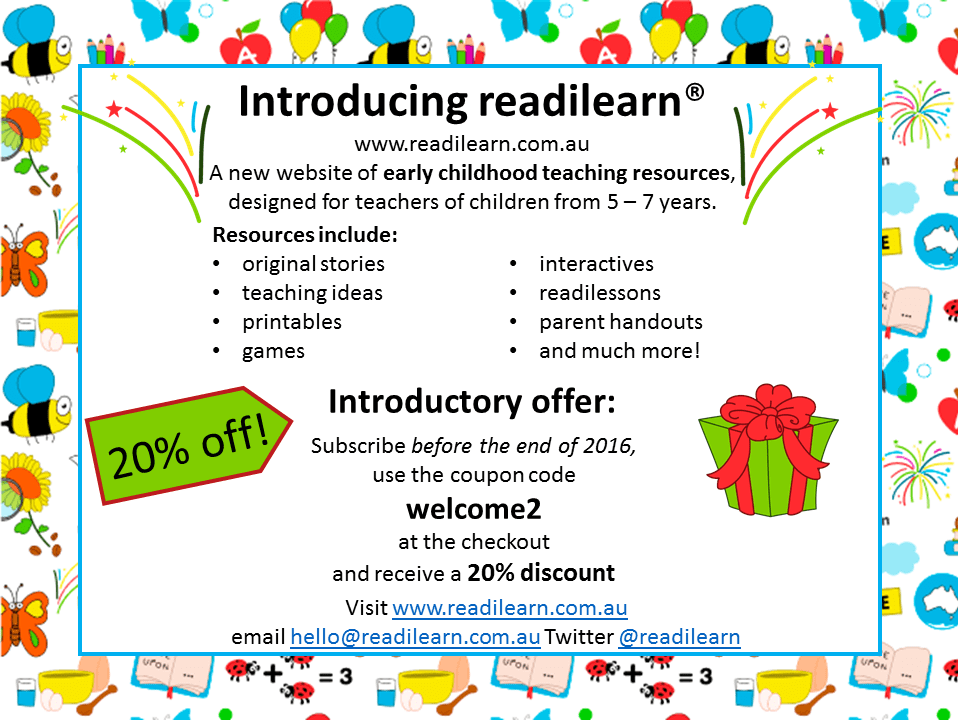
Remember, if you haven’t yet subscribed, an introductory discount of 20% is available to all who subscribe this year. Just use the coupon code welcome2 at the checkout to receive your discount.
I’ll see you next week. In the meantime, enjoy the weekend.
Being able to verbalise the steps taken to arrive at an answer or a conclusion is a valuable skill. It is particularly important with mathematical thinking, even at beginning stages. Sometimes it feels as if the answer appears without the need for thought. Of course we aim for this with automaticity of number facts and times tables. However, I am referring to problems that may involve two or more different calculations.
Unless one understands the processes involved in solving one problem, it can be difficult to apply the same strategy in other situations. Sometimes it may be difficult for a teacher who finds the answer effortlessly to understand a learner’s confusion leading to mis-steps and miscalculations.
I generally collect my six-year-old grandson (G1) from school once or twice a week. Now that he’s a big year one boy he thinks he doesn’t need to hold my hand to cross the road. However, there is a bit of traffic around his school and I prefer him to do so, telling him it’s for my safety too.
One day I, erroneously, told him he needed to hold an adult’s hand until he was ten. (Ten is closer to the age for riding a bike unsupervised.) While this post is about mathematical thinking rather than traffic safety, if you wish to do so, you may find some information about traffic safety with young children here.
Always on the lookout for teachable moments that encourage thinking, I then asked if he knew how many more years it would be until he was ten. It was a bit of a redundant question because, of course he did. He is an able mathematician, just like his dad who constantly extends his ability to compute and think mathematically.
When G1 didn’t answer immediately, I assumed that he was either ignoring my question as it was too easy for him and not worth answering; or that he was thinking of the implications of my initial statement about holding an adult’s hand until he was ten. Then again, perhaps teacher-type questions from GM are sometimes better ignored, particularly after a day in school. I was happy to accept his silence as we continued across the road and didn’t press him for an answer.
Once safely on the footpath he said, “It’s four.”
“Know how I know?” he continued, pre-empting my question (he knows his grandmother well).
He held up both hands. “Because 5 and 5 are 10.” (He put down 4 fingers on one hand.) “And that’s 6. And 4 more makes 10.”
Although I hadn’t asked how he knew (on this occasion), I was pleased he was able to tell me, even though, in reality, he “knew” without having to work it out. On previous occasions when I had asked him how he worked it out, or how he knew, he hadn’t always provided an explanation. He may have shrugged, said “I don’t know” or simply ignored my question. Being able to explain his thinking demonstrates his growing mathematical knowledge and metacognition.
The ability to think through and verbalise steps is important to understanding. How many of you talk yourself through steps of a procedure you are following? I certainly do at times. While knowing that six plus four is ten is an automatic response for most of us. It wasn’t always so and we needed a strategy to help us understand the concept and recall the “fact”.
Opportunities for mathematical conversations occur frequently in everyday situations but are often overlooked. Recently I described some ways the children and I discussed different ways of combining five of us on an outing to show that 3 + 2 = 5.
Recently when two grandparents and two grandchildren were travelling together in the car four-year old G2, without any prompting from me, began describing how we could be combined to show that 2 + 2 = 4, for example
2 adults in the front, 2 children in the back, that makes 4. There were many different ways that we could be combined; and just as many that would group three together and leave one out, for example
1 driver and 3 passengers.
We had other mathematical discussions during that car trip. I had cut an apple for each child into a different number of pieces. Each was to guess how many pieces there were. G1 went first. I’d introduced him to prime number just once previously when I’d cut his apple into seventeen pieces so I didn’t expect him to be proficient with them. He certainly wouldn’t have been introduced to them at school at this stage.
These are the clues I gave him, the guesses he made and my responses supporting his growing understanding. I thought he did very well. He requests a guessing game each time I cut apple for him now. It’s sometimes a challenge for me to think of new clues.
I had cut 15 pieces for G2. G1 helped her work it out when I told her that she needed to count all of her fingers and the toes on one foot.
For an additional challenge I asked G1 if he knew how many fingers and toes there were in the car all together. He thought for a moment before giving the answer. Then proceeded to tell me how he knew as I started to ask. He explained that he had counted in twos because each of us had twenty, and counting twenties was just like counting twos but they’re tens. A quicker and more effective way that adding on twenty each time which I may have suggested he do.
Asking how do you know or how did you work it out helps children think about their own thinking. Listening to their responses helps adults understand where they are in developing mathematical concepts. Asking questions about their thinking can challenge and extend them further, but it is important to not expect too much and to support their developing understanding.
What maths did you engage in today? Did you even realise or was it automatic?
Thank you for reading. I appreciate your feedback. Please share your thoughts.
As completion, and therefore launch, of readilearn, my website of early childhood teaching resources approaches, it has become obvious that some categories are less well-resourced than others.
I consider food preparation to be a great way of involving children in learning that is fun, purposeful, integrates curriculum areas, and develops skills that can be applied in everyday life. I have previously written about learning in the kitchen with suggestions for parents at home.
In the introduction to the readilearn cooking resources I write
Cooking, including food preparation that doesn’t include any heating, is a great way to teach life skills and integrate learning in a meaningful and enjoyable way across curriculum areas. When children are involved in food preparation they may be developing:
Social skills of cooperation, turn taking, sharing, patience
Literacy skills – reading and following the recipe, selecting ingredients, writing a menu and invitations, writing a recount, writing a shopping list
Mathematics – counting e.g. the number of eggs, measuring with spoons and cups, measuring time, sharing (e.g. the number of cookies, how many slices to make)
Science – mixing, adding or removing heat
Safety – with knives, peelers and hot implements and ingredients
Social Studies: Culture – when preparing ethnic food
readilearn materials are designed to engage children in activities that are both fun and purposeful, with opportunities for learning across the curriculum in a meaningful context.
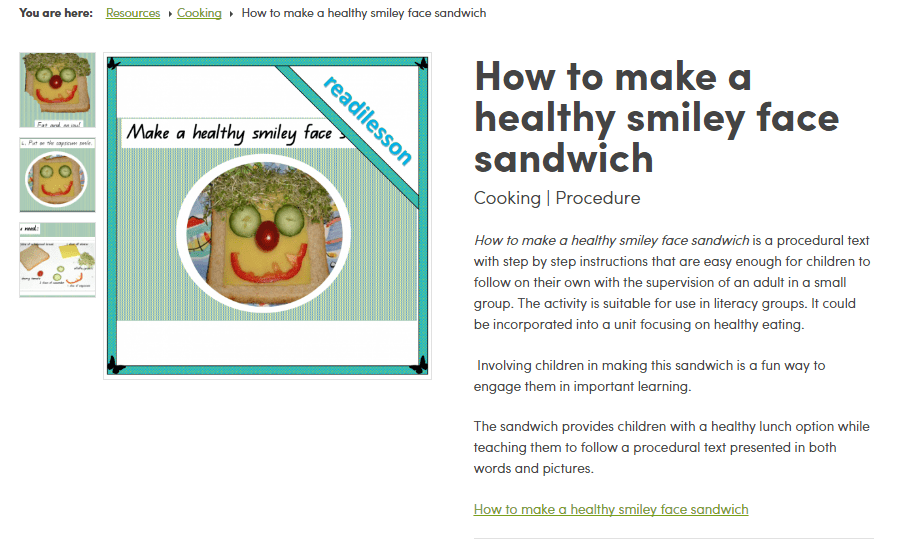
I was disappointed to realise that I had only one cooking resource prepared: How to make a healthy smiley face sandwich
A remedy was required and I tried to think of other resources I could add.
I have previously made ladybird biscuits by icing an Arrowroot biscuit and adding Smarties for spots. I will probably add that recipe in the future, but I was trying to think of something healthier to begin with. I wondered if it might be possible to make a ladybird from an apple. This is what I did:
When I made one for my grandson on the weekend, I was pleased that he recognised it as a ladybird beetle, even without the spots!
Unfortunately, it’s more suitable for an adult to make for a child than for children to make for themselves. Apples are too difficult for young children to cut. It is therefore not suitable for readilearn. However, I had fun making it and will continue to think of other recipes I can add to readilearn’s cooking collection.
Thank you for reading. I appreciate your feedback. Please share your thoughts.
That we live in a print-rich environment is undisputed. Even in country areas one cannot travel far without being bombarded by print. In addition to road signs there is a plethora of billboards advertising the best places to sleep, eat, or play that can be found just ahead.
Environmental print is the genre with which many children first engage successfully with reading. Ask any parent who’s detoured around fast food outlets, hidden shopping catalogues, or camouflaged cheaper brand names of identical products.
That we are immersed in mathematics in our daily lives is just as evident but doesn’t always receive the same recognition. I think this may in part be because people often think of mathematics as abstract algorithms and theorems that we (they try to get us to) learn in school; and that have no apparent application to our lives beyond the walls of the classroom.
However, even the examples mentioned above are just as rich in mathematics are they are in print. They include distances, and perhaps time, to the destination, cost of items, opening hours, and number of attractions. Anyone travelling a distance with young children will have answered questions such as “Are we there yet?”, “How much further?”, and “What time is it?”
As I say in my statement about mathematics on my readilearn site,
“Mathematics is all around us. We use it every day for a huge range of purposes from deciding on the sequence in which we dress ourselves, to calculating how much time we have available for an activity.”
One of the resources suggests 25 ways for parents to keep their children thinking mathematically over the school holidays. I have shared these ideas previously in Counting on the holidays.
Recently I was at the gardens with my two grandchildren (G1 and G2, aged 6 and 4), their mother, and my Hub. The children consulted a map and signposted paths to follow the Children’s Trail which had various sculptures along the way. I am undecided about the value of distracting children from the trees and plants, as if the vegetation itself would not be interesting enough. However, the children enjoyed locating the sculptures in the sequence numbered on the map, and reading the accompanying information. They were engaged in purposeful reading and mathematical thinking in context: real life learning!
As we headed back, G2 made a comment that showed she was engaged in mathematical thinking of her own. She observed that there were two children and three adults, which made five of us all together.
“That’s right,” I confirmed. “There are five’. I thought for a little while, then added, “And do you know what? As well as two children and three adults, there are two boys and three girls.” The children looked at the group and confirmed that I was right. They laughed – a different interpretation.
This gave me an idea for a thinking game: how many other arrangements of three and two could there be? I wondered if the children would like to play along. I had never attempted this before and had no idea if there’d be more, or if we had already exhausted all options.
I looked at the group. I noticed our shoes: three had closed shoes and two had open shoes. I thought about our names: three shared one surname, two another. Then we were on. Everyone was thinking of ways we could be arranged into groups of two and three.
Sometimes we sorted according to different characteristics, as in the previous examples. Others times we used a simple yes or no sorting, such as two have hats with brims and three don’t have hats with brims. This is the easiest sorting to do, and the first that children learn.
G2 made many suggestions of this type of sorting for one and four. One has the characteristic, the others don’t. This was age appropriate for her, and it was great to see her joining in confidently and contributing to the discussion. G1 was able to engage in the more complex thinking required for the groupings of three and two.
I was amazed at the number of different combinations we came up with, and that each of us was combined with others in many different ways.
These are some of the ways we arranged ourselves into groups of two and three (not physically, just in our discussion).
This seemingly mundane activity has potential for developing thinking and learning by encouraging:
thinking about things in new and different ways
looking for similarities and differences
observing detail
sorting according to different characteristics – which is important to both maths and science (think animal and plant classification)
having fun with maths
having fun with family
But wait, there’s more: When we left for home, two went in one car and three in the other!
I think this would be a great activity to do with young children learning about number. It may be a challenge for teachers in Australia where children wear uniforms to school but I’m already thinking of how it could be done with toys or illustrations. It’s not quite the same as doing it with the children themselves, but it could be fun. What do you think?
You won’t be surprised to discover that I have prepared a readilearn resource for sorting as well!
Thank you for reading. I appreciate your feedback. Please share your thoughts.
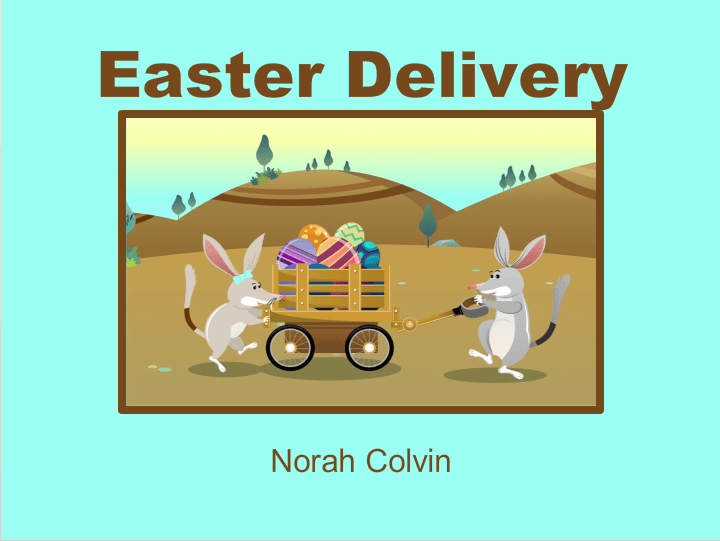
For the past few years I have been preparing early childhood teaching resources for a website that I hoped would be up and running by now. Unfortunately, there have been some delays with the developer. In the meantime, I thought I’d share a resource with an Easter theme to give you a free taste test. This will be of interest mainly to early childhood teachers or parents of young children. Everyone else is excused.
The resource, called “Easter Delivery”, is a story about twin bilbies, Benny and Belinda, who get to deliver eggs to the families of some friends for the first time. It incorporates addition conceptsand is suitable for use with the whole class on the interactive white board.
The story involves the children in helping Benny and Belinda work out how many eggs they need to deliver to each family and the combination of packs they could choose. The maths concepts are probably most suitable to year one students but teachers may use their discretion about how much maths to include.
Included is an information sheet about the resource and three printable follow-up activities:
Benny and Belinda’s Easter Activity – children record the number of people in their own family and draw and calculate the number of eggs Benny and Belinda would deliver
A Happy Easter Card from the Bilbies– a card with a picture to colour and blank inside for children’s own messages
The Bilbies’ Easter Colouring Page
The resource is available clicking on the image until Thursday 24 March 2016. Hopefully it will be available on my website for Easter 2017!
Yes. It is a bit of shameless promotion but it is also a gift for you to use if you would like to in the lead-up to Easter. The resource is not downloadable, but I am happy for the link to be shared with your early childhood teaching friends and colleagues. While it is not a requirement of use, I’d really appreciate some feedback. Please use the poll or share your thoughts in the comment box below.
Thank you for reading. I do appreciate your feedback. Please share your thoughts.
Although I am enjoying the audiobook, I think I will be none the wiser at its conclusion and retain little more than in earlier days. It is a reflection on my retention rather than the worthiness of the book. At the top of Taggart’s webpage is a statement from the Yorkshire Post that I think is probably no idle boast:
Caroline Taggart…has carved out a niche for herself in user-friendly, wittily written factual books which capture the imagination and quickly find their way to the top of the bestseller lists.
Prior to reading this statement I had thought that it was perhaps the narration that had brought the book alive in a most entertaining way. I was surprised that the narrator was not the author for the wonderful meanings and interest he evokes. If not the author then, I thought, he must be a wonderful character actor. Indeed, I was not surprised to find, he was.
According to the Yorkshire Post, the writing itself is worthy too, though it seems to me, in many ways to be little more than a list of names, dates and snippets of events brought to life by an expert narrator. I’m not sure that I would read it cover to cover as I have listened to it, but it would definitely make a useful resource for checking out who and when, which is more or less impossible to do with an audiobook.
One thing I have not liked about the book is the repeated opinion that maths and science in school are boring, and that most of us would only groan when thinking of what mathematicians like Archimedes and Pythagoras have burdened us with. If you’ve read many of my posts you would probably accuse me of being inconsistent, for haven’t I often agreed with that opinion of maths at school?
However, learning in mathematics should not be that way. I wish that everything we learned in school would be alive with interest, purpose and meaning. Then there’d be no need to groan. We’d be amazed and inspired by these great thinkers who have enlightened our lives.
“Mathematics is not just solving for x, it’s also figuring out why.”
But I digress a little. Charli’s main point was about the joy to be found in libraries. In my younger years I spent many hours in libraries. And if I wasn’t in a library, I was reading a book I’d borrowed from a library. Our home was filled with books but there were never enough to read and my parents and many of my siblings were frequent library book borrowers. On many Saturday afternoons throughout my teenage years I would walk the 5½ kilometre journey to the local library and back. I can’t remember how many books I was allowed to borrow, but I borrowed as many as I could.
So many things about libraries have changed from those days of enforced silence, carded catalogues, and microfiche readers. But I don’t feel nostalgic for it. The systems are much more efficient now, and libraries have much more to offer the changing needs of a changing society.
What does sadden me is that many local councils and schools are doing away with their libraries, and many schools are choosing administrators over teacher librarians when organising their staffing. A teacher librarian should be first enlisted. Nobody knows books and readers better than a teacher librarian.
While I have not frequented my local library in recent years, I would be very distressed if it were to close. Not everyone has the luxury of being able to choose ownership over borrowing as I do. Libraries are important to communities and should be accessible to everyone; and not only for their books. Libraries play a significant role in developing a sense of community by providing meeting spaces for books clubs and groups of all sorts, activities for children including storytelling and reading, craft activities, films, games and puzzles, visits by authors and illustrators …
They are also a great place to brush up on the classics that you may have missed out on in school, or find a book about mathematics that may inspire you to ask a big question and figure out why.
Another life, another dream, another possibility …
The Book Lady
She pulled the trailer from the shed, cleaned off the grime, gave it a lick of paint and hitched it to its once permanent position behind her bicycle. A trial ride around the yard confirmed all, including her knees, were still in working order. She propped the bike against the stairs and trundled back to her library where books lay scattered, spewed from shelves no longer able to hold them. She bundled them lovingly, tied them with memories, and wished them new hands to hold and hearts to love. It was time to share, and she knew just where.
Thank you for reading. I appreciate your feedback. Please share your thoughts.
I am struggling with a writing task at the moment. Part of the reason is that is has been at the back, rather than the forefront, of my mind as I worked on other tasks, and part of the reason is that it involves self-promotion in a marketing kind of way. It confuses me a little, because haven’t I been self-promoting all the time I have been writing a blog? Surely putting my ideas out there is at least presentation, if not promotion, of said ideas.
With the goal of sharing original early childhood teaching resources and stories for children on a website of my own, I began writing a blog and engaging in social media about two and a half years ago. This was in responses to advice received from attending writing seminars and reading books about website development. Preparation of resources for my website took a back seat for a while as I engaged with other writers in the blogosphere.
Now it is time to turn the focus back onto the website, the launch of which is fast approaching. With an extra effort over the past couple of weeks, I now have sufficient resources to begin. Additional resources will be uploaded at relatively frequent, if irregular, intervals, not unlike adding to my blog.
I have no issue with ideas for additional resources or blog posts. My stumbling block is the content for my bio and promotional information about the website. It should be easy, I know, but I am struggling to find the answers to these questions:
What do people want or need to know about me?
How can I promote my resources in an honest way that entices people to sign up to a paid subscription?
What is a fair price for subscription?
How can I persuade potential subscribers that they will get value for money?
How can I ensure that subscribers do not feel let down by the available resources or ripped off by misleading promotion?
These questions arise even before I begin to tackle the really difficult one:
How do I connect with my target audience: early childhood teachers?
I know I am not alone with these concerns.
Recently Sarah Brentyn, who blogs at Lemon Shark, questioned the validity of her profile, enflaming my anxiety by stating that “It’s seen by far too many people who judge you by those 10 – 20 words.” The thought to change my blog’s About page, with far more than 10-20 words, hasn’t yet moved beyond that guilt-ridden thought. And while I know it is not suitable as is for my website, perhaps editing or rewriting it is a place to start.
Throughout the year Anne Goodwin, who blogs at Annecdotal, shared the process of stepping out from under the covers of introversion to promote her debut novel Sugar and Snails. In her post One huge leap for Anne, one teeny tiny step for womankind, she questioned how to balance celebrating her achievement with the suspicion that many would be unimpressed. In another post on Book pricing: a cautionary tale Anne questioned pricing and value and shared the hope that people wouldn’t feel ripped off. I am fairly confident that Anne’s concern on each of these issues turned out to be unwarranted. Will mine be the same?
“My intention … (is) to write and publish novels. My intention is to be a successful author. Success to me is publishing books I want to write for readers who want to read them. My secondary goal is to market well enough to eat more than hand-picked dandelions from my yard. Many will say it’s a fool’s dream.”
Charli has expressed it well. Substitute “early childhood teaching resources and stories for children” for novels and it could be me. I hope that neither Charli nor I are dreaming the impossible. Charli at least has a long list of credentials.
I have spent some time looking at other websites which may be considered competitors and looking at bios on others. If there’s one thing I have discovered it is this:
There is a multitude of websites offering early childhood teaching resources. Some websites offer all resources free. Teachers love freebies. There are also many websites with resources available to subscribers. Why would anyone want mine?
However, I’m not going to give up now.
I hope there are many early childhood teachers who will see sufficient value in my website to pay the annual subscription. As far as I explored, I have not found anyone offering interactive resources similar to mine. It is possible that they exist and I just haven’t found them. However, I am hoping that teachers see value enough in these alone, and consider the other resources a bonus. Time will tell. If it returns nothing but the pleasure of achievement, then I will consider it my jetski. If it does more than that I will be well pleased.
So, if I am not going to give up, maybe I just need to get on with the task of writing my bio and promotion paragraph. The other day I read a bio that described the website owner as its founder. Hmm. I thought. Maybe that’s a title I could use.
I was amused at the thought that I would found something that hadn’t been lost. It just hadn’t been before. I thought about other things, briefly mentioned in other posts, that I had founded:
Create-A-Way, educational sessions for children of before-school-age and their parents.












![By UnknownMarie-Lan Nguyen (Own work) [CC BY 3.0 (http://creativecommons.org/licenses/by/3.0)], via Wikimedia Commons](https://norahcolvin.com/wp-content/uploads/2016/03/330px-homeros_caetani_louvre_ma440_n2-must-be-attributed.jpg?w=330&h=480)





 Norah Colvin