Live Love Laugh Learn … Create the possibilities

Category: Literacy education

  • Well I declare

    This week at the Carrot Ranch Charli Mills is making declarations. Specifically she is declaring herself an author, making it clear what her writerly intentions are. I also have declared my writerly intentions. In previous posts, here, here and here, I shared my goal of establishing a website with early childhood teaching resources of my creation.

    In her post Charli expresses it this way: success for her is publishing books. She wants to write books for readers who want to read them. Not only that, she wants to market her books “well enough to eat more than hand-picked dandelions from (her) yard”.

    www.morguefile.com
    http://www.morguefile.com

    Change books to early childhood teaching resources and, for me it’s the same. I want to publish teaching resources that teachers want to use, that enhance their teaching and improve children’s learning. I’d also like to do well enough to not be reduced to eating dandelions from my backyard.

    Some writers consider “educational writing” less worthy and lacking in creativity. “Oh educational writing,” said one disparagingly, “that’s so prescriptive,” and quickly moved on to discuss others’ more literary pursuits.  

    I know some educational writing can be prescriptive. I have done some of that formulaic writing myself. However the resources I am creating do not conform to a formula, are not worksheets to be completed by students sitting quietly in rows.

    I am developing a variety of resource types, some with interactivity, to help develop understanding and skills in a meaningful context. Many encourage critical thinking, problem solving and purposeful applications. Many are built around my own original stories and poems as well as non-fiction texts.

    I have chosen this path in order to support teachers with ready to use teaching episodes and parents with suggestions for nurturing their child’s development. Prescriptive? Far from it. And please don’t prejudge my educational writing against the stereotype of formulaic worksheets and textbooks which are far too abundant and easily accessible on the internet and in bookstores.

    Guiding parents in play sessions for parents and children.
    Guiding parents in play sessions for parents and children.

    From the declaration of writing goals to a declaration of another kind, repeated often on my blog: my appreciation of all things early childhood, especially literacy and picture books, and the importance of reading to and with children on a daily basis.

    The years from birth to eight, especially those before formal schooling begins, are crucial to a child’s development and have an enormous impact on future happiness and success.  It is during these years that basic skills and language are developed along with attitudes to self and relationships.
    noisy nora

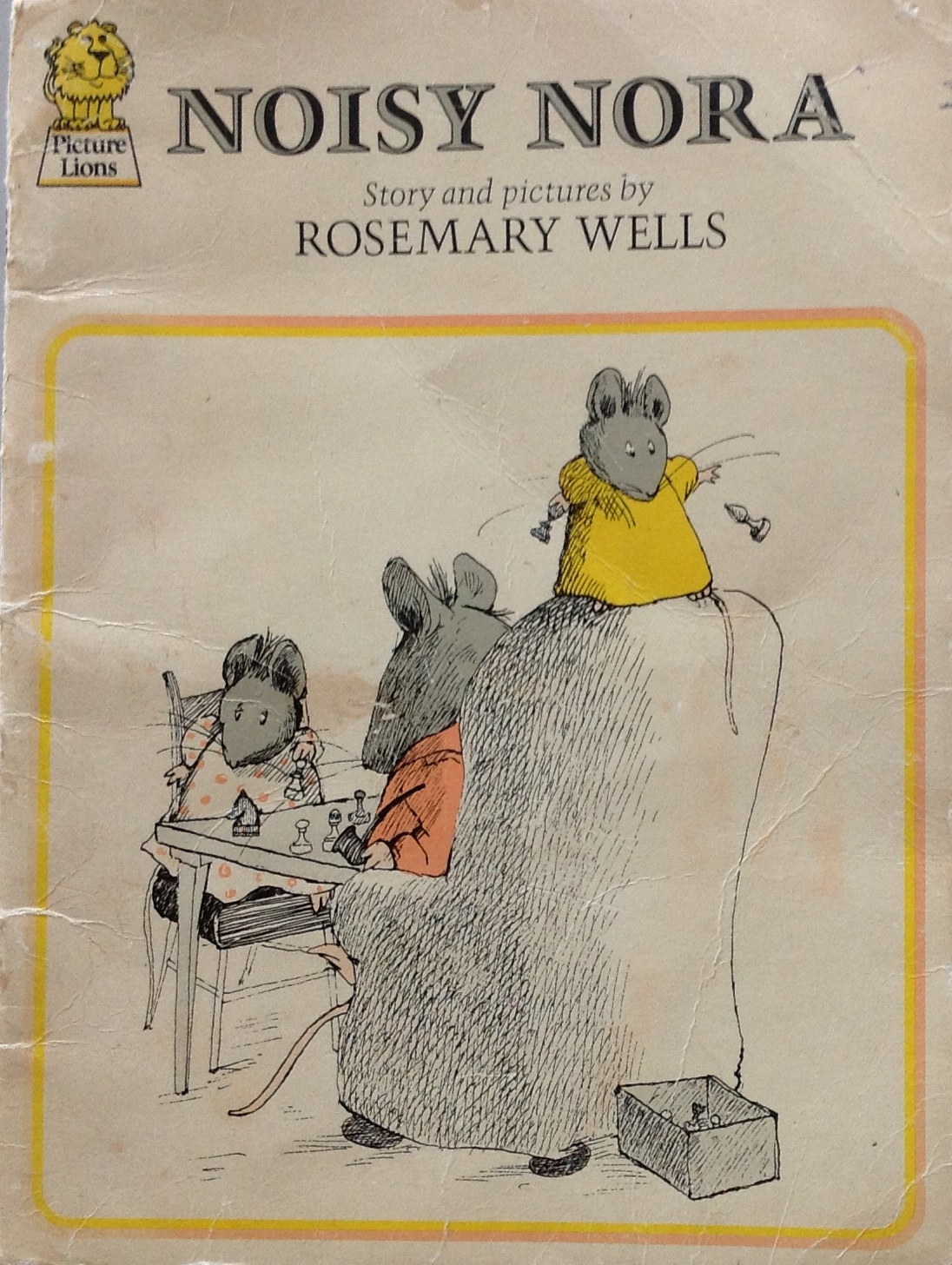
    The picture book Noisy Nora by Rosemary Wells is a delightful book about a middle child who fails to get the attention of her parents who are busy with the older and younger siblings. Finally Nora declares that she is leaving and never coming back. With Nora gone the house becomes unusually quiet and the family go looking for her. At last she declares herself back again as she clatters out of the broom closet.

    (This information from Wikipedia explains why my cover differs from the one in the Amazon store.)

    I took Nora’s declaration as the basis for my response to Charli’s flash challenge to In 99 words (no more, no less) declare an intention in a story. Is it one person, a character speaking up or speaking out? Is it a group or a nation? Create a tension before or after the declaration. It can be private or public, big or small. Does it have power to those who state it or hear? What does it change?

    While I wrote it with Marnie in mind, it could be about any number of others in oppressive situations and seems particularly appropriate to those trapped by the horrors of domestic violence which is at the forefront of our news at the moment. Unlike Nora, who declared she was leaving and never coming back but didn’t really leave, Marnie definitely won’t be coming back.

    from "Noisy Nora" by Rosemary Wells
    from “Noisy Nora” by Rosemary Wells

    Leaving

    It was time. No more would they treat her this way. No more would she accept the cruelty of their world. She was more than this, more than they made her believe. With cash from a secret job stashed in her pockets, a few clothes in a backpack, and hope in her heart, she left. No need to follow a bag through the window. No need to wait for night’s darkness. No. She navigated past their stupor of beer, smoke and flickering screens; paused at the door to declare, “I’m leaving,” then closed off that life as she left.

    Thank you

    Thank you for reading. I appreciate your feedback. Please share your thoughts about any aspect of this post or flash fiction.



  • A celebration of Australian picture books #1

    Recently my friend Sarah Brentyn, who blogs at Lemon Shark: Navigating the Unchartered Waters of Parenting and Life, shared a series of posts about first lines (paragraphs, sentences and pages). She discussed the importance of hooking the reader and shared some of her favourite first lines from a variety of genres. When she shared picture books I was inspired to share some by our many wonderful Australian authors and illustrators.

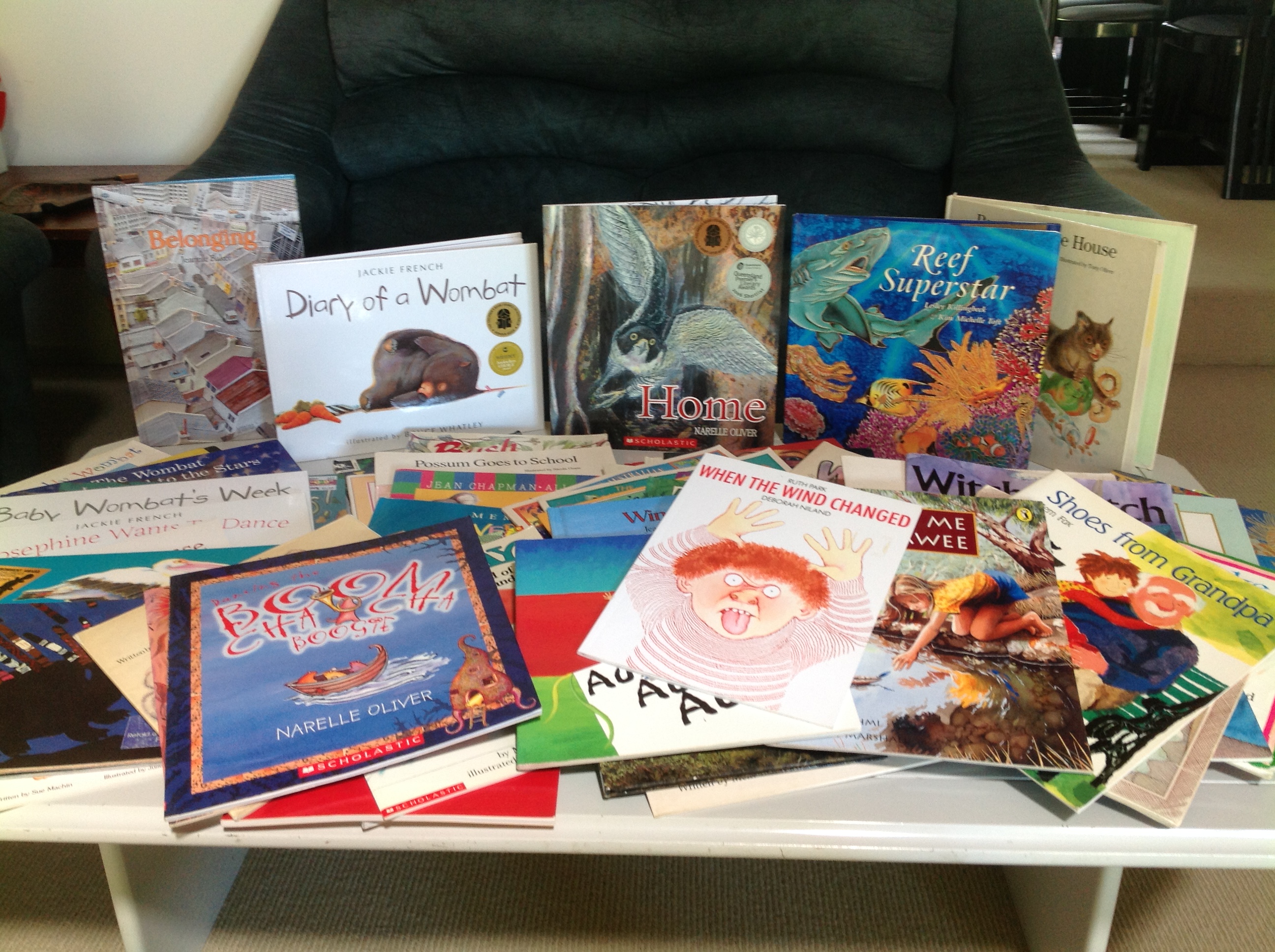
    These are just some of the Australian picture books I quickly located on my shelves:

    Australian picture books

    I own multiple titles of some authors’ work, and of others’ I own but one or two. Sadly, there are many whose work I don’t own. There are too many wonderful books to share in just one post so I have decided to write a series with a post dedicated to each author of whose work I own multiple titles, including Mem Fox, Narelle Oliver, Jeannie Baker and Kim Michelle Toft (and I might sneak in New Zealander Pamela Allen).

    In this post I share some lovely books, their first lines (according to Sarah’s definition) and tell you a little about why they are on my shelves.

    For this series I have commandeered “celebration” as a collective noun for Australian picture books so it is fitting that the first I share is A Compendium of Collective Nouns by Jennifer Skelly.

    A Compendium of Collective Nouns

    This delightful little book was a gift from my grandchildren (chosen by their mother). In the introduction Jennifer asks, “Do you remember laughing when you first learned that a group of crows is called a murder? Or a group of owls is called a parliament?” Like me, Jennifer has always been interested in collective nouns but, unlike me, she has published a collection of them. Her beautiful drawings illustrate collections such as “a crash of rhinoceroses”, “a flamboyance of flamingos” and “a wisdom of wombats”, but who ever heard of “a rabble of butterflies”?

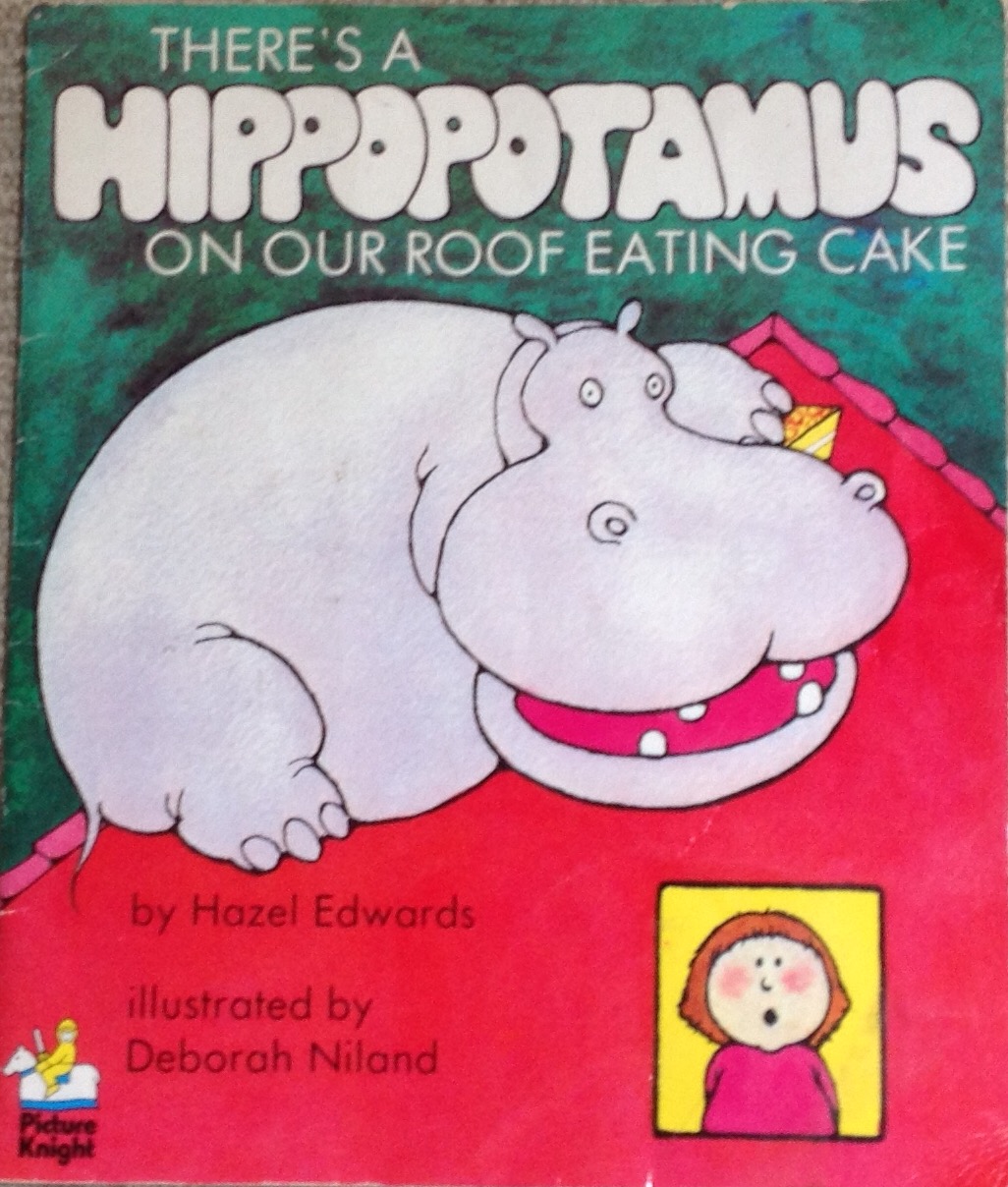
    While there are a number of Hippopotamus on the Roof books I have only the original, There’s a Hippopotamus on our Roof Eating Cake by Hazel Edwards (illustrated by Deborah Niland).

    There's a Hippopotamus on the Roof Eating Cake

    It begins,

    “Our roof leaks.

    Drip!

    Drip!

    Drip!

    My Daddy says there’s a hole in our roof.

    I know why there’s a hole.

    There’s a hippopotamus on our roof eating cake.”

    The copy on my shelf actually belongs to Bec. Her dad bought it for her on a trip back home to Belfast in 1990. He went all the way to Belfast and brought her back an Australian picture book! A good one though.

    In this video Hazel Edward talks about the original idea for the book, other contributing ideas and changes as well as the the important relationship between author and reader. She also reads the book.

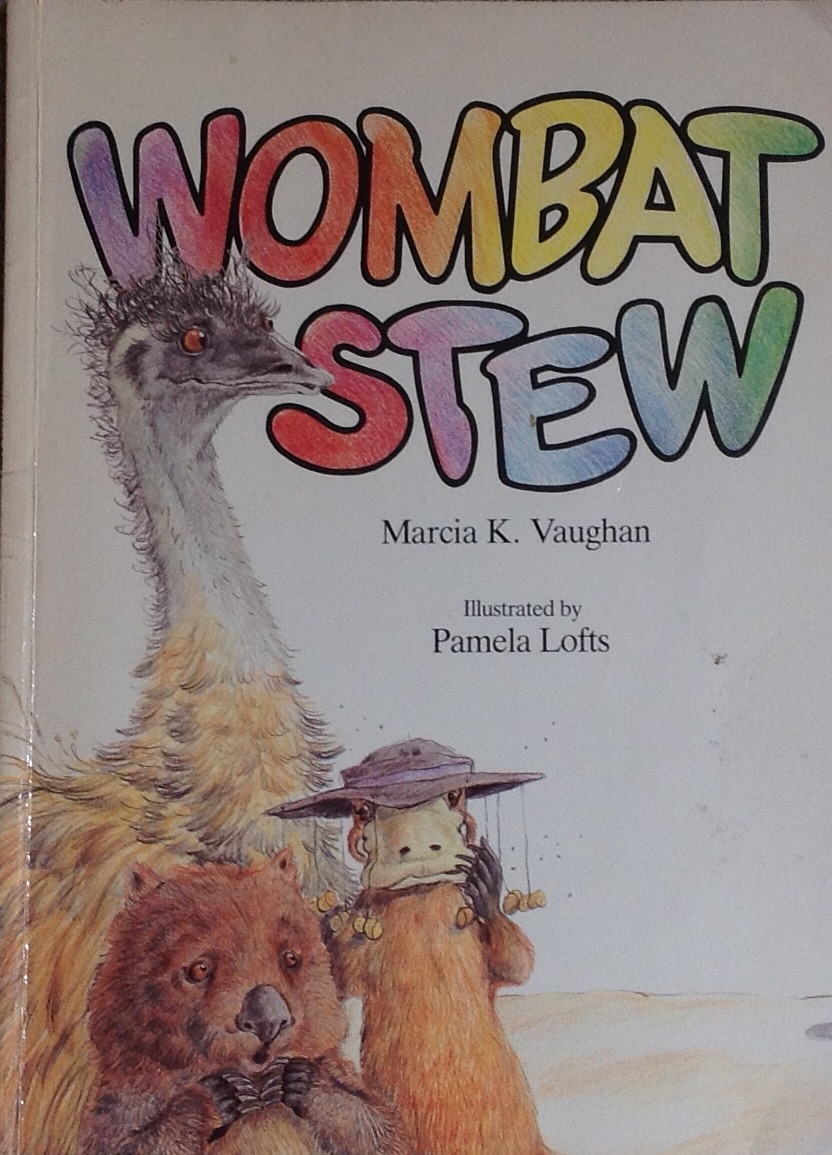
    Wombat Stew by Marcia K. Vaughan (illustrated by Pamela Lofts) is a favourite.

    Wombat Stew

    It begins,

    “One day, on the banks of a billabong, a very clever dingo caught a wombat …

    and decided to make  …

    Wombat stew,

    Wombat stew,

    Gooey, brewy,

    Yummy, chewy,

    Wombat stew!”

    The amusing story tells how the animals trick the dingo and save wombat from his fate. It is a great book to read aloud with its rhythmic language and repetition of the song “Wombat stew” with slight word changes each time. Children enthusiastically join in with the reading and love acting it out. One year I wrote a play with my year one class and they performed it for the school and their parents. It was a lot of fun.

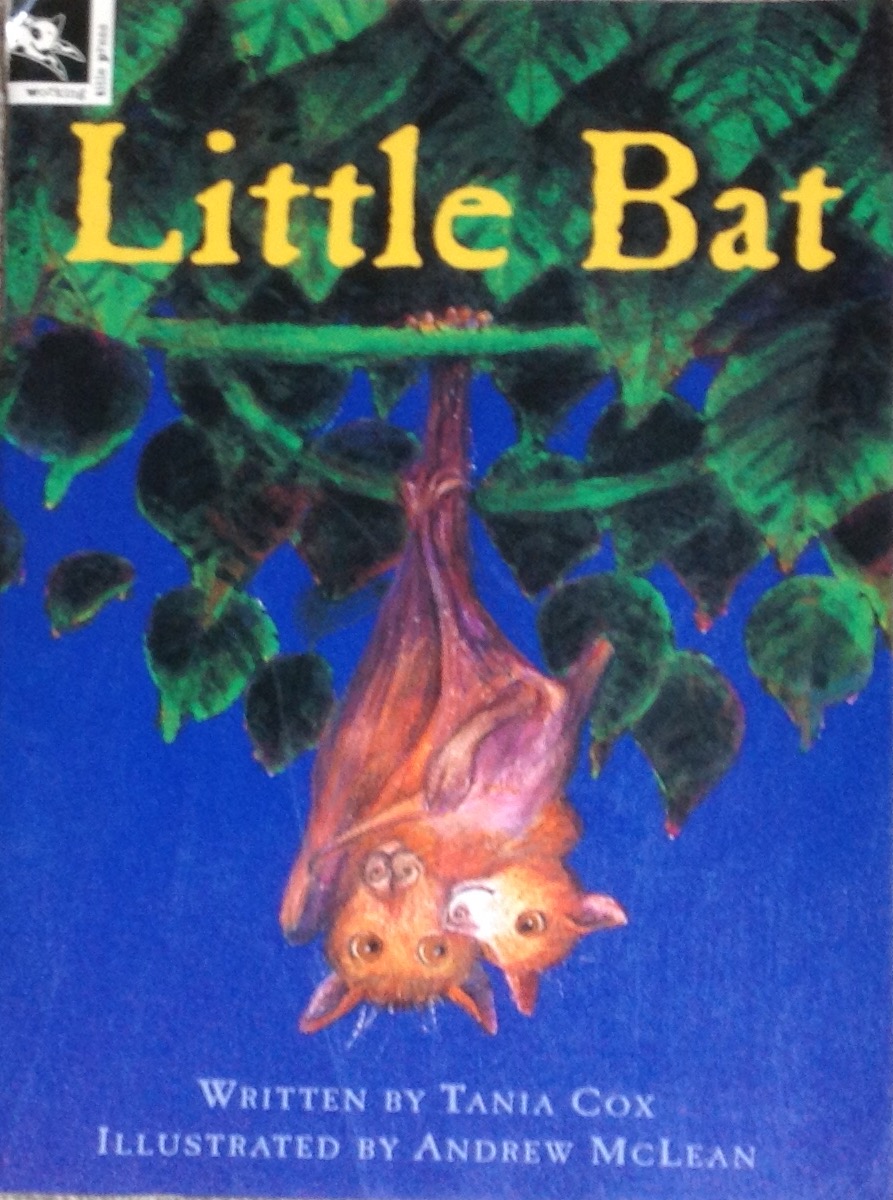
    Little Bat

    Little Bat by Tania Cox (illustrated by Andrew McLean) begins

    “Little Bat was nervous.

    She’d never done this before.”

    With the encouragement of her mother and other animal friends, Little Bat discovers that she can fly. I like the story’s positive message that if you try you can succeed. Books with this theme were always popular and inspired lots of discussion in my classroom.

    When I saw When the Wind Changed by Ruth Park (illustrated by Deborah Niland) in a bookstore, I had to have it for my bookshelf! When I was a child I, like Josh, must have been good at making faces, because my mother was always telling me that if the wind changed I’d stay like that. Well, I don’t think that happened to me, but it did to Josh! The book begins

    “There was this boy named Josh.

    He could do lots of things.

    There was one thing he could do best of all.

    He could make faces.”

    Of course one day the inevitable happens! Fortunately the story has a happy ending, for Josh anyway – I’m not so sure about Dad!

    Are you familiar with any of these books? Have you seen them in bookstores near you? What books by Australian authors have you read?

    Thank you

    Thank you for reading. I appreciate your feedback. Please share your thoughts.


  • The Power of Reading

    The love of reading is gift

    A constant thread running through posts on my blog is the importance of reading to and with young children every day. I have often said that passing on a love of reading is one of the greatest gifts a parent can give a child. The ability to read for information and for enjoyment is empowering. It allows one to take charge of one’s learning and one’s recreational pursuits.

    While my focus is specifically on early childhood, I am interested in education at all levels. I was pleased therefore to recently see a post about the importance of reading for older students. In his post The Power of Reading, Trevor Pilgrim discusses the “correlation between extensive critical reading and higher academic achievement” through the acquisition of knowledge and understanding of abstract concepts. He makes a link between reading of fiction and the development of emotional intelligence. He goes on to list the important role of reading in the academic lives of students.
    If you ever questioned why it is important for children to read, here are some of the answers:

    Trevor Pilgrim's avatareduflow

    He that loves reading has everything within his reach.”  – William Godwin.

    If anyone were to ask me what is the most effective learning tool available to students, my answer would be frequent reading.  I can speak of this from personal and professional experience.  Students can read traditional books or they can read online.  In fact, online reading is growing by leaps and bounds these days.

    Educational experts agree that there is a strong correlation between extensive critical reading and higher academic achievement.  Eclectic and targeted reading both lead to significant acquisition of knowledge.  Habitual readers develop their reading comprehension skills and derive greater meaning from the text.  They get better at doing this with practice and at the same time they develop their higher order thinking and learning skills along with their understanding of abstract concepts.  All of this helps to create a much better student in…

    View original post 369 more words

  • Hear ye! Hear ye! Read all about it!

    asco Soares, Jornal News, https://openclipart.org/detail/183225/jornal-news
    asco Soares, Jornal News, https://openclipart.org/detail/183225/jornal-news

    This week over at the Carrot Ranch Charli Mills challenged writers to In 99 words (no more, no less) write a story that is ripped from the headlines. Look at local, regional or global news.

    Now if there is one thing I have noticed about “the news” over the years, it’s that the news reported in the media is generally bad. Often the stories are meant to alarm or frighten. I think it must be easier to control a population through fear. A little scaremongering may go a long way.

    Although the song is called It’s Good News Week, it doesn’t have much good news to tell.

    I selected a few headlines (expressly for my purpose) from a recent Conversation:

    • The role of water in Australia’s uncertain future
    • The scariest part of climate change isn’t what we know, but what we don’t
    • Stop, go back, the NDIS board shake-up is going the wrong way
    • We’re overdosing on medicine – it’s time to embrace life’s uncertainty
    • Australians less likely to survive home ownership than Britons

    “They” can do it with Education too:

    • Is your child less likely to be bullied in a private school?
    • Uni drop-out rates show need for more support, not capped enrolments
    • The slide of academic standards in Australia: a cautionary tale
    • The absurdity of English spelling and why we’re stuck with it

    F

    All of these headlines state the existence of a situation or condition as irrefutable, like falling standards and failing students. I’m sure most of you will be familiar with headlines such as this one from the Conversation nearly two years ago:

    Lost for words: why the best literacy approaches are not reaching the classroom

    In this article Misty Adoniou attributes the failure of some Australian children on national and international literacy tests to their lack of exposure and experience with standard English – they do not speak standard or “school” English at home. Adoniou says that is up to teachers to improve the language used by students and to make their understanding of correct usage explicit. However she says that many teachers do not have an explicit understanding of English and, as a result, are unable to teach it to their students.


    SnipsandClips, Teacher and Child https://openclipart.org/detail/205589/teacher-and-child
    SnipsandClips, Teacher and Child https://openclipart.org/detail/205589/teacher-and-child

    I’m not sure how true that statement is. However, what I do like about this article is the advice Adoniou gives about teaching. She says that “all our teaching about language must be done in context and in the course of achieving real outcomes.” I couldn’t agree more.

    Daily news – learning in context

    In fact, from their first weeks of school I was explicitly teaching students about language and literacy using a strategy I borrowed and developed from the ubiquitous “show and tell”. I called this strategy simply “News”, and found it to be a powerful tool for teaching the skills of both reading and writing.

    Its strength came from the familiar context, the connection to children’s lives and the importance it placed upon them. The teaching could be adjusted to suit different stages of development, to reinforce learning for some and extend the learning of others. For me, as teacher, it was a powerful learning tool. I was able to gauge children’s developing strategies, understand their needs and identify next steps for learning.

    How it worked

    Talk

    A few children each day would have the opportunity to share their item of interest or “news” with the class. Class mates could ask for additional information or clarification if they wished.

    Compose

    We (teacher and children) would collaboratively compose a report, initially just one or two sentences, of what had been shared.

    Write

    I would model the composition and the writing process, rehearsing what to write while involving children in thinking about what to write and how to write it. How much they were involved, and the detail of language and skills discussed could be easily adjusted to suit their development.  There was always ample practice and repetition, in a meaningful context, for children who needed more time; and discussion of strategies and ideas to extend the most advanced students.

    Some of the writing strategies children were learning include:

    • Composition or rehearsal before writing
    • Directionality of writing
    • Translating conversational language into written language
    • Changing first person spoken text into third person written text
    • Identifying letters used to spell the sounds of language
    • Awareness of punctuation
    • Tenses, past and future, depending on what the children shared
    • Rereading to ensure message is correct and what to write next
    • Proofreading and editing
    • Identifying the main idea through choosing a suitable headline

    Read

    After the news was written, we would read it together to ensure it was correct and the child was happy with the way the news had been reported.

    The text could then be used for developing a number of reading skills, for example:

    • Recognising words by sight
    • Noticing similarities in spellings, or differences in spelling of words with similar sounds
    • Punctuation and its effect on reading
    • Comprehension and grammar: who, what, where, when, and (sometimes) why
    • Reading with expression

    Share

    Each day I would print up the news for the children to take home to share with their family. It was a great first reading experience – about them, their friends and their families.

    While this is only a brief overview of the strategy, the learning that can take place using children’s own language is obvious. Used as one small part of a rich literacy focused and literature-based classroom environment it is a powerful teaching tool. One day I will explain the strategy in detail so that others can use it too.

    Flash fiction

    But back to the headlines and Charli’s challenge.

    Over recent years I have noticed an increased use of ambiguity in headlines and the introduction of (attempted) literary expressions into the body of articles. I have drawn on that for my flash. I hope it works.


    Bridge plans in jeopardy

    She scrolled through the headlines, searching …

    Minister passes over bridge in favour of tunnel

    Minister fails to dig himself out of tunnel fiasco

    searching …

    Minister reveals hand on bridge impasse

    Minister’s tunnel vision blocks bridge improvement

    searching …

    Minister jumps from bridge over tunnel plans

    Talks with Minister over bridge collapse

    searching …

    Bridge closure forces Minister’s hand

    She was sure she had heard something … it must be here … why couldn’t she see it?

    Scrolling … scrolling …

    “Finally,” she sighed.

    Bridge players wanted, Tunnel Street Community Hall, Wednesdays 10 am!


    A Day in the Life

    Thank you

    Thank you for reading. I appreciate your feedback. Please share your thoughts about any aspect of this post or flash fiction.

  • It’s all in how you look at it

    © Norah Colvin
    © Norah Colvin

    Is the jar half full or half empty?

    Many years ago I was employed to be an “agent of change” in a school. My job title was Resource/Remedial Teacher and my role was two-fold: to fix up the children who were “failing”, in reading especially, and to “teach” the teachers more effective strategies for teaching and learning. To say it was a difficult role is an understatement. Think of the old lightbulb jokes.

    psychologist lightbulb

    It is just as difficult for change agents.

    But the job wasn’t without some rewards.

    © Norah Colvin
    © Norah Colvin

    Easy fix

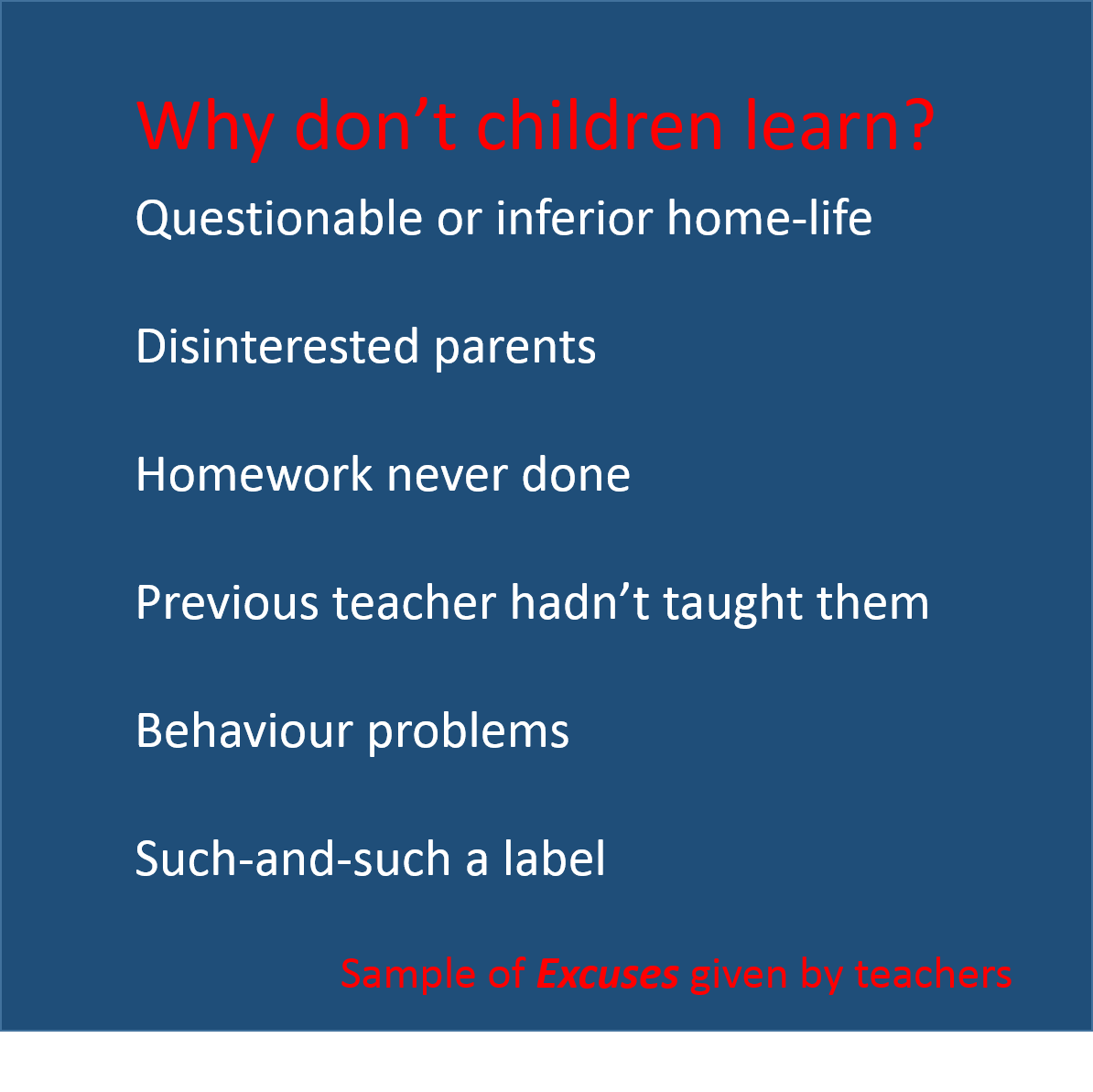
    Teachers considered that one brief session each week in a small group of other children would not only be sufficient to “fix” a child’s learning difficulty, it would also fulfil any requirement to provide differentiated instruction for the learners in their classrooms. “He goes to remedial,” both explained the child’s lack of progress and released the teacher from the obligation to make any other concessions or attempts to support the child.

    Improve teaching

    It soon became obvious that the attitudes of teachers fitted into two opposing “camps”, with a smattering of differences along a continuum stretched between. There were those who focused on the children, what they knew, what they needed to know and how to help them learn. These teachers were creative and innovative in their approaches, trying out new ideas and constantly on the lookout for ways to engage, motivate and inspire children.

    There were those who were focussed on what was to be taught, on their lesson plans, assessment and results. They expected the children to attend, respond and learn because that was what was expected of them. If the students failed to learn what was taught, the teachers questioned neither their methods nor the content for its suitability to student needs. Rather they found the fault to be with the students who were lacking in some way. Their view was of students as empty vessels to be filled, and if they did not fill from what they were offered, then it was the vessel, not the method of filling that was faulty.

    © Norah Colvin
    © Norah Colvin

    So many times the teachers would complain that they had “taught” the work but the students hadn’t learned it.

    In “my world”, if there was no learning there had been no teaching; and I found this attitude difficult to comprehend or accept. Nonetheless I tried to be understanding, patient and supportive, listening to and restating their complaints to ensure them I had understood. I would then make gentle suggestions like “Have you tried?” “Have you thought about?” Rarely was I successful in getting them to reflect upon, interrogate or make adjustments to their practices. I guess if they saw no fault with their practices, why should they change?

    A current focus in assessment driven school programs is what the students can and can’t do, with the main focus on the “can’t”. I much prefer changing perspective to the “not yet” thinking and growth mindset of Carol Dweck.

    success


    This week at the Carrot Ranch Charli Mills is talking about perspective. She challenges writers to In 99 words (no more, no less) write a story that has a shift in perspective. It is right up my alley. Thanks Charli!

    Inside

    They slumped around the table, eyes transfixed on hands clasping coffee cups, bemoaning their lot, each desperate to outdo the other in frustration and despair.

    “They just don’t get it.”

    “I’ve tried everything.”

    “They don’t listen —”

    “They’re so rude —“

    “In my day we wouldn’t dream —“

    Outside

    They welcomed the kiss of sun upon their cheeks, the freshness of air to their lungs; and breathed as one in wonder.

    They found cloud-painted sky pictures, brightly coloured beetles in green grass stalks, claw-made scratches in the rough tree bark; and brimmed with wonder.

    and dared to dream …

    Thank you

    Thank you for reading. I appreciate your feedback. Please share your thoughts about any aspect of this post or flash fiction.
  • Ignorance is bliss … Learning to be explicit

    My Dad used to say that what I didn’t know wouldn’t do me any harm. He was not impressed when a brother wrote in my autograph book when I was in my early teens that what I didn’t know wouldn’t do me much good either!

    © Norah Colvin
    © Norah Colvin

    I’m torn between the two. I have come to realise that the more I know, the more there is to learn.

    the more I know the more there is to learn

    This learning journey never ceases. Each step is just one further into the unknown. I seem to know less now, or need to know more now, than I ever have before. How can that be?

    There are those around me who are content with who they are, with where they are, with what they are doing, and wake up to each day wanting no more than it brings. I strive to achieve that contentment, and practice the joy of being in the present moment, believing strongly in its rewards. But at the same time I strive to do more, to learn more, to achieve more. The doing and learning is joy in the present moment, for me. It is both exhilarating and disheartening to realise that the learning journey stretches so far ahead.

    Learning about learning

    I have spent almost my entire life thinking and learning about learning and education, particularly literacy education and the education of young children. Though the journey has been long, my knowledge is narrow and small, and of absolutely no use in a trivia quiz, unless the question happens to be about a nursery rhyme, and then don’t ask me too much about its “real” or original meaning.

    GDJ, Humpty Dumpty https://openclipart.org/detail/223086/humpty-dumpty
    GDJ, Humpty Dumpty https://openclipart.org/detail/223086/humpty-dumpty

    When I set upon my journey to create a website of teaching resources that I had made, I thought it was an easy thing. I had many resources already made. I just needed to get some illustrations done and put them on a website. What could be simpler than that?

    Simple?

    Every step I take drives me deeper into complexity, into the unknown. Unravelling the complexity demands that I be explicit, that I see and describe each minute step.

    Being explicit

    I always considered the ability to be explicit, to see and understand each step, essential to effective teaching in an early childhood classroom. If one was unable to see the exact spot where a child was going wrong, where a misunderstanding had been formed, or a misconception learned, or the potential for its occurrence, it was difficult to either prevent or repair it. I considered that ability to be one of my strengths as a teacher.

    nicubunu, broken chain https://openclipart.org/detail/22063/broken-chain
    nicubunu, broken chain https://openclipart.org/detail/22063/broken-chain

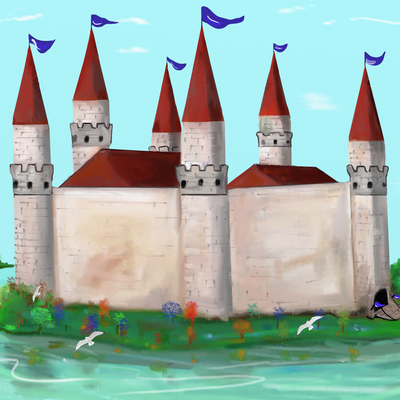
    Over the past few years when I have been giving art briefs to illustrators, my need to be explicit was stretched anew. I had to describe in precise detail exactly what I wanted. It was no use saying I wanted a castle on a hill and expect that the artist would be able to fill in all the details I could see in my mind. I had to explicitly describe it in detail:  did it need a moat or a drawbridge, was the drawbridge to be up or down, were there turrets or flags, and if there were flags, what colour and design they would have, how many windows, how many people, and what were they doing and how were they dressed …

    © Norah Colvin Artwork by Kari Rocher Jones
    © Norah Colvin Artwork by Kari Rocher Jones

    Then it was time to start thinking more specifically about what I required of the website … More complexity to unravel!

    frankes, ship – colored  https://openclipart.org/detail/214500/ship-coloured
    frankes, ship – colored https://openclipart.org/detail/214500/ship-coloured

    Oh for a journey across the seas rather than deeper into complexity!

    It is said that it is darkest before the dawn. How much darker will it get?

    A recent comment by Sarah Brentyn of Lemon Shark alerted me to the fact that although I have mentioned my website in previous posts, I had not made it clear that the purpose of the website is to make my resources available through subscription i.e. to sell my resources. While some will be available without subscription, many will be available only by paid subscription. I have received a quote for establishing the website, which I am considering. I have previously referred to it being my jetski. I think I was fairly explicit about my requirements in discussions with the designer.

    However, I want some of my resources to be interactive, not downloadable, used only on the website by paid subscribers. It appears that creating the types of interactivity I have in mind will be more problematic, but they are what I consider will be my point of difference. I have had to learn to explain, very explicitly, the types of interactions I require. I even made videos demonstrating the interactions in the hope of achieving greater clarity.

    However, it was while being explicit about these steps that I realised I had omitted something from my website brief that will be necessary for the interactions to be used effectively, if they can be made at all.

    © Norah Colvin
    © Norah Colvin

    And so I go in my merry dance – up the ladders and down the snakes, hoping to fall into a pool of clarity rather than a puddle of complexity.

    Thank you for allowing me to express my muddle through writing in an attempt to make sense of it all.

    Thank you

    Thank you for reading. I appreciate your feedback and suggestions. Please share your thoughts.


  • Experiential learning – what’s good and what’s hot

    farm

    I am a proponent of learning by experience, of learning through one’s own explorations and making one’s own discoveries. In early childhood centres it is sometimes called ‘hands on’ learning. The recommendation is to provide opportunities for children to learn by doing rather than simply by listening to someone tell about it or by reading information in a book. For example, experiencing the sights, smells and sounds of a farm create an enriched understanding of farm life that is not possible simply from looking at pictures of farm animals in a caption book. Activities like mixing and making with modelling dough, or building and creating with construction sets provide opportunities for developing numerous skills and understandings.

    That’s not to say that experiential learning is best in every situation or that learning from the explanations of others, including reading information in a book, is less worthy. Indeed there is a place for each and it is important to get the balance, timing and application right. You would not need to view many posts on my blog (for example here and here) to realise that I am a proponent of reading also and believe that instilling a love of reading is one of the greatest gifts a parent can give a child.

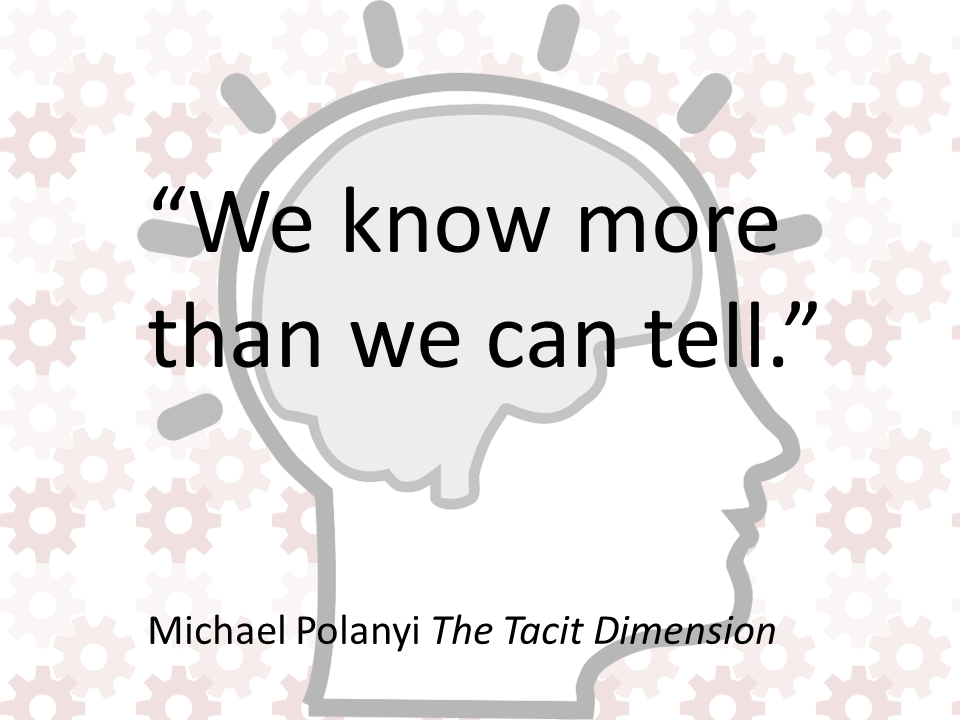
    In their book A New Culture of Learning: Cultivating the Imagination for a World of Constant Change, Douglas Thomas and John Seely Brown discuss the differences between explicit knowledge and tacit knowledge.  This chart shows my understanding of some of the differences.

    Explicit and tacit learning


    Michael Polanyi  The Tacit Dimension

    I think it would be undisputed that there is knowledge best learned through explicit instruction and other best learned through experience. I am sure you can think of many examples in your own life, like riding a bicycle, learning a foreign language or playing a musical instrument.

    netalloy, glossy flame https://openclipart.org/detail/91951/glossy-flame
    netalloy, glossy flame https://openclipart.org/detail/91951/glossy-flame

    But what about teaching young children about heat? It is not far into the life of any young child that they are cautioned about the heat of an oven or stove, heater or barbecue plate. But what is “hot” if you have never experienced it?

    Thomas and Brown say that “when a parent first tells a child not to touch a flame because it is hot, the child will almost always put out her hand and get burned” because the child has only been given the explicit part of the information, the part that could be articulated: that “Fire is hot”. When the child is burned much more information is learned by the body: that it hurts and is unpleasant. The child is then able to make connections with other similar “hot” things and situations.

    I think neither of the authors nor any parent would suggest a child be burned “for educational purposes” but the power of experience can be seen in this example. Perhaps it also helps to explain why young children need constant reminders to stay away, or precautions need to be taken to protect them, from hot things. Without the burning sensation they have not formed a true understanding.

    thomas and brown - learning

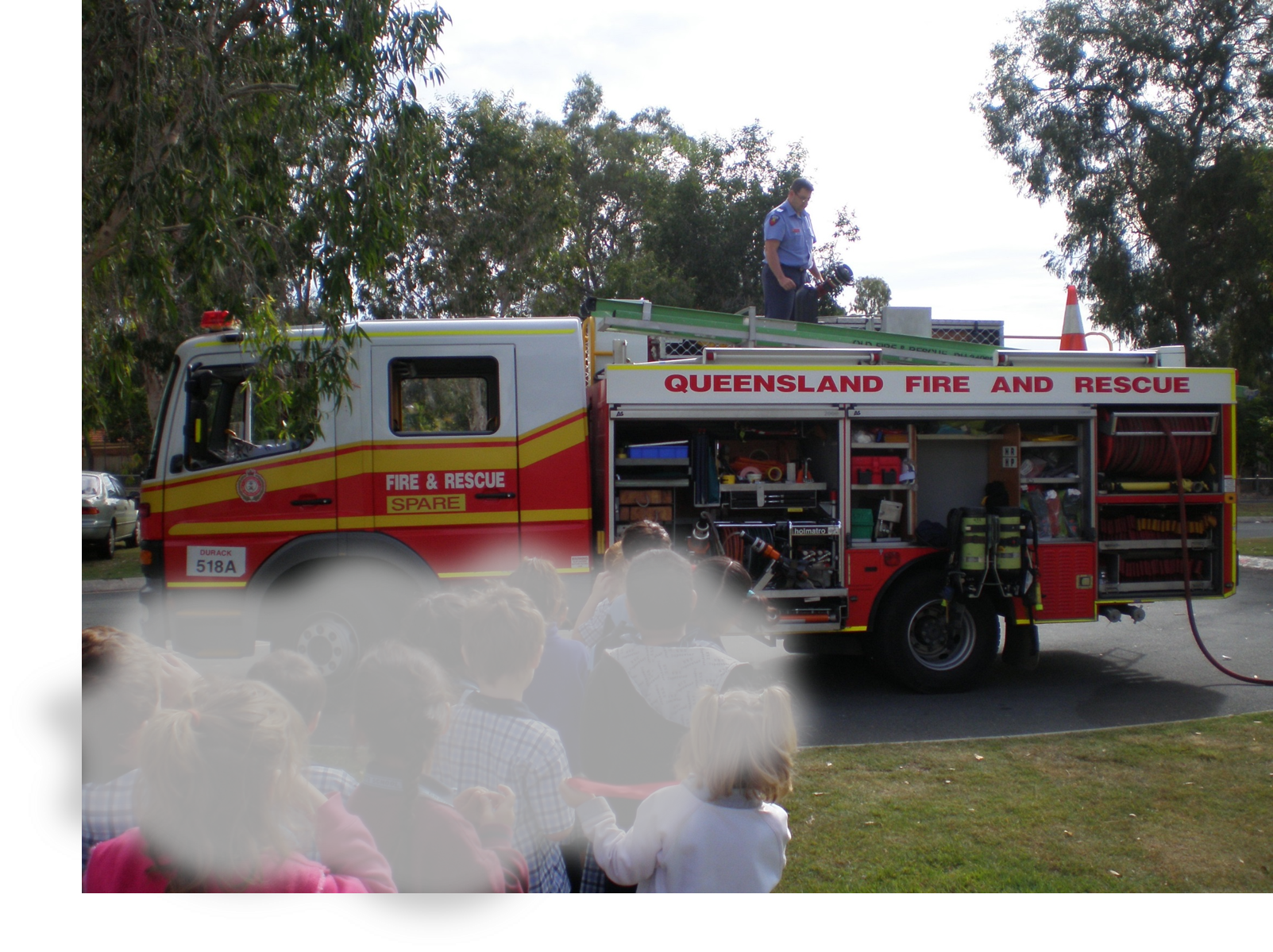
    At my previous school our year one classes were always visited by the local fire fighters who talked about fire safety, explaining the difference between “good” fires (like birthday candles, barbecues and campfires) and “bad” fires, while warning that even good fires could quickly become bad  if not monitored correctly.

    They talked about the need for smoke alarms in the home and the importance of having escape routes and meeting places planned and practised. They ensured students knew their full name and address and the procedure for calling emergency (000 in Australia) if the need should arise. These are things that all young children should know.

    firetruck

    The children were always excited about the firefighters’ visit as they got to look at the firetruck close up, maybe even sit in it or, if they were lucky, see how high they could spray water with the large hose. The tacit knowledge learned through this type of experience, combined with explicit knowledge provides a context that allows children to learn the realities of fire danger and the importance of safety. It wasn’t unusual for the crew to receive a call and rush away during one of their visits, adding further to the overall experience for the children.

    rg1924, unexpected frog in my tea    https://openclipart.org/detail/21079/unexpected-frog-in-my-tea
    rg1924, unexpected frog in my tea https://openclipart.org/detail/21079/unexpected-frog-in-my-tea

    Thinking about heat and education, and the hold that explicit knowledge and its testing has on current practice makes me think of the story about a frog in a pot of hot water.

    The story says that if you were to put a frog into a pot of hot water, it would jump out immediately; but that if you were to put the frog into a pot of cold water which is warmed slowly, the gradual increase in temperature wouldn’t be noticed and the frog would be boiled alive.

    Perhaps this is why some educational practices are accepted without question. People have become so used to them, with small incremental changes seeming insignificant and unworthy of comment. However the cumulative effects over time can be enormous. By the time they are realised, making amends would require so great a change, possibly a total restructuring, that it would defy plausibility.

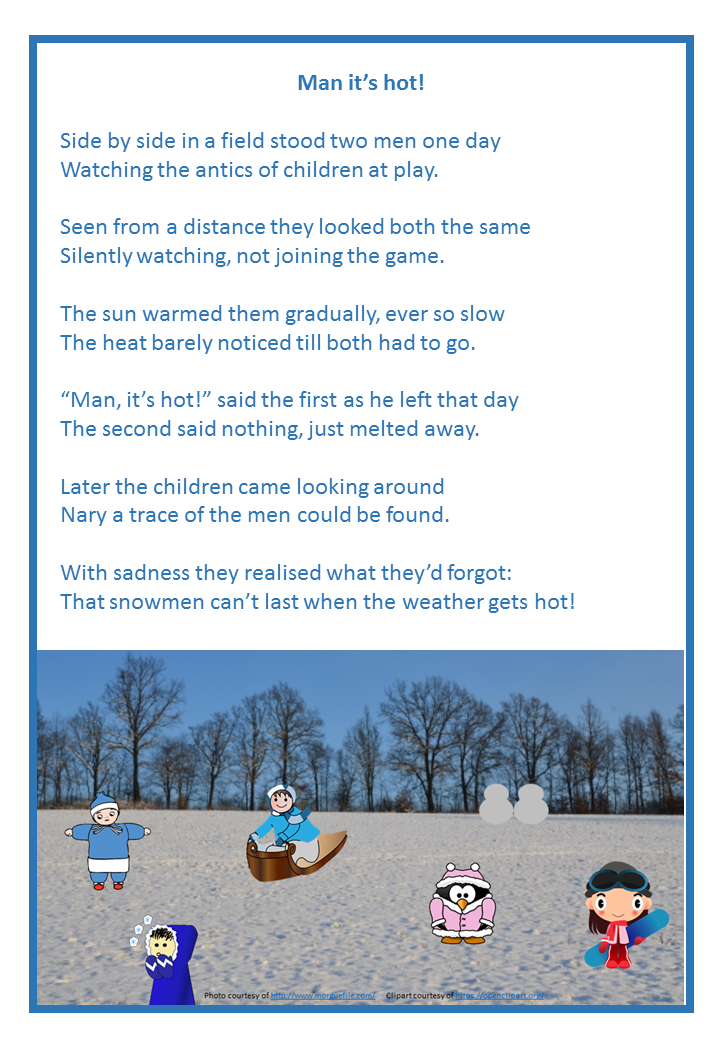
    It is this thinking that has led to me my flash response to the challenge set by Charli Mills at the Carrot Ranch this week to In 99 words (no more, no less) write a story that includes the phrase, “Man, it’s a hot one.” I hope my contribution is a little more environmentally friendly and suitable for young children than boiling frogs.

    Man it's hot

    Thank you

    Thank you for reading. I appreciate your feedback. Please share your thoughts about any aspect of this post or flash fiction.
     

  • Learning fun for the holidays, without a slide in sight!


    Alanspeak, A slide for children to play on https://openclipart.org/detail/191139/childrens-slide
    Alanspeak, A slide for children to play on https://openclipart.org/detail/191139/childrens-slide

    A week or two ago my good friend Sarah Brentyn who blogs at Lemon Shark (Navigating the uncharted waters of parenting and life) raised the issue of students having required reading over the summer holidays. Sarah recalled that when she was at school she had lists of books to read, and book reports to complete as proof of having done so. She expressed concern that no holiday reading is currently required of her school-age sons.

    nlyl, reading man with glasses https://openclipart.org/detail/3133/reading-man-with-glasses
    nlyl, reading man with glasses https://openclipart.org/detail/3133/reading-man-with-glasses

    The basis for Sarah’s concern is what is known as “the summer slide”, the loss of skills, especially reading, if not practised over the long summer holidays.  Studies show what teachers observe: that students start a new school year with skills at lower levels than just a few months earlier. Revision and review of the previous year’s work must be factored in before new work can be commenced.

    Sarah wasn’t so much concerned for her sons who are avid readers and will read regardless of whether it is required or not. Knowing Sarah, her sons will also benefit from an environment enriched with a variety of other learning experiences. All children could benefit from the types of support and encouragement Sarah provides for her sons.

    Sarah’s concern was for children who don’t choose reading as a holiday activity. She believes children should continue to learn over the holidays, and does not understand why learning can’t be fun. I agree with Sarah. However I am a bit ambivalent about the requirement that particular books be read, and probably am not in favour of asking that book reports be submitted.

    CoD_fsfe_Books_icon

    There was never any set reading to be done over the holidays when I went to school, or when my children went to school, and I am not aware of any such requirement of children attending school currently in Australia. The fact that it is not a requirement doesn’t make it either right or wrong. It is simply a new concept to me.

    I would be reluctant to set homework for completion over the holiday period, especially the summer holidays for a number of reasons, including:

    • students will be moving to a new class and teacher, some even to a new school, after the holidays and that teacher may not view the set work in the same way
    • students have spent the school year reading, writing and performing other activities required of them, activities that may have little relevance or interest to them
    • students may spend the holiday period in alternate activities and then rush or “fudge” required tasks, seeing them simply as work that must completed, rather than something they want to do
    • I think children need time to follow their own pursuits and interests without having to fill in a worksheet to say what they have done
    • I think children and their families need some time together without the stress of completing set tasks
    • I think it is important for children to have time to wonder, imagine and create, to be comfortable in their own company, devising their own plans and schedules and activities, some of which may be just down time (the ability to relax in an ever-hurried world is very desirable).

    gardening

    But, like Sarah, I wouldn’t always be leaving children to their own devices, allowing them to wander the bush and beach from daylight till dusk as I did during the school holidays (when I wasn’t reading a book, playing games with siblings or friends or doing household chores). I would be mindful of their activities, ready to make suggestions, provide experiences or encourage other interests; but the direction would always be theirs and never forced or “required”.

    However I am equally as keen to avoid the occurrence of that “summer slide”. As my contribution towards its prevention while also promoting the notions that learning is fun and that opportunities for it abound, I link to three of my previous posts:

    20 suggestions for maintaining reading momentum during the school holidays

    Let the children write! 20 suggestions to get children writing during the school holidays

    Counting on the holidays!

    While I reproduce the suggestions from each post here, each set of suggestions is also available as a free downloadable PDF in my TEACHERS PAY TEACHERS store. For your convenience, I have provided a link to each in the headings below:

    https://openclipart.org/image/800px/svg_to_png/174860/bookworm_penguin.png
    https://openclipart.org/image/800px/svg_to_png/174860/bookworm_penguin.png

    Reading

    1.  Read to and with your child every day – continue the practice established throughout the year with special sharing times during the day or at bed-time — or both!
    2. Demonstrate that you value reading by making time for your own reading, or setting aside a special quiet time when everyone in the family reads.
    3. Visit the library and borrow to read, read, read!
    4. Read poetry books, song books, picture books, joke and riddle books, crossword books, information books, chapter books (these can be read to younger children, or with older children – taking turns to read a page or a chapter each) — what are your favourites?
    5. Trade books no longer read for others at a second-hand book store.
    6.  When dining out, have your children read the menu and choose their own meal.
    7. Include your child in holiday cooking and have them read the recipe – ingredients and method. Perhaps they could read the recipe book to select the meal for the day.
    8. Suggest your child read the TV guide to find when favourite programs are showing and establish a timetable for viewing, rather than haphazard watching with random flicking through channels.
    9. Provide your child with bookstore catalogues and encourage them to read book descriptions to guide their next selection.
    10. Bestow upon your child the title of ‘Family weather watcher’ and have them consult weather forecasts in the newspaper or online to select the most suitable days for planned outings and activities. 
    11. Include your child in making decisions about holiday activities. Give them the guide, or read the guide together and jointly choose the activities.
    12. Make the library, museums and art galleries high on the list of must-dos. Many of these offer a wonderful assortment of free holiday entertainment for children, and reading is an essential part of getting the most from each visit! 
    13. Engage your child in some craft activities which require them to follow written instructions. The ability to understand and follow procedures is empowering and requires the ability to read written, as well as visual, instructions.
    14. Encourage your child to ask questions about every day events and phenomena. Help them to research in books at home, in the library or on the internet. 
    15. Provide eBooks as well as books in print. Good ones bring a new dimension to the reading experience.
    16. When going out for the day, or journeying further away on a holiday, support your child in locating destinations on a map and in selecting an appropriate route. Engage your child in giving directions while en route. 
    17. Include your child when reading bus or train timetables.
    18. When doing the family grocery shop, give your child their own list of items to look for. 
    19. Listen to recorded books on long car journeys, or have books for listening to or reading along with in bed.
    20. Make the most of every reading opportunity that occurs throughout the day!


    https://openclipart.org http://goo.gl/ZvsCFc
    https://openclipart.org
    http://goo.gl/ZvsCFc

    Writing

    1. Use adhesive notepaper to write messages to your child and encourage your child to write a message back.
    2. Encourage children to write letters or emails, cards or postcards to grandparents, aunties, uncles and friends. These can be to inform them of the holiday or the year’s activities, or to thank them for a visit or gift.
    3. Demonstrate that you value writing by making time for your own writing, e.g. keeping a diary, writing letters and cards to family or friends, writing a shopping list.
    4. Display a message board prominently in the home and list important events, reminders and messages. Encourage your child to add their own messages to the board.
    5. Provide a calendar or diary and ask your child to note family birthdays, holidays and events for future reference.
    6. Encourage your child to keep a diary in which important events and feelings are noted.
    7. Play word games e.g. Scrabble and other crossword games; Boggle or ‘hangman’. (If you don’t like the connotation of ‘hangman’, give each player ten counters to start with. Each time an incorrect guess is made, they give away a counter. If all counters are used then they miss that word.)
    8. Write poems and songs together.
    9. Encourage children to write and perform ‘plays’ for the family.
    10. Take photos of events during the day and use them to make a photo book. This can be done instantly on a computer with photos taken using a phone or tablet and emailed with accompanying text.
    11. Insert photos from a phone, digital camera or tablet into a slideshow program such as PowerPoint, then add text to create a digital story or record. With one click these can be saved as an automatic show or MP 4 video.
    12. Involve children in planning the weekly meals by selecting recipes for a menu they write, and for which they create a shopping list of required ingredients.
    13. Write rebus messages to your children and ask them to write a rebus message back, e.g.                 I think you are great
    14. Invite your child to create lists e.g. activities they would like to do over the holidays, movies they would like to see or friends they would like to invite to a sleep over.
    15. Encourage your children to write the step-by-step instructions for making a craft item they have just designed, or to write down the rules for a game so that everybody is sure how to play.
    16. Suggest that your child write down questions they would like answered, and then write the information discovered during research (by interviewing or asking people, reading books or internet search).
    17. Suggest to children that they make a storybook for a younger sibling or friend.
    18. When going out for the day, or journeying further away on a holiday, children could be asked to write directions for the journey as discovered by consulting paper or online maps.
    19. Help children to set up and maintain a blog to create a record of activities and events to be shared with family and friends. The posts could be regular e.g. daily or weekly, or follow particular activities.
    20. Make the most of every writing opportunity that occurs throughout the day!
    Moini, sleuth penguin https://openclipart.org/detail/221475/sleuth-penguin
    Moini, sleuth penguin https://openclipart.org/detail/221475/sleuth-penguin

    Maths

    Number and place value

    1. Count items e.g. birds in the sky, shells collected from the beach, people for lunch, steps in a staircase, windows on a house, seats in a bus . . .
    2. Count out the cutlery required for each person at dinner
    3. Include your child in shopping activities by helping them to:
    • Recognise the coins and notes
    • Count the value of coins and notes
    • Predict whether they have enough money to purchase an item, and whether there will be change
    • Tender the money in payment for an item

    4. When your child is sharing e.g. the biscuits, balloons or slices of fruit, ask them to:

    • Predict if there will be enough for everyone to have one, or more than one each
    • Share out the items, allocating the same number to each
    • Determine if there are any left over and what to do with them

    5. Use terms like half and quarter correctly, e.g. when cutting apples, oranges, sandwiches, pizza, to indicate pieces of equal size

    6. Play games that involve counting, e.g. counting the number of skips, balls in hoops, pins knocked down or dice games like snakes and ladders that require adding as well as number recognition and counting

    7. Make up number stories e.g. “We had five apples in the bowl. I ate one, and you ate one, how many are left?”

    8. Read books with number concepts e.g. Pat Hutchins The Doorbell Rang, Eric Carle Rooster’s off to see the world  or Kim Michelle Toft One Less Fish

    Patterns and algebra

    1. Use items to make patterns e.g. sort and create a pattern from shells collected at the beach, building blocks or toy cars
    2. Look for patterns in the environment e.g. fences, tiles, walls and window, zebra crossings
    3. Decorate cards and drawings with a patterned frame
    4. Make gift wrapping paper by decorating with potato prints or stamp patterns

    Measurement and geometry

    1. Include your child in cooking activities and allow or support them to:
    • measure the ingredients
    • set the temperature on the oven
    • work out the cooking finish time
    1.  A child’s understanding of volume and capacity can be developed when they:
    • pour glasses of water from the jug and discuss terms such as enough, full, empty, half or part full, more, less
    • pour from one container into another of a different shape to compare which holds more and which holds less
    1.  Scales can be used to compare the mass of different items or quantities e.g. compare an apple and an orange, measure the mass of butter required for a recipe
    2.  Measuring length can be included by:
    • measuring and comparing height
    • cutting a length of string to tie a package
    • measuring who is closest to the jack in a backyard game of lawn bowls
    1.  Use the calendar to
    • Learn the names and sequence of days in the week or months in the year
    • count the passing days or the number of days until an event
    1.  Identify shapes in the home and environment e.g.
    • 2D shapes: tiles on floor and walls, shapes of windows, sections of footpath
    • 3D shapes: cereal boxes (rectangular prism), balls (sphere), bottles or cans (cylinder), dice (cube)
    1.  Play games that involve shapes e.g. jigsaw puzzles, tangrams
    2.  Talk about directions e.g. left, right, forwards, backwards and follow directions on a grid
    3.  Play games that involve directions and movement in space e.g. battleship,Hokey Pokey,Simon Says, snakes and ladders, ludo
    4.  Read and discuss books that include measurement concepts e.g. Pamela Allen:Who Sank the Boat?(volume); Eric Carle: The Very Hungry Caterpillar (days of the week) and The Bad Tempered Ladybird (time); Penny Matthews and Andrew McLean A Year on our Farm (months and seasons); and for looking at places on a map Mem Fox Sail Away The ballad of Skip and Nell or Annette Langen & Constanza Droop Letters from Felix

    Probability and statistics

    1. When discussing the weather or desired activities include the language of probability e.g. possible, certain, likely, unlikely, impossible
    2. Encourage children to collect data about family or friends by asking yes/no questions e.g. do you like swimming, or making a graph of the family’s favourite colour or meal.
    3. Play games with spinners and dice and talk about the likelihood of spinning or throwing a particular number.


    I hope these activities demonstrate how easy it is to maintain learning while having fun over the holidays. I’m sure you will have many more favourites of your own.

    Thank you

    I appreciate your feedback. Please share your thoughts about any aspect of this post.

  • Are you game?

    This week at the Carrot Ranch Charli Mills is talking about childhood games and has challenged writers to In 99 words (no more, no less) write a story that involves a children’s game or rhyme. I think she chose this topic just for me. Thank you, Charli.

    I love games and am a strong believer in the use of games to enhance learning. I have memories of playing games that span my lifetime, from early childhood until the present, and have visions of playing games far into the future.

    Johnny Automatic, cartoon of a girl and boy playing with a ball https://openclipart.org/detail/721/playing-ball
    Johnny Automatic, cartoon of a girl and boy playing with a ball https://openclipart.org/detail/721/playing-ball

    One of my earliest memories of an organised game was of “Drop the hanky” played at a birthday party. I was about five years old at the time. I think that perhaps, until this event, I had only ever played imaginative games with my brothers and sisters. I was obviously not familiar with the rules or the ethos of the game. I’ll let my flash (non-) fiction explain.

    Plum pudding

    We sat in the circle chanting,

    “I wrote a letter to my love and on the way I dropped it.”

    “It” skipped around the outside, waving a handkerchief.

    “One of you has picked it up and put it in your pocket.

    Not you. Not you. Not y-o-u!”

    Suddenly “It” was running and children were scrabbling behind them.

    “Run,” they called.

    Then “It” was beside me.

    “Plum pudding!” they all screamed hysterically.

    The adult pointed to the centre of the circle. “We’ll have you for dessert,” he grinned.

    I cried, wondering what it would be like to be eaten alive!

    © Norah Colvin 2015
    © Norah Colvin 2015

    Obviously I was traumatised for the memory to be so vivid and almost nightmare-like since the memory ends abruptly with the fear. Obviously I wasn’t eaten for dessert, I survived the trauma and, to complete the fictional narrative, I guess you could say “I lived happily ever after.”

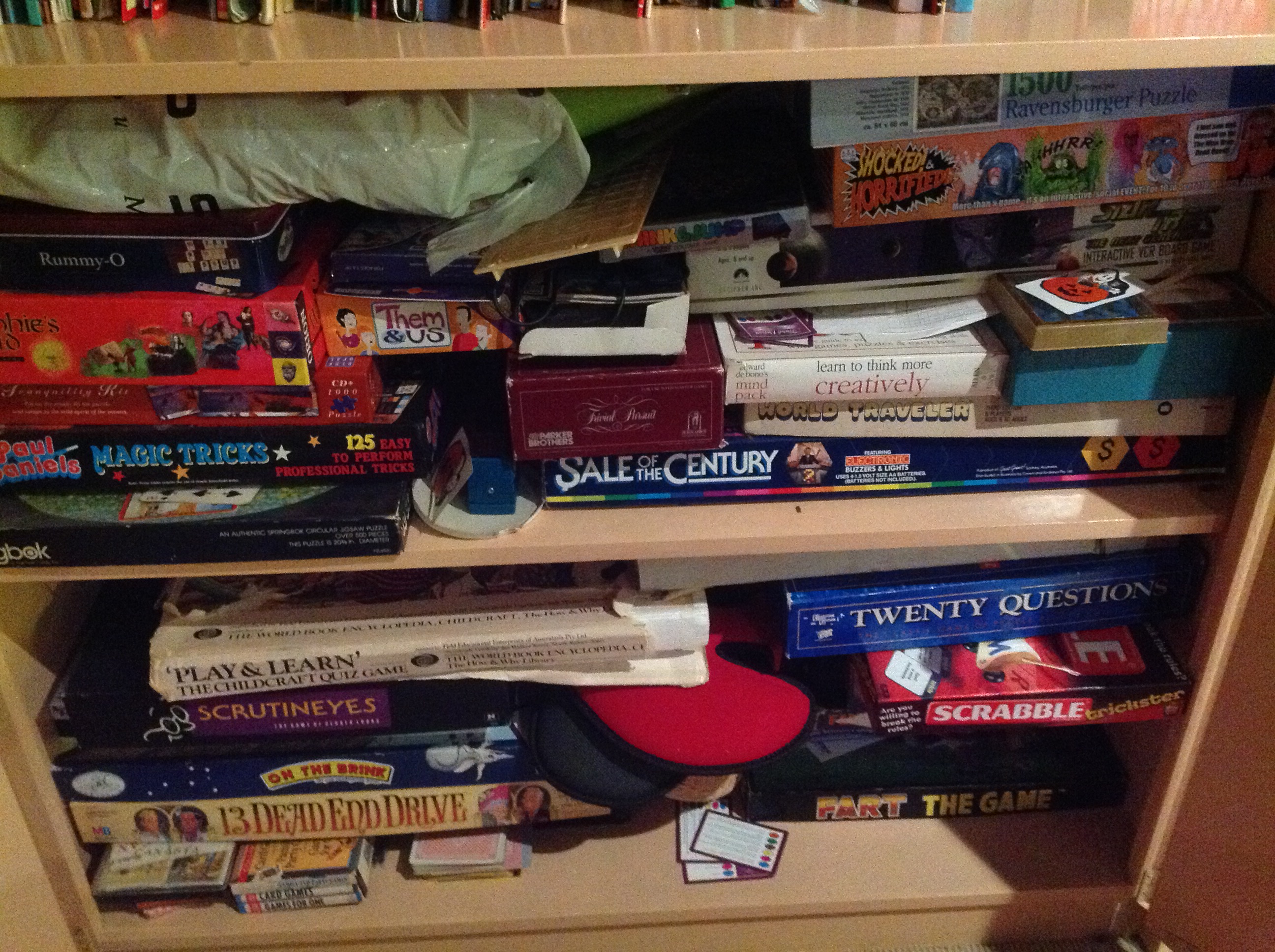
    But games don’t need to be traumatic. Games are better when they are fun; and I have many more memories of having fun with games than I do of being traumatised by them. Some of my “best” memories are of the laughs shared playing games like “Balderdash” and “Billionaire” when we (hub, son, daughter and partners) set aside traditional holidays for playing games together as a family. My house may have shelves laden with books, but they also have cupboards bursting with games.

    © Norah Colvin
    © Norah Colvin

    We didn’t always play purchased games. Sometimes we made up our own. It takes some skill in problem solving to think up a new game that will be fun to play with just the right amounts of challenge and competition, and an equal chance of “winning”, if there is a winner. Games without a winner, played for the fun of playing, are just as enjoyable.

    I have always included games in my class program. As well as being fun, if carefully chosen they can also progress learning. Games can be played at the beginning and conclusion of sessions; at transition times to reenergise, refocus and refresh; and as part of the teaching/learning program with whole class, small group or individual participation for targeting practice of particular concepts.

    One obvious benefit of playing games is the development of social skills such as:

    • Sharing
    • Taking turns
    • Cooperation
    • Dealing with competition
    • Accepting a loss
    • Accepting a win graciously

    In their book “A New Culture of Learning: Cultivating the Imagination for a World of Constant Change”, Douglas Thomas and John Seely Brown talk about ““arc of life” learning, which comprises the activities in our daily lives that keep us learning, growing and exploring.” They say, “Play, questioning, and — perhaps most important — imagination lie at the very heart of arc-of-life learning.”

    Throughout the book they talk about the importance of collaboration in engaging online in multi-player games and say that When understood properly . . . games may in fact be one of the best models for learning and knowing in the twenty-first century . . . Because if a game is good, you never play the same way twice.

    monopoly

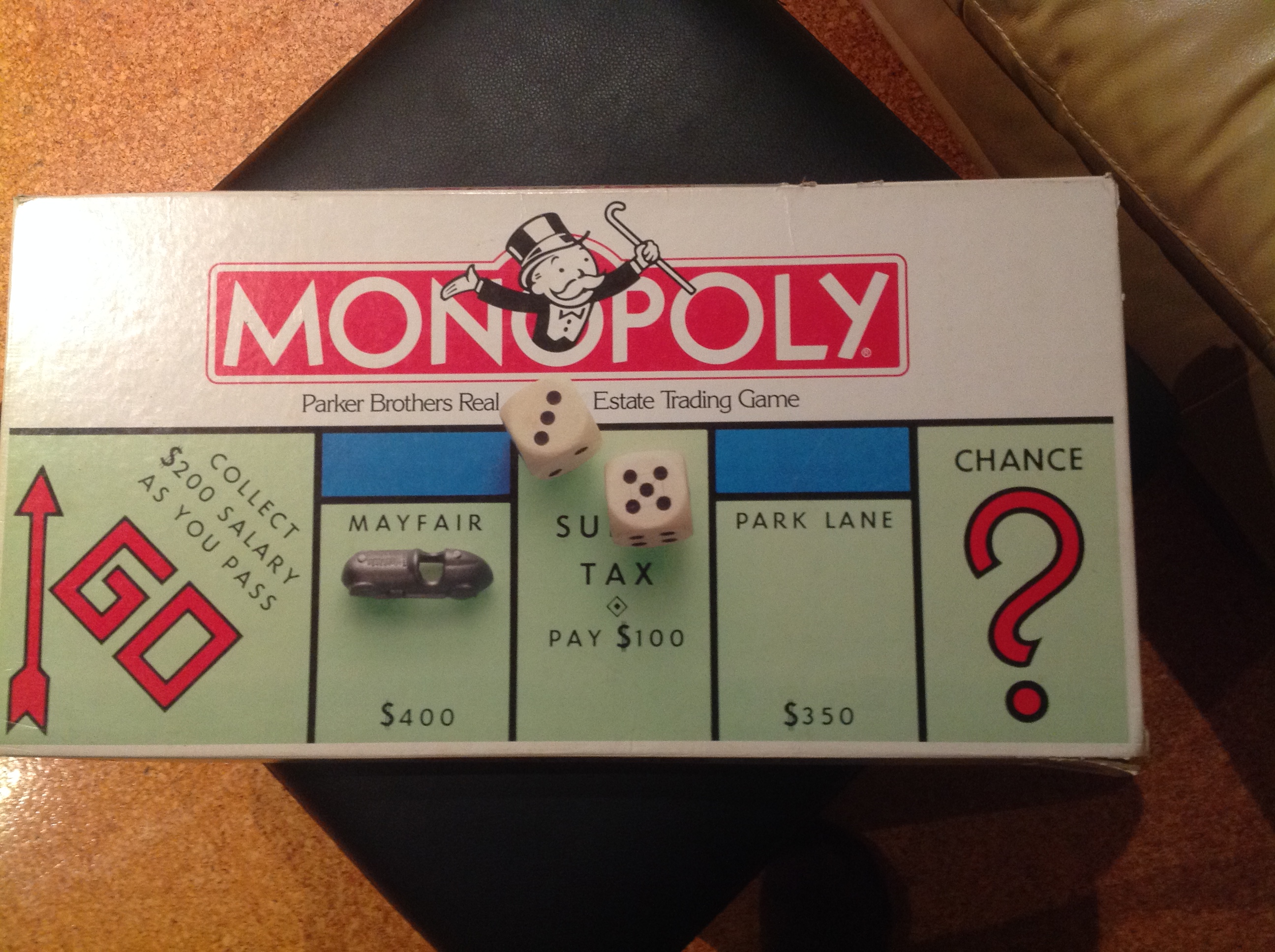
    Robert Kiyosaki in his book “Why “A” Students Work for “C” Students and Why “B” Students Work for the Government” talks about the importance of learning through games and explains how he learned, and was inspired to learn more, about finance from playing “Monopoly”. He says that Games are better teachers than teachers.” While I prefer to not agree with that statement in its entirety (I don’t even like playing Monopoly), I could understand his reasons for making it.

    Rarely a day would go by that at least one game wasn’t played in my classroom. We would play games in literacy groups that required children to read and think critically. We would play games in maths groups to practice skills in fun ways or to solve problems cooperatively. We would play games in science to try out ideas or research information. Some of the games involved physical as well as mental activity. Some were played with the entire class, and some on their own.

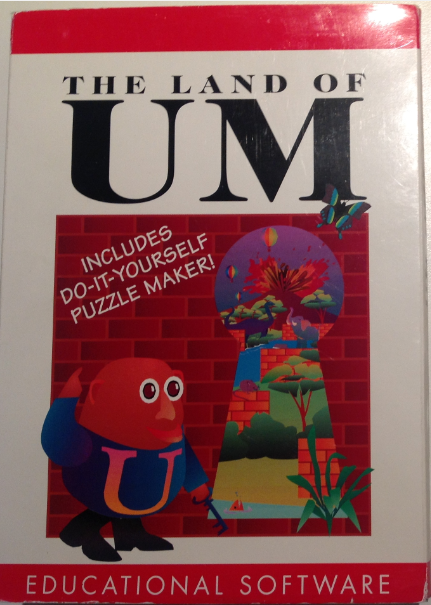
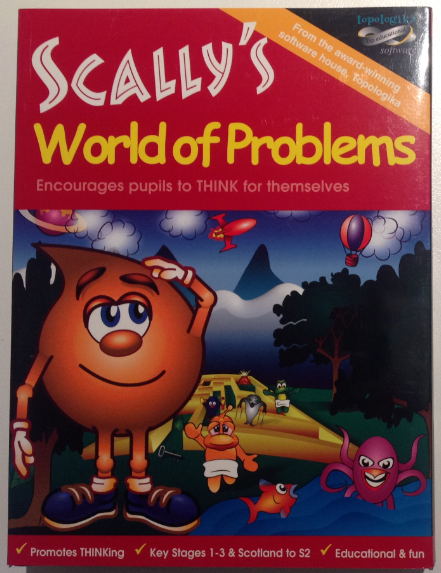
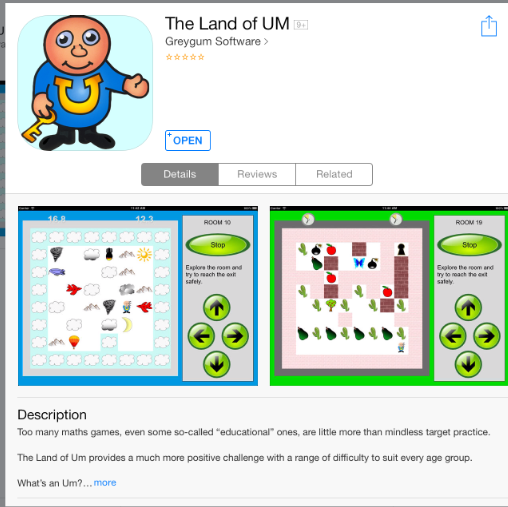
    One game we used in maths groups as well as an activity in the last few minutes of the day was a problem solving game that I was involved with from its inception, The Land of Um or, as it is known in the UK, Scally’s World of Problems. (Also available as an app.)

    http://www.greygum.com.au/nebula/index.php/the-land-of-um

    Scally


    When I was asked for an idea for a program, I suggested something that required children to explore to find out “what happens if” and “how things work”, much as they learn from their exploration of the “real world”. I also suggested that what they learn be consistent and apply at the next level. From that small seed and through the collaboration and synergy of a small group of creative people the “Land of Um” was born.

    Because, in my recollections anyway, it was “my” idea, I am very proud of “Um” and enthusiastic about its potential to encourage children to develop the thinking skills involved in solving problems.

    Um app

    In my class the children worked enthusiastically and collaboratively in small groups on an interactive whiteboard, taking turns to control the “Um” while working together to find the solution to each puzzle. As the level of difficulty increased the children needed to plan ahead, to visualise steps and predict what would happen and the effects of different actions. At each new level and in each new world, while the basics remained consistent, there was always something different to learn and explore. The children never tired of the using the program and were always eager to be the one to suggest the solution to the next problem. It was/is a joy to know that I had a part to play in the design of this program that has so many benefits to learners, not least of which is the fun of working together to solve problems.

    How significant are games in your life? What special memories do you have?

    If you are interested, there are many more stories about games to read on Charli’s blog.

    Thank you

    Thank you for reading. I appreciate your feedback. Please share your thoughts on any aspect of this post or flash fiction.


  • Five Photos Five Stories – Day one

    For the love of books

    This week I was surprised to be nominated by, writer extraordinaire, Geoff Le Pard in a Five Photos Five Stories challenge. Geoff blogs at TanGental where he shares numerous and beautiful photos of his garden, family, travels and adventures. He writes an eclectic assortment of prose and poetry, memoir and fiction, with content both challenging and humorous. He also posts at the speed of light with at least one post each day. I can understand why the challenge would appeal to Geoff.

    I’m not like that. I tend to stick to my routine of two posts each week and write mainly expository text about education with a response to a flash fiction prompt by Charli Mills thrown in. I rarely write explanations of or stories about photos and mostly use photos to support and add interest to the page. Why would Geoff nominate me?

    Well it seems Geoff must have known something about me that I didn’t, as I have decided to throw caution to the wind and join in the challenge.

    The rules of the Five Photos, Five Stories Challenge are:

    1) Post a photo each day for five consecutive days.
    2) Attach a story to the photo. It can be fiction, non-fiction, poetry, or a short paragraph. It’s entirely up to the individual.
    3) Nominate another blogger to carry on the challenge. Your nominee is free to accept or decline the invitation. This is fun, not a command performance!

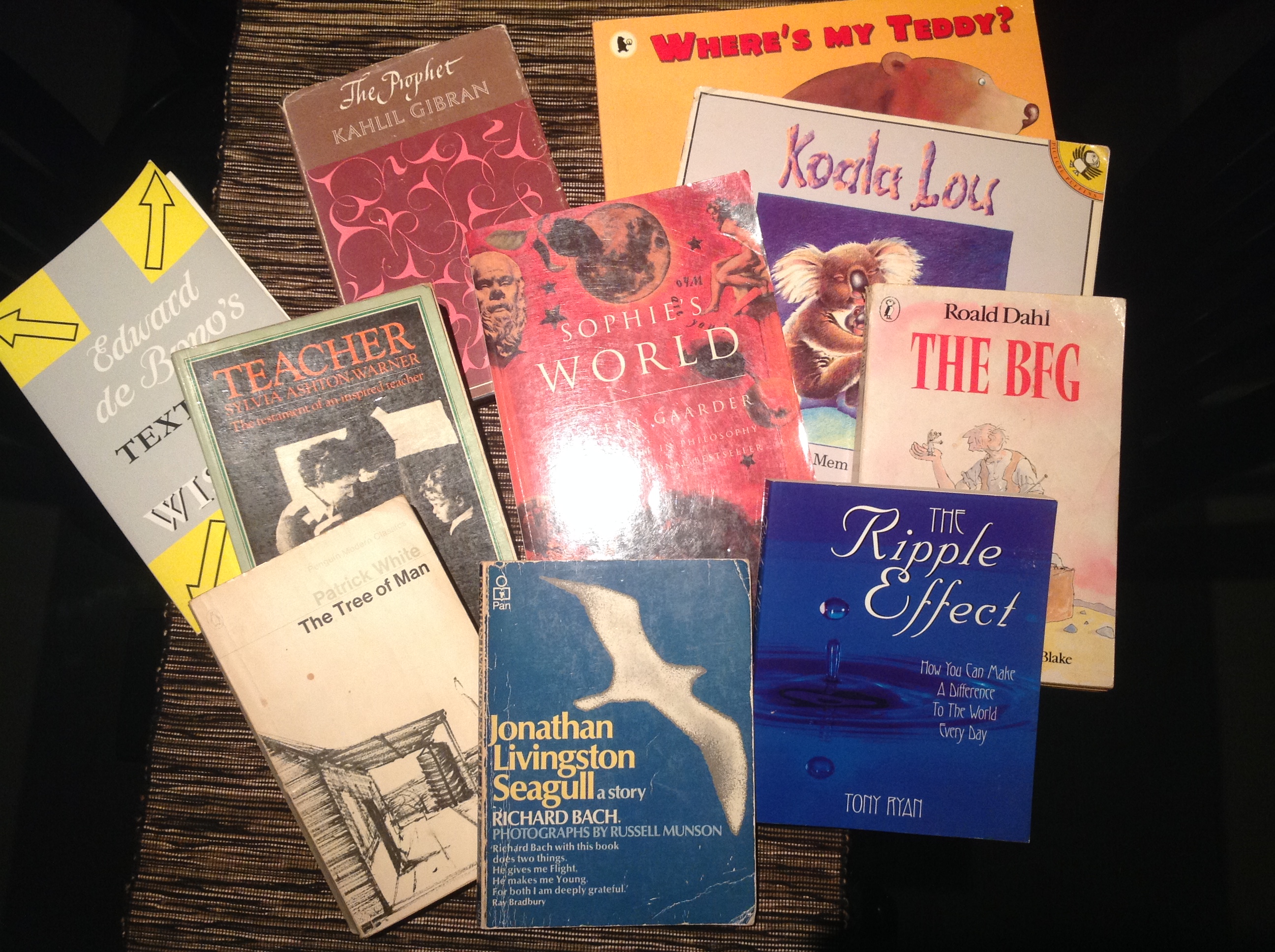
    For my first photo I have chosen, and you won’t be surprised, books:

    books

    These are just a few of my favourites. As you can see I have chosen a range including picture books and chapter books for children and both fiction and non-fiction titles for adults. There are others that should have been there but I could not fit my entire collection into one photo!

    Books have always been an important part of my life and I think a love of reading is one of life’s greatest pleasures. My love of books and reading is one of the reasons, if not THE reason I feel so passionately about education and the teaching of literacy. Sharing a learner’s excitement at becoming literate is both an honour and a joy. I have been privileged to share that excitement with many children during my teaching career, and of course with my own two children who both learned to read well before starting school.

    I have written about the importance of reading many times before, including here, here, and here.

    For this post, and for this photo, I will share ten totally random recollections of books and reading from my younger years.

    I remember:

    • books as gifts for Christmas and birthdays
    • an expedition to the council library, a six-kilometre walk there and back, each Saturday afternoon for an armful of books to read during the week
    • being deaf to the world when totally absorbed in a book for hours on end (particularly so when there were jobs to be done)
    • the eagerness of wanting to get to the end of a book and the sadness and reaching the last page
    • the excitement of finding the next book in a series or by a favourite author
    • marvelling at words and phrases for the imagery or feelings they evoked
    • enjoying an author’s style and trying to emulate it by writing and writing and writing, and wishing to one day be an author too
    • the smell of new books
    • tracing the embossed lettering on the hardcover when the jacket was removed
    • being fiercely protective of my books and having a great dislike of seeing them torn or marked
    • the joy of ownership

    And now I nominate the lovely Michelle James who blogs at Book Chat to take up this challenge if she so wishes. Her love of books is at least as great as my own!

    Thank you


    Thank you for reading. I appreciate your feedback. Please share your thoughts about any aspect of this post.