I have always welcomed and appreciated parent volunteers in the classroom. The value they add to the classroom program and children’s learning is enormous. I always loved that we could do much more with the assistance of parent volunteers than we could without.
But effective use of the parent volunteer’s time requires a certain amount of organisation and preparation. Just as there is little point in a parent volunteer turning up at a scheduled time if you are unprepared; there is also little value in a parent appearing at the door during class time and asking, “Can I help?”
Parent volunteers can play a very important role in the classroom, especially with group work in literacy and maths, assisting with art lessons, outdoor activities and work in the computer lab. They may also help in administrative-type roles such as changing reading books and checking sight words. Perhaps they could read to groups or individual children, or listen to children read.
How their support is utilised will depend upon their availability and your class program.
For a variety of reasons, not every parent is able to offer regular assistance in the classroom. Indeed, parent help should not be viewed as an expectation but appreciated as a gift of their precious time.
Sometimes parents welcome the opportunity to share a special skill or information related to their
We sometimes think of reading as a form of escapism. But many stories, including those in picture books, feature an escape as part of the complication or resolution.
It doesn’t require much thought to create a list. Here are just a few to start:
#6 Traditional stories
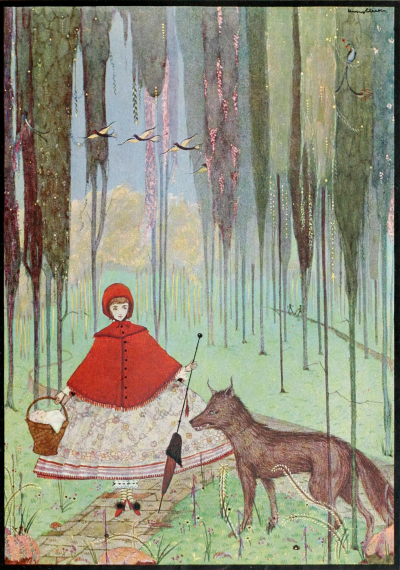
By Charles Perrault, Harry Clarke (ill.) [Public domain], via Wikimedia CommonsJack and the Beanstalk– Jack escapes from the giant
Hansel and Gretel – the children escape from the witch
Snow White– escapes death ordered by the jealous queen
The Three Pigs – escape from the Big Bad Wolf
The Lion and the Mouse – the mouse helps the lion escape the hunter’s trap
The Gingerbread Man – escapes from the oven and those who pursue him
I had a little more difficulty in finding modern tales involving an escape, but here are a few:
#6 Modern tales
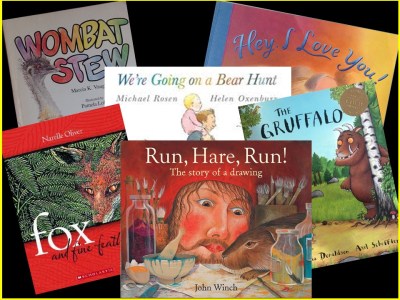
Hey, I Love You!by Ian Whybrow – father and son mouse escape the claws of the cat
The Gruffalo by Julia Donaldson – the mouse uses his wiles to escape being eaten
Wombat Stew by Marcia Vaughan – Wombat’s friends help him escape being Dingo’s dinner
Fox and Fine Feathers by Narelle Oliver – with the help of the nightjar the birds escape being a feast for fox
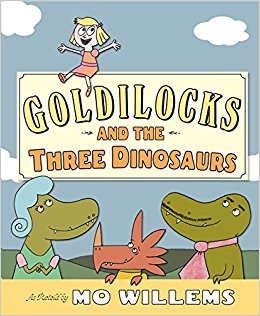
This Mo Willems story is an innovation on the traditional tale of Goldilocks escaping from the three bears. In Goldilocks and the Three Dinosaurs, Goldilocks has a lucky escape out the back door just as the dinosaurs return home through the front door. Willems concludes his story with two morals, one for the dinosaurs:
Lock the back door!
And one for Goldilocks:
If you ever find yourself in the wrong story: leave.
What a great philosophy that we could perhaps employ more often. If we don’t like where we’re at, just leave. Life’s decisions are not always that easy though.
I rather like the idea of characters appearing in the wrong story. What a great topic for discussion with children and a wonderful stimulus for their writing.
What if the Big Bad Wolf knocked on the Giant’s door?
What if the Three Pigs chased the Gingerbread Man?
What if Goldilocks came to the house of Red Riding Hood’s grandma?
What if?
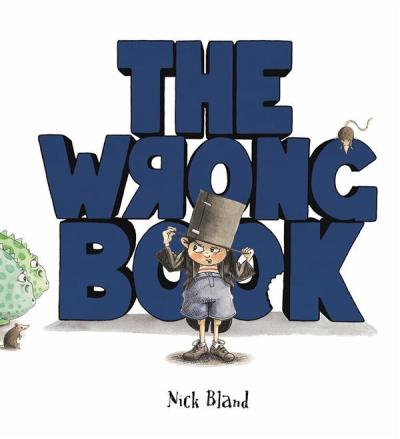
In fact, Nick Bland has written a story that utilises this concept. In The Wrong Book, Nicholas Ickle tries to tell his story but keeps getting interrupted by other characters such as an elephant, monsters, a queen and a pirate. Nicholas tells them that they are in the wrong book and to go away. By the time they leave, we get to the end of the book and there is no time for him to tell his story.
But what if the story characters didn’t want to be in the book at all, and decide to escape? How would they escape? What would the writers do if their characters revolted and walked off the job?
Where could I escape to if not picture books? Here’s my contribution. I hope you like it.
Let’s get out of here
Delaying the inevitable, she was picking wildflowers when she heard sobbing. She gasped to see him cowering behind the bushes but ignored instructions to avoid strangers.
“What’s wrong?”
“I can’t do it anymore. Every day: first the pigs; then your grandma. They’ve painted me bad. I’m not. I’m –“
A giant with a goose crash-landed beside them.
“I’ll not let that nasty boy steal my goose, again. And he says I’m bad.”
A diverse troupe in T-shirts emblazoned “Freedom for princesses” appeared.
“We want out,” they all chanted.
A witch magicked a rocket from a pinecone and everyone disappeared.
Thank you for reading. I appreciate your feedback. Please share your thoughts.
This week we celebrate readilearn’s first birthday. Last year we launched with just over one hundred resources to support early childhood teachers in their role. Now there are more than 250, and the number continues to grow with new resources uploaded nearly every week.
Resources across most areas of the curriculum support teachers of children in their first three years of school. All resources are original and teacher-made, designed to lighten workloads by providing lessons and activities teachers would make themselves, if they only had time.
The collection consists of digital stories, and interactive resources for use on the interactive whiteboard. There are printable activities, teaching suggestions, and notes for distribution to parents. If you can’t find what you’re looking for, let us know and we’ll do our best to support you.
This week, in celebration of the milestone, I have uploaded two new free resources which can be personalised for individual children on their birthday.
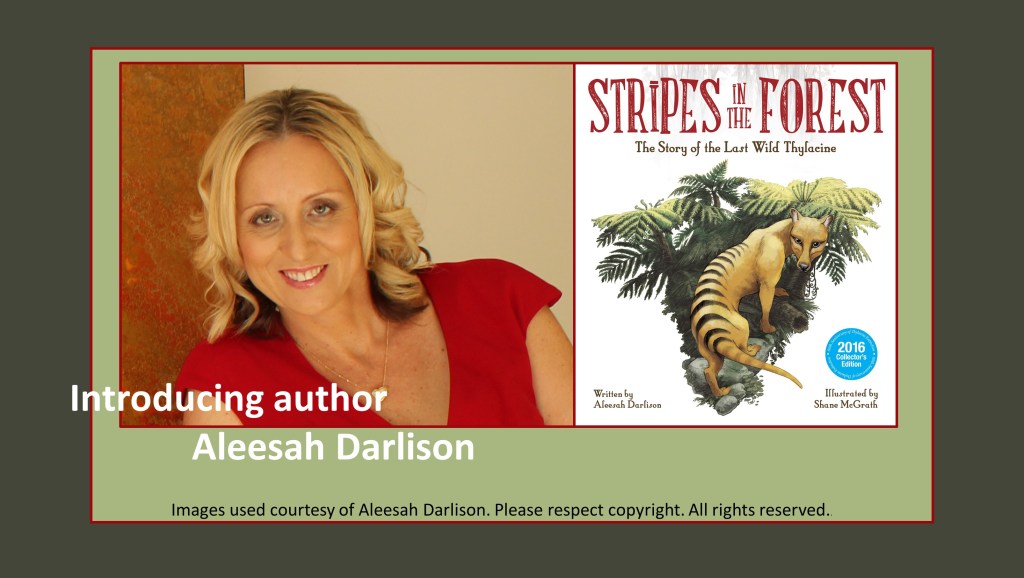
This month, it is my pleasure to introduce you to award-winning Australian author Aleesah Darlison. Aleesah writes picture books, chapter books and novels. Her much-loved stories promote courage, understanding, anti-bullying, self-belief, teamwork and environmental themes. In 2015, she won the Environment Award for Children’s Literature (Non-Fiction) for her picture book, Our Class Tiger. She has won numerous other awards for her writing.
Aleesah has written over thirty-five books for children and in 2016, she set up Greenleaf Press, a business designed to provide critical support services to authors and illustrators. The company also acts as a booking agency for school and preschool visits.
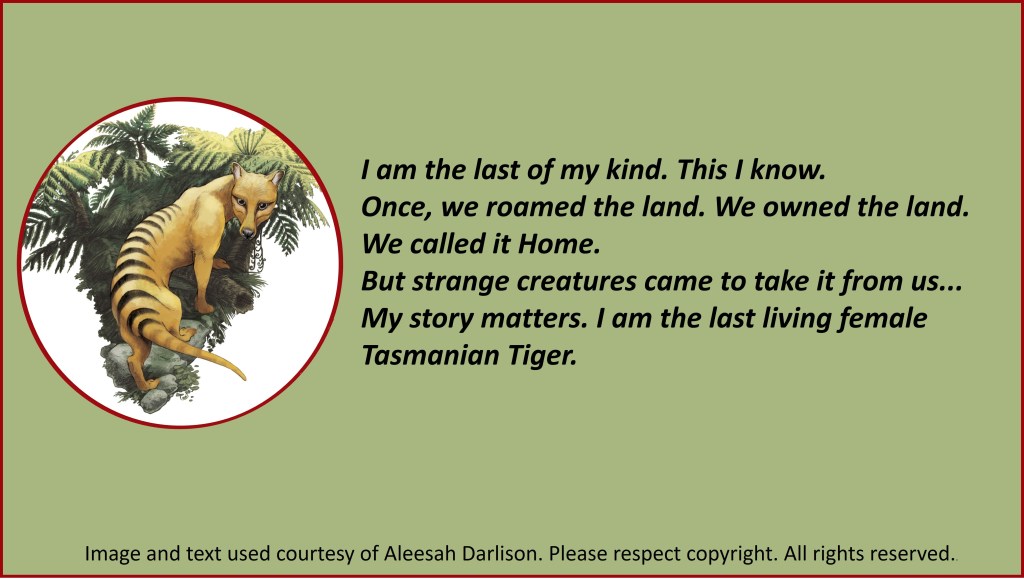
Today, Aleesah and I are talking about her picture book Stripes in the Forest. With National Threatened Species Day just a couple of weeks away on 7 September, it is a timely interview. Stripes in the Forest is the story of an iconic species lost.
Told from the perspective of the last wild female thylacine, it provides readers with an insight into the rare beauty and uniqueness of these amazing animals, explains their fight for survival and provides important lessons for future generations.
An emotive and moving story, children will connect with the solitary, stoic and courageous female thylacine who does all she can to protect her young – just as a human mother would do. The story takes readers to a place in the past, but also offers a twist that projects them
While many around the world celebrated Father’s Day in June, here in Australia Father’s Day is celebrated on the first Sunday in September. Since that is now just a few weeks away, I thought I’d get in early with some low-cost Father’s Day gift suggestions that can be incorporated into your literacy and art programs.
A cautionary note
However, before I share them, I’ll begin with a cautionary note.
Be aware of the diversity of families in your class and the needs of individuals. Not all children have a father present in their lives, and not all fathers fit the perfect role model. While the day is not just for dads, but for grandfathers, stepfathers, and other male carers and role models too, a day to let them know how much they are appreciated; for some children, the day can be a painful reminder of someone missing. Be sure to adjust what you do to be inclusive of children’s circumstances, for example; “Celebrating a special adult in my life day”, or consider leaving any celebration to the children and their families.
Most classrooms are peopled by children from a diversity of traditions and cultures. Learning about and appreciating the similarities and differences is an important part of establishing a supportive classroom environment and encourages acceptance of and respect for each family’s composition and heritage. Suggestions to support discussions are available in readilearn History resources. Conducting Getting to know you surveys about families and who children live with can also help identify suitability of the celebration with your class.
Gifts from the heart on Father’s Day
Encouraging children to create and give a gift from the heart demonstrates that not all gifts need come from a shop. It allows children from even the poorest families to give their Dads a special Father’s Day gift. It helps develop their creativity and teaches them skills that they can apply in future gift-giving situations. It shows how thoughtfulness and imagination can combine to make a unique gift that will be treasured.
A gift of love lasts longer than any store-bought gift.
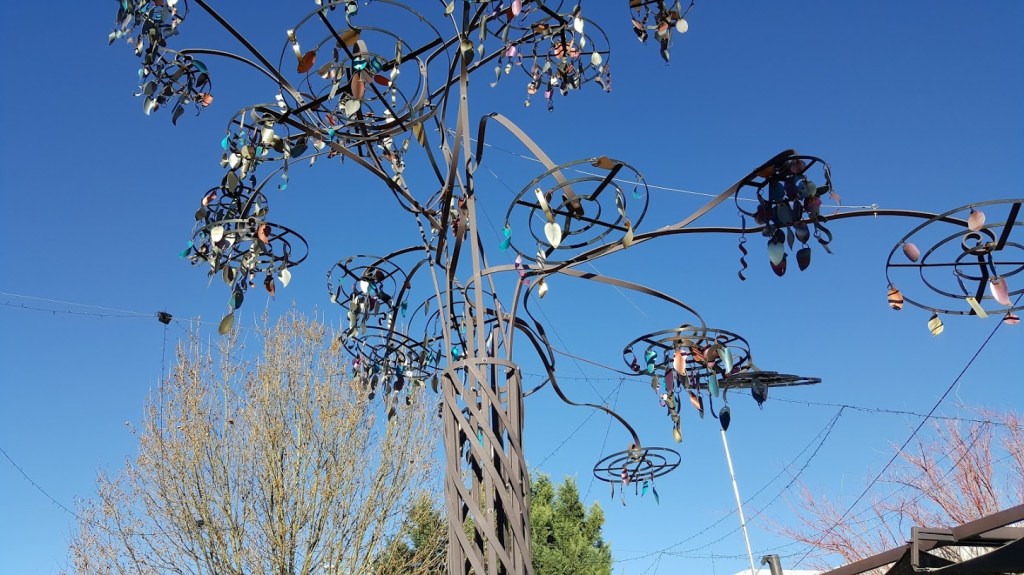
While reading Charli’s post in a motel room, I listened to an amazing chorus of birds in the trees outside. They were mostly magpies, but their song was not quite the same as that of the magpies at home, and I found it entrancing. Not long after, I went for a walk down town and serendipitously came across this beautiful tree sculpture with tinkling metal leaves. Would these sound bites be useful in responding to Charli’s challenge?
I have written about sound in other posts.
In Listen to the sounds I discussed the use of onomatopoeia in children’s picture books, including sounds made by:
animals,
machinery,
musical instruments, and
actions.
I listed pictures books that make use of each, and included a flash fiction piece about storm sounds.
In Sounds like … I wrote about the natural sounds made by some of our native wildlife; the beautiful music of our song birds heralding changes in the days and seasons; and other more unusual sounds that may alarm the unfamiliar, like that of the brushtail possum.
I wrote about the unnerving sound of mutton birds in response to Charli’s challenge in that post.
In Writing poetry with children I shared the structure of a sound poem and experimented with using the structure to write poems about other senses in a 99-word flash fiction. I also wrote about these poems on the readilearn blog. Instructions for writing the poems are available in readilearn resources, including here and here.
I wasn’t sure where to go this time, and after much consideration, found myself in more of a contemplative mood, stuck between ideas. I did what I suggest to children when they say they don’t know what to write: just write what’s in your head.
Sounds surround us
The deadline looms and I wonder how to extract a 99-word story from my unwilling brain. Contemplation, false starts, abandoned ideas: the well is dry. But listen! Outside, the day fades. Birds serenade folk hurrying homewards and signal the changing shifts. Soon they’ll sleep and the night time chorus will begin. Inside, the computer hums patiently, waiting to tap out the words. In the kitchen, doors creak: pantry then fridge. Vegetables are scraped and rinsed. Water bubbles on the stove. What joy! Yes, I get to eat tonight; but my, how the gift of hearing enriches my world. Gratitude.
Thank you for reading. I appreciate your feedback. Please share your thoughts.
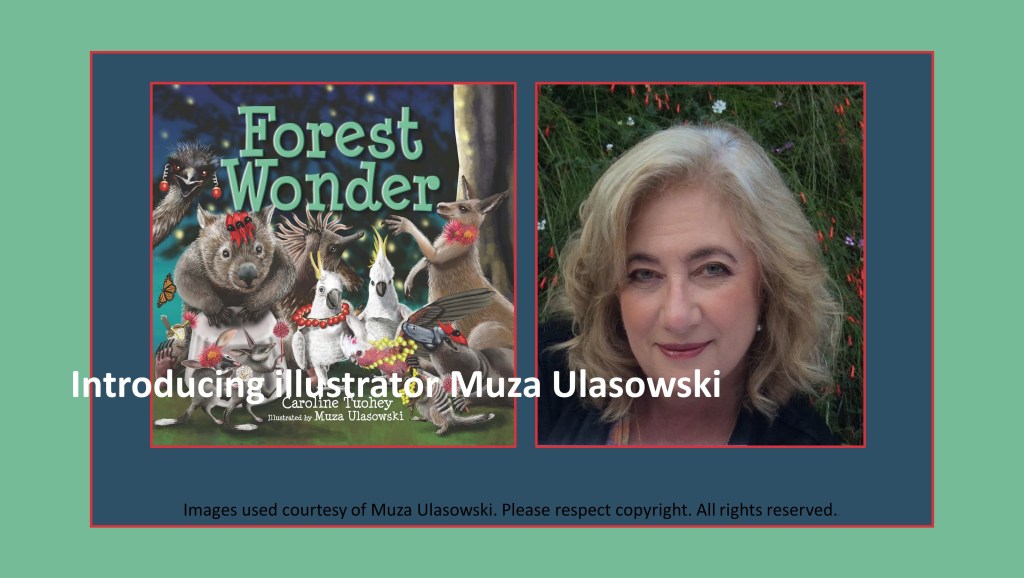
This month I am delighted to introduce you to the very talented illustrator Muza Ulasowski. I’m certain you will find her illustrations to be quite remarkable.
Although Muza has illustrated many books, I first came across her work in the beautiful picture book Forest Wonder, written by Caroline Tuohey. It is Forest Wonder, a winner of international awards, that Muza and I are discussing today. Before we get started on the interview, first let me tell you a little about Muza.
Muza Ulasowski is a graphic designer and children’s book illustrator based in the leafy western suburb of Brookfield in Brisbane, Queensland. Australia. She is inspired and surrounded by a vast array of local birds and animals who tend to make their appearances in her book illustrations. She shares her life with her wonderfully patient husband, their charismatic bulldog called Charlie and a black magic cat named Basil.
In 2010, she was invited to illustrate her first children’s picture book and enjoyed it so much, that
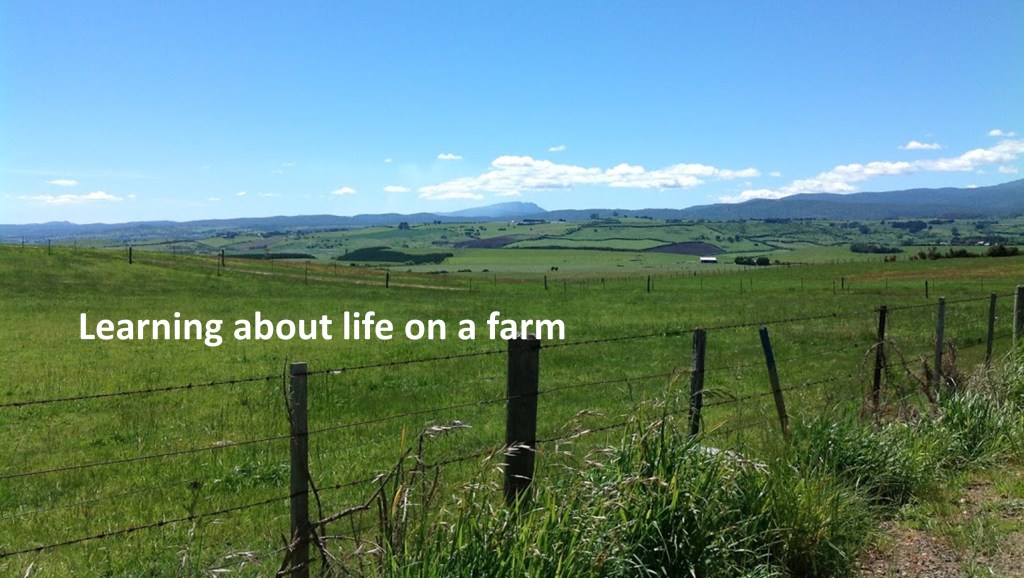
Learning about life on a farm holds great interest for children and many opportunities for integrated learning across the curriculum. Most of today’s children are town-dwellers and have little experience with rural and farm life. Many have no idea where their food comes from beyond the attractive supermarket shelves.
This week I have uploaded some new resources which support an early childhood K-2 unit of work about farms. However, they can be used as part of a literacy program, independent of a farm unit. Sight words and phonic skills can be developed through reading in a context that is both meaningful and interesting to children.
New resources include:
On the farm Who am I? This interactive digital story is great for use on the interactive whiteboard. Children are presented with a series of clues to help them identify an animal that lives on a farm. Children select the answer from those provided. The resource includes both domestic and “wild” animals.
Charli writes about our fear of change, fear of the unknown, and of the need for guides “to bring us in to a new harbor, a light to show us the rocky shoals.” She suggests that “Perhaps blogging, writing, are mediums of light that shine a path to bridge cultural differences.” but also acknowledges that, “Instead of looking for a way, some people have backed out of the water and barricaded themselves on the beach.”
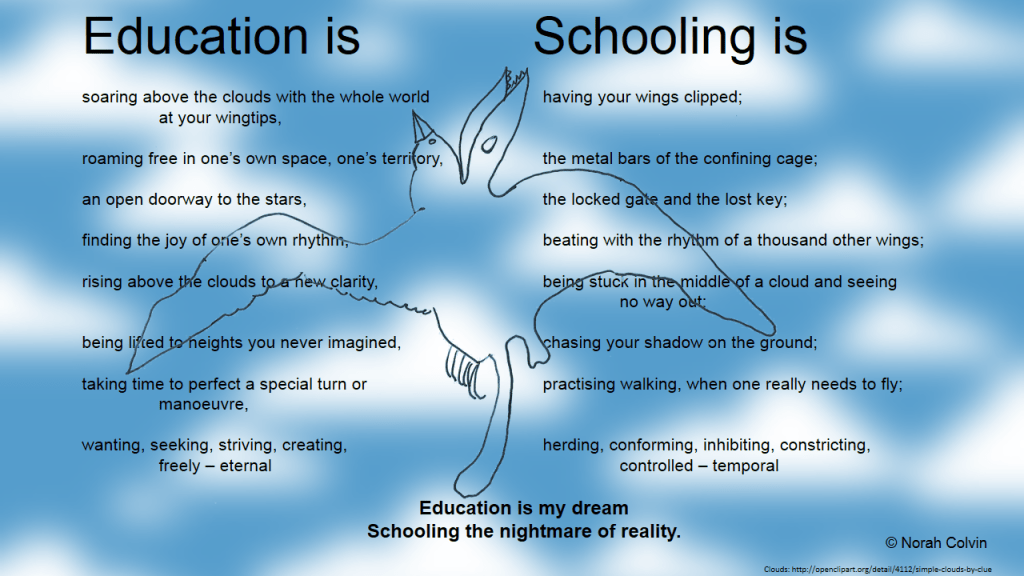
I see education as the way that will bring us to a “new harbour”, the light that will “shine a path to bridge cultural differences”. Sadly, as I say in my poem about education, there is far too much emphasis on schooling and not enough on education, too much desire to keep the masses down by the insistence on conformity and ignorance rather than the encouragement of creativity.
I was well-schooled as a child, but have spent my adulthood exploring what it means to be educated and promoting the benefits of a learner-centred education as opposed to other-directed schooling. I read of a book about “teaching backward”, beginning with what the student needs to know and working backwards. (Needs as determined by others, not the student.) I’d rather teach forwards, beginning with what the student wants to know and going from there.
When my earliest teaching experiences fell short of my expectations, I searched for the beacons to guide my way out of the murkiness in which I found myself. I devoured books by John Holt, A. S. Neill,Ivan Illich, Paolo Freire, and others, with ideas about education and schooling that were as challenging as they were exciting. I read of innovative educators such as John Dewey, Maria Montessori, and Rudolf Steiner.
The ideas challenged what I’d been taught but blended comfortably what I had learned through observation of children, including my own young child, and relating it to my own experiences. The pieces began to fit.
At about the same time, I undertook further studies in literacy learning and was fortunate to work with a team of inspired educators led by Brian Cambourne, whose work and guidance placed the piece that helped the puzzle take shape, and guided my learning journey.
Beacons, or shining lights, that guide and inspire us, are as essential to our growth as sunlight is for plants. Educators such as those mentioned, and more recently, Ken Robinson, Rita Pierson, and many others, are such beacons. We are constantly told of the success of the Finnish school system and I wonder why it is that those holding the power in other school systems fail to see their light. We need at least one to rise above the fog of number crunching and data collecting to see the bright lights shining on the hill.
Is it fear, as Charli suggests, that keeps them out of the water? I watched the movie Monsters Inc on the weekend. It seems to deal with the issue of controlling the masses with falsehoods and fear quite well. It is also a great laugh – one of the most entertaining movies I’ve seen for a while. If you haven’t seen it yet, I recommend it.
I’ve attempted a similar situation with my response to Charli’s challenge. I hope it works.
Let there be light
Eyes squinted in the dim light under low ceilings. Immobilised by never-ending paperwork, the menials dared not look up. Flickering numbers on data scoreboards mesmerised supervisors. Inconsistencies meant remonstrations, even punishment, from above. Heads down, keep working, don’t ask questions. The system worked fine, until … Maxwell nodded off. His pencil fell, tapped first, then rolled away. Startled, Maxwell went after it. The room stilled. Sliding too fast, he slammed into the wall, activating a button that illuminated a set of stairs leading up. Everyone gasped. Maxwell hesitated, took one step, then another. Nothing happened. He continued. Everyone followed.
Thank you for reading. I appreciate your feedback. Please share your thoughts.
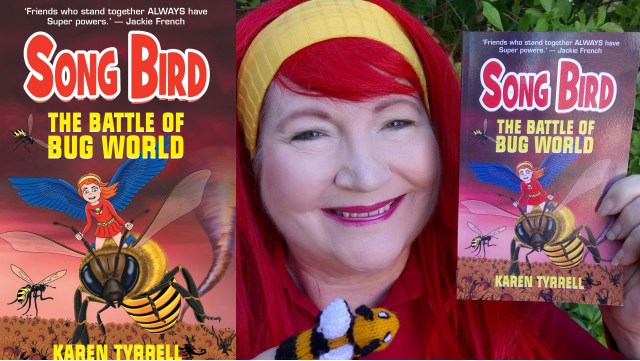
This week I have the pleasure of welcoming Karen Tyrrell back to the blog. I previously interviewed Karen about her book Songbird Superhero for the Author Spotlight series. Karen has now published a second book in the Song Bird Series The Battle of Bug World.
I enjoyed Songbird Superhero, so was delighted when Karen approached me to participate in her blog tour. The fact that the book is about bugs may have something to do with it. As you saw last week, I am a fan of minibeasts, including bugs.
As soon as Karen announced the release of her book, I purchased an advance copy and was able to post a pre-review on Goodreads. This is what I wrote:
I loved Song Bird Superhero and wondered if a sequel could possibly match it. But with The Battle of Bug World, Karen Tyrrell didn’t just match it, she surpassed it!
This fast-paced page-turning story is packed with disasters that even Song Bird is not sure she can fix.
What is that nasty Frank Furter up to now? And what’s with the severe thunder storm hovering above his house? What’s happened to all the bees? And why has Song Bird’s sister














 Norah Colvin