With today 16 March being the National Day Against Bullying and Violence and next Wednesday 21 March being Harmony Day in Australia, now is a good time to think about what it means to be a friend, what bullying is, and how to combat it. Of course, any time is a great time for developing friendship skills, but these special days help to raise awareness.
The purpose of the National Day Against Bullying and Violence is fairly clear in its title. Harmony Day is for celebrating cultural diversity. “It’s about inclusiveness, respect and a sense of belonging for everyone.” That sounds very much like friendship to me.
The development of social skills, including the friendship skills of getting along, can not be left to chance. The skills must be actively encouraged and taught. Children must learn what behaviour is friendly, what is not friendly and what is bullying.
The teaching of these skills and behaviours should not be left to one or two days of the year but integrated into the teaching program. In fact, the best way to encourage friendship and discourage bullying is through the implementation of policies that foster respect and accept
Every day is a great day for reading aloud to children, but with the celebration of International Read to Me Day on March 19, now is a great time to give some thought to the importance of reading aloud in preparation for the Day’s celebrations. by arming yourself with a basket of books to read.
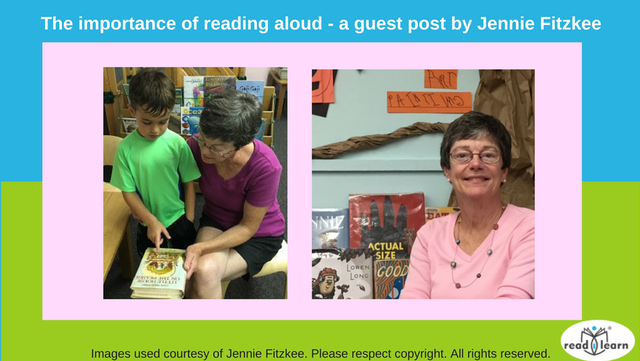
To help put us in the mood and assist our preparations, Jennie Fitzkee is here to tell us why reading aloud to children is important.
Jennie, a passionate and inspirational teacher, has been teaching preschool in Massachusetts for over thirty years. She is considered by many to be the “book guru” and the “reader-aloud”. She is also a writer and her work is often posted by The Eric Carle Museum of Picture Book Art. This is what Jennie says of teaching:
“I believe that children have a voice, and that is the catalyst to enhance or even change the learning experience. Emergent curriculum opens young minds. It’s the little things that happen in the classroom that are most important and exciting. That’s what I write about.”
Jennie is highlighted in the new edition of Jim Trelease’s bestselling book, The Read-Aloud Handbook because of her reading to children. Her class has designed quilts that hang as permanent displays at both the National Liberty Museum in Philadelphia, and the Fisher House at the Boston VA Hospital. Their latest quilt is currently hanging at the Massachusetts State House in Boston. In 2016, Jennie was one of seven teachers in Massachusetts to receive the Teacher of the Year Award.
I’m sure you’ll agree that there is much we can learn from Jennie.
Providing children with fun and purposeful activities for writing is one of the best ways to encourage a love of writing, to replace the drear with enthusiasm.
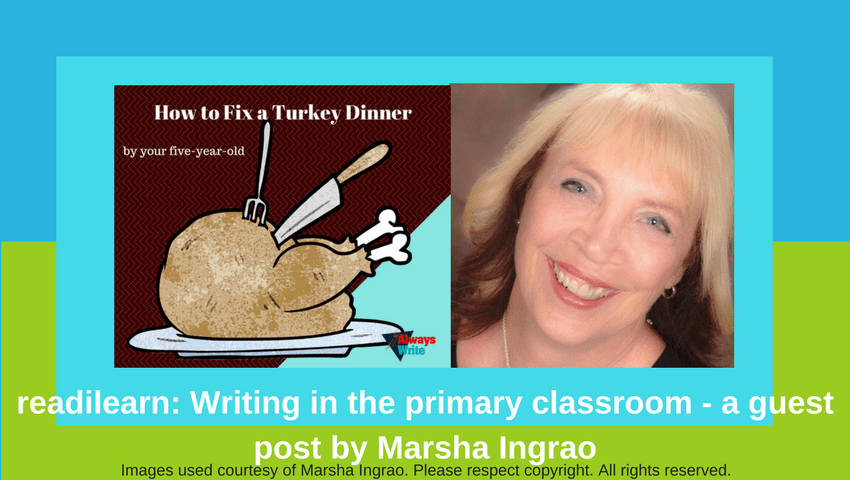
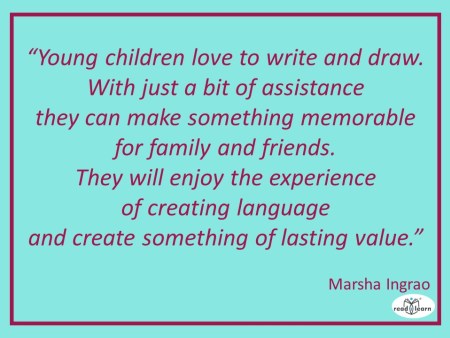
In this post, I introduce guest author Marsha Ingrao who shares suggestions for bringing joy to your writing lessons through the Language Experience Approach.
“The Language Experience Approach (LEA) is a literacy development method that has long been used for early reading development with first language learners…It combines all four language skills: listening, speaking, reading, and writing.”
Although Marsha retired from public education in 2012, her passion for education remains and she continues to educate through blogging, speaking engagements and volunteering for Kiwanis and the Chamber of Commerce. Her classroom experience ranged from teaching kindergarten to fourth grade. She left the classroom to work as a consultant for the county office of education first in math, working with migrant education, then in history and language arts. She is author of Images of America Woodlake, a history of her local Woodlake area, published by Arcadia Press.
Welcome to readilearn, Marsha. Over to you.
Because LEA employs all four branches of language arts, listening, speaking, reading and writing, it is perfect for teaching writing to pre-school and primary students as well. With the thrust in the United States for non-fiction reading, the language experience approach becomes the perfect avenue for teaching writing to young children.
To make the language experience approach applicable to all young students, adult assistance is required.
The “How To” Essay
Beginning in pre-school, we tackled one of the hardest types of writing, the “how to” essay. Holiday traditions are the perfect avenue for this
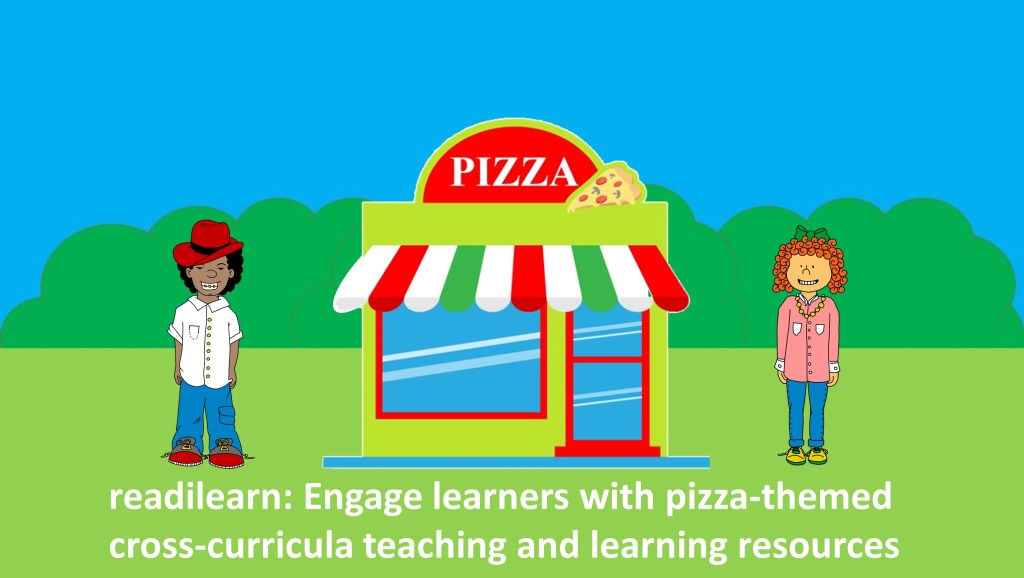
Pizza is a popular food in many countries around the world and is often a children’s favourite. Why not capitalize on children’s interests to make learning fun and meaningful?
This week I have uploaded six new pizza-themed resources with suggestions for learning across the curriculum; including literacy, mathematics, and science.
The new interactive resource What’s on your pizza is a great stimulus for engaging children. Children help Andy and Paige make their own pizza by choosing the toppings and working out the different combinations of toppings that are available. The resource can be used as a springboard for discussion, writing, mathematical investigations, science explorations and talking about healthy food choices.
In this post, I outline some ways pizza-themed learning can be incorporated across the curriculum. I anticipate the suggestions will inspire ideas of your own with relevance to your own group of children.
Literacy
Oral Language
Discussion is one of the best ways of developing children’s language. Starting with topics already familiar to and of interest to children facilities discussion into which new vocabulary and concepts can be added. Discussion could centre around; for example: who likes pizza, types of pizza, when children have pizza and their favourite pizzas.
This week, it is my pleasure to introduce you to Jacqui Halpin – author, founding member of Write Links (a local group of published and unpublished authors and illustrators of children’s books), a former nurse and tuckshop convenor.
Jacqui grew up in Brisbane where she still lives with her husband, one of her three adult children, and a cat called Loki. While writing and editing, Jacqui likes to sip tea from fine china and eat copious amounts of chocolate. She says she should never be allowed in a bookshop with a credit card in her possession.
Jacqui writes picture books and short stories, some of which appear in anthologies by Stringybark Publishing and Creative Kids’ Tales. She co-wrote and independently published her elderly father’s memoir, A Long Way from Misery.
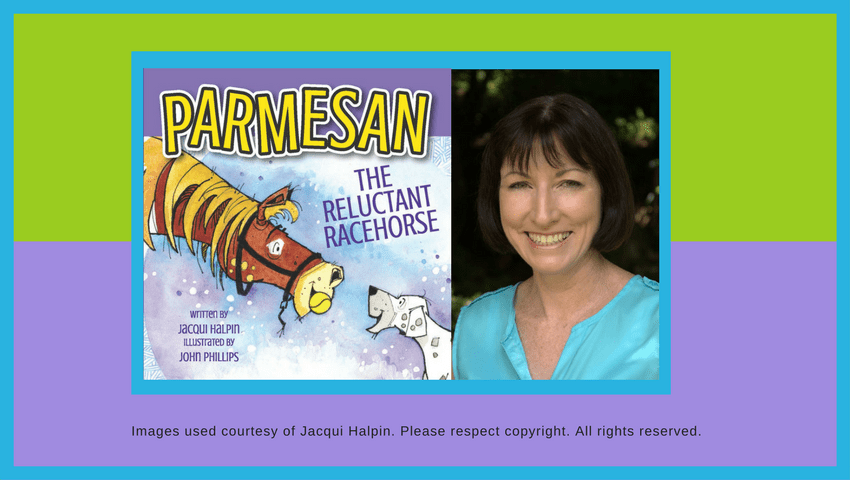
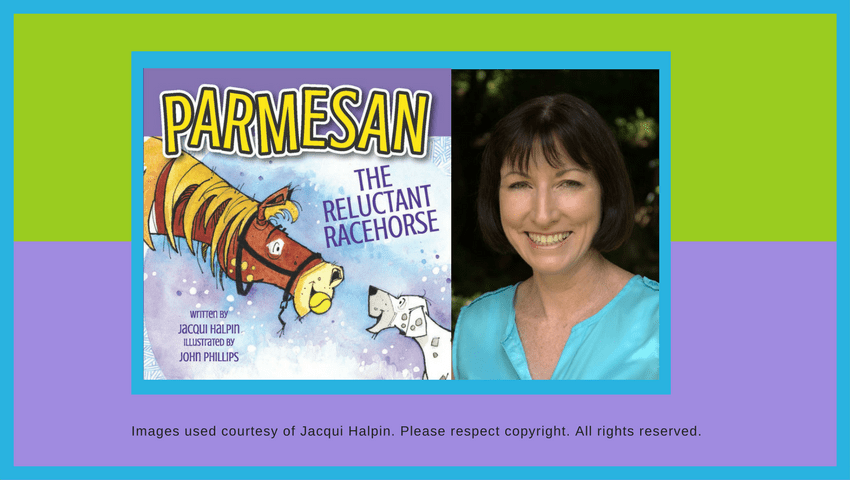
Today Jacqui is talking with us about her first picture book Parmesan The Reluctant Racehorse, humorously illustrated by John Phillips and published by Little Pink Dog Books in October 2017. Jacqui’s second picture book, Where’s Lucky?, based on an orphaned swamp wallaby joey at a wildlife shelter, will be published in mid-2019.
Parmesan is a delightful story of a thoroughbred racehorse who should be winning races and earning lots of money for his owner. However, Parmesan thinks he’s a dog. Instead of training with the other horses, he’s off with his doggy friends doing doggy things like playing fetch. His owner is not happy. If Parmesan isn’t ready to run in the Spring Carnival, he’s getting rid of him. Parmesan’s trainer is worried. He knows Parmesan won’t be ready, but as they arrive at the Spring Carnival, he thinks of a brilliant way to get Parmesan to run around the track. Parmesan’s triumph proves you can be a winner and stay true to who you are.
Welcome to readilearn, Jacqui, we are looking forward to getting to know you better.
Thanks for inviting me.
Jacqui, when did you know you wanted to be a writer?
Learning lists of sight words is an activity familiar to beginning readers, their parents and teachers. There’s no denying the importance of being able to recognise words by sight, and the aid it is to reading fluency and comprehension. Yes, comprehension. Due to the constraints of short-term memory, it is difficult to think about meaning, when working memory is employed in attempts to figure out individual words.
Many lists of basic sight words are available, but there is a consistency to the words included and their number, generally varying between one and two hundred. Many of the words do not have a regular letter-sound correspondence and cannot be “sounded out” using knowledge of phonics. They are also words that have meaning only in context and cannot be “pictured”. The words make up a high percentage of those appearing in texts for beginning readers and so are often referred to as high frequency words.
Children are often given lists of words to take home and learn with the assistance of parents. Not all parents know how to encourage children to learn the words and it can be a battle if children struggle to remember them. If you are sending children home with words to learn, it is important to provide parents with strategies as well as what they need; for example:
Provide the words on strips or in small booklets with the word written on one side and a short sentence with a picture on the other for checking.
Provide one set of words. Spread the words face up on the table. Ask the child to find the word; for example, put. This is easier at first as other letter/sound cues can be used. Later, as the child is
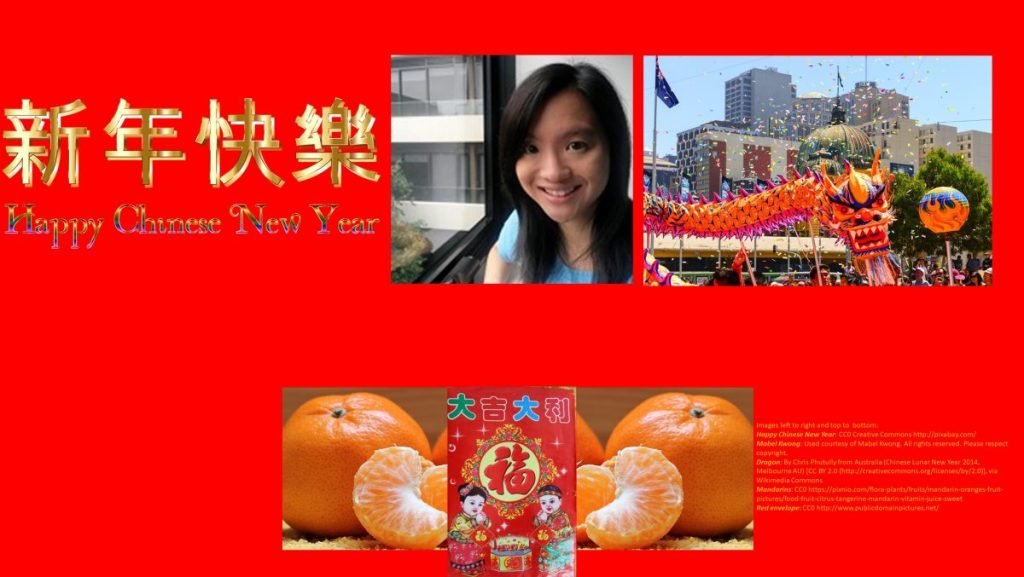
Chinese New Year is an important Chinese festival celebrated around the world, not only in Asian countries, but in many countries where there is a large population of Chinese people or their descendants, including Australia. Maybe it is celebrated where you are too.
This week I have the great pleasure of introducing you to Mabel Kwong, a writer and Chinese Australian. Mabel explores and writes about the topics of multiculturalism, cultural diversity and identities. She feels that the more you get to know others of different backgrounds and each other’s cultures, the more you learn to see things from different perspectives. In her spare time, she is a keen photographer and video gamer.
In this post Mabel shares with us some background information about the Chinese New Year as well as her personal experience of Chinese New Year celebrations when she was growing up in Malaysia and Singapore.
Mabel has written the post in such a way that it could be read to a class of children. Indeed, we have worked together to prepare it as such, and it is now available as an estory, free to everyone—there is no need even to register—in Chinese New Year Cultural Studies resources.
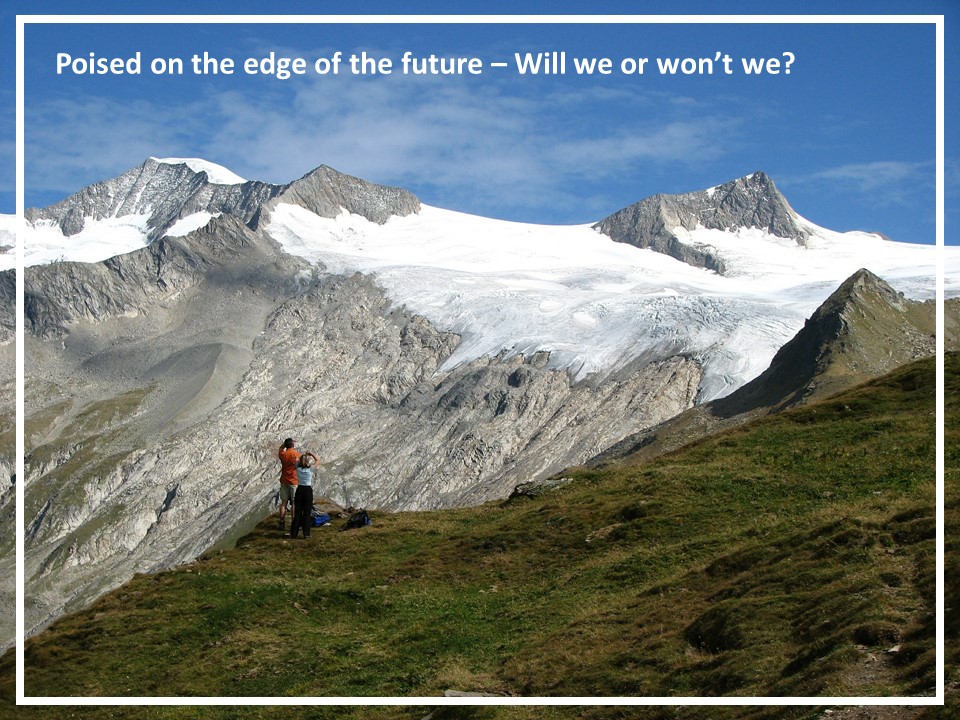
Every morning we wake up to a new day and step into the future. The past is gone, in memories of yesterday and soon to be forgotten. How we approach each day–with excitement, fear, anticipation, dread, joy or boredom, lulled by repetitious acceptance devoid of creativity–is our choice. We can accept the mundane or jump into the unknown, feet first.
I jumped straight in and wrote my 99-word response in one go. Normally I mull it over for days, struggling to find threads of meaning to tie together post and story.
Last week in response to Charli’s “boots” prompt, I wrote about Grandma’s sparkly storytelling boots. I was pleased so many of you confirmed it was a great idea for a story. I had already decided to work on it and submit it to my critique group this week. You could say, I jumped into that abyss–boots first. Wearing grandma’s sparkly boots, I’m sure to fly.
It’s funny when you write a post that connects with people in unexpected ways. I was surprised, delighted, honoured and extremely grateful this week when three of my favourite bloggers, whose work I admire shared my post on their blogs:
Jennie Fitzkee–an inspiring early childhood teacher who, like me, expounds the benefits of respect for children, story reading and telling–blogs at A Teacher’s Reflections. If you haven’t visited her blog yet, I recommend you do. Every post delights.
Dayne Sislen–an illustrator of children’s picture books who shares information about illustrating books and also writes about the importance of reading to children–blogs at Dayne Sislen Illustration. Her love of children’s picture books and illustration is obvious. In her post last week How to extend the attention span of your children, Dayne discussed the importance of reading to children. It was a wonderful match for mine about storytelling. You can find out more about Dayne on her blog or website.
Charles French–who I came to know through Jennie reposting his series of inspiring quotes–blogs at Charles French Words Reading and Writing. How delightful to know that he also enjoyed my post enough to share with his readers. This is just one of his posts of quotations that spoke to me: Quotations on teaching. 😊 I suggest you pop over to visit Charles as well to share in his words of wisdom.
Those of you who write YA or adults novels, memoir or non-fiction, may wonder what we early childhood teachers and writers and illustrators of children’s picture books have that could be of interest to you. Let me tell you, we have everything. We have the key. We are the ones who create the readers of tomorrow, the future readers of your books. We turn the children onto reading as we take their hands and lead them to the edge of tomorrow when they leap into the unknown worlds of books.
In case you haven’t yet read my response to Charli’s “edge” prompt, this is it. It doesn’t necessarily have anything to do with my previous statement but starting anything new can push us to the edge and we don’t really know just what will happen until we give it a try. I wish you all many joyous flights.
The edge
She stood at the edge of the abyss and wondered what would happen should she jump – would she fly, or would she plummet to the bottom and rest, fractured and alone, forgotten and abandoned, with all the others who dared to try but failed. It was fear that held her back, chained her to the ledge. But there was nowhere else to go. She’d tried all other paths. This was all that remained. Could she stay there forever. Would there be a point? What if she fell? But what if she flew? She inhaled, closed her eyes, and jumped…
Thank you for reading. I appreciate your feedback. Please share your thoughts.
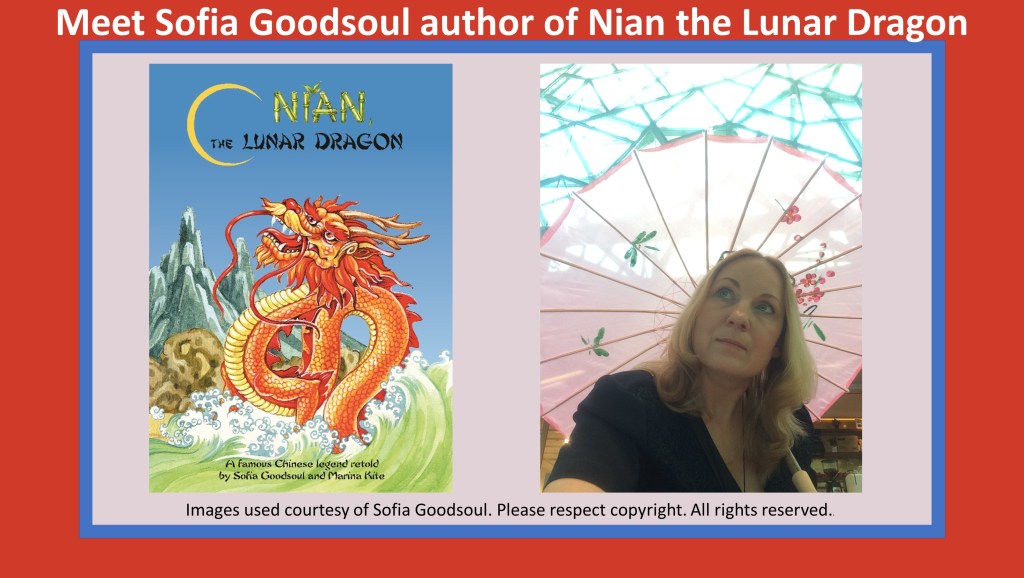
This week I am very excited to be interviewing Australian author Sofia Goodsoul about her picture book Nian the Lunar Dragon, illustrated by Marina Kite. With Multicultural Children’s Book Day coming up on 27 January (see previous post I am Australian) and Chinese New Year on 16 February, the time is just right.
Before we begin the interview, let me provide you with a little information about Sofia.
Sofia Goodsoul is an author, emergency kindergarten teacher and indie-publisher. Her poetry writing has grown from a hobby into a great passion. Now she can’t live a day without writing poems, riddles and stories for young children. The children give themes and inspiration for her books.
Sofia lives in Melbourne with her family and pets. She loves going to Zumba classes and taking long walks with her husband and family dog Mack. Sofia dedicates all her spare time to her writing and publishing career.
Nian the Lunar Dragon, an entertaining and beautifully illustrated rhyming narrative for young readers, is Sofia’s second picture book in collaboration with Marina Kite. The book is about the legend behind the traditions and celebrations of Chinese New Year, sometimes called Lunar New Year. According to the lunar calendar, Chinese New Year commences with the new moon at the beginning of spring.
A long time ago, the dragon named Nian lived in the deep ocean to the east of China. Nian was a strong and ferocious dragon, which no creature could defeat. Once a year, Nian climbed ashore to hunt for cattle and human prey. The people of the nearby villages and towns lived in terror, and each New Year’s Eve they had to leave their homes to save themselves. One day, a monk came to the village. He knew a well-kept secret about how to scare Nian away and free the Chinese people from the danger and their fear.
Welcome to readilearn, Sofia. We are looking forward to getting to know you a little better.
Thanks for inviting me!
Sofia, when did you know you wanted to be a writer?
I don’t remember capturing that specific moment, but my grandmother was a children’s book illustrator and I often stayed with her
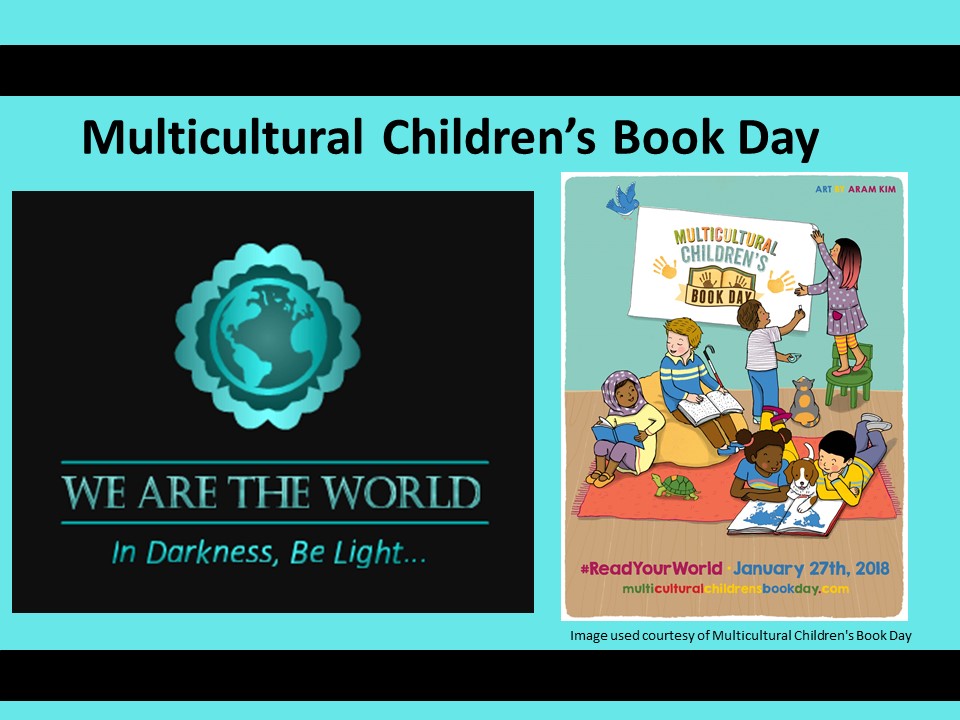
On the last Friday of each month We Are the World Blogfest invites bloggers to join together in promoting positive news. With this the first for 2018, it’s a good time to think about joining in. If you would like to do so, please check out the rules and links below.
A statement of mission from the We are the World Blogfest website:
“There are many an oasis of love and light out there, stories that show compassion and the resilience of the human spirit. Sharing these stories increases our awareness of hope in our increasingly dark world.”
This month I am sharing an inspiring story that, while it may not be “News”, was certainly news to me and maybe is news to you too. I hope it fits the criteria for sharing.
“not only raise awareness for the kid’s books that celebrate diversity, but to get more of these of books into classrooms and libraries.”
There is certainly a need for more understanding, acceptance, empathy and compassion in the world, and it is very pleasing to see projects such as this being promoted. I’m sure you’ll agree that education of our children is a great place to start.
Used courtesy of Multicultural Children’s Book Day
Multicultural Children’s Book Day was initiated by Valarie Budayr from Jump Into a Book and Mia Wenjen from Pragmatic Mom, and is celebrated for the fifth time this year on 27 January with a #ReadYourWorld Twitter party!
(Note: There is also a great way for authors and publishers to help out by donating their books with multicultural themes.)
I hope you see how both these organisations are working towards making our world a more positive place for all of us.
Here are the guidelines for #WATWB:
1. Keep your post to Below 500 words, as much as possible.
2. Link to a human news story on your blog, one that shows love, humanity, and brotherhood. Paste in an excerpt and tell us why it touched you. The Link is important, because it actually makes us look through news to find the positive ones to post.
3. No story is too big or small, as long as it Goes Beyond religion and politics, into the core of humanity.
4. Place the WE ARE THE WORLD badge or banner on your Post and your Sidebar. Some of you have already done so, this is just a gentle reminder for the others.
Help us spread the word on social media. Feel free to tweet, share using the #WATWB hashtag to help us trend!
Tweets, Facebook shares, Pins, Instagram, G+ shares using the #WATWB hashtag through the month most welcome. We’ll try and follow and share all those who post on the #WATWB hashtag, and we encourage you to do the same.

















 Norah Colvin