Live Love Laugh Learn … Create the possibilities

Category: Flash fiction

  • Shaping the future #myfirstpostrevisited

    Almost every week since Charli Mills at Carrot Ranch Communications challenged writers with her first flash fiction prompt in 2014, I have written a 99-word story in response. Sometimes an idea forms quickly, like a cup of instant coffee. Other times the prompt needs to percolate interminably, before the flavour is rich enough to share.

    This is one of those weeks.

    In her wonderful post, Charli writes about the changing desert of Utah that she refers to as Mars, so different is the landscape from that of her beloved mountainous northern states.

    Charli, a historian, seeks clues to lives past and finds traces from different times. “Life is like multiple disconnected plays that share the same stage over and over,” she muses.

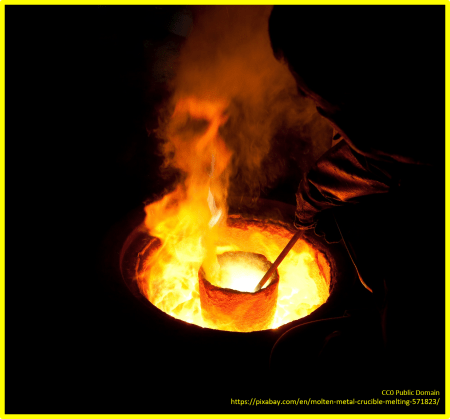
    She finds remnants of slag and uses it as an analogy to life, her life, and its changes, many forced upon her like the heat of a smelter and says that, “We are slag forged in the fires …, and want to fully transform into something of beauty and purpose.

    She concludes her post by challenging writers to “In 99 words (no more, no less) include slag in a story. Slag is a glass-like by-product of smelting or refining ore. Slag is also used in making glass or can result from melting glass. It can be industrious or artistic. Go where the prompt leads.”

    I was lost. How could I possibly tie a challenge like that into the educational focus of my blog? As usual, my thoughts scattered. I guess that makes me a scatterbrain. But I am a scatterbrain with focus, looking for ideas everywhere, trying for the proper fit. Sometimes I’m surprised where I find inspiration.

    A fellow participant in Charli’s challenges is Sarah Brentyn who blogs at Lemon Shark Reef. Sarah, who posted a piece called Transformation, also quoted Charli’s words about slag and transformation, and shared a tweet of her own from August 2016:

    Interesting to me is that August 2016 is when readilearn, my website of early childhood teaching resources, launched; and my first readilearn blog post was published. That was almost three years to the day after my first post here on NorahColvin.com.

    I could say that blogging has been a bit of a trial by fire, and that I too have, through both projects, endeavoured to create something of “beauty and purpose”, with NorahColvin forging the way for readilearn. No doubt a lot of slag has been manufactured and either shared or discarded in the process.

    On her other blog Lemon Shark (she’s got two, I’ve got two), Sarah recently invited me through her post My New Blog Scares me #MyFirstPostRevisited to share my first blog post. She provided me with some rules to follow, so in this post, I will do my best to follow two sets of rules, Sarah’s and Charli. Or not. Rules are meant to be broken. Aren’t they?

    I apologise for the length of this post which is really three rolled into one! Feel free to skip over or speed read any section you wish.

    This is my very first post from 15 August 2013:

    “Welcome to my blog. This is a whole new adventure for me and I am excited about where it may lead. I hope you will be inclined to pop in from time to time to share my journey and offer some encouragement along the way.

    Since education is my life a good deal of what I write will focus on my thoughts and ideas about education and learning. Check out my poem Education is on the “Education is” tab to see how different I believe education and schooling to be. I would love to hear the ways in which you may or may not agree with me. I am in for a bit of education myself as I explore this new world (to me) of blogging and I know there are many wonderful teachers out there ready to teach me what I need to know.

    When the student is ready the teacher appears.”

    I am ready.

    Let the adventure begin!”

    The post drew six comments (five from family and friends, one unknown from the blogosphere) and no likes.

    Three years later, on 23 August 2016, I published my first readilearn blog post:

    “Hi, welcome to readilearn, a new website of early childhood teaching resources.

    I’m Norah Colvin, founder of readilearn and writer of all readilearn materials. I’m excited to be able to share them with you, and hope you find them useful in your early childhood classroom.

    After making the decision to be a teacher at age ten, my focus has never wavered.  I have spent most of my life thinking, reading, discussing and learning about education. I have always been involved in education in some way, whether as classroom teacher, support teacher, home educator, private tutor, play group leader, or simply parent and grandparent.

    I am passionate about young children and their learning.

    I plan to post on this blog about once a week, usually on a Friday, but that may vary from time to time. Through the blog I will keep you updated with information about new resources I add to the site, provide teaching suggestions, and discuss topics relevant to early childhood educators. I also invite you to follow my other blog NorahColvin.com, and join in the conversation there.

    I believe strongly in the value of community and our ability to learn from each other. I welcome your feedback. If there are any topics that you would especially like me to address, suggestions for improvements to existing resources, or ideas for new ones, please let me know.

    In this post I will simply invite you to explore the readilearn website to see what is available. You may register for free to download a variety of free resources, or subscribe to access all resources. I am particularly excited about the range of interactive resources I have available. I hope you are too.”

    The post drew comments from three lovely supporters of this blog, including both Charli and Sarah who rate a big mention in this post. Thank you, lovely ladies, for your ongoing encouragement and support without which I wouldn’t have made it through those first three years.

    It then became obvious to me. Isn’t this our role as teachers – to shape, to sculpt, to mould, and to help each child shine by appreciating their uniqueness, polishing their strengths and abilities, and encouraging each to turn their best side to the world?

    This thought was further confirmed by a recent comment on an older post in which Anita Ferreri said that we teachers must try to pay it forward. Yes, that’s part of it too. We shape lives, hearts, and minds, as we work to create the future we wish to see.  We pay it forward, not only for each individual, but through them to the unknown future. The ripple effect is a mighty powerful thing. Never underestimate the effect of one thought, one word, one action

    So, thank you Charli, Sarah, and Anita, I am mixing up the thoughts, ideas, and challenges that your words have inspired, and (hopefully) refining them to mould something just a little artistic with both beauty and purpose. I hope you enjoy it.

    The artist

    They, each with a single colour, used packaged accessories to form identical sets of flat, life-less shapes. He worked by hand, collecting and incorporating their slag, as he explored the properties of his clump of multi-coloured dough. They proudly displayed neat rows of unimaginative templated shapes. With humble satisfaction, he regarded his creation with its countless possibilities. Each time they started again, they repeated the same familiar fail-safe patterns. Each time he began anew, exploring, seeking, discovering the dormant, hidden potential, sculpting to allow uniqueness to shine. They remained stuck in what is. He focused on creating the future.

    Oh, I almost forgot. One of Sarah’s rules was to tag five people to carry on her #myfirstpostrevisited challenge. Um, well, I did say that rules are meant to be broken. If you have read thus far, thank you, and consider yourself tagged. If you would like to join in the blog hop and wish to do a little better at following the rules than I have, please pop over to Sarah’s post. I would love to read your first posts. Please leave a link, if you wish, or not, in the comments.
    Thank you for reading, I appreciate your feedback. Please share your thoughts.

  • Who’s on the move?

    This week at the Carrot Ranch, Charli Mills raised the subject of migration and challenged writers to In 99 words (no more, no less) write a migration story.

    Although Charli always provides suggestions, she also permits writers to go where the prompt leads, allowing their thoughts to migrate in whichever direction they choose. This is good for me as my thoughts always bring me back to early childhood education and, if I can somehow squeeze it in, butterflies.

    Migration is a part of human history. We are told that humans originated in Africa, and that migration out of Africa began about 60 000 years ago (well, that’s one of the stories). That we are now spread across the world is no mean feat, particularly when we acknowledge that most of the migration occurred before the industrial age, long before steam ships and ocean liners, before motor cars and air travel.

    But migration continues still, and our countries and cities become home to those whose lives began far away and who share different cultural traditions. The purpose of the National Geographic Society’s Genographic Project is to discover more about our shared genetic heritage. In an early childhood classroom, we, too, can discover how much we have in common and learn to appreciate our differences.

    Whoever you are.

    Mem Fox’s beautiful book Whoever You Are is great for encouraging children to recognise, respect, and  appreciate each other, similarities and differences included.

    mem-fox-im-australian-too

    This year sees Mem publish another beautiful book I’m Australian Too which shows appreciation for everyone who is part of our wonderful multi-cultural Australia. (Follow the links to both books and you can listen to her read them too!)

    A number of readilearn resources support teachers in developing an appreciation for everyone’s heritage, including a history unit which helps children learn more about their own family history and traditions, and the histories and traditions of their classmates’ families.

    Just as amazing as stories of human migration, are those of animal migration. I was surprised when I first heard of the migration of monarch butterflies from Canada to Mexico in the autumn, and back again in spring, a distance of over 4800 miles or almost 8000 kilometres. What a long flight for a butterfly, I thought, the poor butterfly’s wings must be ragged by the end of the journey. But the round trip involves at least four generations.

    And although monarch butterflies are native to North America, they are now part of the Australian landscape, having arrived, possibly during the gold rushes of the mid-1800s.

    Even longer, twice as long in fact, than the monarch’s migratory flight, is that of a dragonfly which, also over four generations, makes a complete circuit of the Indian Ocean – almost 1000 miles or about 16 000 kilometres. The story of how this tiny insect’s epic journey was discovered is fascinating. Who knows what one may discover when wonder is mixed with observation.

    There’s obviously plenty of diversity from which to draw inspiration for a migration story. I’ve chosen to write a story set a little bit closer to home. I hope you like it.

    Please pop over to Charli’s post to see where the prompt has taken other writers.

    Adventurous plans

    His bag was packed. He was ready. He stopped at the door for one last look, then stepped outside, pulling it closed behind him. At that moment, he was certain; he would never return. There was nothing for him here. Exotic places and untold adventures awaited. At the stop, he hailed a bus and climbed aboard. “Where are you off to?” asked the driver. “I’m on an adventure,” he said, tendering a fistful of plastic coins. “But only if you take me with you,” said his out-of-breath mother, smiling. “Okay,” he said. The driver winked as she climbed aboard.

    Thank you

    Thank you for reading. I appreciate your feedback. Please share your thoughts.

    P.S. I’m excited to announce the launch of a new app for beginning readers created by my son, Robert. If you know anyone with young children who may be interested, please let them know about Word Zoo, available now in the App Store.

    ad1


  • Who’s watching?

    This week in her fascinating post at the Carrot Ranch Charli Mills challenged writers to In 99 words (no more, no less) write a story that includes a watcher.

    153

    From the moment of birth children are watchers, learning from their observations of the world around them – objects, people, actions, interactions. The adage “Do what I say, not what I do” holds little significance for young children. They may do what you say, but they are more likely to mirror what you do. For this reason, it is important to model the behaviours you wish children to emulate; for example, kindness, patience, empathy, truthfulness, tolerance, understanding. You need to be the type of human being you wish them to be. Example is a powerful teacher.

    Dorothy Law Nolte summed it up in her poem Children Learn What They Live.

    Watching is also important to teachers, especially early childhood teachers who spend a lot of time observing children to discover more about their learning needs. Learning in this sense is not confined to the academic. It involves regard for the whole person, especially social-emotional development. So much of what we learn about getting along with others is learned in the early years. While the teachers are watching the children, the children are watching them.

    Thank you to my wonderful students, and their lovely Mum who made this for me!
    Thank you to my wonderful students, and their lovely Mum who made this for me!

    But children’s observations are not confined to the home or classroom. They are constantly watching the behaviour of others, learning about interactions and what is, and is not, acceptable. The responsibility for developing the kind of world citizens we want lies not solely with parents and teachers. We must all be mindful of the influence our actions may have upon the expanding world knowledge of those around us. That’s not to say we should be perfect. (Thank goodness, or I’d have been shot long ago!) We just need to be aware that little eyes (and big eyes) are watching and learning.

    The way new situations are approached can vary according to personality as much as to the behaviour that has been observed in similar circumstances. Sometimes the expectation seems to be that, if children are put with a whole bunch of other kids their age, they will make friends easily. But that is no more likely than if a bunch of people my age were thrown together. Some of us are outgoing and feel comfortable talking with unknown others. Some like to observe for a while to determine an approach with which we may feel more comfortable.  Some require support to venture into unknown territory.

    For my response to Charli’s prompt, I have written about a little one, hurt in the past and now facing a new situation, hesitant to make the first move. When children are taught to be accepting of and friendly towards others, reluctance can turn into confidence. I hope it works.

    Friends

    He stood at the periphery, silently observing, calculating their disposition, weighing his chances. Were they friend or foe? Appearances could be deceiving, as could his gut reaction.

    They seemed harmless enough; but his sweaty palms, throbbing temples, and churning belly turned his legs to jelly. Even breathing was a struggle.

    He became aware of someone tugging his shirt. Though unsure if she was talking or mouthing, he understood, “Would you like to play?”

    His head would neither nod nor shake, but she led him by the hand anyway.

    “Hey, everyone! This is Amir,” she announced.

    “Hi Amir!” they chorused.

    Thank you

    Thank you for reading. I appreciate your feedback. Please share your thoughts.

  • Of puddles and rainbows

    wonder-socrates

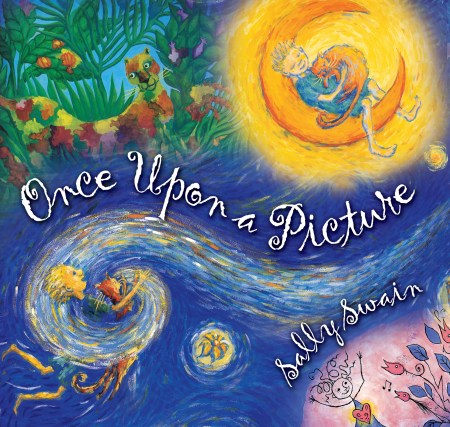
    In her beautiful picture book Once Upon a Picture Sally Swain asks readers to wonder about famous artworks by Renoir, Klee, Van Gogh, and Rousseau.

    once-upon-a-picture

    I am very much in favour of wonder, and have written about it before in

    Is it any wonder? about reclaiming your right to wonder;

    Breathe – a sense of wonder! about watching nature close-up with live butterfly kits in the classroom;

    Wondering in the everyday reminds us to pause and observe our surroundings; and

    Noticing and Wondering: Kicking off and supporting enquiry shares a post in which Aaron Eden on Edunautics, Exploring a World of Learning questions whether there could be any skills more important than noticing and wondering.

    questioning-einstein

    This week Charli Mills at the Carrot Ranch got me wondering about rainbow puddles with her flash fiction prompt to In 99 words (no more, no less) write a story about a rainbow in a puddle. Is it a silver lining of sorts or a false reflection? Think about what it might mean or convey. Simple science? Hope? Or the doom of humankind? Create action or character reflection.

    I wasn’t sure if rainbows would be seen in puddles that weren’t coated with oil, but it did make me wonder.

    Pierre-Auguste Renoir The Umbrellas ca. 1881-86
    Pierre-Auguste Renoir The Umbrellas ca. 1881-86

    Sally Swain invites readers to wonder about the girl with the hoop in Renoir’s painting “The Umbrellas”. Swain asks, “What does she want to do? Play?” and illustrates her thoughts with pictures of the girl playing in the muddy puddles that are inevitable on a rainy day. There is not a hint of rainbow though.

    Rainbows are common in works for children.

    rainbow-fish

    There is the beautiful series of Rainbow Fish books by Marcus Pfister with a simple message about the joy of sharing, of making oneself happy by making others happy too.

    There are songs such as Somewhere Over the Rainbow” sung by Judy Garland in her role as Dorothy in the movie version of The Wizard of Oz, and Sing a Rainbow.

    Rainbows are also popular for helping children learn maths facts and colours.

    Of course, there is the science of rainbows too; but before the science comes the wonder: looking at rainbows in the sky, and wondering.

    rainbow-wonder

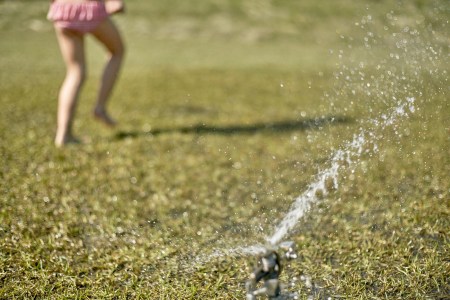
    When I was a kid we loved playing with the hose or in the sprinkler. Depending on the angle of the water and the sun, we could make our own rainbows, we didn’t need to wait for rain.

    sprinkler-926779_1920

    This got me thinking of children who might go for years without seeing rain, or therefore a rainbow, and how exciting their first sighting might be. I have combined a few of these ideas in my flash. I hope you enjoy it.

    Of puddles and rainbows

    For children of the drought who had never seen rain, the gush when the pipe from the bore burst a seam was a rare opportunity for water play and unexpected learning. While Dad and his Station Hand worked to repair the hole, the children danced in puddles under the cooling spray.

    “Look at the colours,” a child exclaimed, trying to capture each one. The men paused to smile at the children’s delight, remembering their own childhood glee. Mum watched from the verandah – without their precious resource, there’d be no washing off mud or cooking the dinner that night.

    Thank you

    Thank you for reading. I appreciate your feedback. Please share your thoughts.


  • Rocks in her head

    charlis-challenge-february-2

    This week at the Carrot Ranch Charli Mills is talking about rocks; rock formations in the landscape and rocks in the middle of the road, literally and figuratively.

    She talks about the mesas in Zion National Park near to where she is living in Utah.

    She describes it as 250 million years old with sandstone cliffs reaching ¾ mile, or 1207 m, high.

    Uluru © Norah Colvin
    Uluru © Norah Colvin

    Of course, I can’t think of large sandstone rocks without thinking of Australia’s Uluru/Ayers Rock, the world’s largest sandstone inselberg or “island mountain”, which I was lucky enough to visit a couple of years ago.

    We’re not going into competition here, but Uluru is estimated to be about 600 million years old. Reaching (only) 348 metres high, it is not as high as Zion’s cliffs.  However, it goes deeper under the ground than above.

    While indigenous peoples of Australia have lived near Uluru for at least 10 000 years, it was only “discovered” by European explorers in the mid-nineteenth century. They named it Ayers Rock after the then Chief Secretary of South Australia Sir Henry Ayers. Since 1993 it has borne the dual name Uluru/Ayers Rock.

    I couldn’t imagine what it must have been like for those first European explorers when they came across the enormous rock which reaches further below ground than it does above, though I guess they didn’t know that at the time. There are also many other hazards to negotiate in Central Australia.

    With Charli’s challenge to write about a rock, I was tempted to innovate on Michael Rosen’s Going on a Bear Hunt.

    “Oh-oh, a rock.

    A big red rock.

    Can’t go over it.

    Can’t go under it.

    Oh no! We’ve got to go around it.

    Huff-puff. Huff-puff.”

    But Charli moves on from the literal to the figurative as she describes challenges; the ones, unlike sand that is easy to sweep away; as “rocks in the road”, rocks that “cannot be ignored . . . (that) call us to change or be changed.”

    Sometimes the rocks have been placed by someone or something else. Sometimes they are of own making. Sometimes they reside only in our heads. Often the rock’s size and our ability to move it depends on our attitude.

    There is a rock in my path at the moment; small but, like a pebble in a shoe, bothersome. I have tried many alternatives but not yet found the solution. There is a popular saying that “When the student is ready, the teacher appears.” I’m ready and waiting.

    Sometimes I feel that my attempts are a bit like those Sisyphus moving his rock, but without the physical effort. Sometimes I just think I’ve got rocks in my head. Most people don’t understand why I bother; but how can I not?

    Edison said,

    “I’ve not failed. I’ve just found 10 000 ways that won’t work.”

    I don’t think I’m quite to 10 000 yet, but the number is growing.

    As Charli says, those rocks call us to change; they give us an opportunity for new learning. I’m never against learning something new. I’ve combined these ideas in my story.

    But before I take you there, I want to tell you about Charli. She has been squeezed between a rock and a hard place since she was kicked out of her beautiful home over six months ago. You can only admire her tenacity in remaining positive. With all the rocks that have been pelted at her, she still takes up the broom to sweep away the rocks that fall in others’ paths. Please check out her post and read of the J-Family, who have finally found a home after months of homelessness. Charli is hosting a Amazon Housewarming party to help them acquire basic household items. The seven-year old boy would also love some books to read.  If you can help, please visit Charli’s post for details.

    Now, back to my response to Charli’s challenge to “In 99 words (no more, no less) write a story about a rock in the road. It can be physical, adding to a plot twist, or it can be metaphorical for a barrier or hardship. Go where you find the rock.” I hope you like it.

    Rocks in her head

    The newcomer was intrigued. Every morning she’d be there, filling a battered barrow with rocks from the road. You’d think that, after a day or two, she’d have removed them all. But, every morning, even earlier, a quarry truck would rumble by, spilling more.

    Longer-term residents shrugged indifferently, “She’s got rocks in her head.”

    When he asked her one day, she replied, “Come and see.”

    He followed into her back garden, and watched. She stood at the edge of a pit and threw in the rocks. After each she listened, hopeful of a sound, of one day filling it.

    Thank you

    Thank you for reading. I appreciate your feedback. Please share your thoughts.


  • What do you create?

    symbol

    I am a fan of creativity. I like to develop my own creativity, and I like to encourage the development of creativity in others.

    One thing I always loved about teaching was the opportunity it gave me to be creative: writing stories, units of work, and lessons plans to interest and excite the children about learning. It is this love that drives me to write my blog posts each week, and to create new early childhood teaching resources for readilearn nearly every week.

    Just as exciting was the opportunity to support the development of children’s thinking, imagination, and creativity. I am more in favour of treating children as individuals, than as one of a homogeneous group from which any difference is considered an aberration.  After all, imagination and creative thinking are what inspire and drive improvement, innovation and progress.

    I affirm my belief in the power of creativity in my tagline: ‘Create the possibilities . . .’, a tagline I previously used for an independent school I was establishing.

    create-the-possibilities

    Preceding both was my first independent undertaking: Create-A-Way.  Create-A-Way provided a richer educational and social setting for my young daughter than what was generally available, allowed me to share my educational philosophy and knowledge, and provided the same rich learning opportunities for other children and their parents. The development of imagination and creativity was a focus.

    Guiding parents in play sessions for parents and children.
    Guiding parents in play sessions for parents and children.

    One of the things I love most about responding to the weekly flash fiction challenges set by Charli Mills at the Carrot Ranch is the additional opportunity to engage in something creative and to hone my writing skills. The supportive environment of a welcoming community makes it a safe and enjoyable experience. There is something affirming about belonging to a community of other creatives, online or in -person.

    karen

    On Saturday I, along with a whole bunch of other women creatives, attended an excellent Book Marketing Masterclass conducted by authorpreneur Karen Tyrrell. (I am looking forward to interviewing Karen for the Author Spotlight series on readilearn in March.) The class was attended by writers of a variety of genres; including memoir, romance, science fiction, fantasy, YA, and picture books.

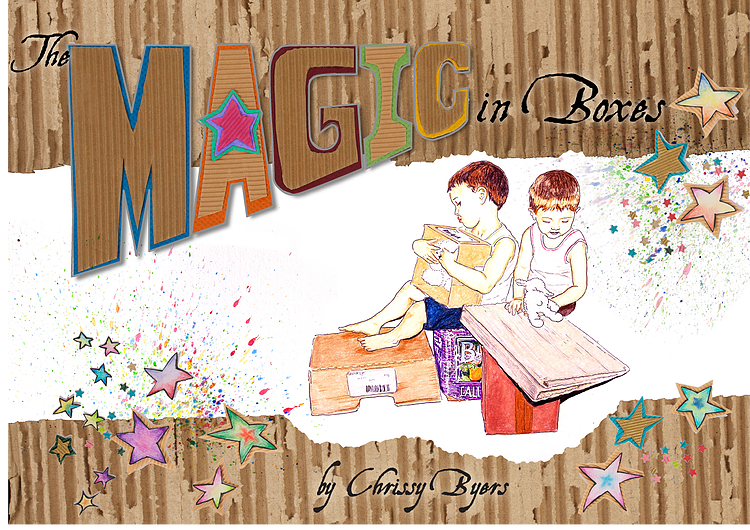
    One of the attendees Chrissy Byers has created a lovely picture book The Magic in Boxes which “aims to capture the imagination of young readers and inspire creative play.”

    the-magic-of-boxes

    Not only does the book suggest ways of stimulating creativity using recycled materials such as cardboard boxes, the book is made from recycled paper. I think that’s pretty awesome. It’s a beautiful book with a wonderful aim.

    lemons and grapefruit

    For a little more on creativity; in a previous post, Are you a lemon or a grapefruit? I shared ten articles about creativity. They are still relevant and worthy of a read if you haven’t yet done so.

    I also shared one of my favourite TED talks by Sir Ken Robinson How schools kill creativity. If yours is not yet one of the over 41 million views, I urge you to watch it. As well as sharing a very important message, Ken is hugely entertaining.

    I hope I have convinced you of the importance and power of creativity. I thank Charli and her flash fiction prompt for the opportunity of revisiting some of my favourite articles and talks about creativity. This week her challenge is to “In 99 words (no more, no less) write a story using the theme, “women create.” It can be art, sewing, ideas, babies. What is at the heart of women as creators? Go where the prompt takes you.”

    I’m a woman, and I create, and education is in my heart.

    In response to Charli’s challenge, I thought I’d get a little dirty. I hope you like it.

    Prize pies

    “Life’s not on a plate. It’s what you create.”

    Two little girls in their Sunday best

    Snuck outside when they should have been at rest;

    Splashed in the puddles, laughed in the rain,

    Shared mud pies and murky champagne.


    Two young girls with flour in their hair

    Climbed on the bench from the back of a chair;

    Opened up the cupboards, emptied out the shelves,

    Less in the bowl and more on themselves.


    Two young women watching TV

    Decide master chefs are what they will be;

    Enter the contest, invent new pies,

    Wow the judges and win the prize.

    thank-you-1200x757

    Thank you for reading. I appreciate your feedback. Please share your thoughts.


  • Scratching around the quarry

    charlis-quarry

    This week at the Carrot Ranch Charli Mills has challenged writers to

    “In 99 words (no more, no less) write a about a quarry. It can be a place or include the the by-product. The quarry can be operational, abandoned, it can be in real-tie or mentioned from another time. Where will the quarry take you? Go where the prompt leads.”

    I usually find Charli’s prompts a challenge but, with a bit of digging around in the old brain cells, I can usually concoct something with which I am reasonably happy. This time I’ve been scratching around the surface but have found little worthy of further investigation.

    I considered a story of epic proportions, as I can’t think of a quarry without thinking of Gilgamesh.

    Many years ago, I took my teenage son and a friend to a performance of the ancient story in a disused quarry. Whether it was part of their English or theatre studies, or what prompted the outing, I can’t recall. I think they were no more familiar with this “first great work of literature” than I; and I knew nothing. The performance made a lasting impression, both for its setting and the repetitious dialogue. I recall little of the hero’s epic journey. We were amused rather than awed.

    From Gilgamesh, I considered play of a different, but more familiar kind: play in a sandpit or the dirt with diggers and trucks.

    The sandpit was always popular for play at lunchtime, particularly if diggers, trucks, and other tools were available. Often the same children would play day after day, creating and re-creating the same scene with roads, rivers, bridges, and cities. Each seemed to have a particular role and responsibility. Found objects; like leaves, bark, feathers, sticks, and stones, would also be incorporated into the designs.

    This play was great for the imagination, and for developing the friendship skills of cooperation and getting along, teamwork and working together. Surely I could find a story in there? But any ideas disintegrated faster than the sandpit structures.

    It seems timely then, to revisit previous discussions of the difficulty experienced by children when expected to write to a prompt that may have little significance for them, and about which they may have little opportunity for discussion, reflection or planning.

    I discussed this in both Writing to order – done in a flash! and Writing woes – Flash fiction. I suggested that, rather than  using a one-piece response to a prompt to assess children’s writing, the use of portfolios would provide more valuable information about children’s writing development.

    A portfolio, similar to that of professional writers, would consist of work at various stages: some as ideas jotted on slips of paper, some in planning stages, others in draft form, others completed and waiting for the next step, and others in publication. Rarely would a piece need to be completed in one sitting, let alone judged for it worth on the spot.

    I believe that:

    • a one-off writing assessment task does not give students an opportunity to show their best work and puts pressure on them to perform
    • a portfolio of work collected over time provides a clear picture of student ability, development, and next steps for learning.

    However, that writers have a choice about responding to Charli’s flash fiction prompts, makes the process quite different from that experienced by children responding to a prompt as a requirement.

    Writers have a choice whether to participate, in what genre to respond, and how to interpret the prompt.

    In recent posts Charli has discussed the importance of accepting our first drafts as “raw literature”, as part of the process. She provide us with the opportunity to hone our writing skills, and share and receive feedback on our writing in a safe, supportive environment. Surely this is no less important when encouraging young writers.

    Out of sympathy for the requirements imposed on children almost every day, I thought it only fair to respond to Charli’s prompt. This is it.

    The Quarry

    Old and disused, the bare earth was dry with no hint of topsoil or sign of life. Rock fragments, remnants of its past, littered the surface still pockmarked by tyre tracks. One wall, etched by diggers’ teeth, stood silently telling its story. Circles of ash littered with shards of glass and cigarette butts told another. But tonight it was to tell a story as old as time.  Where once huge trucks had carted away boulders carved from its interior, now rough timber platforms stood.  As darkness fell, flaming torches cast an eerie light as storytellers wove their epic tale.

    Thank you

    Thank you for reading. I appreciate your feedback. Please share your thoughts.


  • Who gives a crap?

    This week at the Carrot Ranch, Charli Mills asks “Who gives a crap?” and about what. She declares some things that are important to her, things she gives a crap about, including, but not limited to:

    • the environment
    • nature
    • truth
    • principles
    • equality
    • diversity
    • jobs for all
    • literature and it’s role in society, and
    • conflict resolution.

    She says that

    “Conflict resolution is finding a peaceful solution to a disagreement. It’s drawing back my hand from the urge to smack. It’s letting go of a need to punish. It’s hearing both sides of the concerns and working toward a way to save our environment and jobs. It means acknowledging the rights or privileges of all. It means agreeing to disagree with compassion for the other. It means uplifting the lowest in our midst instead of only seeking to better our own. It also means checking our words and behavior.”

    I give a crap about education. I care about the education of our children. It is through education that we can make a difference in the world; but we can only do that if we educate our children to be thinking, caring, responsible, contributing participants in society and inhabitants of the planet.

    We need to teach children about their relationship with the environment, and the impact of their individual, and our collective, actions.

    We need to give children time to experience nature and the outdoors; to marvel at its beauty, to appreciate its diversity, and to wonder …

    We need to model for children a principled life, in which truth, equality, and diversity are valued, and in which the collective good is more important than an individual’s need for fame or fortune.

    We acknowledge that making mistakes is integral to an individual’s learning and tell children it is okay to make, and learn from, mistakes. We encourage them to think for themselves and to be innovative, to see alternative solutions to problems.

    If we were to teach them to just accept things as they are because that’s the way they’ve always been (and I query that statement!) how can we expect them to come up with solutions to issues that confront us?

    Some of the conflicts mentioned by Charli; for example, providing jobs and preserving the environment, have resulted from our learning, our development, our education.

    Maybe we should consider that making mistakes is also integral to our collective learning and development; and be prepared to accept them as such, learn from them, and devise alternative solutions.

    For example: We learned about fossil fuels. We saw how they would enhance our lifestyle, and we implemented that learning, creating many new jobs as a consequence.

    Now we see that some of those advancements are not as beneficial overall as was initially thought. We made a mistake. It is time for reassessment, for learning, and for thinking of new strategies. We need to leave behind what does not work, and embrace the next step in our development.

    Charli asks, “When did we start thinking that only our crap matters and stop giving a crap about others?”

    For a while the focus moved away from the importance of community to the importance of the individual and individual rights. Maybe now it’s time to put the focus on community and the role of the individual in it. Let’s not ask what the community/humanity/the world can do for me, but what I can do for the community/humanity/the world.

    This brings me back to Charli’s flash fiction prompt to: “In 99 words (no more, no less) write a story that expresses a strong concern, something to give a crap about. Something that brings out the feeling to stand up. How can you use it to show tension or reveal attitudes?”

    This is my response. I hope you enjoy it.

    Pulling together

    “It’s mine!” they spat at each other. With faces red and contorted, they pulled in opposite directions.

    The object finally stretched to its limit and ripped apart, catapulting the opponents backwards to land on their derrieres.

    “Now look what you’ve done!” they accused each other, and scrambled to retrieve what was salvageable.

    They contemplated the useless fragments. There were no winners, only losers. Their eyes, previously filled with hate, now brimmed with sorrow.

    “What have we done?”

    Moving together, each comforted the other, feeling as much for the other’s loss as for their own.

    “Let’s start anew,” they said.

    I’d love to know what situation you think my story might be about. I’d also love to know what it is that you give a crap about.

    Oh, and thanks to Bec’s reminder, I will mention the Who gives a crap toilet paper (that is far from crappy and great for the environment) that Charli mentioned in her post, and I previously mentioned in Around the Campfire.

    Thank you

    Thank you for reading. I appreciate your feedback. Please share your thoughts.

  • Can I keep the change?

    This week at the Carrot Ranch Charli Mills has challenged writers to In 99 words (no more, no less) write a story about a rattling sound.

    Charli mentioned a variety of rattling sounds:

    • Hail – “Balls of ice the size of frozen peas” rattling on her RV

    (Here’s a video of some pea-sized hail dancing in my garden recently.)

    • Political divisions and discussions, with each side clamouring to be heard but only sounding “like discordant hail on a fiberglass roof”

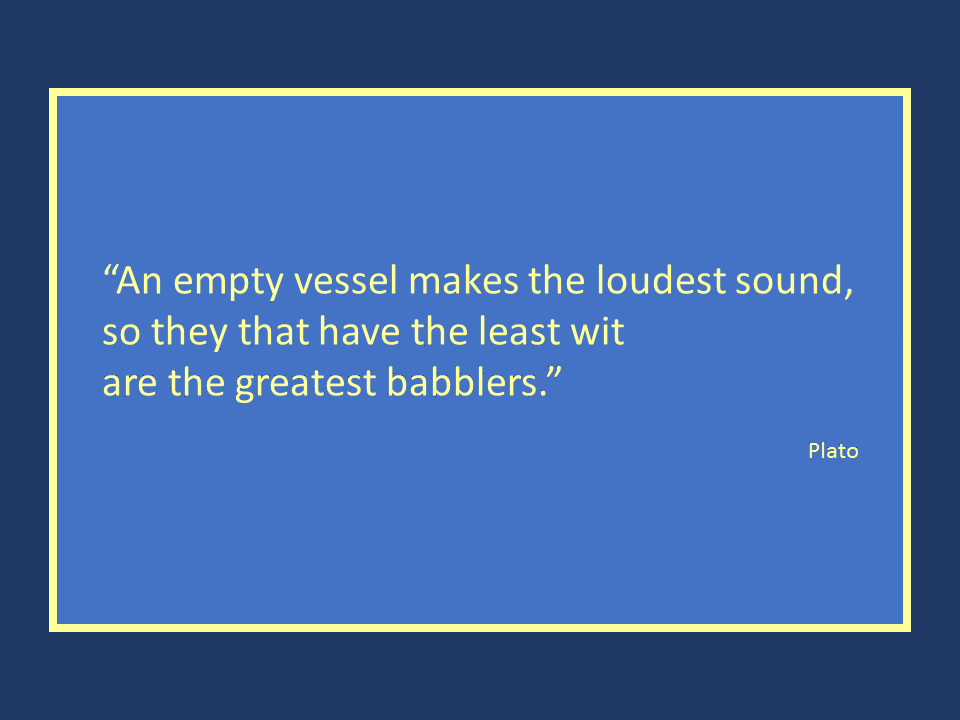
    (Remember that saying about “Empty vessels make the most noise?”)

    plato-empty-vessels

    • The saber-rattling incident in Chilean history “when a group of young military officers protested against the political class and the postponement of social measures by rattling their sabers within their scabbards.”

    In her prompt, Charli suggests that the rattling sound could be “an intimidating sound of protest, a disorienting loud sound, a musical expression or a gentle baby’s toy.”

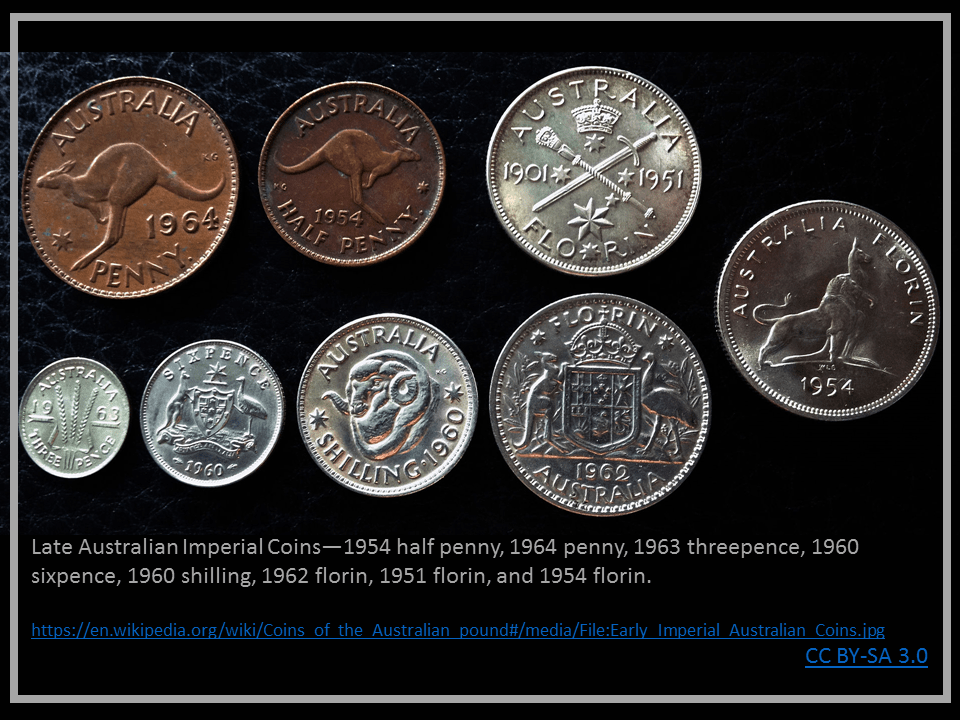
    I thought of the rattle of coins – reasonably familiar in my childhood, less so now.

    australian-imperial-coins

    When I was a child, most transactions involved the use of cash – notes and coins. Back then, before the introduction of decimal currency just over fifty years ago, we had pounds, shillings and pence.

    Decimal currency certainly made calculations easier but, though I remember my mother occasionally writing a cheque, transactions were still made mainly with cash.

    I am from a large family and the finances didn’t stretch to pocket money. However, I do remember the occasional threepence to spend at the shop beside the school. I think they may have been gifts from the “tooth fairy”. How we agonised over which sweets to buy – maybe a rosy apple, four aniseed balls and some musk sticks.

    Occasionally we might find a coin in the sand at the playground or beach, or be gifted one or two from an aunt, uncle or grandparent. Sometimes, when sent to the shop for bread or milk, we’d ask if we could keep the change. Sometimes the answer was “Yes”!

    Although the anticipation of a purchase was heightened by the sound of a couple of coins jingling in a pocket or purse, we were also keen on saving them toward future desires.

    The money box most of us had back then was a tin replica of the Commonwealth Bank’s head office in Sydney.  The clink of coins being added to the box was music to our ears, as was their rattle as we shook it to determine how full it might be and how much we may have saved.

    The trouble with these money boxes was twofold:

    1. It was impossible to do anything with them quietly, and
    2. It was practically impossible to extricate any coins once they were in. The tins could only be opened with a tin opener! Sometimes, with the right tool, the opening could be widened and one or two coins could be removed, but the shaking and rattling required was a real give-away.

    How different it is for children today. Not only are many transactions made using credit or debit cards, many purchases are made online. No cash, no “money” is seen to exchange hands.

    Nonetheless, it is still important for children to understand monetary values and to be able to calculate the cost of items. I think it is good for children to have pocket money for which they can make decisions regarding spending or saving. The ability to save up for something, to delay gratification, is an important part of maturation. I wonder how many of today’s children are sent to the store on their own and, if so, whether they can keep the change.

    The use of technology means that even cashiers (is that term also becoming outdated, like hanging up the phone?) are no longer required to calculate. The register does that for them. Yes, they do have to count out the change, but that involves little calculation.

    With the changing values, too, Australia no longer has one or two cent coins. Five cents is the lowest denomination, and I doubt that a child could buy anything with just one, not even an aniseed ball or a musk stick. I wonder how long before it too disappears.

    While online shopping, and paying with cards and phones is becoming commonplace, it is still important for children to handle, recognise, and become familiar with money. They need to be able to compare the value of coins and notes, and perform calculations with them. It is important for children to realise that a greater number of coins doesn’t necessarily mean more money.

    australian-coins

    The images on the coins and notes also provide an opportunity for learning about our Australian animals and significant people and events in our history. Perhaps in the lifetimes of today’s children, coins and notes will go the way of our Imperial currency and become simply items in a museum and history lessons.

    For my response to Charli’s prompt, I have gone back to the days of coins rattling in pockets and money boxes, when thinking of the wonderful things that a few coins could buy was pure delight.

    Can I keep the change?

    With the string bag slung over his shoulder and the purse clutched tight, he was on his first big boy errand. And, he could keep the change. He rattled the purse. What possibilities awaited. Should he hurry to get the money, or dawdle and contemplate? Regardless, he got there soon enough.

    He handed the purse to Mrs Kramer, who extracted the list and gathered the items. As she counted the coins into the till, he announced, “I can keep the change.” She peered over her glasses, then held out one large brown coin. He trembled: what could he choose?

    australian-imperial-penny

    A penny for your thoughts!

    Thank you

    Thank you for reading. I appreciate your feedback. Please share your thoughts.

  • Happy as a possum in a pouch

    This week at the Carrot Ranch, Charli Mills is talking about getting cozy. While we swelter in the heat of our Australian summer, getting cosy is the last thing we are thinking of. Keeping cool is our current priority. (Note: cozy in North America, is cosy in Australia!)

    When I think of cosy, I think of huddling in front of a fireplace, shawl over my knees, cat at my feet, and a glass of wine, perhaps Prosecco, in my hand. This is not something I have ever experienced. It is an image portrayed on Christmas cards, book covers, and in movies.

    It’s a bit of a stretch for me to contemplate cosy at the moment, and I wondered how young Australians with little experience of “cosy” might respond to the word.

    I asked 7-year-old grandson what he thought of when he heard the word “cosy”. He said,

    “Nice and warm in bed.”

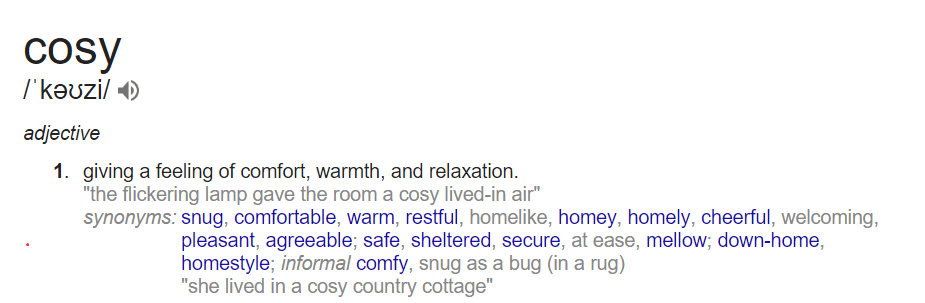
    His Dad thought there could be no better definition. In fact this is the definition provided by Google:

    cosy

    I asked grandson if he thought we would want to be cosy in summer and he said, “Well maybe not warm, but snuggly.” I think he did pretty well in defining the word.

    Snuggly makes me think of the children in bed as shown in Helen Magisson’s version of The Night Before Christmas. (Look for the interview with Helene on the readilearn blog later this month.)

    No doubt you have heard the expression, “snug as a bug in a rug”. Like cosy, the expression refers to being in a pretty comfortable position. I figured that being in a pouch would be about as cosy as a creature could get and, since Australia is home to many marsupials, it seemed a perfect fit for the post.

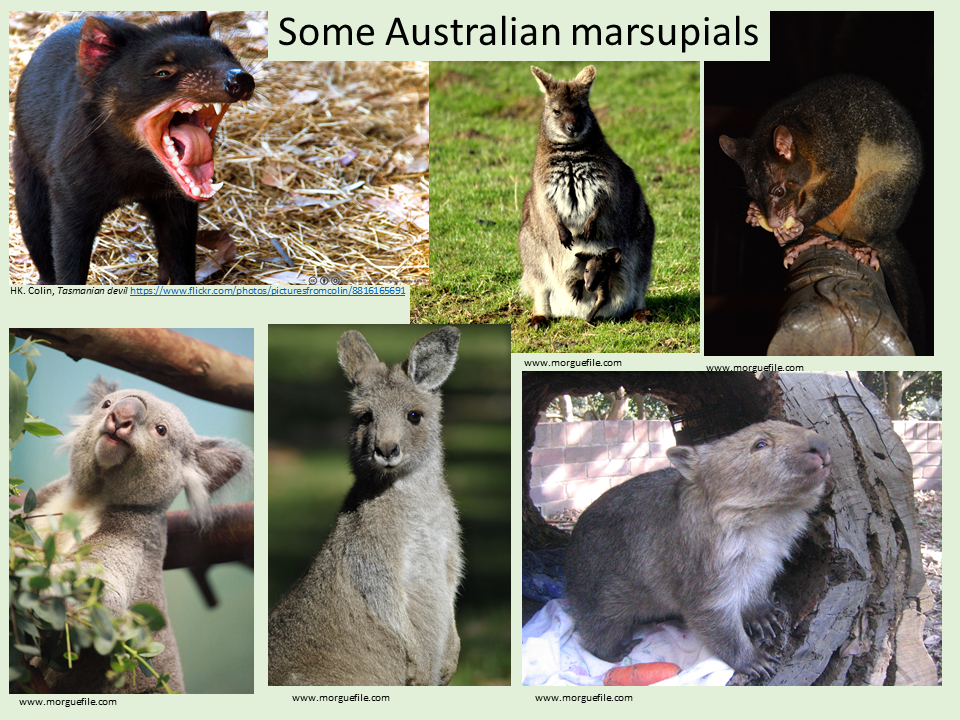
    Marsupials are mammals that give birth to live young before they are fully developed. The young, usually referred to as joeys, continue to develop in the mother’s pouch for a number of months, suckling on their mother’s milk.

    feeling-prickly-marsupials

    As explained in Feeling a little prickly, Australia is home to almost 70% of the world’s marsupials. Other marsupials are found in the Americas, mostly South America. Kangaroos, wallabies, koalas, possums, wombats, Tasmanian devils, numbats, bilbies, and quolls are among the species of marsupials found in Australia.

    Brushtail possums are common in Australia and frequently share our homes as well as our neighbourhoods.

    At the moment, a mother and baby have taken up residence in Hub’s carport/workshop. We’re not particularly happy when they share our homes, but I love to hear and see them in the garden. Although I must admit that hearing a male brushtail possum for the first time can be a disturbing experience. I wrote about this in Sounds like …

    While possums are not popular in New Zealand and efforts are being made to eradicate them, and other introduced pests, from the island nation; I think they are rather cute. When I was young I climbed everywhere and got into everything and, as a result, was nicknamed “Possum”. (What happened to that inquisitive child?)

    I have previously written about some of my favourite picture books about possums, including  Possum in the House and Possum Goes to School in Listen to the sounds, and Possum Magic by Mem Fox in A celebration of Australian picture books #2 – Mem Fox

    Possum goes to school2015-09-19-10-55-23

    When Charli Mills of the Carrot Ranch challenged writers to In 99 words (no more, no less) write a cozy story, how could I not write about a cute little possum joey getting cosy in the mother’s pouch. I hope you like it.

    Watermelon by Peter Firminger https://www.flickr.com/photos/wollombi/251246865
    Watermelon by Peter Firminger https://www.flickr.com/photos/wollombi/251246865

    Happy as a possum in a pouch

    Warm and cosy in mother’s pouch, for months he did no more than suckle and sleep. Lulled by her gentle heartbeat and rhythmic breathing, he barely noticed as she scurried about at night; foraging for food, leaping from branch to branch, avoiding neighbourhood cats, sometimes scouring dogs’ bowls for leftovers, or accepting humans’ sweet titbits. For him, nothing else existed.  Until … one night, a strange feeling stirred inside. He poked his whiskery nose outside. Sniff, sniff. The most delicious scent beckoned him out. Mother offered him something red. Zing! His senses ignited. Milk was forgotten, nightly foraging began.
    Thank you

    Thank you for reading. I appreciate your feedback. Please share your thoughts.