Live Love Laugh Learn … Create the possibilities

Category: Education

  • A sprinkling of semicolons

    wordle semicolons

    This week at the Carrot Ranch Charli Mills is talking about semicolons; but not the little squiggles on a page, the semicolons that are sprinkled liberally through life as new beginnings. Sometimes we see them and grasp the opportunity for renewal, other times we ignore them and miss the chance to revitalize. Sometimes we get pushed down and it takes all our strength to pull back up, grasping onto the semicolon as if it was a dragon’s tail.

    mystica, A remix of dragonart  https://openclipart.org/detail/132805/rainbow-dragon
    mystica, A remix of dragonart https://openclipart.org/detail/132805/rainbow-dragon

    Charli was inspired by Project Semicolon that provides this explanation:

    “A semicolon is used when an author could’ve chosen to end their sentence, but chose not to. The author is you and the sentence if your life.  Project Semicolon exists to encourage, love and inspire.”

    Every day can be a new beginning in some way. With our thoughts, words and actions we can change our own lives, or the lives of others. The impact may be deliberate or unintentional. We may be aware of the effects, or we may never know the consequences.

    Without wishing to diminish the importance of helping those “who are struggling with depression, suicide, addiction and self-injury”, which is the focus of Project Semicolon, my focus as always is on education and the importance of maintaining curiosity and an interest in and love of learning.

    jimmiet, A colourful monarch butterfly   https://openclipart.org/detail/19002/monarch-butterfly
    jimmiet, A colourful monarch butterfly https://openclipart.org/detail/19002/monarch-butterfly

    What better analogy of a semicolon of life than the transformation from a caterpillar in a pupa to the beauty and flight of a butterfly. An inspiring teacher can mean the difference between full stops and semicolons in learning.

    To illustrate this I refer a post called Deeper Learning: Highlighting Student Work written by Ron Berger and shared on Edutopia.

    In the article Berger discusses his obsession with “collecting student work of remarkable quality and value . . . the work of regular students in typical schools around the country . . . (whose) teachers have helped them develop the skills and mindsets necessary to produce work of exceptional quality, and have built classroom and school cultures in which exceptional work is the norm”.

    Berger discusses ways of engaging students in authentic work, work that can have an impact on their communities and on the way they see themselves as learners. I remember Charli Mills telling me about similar work that her children were engaged in when they attended The School of Environmental Studies in Minnesota; and I shared some of Chris Lehmann’s work at the Science Leadership Academy in Philadelphia here.

    Berger says,

    “Once a student creates work of value for an authentic audience beyond the classroom — work that is sophisticated, accurate, important and beautiful — that student is never the same. When you have done quality work, deeper work, you know you are always capable of doing more.”

    Semicolons in teaching and learning, all.

    As with the three cited above, the situations referred to are often of teenagers in high schools. I am an early childhood teacher and, while I find the work exciting, I sometimes struggle to see the relevance to my situation. However, in this article Berger shares the work of Austin, a year one student from Boise, Idaho doing a project about a tiger swallowtail butterfly.

    Austin was to illustrate his project with a detailed scientific drawing of the butterfly. His initial drawing was what I would consider to be fairly typical of a year one child. However he received feedback that was specific and not mean from follow students; and through a series of six drafts finished with a drawing that was much more sophisticated and demonstrated more careful ‘scientific’ observation.

    Berger also shared work by year two students at another school, demonstrating what can be achieved “when students are allowed, compelled and supported to do great things”.


    Last week Charli’s flash fiction challenge “the day the earth turned brown” prompted me to write about a student mixing all the colours together to make one muddy brown. The teacher paused before responding. There are many such pauses, (semicolons) in a teacher’s day. The teacher knows the power of every remark and must consider the impact that a response may have.

    If you had provided each child with a palette of primary colours and black and white expecting them to mix a variety of colours and shades and tones to create an interesting picture; then found that one child had mixed them all together to make one muddy brown, how would you respond?

    There were a number of comments on the flash including one from Geoff Le Pard  who said that there were “So many questions as to why the little girl is making muddy browns and lathering them everywhere.”

    So true. The teacher’s response would be influenced by knowledge of the child’s background, interest in art, and behaviour that day, among other things.

    Charli Mills said that “It could mean many things and nothing!” She recalled, “mixing paints as a child hoping to create a vivid new color and (being) disappointed to end up with mud.Anne Goodwin agreed, saying that “mixing paints to make a muddy brown, (was) a distinctive childhood memory”.

    In my experience there was usually one child who ended up mixing all the colours together, often for no other reason than to see what happened. Sometimes the process of discovery gave as much pleasure as would a colourful painting of a house a tree and a sun.

    house and sun

    However, there might be more to it than that. Charli Mills sympathesised with the teacher, saying that “So much is put on the teacher to figure it out.” She thought that the child “might be disturbed, highly imaginative or confident enough to experiment”.  Sherri Matthews suggested that perhaps the child was “troubled . . . living in a dark, mixed up world, but . . . trying to find their way”.

    So much to consider. So powerful the response. Will it be a full stop, or a semicolon?

    This is my response to Charli’s challenge to In 99 words (no more, no less) write a renewal story that proclaims, “This isn’t the end; I will go on.
    muddy brown

    She paused. The muddy brown extended beyond the paper virtually cementing it to the desktop. The palette too was brown with little trace of the beautiful primary colours she had prepared. Looking from desk to child she observed two large smears adorning the shirt. A bruise-like smudge on the cheek showed where an intruding hair had been brushed away. “Oh!”

    She breathed; she counted to ten; and back again; “Breathe,” she told herself. “Why?”

    She moved on, observing the assortment of smiling suns, houses and garden paths, but her mind was on the mud; the child . . .

    What would be the appropriate response?

    Thank you

    Thank you for reading. I appreciate your feedback. Please share your thoughts about any aspect of this post or flash fiction.

     

  • Spelling tests – How well do you score?

    ABC

    Familiar to most will be the weekly spelling test held on a Friday morning after a week’s practice at learning a list of words. Some will have dreaded the test fearing they may forget the “i before e”, “silent” letter or double letter rules, for example, their inadequacies made all too obvious by the large red crosses. Others would have relished the experience, requiring little effort to learn words they already knew, seemingly by osmosis, with the expectation of large red ticks and 10/10.

    Spelling test

    I dare say that most of you reading this blog are of the 10/10 variety. Just to be sure this is so, I have set you a little spelling test to do before you read any further. Please get your pen and paper, finger and notebook, or keyboard ready, then press PLAY to take the test.

    So how did you go?

    I hope you could see from that exercise that knowing how to spell has a lot to do with meaning. In fact the spelling of many of our words in English has more to do with morphology than with sound, and although sound can be helpful there are often many different letters or letter combinations that can be used to represent the same sound, for example:

    eye

    According to the Bullock Report, published in 1975:

    “For 6092 two-syllable words among the 9000 words in the ‘comprehension vocabularies’ of a group of 6-9 year olds, 211 different spellings of the phonemes were needed – and these spellings required 166 rules to govern their use! Even at that, 10% of the words had to be left aside as ‘exceptions’; which means that ‘even if a young child memorised these rules while learning to read he would still encounter hundreds of words not governed by them.’”

    Lists of words, such as spelling lists, provide little support for learners, rarely providing context or meaning which might help them remember the words, or choose the correct meaning and therefore spelling, as shown by the spelling test exercise given above.

    Alphabetical

    In his book “Alphabetical: How Every Letter Tells a Story”, Michael Rosen explains that transmitting meaning is the reason for writing, for having an alphabet.

    Rosen describes the alphabet as “a stunningly brilliant invention. We could call it a ‘cunning code’ or a ‘system of signs’ whereby we use some symbols (letters) to indicate some of the sounds of a language. … Though it is wonderful, there are some snags for users …” including:

    • letters and letter combinations do not represent the same sound each time they are used (e.g. ‘c’ in ‘cat’ and ‘city’)
    • letters represents different sounds according to regional accents
    • a particular sound is not always represented by the same letters (see the ‘eye’ example above)

    He says that “Becoming or being a reader of English involves absorbing all these variations and then forgetting that they exist.”

    a phonic's teacher's lament

    He explains that the alphabet is more than a system of sounds and syllables and that “Our forebears devised alphabets so that they could store and retrieve meaning … over time and/or space”.

    While not speaking specifically about learning spelling words, in his book “Why Don’t Students Like School? A Cognitive Scientist Answers Questions About How The Mind Works and What It Means For Your Classroom” (referred to in a previous post here), Daniel T. Willingham consistently refers to the importance of meaning when acquiring knowledge. He says,

    “Teachers should not take the importance of knowledge to mean they should create lists of facts . . . some benefit may might accrue, but it would be small. Knowledge pays off when it is conceptual and when the facts are related to one another, and that is not true of list learning. Also … such drilling would do far more harm by making students miserable and by encouraging the belief that school is a place of boredom and drudgery, not excitement and discovery.”

    When a child scores poorly in a spelling tests and their errors are marked in red they see themselves as bad spellers, lose confidence in their ability and have a defeatist attitude before they even try.

    Why is spelling important?

    Standard spelling is essential to ensure the meaning of the message is transmitted correctly from writer to reader. While readers may very quickly notice spelling errors in text they are reading, these few errors, when embedded in meaningful text, rarely inhibit the transmission of meaning. However if the bulk of the text is in nonstandard spelling, the message would be virtually indecipherable.

    How do we learn to spell?

    The most effective way most of us use to learn to spell is reading. While reading we are exposed to a large number of correctly spelled works in context. If we read often enough, we see words frequently and learn to recognise them. We notice when they are misspelled and so recognise how they are spelled.

    The importance of spelling correctly is relevant to and a tool for our writing. The learning of particular words is best done in the context of writing.

    These are some strategies that can be used with beginning writers:

    • Model writing for them, let them see you write for real purposes, think out loud so they can see what you are doing, for example: “I going to write a . . . I’m going to start … I need to write … ”
    • Encourage them to write for self-expression, to share ideas, to tell a story . . . sustained and uninterrupted writing without the fear of a red pen anywhere.
    • Encourage them to listen to the sounds in the words and write any of the letters they know (Beginners usually start with the initial consonant, then perhaps the initial and final consonant. Vowel sounds are the most difficult to hear and differentiate and are irregular in how they are represented.)
    • Respond to their writing with written comments to their messages, modelling the correct form, for example: If the child writes “I wet to the bich on the weced” you could reply with “Did you have fun when you went to the beach on the weekend?” This enables the child to see the importance of writing for communication, demonstrates the correct spelling without being “corrected” and provides a model which can be used in future writing.
    • Encourage children to proofread their own writing by circling words they weren’t sure how to spell. Don’t always expect them to discover the correct spelling. Being able to recognise when a word is or is not spelled correctly is a first step in developing competence.
    • Notice and comment on any development that can be seen in the child’s spelling ability, for example: “You have written the word ‘kitten’. You have written the ‘k’, you know that it begins with ‘k’; you have written the ‘t’ you can hear in the middle and the ‘n’ at the end. You have listened very well to the sounds in the word.”  
    • If you want to give a child a list of words to learn, use words that have been misspelled in independent writing. Independent writing provides you with information about what the child wants to write about.
    • As they begin using technology for writing, show them how to use the tools available for checking their spelling.

    bee 5

    As a final note, in the Conversation this week was an article by Nathaniel Swain, entitled Spelling bees don’t teach kids literacy, or much else. The article discusses a soon-to-be aired television show that pits nine to thirteen year old children against each other in a spelling competition.

    Swain says,

    “How would you go spelling feuilleton, stichomythia, cymotrichous, or appoggiatura? More importantly, do you know the meaning of these words, and could you use them in a sentence?

    Challenging and insightful, or obscure and essentially pointless? Spelling bees encourage endless memorisation of complex but low-frequency words – and are a distraction from the core of literacy education.”

    Thank you

    Thank you for reading. I appreciate your feedback. Please share your thoughts about any aspect of this post.


  • A palette of colours

    Moini, Painter penguin https://openclipart.org/image/800px/svg_to_png/174634/painter_penguin.png
    Moini, Painter penguin https://openclipart.org/image/800px/svg_to_png/174634/painter_penguin.png

    I think few of us would deny that each of us is unique, or question the importance of an individual’s interests and abilities to learning. Much has been written about learning styles, multiple intelligences and differentiation of instruction.

    Most teachers try to incorporate a variety of experiences into their programs in order to maximise learning opportunities in the hope that, if students don’t “get” it one way, they will “get” it in another. The imposition of national standardised assessment makes doing this a challenge for teachers. The increased requirement for the implementation of particular approaches to teaching makes it even more so.

    To say that I hold fairly strong views about learning, and the differences I consider there to be between education and schooling is perhaps an understatement, but it wasn’t always so.

    My memory tells me that, while I probably didn’t “love” school, I probably didn’t “hate” it either. It was simply something that I had to do. I didn’t question it. I did my best to be a “good” girl, do what was expected of me, and conform. All of which I think I did pretty well.

    The questioning came later and had more impact upon my teaching and parenting than it did on my own schooling. I came to view schooling as something that is “done” to us, and education as something that we do for ourselves. That is not to say that no worthwhile learning takes place in school, for it does, but education is a whole-of-life experience and schooling is but one small part of that.

    Education is a whole of life experience

    However, if the importance of schooling, and here I mean learning of particular content by particular ages, is inflated and rated more highly than children’s natural curiosity, interests and abilities, then the consequences to individuals and the community in general can be more negative than positive. One consequence may be that children don’t enjoy school; another may be the view that only school knowledge is important; and yet another may be that children are turned off learning all together.

    My first conscious discomfort with what, for convenience, I’ll call a factory model of schooling (children go in one end, have things “done” to them, and come out the other end all the same) was as a young teacher when all five year two teachers were expected to be doing the same thing at the same time. That imposition, along with other inadequacies that were beginning to become apparent, set me on a quest to learn more about learning and education. My quest has never ceased and I am still searching for answers.

    Recently I read a book by Daniel T. Willingham entitled Why Don’t Students Like School? The title had instant appeal, of course, and I thought I’d recognise a few of the reasons at least. My initial expectation was of reading views similar to those of authors like John Holt, Ivan Illich, A.S. Neill and John Dewey whose books I had read in the 70s and 80s; but a closer look at the subtitle told me I was in for more: “A Cognitive Scientist Answers Questions About How The Mind Works and What It Means For The Classroom”.

    The book is a wonderful read and I’m certain to share many of Willingham’s ideas with you in future posts. I enjoyed it because, in almost equal measure it reinforced, challenged and extended my thinking about many aspects of learning and how best to provide for and stimulate it in a classroom setting.

    Sometimes Willingham would make a statement with which I agreed, and then go on to explain the faulty thinking behind it. Sometimes his statement would seem to completely contradict what I think but his explanation would show that we simply had different ways (mine perhaps inadequate) in explaining it.

    What I really appreciate about the book is that Willingham carefully translates what has been learned from research into practices that can be implemented in the classroom to enhance student learning. Often research seems only to tell teachers what they already know from experience and observations, or provides information in such an abstract way that nothing of practical use can be gleaned.

    The section of Willingham’s book that I refer to today is “Chapter 7 – How Should I Adjust My Teaching for Different Types of Learners?” Willingham opens the chapter with the words “All children are different.” He says that some learn visually, some auditorily; that some are linear thinkers and some holistic, for example, and that

    “It seems that tailoring instruction to each student’s cognitive style is potentially of enormous significance”.

    The important word in that sentence is “seems”. He talks about the differences in the way that hypothetical Sam and Donna might learn and says that “An enormous amount of research exploring this idea has been conducted in the last fifty years, and finding the differences between Sam and Donna that would fit this pattern has been the holy grail of educational research, but no one has found consistent evidence supporting a theory describing such a difference.”

    He states that the “cognitive principle guiding this chapter is:

    “Children are more alike than different in terms of how they think and learn.”

    That statement really made me sit up and take notice: “Children are more alike than different”. But it turns out, those words are not the most important ones in the sentence. The most important ones are: “in terms of how they think and learn.

    He goes on to say that, “the claim is not that all children are alike, nor that teachers should treat children as interchangeable. Naturally some kids like math whereas other are better at English. Some children are shy and some are outgoing. Teachers interact with each student differently, just as they interact with friends differently; but teachers should be aware that, as far as scientists have been able to determine, there are not categorically different types of learners.”

    He also talks about it in this video:

    Willingham acknowledges that students differ in their cognitive abilities and styles. What he does in the chapter is “try to reconcile the differences among students with the conclusion that these differences don’t mean much for teachers.” In reading these words one might expect that Willingham is proposing that differentiation is not an important part of classroom practice. But such is not the case, as stated in this video:

    In the book he writes, “I am not saying that teachers should not differentiate instruction. I hope and expect that they will. But when they do so, they should know that scientists cannot offer any help.” According to Willingham, scientists have not identified any types of learners or styles of learning.  He says, “I would advise teachers to treat students differently on the basis of the teacher’s experience with each student and to remain alert for what works. When differentiating among students, craft knowledge trumps science.

    What Willingham says is of most importance for a learner to learn is background knowledge. If a student does not have sufficient background knowledge to understand the content or concepts which are presented, learning will not take place. This supports the advice that I repeatedly give to parents: read to your children, talk with them, and provide them with a wide range of experiences and activities. The same is true for teachers: ensure the students have sufficient knowledge on which to build the new work you are expecting them to grasp.

    This week at the Carrot Ranch Charli Mills has thrown a prompt with which I have struggled: In 99 words (no more, no less) write about the day the earth turned brown. I always like to tie my responses to the educational focus of my blog and this one had me stumped for a while. A mind journey following various twists and turns, retracing well-worn paths, and hitting many dead ends, finally led me to an oasis in the parched brown earth: the uniqueness of each of us; the amazing potential of each new child to create possibilities beyond our imagining; and the contrasting effect of a narrow test-driven school system that attempts to reduce each to the sameness of minimum standards and age (in-)appropriate benchmarks. A paint palette seemed a suitable medium for the story.

    For those of you who have been following Marnie’s story, I apologise. She makes no appearance this time, though I have not ruled out the possibility with student M. I’d be pleased to know what you think.

    palette

    Palette potential

    She walked between the desks admiring their work. From the same small palette of primary colours, and a little black and white for shades and tones, what they produced was as individual as they: J’s fierce green dinosaur and exploding volcanoes; T’s bright blue sea with sailing boat and smiling yellow sun; B’s football match . . . At least in this they had some small opportunity for self-expression. She paused at M’s. M had mixed all the colours into one muddy brown and was using hands to smear palette, paper, desk and self . . .

    Thank you

    Thank you for reading. I appreciate your feedback. Please share your thoughts about any aspect of this post or flash fiction.


  • Learning without knowledge

    First birthday
    First birthday

    Earlier this week the television was on as I was getting ready for work. I wasn’t taking much notice as the voices droned on. I was lost in my thoughts of what needed to be done, what I’d be doing at work, which illustrator I’d choose to win my design contest, what I’d write about next, what I needed to get at the shops on the way home from work . . . the usual clutter.

    Suddenly the words “they don’t even know they are learning” drew my attention to the television. I paused to see what they were talking about. The image showed children of about three years of age in a child care centre. The children were counting as they walked along stepping stones laid out in a path!

    Kids' Work Chicago Day Care
    Kids’ Work Chicago Day Care

    Remarkable? I didn’t think so.  Children were happily engaged doing what comes naturally to them: playing, having fun, making sense of the world around them. Pre-school children will naturally join in the fun of counting and learn to do so without structured lessons, with just an attentive adult who encourages it incidentally in daily activities. I have made a few suggestions here and here.

    Easter Egg Patrol
    Easter Egg Patrol

    What I think is far more remarkable (worthy of discussion) about those words is the insidiousness of the thinking that underlies them and what that thinking implies.

    “They don’t even know they are learning!”

    This to me implies that learning is something that:

    • children don’t want to do but “we” expect of them,
    • children won’t do unless it is “hidden” in sugar-coating,
    • must be planned for in a structured program and done to children by adults,
    • fits into a narrow band of skills and abilities with easily identifiable criteria that can be measured, and
    • is definitely NOT fun!

    Perhaps more insidious is the implication that it occurs only in those situations.

    CoD_fsfe_Checklist_icon

    Children are born to learn. Their every waking moment is spent figuring out how the world works and what they can do to have their needs met. They are born scientists. They have an innate desire to know. Why one should think it remarkable that children are learning, but they don’t even know they are doing so, boggles my mind.

    Anyone who has spent any time with young children know that learning is what they do. They can spend hours absorbed in a particular activity figuring out how something works, how things fit together, what happens when and if …

    As soon as an adult intervenes in an attempt to “teach” something that seems appropriate and important to the adult, the child switches off, disengages and chooses another activity.

    That’s not to say that the adult shouldn’t intervene to support a child’s learning, but the adult needs to be sensitive to the child’s needs and responses and to not force the situation to one in which the learning may be more important to the adult than the child at that moment, when the child is doing very well on its own, thank you very much.

    https://openclipart.org/image/800px/svg_to_png/190148/White-Stupid-Cute-Cartoon-Sheep.png
    https://openclipart.org/image/800px/svg_to_png/190148/White-Stupid-Cute-Cartoon-Sheep.png

    The article I refer to was broadcast on April 1st. An April Fool’s Day joke? Sadly, not. But if we fail to honour children’s natural curiosity and desire to learn and continue to value only that which can scored on a test, I fear we will develop a multitude of fools.

    Thank you

    Thank you for reading. I appreciate your feedback. Please share your thoughts about any aspect of this post.

    First birthday: http://www.flickr.com/photos/34547181@N00/6979867095; http://photopin.comhttps://creativecommons.org/licenses/by/2.0/

    Kids’ Work Chicago Daycare: http://www.flickr.com/photos/130419557@N06/16158455502; http://photopin.comhttps://creativecommons.org/licenses/by/2.0/

    Easter Egg Patrol: http://www.flickr.com/photos/98856605@N00/250708277; http://photopin.comhttps://creativecommons.org/licenses/by/2.0/

  • Making choices

    http://www.morguefile.com/archive/display/227510
    http://www.morguefile.com/archive/display/227510

    In my most recent post I discussed my goals and the steps I was taking towards, and away from achieving them. Writing that post, and receiving your wonderful comments, advice and suggestions, provided me the opportunity of really assessing how I spend my time and of deciding where to from here; at least until I meet the next juncture anyway.

    https://openclipart.org/detail/117199/Friendship
    https://openclipart.org/detail/117199/Friendship

    My most important realisation is that

    I love the writing community that welcomed me so warmly and of which I feel very much a part:

    • The friendship and sharing
    • The open communication and exchange of ideas
    • The feedback and encouragement
    • The writing practice
    • The opportunity to be doing something with my time – it does a good job of keeping me off the streets!

    The impact that being a part of this community may have on my ability to reach other goals may never be known. But for now it meets other needs in many wonderful ways that I am not prepared to forgo just yet. I may need to reassess the content of my posts in view of my writerly, as opposed to teacherly, audience; but since you have all accepted and responded so well to them thus far, maybe not. I can’t think what else I know about anyway!

    However, I must prioritise my other work as well.

    To do this I have refined my record of comments:

    • to include the twenty bloggers I engage with most frequently (reduced from the approximately thirty I showed on the infographics in that previous post, and seventy plus I had in the table when I began the record!)
    • by arranging the bloggers alphabetically to make them easier to locate and record
    • to match the Monday to Sunday week used in WordPress stats (I was using Sunday to Saturday previously)
    ytknick, email icon https://openclipart.org/detail/17371/email
    ytknick, email icon https://openclipart.org/detail/17371/email

    While I have not unfollowed any bloggers, I have requested to not be notified of new posts of bloggers who have not engaged with me. This will reduce the number of emails I receive and therefore the time taken in dealing with the burgeoning inbox. I won’t be distracted by their content; and, if I have any spare time, I can always check out their posts in my reader.

    Reducing the number of emails I receive each day is one of the things I am looking most forward to! It has always been a bugbear.

    I have also decided that I will not actively seek new blogs to follow at this stage but will continue to maintain existing relationships. However if someone new engages with me, I will be more than happy to respond.

    These changes should help me devote more time to other projects.

    Moini, Painter penguin https://openclipart.org/image/800px/svg_to_png/174634/painter_penguin.png
    Moini, Painter penguin https://openclipart.org/image/800px/svg_to_png/174634/painter_penguin.png

    I have already written a lot of teaching resources. Unfortunately I am no more of an artist than I am a singer and, since my resources are mainly for use in early childhood settings, most of them need to be illustrated. My niece has illustrated some for me but she has her own life and busy work schedule as well so I need to look further afield.

    Last week I decided to take action.

    I signed up to 99 designs and ran a contest to see if it was possible to get some illustrations for one of my stories. It has been a steep learning curve and very interesting; even a bit harrowing at times. Many artists submitted work in the contest and I have narrowed it down to four finalists. I am running a poll to get some advice on the illustrations. I’d appreciate your thoughts if you have time to check it out.

    monsterbraingames, golden trophy with glaze (remix)  https://openclipart.org/detail/202115/golden-trophy-with-glaze-remix
    monsterbraingames, golden trophy with glaze (remix) https://openclipart.org/detail/202115/golden-trophy-with-glaze-remix

    I feel a bit uncomfortable with all the work the artists have done, in the hope of winning the contest (these are 99designs’ terms), but it seems to be the way it is done so I guess they are aware of and expect it. I am already looking towards future contests and getting more work illustrated. I may also look at other options, so if you have other suggestions I’d be pleased to hear them.

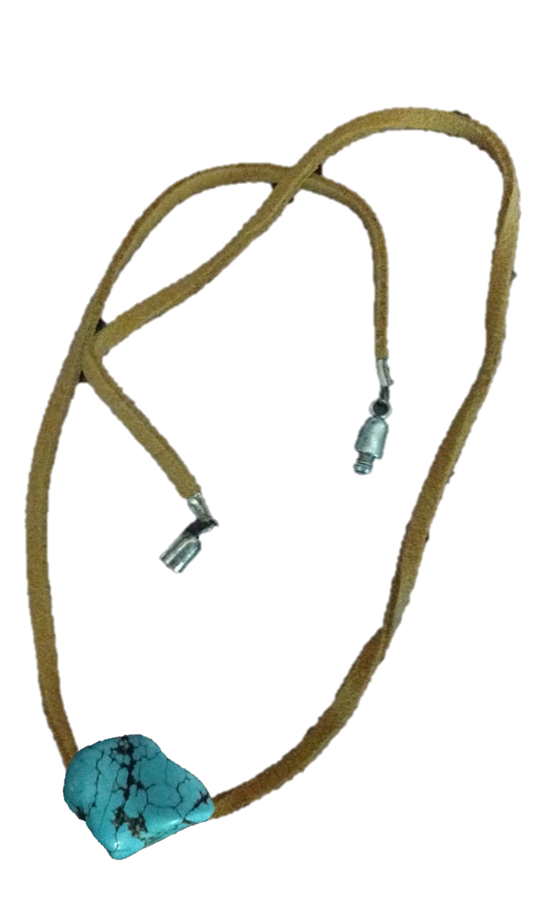
    I’ve been trying to think of a segue from there into my flash fiction response to the challenge set by Charli Mills at the Carrot Ranch this week. Charli’s prompt is to In 99 words (no more, no less) include a juxtaposition between the ordinary and natural worlds. Now that I look at it again, I’m not so sure my response quite fits, so perhaps that is fitting in itself. It seemed like a good idea at the time: matching the turquoise stone to the colour of Marnie’s eyes, which I didn’t even include!

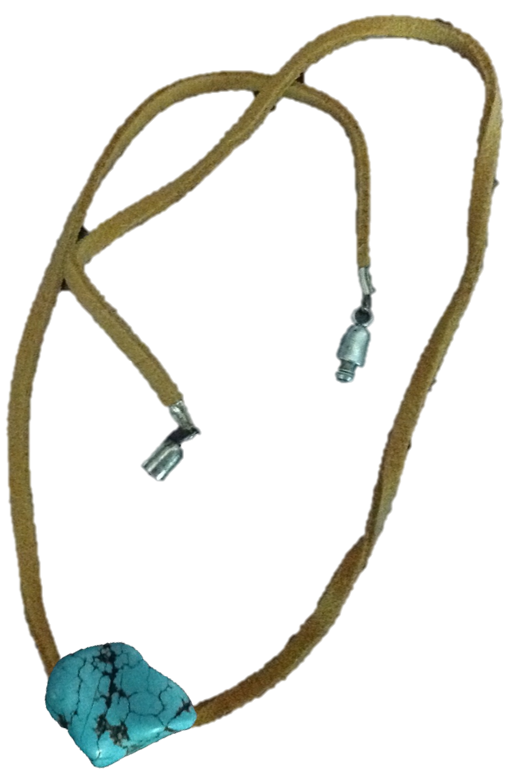
    turquoie necklace

    Here it is anyway, the next little revelation of Marnie’s story that continues on from this one:

    Juxtaposition

    She paused her dusting, as often she did, scanning the fading faces. Her gaze lingered, as always, on one. She gave it an extra rub as if to wipe away a tear, erase the pain.

    She lifted the postcard wedged into the frame to read the words she knew so well but wished had more to tell: “Thank you, Miss. Remember me.”

    “Where are you? How are you doing?” she’d never stopped wondering, hoping.

    She fingered the smoothness of the turquoise stone, its partner given long ago . . .

    A quiet knock on the door interrupted her thoughts.

    Thank you

    Thank you for reading. I appreciate your feedback. Please share your thoughts about any aspect of this post or flash fiction.


  • Assessing the impact of blogging on writing goals

    cyberscooty, a basketball about to enter a basketball hoop https://openclipart.org/detail/205569/basketball
    cyberscooty, a basketball about to enter a basketball hoop https://openclipart.org/detail/205569/basketball

    I love writing. Always have. I usually confess that I am a better writer than a speaker.

    I like the time that I can take to choose a word or phrase and combine them to mean just what I intend.

    I like the opportunity to check a word’s appropriateness before using it. Often when speaking I leave my sentence hanging embarrassingly in mid-air while I grope around in the murkiness of my mind for the “correct” word.  Why can my fingertips find the right word, without any thought, and the tongue cannot?

    And of course there are all the opportunities that writing provides for self-expression, creativity and sharing ideas with a wider audience.

    I started out writing stories, poems and songs, as most children, do and tried my hand at short stories, children’s stories and poetry as I got older. As I became more involved with my career in education, and in raising my children, I had (or made) less time for those creative pursuits.

    There are many reasons I loved being a teacher and one of those was the opportunity it provided for me to be creative: creative and innovative in the way I worked with children to encourage their learning; and creative in writing resources to assist my teaching and the children’s learning.

    I was fortunate in having a variety of opportunities to write materials for educational publishers at different times during my career, and I am currently writing documents to support curriculum implementation for my state educational authority. But I really wanted to be in control of my own writing.

    At the back of my mind there was always the thought of sharing my teaching and learning resources with a wider audience. (Just a little bit further back, or maybe even close to equal footing, is the thought of publishing children’s stories, short stories, and maybe even a novel . . . one day.) I had had no success with submitting unsolicited manuscripts before and couldn’t think what publisher might be interested in the variety of educational resources I had made, many specifically for use on a computer.

    So a couple of years ago I decided that a website of my own was the ideal platform for sharing my resources.  Getting that website up and running is my primary goal. However, observers could be mistaken in thinking that writing a blog is my primary goal. The path to establishing a website has taken a side-track via blogging.

    venkatrao, A butterfly flying with a dotted path over a hill background https://openclipart.org/detail/69967/1278212857
    venkatrao, A butterfly flying with a dotted path over a hill background https://openclipart.org/detail/69967/1278212857

    Blogging, Twitter, Facebook and other forms of social media were recommended me to right from the beginning as a way of targeting and establishing an audience. At the time I was familiar with none of these and set off learning how to become involved. It has been an exciting journey. I have learned lots and made many wonderful online friends.

    However I am not sure how far it has moved me towards achieving my website goal. In fact, I think very little progress has been made.

    • I have not found and established my “target” audience and am really none the wiser about doing that.
    • The time that I am spending writing, reading and commenting on blogs is time that I am not spending on preparing materials for my website.
    • I need to be more proactive in finding illustrators for my work.
    • When I discovered the Teachers Pay Teachers site and established my Teachers Pay Teachers Store I had thought this may be an alternative avenue for sharing my work. But I haven’t been as successful there as I would like either. This may be telling me something about my website goal. What is it telling me? Should I listen?

    So my dilemma comes down to these questions”

    To blog or not to blog?

    How to blog?

    How much time for blogging?

    The answer to the first one is easy:

    Yes! I very much enjoy writing my post and receiving the almost immediate feedback from the wonderful community of writers I engage with.

    Yes! I love reading and commenting on others’ blogs and joining in the discussions that ensue. We are a S.M.A.G. group: Society of Mutual Appreciation and Gratitude. What’s to not like?

    The second two questions are a little more difficult.

    The focus of my blog is education, but my audience consists of writers. Educators have shown little interest in developing a relationship with me online. I haven’t been able to figure that one out, but I have a few hazy ideas, none of which I think I want to address at this stage. If I change the way I blog I would quite likely fall out with the community I have become part of; and there is no guarantee I would pick up a teacher audience. So I’ll have to keep mulling this one over for a while.

    The third question is the one I have been “researching” for close on five months. As time is limited and I need to devote more time to achieving my primary goal, it is important that time spent on blogging activities is worthwhile.

    I decided to find out who is keen to engage with me and who isn’t.

    I began keeping a record of the number of comments I made on others’ blogs, and of those they made on mine.  It wasn’t always as I expected, and highlighted some interesting trends; the main one of which I have noted above:

    Writers have a wonderful sense of community.

    The record helped me ensure that, if someone visited and commented on my blog, I would visit and comment on theirs, maintaining a balance as much as possible.

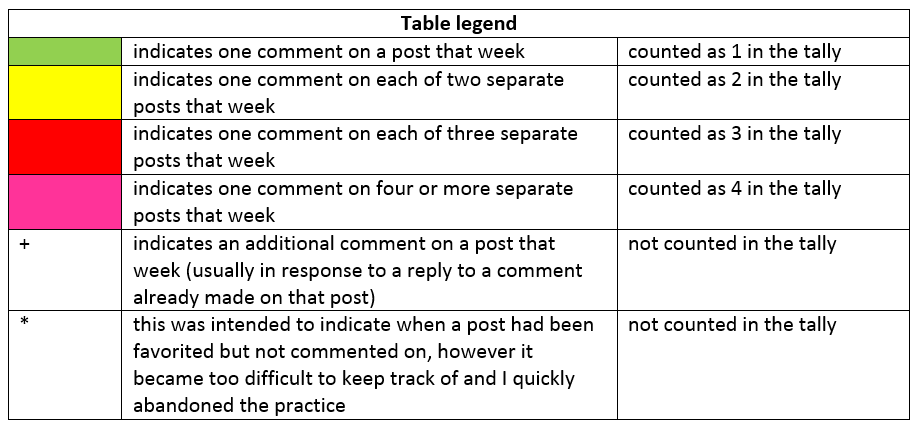
    This key explains how to interpret the information on the tables below.

    Table legend

    I have removed names from the tables to respect privacy. (I don’t really expect you to look too hard at the tables. You have better things to do. But they do look pretty!)

    November 9 2014 – Jan 24 2015

    Slide1


    Jan 25 2015 – March 26 2015


    Slide2

    I have not included all blogs I “follow”, or even all the ones I have ever commented on. Only the ones on which there has been some consistency in connecting.

    I have also not included the comments of those who follow and comment on my posts but do not have a blog of their own on which I could reciprocate.

    I generally post twice a week.

    Others post more often.

    Sometimes the number of comments I make on their posts in relation to their comments on mine is affected by the greater number of times they post. If someone chooses to post more often than twice a week, I will not necessarily read all their posts, regardless of how much I enjoy reading them, as there are other ways I must use my time, including a reading greater variety of writer’s work, and getting more done on my own. I’m sure they have enough other readers to not miss me!

    Sometimes when a blogger posts less frequently than I do, their comments on my posts may tip the scales in my favour. I can’t do much about that either, but I do try to catch up when next they post.

    I have found that it can take a few weeks of commenting on a blog I like to get a return visit and comment on my blog. Frequently I don’t even get a response to a comment I’ve made on theirs. I guess that’s how it goes. Some bloggers blog to develop community. Others blog to broadcast. I just need to decide how best to use my time.

    If you have walked with me to the end of this post, thank you. It is rather longer than I intended. I had intended to respond to Anne Goodwin’s invitation to join in a writing process blog hop , Sherri Matthews’ invitation to join a workspace blog hop, and Sarah Brentyn’s questions for writers, as well as explain my writing goals to Sacha Black, thank Julie stock for her Sisterhood of the World bloggers award and draw on Paula Reed Nancarrow’s wonderful survey about Twitter #hashtag days and blogging. But they will have to wait. We all have others things to do.

    Contributing partly to my procrastination with responding to these wonderful invitations, which I do very much appreciate, is that I have already nominated the majority of bloggers I follow, or if I haven’t someone else has. And the remaining ones don’t wish to be nominated. What is a girl to do? I’d appreciate your suggestions.

    Thank you

    Thank you for reading.

    I appreciate your feedback. Please share your thoughts and advice, especially about how to increase time. If anyone knows a good time alchemist, I’d love to meet her!

  • Displaying symptoms or true colours

    For just over a year now I have been participating in the weekly flash fiction challenge set by Charli Mills of the Carrot Ranch. I enjoy participating for a variety of reasons, including:

    Challenge: I enjoy the challenge of

    • thinking of something to write
    • telling in story or scene in the 99 word total
    • applying it in some way to my blog’s focus on education

    Variety: I enjoy writing in various forms and genres and the fiction is a pleasant change from the informational writing that I am primarily engaged with at the moment

    Practice: The requirement to tell a story in just 99 words means that I need to:

    • choose my words carefully to make my meaning explicit
    • decide what can be told, what can be implied, and what can be omitted
    • think of alternate ways of expressing an idea or describing a situation or character

    rough-writers-web-compCommunity: The Congress of Rough Writers: I have made connections and online friendships with a wonderfully supportive and encouraging group of bloggers, whose numbers are constantly growing.


    Feedback: The feedback that I receive in response to my flash fiction pieces and the posts in which I embed them gives meaning and purpose to the writing. I enjoy the in-depth discussions which quite often occur in response to the blog’s content and the additional thinking that I often need to do as a result. While it does distract me somewhat from my longer-term writing goals, the immediacy of the feedback is encouragement to continue and I am always appreciative of it.

    There are many other reasons and benefits of participating in the challenges. The above are just a few. If you have not yet considered joining in the fun, now might be the time to do so.

    www.openclipart.org
    http://www.openclipart.org

    This week Charli Mills wrote about a vivid dream that compelled her from her bed in order to capture it on paper before it escaped. She says that

    “Characters sneak into our dreams, our waking moments and tease us. We write to find out who they are.”

    Thinking about the character from her dream led her to consider symptoms, and the way that symptoms reveal more of who they are.  She challenged the Rough Writers to In 99 words (no more, no less) write a story to reveal a character’s symptoms. 

    Many of my responses to Charli’s challenges have been written to find out more about Marnie, who reveals snippets of her life, as if in flashbacks or dreams, at various ages. You can read what we already know about Marnie here.

    “Symptoms” seemed perfect for revealing a little more about Marnie. A child such as she would display a great variety, an important one of which would be her attempt to hide those symptoms from others.

    Here then is the next part of Marnie’s story, which follows on from the bullying episode shared last week.


     Symptoms

    The children suddenly appeared: one bedraggled and muddied, the other exuding authority.

    “Brucie tripped her. On purpose!” declared Jasmine.

    “Come on, Marnie. Let’s get you cleaned up,” said Mrs Tomkins. ”Then we’ll see about Brucie.  Is your mum home today?”

    Marnie looked down and shook her head.

    “Will I help you with that jumper?”

    A jumper? It’s too warm . . .” Her thoughts raced.

    Marnie turned away. As she pulled up her jumper, her shirt lifted revealing large discolorations on her back.

    Over the years Mrs Tomkins had seen too many Marnies; too many Brucies; never enough Jasmines.


    Sadly, children like Marnie and Brucie are very real and very familiar to many teachers.

    A few weeks ago I shared a post by Julieanne Harmatz on her blog To Read To Write To Be. I always enjoy reading Julieanne’s blog because it helps me walk right back into the classroom, in my mind. The Student Z she described in that post has many “symptoms” in common with other students I have worked with over the years.

    This week Julieanne shares ways she provides authentic opportunities for using digital technologies in her classroom. One of the ways is student blogging, and Julieanne linked to a post written by one of her students, Zoe. I was very impressed. I’m sure you will be too.

    In the post Zoe shares information about, and links to, her favourite song and singer. She says it is her “favorite song because it teaches you why not to bully.”

    The song is a rap version of “True Colours” with additional original anti-bullying content written by 12 year old MattyB to support his younger sister who is excluded and bullied because of her “symptoms”. I have not linked to the song here because I would like you to read Zoe’s blog and listen to the song there.

    I was so impressed by Zoe and MattyB, both showing traits of strength and of being an “upstander”, as described by Mrs Varsalona in the comments on Zoe’s post,  that I decided to find out a bit more about MattyB.

    Here is the story of how MattyB and his family wrote the song to support MattyB’s sister Sarah.

    I love to hear positive stories like this, don’t you?

    Thank you

    Thank you for reading. I appreciate your feedback. Please share your thoughts about any aspect of this post or flash fiction.

  • Stop bullying now!

    No bullies allowed2

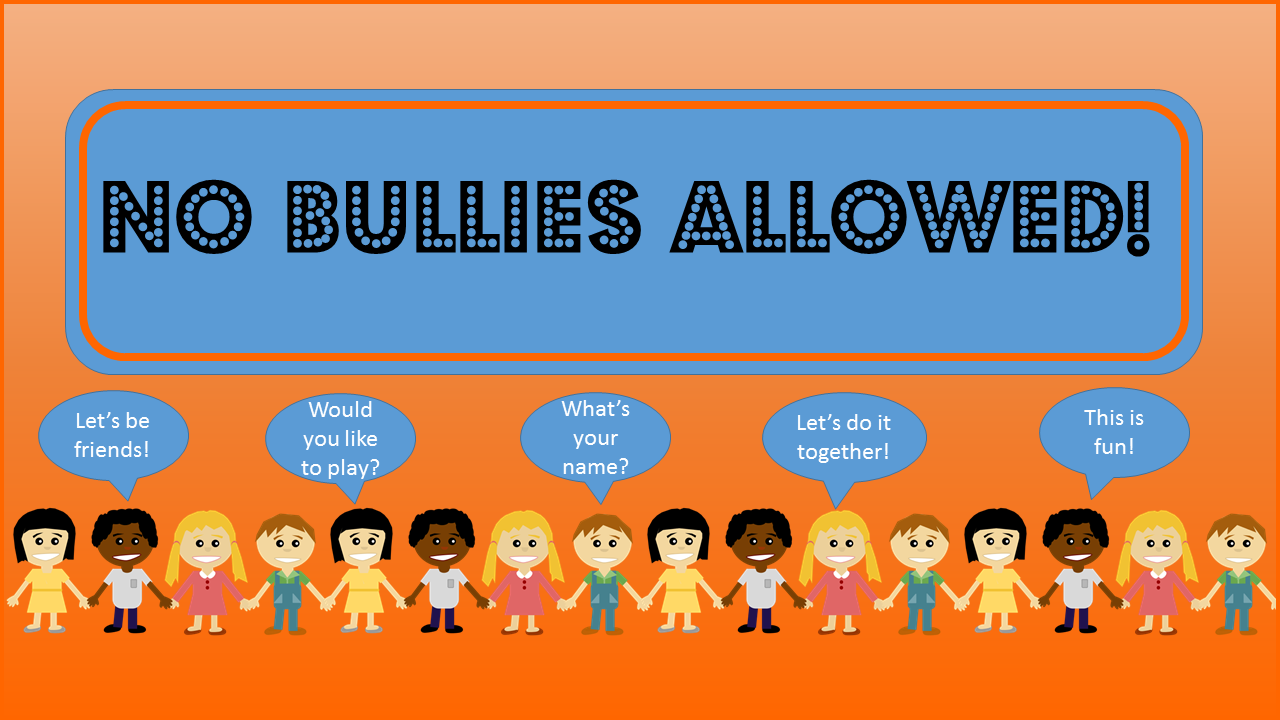
    Today all across Australia children, teachers and other school personnel are dressing in orange to mark the National Day of Action against Bullying and Violence. The Bullying No Way! Program aims to

    “create learning environments where every student and school community member is safe, supported, respected and valued”

    A very worthwhile goal, I’m sure you’ll agree.

    The Bullying No Way website has resources for parents, teachers and students, including this video for young children:

    The Prime Minister Tony Abbott delivered a message to children telling them that there is no place for bullying in Australia, that bullying is wrong.  I definitely agree!

    Picture1

    Last month Yvonne Spence organized a very successful #1000 Speak for Compassion campaign. This month she has placed the focus on bullying and requested bloggers to unite their voices against bullying. You can join in by visiting the Facebook page. I have already linked my most recent post Bully for you! as well as this one. There are many others there to read.

    Last week Charli Mills extended a challenge to write a flash fiction story about bullies. She has compiled the wonderful stories in her post Circling the Bullies.

    My previous post, Bully for you! received many comments, some sharing experiences of bullying, either of themselves or someone close to them. One comment was from a new visitor to my blog Sherrill S Cannon who shared information about her books dealing with bullying for children, and also explained her involvement with I’m bully free.org to which she donates 50% of the revenue from her books purchased through that page.

    There are many other organizations that promote information about and actions against bullying worldwide.  Hopefully as more voices unite in making others aware of, and in speaking out against bullying, we can come close to eradicating it from our society.

    As Michelle James commented on my previous post

    “More needs to be done to prevent bullying. I really believe that there should be more intensive courses for teachers and administrators to learn to deal with the bully issue. We will never eradicate bullying completely. It is a tactic used by despots and terrorists, and sadly, they seem to thrive.”

    Many of the comments on the post last week were in relation to the bullying incident involving Marnie. I share her story again here in case you missed it:

    Not funny at all!

    Jasmine and Georgie rushed towards the cluster of children who were laughing hysterically at something unseen. They expected to see an entertainer performing magic tricks. Instead they saw Marnie, face down in a puddle, reaching for her unicorn; sobbing.

    “Good one, Brucie!” Two boys high-5ed. Another called, “Way to go!”

    The children stood transfixed by the spectacle. Jasmine pushed through. She picked up the muddied unicorn, stretched out a hand to help Marnie up, then put an arm around her waist,

    As she led Marnie away Jasmine glared at the group of disbelieving faces.

    “Shame on you,” she said*.

    *Thanks to Donna Marie for suggesting I change “mouthed” to “said”.

    In this piece I tried to show that there may be many participants in bullying, not just the obvious “victim” and “bully”.

    Marnie is the obvious victim. But there were many onlookers. None, except Jasmine, spoke up against the bully. By their silence were they condoning it? Or were they fearful that they would be the next targets if they said anything? Does that also make them victims? How does that affect their confidence and self-image?

    Brucie was the obvious bully, causing Marnie’s embarrassment. But what of the boys who applauded with their high-5s and words of encouragement? Were they joining in because they too were mean; part of a gang of bullies? Or like the other onlookers, did they feel threatened about what may happen to them if they didn’t join in?

    But is Brucie also a victim? What makes a bully a bully? Why did he pick on the vulnerable? What in his life caused him to act this way?

    And what of Georgie who stood back in the crowd and did nothing while her friend Jasmine went to Marnie’s rescue? Why was she reticent to support her friend?

    I wonder, too, what they all said when they turned away. Did they speak out in private about the bullies? Geoff Le Pard commented on a similar lack of support for him when he was bullied at school.

    Jasmine was the only one who came to her rescue? Why did she? How was she feeling? Had she been the victim of bullying and so felt empathy with Marnie? Did she just know it was wrong and that it was important for someone to take a stand? What had happened in her life to make her so strong?

    Donna Marie of Writer’s Side Up commented how being bullied had ruined her boyfriend’s life and suggested that more needs to be done to change the bully’s behaviour. Perhaps some bullies need protection from bullies themselves. Did they need to learn the behaviour somewhere?

    https://openclipart.org/detail/205654/Angry%20Smiley
    https://openclipart.org/detail/205654/Angry%20Smiley
    https://openclipart.org/detail/213515/Emoticon%20-%20tongue
    https://openclipart.org/detail/213515/Emoticon%20-%20tongue

    The word bullying is sometimes used to describe a one-off unpleasant incident, like poking out a tongue or showing the “rude” finger. However bullying usually refers to something more ongoing, where there is an imbalance of power, the “stronger” picking on the “weaker”.

    To avoid becoming the weaker, I think children need to develop resilience. They need to realise that just because somebody says it doesn’t make it true. They need to learn to take responsibility for their feelings, realise that they can choose to feel upset or choose to ignore it. I am in no way saying they should ignore aggressive, violent, intimidating behaviour, but learning to be resilient about the little things helps to develop strength of character.

    I think we would probably all agree that bullying is a complex issue with many facets. That education is required to reduce its incidence is a given. What do you think?

    Thank you

    Thank you for reading. I appreciate your feedback. Please share your thoughts about any aspect of this post.


  • Who wants five-year old sheep? Bah!

    Who wants five-year old sheep? Bah!

    Recently, thanks to a recommendation by Anne Goodwin, I read a great article on the website of The Writers’ Centre at Norwich. This article is called “Fuelling Creative Minds” and was written by Meg Rosoff. The article is part of The National Conversation about writing reading, publishing and bookselling, or why books matter.

    Rosoff introduced her article by questioning what we consider to be success in life. She discussed a study of 268 men over seventy-five years conducted by George Vaillant who concluded that “warmth of relationships throughout life have the greatest positive impact on ‘life satisfaction‘”.

    Rosoff said that,

    “If you live a happy and fulfilled life, then you die successful. “

    but wondered why, then, “do we persist in measuring success in terms of salaries, job titles and assets?” if they have little real impact on one’s happiness.

    Rosoff suggested that a good place to start thinking about attitudes to success is in school.

    The next part of her article was devoted to attitudes towards success in schools. Rather than provide just an outline of her thoughts, I am quoting them in entirety, as I don’t want to misrepresent her ideas and she says it all so well. While she discusses specifically the situation in the UK, I think many readers will recognise similarities to their own locale. I have highlighted parts that I find particularly noteworthy. I do recommend, however, that you follow the link and read her article in full.

    Excerpt from: “Fuelling Creative Minds” by Meg Rosoff and published by The Writers’ Centre Norwich 1 March 2015

    “In the twenty-first century, educational success is largely determined by the government.  The government puts in place a series of goals that evaluate children as young as three against measures of socialisation, reading proficiency, an understanding of numbers, the ability to answer questions in an acceptable, established manner, and later – during GCSEs and A levels – the ability to pass exams in up to twelve subjects and write essays in a strictly approved fashion.  

    Success in school requires hard work and a competitive approach to study on the part of students – but more to the point, a successful student is one capable of achieving goals as defined by the exam graders, as defined by the government.

    A successful student is one capable of matching learning to this very specific series of goals.

    In other words, a child who reads all day is not a successful student.  A child who writes brilliantly and with a distinctive voice but can’t spell, is a failure. A child who loves history but can’t write an essay in the approved manner, is doomed.  A child who loves stories, who loves to dream, who makes unusual connections, whose brain works in unconventional, peculiar ways – but who can’t multiply 11 x12 – is not a successful student.

    Successful students must sit still and concentrate for long periods of time, temporarily memorise large amounts of information, understand and achieve received goals, think inside the box.  A desire to please and a willingness to conform are key.

    The least successful children in this sausage factory will be branded from the age of five. Children with parents or carers who don’t talk or read to them enough are most likely to fall into this category of early failures. As are dyslexic children.  Or eccentric thinkers. An irregular schedule, disorderly home life and financial instability all interfere with the attainment of ‘success’ as determined by the government.

    Less support at home, fewer books, a less regular schedule, a less orderly home life, less healthy meals, less consistent love – all these economic or emotional disadvantages further condemn the five year old to failure.  Food banks, immigration problems, substance abuse problems, unemployment, parental absence or mental illness – all of these elements interfere with the attainment of ‘success’ as determined by the government.

    I see them when I visit secondary schools – the children branded failures because they can’t get on in school. Because they’re bored, or not very verbal, or not very good at sitting still and taking information in as required in a classroom situation – or the ones who just don’t see why thirteen years of their lives should be spent taking exams they’re not good at, absorbing information in a manner that hasn’t changed much in two hundred years.  ‘Not a student’ is a label that has condemned decades of children to a diminished sense of what they’re capable of in life.  When in fact all it means is, ‘does not thrive within government parameters’.

    Do I buy into the idea that these students are without value?  Of course not.  Put them in a different sort of learning environment or teach them something that stimulates their imaginations and they’ll be fine.  But sit them in a classroom for thirteen years with a series of targets chosen by a government that knows nothing at all about education and they’re doomed.

    In contrast, the most successful children in this whole process of learning and taking exams will get all A*s and go to Oxford or Cambridge, after which they will go on to have what most people consider to be the most successful lives – the best jobs, the highest salaries, large and comfortable and expensive houses and cars.

    And yet.

    In a 2014 book, Excellent Sheep: The Miseducation of the American Elite and the Way to a Meaningful Life, award winning American essayist and educator William Deresiewicz concerned himself with what’s going at the top level of American education.

    ‘Our system of elite education manufactures young people who are smart and talented and driven, yes, but also anxious, timid, and lost, with little intellectual curiosity and a stunted sense of purpose … great at what they’re doing but with no idea why they’re doing it.’

    This was written about Harvard and Yale but applies just as well to elite British universities. Like the highest rated state primary and secondary schools, these institutions take few risks – they admit top performing, highly driven teenagers and turn out graduates with no motive to question the status quo, no motive to question the structure of society or the weight that society puts on a certain kind of success.  

    If you win a beauty contest, you don’t dedicate your life to challenging society’s perceptions of beauty.

    William Deresiewicz continues:

    ‘So extreme are the admission standards now that kids who manage to get into elite colleges have, by definition, never experienced anything but success. The prospect of not being successful terrifies them, disorients them. The cost of falling short, even temporarily, becomes not merely practical, but existential. The result is a violent aversion to risk.’

    All of this is happening at exactly the moment at which the world most needs risk takers: individuals willing and able to retell the story of society in a more positive way.  People willing to take risks with meaningful social and political change. Hardly anyone would disagree that our political system needs changing – free market capitalism has led to terrifying extremes of wealth and poverty.  The pharmaceutical industry needs meaningful change along with the system of drug patents that price simple, inexpensive drugs out of the reach of entire populations whose lives they might save. The legal system favours those with money, as does education, as does housing.  In the meantime, there is little financial motive to stem – or even acknowledge – the devastating effects of global warming.  It is difficult to think of a single aspect of life on earth today that couldn’t do with rigorous deconstruction and rethinking.

    If schools are going to train a better class of political leaders, entrepreneurs, scientists, parents, and social policy-makers, they’re going to have to ask themselves which qualities to promote.  If we require a more compassionate, more radical, less class-riven and self-centered definition of success, where does it begin?

    I would like success to be redefined.  I would like a successful man or woman to be defined as one who thinks creatively and laterally, who questions authority and accepted wisdom, who lives thoughtfully, generously and not entirely for personal gain.  To be successful, I believe, it is important to leave the world a little bit better than you found it.

    How do we do this?  By listening to the wise and enduring voices of our civilization – by encouraging each new generation to read history and philosophy and to think big thoughts – about religion, politics, ethics, love, passion, life and death and the origins of the universe.  The extraordinary imagination of our species – as expressed in poetry and fiction, music, art, dance – might someday spill over into cures for cancer and war and inequality. This will happen not by thinking about what we are, but what we might be.

    A further striving after knowledge and meaning is the proper goal for education.  Everyone doesn’t need to achieve A*s.  But everyone needs to learn how to live a good, creative, questioning life.

    What we don’t need are more five-year-old failures and more excellent sheep. “ 

    Thank you


    Thank you for reading. I always appreciate your thoughts and feedback but, if you have some to share about this article, I’m sure The Writers’ Centre would love to hear them too. If you have time, please copy and paste them over there as well to keep their conversation going.


  • Empowering women – International Women’s Day

    international women's day


    Yesterday, 8th March 2015, was celebrated as International Women’s Day around the world. While the day has a history (or herstory) of over one hundred years, yesterday marked the 40th anniversary of the date being claimed for this celebration by the United Nations and the 20th anniversary of the signing of the Beijing Declaration and Platform for Action.
     “The Platform for Action covers 12 critical areas of concern that are as relevant today as 20 years ago: poverty; education and training; health; violence; armed conflict; economy; power and decision-making; institutional mechanisms; human rights; media; environment; and the girl child.”

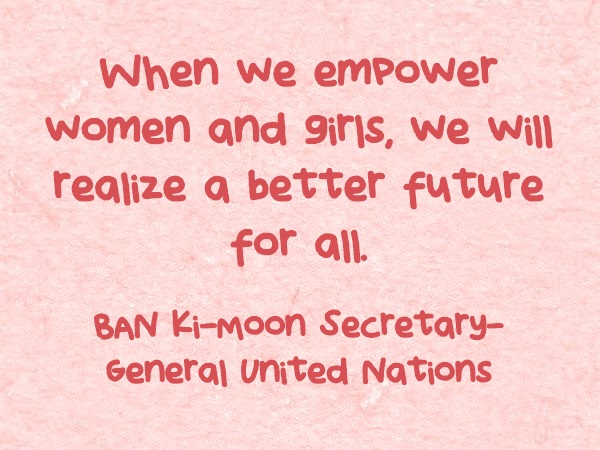
    The Secretary-General of the United Nations concludes the foreword to the 2015 paper with these words:

    When-we-empower-women

    The paper states that

     “Nearly 20 years after the adoption of the Platform for Action, no country has achieved equality for women and girls and significant levels of inequality between women and men persist.”

     This article in Time Magazine recognises that, while some gains have been made, there is still much more to be done to eliminate inequality. It repeats the call to action made by the UN Women Executive Director Phumzile Mlambo-Ngcuka:

    In line with the general achievements that have been made towards gender equality, and the gaps that still exist, is the situation for girls in schools, especially with regard to maths and science education. While more girls are moving into those areas than did when I was at school, there are still not enough.

    Ainissa Ramirez, who describes herself as a “Science Evangelist” says in her article Girls and Science: A Dream Deferred, that it is important to nurture girls’ interest in science and maths.

    She says that “the data . . . shows that the difference among graduates is not due to girls’ ability to do math and science; instead, the gender gap is caused by attitudes and behaviors toward girls and women, especially in the classroom.”

    This article by Claire Cain Miller in The New York Times reinforces this, saying that the attitude of elementary teachers is even more influential that attitudes in the home. Miller says that

    “Reversing bias among teachers could increase the number of women who enter fields like computer science and engineering, which are some of the fastest growing and highest paying.”

    This article by Sue Wilson cites research confirming the bias of teachers against girls showing that boys often received higher marks than did girls of equal ability. While the girls were discouraged from continuing their studies of maths and science subjects, the boys (whose teachers had over-assessed their ability) went on to be successful in those subjects.

    For the past three years during which time I have been writing science curriculum documents, I have had the extreme good fortune of working with one of Australia’s top science teachers. In fact Deb Smith has won many awards for her science teaching including the Prime Minister’s Prize for Excellence in Science Teaching in Secondary Schools in 2010. Throughout her career Deb has been an advocate for girls in science and has encouraged many girls, who otherwise would not have, to pursue careers in science.

    I haven’t yet considered whether Marnie, a character I have been developing through my flash fiction stories, would have, let alone pursue, an interest in maths and science subjects. I think it would be all she could do to survive.  You see, Marnie’s childhood had little to recommend it: a dysfunctional family in which she suffered neglect and abuse, and difficulties at school and with friendships as a result. However a teacher like Deb Smith or Ainissa Ramirez could make a difference to her engagement with those subjects. Marnie was fortunate that a teacher saw in her something special and provided support and guidance at a time that was crucial to her survival.

    This week, in response to the prompting by Charli Mills at the Carrot Ranch to In 99 words (no more, no less) color your story turquoise, I take Marnie one step closer to empowerment. Charli says that turquoise blue evokes trust and strength. I have also heard that it signifies protection, friendship and peace. What wonderful qualities to aspire to for Marnie, and for all women. Coincidentally, it is my favourite colour.

    Here is my flash fiction response to Charli’s challenge, with a Marnie who has found a new inner strength and sense of peace, and recalls the trust that was given in friendship along with a charm for protection.

    I hope you enjoy it.
    turquoie necklace

    Turquoise dreaming

    Marnie paused at the gate. The house looked the same: roses by the steps, bell by the door, windows open and curtains tied back; just as she remembered.

    She shuddered as the memory of her last visit flashed momentarily: she was running, almost blinded by tears, stumbling with fear, up the steps, to the open door and open heart. She rubbed the turquoise pendant Miss had given her then, for “protection and peace”. She had worn it always.

    Now, Marnie walked the path with an unfamiliar lightness. It was over. Really over!

    She knocked at the door.

    Thank you

    Thank you for reading.

    I appreciate your feedback. Please share your thoughts about any aspect of this post and flash fiction.