Live Love Laugh Learn … Create the possibilities

Category: Education

  • It’s all in how you look at it

    © Norah Colvin
    © Norah Colvin

    Is the jar half full or half empty?

    Many years ago I was employed to be an “agent of change” in a school. My job title was Resource/Remedial Teacher and my role was two-fold: to fix up the children who were “failing”, in reading especially, and to “teach” the teachers more effective strategies for teaching and learning. To say it was a difficult role is an understatement. Think of the old lightbulb jokes.

    psychologist lightbulb

    It is just as difficult for change agents.

    But the job wasn’t without some rewards.

    © Norah Colvin
    © Norah Colvin

    Easy fix

    Teachers considered that one brief session each week in a small group of other children would not only be sufficient to “fix” a child’s learning difficulty, it would also fulfil any requirement to provide differentiated instruction for the learners in their classrooms. “He goes to remedial,” both explained the child’s lack of progress and released the teacher from the obligation to make any other concessions or attempts to support the child.

    Improve teaching

    It soon became obvious that the attitudes of teachers fitted into two opposing “camps”, with a smattering of differences along a continuum stretched between. There were those who focused on the children, what they knew, what they needed to know and how to help them learn. These teachers were creative and innovative in their approaches, trying out new ideas and constantly on the lookout for ways to engage, motivate and inspire children.

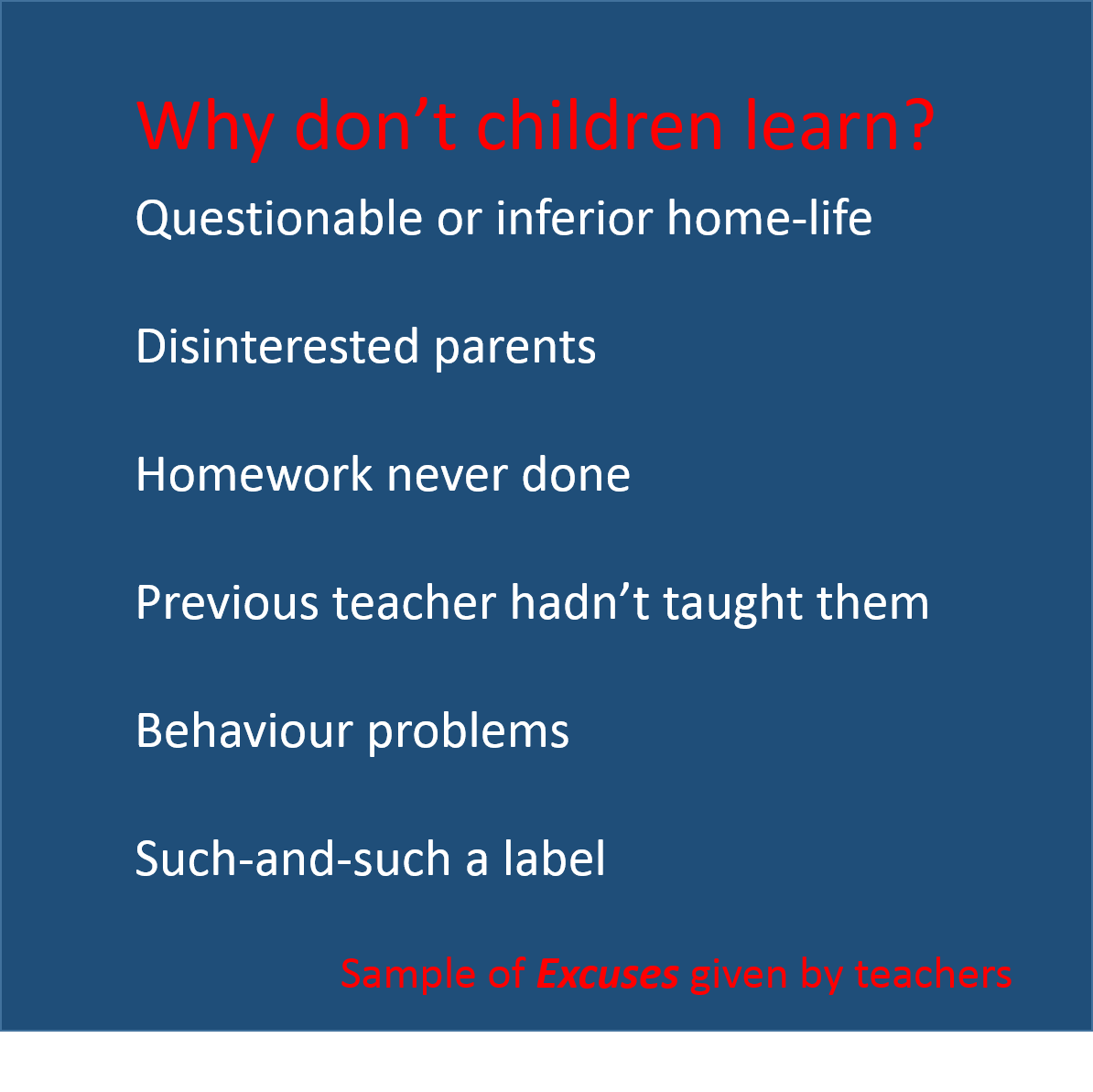
    There were those who were focussed on what was to be taught, on their lesson plans, assessment and results. They expected the children to attend, respond and learn because that was what was expected of them. If the students failed to learn what was taught, the teachers questioned neither their methods nor the content for its suitability to student needs. Rather they found the fault to be with the students who were lacking in some way. Their view was of students as empty vessels to be filled, and if they did not fill from what they were offered, then it was the vessel, not the method of filling that was faulty.
    © Norah Colvin
    © Norah Colvin

    So many times the teachers would complain that they had “taught” the work but the students hadn’t learned it.

    In “my world”, if there was no learning there had been no teaching; and I found this attitude difficult to comprehend or accept. Nonetheless I tried to be understanding, patient and supportive, listening to and restating their complaints to ensure them I had understood. I would then make gentle suggestions like “Have you tried?” “Have you thought about?” Rarely was I successful in getting them to reflect upon, interrogate or make adjustments to their practices. I guess if they saw no fault with their practices, why should they change?

    A current focus in assessment driven school programs is what the students can and can’t do, with the main focus on the “can’t”. I much prefer changing perspective to the “not yet” thinking and growth mindset of Carol Dweck.

    success


    This week at the Carrot Ranch Charli Mills is talking about perspective. She challenges writers to In 99 words (no more, no less) write a story that has a shift in perspective. It is right up my alley. Thanks Charli!

    Inside

    They slumped around the table, eyes transfixed on hands clasping coffee cups, bemoaning their lot, each desperate to outdo the other in frustration and despair.

    “They just don’t get it.”

    “I’ve tried everything.”

    “They don’t listen —”

    “They’re so rude —“

    “In my day we wouldn’t dream —“

    Outside

    They welcomed the kiss of sun upon their cheeks, the freshness of air to their lungs; and breathed as one in wonder.

    They found cloud-painted sky pictures, brightly coloured beetles in green grass stalks, claw-made scratches in the rough tree bark; and brimmed with wonder.

    and dared to dream …

    Thank you

    Thank you for reading. I appreciate your feedback. Please share your thoughts about any aspect of this post or flash fiction.

  • Ignorance is bliss … Learning to be explicit

    My Dad used to say that what I didn’t know wouldn’t do me any harm. He was not impressed when a brother wrote in my autograph book when I was in my early teens that what I didn’t know wouldn’t do me much good either!

    © Norah Colvin
    © Norah Colvin

    I’m torn between the two. I have come to realise that the more I know, the more there is to learn.

    the more I know the more there is to learn

    This learning journey never ceases. Each step is just one further into the unknown. I seem to know less now, or need to know more now, than I ever have before. How can that be?

    There are those around me who are content with who they are, with where they are, with what they are doing, and wake up to each day wanting no more than it brings. I strive to achieve that contentment, and practice the joy of being in the present moment, believing strongly in its rewards. But at the same time I strive to do more, to learn more, to achieve more. The doing and learning is joy in the present moment, for me. It is both exhilarating and disheartening to realise that the learning journey stretches so far ahead.

    Learning about learning

    I have spent almost my entire life thinking and learning about learning and education, particularly literacy education and the education of young children. Though the journey has been long, my knowledge is narrow and small, and of absolutely no use in a trivia quiz, unless the question happens to be about a nursery rhyme, and then don’t ask me too much about its “real” or original meaning.

    GDJ, Humpty Dumpty https://openclipart.org/detail/223086/humpty-dumpty
    GDJ, Humpty Dumpty https://openclipart.org/detail/223086/humpty-dumpty

    When I set upon my journey to create a website of teaching resources that I had made, I thought it was an easy thing. I had many resources already made. I just needed to get some illustrations done and put them on a website. What could be simpler than that?

    Simple?

    Every step I take drives me deeper into complexity, into the unknown. Unravelling the complexity demands that I be explicit, that I see and describe each minute step.

    Being explicit

    I always considered the ability to be explicit, to see and understand each step, essential to effective teaching in an early childhood classroom. If one was unable to see the exact spot where a child was going wrong, where a misunderstanding had been formed, or a misconception learned, or the potential for its occurrence, it was difficult to either prevent or repair it. I considered that ability to be one of my strengths as a teacher.

    nicubunu, broken chain https://openclipart.org/detail/22063/broken-chain
    nicubunu, broken chain https://openclipart.org/detail/22063/broken-chain

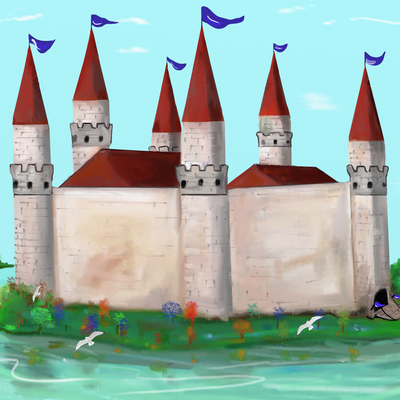
    Over the past few years when I have been giving art briefs to illustrators, my need to be explicit was stretched anew. I had to describe in precise detail exactly what I wanted. It was no use saying I wanted a castle on a hill and expect that the artist would be able to fill in all the details I could see in my mind. I had to explicitly describe it in detail:  did it need a moat or a drawbridge, was the drawbridge to be up or down, were there turrets or flags, and if there were flags, what colour and design they would have, how many windows, how many people, and what were they doing and how were they dressed …

    © Norah Colvin Artwork by Kari Rocher Jones
    © Norah Colvin Artwork by Kari Rocher Jones

    Then it was time to start thinking more specifically about what I required of the website … More complexity to unravel!

    frankes, ship – colored  https://openclipart.org/detail/214500/ship-coloured
    frankes, ship – colored https://openclipart.org/detail/214500/ship-coloured

    Oh for a journey across the seas rather than deeper into complexity!

    It is said that it is darkest before the dawn. How much darker will it get?

    A recent comment by Sarah Brentyn of Lemon Shark alerted me to the fact that although I have mentioned my website in previous posts, I had not made it clear that the purpose of the website is to make my resources available through subscription i.e. to sell my resources. While some will be available without subscription, many will be available only by paid subscription. I have received a quote for establishing the website, which I am considering. I have previously referred to it being my jetski. I think I was fairly explicit about my requirements in discussions with the designer.

    However, I want some of my resources to be interactive, not downloadable, used only on the website by paid subscribers. It appears that creating the types of interactivity I have in mind will be more problematic, but they are what I consider will be my point of difference. I have had to learn to explain, very explicitly, the types of interactions I require. I even made videos demonstrating the interactions in the hope of achieving greater clarity.

    However, it was while being explicit about these steps that I realised I had omitted something from my website brief that will be necessary for the interactions to be used effectively, if they can be made at all.

    © Norah Colvin
    © Norah Colvin

    And so I go in my merry dance – up the ladders and down the snakes, hoping to fall into a pool of clarity rather than a puddle of complexity.

    Thank you for allowing me to express my muddle through writing in an attempt to make sense of it all.

    Thank you

    Thank you for reading. I appreciate your feedback and suggestions. Please share your thoughts.


  • Breathe – a sense of wonder!

    Life is short – enjoy every moment!

    I have been privileged to spend time with young children throughout my adult life: my own, children I have taught, and now my grandchildren. Spending time with young children is one of the best ways of maintaining a sense of wonder and awe in the everyday. Opportunities abound, if one is willing to see the world afresh through their eyes,

    to notice:

    • the softness of petals in a newly opened flower
    • the collection of pollen on a bee’s legs as it rests within the flower
    • the snail’s silver trail on the pavement

    to question:

    • where the puddle goes after the rain
    • how the toothpaste gets into the tube
    • how aeroplanes stay in the air

     to wonder:

    • why the sky is blue
    • where clouds come from
    • why tigers have stripes and kangaroos hop
    • what came first: the chicken or the egg

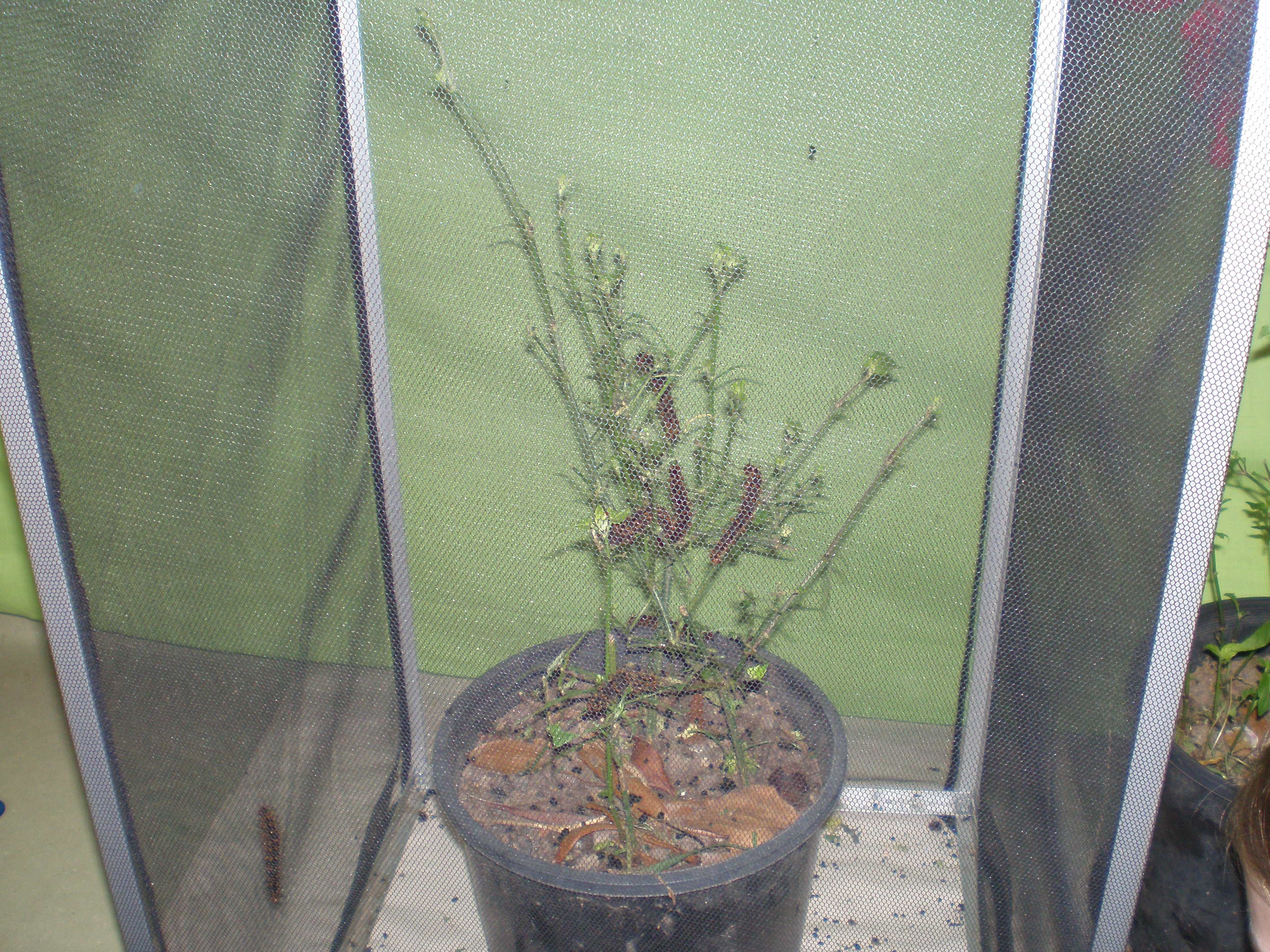
    One of my favourite ways of bringing the wonders of nature into the classroom is through observations of a live butterfly kit. We would watch the tiny caterpillars hatch, eat voraciously as they grew larger and larger, and then pupate before emerging triumphantly as beautiful butterflies.

    © Norah Colvin
    © Norah Colvin

    There are many opportunities to notice, to question and to wonder:

    • What will happen if the caterpillars eat all the leaves?
    • How big will the caterpillars grow?
    • How long will it take for the caterpillar to change into a butterfly?
    • How does the caterpillar breathe?
    • Does the caterpillar know it is going to be a butterfly?
    • Does the butterfly remember being a caterpillar?
    • What happens to the caterpillar in the chrysalis?
    • Why do they poo so much?

    We got to know that when a caterpillar was ready to pupate, it made a ‘j’ shape, hanging from under a leaf or branch, or from the top of the butterfly house. It would stay that way for a number of hours. Children (and teacher) would sneak over from time to time to see if anything was happening.

    As soon as the caterpillar started wriggling, we would quietly rush over to watch as it shed its last skin to become a pupa. It is an amazing spectacle, one that is not often seen “in the wild”. In fact it is a very quick process, and unless someone just happened to be watching at the time, we would miss it. Although we didn’t see every caterpillar pupate, we saw enough to appreciate and wonder.

    Equally as exciting was watching a butterfly emerge from the chrysalis. As the time was approaching the chrysalis would become transparent and we could see the shape and colour of the butterfly’s wings through the chrysalis. Watching the butterfly push open the chrysalis and emerge with crumpled wings was amazing. Oftentimes the butterflies would emerge in the mornings before the children arrived. But sometimes they waited, and we all watched as the butterflies pumped up their wings and spread them to dry in readiness for flying.

    When the butterflies’ wings were dry and they were almost ready to fly we would remove them from the house. If we timed it just right, we could hold them on our fingers, transferring carefully from fingertip to fingertip without touching the wings. When they were ready to fly, we would go outside and release them. The children loved to look for the butterflies at lunch time and learned that observation was the best way to appreciate them.

    varied eggfly
    Varied eggfly © NorahColvin

    The children’s interest and excitement was shared with anyone who visited the classroom: administrators, other teachers and children, siblings and parents.  I tend to think that the children’s sense of wonder may have ignited a spark in others too.

    This week at the Carrot Ranch Charli Mills challenged writers to In 99 words (no more, no less) write a story about a breathless moment. Write about life.

    Watching the short stages of a butterfly’s life is a good way to get children thinking about life, its beauty and its frailty, its dangers and its strength.  Watching the transformations that take place can certainly take one’s breath away. It is this that has inspired my response to Charli’s challenge.  I hope you enjoy it.

    Breaths - life is not measured

    Eclosion

    I heard the scurry of footsteps. Then he was in the doorway; eyes ablaze, breathless.

    “Come … quick … Miss,” he said, punctuating each word with puffs and pants.

    Before I had moved, there were others behind him, imploring me to come.

    With quickened pace I followed, hoping that I, that all, would be in time.

    Others were there already, clustered around. I peered over their heads, expectantly, holding my breath in a vain attempt to make time stand still.

    “Ahh!” we breathed in unison and awe as we watched the butterfly emerge from its now transparent shell.

    Thank you

    Thank you for reading. I appreciate your feedback. Please share your thoughts about any aspect of this post or flash fiction.


  • Life is like . . . a game of Snakes and Ladders

    http://www.morguefile.com/
    http://www.morguefile.com/

    Well, maybe not the whole of life; that would be rather two dimensional; but certainly parts of life. I’m feeling a little that way at the moment about my website plans. No sooner do I seem to find a ladder to climb up, than I encounter a huge snake, and down I go again. At the moment I seem to be stuck in a three-steps-forward three-steps-back dance.

    © Norah Colvin
    © Norah Colvin

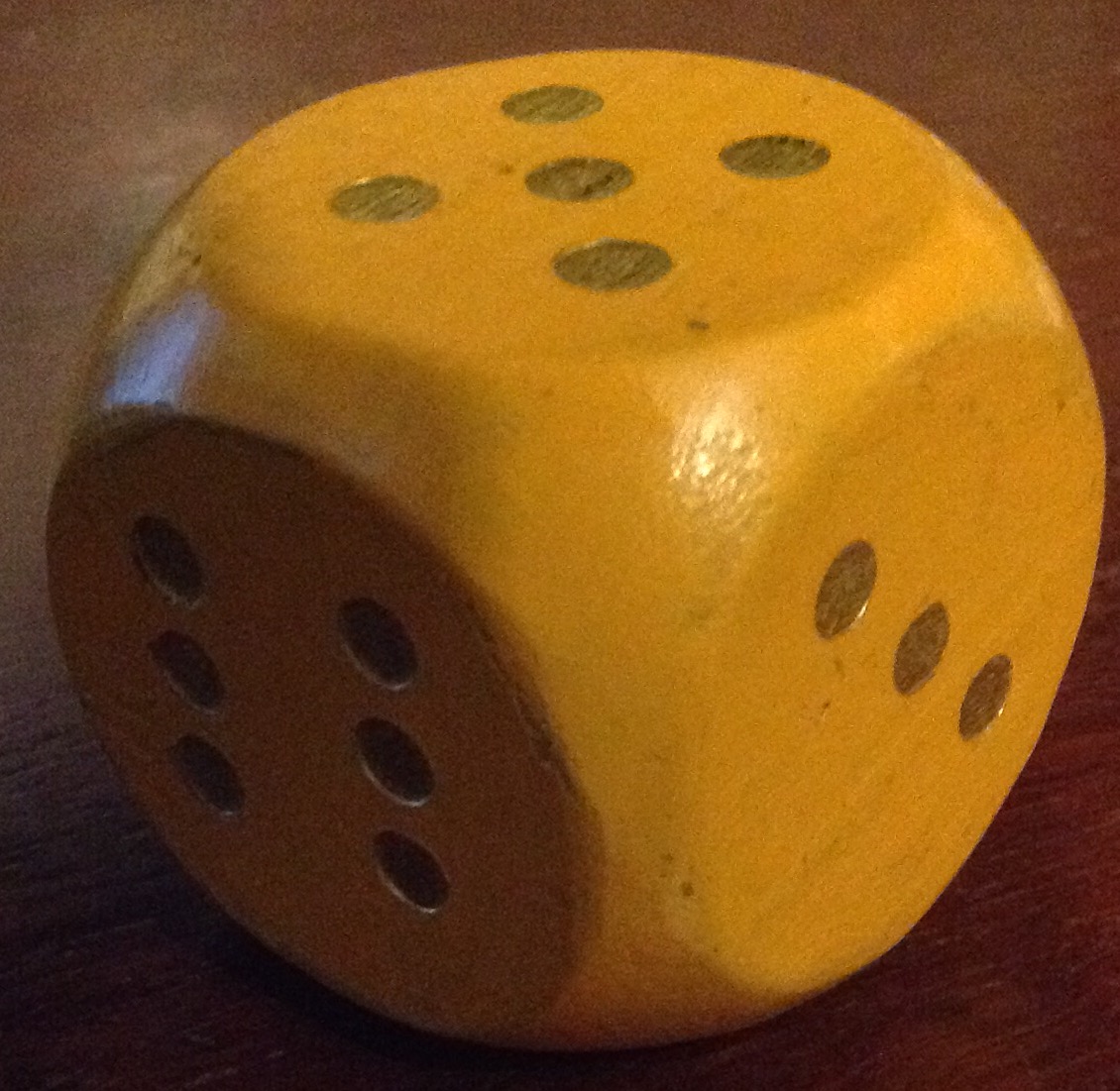
    I won’t say that everything one needs in life can be learned from playing Snakes and Ladders, but there are certainly some good lessons to learn from playing games. I mentioned some previously in Are you game? written in response to a flash fiction challenge set by Charli Mills at the Carrot Ranch; and observed them recently when playing Snakes and Ladders with my five year old grandson:

    dice

    • Getting along and taking turns
    • Acceptance – accept the roll and respond accordingly: don’t try to pretend it wasn’t a “proper” roll (e.g. dropped); or attempt to change the count by skipping or counting twice on a square
    • Resilience ­– stay strong and focused and don’t crumple with repeated setbacks: okay, so you’ve been swallowed by this same snake three times now; next time you just might overcome it
    • Persistence – keep going: you might roll a succession of small numbers but each moves you closer to the goal
    • Humour and fun – always look for the light side: it is just a game after all, it’s not the winning that matters, it’s how you play it. (On the board that we played, one of the ladders ended on the same square as a snake’s head! What could we do but laugh!)
    © Norah Colvin
    © Norah Colvin

    I guess those are lessons I need to apply to my website “game”: I have made some good progress preparing resources; I have had some work illustrated; and I approached a web designer for a quote. The ladders seemed to be lining up just right.

    Then I landed on another snake!

    In a comment on a previous post Anne Goodwin, who blogs at Annecdotal and is author of the soon-to-be-released Sugar and Snails, suggested that I be mindful of my Unique Selling Point (USP).

    I think my USP is probably the same as what I consider my Point of Difference (POD): resources that are interactive. Unfortunately, judging by the quote I received, the POD snake has an extreme appetite.

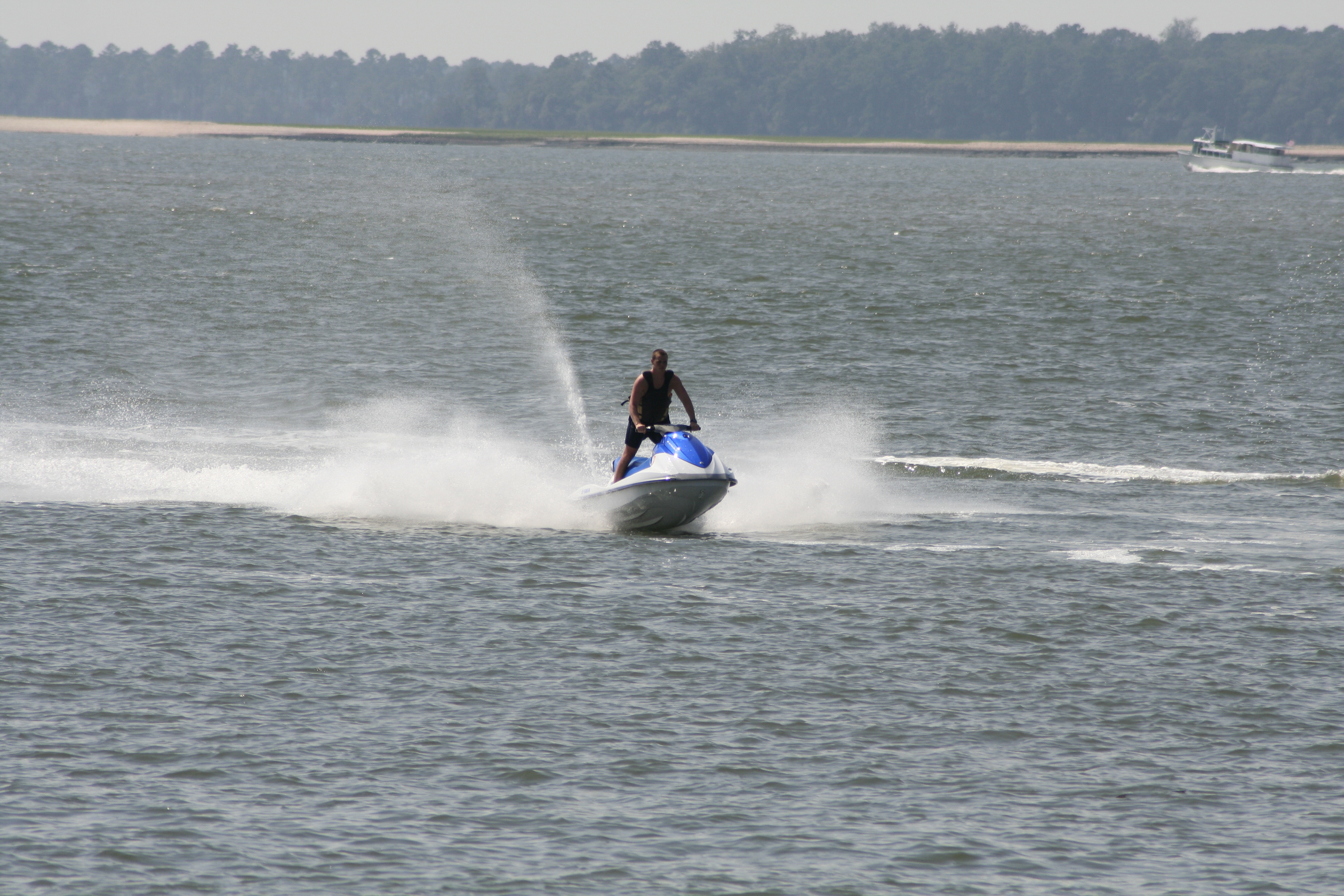
    In a post about his self publication journey Geoff Le Pard, author of Dead Flies and Sherry Trifle who blogs at TanGental, stated that he wanted to spend as little “real” money as possible. I know that I need to spend some to achieve my goals, and as a way justifying the expense to myself, if not to anyone else, I decided to consider it a “retirement jetski”.

    My retirement jetski
    My retirement jetski

    However an initial quote indicates that the interactive component of resources could end up costing as much as a Bugatti or a Lamborghini!

    http://www.morguefile.com/
    http://www.morguefile.com/

    Okay, I am exaggerating – a little.

    But I think I’ve slid down the back of that long snake and need to do a little recalculation as recommended a short while ago Charli Mills. I will let you know how I go extricating myself from the loop.

    Snakes and ladders – Opportunities for learning

    In the meanwhile, here are some suggestions for parents to make the most of learning opportunities while playing Snakes and Ladders with their children over the long summer holidays. We don’t want the progress that children have made during the term to be swallowed up by those snakes as was suggested as a distinct possibility by Sarah Brentyn in her post Harry Potter or Sidewalk Chalk? on her blog Lemon Shark. While I provided some suggestions for preventing that slide in a previous post, these suggestions are specifically for

    Making the most of “teachable moments” while playing snakes and ladders:

    On each turn, ask children to:

    • identify the number rolled on the dice and move their tokens the corresponding number of squares, counting them out. Ensure they do not count the square they are on.
    • tell the number they land on.

    Other opportunities for discussion:

    • Who is coming first? What number are they on? What number are you on? How many do you (they) need to catch up? Could you (they) catch up with the next throw? Why/Why not?
    • How many do you need to throw to land on a snake, on a ladder? Do you want to land on a snake or a ladder? Why or why not? If you land on a snake (or a ladder), will the number be higher or lower than where you are now?
    • What number do you not want to roll if you don’t want to land on a snake?
    • What number do you need to roll to land on a ladder?
    • How many do you need to win?

    Ask the children what they notice about the way the numbers are arranged. How does it differ from a usual 100 board? ( On a Snakes and Ladders board, 100 is at the top and the numbers “snake” back and forth across the board. On a 100 counting board, 100 is at the bottom and each row of ten numbers goes from left to right.)

    100 flowers outline
    100 counting board © Norah Colvin

    Ask the children why the numbers may be arranged differently (eg 100 has to be at the top so you can go up the ladders, numbers go back and forth so you can just keep going).

    But most of all, just have fun!

    Thank you

    Thank you for reading. I appreciate your feedback. Please share your thoughts.


  • Which came first – the chicken or the duckling?

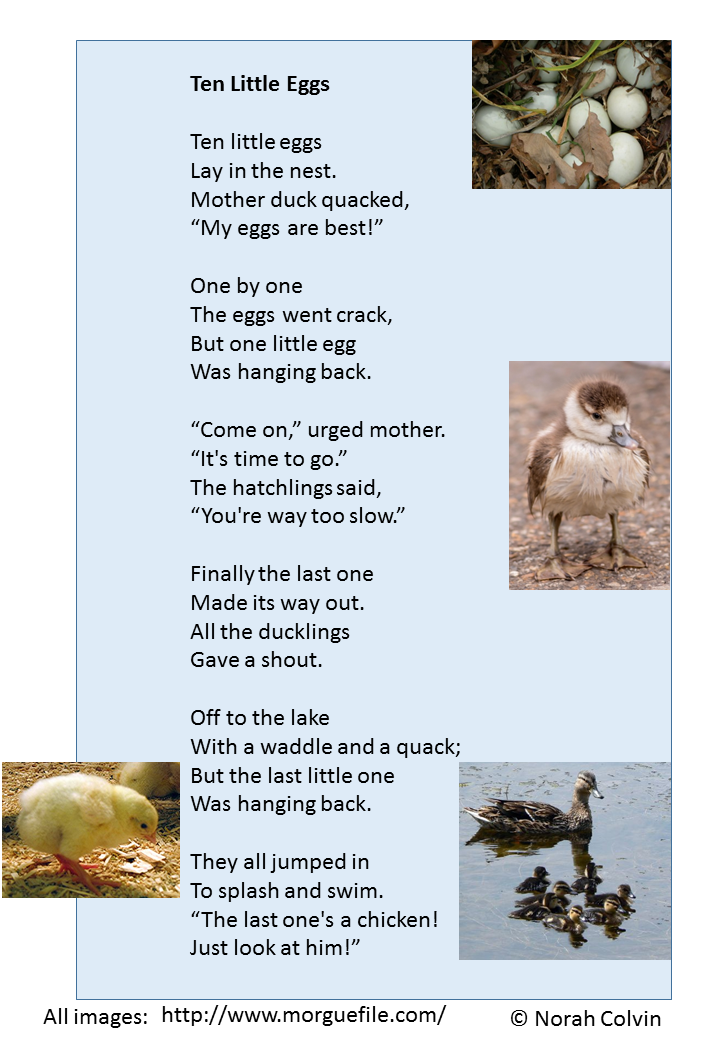
    First of all in this post I would like your opinion, if you are happy to give it, about a story for young children I have been working on.  This is it:

    Ten Little Eggs


    I recently revisited a series interrogating whether it is important for authors to ensure the correctness of information in picture books, and where the line between fact and fiction should be drawn.

    I questioned the inaccuracies in Eric Carle‘s book The Very Hungry Caterpillar and whether it mattered that what emerged from the cocoon was a butterfly rather than a moth (butterfly caterpillars don’t spin cocoons, moth caterpillars do).

    Responses varied greatly, but seemed to be evenly divided, from it doesn’t matter at all to it matters a lot. You can read the responses on the posts here, here, here, here, and here.

    I realise that the comments are subjective and personal and greatly dependent upon the readers’ experiences with the book and attitude towards the well-known, highly respected and prolific author.  I wondered what the attitude would be to my less worthy story.

    My intention was for an amusing twist at the end with the realisation that the 10th hatchling was slow because it really was a chicken, not just “chicken” as in scared.

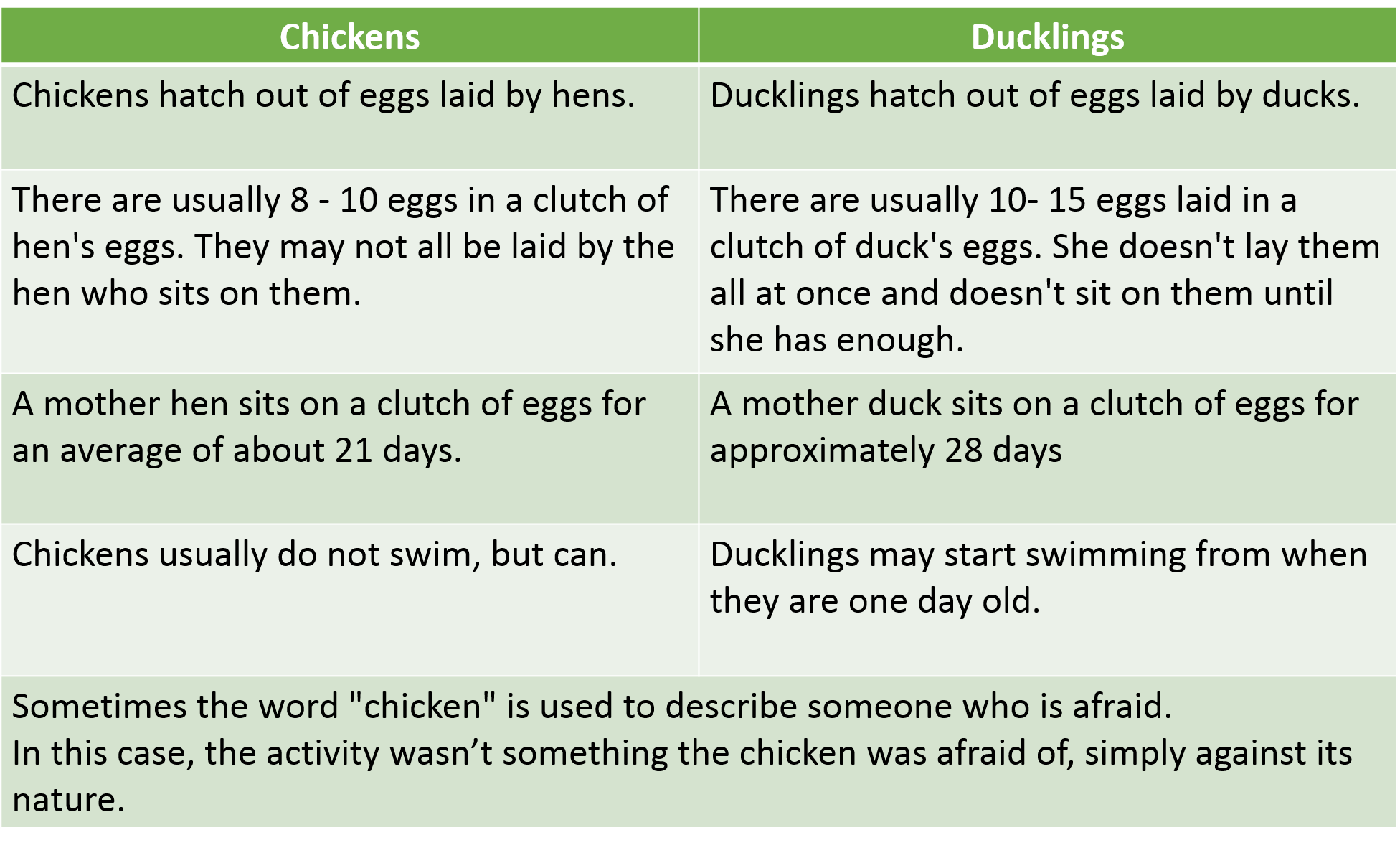
    However, when I researched incubation times for chickens and ducklings, I discovered that ducklings take longer to hatch than chickens. Therefore the story not only doesn’t work but, if I was to publish it, I would be misleading readers. While it is also unlikely that a chicken’s egg would turn up in a duck’s nest, it is possible and I am not as concerned about that inconsistency. However I stopped working on the story because of the inaccuracy and have let it sit.

    A suggestion made by Steven during the cocoon/chrysalis debate was that a page of facts at the end of the book would overcome any inaccuracies in the text. This made me think that perhaps I could include a page of facts about chickens and ducklings to counterbalance the inaccuracy in the story,  for example:

    Chickens and ducklings - Would you believe

    Thank you

    Thank you for reading. I appreciate your feedback. Please share your thoughts.

  • Experiential learning – what’s good and what’s hot

    farm

    I am a proponent of learning by experience, of learning through one’s own explorations and making one’s own discoveries. In early childhood centres it is sometimes called ‘hands on’ learning. The recommendation is to provide opportunities for children to learn by doing rather than simply by listening to someone tell about it or by reading information in a book. For example, experiencing the sights, smells and sounds of a farm create an enriched understanding of farm life that is not possible simply from looking at pictures of farm animals in a caption book. Activities like mixing and making with modelling dough, or building and creating with construction sets provide opportunities for developing numerous skills and understandings.

    That’s not to say that experiential learning is best in every situation or that learning from the explanations of others, including reading information in a book, is less worthy. Indeed there is a place for each and it is important to get the balance, timing and application right. You would not need to view many posts on my blog (for example here and here) to realise that I am a proponent of reading also and believe that instilling a love of reading is one of the greatest gifts a parent can give a child.

    In their book A New Culture of Learning: Cultivating the Imagination for a World of Constant Change, Douglas Thomas and John Seely Brown discuss the differences between explicit knowledge and tacit knowledge.  This chart shows my understanding of some of the differences.

    Explicit and tacit learning


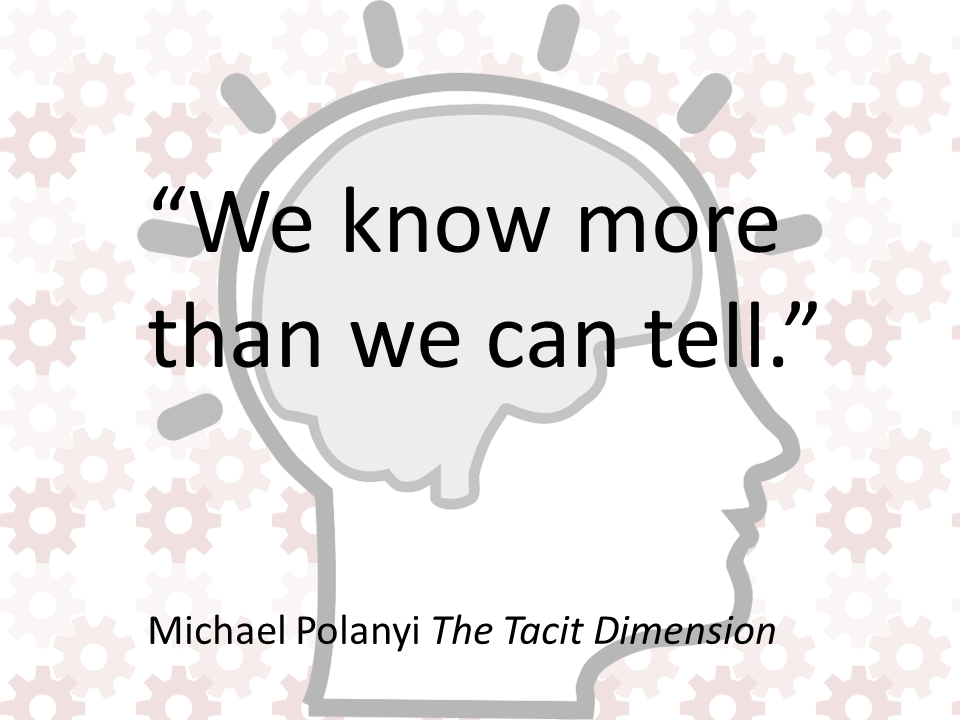
    Michael Polanyi  The Tacit Dimension

    I think it would be undisputed that there is knowledge best learned through explicit instruction and other best learned through experience. I am sure you can think of many examples in your own life, like riding a bicycle, learning a foreign language or playing a musical instrument.

    netalloy, glossy flame https://openclipart.org/detail/91951/glossy-flame
    netalloy, glossy flame https://openclipart.org/detail/91951/glossy-flame

    But what about teaching young children about heat? It is not far into the life of any young child that they are cautioned about the heat of an oven or stove, heater or barbecue plate. But what is “hot” if you have never experienced it?

    Thomas and Brown say that “when a parent first tells a child not to touch a flame because it is hot, the child will almost always put out her hand and get burned” because the child has only been given the explicit part of the information, the part that could be articulated: that “Fire is hot”. When the child is burned much more information is learned by the body: that it hurts and is unpleasant. The child is then able to make connections with other similar “hot” things and situations.

    I think neither of the authors nor any parent would suggest a child be burned “for educational purposes” but the power of experience can be seen in this example. Perhaps it also helps to explain why young children need constant reminders to stay away, or precautions need to be taken to protect them, from hot things. Without the burning sensation they have not formed a true understanding.

    thomas and brown - learning

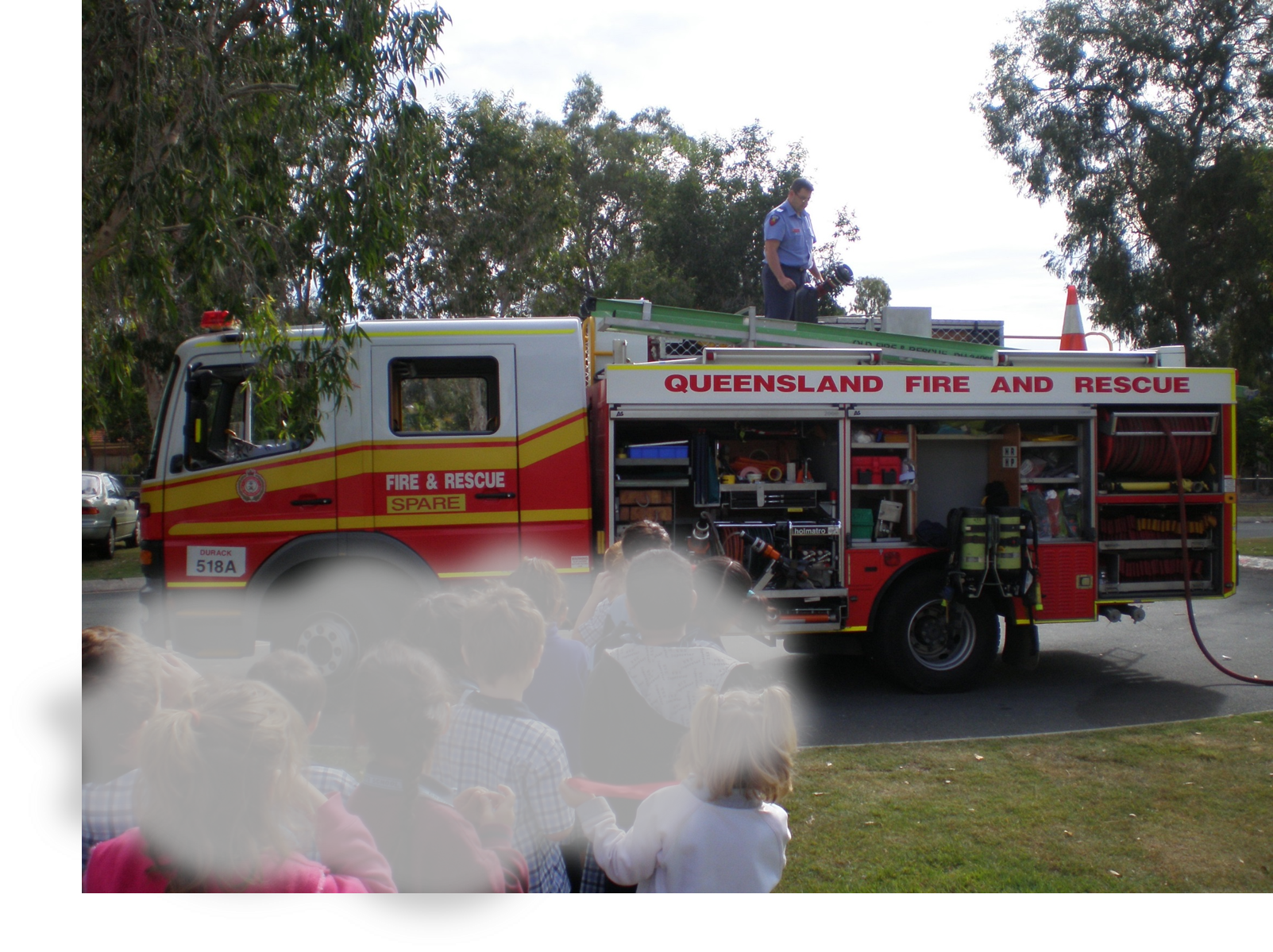
    At my previous school our year one classes were always visited by the local fire fighters who talked about fire safety, explaining the difference between “good” fires (like birthday candles, barbecues and campfires) and “bad” fires, while warning that even good fires could quickly become bad  if not monitored correctly.

    They talked about the need for smoke alarms in the home and the importance of having escape routes and meeting places planned and practised. They ensured students knew their full name and address and the procedure for calling emergency (000 in Australia) if the need should arise. These are things that all young children should know.

    firetruck

    The children were always excited about the firefighters’ visit as they got to look at the firetruck close up, maybe even sit in it or, if they were lucky, see how high they could spray water with the large hose. The tacit knowledge learned through this type of experience, combined with explicit knowledge provides a context that allows children to learn the realities of fire danger and the importance of safety. It wasn’t unusual for the crew to receive a call and rush away during one of their visits, adding further to the overall experience for the children.

    rg1924, unexpected frog in my tea    https://openclipart.org/detail/21079/unexpected-frog-in-my-tea
    rg1924, unexpected frog in my tea https://openclipart.org/detail/21079/unexpected-frog-in-my-tea

    Thinking about heat and education, and the hold that explicit knowledge and its testing has on current practice makes me think of the story about a frog in a pot of hot water.

    The story says that if you were to put a frog into a pot of hot water, it would jump out immediately; but that if you were to put the frog into a pot of cold water which is warmed slowly, the gradual increase in temperature wouldn’t be noticed and the frog would be boiled alive.

    Perhaps this is why some educational practices are accepted without question. People have become so used to them, with small incremental changes seeming insignificant and unworthy of comment. However the cumulative effects over time can be enormous. By the time they are realised, making amends would require so great a change, possibly a total restructuring, that it would defy plausibility.

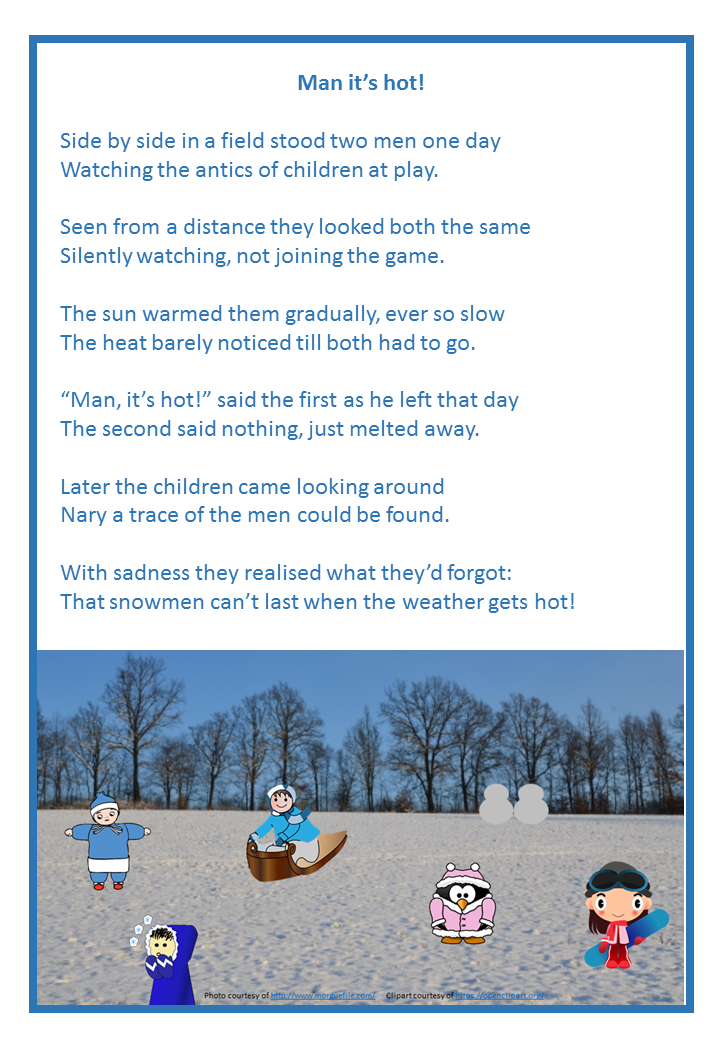
    It is this thinking that has led to me my flash response to the challenge set by Charli Mills at the Carrot Ranch this week to In 99 words (no more, no less) write a story that includes the phrase, “Man, it’s a hot one.” I hope my contribution is a little more environmentally friendly and suitable for young children than boiling frogs.

    Man it's hot

    Thank you

    Thank you for reading. I appreciate your feedback. Please share your thoughts about any aspect of this post or flash fiction.


  • Learning fun for the holidays, without a slide in sight!


    Alanspeak, A slide for children to play on https://openclipart.org/detail/191139/childrens-slide
    Alanspeak, A slide for children to play on https://openclipart.org/detail/191139/childrens-slide

    A week or two ago my good friend Sarah Brentyn who blogs at Lemon Shark (Navigating the uncharted waters of parenting and life) raised the issue of students having required reading over the summer holidays. Sarah recalled that when she was at school she had lists of books to read, and book reports to complete as proof of having done so. She expressed concern that no holiday reading is currently required of her school-age sons.

    nlyl, reading man with glasses https://openclipart.org/detail/3133/reading-man-with-glasses
    nlyl, reading man with glasses https://openclipart.org/detail/3133/reading-man-with-glasses

    The basis for Sarah’s concern is what is known as “the summer slide”, the loss of skills, especially reading, if not practised over the long summer holidays.  Studies show what teachers observe: that students start a new school year with skills at lower levels than just a few months earlier. Revision and review of the previous year’s work must be factored in before new work can be commenced.

    Sarah wasn’t so much concerned for her sons who are avid readers and will read regardless of whether it is required or not. Knowing Sarah, her sons will also benefit from an environment enriched with a variety of other learning experiences. All children could benefit from the types of support and encouragement Sarah provides for her sons.

    Sarah’s concern was for children who don’t choose reading as a holiday activity. She believes children should continue to learn over the holidays, and does not understand why learning can’t be fun. I agree with Sarah. However I am a bit ambivalent about the requirement that particular books be read, and probably am not in favour of asking that book reports be submitted.

    CoD_fsfe_Books_icon

    There was never any set reading to be done over the holidays when I went to school, or when my children went to school, and I am not aware of any such requirement of children attending school currently in Australia. The fact that it is not a requirement doesn’t make it either right or wrong. It is simply a new concept to me.

    I would be reluctant to set homework for completion over the holiday period, especially the summer holidays for a number of reasons, including:

    • students will be moving to a new class and teacher, some even to a new school, after the holidays and that teacher may not view the set work in the same way
    • students have spent the school year reading, writing and performing other activities required of them, activities that may have little relevance or interest to them
    • students may spend the holiday period in alternate activities and then rush or “fudge” required tasks, seeing them simply as work that must completed, rather than something they want to do
    • I think children need time to follow their own pursuits and interests without having to fill in a worksheet to say what they have done
    • I think children and their families need some time together without the stress of completing set tasks
    • I think it is important for children to have time to wonder, imagine and create, to be comfortable in their own company, devising their own plans and schedules and activities, some of which may be just down time (the ability to relax in an ever-hurried world is very desirable).

    gardening

    But, like Sarah, I wouldn’t always be leaving children to their own devices, allowing them to wander the bush and beach from daylight till dusk as I did during the school holidays (when I wasn’t reading a book, playing games with siblings or friends or doing household chores). I would be mindful of their activities, ready to make suggestions, provide experiences or encourage other interests; but the direction would always be theirs and never forced or “required”.

    However I am equally as keen to avoid the occurrence of that “summer slide”. As my contribution towards its prevention while also promoting the notions that learning is fun and that opportunities for it abound, I link to three of my previous posts:

    20 suggestions for maintaining reading momentum during the school holidays

    Let the children write! 20 suggestions to get children writing during the school holidays

    Counting on the holidays!

    While I reproduce the suggestions from each post here, each set of suggestions is also available as a free downloadable PDF in my TEACHERS PAY TEACHERS store. For your convenience, I have provided a link to each in the headings below:

    https://openclipart.org/image/800px/svg_to_png/174860/bookworm_penguin.png
    https://openclipart.org/image/800px/svg_to_png/174860/bookworm_penguin.png

    Reading

    1.  Read to and with your child every day – continue the practice established throughout the year with special sharing times during the day or at bed-time — or both!
    2. Demonstrate that you value reading by making time for your own reading, or setting aside a special quiet time when everyone in the family reads.
    3. Visit the library and borrow to read, read, read!
    4. Read poetry books, song books, picture books, joke and riddle books, crossword books, information books, chapter books (these can be read to younger children, or with older children – taking turns to read a page or a chapter each) — what are your favourites?
    5. Trade books no longer read for others at a second-hand book store.
    6.  When dining out, have your children read the menu and choose their own meal.
    7. Include your child in holiday cooking and have them read the recipe – ingredients and method. Perhaps they could read the recipe book to select the meal for the day.
    8. Suggest your child read the TV guide to find when favourite programs are showing and establish a timetable for viewing, rather than haphazard watching with random flicking through channels.
    9. Provide your child with bookstore catalogues and encourage them to read book descriptions to guide their next selection.
    10. Bestow upon your child the title of ‘Family weather watcher’ and have them consult weather forecasts in the newspaper or online to select the most suitable days for planned outings and activities. 
    11. Include your child in making decisions about holiday activities. Give them the guide, or read the guide together and jointly choose the activities.
    12. Make the library, museums and art galleries high on the list of must-dos. Many of these offer a wonderful assortment of free holiday entertainment for children, and reading is an essential part of getting the most from each visit! 
    13. Engage your child in some craft activities which require them to follow written instructions. The ability to understand and follow procedures is empowering and requires the ability to read written, as well as visual, instructions.
    14. Encourage your child to ask questions about every day events and phenomena. Help them to research in books at home, in the library or on the internet. 
    15. Provide eBooks as well as books in print. Good ones bring a new dimension to the reading experience.
    16. When going out for the day, or journeying further away on a holiday, support your child in locating destinations on a map and in selecting an appropriate route. Engage your child in giving directions while en route. 
    17. Include your child when reading bus or train timetables.
    18. When doing the family grocery shop, give your child their own list of items to look for. 
    19. Listen to recorded books on long car journeys, or have books for listening to or reading along with in bed.
    20. Make the most of every reading opportunity that occurs throughout the day!


    https://openclipart.org http://goo.gl/ZvsCFc
    https://openclipart.org
    http://goo.gl/ZvsCFc

    Writing

    1. Use adhesive notepaper to write messages to your child and encourage your child to write a message back.
    2. Encourage children to write letters or emails, cards or postcards to grandparents, aunties, uncles and friends. These can be to inform them of the holiday or the year’s activities, or to thank them for a visit or gift.
    3. Demonstrate that you value writing by making time for your own writing, e.g. keeping a diary, writing letters and cards to family or friends, writing a shopping list.
    4. Display a message board prominently in the home and list important events, reminders and messages. Encourage your child to add their own messages to the board.
    5. Provide a calendar or diary and ask your child to note family birthdays, holidays and events for future reference.
    6. Encourage your child to keep a diary in which important events and feelings are noted.
    7. Play word games e.g. Scrabble and other crossword games; Boggle or ‘hangman’. (If you don’t like the connotation of ‘hangman’, give each player ten counters to start with. Each time an incorrect guess is made, they give away a counter. If all counters are used then they miss that word.)
    8. Write poems and songs together.
    9. Encourage children to write and perform ‘plays’ for the family.
    10. Take photos of events during the day and use them to make a photo book. This can be done instantly on a computer with photos taken using a phone or tablet and emailed with accompanying text.
    11. Insert photos from a phone, digital camera or tablet into a slideshow program such as PowerPoint, then add text to create a digital story or record. With one click these can be saved as an automatic show or MP 4 video.
    12. Involve children in planning the weekly meals by selecting recipes for a menu they write, and for which they create a shopping list of required ingredients.
    13. Write rebus messages to your children and ask them to write a rebus message back, e.g.                 I think you are great
    14. Invite your child to create lists e.g. activities they would like to do over the holidays, movies they would like to see or friends they would like to invite to a sleep over.
    15. Encourage your children to write the step-by-step instructions for making a craft item they have just designed, or to write down the rules for a game so that everybody is sure how to play.
    16. Suggest that your child write down questions they would like answered, and then write the information discovered during research (by interviewing or asking people, reading books or internet search).
    17. Suggest to children that they make a storybook for a younger sibling or friend.
    18. When going out for the day, or journeying further away on a holiday, children could be asked to write directions for the journey as discovered by consulting paper or online maps.
    19. Help children to set up and maintain a blog to create a record of activities and events to be shared with family and friends. The posts could be regular e.g. daily or weekly, or follow particular activities.
    20. Make the most of every writing opportunity that occurs throughout the day!
    Moini, sleuth penguin https://openclipart.org/detail/221475/sleuth-penguin
    Moini, sleuth penguin https://openclipart.org/detail/221475/sleuth-penguin

    Maths

    Number and place value

    1. Count items e.g. birds in the sky, shells collected from the beach, people for lunch, steps in a staircase, windows on a house, seats in a bus . . .
    2. Count out the cutlery required for each person at dinner
    3. Include your child in shopping activities by helping them to:
    • Recognise the coins and notes
    • Count the value of coins and notes
    • Predict whether they have enough money to purchase an item, and whether there will be change
    • Tender the money in payment for an item

    4. When your child is sharing e.g. the biscuits, balloons or slices of fruit, ask them to:

    • Predict if there will be enough for everyone to have one, or more than one each
    • Share out the items, allocating the same number to each
    • Determine if there are any left over and what to do with them

    5. Use terms like half and quarter correctly, e.g. when cutting apples, oranges, sandwiches, pizza, to indicate pieces of equal size

    6. Play games that involve counting, e.g. counting the number of skips, balls in hoops, pins knocked down or dice games like snakes and ladders that require adding as well as number recognition and counting

    7. Make up number stories e.g. “We had five apples in the bowl. I ate one, and you ate one, how many are left?”

    8. Read books with number concepts e.g. Pat Hutchins The Doorbell Rang, Eric Carle Rooster’s off to see the world  or Kim Michelle Toft One Less Fish

    Patterns and algebra

    1. Use items to make patterns e.g. sort and create a pattern from shells collected at the beach, building blocks or toy cars
    2. Look for patterns in the environment e.g. fences, tiles, walls and window, zebra crossings
    3. Decorate cards and drawings with a patterned frame
    4. Make gift wrapping paper by decorating with potato prints or stamp patterns

    Measurement and geometry

    1. Include your child in cooking activities and allow or support them to:
    • measure the ingredients
    • set the temperature on the oven
    • work out the cooking finish time
    1.  A child’s understanding of volume and capacity can be developed when they:
    • pour glasses of water from the jug and discuss terms such as enough, full, empty, half or part full, more, less
    • pour from one container into another of a different shape to compare which holds more and which holds less
    1.  Scales can be used to compare the mass of different items or quantities e.g. compare an apple and an orange, measure the mass of butter required for a recipe
    2.  Measuring length can be included by:
    • measuring and comparing height
    • cutting a length of string to tie a package
    • measuring who is closest to the jack in a backyard game of lawn bowls
    1.  Use the calendar to
    • Learn the names and sequence of days in the week or months in the year
    • count the passing days or the number of days until an event
    1.  Identify shapes in the home and environment e.g.
    • 2D shapes: tiles on floor and walls, shapes of windows, sections of footpath
    • 3D shapes: cereal boxes (rectangular prism), balls (sphere), bottles or cans (cylinder), dice (cube)
    1.  Play games that involve shapes e.g. jigsaw puzzles, tangrams
    2.  Talk about directions e.g. left, right, forwards, backwards and follow directions on a grid
    3.  Play games that involve directions and movement in space e.g. battleship,Hokey Pokey,Simon Says, snakes and ladders, ludo
    4.  Read and discuss books that include measurement concepts e.g. Pamela Allen:Who Sank the Boat?(volume); Eric Carle: The Very Hungry Caterpillar (days of the week) and The Bad Tempered Ladybird (time); Penny Matthews and Andrew McLean A Year on our Farm (months and seasons); and for looking at places on a map Mem Fox Sail Away The ballad of Skip and Nell or Annette Langen & Constanza Droop Letters from Felix

    Probability and statistics

    1. When discussing the weather or desired activities include the language of probability e.g. possible, certain, likely, unlikely, impossible
    2. Encourage children to collect data about family or friends by asking yes/no questions e.g. do you like swimming, or making a graph of the family’s favourite colour or meal.
    3. Play games with spinners and dice and talk about the likelihood of spinning or throwing a particular number.


    I hope these activities demonstrate how easy it is to maintain learning while having fun over the holidays. I’m sure you will have many more favourites of your own.

    Thank you

    I appreciate your feedback. Please share your thoughts about any aspect of this post.

  • Can you dig it?

    This week at the Carrot Ranch Charli Mills is talking about dirt and has challenged writers to In 99 words (no more, no less) write a story about dirt.

    In her post Charli says that,

    writing is like gardening - Charli Mills

    and talks about sowing compassion to make our world a “worthier place to live”.

    These are wonderful ways of thinking about dirt and good reminders of the importance of the earth beneath our feet, which is often taken for granted, even ignored, unless one is a farmer, a gardener, perhaps a miner, or possibly a child.

    Morguefile  http://mrg.bz/omEd2M
    Morguefile http://mrg.bz/omEd2M

    Children are often admonished about playing in the dirt, as if washing off a little soil  was the greatest difficulty. In our towns and cities we cover the soil with concrete and leave few patches of bare earth where children have an opportunity to dig.

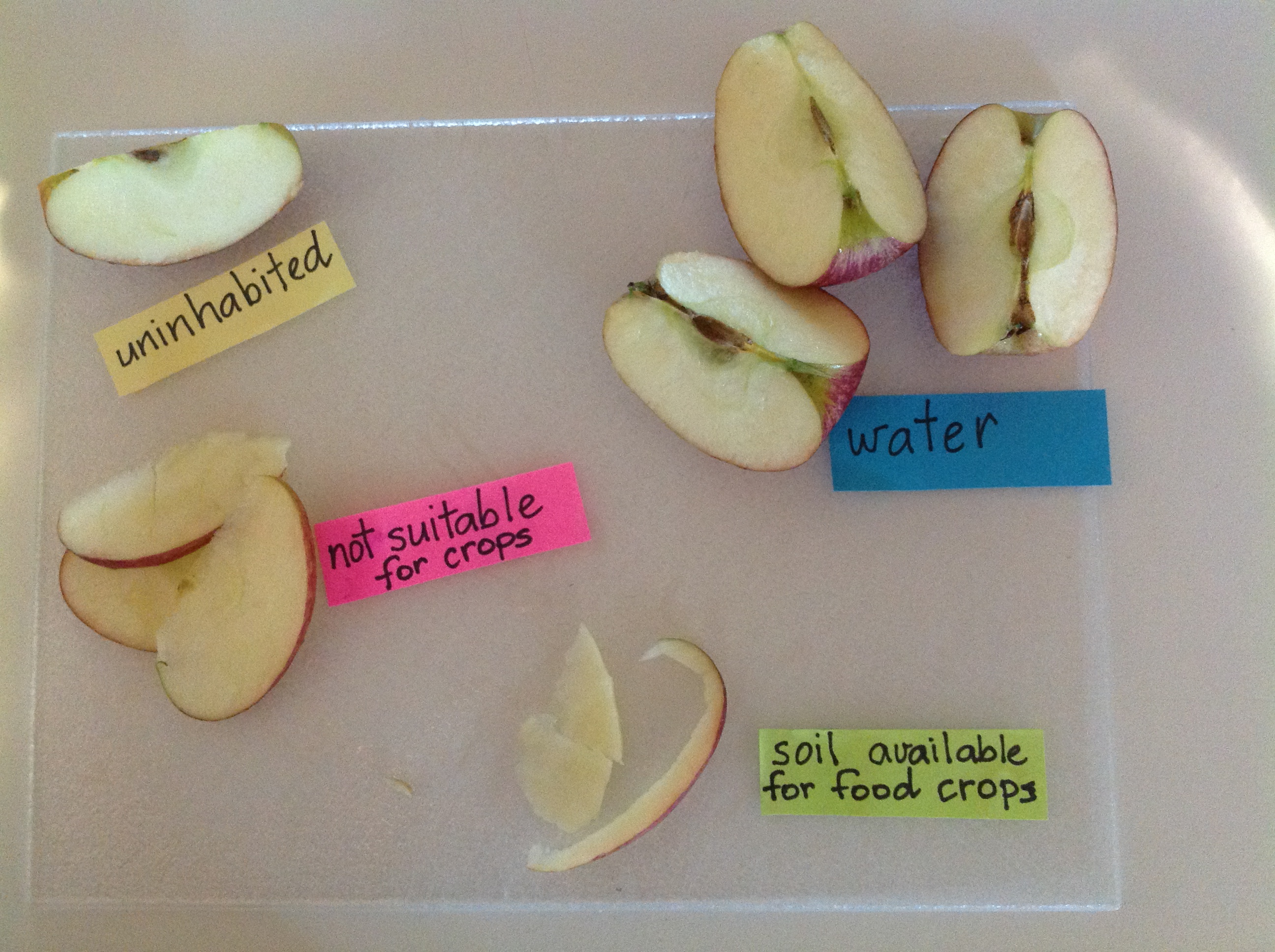
    Soil, though an essential resource of our Earth, is often overlooked. Ask a young child what living things need and they may say “water, air, food, sunshine and shelter”. Soil won’t rate a mention. But without it we wouldn’t have a thing to stand on! Nor would we have our other essentials: air, food and shelter – all dependent on the soil for their production.  The importance of soil and of conserving becomes even more evident with the realisation of how little of the Earth’s surface is available for producing food.

    © Norah Colvin
    © Norah Colvin If Earth was an apple . . .

    Another great gift from the soil is knowledge. Much of what we know of Earth’s history and human history has been revealed by the soil as successive layers have been exposed or excavated; uncovering secrets of the past and enabling a much richer understanding of earlier times.

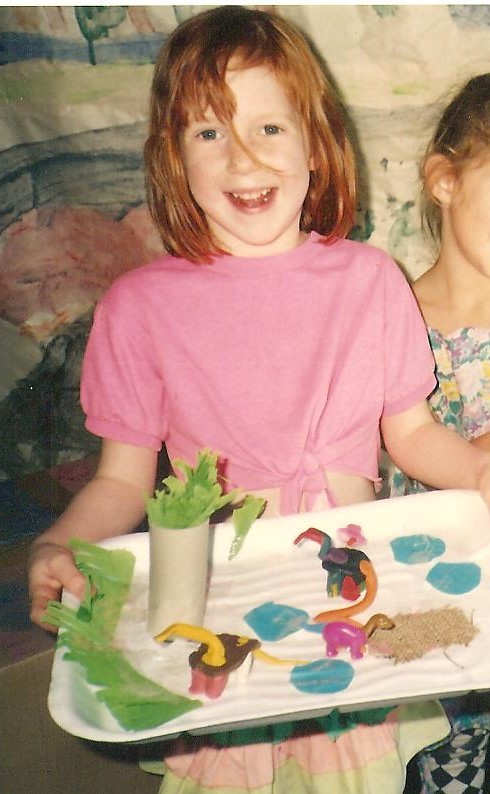
    dinosaurs at museum Jan 91
    © Norah Colvin

    Our knowledge of dinosaurs has all been revealed from the earth with the first discoveries and identifications made only a few hundred years ago.  And there is still much more to be discovered. My children and grandchildren, along with many other children and adults, are fascinated by dinosaurs. How exciting it would be to make a new dinosaur discovery, find hidden treasures or unlock secrets of the past!

    © Norah Colvin
    © Norah Colvin

    It is possible that many more dinosaur, and other, discoveries are yet to be made. The world’s only known evidence of a dinosaur stampede was found in Australia just a little over fifty years ago.  Even more recently a gardener in the UK found a dinosaur bone in his backyard! In the US, if you find a dinosaur fossil in your backyard it’s yours to keep!

    According to this video, finding dinosaur fossils is quite easy:

    The excitement of making new discoveries  and finding answers to questions is motivation for many.

    In his book Good Ideas: How to Be Your Child’s (and Your Own) Best Teacher Michael Rosen relates a story told by David Attenborough. He says that, as a child, David took an interest in bones and if he was out walking and found some he would take them home and ask his father (a GP so would probably know) about them.

    But his father didn’t just tell him. Wanting his son to be curious and interested in finding things out for himself, he responded, for example: “I wonder if we can work it out . . .” They would then look through books about zoology and anatomy and try to identify the bone’s origin.

    Knowing that it is through the comparison of found bones with bones of familiar creatures that scientists have been able to work out much of what we now know about dinosaurs and other extinct creatures makes such an activity even more exciting and inspirational.

    Rosen goes on to share an experience from his own school days. When a teacher confessed to students that he didn’t understand Comus by Milton, which had been set for study, the class and teacher spent the year together figuring out its meaning. Rosen compares the effectiveness of this approach to many others, stating that study techniques, “didn’t teach me how to find things that I really wanted to learn about. It didn’t take me down interesting side-alleys where I would find things that I didn’t know I would be interested in until I found them.” But he says what he learned from exploring Comus was “something that’s more to do with feeling than knowledge or learning: it was a confidence that I could investigate and discover things for myself. It’s ironic, isn’t it, that I got that feeling from someone who quite genuinely didn’t understand something?

    A sense of wonder and curiosity, and a desire and willingness to find out for oneself answers to one’s own questions is fundamental to learning. Digging in the dirt occasionally can’t do that much harm. You never know what new discovery you may make!

    Moini, A treasure chest with lots of twinkling gold coins, https://openclipart.org/detail/188617/treasure-chest
    Moini, A treasure chest with lots of twinkling gold coins, https://openclipart.org/detail/188617/treasure-chest

    The thought of just such a discovery is what inspired my response to Charli’s challenge:

    Digging for gold

    Her spade crunched against the obstinate soil. Then tap, tap, tap, another thin layer loosened. She scooped up the soil and tossed it onto the pile growing steadily beside the excavation site. With expectant eyes and gentle fingertips she scanned each new surface. Then again: tap, tap, tap — toss; tap, tap, tap —toss!

    She pushed back her hat to wipe her sweaty brow, leaving a smudge of dirt as evidence. She glanced skyward. The sun was high. She’d been digging for hours. She must find something soon. What would it be? Pirate’s treasure or dinosaur bones . . .?


    Thank you

    Thank you for reading. I appreciate your feedback. Please share your thoughts about any aspect of this post or flash fiction.



  • Empowerment – the importance of having a voice

    I recently revisited a series of posts about the value of using Eric Carle‘s picture book The Very Hungry Caterpillar in an early childhood setting; home or classroom.

    In this post I share a follow-up to that series which addressed the issue of empowering children by giving them a voice. At the time the post attracted quite a few thought-provoking comments which are worth reading if you haven’t already done so.

    In one of those comments it was suggested that perhaps a new edition with a correction made in response to children’s comments could be considered. It is not unlike the suggestion by Steven in the previous post that correct information be provided at the end of the book. It was felt that the “correction” would be seen by children as a response to their requests and help them see the value in voicing their opinions.

    But this post goes beyond a debate about the correctness of “cocoon” or “chrysalis”. It states the case for empowering children by giving them a voice.

    I appreciate your readership, and your comments. Please share your thoughts about any aspect of this post, including past and current comments.

    Norah's avatarNorah Colvin

    In a previous series of posts I wrote about science inaccuracies in a picture book and questioned with whom lay the responsibility for providing young children with correct information.

    While this post builds upon those posts, it also takes a divergent path: the need for children to have a voice; to be empowered to ask questions, to state their needs and report wrongdoings.

    On a highly respected educational website Scholastic, with the by-line “Read Every Day. Lead a Better Life.”, in an article about Eric Carle author of The Very Hungry Caterpillar, children are told that

    “Eric already knows that a caterpillar emerges from a chrysalis, not a cocoon! So don’t bother writing to tell him.”

    This seemingly innocuous statement may be easily overlooked but packs a powerful message.

    What does it tell children?

    The author has been told many times, already knows and isn’t going to…

    View original post 696 more words

  • Are you game?

    This week at the Carrot Ranch Charli Mills is talking about childhood games and has challenged writers to In 99 words (no more, no less) write a story that involves a children’s game or rhyme. I think she chose this topic just for me. Thank you, Charli.

    I love games and am a strong believer in the use of games to enhance learning. I have memories of playing games that span my lifetime, from early childhood until the present, and have visions of playing games far into the future.

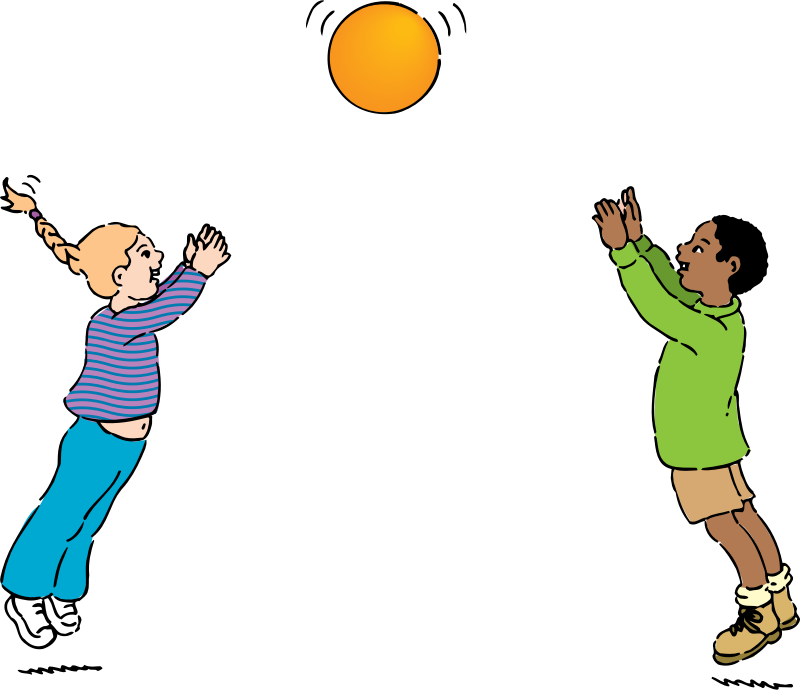
    Johnny Automatic, cartoon of a girl and boy playing with a ball https://openclipart.org/detail/721/playing-ball
    Johnny Automatic, cartoon of a girl and boy playing with a ball https://openclipart.org/detail/721/playing-ball

    One of my earliest memories of an organised game was of “Drop the hanky” played at a birthday party. I was about five years old at the time. I think that perhaps, until this event, I had only ever played imaginative games with my brothers and sisters. I was obviously not familiar with the rules or the ethos of the game. I’ll let my flash (non-) fiction explain.

    Plum pudding

    We sat in the circle chanting,

    “I wrote a letter to my love and on the way I dropped it.”

    “It” skipped around the outside, waving a handkerchief.

    “One of you has picked it up and put it in your pocket.

    Not you. Not you. Not y-o-u!”

    Suddenly “It” was running and children were scrabbling behind them.

    “Run,” they called.

    Then “It” was beside me.

    “Plum pudding!” they all screamed hysterically.

    The adult pointed to the centre of the circle. “We’ll have you for dessert,” he grinned.

    I cried, wondering what it would be like to be eaten alive!

    © Norah Colvin 2015
    © Norah Colvin 2015

    Obviously I was traumatised for the memory to be so vivid and almost nightmare-like since the memory ends abruptly with the fear. Obviously I wasn’t eaten for dessert, I survived the trauma and, to complete the fictional narrative, I guess you could say “I lived happily ever after.”

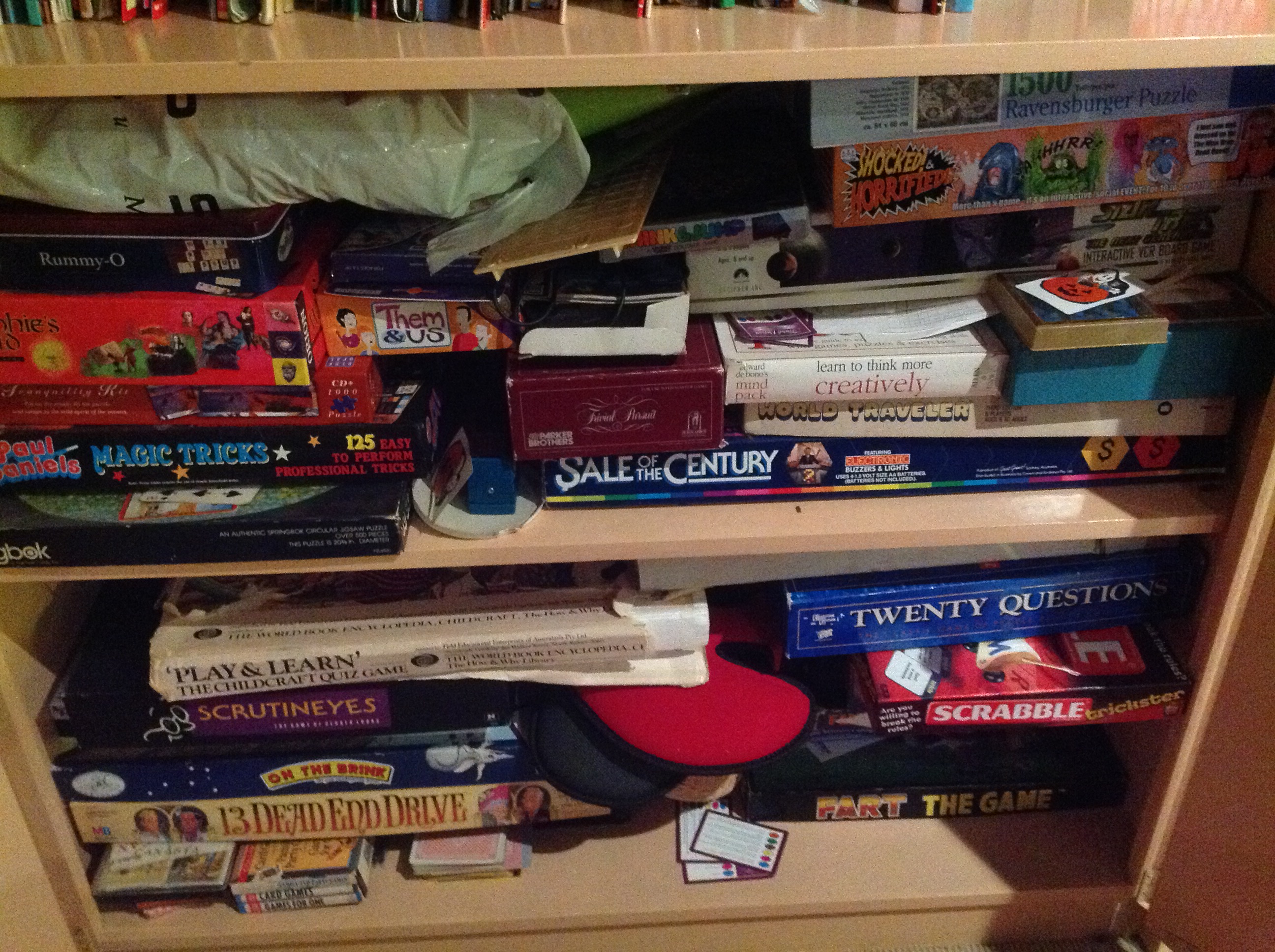
    But games don’t need to be traumatic. Games are better when they are fun; and I have many more memories of having fun with games than I do of being traumatised by them. Some of my “best” memories are of the laughs shared playing games like “Balderdash” and “Billionaire” when we (hub, son, daughter and partners) set aside traditional holidays for playing games together as a family. My house may have shelves laden with books, but they also have cupboards bursting with games.

    © Norah Colvin
    © Norah Colvin

    We didn’t always play purchased games. Sometimes we made up our own. It takes some skill in problem solving to think up a new game that will be fun to play with just the right amounts of challenge and competition, and an equal chance of “winning”, if there is a winner. Games without a winner, played for the fun of playing, are just as enjoyable.

    I have always included games in my class program. As well as being fun, if carefully chosen they can also progress learning. Games can be played at the beginning and conclusion of sessions; at transition times to reenergise, refocus and refresh; and as part of the teaching/learning program with whole class, small group or individual participation for targeting practice of particular concepts.

    One obvious benefit of playing games is the development of social skills such as:

    • Sharing
    • Taking turns
    • Cooperation
    • Dealing with competition
    • Accepting a loss
    • Accepting a win graciously

    In their book “A New Culture of Learning: Cultivating the Imagination for a World of Constant Change”, Douglas Thomas and John Seely Brown talk about ““arc of life” learning, which comprises the activities in our daily lives that keep us learning, growing and exploring.” They say, “Play, questioning, and — perhaps most important — imagination lie at the very heart of arc-of-life learning.”

    Throughout the book they talk about the importance of collaboration in engaging online in multi-player games and say that When understood properly . . . games may in fact be one of the best models for learning and knowing in the twenty-first century . . . Because if a game is good, you never play the same way twice.

    monopoly

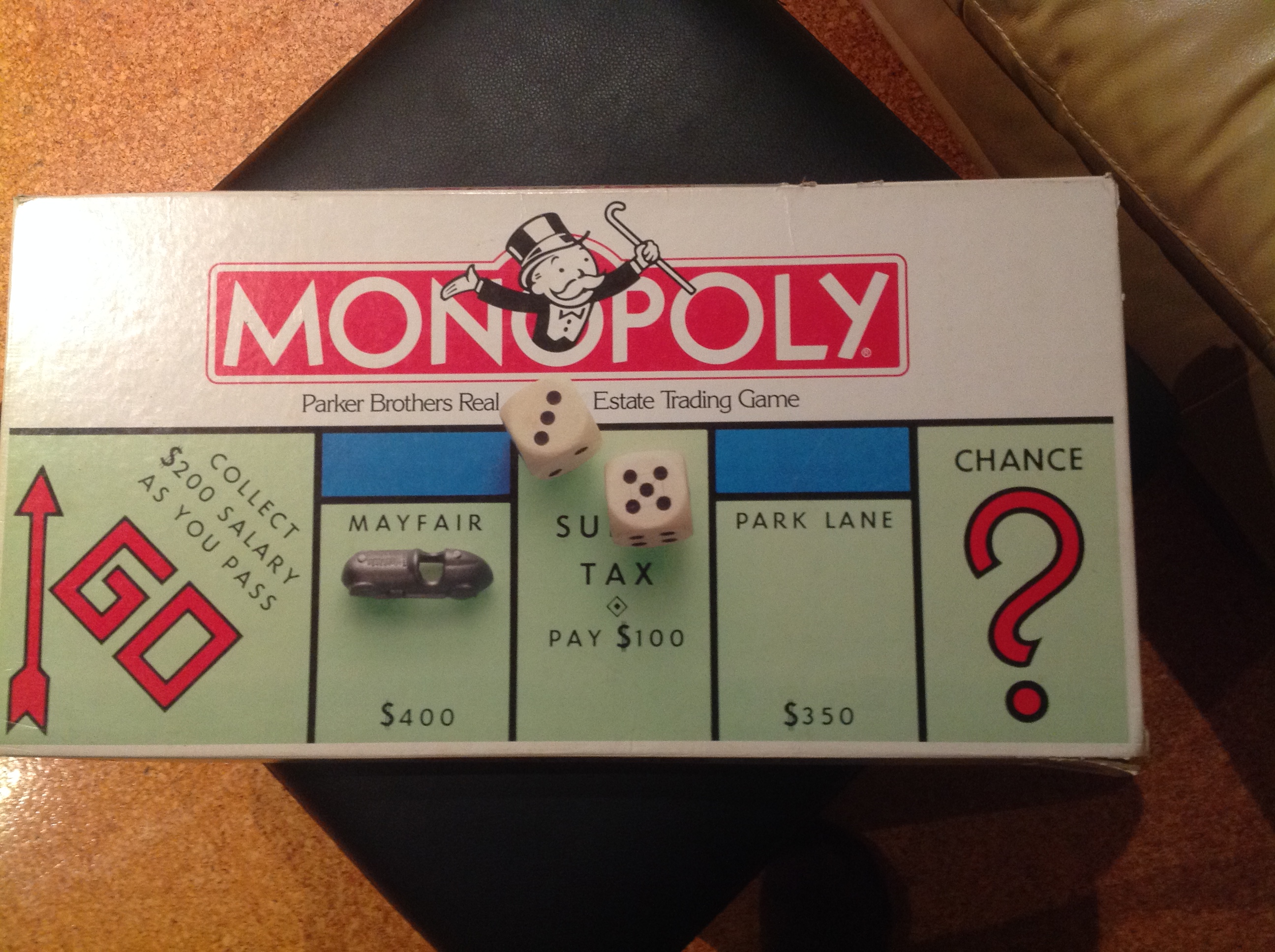
    Robert Kiyosaki in his book “Why “A” Students Work for “C” Students and Why “B” Students Work for the Government” talks about the importance of learning through games and explains how he learned, and was inspired to learn more, about finance from playing “Monopoly”. He says that Games are better teachers than teachers.” While I prefer to not agree with that statement in its entirety (I don’t even like playing Monopoly), I could understand his reasons for making it.

    Rarely a day would go by that at least one game wasn’t played in my classroom. We would play games in literacy groups that required children to read and think critically. We would play games in maths groups to practice skills in fun ways or to solve problems cooperatively. We would play games in science to try out ideas or research information. Some of the games involved physical as well as mental activity. Some were played with the entire class, and some on their own.

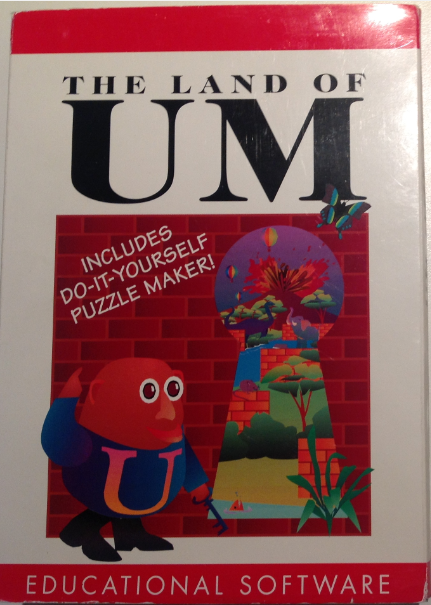
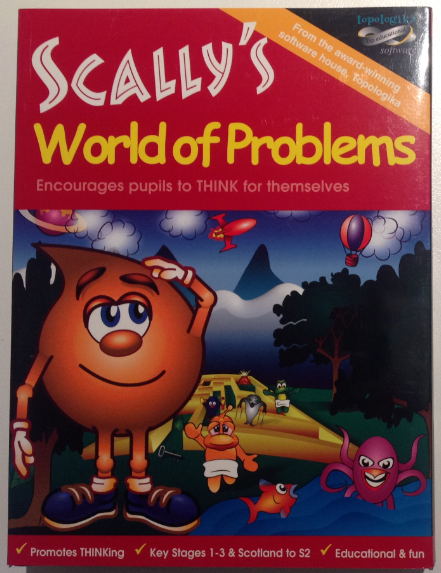
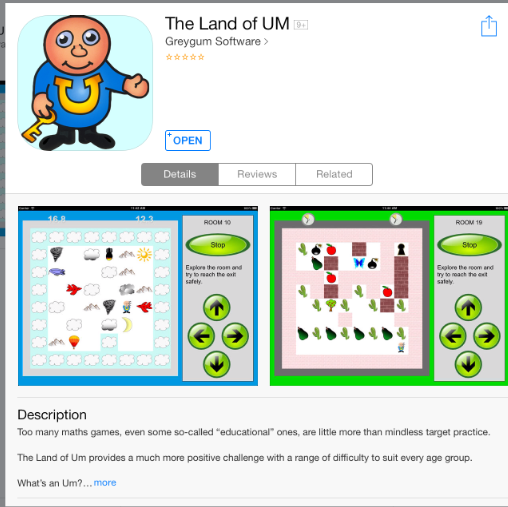
    One game we used in maths groups as well as an activity in the last few minutes of the day was a problem solving game that I was involved with from its inception, The Land of Um or, as it is known in the UK, Scally’s World of Problems. (Also available as an app.)

    http://www.greygum.com.au/nebula/index.php/the-land-of-um

    Scally


    When I was asked for an idea for a program, I suggested something that required children to explore to find out “what happens if” and “how things work”, much as they learn from their exploration of the “real world”. I also suggested that what they learn be consistent and apply at the next level. From that small seed and through the collaboration and synergy of a small group of creative people the “Land of Um” was born.

    Because, in my recollections anyway, it was “my” idea, I am very proud of “Um” and enthusiastic about its potential to encourage children to develop the thinking skills involved in solving problems.

    Um app

    In my class the children worked enthusiastically and collaboratively in small groups on an interactive whiteboard, taking turns to control the “Um” while working together to find the solution to each puzzle. As the level of difficulty increased the children needed to plan ahead, to visualise steps and predict what would happen and the effects of different actions. At each new level and in each new world, while the basics remained consistent, there was always something different to learn and explore. The children never tired of the using the program and were always eager to be the one to suggest the solution to the next problem. It was/is a joy to know that I had a part to play in the design of this program that has so many benefits to learners, not least of which is the fun of working together to solve problems.

    How significant are games in your life? What special memories do you have?

    If you are interested, there are many more stories about games to read on Charli’s blog.

    Thank you

    Thank you for reading. I appreciate your feedback. Please share your thoughts on any aspect of this post or flash fiction.