Some of my most popular posts of 2014 were those that discussed praise, growth mindset, assessment and failure.
My final post for the year included thoughts about failure and the need to reflect and refine to move forward.
It is fitting to begin 2015 with a post that revisits and extends those themes. I’m sharing a post about The Power of Not Yet I read on @TeacherToolkit’s blog. The post includes a video of Carol Dweck explaining that
“if (students) didn’t pass a course, they got the grade “Not Yet.” And I thought that was fantastic, because if you get a failing grade, you think, I’m nothing, I’m nowhere. But if you get the grade “Not Yet” you understand that you’re on a learning curve. It gives you a path into the future.”
I would much rather consider that I have not yet achieved my writing goals, than think I failed to achieve them in 2014. Not yet means I am making progress, and will continue to do so in 2015 and beyond.
In the video Dweck shares research showing a difference that having a growth ‘not yet’ mindset can make to student effort and achievement.
For me, her most powerful statement is that at the end of the talk:
“Once we know that abilities are capable of such growth it becomes a basichuman right for children, all children, to live in places that create that growth, to live in places filled with yet.”
It’s a bit like learning to ride a bike. There is no failure, just stages of growth in ability.
I hope you enjoy the article, and especially, Carol Dweck’s video.
Thank you for reading. I value your feedback. Please share your thoughts about any aspect of this post.
Most of my current writing is non-fiction with a strong focus on education. The two blog posts I publish each week generally address educational issues or share my thoughts about learning.
In my ongoing work-for-self I develop educational materials and resources for parents, teachers and children. Some of these are available in my Teachers Pay Teachers store, and are listed on the Teaching and learning resources page of this blog. My goal is to set up my own website on which all the resources I produce will be available.
During my work-for-pay hours I am also involved in writing resources for teachers. Most of my published material, listed on the Writing – interest and publications page, is also educational.
That is not to say that I am not interested in writing fiction. Over the years I have enjoyed writing in a variety of other genres including stories for children, short stories and poetry; and still do. They are just not my main focus at the moment. That may change in the future. Or it may not.
One opportunity for writing fiction that I am very much enjoying at the moment is the weekly 99 word flash fiction challenge set by Charli Mills at the Carrot Ranch.
Initially my responses to Charli’s prompts were unsystematic. However it was not long before I was incorporating them into longer posts which maintained the educational focus of my blog. A recurrent theme is the importance for schooling to target the particular needs of individual children.
Soon a character emerged: Marnie — a young girl, from a dysfunctional family, for whom school would be a threatening and meaningless experience without the support of a passionate and caring teacher. Sometimes, as with this week’s, the prompt inspires immediately and I write a story in which I hope that the message is strong enough for it to stand alone, without the support of a lengthier post explaining my thinking background.
She examined the new arrival, assessing the possible effects of integration into the existing collective. Would the group be enhanced or would this newcomer disrupt the established harmony?
From every angle the edges were rough and uneven. The years of obvious neglect obscured the potential from any but a trained eye.
Fortunately her eyes were keen. A bit of encouragement here, a little adjustment there, an opportunity to sparkle and display unique and positive attributes.
She smiled. Experience had shown what could be achieved with a little polish and care.
“Welcome to our class, Marnie,” she said.
Thank you for reading. I value your feedback. Please share your thoughts about this post and flash fiction story.
Usually I include my responses to Charli’s prompts in longer posts sharing some thoughts about education.
This week I’m going to leave it as a stand-alone, without the padding I usually provide. I am hopeful that the educational issues I have alluded to will be as obvious to you as they are to me. I’d love to know what you think.
Thanks for reading. I appreciate your feedback. Please share your thoughts about this flash and what you consider its message to be.
When children participate in the preparation and cleaning up of meals and other food items the learning is richer than just cooking and cleaning, they are learning skills which will be invaluable for their future independent lives such as:
cooperation, sharing, taking turns and patience (how long before they’ll be ready?)
the etiquette of dining.
hygienic food handling.
the language of food and cooking and the preciseness of vocabulary such as the difference between dice and chop, shred and slice, boil and steam, bake and roast.
counting and one to one matching when setting the table with one of each item for each person.
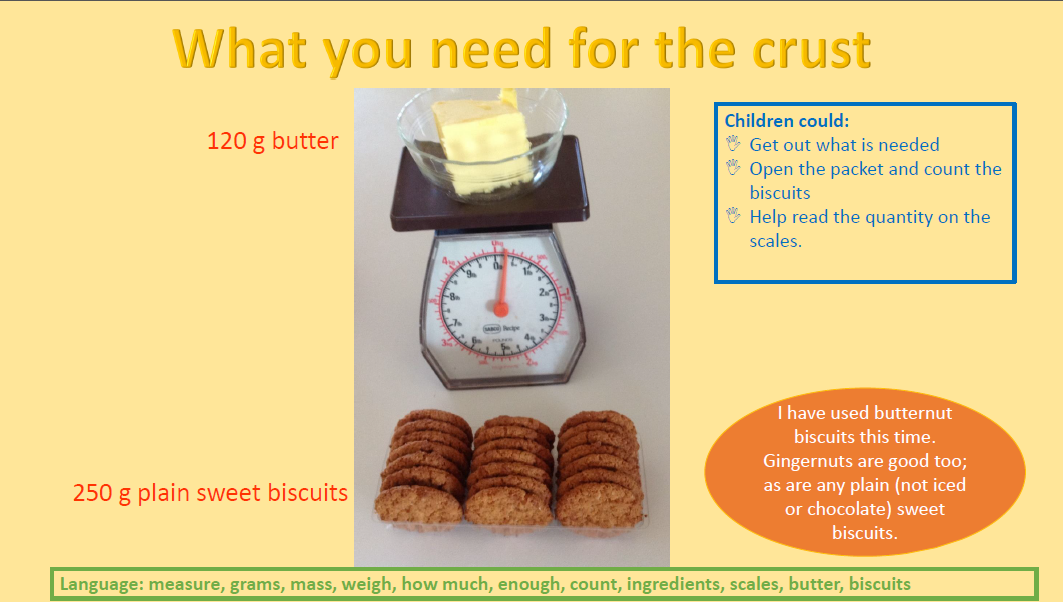
the mathematics of measuring mass (250 g), volume (1 cup or 250 ml) and time (bake for 15 minutes).
the mathematics of linear measurement; measuring the length, width and depth of baking tins and trays.
reading and following procedures, and understanding that unless the steps of a recipe are followed in order the outcome may not be what was expected.
writing of menus and shopping lists.
organisational and preparation skills: making sure all ingredients and utensils are available and assembled.
the science of mixing and combining, heating and cooling, and the different effects these may have upon different ingredients and utensils.
understanding that some of the changes that occur are reversible e.g. water to ice and back again; but that some are irreversible e.g. cream to butter, but not back again.
While it is not suitable for children to use knives or handle hot utensils or heating appliances when young, and only under careful adult supervision when older, children can be included in many kitchen tasks from a young age.
Watching, discussing and asking questions provide great opportunities for learning. Children can be introduced to tasks such as mixing, pouring, measuring, menu planning and cleaning up, amongst others, as they grow.
One of the fantastic things about food preparation is the opportunity it provides for asking questions: it can be an ongoing edible science experiment, for example:
Why do the cakes rise?
What makes the water bubble?
Why is a cloud coming out of the jug?
Where does the water go when it boils?
Why isn’t the egg white white before it’s cooked?
What would happen if I didn’t put the egg in the cake mixture?
Why is some sugar brown?
What the difference between sugar, caster sugar and brown sugar?
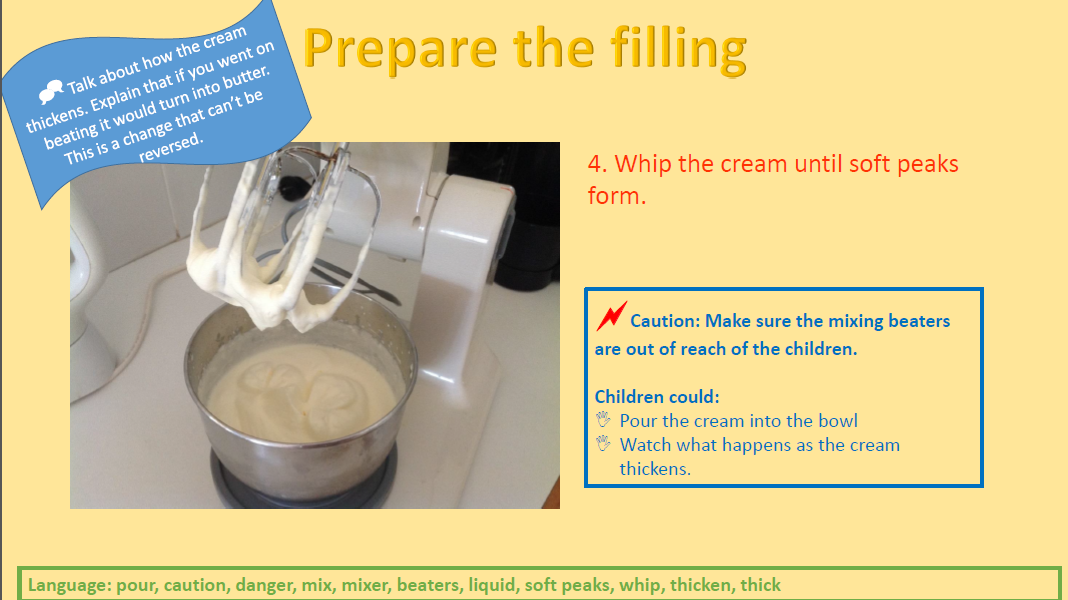
What happens to cream when it is beaten?
At the moment I am grappling with a kitchen science dilemma, and if you can provide an answer to my question, I’d be very appreciative.
My question is:
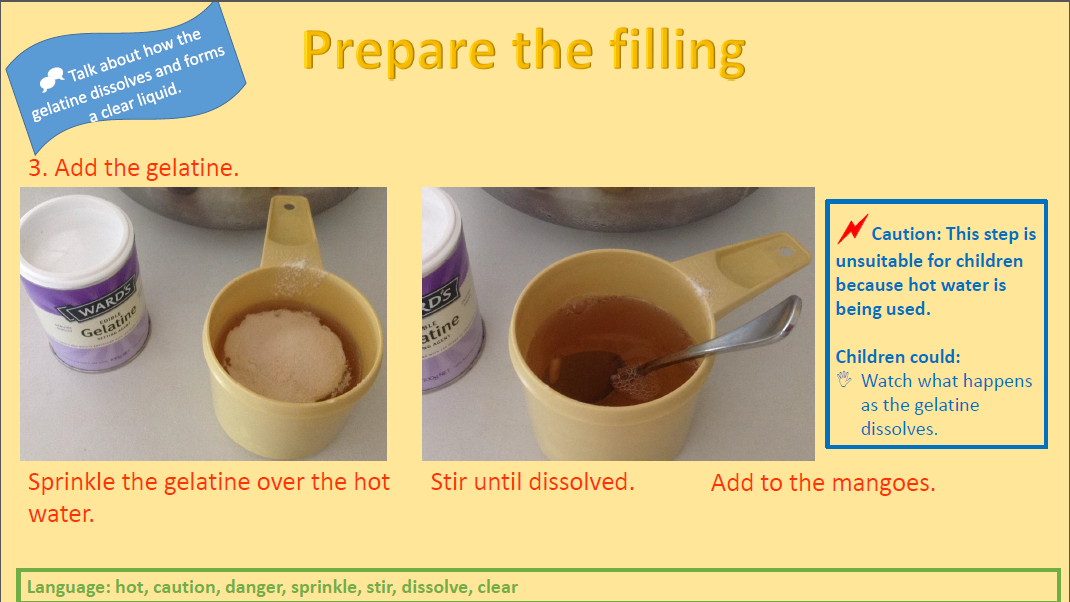
What is a suitable vegetarian substitute for gelatine?
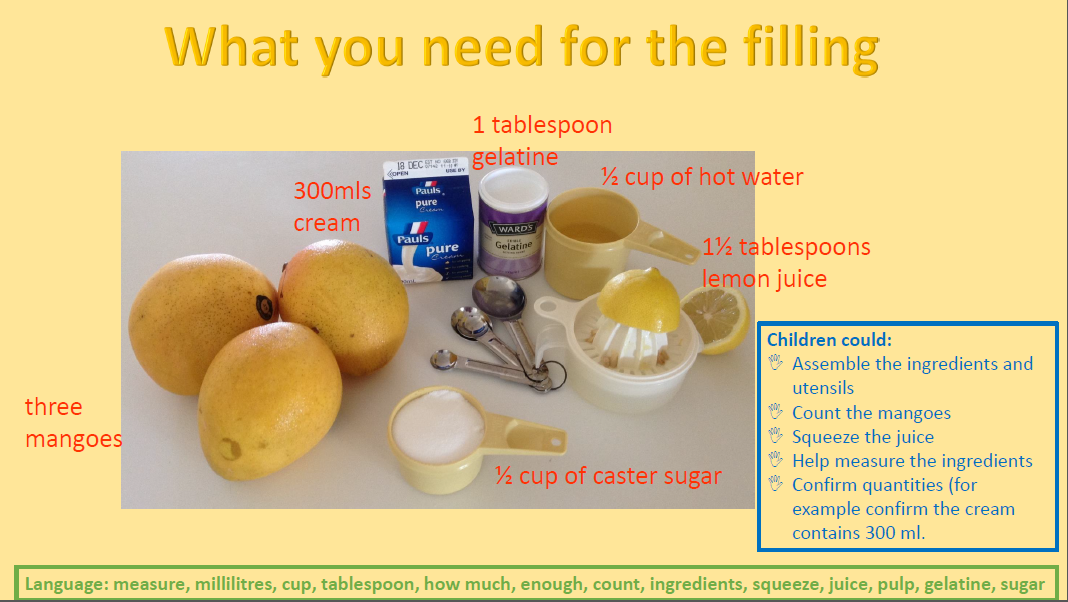
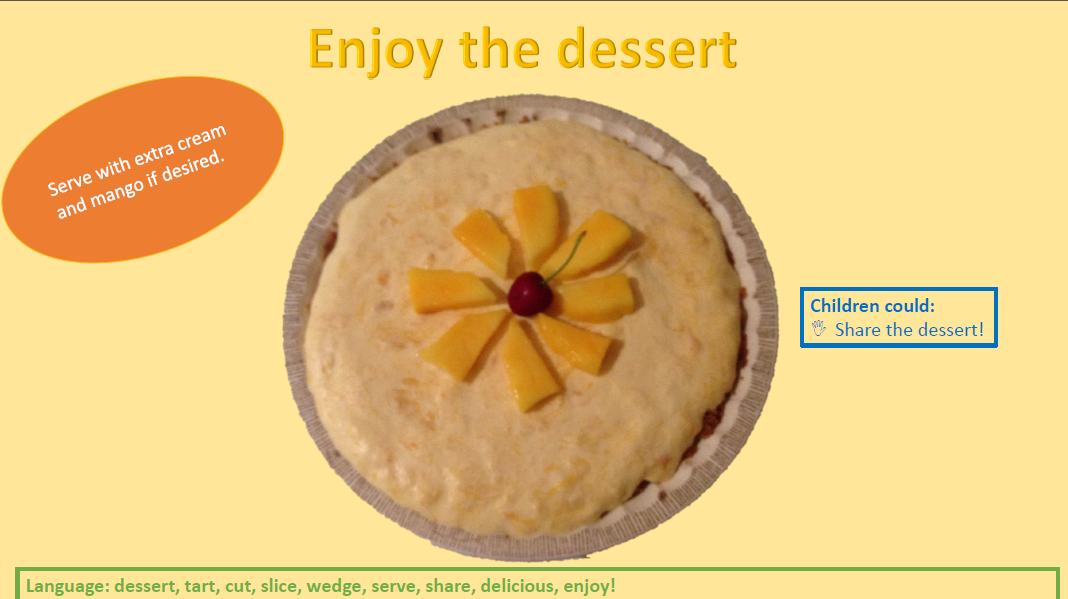
One of my family’s favourite desserts is Mango Cream Tart. Gelatine is used as a setting agent in the dessert.
Some of my family members are vegetarians who, upon discovering the answer to the seemingly innocuous question
What is gelatine made from?
realised that eating anything containing gelatine no longer suited their food choices.
So rather than remove the dessert from family menus, or make something that was unacceptable to these family members, I decided the only thing to do was find a substitute for the offending ingredient.
I have purchased two different vegetarian substitutes but both require being boiled in the liquid which they are to set and are therefore unsuited to the Mango Cream Tart and other cream cheese cheesecakes I may wish to make. An additional factor confirming their lack of suitability is the warning that they may not set some fruit juices.
I did an online search and found 3 Vegetarian Substitutes for gelatine. If you have used with success any these products, or another product, that may be suitable to use in my Mango Cream Tart recipe I would love to know please.
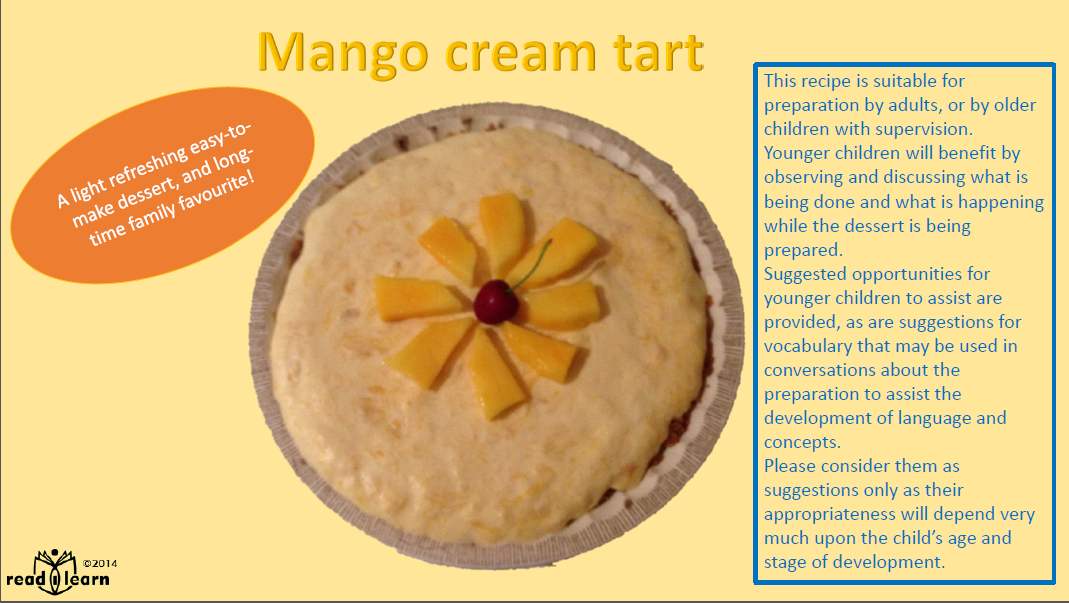
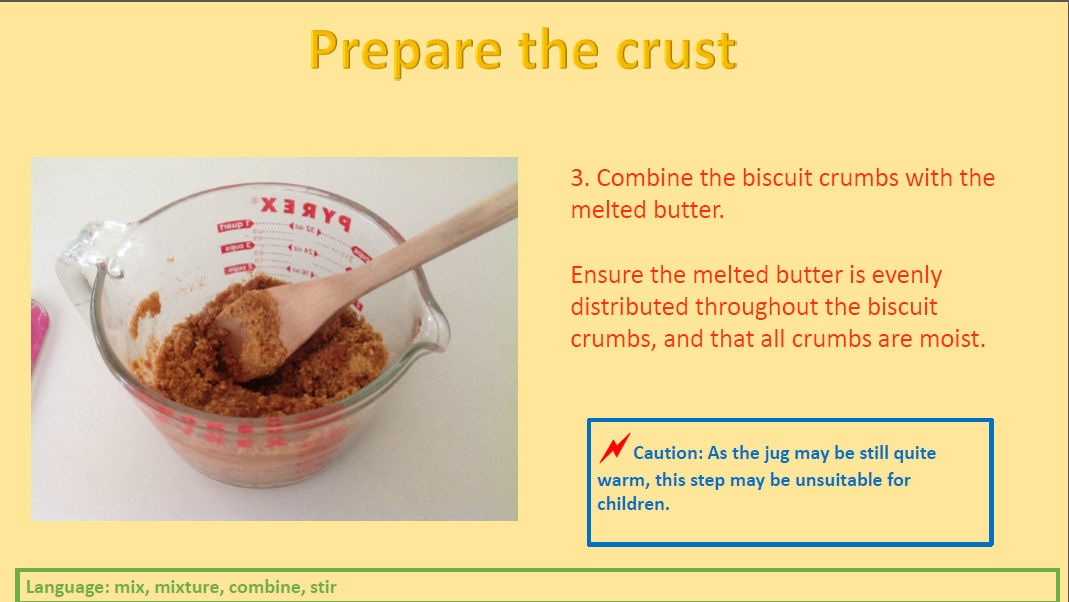
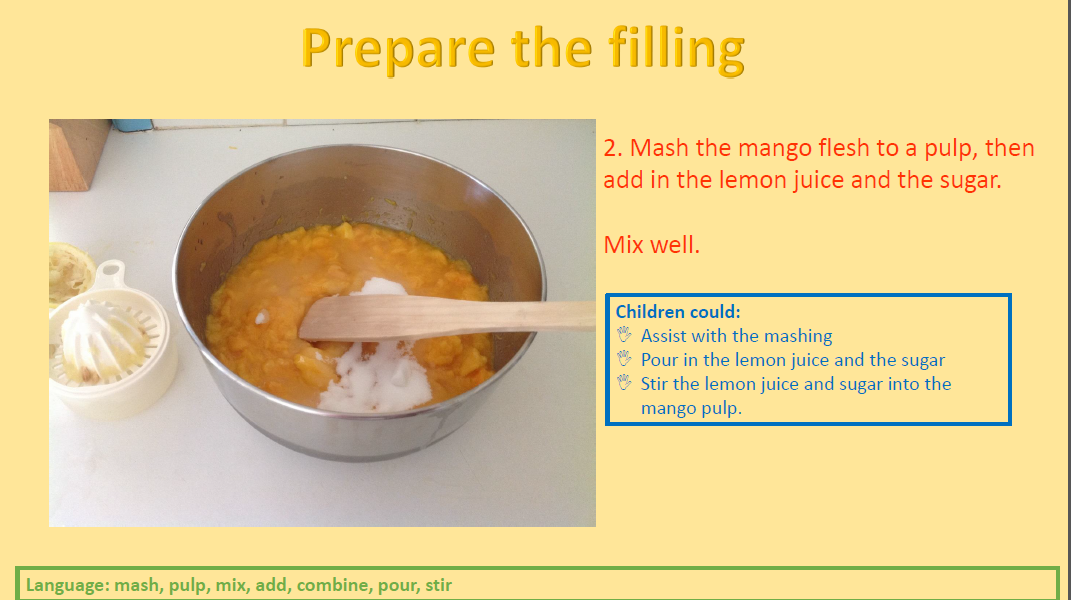
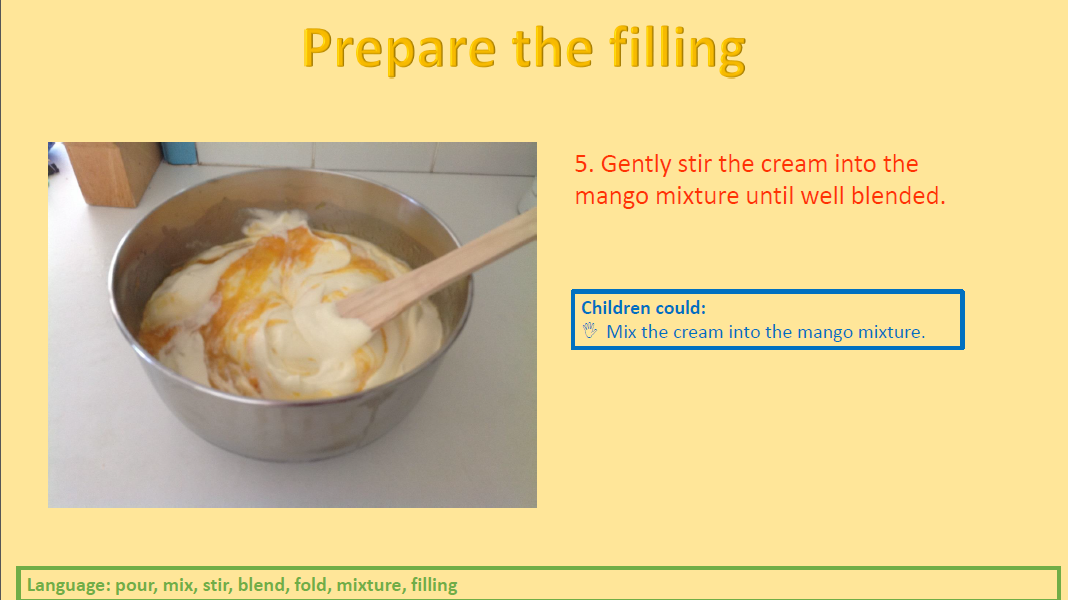
Here is the recipe which includes suggestions for parents on how they can incorporate learning opportunities for their children while making it. If you can’t help solve my gelatine dilemma, I’d love to know what you think of the way I have presented the recipe. Would this format be useful to parents of young children?
Thank you for reading. I appreciate your feedback. Please share your thoughts about any aspect of this post. I’d especially appreciate feedback on my presentation of the recipe and suggestions for a vegetarian substitute for gelatine.
The end of the school year in Australia has approached swiftly and silently this year, for me at least. You see, now that I am not in the classroom I am not absorbed by all the things that the end of the school year brings.
In Australia the school year coincides with the calendar year so November and early December are frantic for teachers completing the final assessment and reporting for the year, preparing their students (and themselves) for separation after spending so much of the year together, and making preparations to welcome a new class in the new year.
The classroom remains busy with learning and curriculum matters until the last day. Both teachers and students begin to tire and the warming (hot, in most parts of Australia) days in classrooms without air-conditioning add to the fraying edges of all as they anticipate the long summer holidays.
One thing I always enjoyed about the end of the year, that made all the extra work and the increasing heat tolerable, was the learning about family traditions and celebrations, including Christmas.
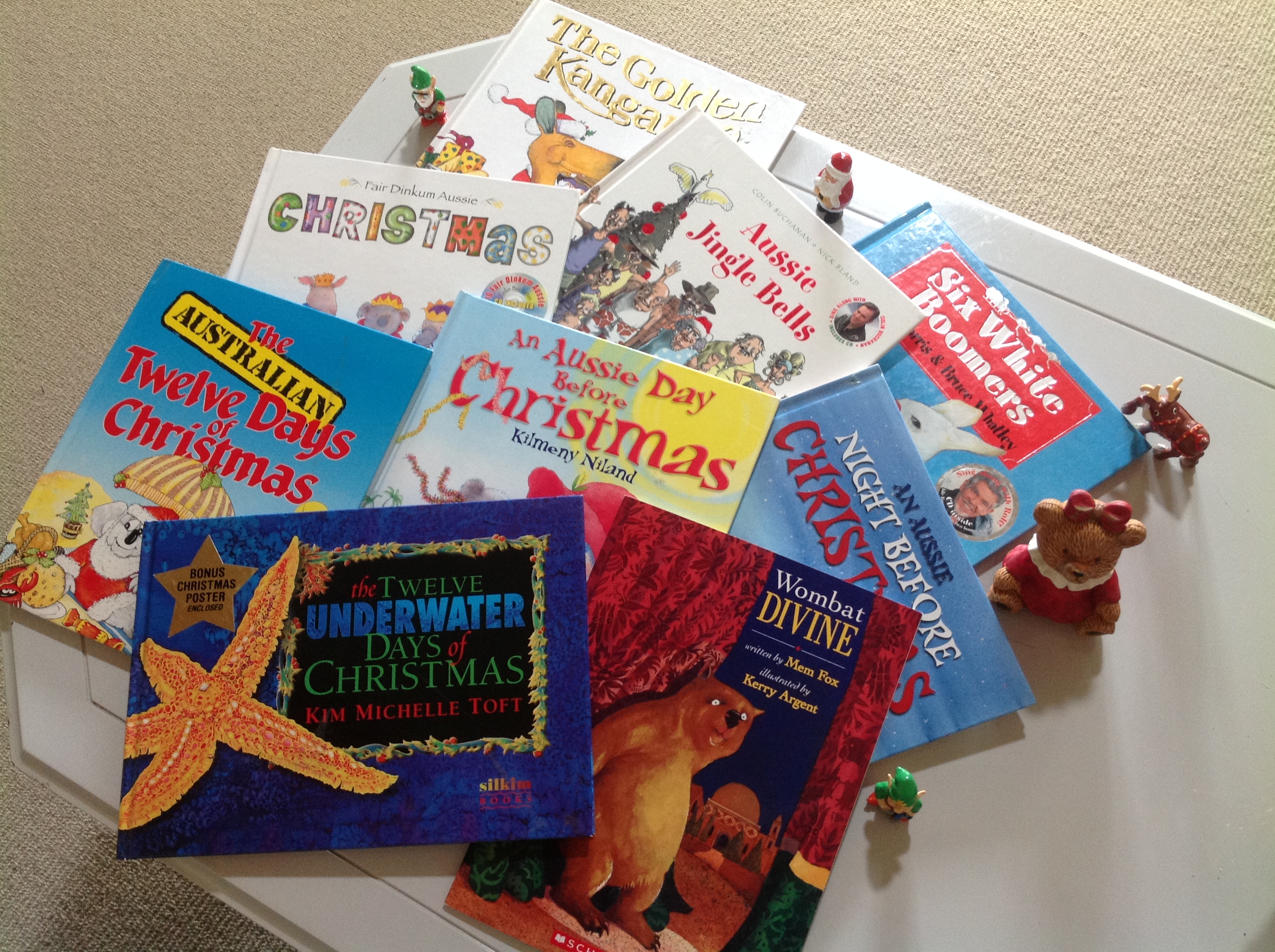
Some Australian Christmas picture books
Last year I wrote about some of the Christmas activities I did with my class, such as making friendship trees
I shared some suggestions for parents to support their children’s reading, writing and maths development in fun ways during the holidays. (These and other items are available in my TeachersPayTeachers store.)
I also provoked a lively discussion about whether Christmas should be included in a school program by suggesting tens reasons for its inclusion. Many readers joined in explaining their position either in support or against.
I always enjoyed this special time of year. I loved hunting through discount stores for items with which children could make cards and gifts for their families and decorations for their home. Often we talked about “free” gifts they could give and made vouchers for things like a free car wash, breakfast in bed or unlimited smiles and hugs.
As well as the gifts they made for each other in class, such as the friendship trees and Christmas crackers, I always gave each child a small gift, usually a book to read, a pencil and notebook for writing in; something to do over the holidays.
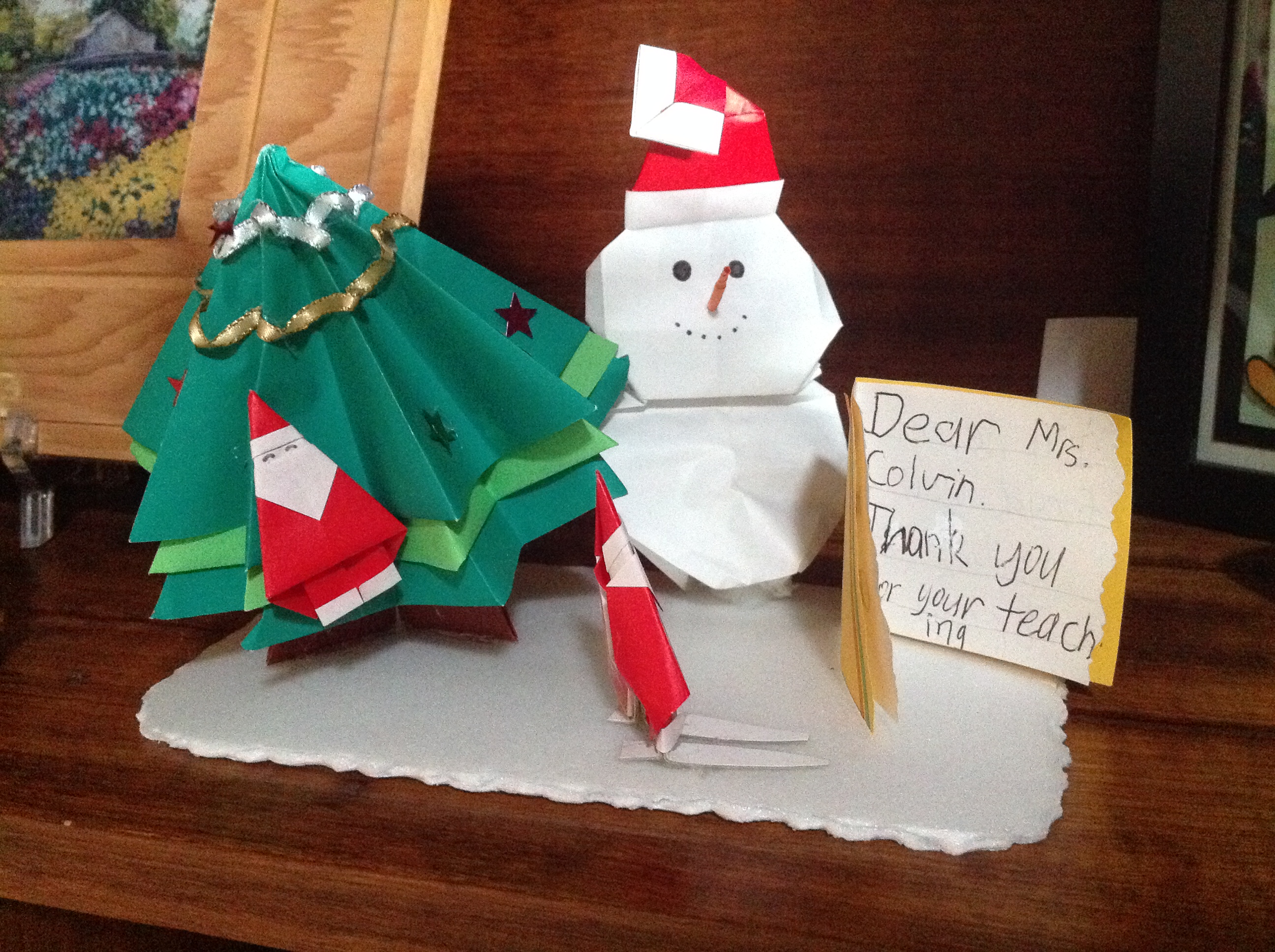
While it was never expected, but always very much appreciated, many of the parents and children presented me with lovely ‘thank you’ cards, letters and gifts, some purchased, many home-made; all treasured. While the consumables were long ago enjoyed, many other items still adorn my shelves!
A selection of gifts from over the years
Sometimes it was difficult to know what to give as a gift to recognise a special teacher. This year Bec has come up with, what I think, is the perfect gift, though she didn’t design it for that purpose. It’s the apple cozy: a special little bag for carrying an apple safely, protecting it from bumps and bruises. They are available in her Made It and Etsy stores. An apple for the teacher in its own special bag: how cute!
Apple Cozy // Joyce
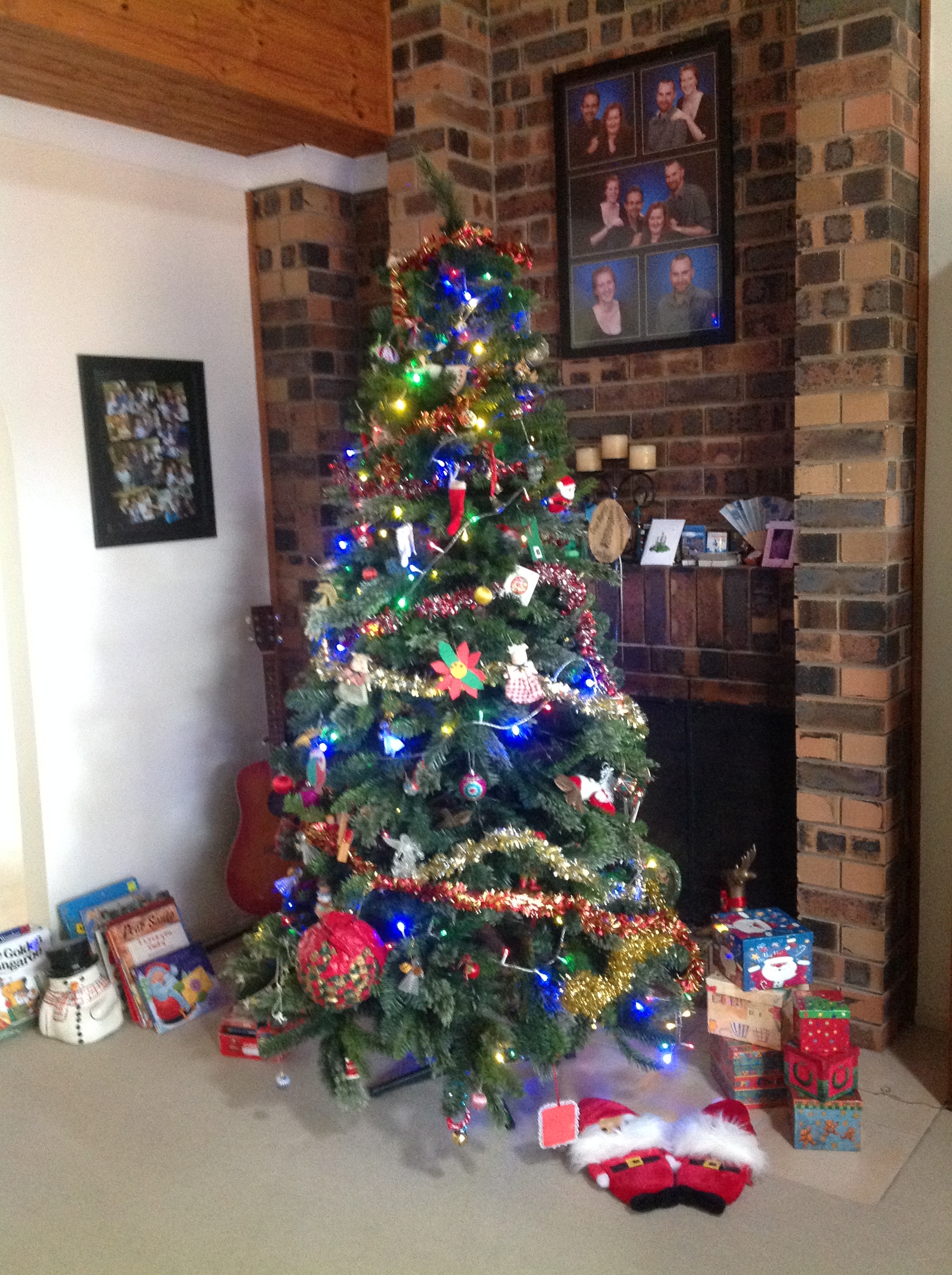
Although there are no preparations for Christmas at work this year (except for Secret Santa) there is still much to do at home. The traditional time for putting up the tree and decorations is December 1, and I usually have mine up by the end of the first week in December. Now that both my children are grown and living in homes of their own, I thought I would have the lonely experience of decorating on my own this year (Hub says he helps by not helping, but actually he gets tree and decorations down from the roof space for me!)
What a delightful surprise it was to have both my children and grandchildren (all two of each) visit on the day I was putting up the tree and help me out. The joy that the excitement of a 3- and a 5-year old bring to such activities cannot be matched. I think we did a pretty good job! When I look at it I relive the fun we had together.
Christmas 2014
Although to most it would appear simply a Christmas tree, and some may consider many decorations to be ready for the discard pile, most decorations have a story to tell. For me it is a memorytree. It holds decorations made by my own children over the years, and now some by my grandchildren. There are gifts from family and friends, and children I have taught. Each item, as it is placed on the tree, provides a time for reflecting upon the wonderful people whose lives have touched mine over the years. Each has its own story to tell of the joy that others’ kindnesses can bring. But it is more even that just a memory tree. It is a givingtree; a time for remembering and being grateful.
What are you family traditions? What and how do you celebrate?
Thank you for reading. I appreciate your feedback. Please share your thoughts about any aspect of this post.
Many of you may recognise this song from Sesame Street: One of these things is not like the other.
Finding the one that doesn’t belong sounds like a simple activity, but which one did you choose? And why? Did you choose the rubber boot? I didn’t. I chose the shoe with laces. Does that make me wrong?
The items had some obvious similarities: they were designed for wearing on the feet, and they were similar colours. Differences in size and style were also obvious. Just what made the rubber boot “not belong” any more than any of the others, I’m not sure. Does that mean I am not as smart as a pre-schooler?
Rather than simply providing children with an answer as happens in this video, I would prefer children were provided opportunities to explore and discuss similarities and differences and would invite children to explain why a particular shoe might be selected. I think there are valid reasons for each to not belong, and there are also many reasons for them to be grouped together.
The ability to make connections between new and established information, including by identifying similarities and distinguishing differences, is an important contribution to learning. Adults can aid in the learning process by making explicit the ways in which objects are similar and by discussing ways in which they are dissimilar.
Young children very quickly learn to notice obvious similarities between e.g. different breeds of dogs, a variety of drinking glasses and cups, or construction items. However adults can assist and challenge children to think creatively and in new and innovative ways by encouraging them to make connections between seemingly disparate objects.
Many innovations have been developed as a result of creative thinkers making links that didn’t previously exist between apparently dissimilar objects or situations. George de Mestral’s invention of Velcro, involving the application of an observed phenomena to a very different situation, is perhaps one such example.
Playing games is a good way of encouraging children to think creatively. It is not necessary to purchase pre-packaged games. Many games can be played with items from around the house or in the toy box, or using picture cards from early childhood games like ‘snap’, printed clipart, or cut from magazines. Here are just a few suggestions around which you can construct your own ways of taking turns, playing and having fun:
Display two pictures e.g. a duck and dog, a bus and a boat. How many ways are they the same?
How are they different?
Display two pictures and explain how the items are different. The differences could be obvious e.g. a duck and a dog, or more subtle e.g. two different breeds of dogs, or a male and female bird.
Which one does not belong?
Display three or four pictures. Discuss similarities and differences, and then decide which one doesn’t belong, providing reasons.
Sorting
Provide children with a larger number of items e.g. construction blocks in different sizes, styles and colours or pictures of a variety of objects or animals. In the beginning it is easiest to sort by one feature e.g. is yellow/is not yellow. Encourage children to look for similarities between particular items e.g. colour or shape and ask them to group all items with that characteristic. They will then have two groups, one with the feature and one without.
Once children can confidently sort in this way they may be able to sort by two characteristics e.g. size and colour. They may even begin to make decision about how to deal with items that fit into two groups.
What else?
Show children a common everyday object and discuss its use. Encourage them to think of alternate uses for the same object e.g. a pencil could be used as a flagstick, a mast on a toy boat or to identify where seeds were planted in a garden.
Link the story
Display pictures of any two items e.g. a beach ball and a pencil. Ask children to create a story that involves both items. I immediately think of a family making plans for a holiday at the beach. The child wants a ball to play with at the beach and uses a pencil to add “beach ball” to the list of items to take. Your thoughts are probably very different. I’m sure someone will have the beach ball impaled on the pencil!
People crammed in, around and in front of the small sidewalk cafe, reminding her of the fairy-tale pageant that had bypassed her radar. She couldn’t move now. Her coffee fix, too hot to sip, had just been served. So, as always, she retreated within.
Cocooned in thoughts flittering across years and experiences, she barely noticed the cacophony of the crowd or passing parade.
The sudden shout of “Unicorn!” penetrated, startling her.
She was six again, cowering with her unicorn, avoiding mocking stares.
But this time pitying and unbelieving stares watched the spreading stain of scalding coffee.
Thank you for reading. I appreciate your feedback. Please share your thoughts about any aspect of this post or flash fiction.
I think about education. A lot. You could say it consumes me. It has been my lifelong passion, and although I am not currently in the classroom I don’t stop thinking and reading about how we learn and how learning can best be encouraged. My discontent with how schooling often is and my optimism for what it could be has been a recurring theme on my blog and a driving force in my life. You would not have to open too many posts to find at least one expressing that view.
My poem “Education Is” sums up the differences I see between education and schooling. Some schools do education really well. Some professing to be educational institutions school, very badly. What I consider to be one of the major differences is that education encourages a love of learning that lasts a lifetime; while schooling attempts to force-feed content in such a way that learning is neither enjoyed nor viewed as anything other than what one is forced to do in school.
In traditional schools assessment often takes the form a test which requires students to regurgitate information that has been thrust upon them, whether they like it, or are interested in it, or not. This occurs across all subject areas. I have written about it before in relation to writing tasks in these three posts: Writing to order – done in a flash!Writing woes – flash fiction and Who tests the testers?
I contrasted my choice of responding to Charli Mills’ flash fiction prompts to the lack of choice students have in state- or nation-wide writing tasks. In Writing woes – flash fiction I suggested that it would be difficult for me, on a given day, with a restricted amount of time, under the watchful eyes of supervisors, to produce my best work in response to a prompt about which I may have little experience, knowledge or interest.
In my flash fiction responses I introduced a unicorn as a symbol of escape from the confines of the classroom or other oppressive situation, into the space where one is free to truly be oneself. It wasn’t a deliberate or premeditated choice, simply a response to Charli’s prompt. However I am happy to adopt it in my flash fiction as a symbol of playfulness and imagination unleashed; the basis for all great inquiry and innovation. Thank you, Charli, for the prompt!
I have returned to both these themes again in response to Charli’s most recent prompt to In 99 words (no more, no less) write a story inspired by your muse. I’m not certain who my muse is, but I am certain that it would be very difficult to call upon a muse to assist when writing in a test situation such as that expected of students in school.
My piece is titled ‘Failure’, but this is the question I have for you: Who really deserves the “F”? Whose failure is it really?
Failure
She spluttered out the splinters of pencil: no longer tasty, never helpful. The assessor’s steely eyes pounced. She wiped the last vestiges from her mouth; staring blankly, as blank as the paper in front of her.
Outside the sunlight danced like fairies on the leaves, beckoning. Below, in the shade, the unicorn pranced and called her name.
“Why do I have to do this stuff? Who cares anyway!”
She grasped the broken pencil and scored a large “F” on the page.
Then she closed her eyes and was away, riding to freedom and joy on the unicorn’s back.
What do you think?
I appreciate your feedback. Please share your thoughts about any aspect of this post or my flash fiction writing.
If you are interested in reading other of my flash fictions pieces, I have collected them all together on one page which you can access here or click on the Flash Fiction tab above.
Recently I was sent a link to an article titled Cheer up, it’s not all doom and gloom published by the Australian Broadcasting Commission’s The Drum.
This article mentioned a book by Steven Pinker called Better Angels of Our Nature which had been recommended to me by Geoff Le Pard in a comment on my post about childhood illness. The premise of this book is that humanity, over the ages, has become less violent. After to listening to Pinker’s history of violence, I’m pleased that I live these relatively peaceful times.
The article also introduced me to a new term ‘meliorism’ which means having a belief that the world can be improved by the actions of humans. While the term may have been unfamiliar to me, the attitude is not and I attest that I am a meliorist.
I have a very strong belief in the power of education to improve the world. Education empowers individuals, and educated individuals empower societies to build improved futures. It becomes very difficult to sustain negative practices in the face of overwhelming evidence and information.
What better place is there for education to begin than in the home?
In a recent post I referred to a new book by Michael Rosen called Good Ideas: How to Be Your Child’s (And Your Own) Best Teacher. At the time I had not read the book but now I can say, with great delight, that I have listened to most of it. With messages such as those contained in Michael’s book, it is easy to be a meliorist.
I think Rosen’s book should be available to, perhaps compulsory reading for, every parent; I consider its message to be that important. In fact, I am off to the shops today to purchase copies to give to parents of young children I know. It will become part of my gift to new parents that also includes Reading Magic by Mem Fox and a selection of picture books. I have previously blogged about that here and here.
The “Good Ideas” contained in Rosen’s book, if implemented, will keep alive the natural curiosity of one’s children and oneself. They will encourage the development of thought, creativity and responsiveness.
In the next few weeks I will post a more detailed review of the book and some of Michael’s ideas for stimulating curiosity, whoever and wherever you are.
What about you? Are you a meliorist?
I welcome your feedback. Please share your thoughts about any aspect of this post.
Two recurring themes, amongst others on my blog, are ways of encouraging a love of literacy and of questioning in young children.
If you read my post Going on a treasure hunt! you will know that I greatly admire the work of Michael Rosen and its contribution to literacy development. You may have followed the links and checked out the riches in store on his website.
My post Child’s play – the science of asking questions introduces my thoughts about ensuring that children’s inborn curiosity is maintained through the encouragement of their questions.
You can imagine my delight, then, when I read a review of new book by Michael Rosen. (Thank you, Anne Goodwin, for alerting me to it.) The review, posted by Sabine Durrant in The Guardian on 6 September 2014, discusses Rosen’s new book How to be Your Child’s (and Your Own) Best Teacher. I confess that I have not read the book but I am very excited to see that it is now available as an audiobook, so it is next on my listening list. So much about the book appeals to me.
Rather than review the review I will simply leave with you the links to the review:
Recently Hope at Nanny Shecando sent me a tweet requesting some thoughts about imaginative play in a school setting. Sadly I would say that imaginative play has been just about pushed out in the ever-increasing content-driven and assessment focused curriculum. Seeing children as young as five spending much of their day sitting at desks filling in worksheets and parroting back isolated bits of information flashed at them in meaningless drill and practice sessions is about as far away from my thoughts about education as you could get. If it is difficult for early childhood teachers to squeeze time for imaginative play into their programs, imagine (there’s that word) how difficult it is for teachers of older children.
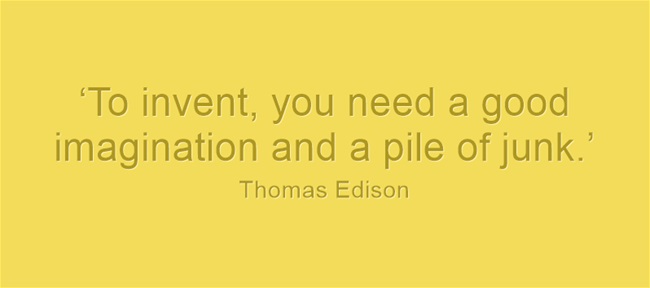
However, whenever I hear the above quote by Thomas Edison, I am reminded of how an early childhood classroom should be: a place for imagination, exploration and discovery. Parents may tire of the cardboard box creations that children regularly bring home, wondering where each one can be stored (or discreetly disposed of!), but the value to be had from the opportunity to create, imagine and play must not be understated.
For imagination to flourish in an early childhood classroom, I suggest the following ingredients are essential:
A recognition of the importance of play and imagination in the healthy development of children and the prioritisation of opportunities for imaginative play every day by providing:
Time – lengthy and uninterrupted, with the opportunity for created play areas to be left intact over a number of days or weeks
Space – both indoor and outdoor with a variety of larger and smaller spaces
Opportunities for self-selection of activity and self-direction
Books for story reading and play acting
Variety of props: things such as dress-up items including lengths of fabric that can be a kings robe, a princess’s dress, a magic carpet, an apron, a bed; hats and scarves; toys like cars, dolls, animal toys; building blocks and cardboard boxes; paper, cardboard scissors and pens for creating signs, posters and crowns; areas for quiet play with cushions; open spaces for creating larger ‘worlds’ . . . the items that can be used to inspire imagination are limitless.
When children are showing interest in a particular topic, an observant teacher may gather up a variety of props and leave then in a box for children to discover and use as they decide.
In an earlier post, Learning at its best: A classroom of magic, Hope herself described a school with an open space ‘where magic happens’. She described a friendship tree where ‘friendship and freedom of speech are fostered’; an area with a ‘magic carpet . . . plush beaded cushions and Middle Eastern style blankets . . . a place for imagination to prosper. Anything is possible when dreamed, imagined or conjured whilst on the magic carpet.’
She described an area for drama and the opportunity of being and expressing yourself. She described a creativity corner where young inventors could create anything they could imagine; and spaces to read, explore, share and dream. One could think this school was in Hope’s dreams, her imagination of what is possible. But it is a real school educating real children in very positive ways that will have a very different effect that the scenario I described above. However it is not a typical school. There is not one like it in every suburb. In Hope’s words, it is a ‘very select private school’. But don’t all children deserve learning opportunities such as these?
After re-reading Hope’s post, I’m not entirely certain why she invited me to share my thoughts about imaginative play in a school setting. I think she has described a wonderful example of imagination in practice. The design of the school and the aspects of the program described above, show the value of imagination, not only of the students but of the school designers, administrators and teachers.
In a recent post Just imagine . . . the power of imagination I talked about the power of imagination to drive creativity and innovation, and suggested that much of what we now accept as commonplace was once only in someone’s imagination. Einstein said that,
‘Imagination is more important than knowledge. For knowledge is limited to all we now know and understand, while imagination embraces the entire world, and all there ever will be to know and understand.’
Maria Montessori is attributed with the idea that ‘Play is child’s work’. In this article Thinking about Children’s PlayDavid Elkind, refutes that idea citing works by both Freudand Piaget, a psychologist whose work greatly influenced thinking about child development and learning. Elkind, himself a professor of child development and of author of books such as The Hurried Child, The Power of Play and Miseducation, says that ‘Although Montessori has made many important and lasting contributions to early childhood education, her identification of work and play in young children was unfortunate.’ He says that, in play, children are not preparing for life, they are living life.
Elkind does not favour the imposition of formal learning situations upon children of increasingly younger ages. The following excerpt from Miseducation, shared in Commentary: The ‘Miseducation’ of Young Children Elkind says, ‘When we instruct children in academic subjects, or in swimming, gymnastics, or ballet, at too early an age, we miseducate them; we put them at risk for short-term stress and long-term personality damage for no useful purpose. There is no evidence that such early instruction has lasting benefits, and considerable evidence that itcan do lasting harm.’
He continues, saying that ‘The most important thing is an excitement about and enthusiasm for learning. Skills are easily learned when the motivation is there.’ I agree wholeheartedly and have joined in with a discussion of motivation in a number of posts, most recently in Motivation – why we do the things we do.
In another article Can we play? shared on The Greater Good in 2008, Elkind explains that imaginative play is important to academic as well as social and emotional development. Unbelievably, he said that ‘More than 30,000 schools in the United States have eliminated recess to make more time for academics.’ It is difficult to imagine how unwelcoming and uninspiring a school without recess would be. I wonder how much lunch time those who made these rules allow themselves.
He says ‘Play is motivated by pleasure. It is instinctive and part of the maturational process. We cannot prevent children from self-initiated play; they will engage in it whenever they can. The problem is that we have curtailed the time and opportunities for such play.’
In the words of Cat Stevens (Yusuf Islam), ‘Where do the children play?’ I add ‘and when?’
If you wish to read further, here are some links to get you started. I don’t agree with all the content. Some suggest a more structured approach than I would favour. However, as with everything, a broader knowledge helps one more clearly formulate one’s own position.



























 Norah Colvin