Live Love Laugh Learn … Create the possibilities

Category: Early childhood education

  • Mending fences

    Mending fences

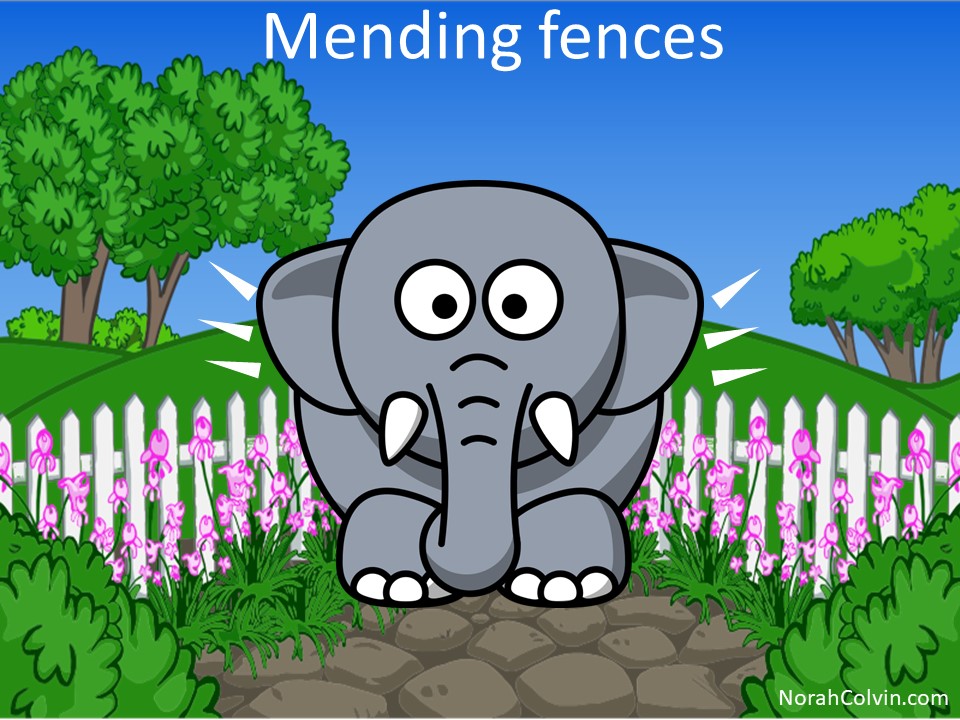
    What time is it when an elephant sits on the fence?

    Time to get a new one!
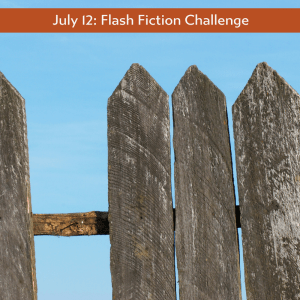
    Mending fences #flash fiction prompt from Charli Mills at the Carrot Ranch

    This week, when Charli Mills at the Carrot Ranch challenged writers to In 99 words (no more, no less) write a story about a broken fence. You can mend it, leave it, or explain its place in a story. Go where the prompt leads, I spent quite a bit of time fence sitting, undecided about which fence story to choose.

    As you know, there are many types of fences: literal, metaphorical, even imagined. Fences are usually built to contain things, to keep people or things on one side or the other, or to define a boundary and possibly restrict passage. But the term “mending broken fences” has a different nuance of meaning. In this use, it means to repair a broken relationship as opposed to improving boundary security.

    But which fence should I choose?

    Should I share some history?

    Rabbit-Proof Fence

    This year marks the one-hundredth anniversary of my family (grandfather, grandmother and their young family – my father, the fifth of nine, was born three years later) taking up residence on a property owned by the Rabbit Board. My grandfather was a boundary rider until 1955, repairing the fence built to protect farming and grazing lands from the destructive introduced species. His youngest son replaced him, continuing until the role terminated in 1957. My uncle purchased the property from the Rabbit Board and lived there with his family until his death this year not long after the anniversary celebrations.

    or perhaps reminisce?

    The Cow Jumped Over the Fence

    Until I was six, my parents were small crop farmers. The farm didn’t generate much income and there were more bad years than good. To help feed the growing family (there were six of us by then) Mum and Dad invested in chickens for both eggs and meat and a milking cow. The first cow knocked down the fence and escaped to freedom. Dad repaired it and bought another cow, which squeezed under the fence. After a third cow jumped the fence, Mum and Dad decided milk deliveries were a better option and we kids never learned to milk.

    Note: I did write about this incident, a little differently, here.

    Should I plan a lesson?

    Teaching positional prepositions with The Elephant’s Fence

    Make a fence from pop sticks.

    Make an elephant using different-sized pom poms for body and head; pipe cleaners for legs, trunk and tail; paper or felt for ears; and googly eyes.

    Place your elephant according to these instructions:

    • Beside the fence
    • In front of the fence
    • Behind the fence
    • Under the fence
    • Between the palings
    • Next to the fence
    • Above the fence
    • Below the fence
    • On the fence.

    Now choose a place for your elephant to be. Tell your elephant’s story:

    • Why is it there?
    • How did it get there?
    • What is it doing?
    • What will happen next?

    or attempt a story?

    Sometimes it is the imaginary fences that can be more limiting. Sometimes it’s better to leave things that aren’t broken in the first place.

    Broken with intent

    The fence was too high to jump or even see over, no footholds to climb, and palings too close to squeeze or even peer through. It hugged the soil too compacted to dig. It seemed impenetrable, and so intrigued. He stacked boxes for makeshift steps—not high enough. Finally, he hatched a plan—balloons! He blew them big and tied them tight, attached some string, and waited. And waited. Then a gust of wind lifted him high, over the fence, where another, just like him, smiled and said, “Should’ve used the gate; latch is broken—always open to friends.”
    Thank you blog post

    Thank you for reading. I appreciate your feedback. Pleasure share your thoughts.

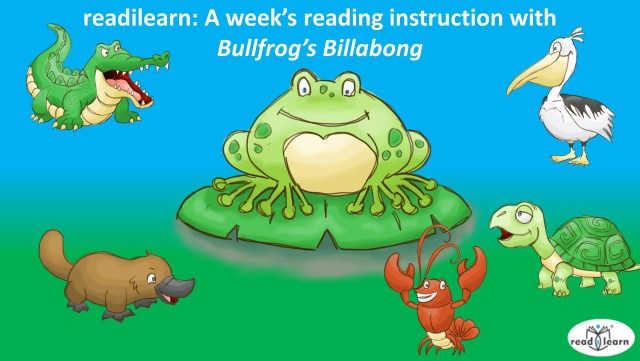
  • readilearn: A week’s reading instruction with Bullfrog’s Billabong

    readilearn: A week’s reading instruction with Bullfrog’s Billabong

    The readilearn Bullfrog’s Billabong suite of cross-curricular resources can be used as the foundation for planning a week’s reading instruction including lessons with the whole class and small groups and independent work. The activities cater for different ability levels in your early childhood classroom and can culminate in a performance to be presented to other members of the class, other classes in the school, or parents.

    Bullfrog's Billabong, teaching effective reading strategies with covered cloze on the interactive whiteboard

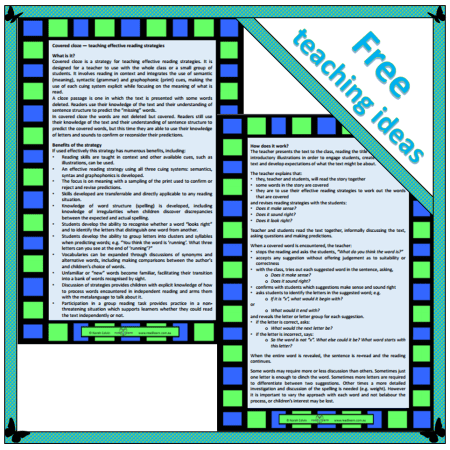
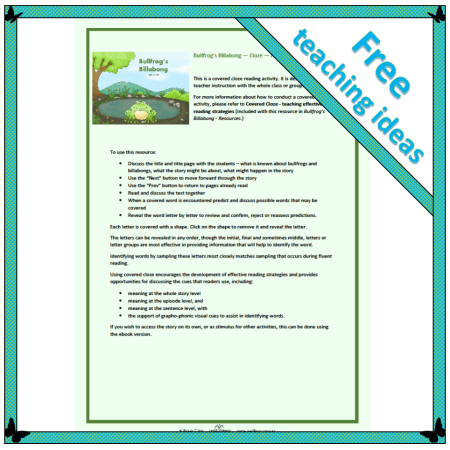
    Begin by introducing the story as a covered cloze activity (a lesson ready for you to teach) presented to the whole class on the interactive whiteboard. Although all children are engaged in reading the same story, the activity allows them to participate at their own level. The teacher-led discussion can be tailored to student needs, allowing each to contribute according to what they already know and extending their understanding by discussing cues for reading and irregular as well as regular spelling patterns. Children learn from each other as they actively participate in the cooperative reading activity. Refer to Covered cloze — teaching effective reading strategies and Bullfrog’s Billabong — Cloze — How to use this resource for suggestions.

    As with introducing all new reading material, it is important to engage children’s interest by making connections with what they already know about the topic and explaining what may be unfamiliar; for example, a billabong, and encouraging them to make predictions about what might happen in the story. As the story unfolds, children may adjust their predictions and thoughts about the story.

    Continue reading: readilearn: A week’s reading instruction with Bullfrog’s Billabong – Readilearn

  • readilearn: Teaching children with ASD — ideas for the classroom- with guest author Kathy Hoopmann

    readilearn: Teaching children with ASD — ideas for the classroom- with guest author Kathy Hoopmann

    Do you have children with Asperger Syndrome in your classroom and wonder how best to cater to their needs? Do you have friends with Asperger Syndrome, or maybe have it yourself? This week’s guest Kathy Hoopmann has a wealth of suggestions to help you understand, appreciate and enjoy the complex syndrome that is known as ASD.

    Combining her knowledge of Asperger Syndrome with her teaching background, Kathy has written over twenty books for children and adults.  She is best known for her photo-illustrated books that deal with Asperger Syndrome, ADHD and anxiety.  The simplicity, charm and insight of these books has made them must-haves for children and adults around the world.

    Kathy has won and been shortlisted for many literary awards including the Children’s Book Council of Australia Award, and she has four times been awarded a silver Nautilus Award (US).  Her books have been translated into thirteen languages and sell widely in Australia, the UK, the US and the Middle East.

    The books help children and adults with ASD recognise that they are not alone and provide support to carers, teachers and other professionals working with people with ASD.  In any home, school or classroom library Kathy’s books would help everyone learn to understand and support each other.

    Welcome to readilearn, Kathy. Over to you.

    The boy crawled under a table, his cap pulled low.  All eyes were on me to watch what I would do.  I was the relief teacher, or ‘light relief’ and the class was eager for a good show.  But I had been a relief teacher for too long to take the bait.  Besides, I recognised the behavior.  The boy displayed many characteristics of Autism Spectrum Disorder and frankly under the table was the very best place he could be, for his sake and mine. 

    ‘Miss?’ a child ventured, ‘Billy’s under the table and he’s wearing a hat indoors.’

    Continue reading: readilearn: Teaching children with ASD — ideas for the classroom- with guest author Kathy Hoopmann – Readilearn

    and be sure to check out the generous discount offered to readers during the month of July.

  • Sketchy Perceptions

    Sketchy Perceptions

    Carrot Ranch Flash Fiction prompt sketches

    This week at the Carrot Ranch, Charli Mills challenged writers to In 99 words (no more, no less) write a story that is a sketch or about a sketch. It can be “A Sketch of a Romance” or “The Sketch of Aunt Tillie.” Go where the prompt leads you to scribble.

    My thoughts were a bit sketchy. This is what I came up with. I’d be interested to know your perception.

    Sketchy Perceptions

    He sketched the outline with chalk then filled in the details, outside-in. Curious passers-by gathered as the image emerged. Was the artist a paid entertainer or busker earning a buck? Some pushed coins into children’s hands to add to the chalk-drawn cap. When satisfied with his work, the artist stood in its centre and tossed the cap and contents high. As they fell, he spread his arms and disappeared into the painting. Perplexed on-lookers reported different perceptions. Many said he plummeted into darkness. Some said he flew on gold-tipped wings. Others described him simply as absorbed by his art.

    It is easy to make snap judgements about others and situations from sketchy information, even at first sight. We do it all the time as we try to make sense of what we perceive, evaluating it against our existing knowledge and beliefs.

    I have strong beliefs about education and how children learn so can quickly judge whether I will agree with the content of articles or not. However, I don’t confine my reading to articles that I know will support my beliefs. I read articles from a variety of viewpoints to gain some understanding of others’ positions. If I don’t know what they think, how can I interrogate those thoughts and evaluate them against my own, perhaps even reassess my beliefs? I would rather be informed than base my ideas upon sketchy information.

    This week, I had the pleasure of reading two articles in popular media which reiterate things I have written about a number of times previously.

    The title of an article by Angela Mollard in my local Courier-Mail intrigued me: We should be ashamed of how we treat teachers. The media is often quick to criticise teachers, blaming them for almost all of society’s ills, it sometimes seems. I wondered at the intent of this article. Mollard wrote that, although she is the daughter of a teacher, sister-in-law of a teacher, and friends with many teachers, she had no idea of a teacher’s life until she read the book Teacher by Gabbie Stroud. I am yet to read this memoir, but it is now high on my TBR list.

    Mollard says, “She (Stroud) writes of the sacred bond between teacher and pupil, of advocating exhaustively for their needs, of loving them even when they were abusive and damaged and victims of the most heartbreaking of family circumstances.”

    Mollard follows this by telling us that “Ultimately, Stroud gives up being a teacher. She’s broken by the profession but she maintains that she didn’t leave teaching, it left her”, and describes her book as “a clarion call to educators to change a system that values standardisation over creativity, curiosity, progress, self-belief and autonomy.”

    Oh, yes! I applaud. I know many teachers who feel the same way.

    Mollard then goes on to say that if parents want inspirational teachers for their children, they must be inspirational too, that they must stand beside and support teachers and do what they can to lighten their workload so more help can be given where it is truly needed. If you are a parent, please read the article for her suggestions. I have sketched out just a few of her ideas here.

    If you can do only one thing for your children, it should be shared reading is the title of an article by Ameneh Shahaeian and Cen Wang in The Conversation. To any regular readers of my blog, the idea behind the title will be very familiar. It gladdens me when I see others promoting such good advice for parents.

    However, in the article Shahaeian and Wang surprised me with the question, “is it really book reading that’s beneficial or is it because parents who read more to their children also provide a lot of other resources, and engage in a range of other activities with their children?

    Does the question intrigue you as much as it did me? Shahaeian and Wang share the results of a longitudinal study they carried out to find an answer. Please read the article for their conclusions and suggestions for parents.

    I’ve provided you with just the sketchy outlines of both these articles. If you are interested enough to read them, I’d love to know what you think.

    Thank you blog post

    Thank you for reading. I appreciate your feedback. Please share your thoughts.


  • readilearn: NAIDOC Week Celebrations 2018—Because of Her, We Can

    readilearn: NAIDOC Week Celebrations 2018—Because of Her, We Can

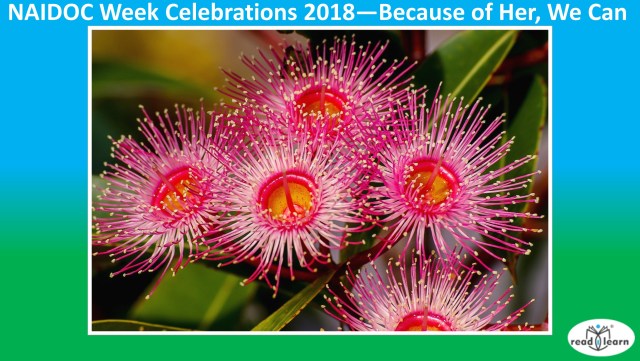
    In Australia, NAIDOC Week is celebrated around the country each July. The acronym NAIDOC stands for National Aborigines and Islanders Day Observance Committee. The theme of this year’s celebration, which runs from 8 to 15 July, is Because of Her, We Can!

    The purpose of the week is to celebrate the history, culture and achievements of Aboriginal and Islander Peoples and acknowledge their contributions to our country. This year’s theme recognises that “Aboriginal and Torres Strait Islander women have played – and continue to play – active and significant roles at the community, local, state and national levels”, roles that have often gone unrecognised.

    The 2018 poster, a painting by Bigambul woman, Cheryl Moggs, from Goondiwindi, portrays the courage and resilience of Aboriginal and Torres Strait Islander women. You can read, in Cheryl’s own words, the inspiration behind her artwork here.

    While most Australian school children are enjoying their mid-year break during NAIDOC Week, many teachers will be looking for ways to share the celebrations with their students when school resumes.

    Any time is a good time to incorporate learning about Indigenous cultures and histories. In fact, embedding Aboriginal and Torres Strait Islander Histories and Cultures is one of the cross-curriculum priorities in the Australian Curriculum.  Although I provide links to resources and suggestions that Australian teachers can use with their classes when celebrating NAIDOC Week, I’m certain many of the resources will be of interest to others around the world when teaching about diverse cultures and histories.

    The NAIDOC website has suggestions to get you started, and you can download a free copy of the 2018 NAIDOC Week poster from the website too. You can also check out their calendar for events near you. Refer to News for stories of women to celebrate.

    In the following video, Uncle Barry Watson, the Elder in Residence with Communities for Children in Logan City in south-east Queensland, explains the

    Continue reading: readilearn: NAIDOC Week Celebrations 2018—Because of Her, We Can – Readilearn

  • readilearn: Libraries: A wondrous universe to explore — A guest post by Dimity Powell

    readilearn: Libraries: A wondrous universe to explore — A guest post by Dimity Powell

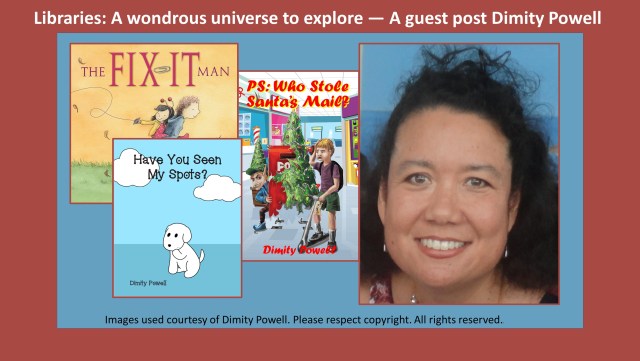
    This week I am delighted to introduce you to award-winning children’s author Dimity Powell.

    Dimity likes to fill every spare moment with words. She writes and reviews stories exclusively for kids and is the Managing Editor for Kids’ Book Review. Her word webs appear in anthologies, school magazines, junior novels, as creative digital content, and picture books including The Fix-It Man (2017) and At The End of Holyrood Lane (2018).

    She is a seasoned presenter both in Australia and overseas, an accredited Write Like An Author facilitator and a Books in Homes Role Model Volunteer in Australia.

    Dimity believes picture books are soul food, to be consumed at least 10 times a week. If these aren’t available, she’ll settle for ice-cream. She lives just around the corner from Bat Man on the Gold Coast although she still prefers hanging out in libraries than with superheroes.

    In this post, Dimity shares her love of libraries and explains why it is important to ensure every child has access to a library at school and every reader a local library.

    Welcome to readilearn, Dimity. Over to you.

    Continue reading: readilearn: Libraries: A wondrous universe to explore — A guest post by Dimity Powell

  • readilearn: Help your child read – some strategies

    readilearn: Help your child read – some strategies

    The importance of reading

    The ability to read is one of the most valuable skills we can acquire.  It is a tool for thinking, learning and entertainment. Reading opens doors and minds; it gives us the ability to unlock the secrets of the universe and release our imaginations. It is a skill that many of us take for granted, but without it the world would seem a more unfriendly place.

    No wonder learning to read is a vital part of each and every school day!

    Like everything else —the more you read, the better you get!

    Reading is more than just saying all the words on the page in order. Reading is a process of getting meaning from print. Effective readers use their knowledge of the world and of language in their quest to make meaning from the words on the page. Reading takes place when the reader understands the message of the writer.

    Strategies used by effective readers

    Effective readers use a combination of three cuing systems to predict and check what the author has written. The use of these systems is obvious in the miscues (rather than “mistakes”) that readers make.

    1. The most important cuing system is knowledge of the topic. If you know lots about dinosaurs, you can read those big difficult-looking words and understand what they mean. If you know nothing of legal jargon then even sounding out those big difficult-looking words won’t help you understand.
    2. The second system is knowledge of language and grammar. We expect the words to flow with meaning and not be a jumble of nonsense.
    3. The first two systems combine to predict the words on the page. We then check with the print to ensure our expectations were correct.

    For example, if the story is about a cowboy you may expect that he would jump on his pony, but when you look at the print, you find he actually jumped on his horse.

    Effective readers may say ‘pony’ instead of horse, but they definitely wouldn’t say ‘house’ (which looks similar) as it just wouldn’t make sense!

    Continue reading: readilearn: Help your child read – some strategies

  • Add a sprinkle of glitter to make your day sparkle

    Add a sprinkle of glitter to make your day sparkle

    Children love to create artworks using pencils, crayons, paints and anything they can stick to a surface using glue. With access to a variety of materials, they can be absorbed for hours creating their masterpieces.

    While they might select from the materials offered, I found the one thing that few children could resist was glitter—and the more of it, the better.

    There is nothing like glitter to add a bit of sparkle to the day. The only trouble is, glitter is so light and so small, that it goes everywhere—on the artwork, on the table, on the chair and on the floor. It sticks to the hands and is smeared on the face and takes forever to remove from the hair. But everyone loves it nonetheless, and it adds a little brightness to the day.

    Smiles are like glitter in that they also spread easily and brighten the day. However, they are not nearly so messy, cost nothing, and require no cleaning up at all.

    I think smiles are the glitter we should add to the artwork that is everyday life. And if there’s one thing about smiles, the more you give, the more you receive. Smiles come from a bottomless well, from a source that never dries up. A sprinkle of smiles will make anyone’s day sparkle, and who knows what difference a smile can make to another’s life.

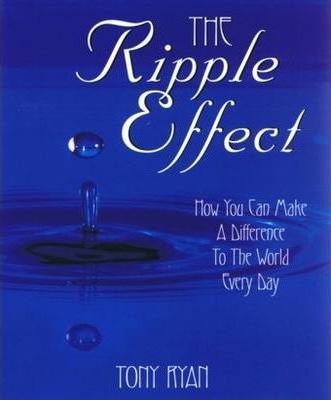
    The Ripple Effect by Tony Ryan

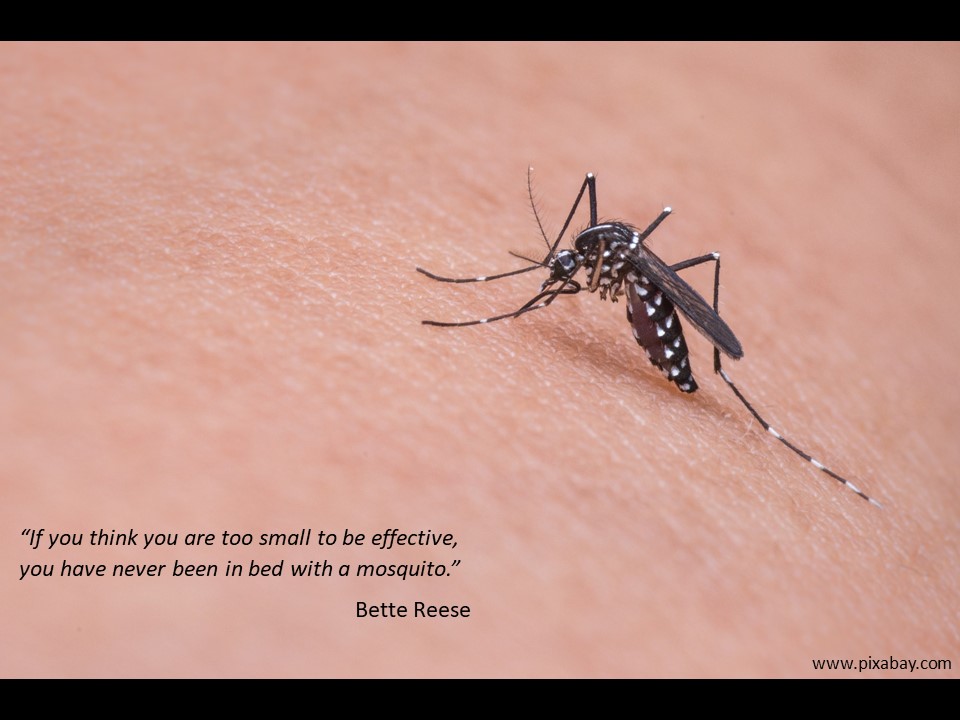
    I often think of The Ripple Effect, written by Tony Ryan, and its inspirational stories. I especially enjoy this quote by Bette Reese included in the book: “If you think you are too small to be effective, you have never been in bed with a mosquito.”

    quote about effectiveness and size by Bette Reese

    One of Tony’s stories describes the following scenario:

    “As you enter the freeway, you discover that the traffic is heavier than usual, and is moving quite slowly. You then notice that the young driver in the car beside you is trying to enter your lane, because her exit is coming up. No-one is letting her in, and she is becoming tense and upset.”

    Tony then describes the turning point in her day:

    “You stop, and wave her in front of you with a flourish and a smile.”

    and the ripple effect:

    • “she returns your smile, acknowledges your thoughtful action, and drives on
    • her tension dissipates, and she arrives at her company office feeling buoyed by your little effort
    • as the main receptionist, she is the first to greet the hundreds of people who enter the office each day
    • with her positive greeting, she decides to brighten up the life of every person she meets throughout that day
    • because of her efforts, many others in the business district are inspired to focus on their own positive efforts.”

    Like glitter, we can never know how far the effects of our smiles might travel. There can never be too many smiles in any one day, especially in a classroom filled with children.

    man glisten a flash fiction challenge by Charli Mills at the Carrot Ranch

    This week at the Carrot Ranch, Charli Mills challenged writers to In 99 words (no more, no less) write a story about man glisten. It was a fun term coined by two men with glitter in their beards. What more could it embrace? Look to the unexpected and embrace a playful approach. Go where the prompt leads.

    I’d only come across the word “glisten” before in the Christmas carol, Walking in a Winter Wonderland.

    But Charli’s prompt reminded me of an incident in my childhood that had absolutely nothing to do with glitter or glisten (I don’t even remember glitter in my childhood) but loads to do with smiles. I’ve rewritten the incident to include glitter and other alternative facts. I hope it gives you a smile.

    Glitter smiles glisten

    Relentless rain meant no beach for the country cousins. They spent eternity on the verandah, making artworks, playing games, and bickering.

    On the last day, when Mum said to clear space for their mattresses, they fought over who’d do what. Toys and games ended up in a haphazard tower with the glitter bucket balanced on top.

    When Dad bent for goodnight kisses, he stumbled and demolished the tower. Glitter went everywhere—including all over Dad. The children gasped.

    “Your hair glistens, Dad,” smiled the littlest.

    Dad smiled too, then everybody laughed.

    Dad wore a hat to work that week.

    Writing Skills workbook with Strike Me Pink

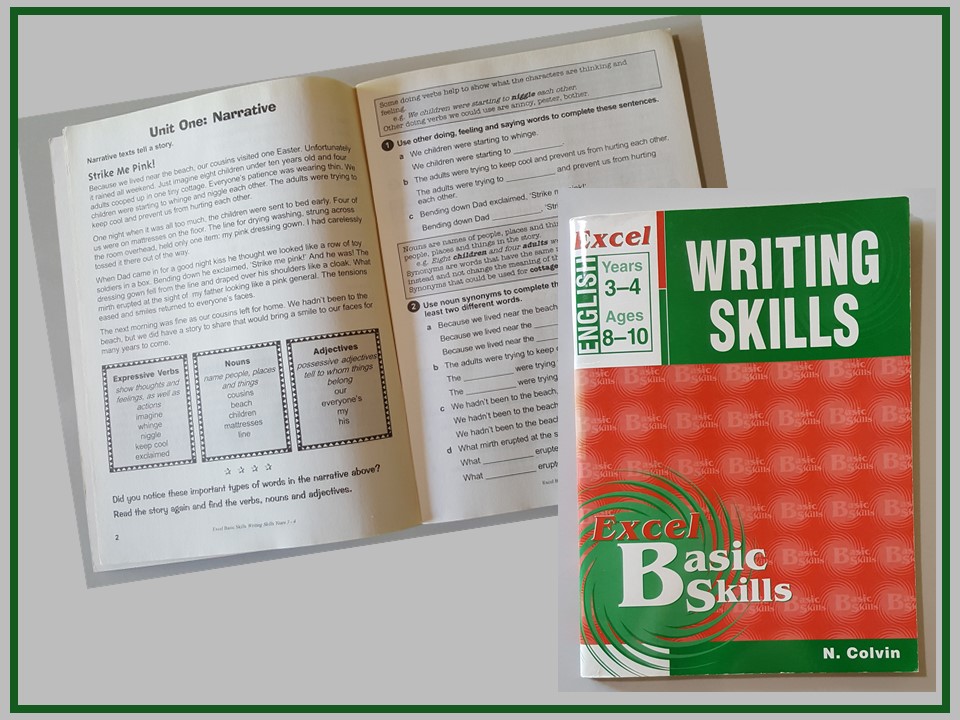
    I previously wrote about this incident for inclusion in a Writing Skills Homework Book published by Pascal Press. Workbooks such as this are very different from the teaching resources I now share on readilearn, but: it was paid work.

    This version is closer to the truth.

    Strike Me Pink!

    Because we lived near the beach, our cousins visited one Easter. Unfortunately, it rained all weekend. Just imagine eight children under ten years old and four adults cooped up in one tiny cottage. Everyone’s patience was wearing thin. We children were starting to whinge and niggle each other. The adults were trying to keep cool and prevent us from hurting each other.

    One night when it was all too much, the children were sent to bed early. Four of us were on mattresses on the floor. The line for drying washing, strung across the room overhead, held only one item: my pink dressing gown. I had carelessly tossed it there out of the way.

    When Dad came in for a goodnight kiss he thought we looked like a row of toy soldiers in a box. Bending down he exclaimed, “Strike me pink!” And he was! The dressing gown fell from the line and draped over his shoulders like a cloak. What mirth erupted at the sight of my father looking like a pink general. The tensions eased and smiles returned to everyone’s faces.

    The next morning was fine as our cousins left for home. We hadn’t been to the beach, but we did have a story to share that would bring a smile to our faces for many years to come.

    Note: I don’t know how many others used the term, but my Dad often said, “Strike me pink” to express surprise.

    Thank you blog post

    Thank you for reading. I appreciate your feedback. Please share your thoughts.


  • readilearn: What do we do when we read?

    readilearn: What do we do when we read?

    Have you ever considered what we do when we read?

    For many of us, reading has become such a natural and intuitive process that we rarely stop to marvel at the way we are able to make meaning from print or to question how one learns to read.

    Although we know that we once weren’t readers, few can remember how we actually made the transition from being a non-reader to being able to read and have been doing it for so long now that it seems we always could.

    Some adult readers have recollections of various instructional methods that were used in school and attempt to engage their own learner readers in similar tasks.

    The recognition that some of the instructional methods did, and still do, equip readers with some tools for reading, does not imply that the use of these methods was the catalyst for learning to read. While they may have contributed to the development of reading, there are other influencing factors.

    Many children learn to read despite the instructional methods, and many others don’t read using them and, in fact, remain non-readers because of them.

    What is reading?

    Reading is more than simply translating letters and words to sound. Reading involves thinking. It is a process of getting meaning from print.

    Continue reading: readilearn: What do we do when we read?

  • The importance of illustrations in picture books – a guest post by Emma Middleton – Readilearn

    The importance of illustrations in picture books – a guest post by Emma Middleton – Readilearn

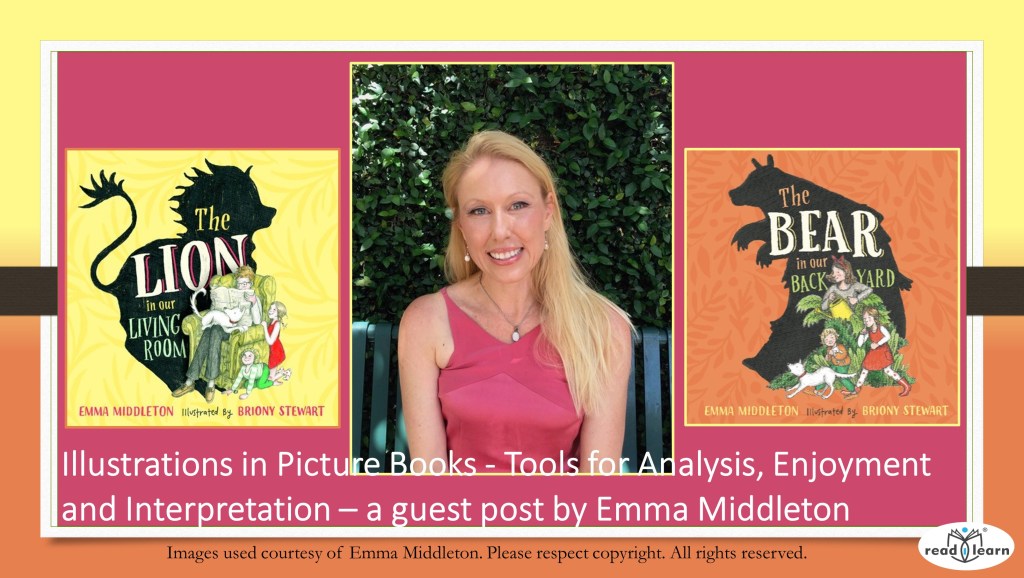
    This week I have great pleasure in introducing you to Emma Middleton who is here to discuss illustrations in picture books as tools for analysis, enjoyment and interpretation.

    Emma is a picture book author, illustrator, children’s performer and former ballerina who lives near Noosa, Queensland. After a career in performing arts, during which time she danced for the Vienna Ballet, she returned to Australia to direct and teach at The Brighton Dance Academy.

    Emma retired from teaching dance to follow her passion for picture books by creating stories that will enhance a child’s sense of wonder, delight and unlimited possibility. Emma is the author of companion picture books The Lion in our Living Room and The Bear in our Backyard.

    Welcome to readilearn, Emma. Over to you.

    Illustrations in picture books can be an excellent tool for developing children’s analytical and interpretative skills, as well as enhancing their enjoyment of art. Picture book advocate Megan Daley says, ‘Picture books are works of art which should adorn the walls of art galleries and libraries.’

    For young children, illustrated books open the door to understanding story. Illustrations provide young readers with an immediate vision of the characters, setting, and mood of the story. Children instantly respond to characters from their visual appeal. We all know and love many picture book characters from their image alone.

    Emma Middleton discusses the importance of illustrations in children's picture books, including Peter Rabbit


    Continue reading: The importance of illustrations in picture books – a guest post by Emma Middleton – Readilearn