Live Love Laugh Learn … Create the possibilities

Category: Early childhood education

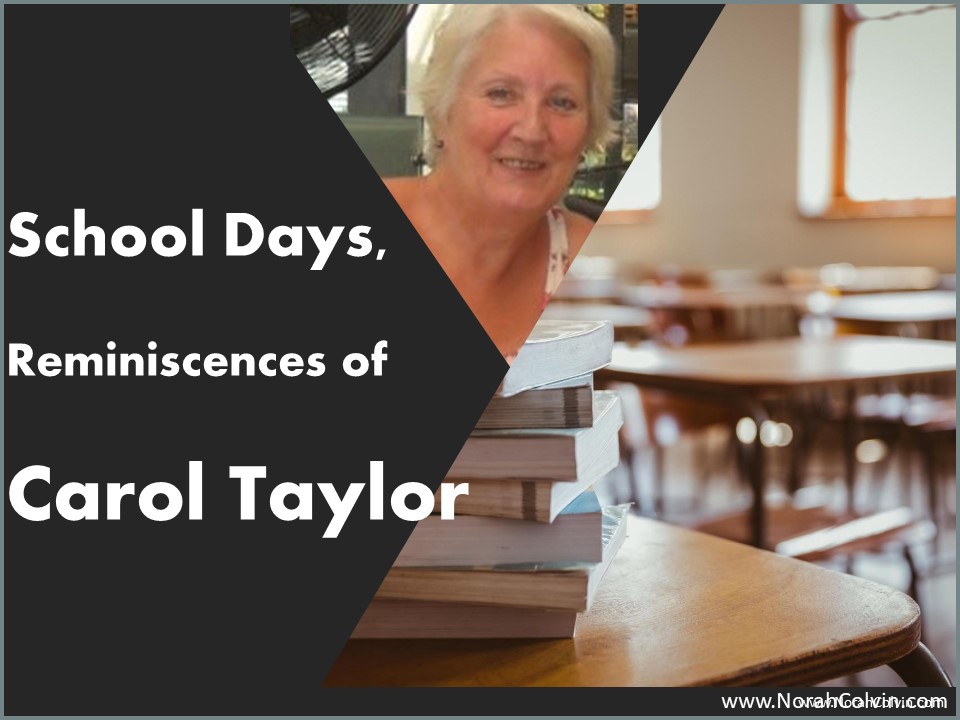
  • School Days, Reminiscences of Carol Taylor

    School Days, Reminiscences of Carol Taylor

    Welcome to the School Days, Reminiscences series in which my champion bloggers and authors share reminiscences of their school days. It’s my small way of thanking them for their support and of letting you know about their services and publications.

    This week, I am pleased to introduce Carol Taylor who blogs at CarolCooks2 and writes about food, health, cooking, the environment and life in general, but especially in Thailand. I enjoy her positive outlook and the honesty with which she writes. I first met Carol at Sally Cronin’s where she contributes a regular column about food and cooking. She has taken a great interest in the school days reminiscences shared by others and was happy to join in the conversation sharing her own.

    Before we begin the interview, I’ll allow Carol to tell you a little of herself:

    Enjoying life in The Land of Smiles I am having so much fun researching, finding new, authentic recipes both Thai and International to share with you. New recipes gleaned from those who I have met on my travels or are just passing through and stopped for a while. I hope you enjoy them.

    I love shopping at the local markets, finding fresh, natural ingredients, new strange fruits and vegetables I have never seen or cooked with. I am generally the only European person and attract much attention and I love to try what I am offered and when I smile and say Aroy or Saab as it is here in the north I am met with much smiling.

    Some of my recipes may not be in line with traditional ingredients and methods of cooking but are recipes I know and have come to love and maybe if you dare to try you will too. You will always get more than just a recipe from me as I love to research and find out what other properties the ingredients I use contain to improve our health and wellbeing.

    The environment is also something I am passionate about …Plastic, Recycling and effects of Global Warming are all high on my agenda now…I am appalled at man’s waste and how they are destroying our beautiful natural world…But also how successive governments around the world are not doing enough to address this problem.

    introducing Carol Taylor

    Welcome, Carol.

    Let’s talk school. First, could you tell us where you attended school?

    Carol Taylor in class photo

    My school days…I am dredging deep now as that was many, many years ago…I started at Potter Street Infants and Juniors and then progressed to the local Comprehensive which it became just as I started. Brays Grove, Harlow, Essex, England.

    I then progressed to Tottenham Technical College before starting work…

    What is your earliest memory of school?

    I can’t remember much about my early school years …I was happy I don’t have any bad memories I remember my mother still tells that tale as how when I first started school I stated I was now old enough to walk on my own…She got the bigger girls in the street to watch me..we didn’t live far it was maybe a five minute walk but I never let my mother take me I was always an independent miss or minx…ha-ha

    What memories do you have of learning to read and write?
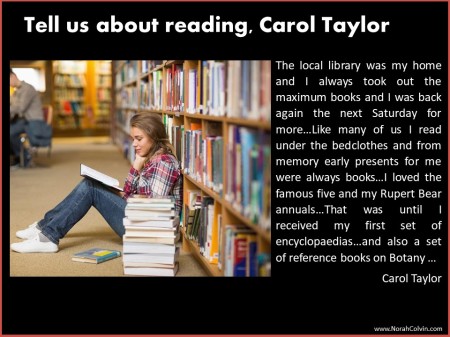
    Carol Taylor explains her love of reading

    I think I was born being able to read and write I never remember struggling and my handwriting was always neat and tidy I tried to emulate my father who wrote beautifully. The local library was my home and I always took out the maximum books and I was back again the next Saturday for more…Like many of us I read under the bedclothes and from memory early presents for me were always books…I loved the famous five and my Rupert Bear annuals…That was until I received my first set of encyclopaedias…and also a set of reference books on Botany …

    What was your favourite subject?

    Carol Taylor enjoys playing piano

    My father thought girls just got married and had children my mother always said very nice dear when I showed her my A+ marks…I was a good student…Particularly in Biology, History and Geography because I could write and add illustrations…Domestic Science and needlework I have always loved and music I mean we should all have music in our lives and I love to play the piano which was my first instrument. My nana’s every day after school as she had a lovely piano…and practise I did…until she passed away and her piano was given to the nurse who looked after her…I have never quite forgiven that action…

    What do you remember about math classes?

    You have probably noticed I didn’t mention Maths, Physics or P.E….Apart from the swimming I hated the rest and avoided where possible…Or tried to sit at the back of class unnoticed…

    What other memories do you have of school?

    Languages I studied 3…Latin, German and French… all at my senior school which I think is too late to start…Language is learnt far easier when the child is younger I can only speak for here( Thailand) but English is taught from when the child first starts school so much easier to pick up…

    I was never the most popular or unpopular I was just there. I had a few friends rather than everyone…

    What work or profession did you choose after school and was there anything in school that influenced this choice?

    From senior school I progressed to Tottenham Technical College to do Hair dressing and Beauty culture …I enjoyed my two years there. I learnt a lot about culture as I was meeting people from different backgrounds…I had led a sheltered life until then… I have always had a streak in me which didn’t want to conform to the norm so college allowed me to do that…I was a competition model my hair has been all colours and wacky styles which meant when my children wanted to dye their hair green I was overjoyed not the reaction kids like …ha-ha..

    I finished my two years with a distinction and came out raring to go…First Year improver…Hmmm…Not for this girl… I joined an Engineering company and did their stats for them…I left school and college still not knowing what I really wanted to do…

    I then had my first daughter and worked part time at our local Hospital…I was there for a few years mostly enjoyable and a learning curve …I was still an avid reader but apart from a diary never wrote much…That came much later in my life…

    What is the highest level of education you achieved?
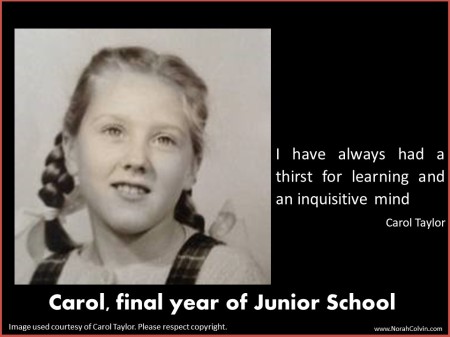
    Carol Taylor's thirst for learning and inquisitive mind

    I have always had a thirst for learning and an inquisitive mind and when I saw an advert for a Banking position I applied…Although maths was not my strong point in Senior school I can add up in my head all that early learning in Infants and Juniors paid off I still remember all of that…I passed the entrance exams…That really was the start of learning as while at the bank I took evening classes and passed A-level law and The London Institute of Banking and Mortgage Practise exams with distinction which is my highest level of education…

    My dear friend Jilly was my mentor she was a nursing sister…and she encouraged my thirst for knowledge telling my children and me that when I was studying I was unavailable…anything they wanted they asked before or after and it worked after a few days…

    After 15 years in banking I then started work for the government until I retired…Another learning curve …That was when my real distrust of politicians started…

    After retiring to Phuket and by chance joining a writing group…All my thanks go to them, they encouraged me …In my friend Dianne’s words…’ Oh my Buddha what have we released?” My writing journey began in earnest as did my cooking as much is not available here so some was borne out of necessity and the rest out of my growing awareness of what is in our food.

    How do you think schools could be improved?

    Carol Taylor's suggestions for improving schools

    Having lived here, Thailand for 8 years now…and watched my grandsons grow up through the Australian school system …My observations are that schools are too politically correct now…too qualification driven…I think children should be allowed to be children first and foremost…I think more attention should be paid to the fact that not everyone is academic and if they have other qualities like working with their hands it should be encouraged…

    So should a community spirit which is high on the agenda here in Thailand…I was a late starter as regards qualifications and that door should always be open…By listening and advising in a non-doctorial way but a two way conversation… if a child struggles with reading let them read a book which is of interest to them and fosters questions.

    What do you think schools (in general) do well?

    Carol Taylor on what schools do well

    From my research into climate change I have been heartened by the fact that many schools now are encouraging children to learn about the environment and showing them how to grow food…I think that is good way forward …
    thank you for your participation

    Thank you for sharing your reminiscences of school and thoughts about education in general, Carol. It’s been wonderful to have you here. I love your attitude to learning and agree that it should be life-long. I also agree that ‘children should be allowed to be children first and foremost’ and to ‘let them read a book which is of interest to them and fosters questions.’ I am heartened by your observation that ‘many schools are now encouraging children to learn about the environment’.

    Find out more about Carol Taylor

    on her blog: https://carolcooks2.com/

    and connect with her on social media

    Twitterhttps://twitter.com/TheRealCarolT

    Face bookhttps://www.facebook.com/carol.taylor.1422

    Pinterest: https://www.pinterest.com/caroltaylor56/pins/

    Carol is a contributor to the Phuket Island Writers Anthology:

    https://www.amazon.com/Phuket-Island-Writers-Anthology-Stories-ebook/dp/B00RU5IYNS

    If you missed previous reminiscences, check them out here:

    Charli Mills

    Sally Cronin

    Anne Goodwin

    Geoff Le Pard

    Hugh Roberts

    Debby Gies

    Pauline King

    JulesPaige

    D. Avery

    Christy Birmingham

    Miriam Hurdle

    Robbie Cheadle

    Marsha Ingrao

    Ritu Bhathal

    Joy Lennick

    Darlene Foster

    Susan Scott

    Barbara Vitelli

    Sherri Matthews

    Mabel Kwong

    Chelsea Owens

    Look for future interviews in this series to be posted on Sunday evenings AEST.
    Coming soon:

    Pamela Wight

    Pete Springer

    Yvette Prior

    Colleen Chesebro

    Thank you blog post

    Thank you for reading. I appreciate your comments. Please share your thoughts.


  • Great App for Future Readers: Word Zoo | Ask a Tech Teacher – readilearn

    Great App for Future Readers: Word Zoo | Ask a Tech Teacher – readilearn

    This week I am pleased to share with you information about a new reading app, Word Zoo, reviewed by Jacqui Murray on her website Ask a Tech Teacher. If you need to know anything about using technology in the classroom, Jacqui will be able to help you out.

    Over to you, Jacqui:

    Reading is defined as “the action or skill of absorbing written or printed matter silently or aloud.” Sounds dry, maybe even boring, but the ability to read has been credited with exercising the mind, saving lives, bringing people together, and predicting success in school. It alleviates boredom in the bits of free time that pop up between soccer and dinner and it can be done alone or in a group.

    “Books are the quietest and most constant of friends…”
    ― Charles William Eliot

    So when I find an app that organically encourages reading, I get excited. But I’m fussy. Here’s what I look for–the red answers are how this mystery ready app sized up:

    Continue reading: Great App for Future Readers: Word Zoo | Ask a Tech Teacher – readilearn

  • Move it like a rock star

    Move it like a rock star

    Charli Mill's flash fiction challenge - rock star

    This week at the Carrot Ranch, Charli Mills challenged writers to In 99 words (no more, no less) write a story about a rock star. You can feature a central character or write about the feeling like a rock star. Go where the prompt leads!

    One of my favourite TED talks is Ken Robinson’s Do Schools Kill Creativity? If you haven’t watched it yet, I recommend it as a very entertaining 20 minutes. I find it both heartbreaking and inspiring at the same time.

    In the video, Ken suggests that all kids have tremendous talents, and we squander them, pretty ruthlessly.” He quotes Pablo Picasso as saying that every child is an artist. Remaining one into adulthood is the problem.

    Robinson then goes on to talk about having lived at Snitterfield just outside Stratford, which is where Shakespeare’s father was born.”

    He asks, Are you struck by a new thought? I was. You don’t think of Shakespeare having a father, do you? Do you? Because you don’t think of Shakespeare being a child, do you? Shakespeare being seven? I never thought of it. I mean, he was seven at some point. He was in somebody’s English class, wasn’t he?”

    Now that’s an interesting thought. I wonder if your English teachers remember you from their classes. Could they have made any of the comments that Robinson suggests may have been made about the young William Shakespeare, including:

    “Must try harder.”

    or at bedtime, being sent to bed by his dad,

    “Go to bed, now!”

    “And put the pencil down!”

    “Stop speaking like that.”

    “It’s confusing everybody.”

    It’s quite a thought. Perhaps as writers, we should reveal our school reports that are relevant to our writing careers. How well did our teachers predict our futures?

    But we’re not discussing writers in this post. We’re discussing rock stars. I guess most rock stars started out in someone’s classroom too. And that made me think of this inspirational video by Clint Pulver, professional drummer and motivational speaker, who discusses one moment and one teacher who changed his life.

    We all hope for a Mr Jensen in our lives to help us realise our full potential.

    Movin’ It

    Miss Prim turned from the board just in time to see Max land a punch on Michael.

    “Ma-ax!”

    “He bumped me.”

    Miss Prim sighed. “What were you doing, Michael?”

    “Noth—”

    “He was rocking the desk again.”

    “How many times—”

    Without direction, Michael removed himself to sit in the corner. Before long, his feet were twitching, his elbows were pumping and his whole body was squirming.

    “Michael!”

    Everyone looked.

    “Sorry, Miss,” Michael muttered.

    But he couldn’t keep still.

    Years later, when he was a rock star, Miss Prim said, “I knew he’d make something of himself one day.”

    «»

    I chose the name Michael for my character for three rock stars, only one of whom is still living (the oldest) but all of whom had the moves.

    Mick Jagger

    Michael Hutchence

    Michael Jackson

    Thank you blog post

    Thank you for reading. I appreciate your feedback. Please share your thoughts.

  • Let’s celebrate National Aboriginal and Torres Strait Islander Children’s Day – readilearn

    Let’s celebrate National Aboriginal and Torres Strait Islander Children’s Day – readilearn

    Ideas and resources for celebrating National Aboriginal and Torres Strait Islander Children’s Day held on 4 August each year.

    This Sunday 4 August, is National Aboriginal and Torres Strait Islander Children’s Day. Celebrated on this date for over thirty years, the day provides a special opportunity for Aboriginal and Torres Strait Islander families to celebrate their children and for us all to get to know a little more of their culture.

    Although this year the day falls on a Sunday, there is no reason it can’t be celebrated in the classroom during the week. In fact, with Aboriginal and Torres Strait Islander histories and cultures one of the ACARA cross-curriculum priorities, every day is a good day for celebrating our children and helping them to feel special and included.

    The theme for this year’s celebration is We Play, We Learn, We Belong. It focuses on the importance of education for young children with special emphasis on the need for it to be culturally appropriate. The website has many suggestions to help you celebrate the day and some free downloadable resources.

    In this video, this year’s ambassador, Nanna from Little J and Big Cuz, introduces the day.

    Continue reading: Let’s celebrate National Aboriginal and Torres Strait Islander Children’s Day – Readilearn

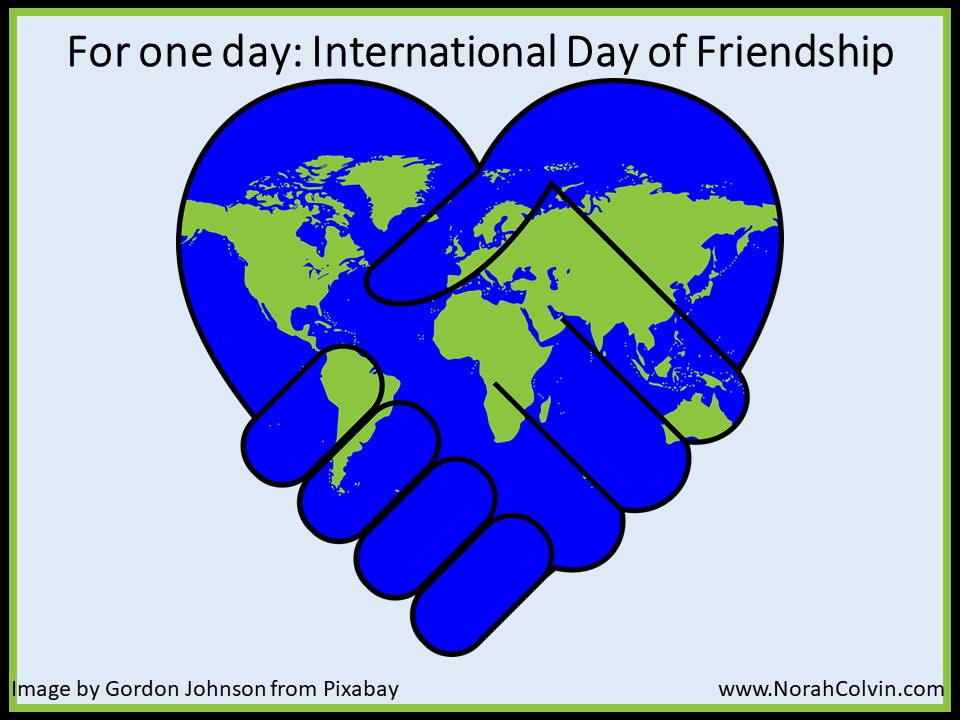
  • For one day: International Day of Friendship

    For one day: International Day of Friendship

    Carrot Ranch flash fiction challenge - for one day

    This week at the Carrot Ranch, Charli Mills challenged writers to In 99 words (no more, no less) write a story that includes the phrase “for one day.” The words single out a special occurrence. What is the emotion and vibe, where does it take place and why? Go where the prompt leads!

    For more than one day, I have thought about what to write. I was drawn by the theme of empathy, of walking in someone else’s shoes, of being able to see oneself through the eyes of another, or of having the opportunity to heal past wounds, for one day. But I couldn’t quite get it. It was elusive, until I came across this video of Chris Rosati.

    Chris Rosati decided that what he wanted to do most with his life was spread kindness. It led me to consider what the world might be like if, for one day, everyone of us, wherever we are, put aside our differences and spread kindness. Perhaps then, we wouldn’t need to walk in the shoes of another, see ourselves as others see us, or heal old wounds. Kindness would prevail.

    Pandemic

    It started slowly. First an outbreak in a school in central Australia, barely newsworthy. Then another in South America. A post on social media drew a few views but was largely ignored. When a third occurred in Western Europe, reports flooded news services. Soon, small isolated pockets erupted on every continent, and they multiplied and spread. The touch of a hand, a pat on a shoulder, the nod of a head, a brush of lips, the trace of a smile; all were infectious. The contagion was rampant. Random acts of kindness proliferated, and unbridled bursts of joy exploded everywhere.

    A bit too Pollyanna? Maybe. But wouldn’t it be wonderful? And since today, 30 July, is International Day of Friendship, it’s totally appropriate.

    friendship
    https://openclipart.org/detail/117199/Friendship

    Teaching friendship skills was always a big part of my classroom practice and many of the lessons I develop for the readilearn collection of teaching resources for the first three years of school also focus on the development of friendship skills; including:

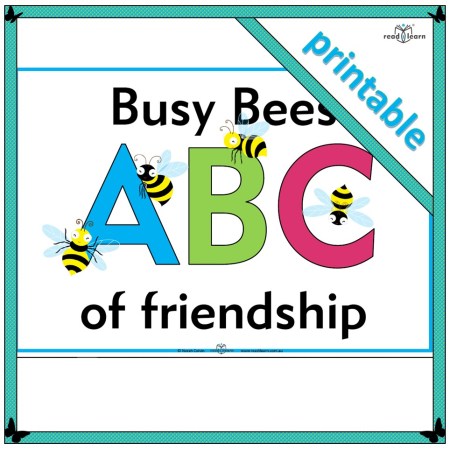
    busy bees ABC of friendship

    Busy Bees ABC of Friendship

    friendship superhero posters

    Friendship Superpower posters

    Getting to know you surveys 1

    Getting to know you surveys

    Extend the hand of friendship

    Extend the hand of friendship

    how to make a friendship tree

    How to make a friendship tree


    SMAG

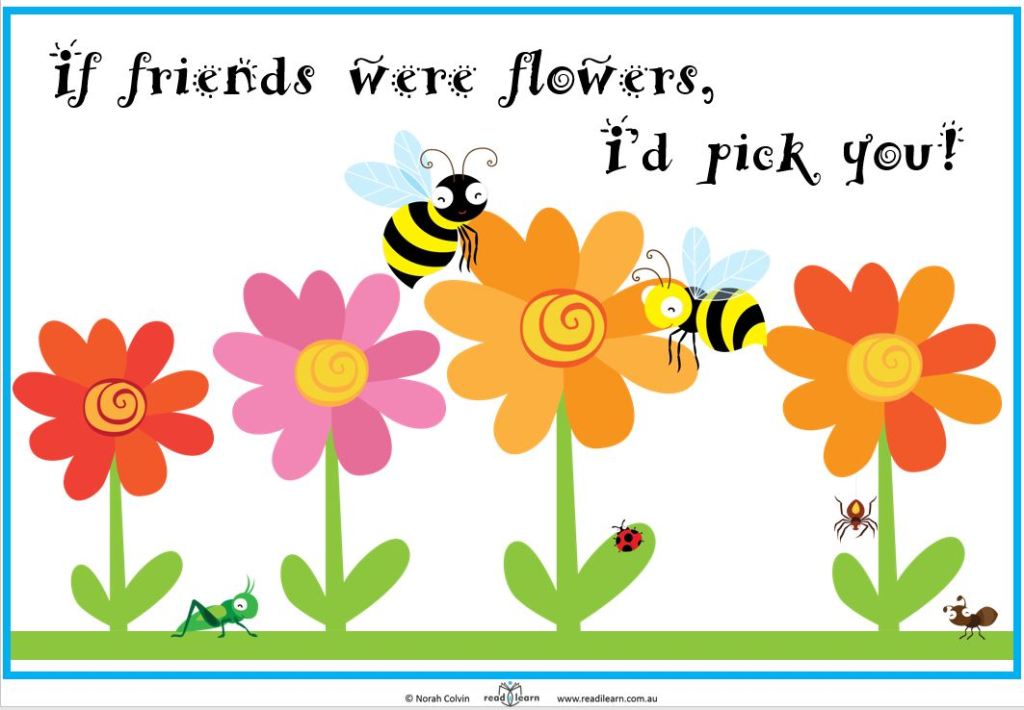
    Happy International Day of Friendship to all my friends. Thank you for bringing joy to my life.

    If friends were flowers I'd pick you

    Thank you blog post

    Thank you for reading. I appreciate your feedback. Please share your thoughts.


  • School Days, Reminiscences of Mabel Kwong

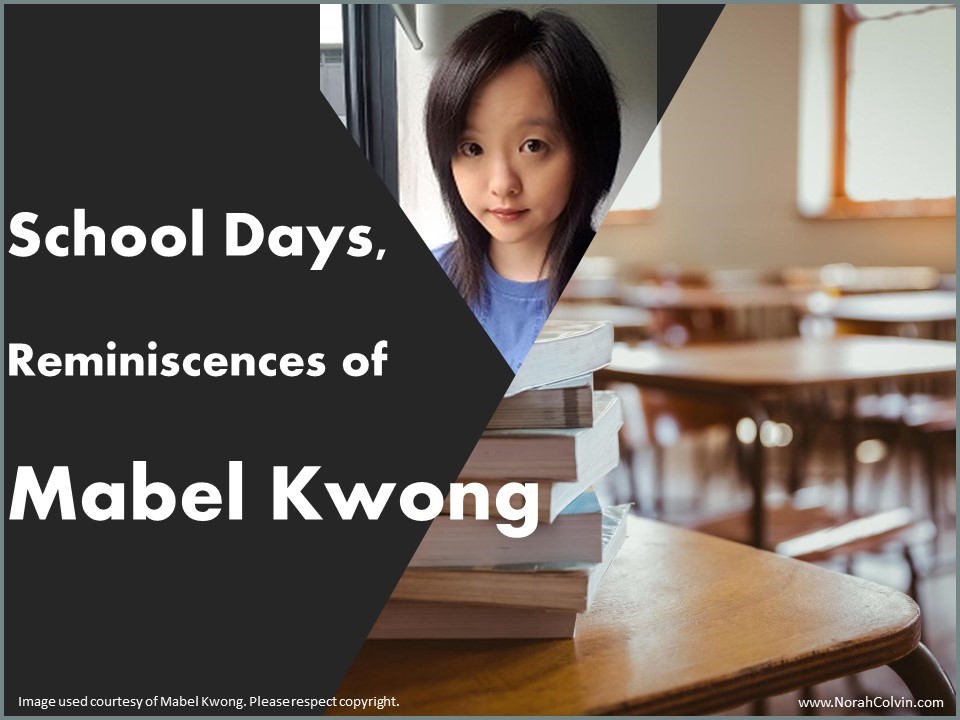
    School Days, Reminiscences of Mabel Kwong

    Welcome to the School Days, Reminiscences series in which my champion bloggers and authors share reminiscences of their school days. It’s my small way of thanking them for their support and of letting you know about their services and publications.

    This week, I am pleased to introduce Mabel Kwong, non-fiction writer and blogger. I enjoy reading Mabel’s eponymous blog where she shares her thoughts about life and attitudes in Australia. It is enlightening, and also saddening at times, to read her perspectives. It seems that racism is still alive and a little too well in Australia.

    I have great admiration for Mabel and admire her honesty. I think all Australians, and others, would benefit from reading her blog. Perhaps then we’d come to know and understand each other a little better and in turn, be more accepting and respectful.

    At the beginning of 2018, I was honoured when Mabel accepted my invitation to write a post for readilearn about her experience of Chinese New Year celebrations. She wrote this lovely post The significance of the Chinese New Year — a guest post by Mabel Kwong. Mabel also generously permitted me to present her information as an ebook Let’s read about Chinese New Year which is available to read free on readilearn.

    Before we begin the interview, I’ll allow Mabel to tell you a little of herself:

    Mabel Kwong is a non-fiction writer in Melbourne, Australia. Mabel was born in Australia and has spent time living in Singapore and Malaysia. With a keen eye on observing everyday details, she writes about multiculturalism, cultural differences and the writing process. She blogs at MabelKwong.com and shares various perspectives on these topics, encouraging all of us to learn from one other.

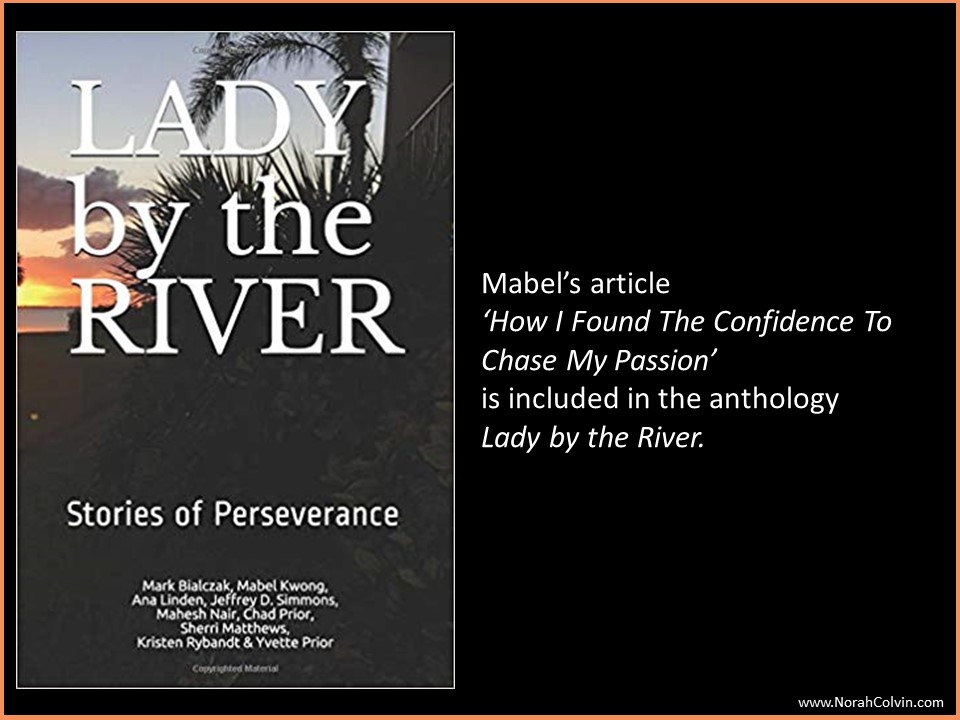
    In 2017, Mabel published ‘How I Found The Confidence To Chase My Passion’ in the self-help book Lady by the River: A collection of personal stories about persevering through challenging times. Her works on current affairs, lifestyle tips and audience reception have also been published in magazines, online editorials and academic journals. She is currently working on her first book about being Asian Australian and finding the inspiration to pursue one’s passion.

    Outside of writing, Mabel is a photographer and enjoys going to gigs, walking, playing video games and watching YouTube.

    Purchase Lady by the River here

    Welcome, Mabel.

    Now let’s talk school. First, please tell us where you went to school.

    Growing up as a third culture kid, I moved around a lot and attended schools in different countries. I went to kindergarten in Australia. Then I did primary school in Malaysia and later in Singapore. Most of my high school education was done in Singapore, and the last year was completed in Melbourne. I attended university in Melbourne.

    Did you attend a government, private or independent school?

    My education was a mix of government and private schooling.

    What is the highest level of education you achieved?

    A postgraduate degree.

    What work or profession did you choose after school and was there anything in school that influenced this choice?

    When I was in high school, I was intent on pursuing a career in the media, aspiring to be a journalist or a writer smithing non-fiction narratives. At university I was keen on developing my written skills and took writing classes in my Bachelor of Arts. I was also very good at maths and ended up majoring in that alongside cultural studies as part of my degree.

    What is your earliest memory of school?

    I remember my kindergarten days quite vividly. I was about five and went to kindergarten in a quiet eastern suburb in Victoria where the demographic was predominantly white. My classmates were mostly of western background. They came up to me during recess and laughed at my razor straight bangs and avoided sitting with me during lunch.

    I also remember back then my kindergarten had a set uniform code. Girls had the choice of dressing up in a green and yellow checkered dress that hit just at the knee or a blouse with long pants. My parents dressed me in the latter most of the time even when it was 30’C because they thought the dress was not modest enough.

    What memories do you have of learning to read?

    Mabel Kwong school days reminiscences

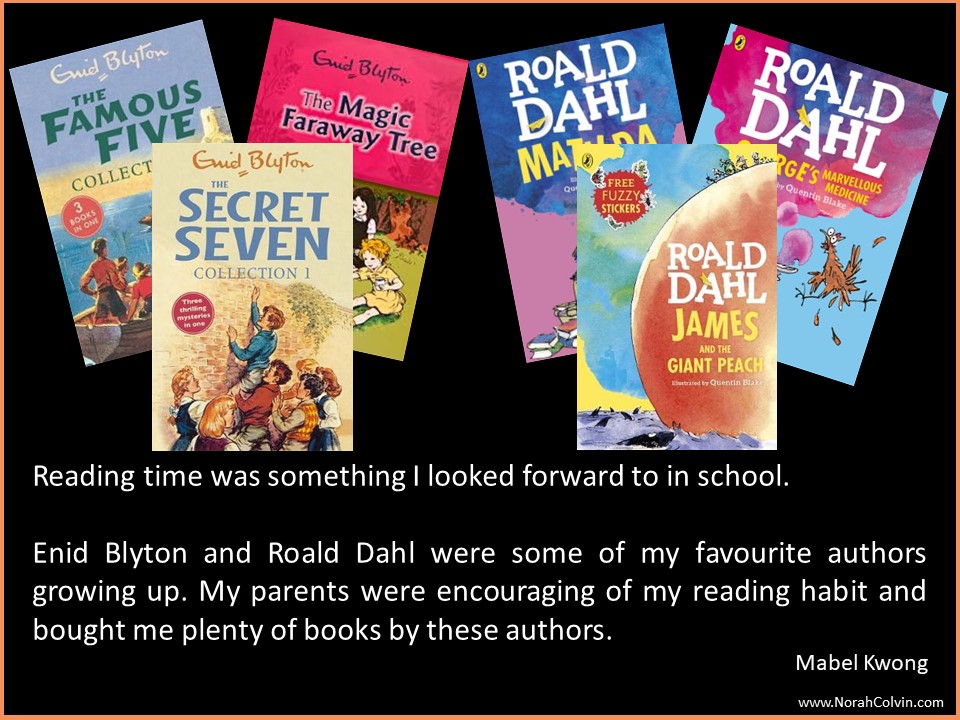
    Reading time was something I looked forward to in school. In kindergarten, reading time meant reading aloud. Each time it came to my turn to read, my stuttering voice stumbled over the words. Every time I got stuck at a word my heartbeat raced and my face felt flush. It was a mortifying feeling when the other kids giggled but my teacher was always patient, letting me finish reading aloud at my own pace.

    Enid Blyton and Roald Dahl were some of my favourite authors growing up. My parents were encouraging of my reading habit and bought me plenty of books by these authors. As a teenager, I got into reading young adult fiction books based off TV series, including Buffy The Vampire Slayer, Charmed, Sabrina The Teenage Witch and also Archie Comics. Later on in high school, I started reading more non-fiction. My high school classes in Singapore made us read articles from the Reader’s Digest magazine each week. I was always the first to finish reading the required articles in class and went on to read more articles in the magazine.

    What memories do you have of learning to write?

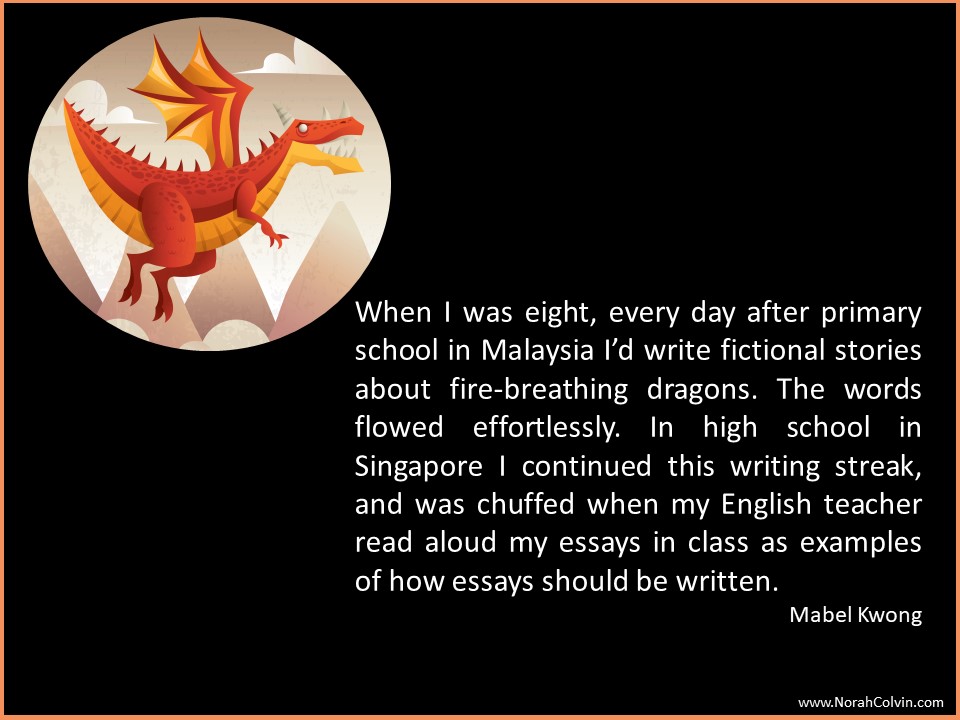
    Mabel Kwong school days reminiscences

    When I was eight, every day after primary school in Malaysia I’d write fictional stories about fire-breathing dragons. The words flowed effortlessly. In high school in Singapore I continued this writing streak, and was chuffed when my English teacher read aloud my essays in class as examples of how essays should be written. Later at university in Australia I struggled to write poetry in creative writing classes and my tutors commented my attempts at journalistic news writing were ‘a good start’. Life at university did make me question my ability to be what it takes to be a writer.

    What do you remember about math classes?

    A love-hate relationship would be how I’d describe me and maths. All throughout school and university, I was good at maths. Studying maths is emphasised a lot in South-East Asian school curriculum and getting less than a B grade meant attending maths remedial classes. While I aced high school maths and aced calculus/fluid dynamics within my Applied Mathematics major at university, I lacked the passion for maths. When I sat down to revise for maths at university, my mind wandered to my cultural studies and journalism classes, planning that next story I wanted to write in my head. That said, from a young age my teachers instilled in me that maths (and science) is important – such as important for calculations, predicting weather patterns and drawing up code to build phone apps.

    What was your favourite subject?

    English. I’ve always wanted to be a writer and all things grammar and vocabulary appealed to me.

    What did you like best about school?

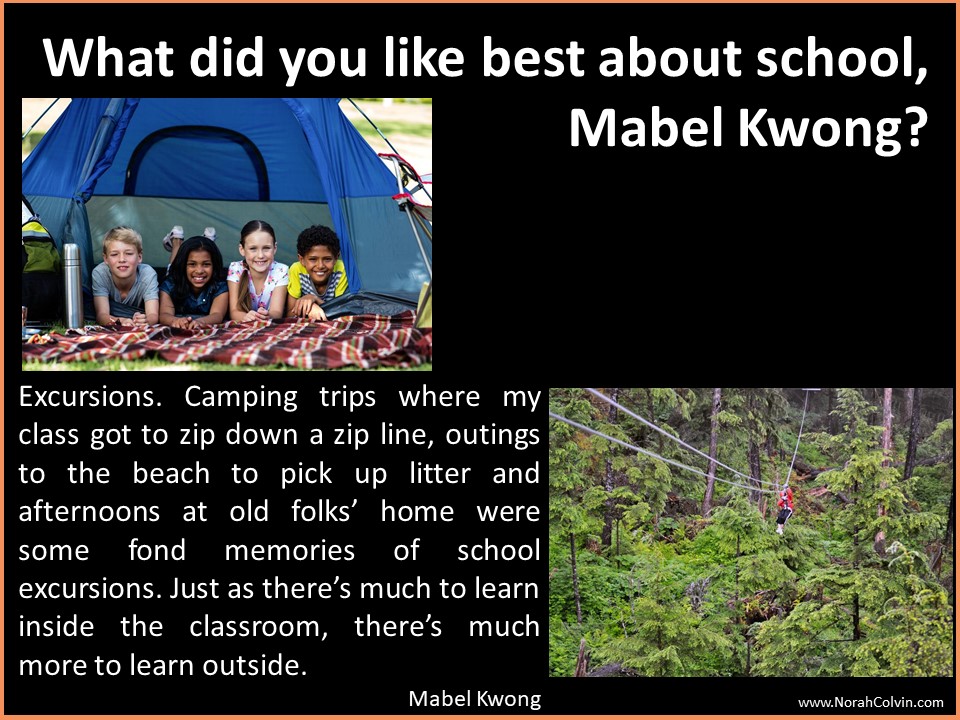
    Mabel Kwong school days reminiscences

    Excursions. Camping trips where my class got to zip down a zip line, outings to the beach to pick up litter and afternoons at old folks’ home were some fond memories of school excursions. Just as there’s much to learn inside the classroom, there’s much more to learn outside.

    What did you like least about school?

    School is a place where there are rules to adhere to whether you like it or not. I wasn’t a huge fan of wearing compulsory school uniforms where skirts had to be a certain length and in Singapore schools, long hair had to be tied up (in some South-East Asian schools, girls’ hair couldn’t go past their ears). Also my Singapore high school divided the cohort into academic streams – the Express stream learnt at a faster pace and took more advanced subjects while the Normal stream took more technical subjects. Moreover, not everyone got to do the subjects they wanted to do; I wanted to do geography but by luck of the draw I was put into history class.

    There’s also not forgetting that my Singapore high school classes started at 7.30am each day. P.E. classes required us to run 2.5km within a certain time or get a low grade. As a night owl and someone who isn’t all that athletic, I don’t miss either of these.

    How do you think schools have changed since your school days?

    These days there are many options on getting an education especially higher education in Australia. Online and distance learning at our own pace off-campus can be convenient if we work full time. Notably, primary and secondary school fees are in the thousands each year per student and tertiary student loans are on the rise in Australia. While education may be more accessible, it might not be more affordable.

    What do you think schools (in general) do well?

    Patient and encouraging teachers make learning much more enjoyable.

    How do you think schools could be improved?

    Mabel Kwong on how schools could be improved

    At times school can be a place where we feel we don’t belong. As Hugh Roberts said in his interview for this series, ‘Nobody should feel afraid to go to school because they are bullied or just because they’re told they are different and don’t fit in.’ There needs to be more focus on bringing awareness towards discrimination, racism and bullying. Having more open discussions in class about different cultures, sexualities, gender, mental illness and disabilities would foster a stronger sense of belonging in school and encourage us to embrace and respect differences early on.


    thank you for your participation

    Thank you for sharing your reminiscences of school and thoughts about education in general, Mabel. It’s been wonderful to have you here. I think your suggestions for improving schools are lessons we could all apply throughout life. When we feel like we belong we are more likely to respect and accept others.

    Find out more about Mabel Kwong

    on her blog: MabelKwong.com

    or connect with her on social media

    Facebook: @TheMabelKwong

    Twitter: @TheMabelKwong

    Instagram: @TheMabelKwong1

    LinkedIn: @TheMabelKwong

    Purchase Lady by the River here

    Purchase your own copy of Lady By The River here on Amazon.

    If you missed previous reminiscences, check them out here:

    Charli Mills

    Sally Cronin

    Anne Goodwin

    Geoff Le Pard

    Hugh Roberts

    Debby Gies

    Pauline King

    JulesPaige

    D. Avery

    Christy Birmingham

    Miriam Hurdle

    Robbie Cheadle

    Marsha Ingrao

    Ritu Bhathal

    Joy Lennick

    Darlene Foster

    Susan Scott

    Barbara Vitelli

    Sherri Matthews

    Look for future interviews in this series to be posted on Sunday evenings AEST.
    Coming soon:

    Chelsea Owens

    Carol Taylor

    Pamela Wight

    Pete Springer


    Thank you blog post

    Thank you for reading. I appreciate your comments. Please share your thoughts.
     

  • #WATWB New Indigenous doll to foster understanding

    #WATWB New Indigenous doll to foster understanding

    On the last Friday of each month, We Are the World Blogfest invites bloggers to join together in promoting positive news. I join in as often as I can as we need to look beyond the alarmist headlines and see all the good that is happening in the world. If you would like to join in, please check out the rules and links below.

    This month, I am sharing a story that I think is long overdue. In celebration of NAIDOC Week at the beginning of July, Play School, a television show for young children, added an Indigenous doll to its collection. The doll’s name Kiya means ‘Hello’ in Noongar language from Noongar country in Western Australia.

    Kiya is a modern Aboriginal girl doll and will remain part of the show’s collection to foster understanding of Aboriginal culture and respect for country.

    I think it is a fabulous addition to the show and is especially significant this year, The International Year of Indigenous Languages.

    Click to read the whole article: Play School reveals Indigenous doll Kiya for NAIDOC Week.

    As stated by #WATWB, “There are many an oasis of love and light out there, stories that show compassion and the resilience of the human spirit. Sharing these stories increases our awareness of hope in our increasingly dark world.”

    I think the world could do with some more light at the moment. Please join in and share positive stories to lift the clouds.

    Here are the guidelines for #WATWB:

    1. Keep your post to Below 500 words, as much as possible.

    2. Link to a human news story on your blog, one that shows love, humanity, and brotherhood. Paste in an excerpt and tell us why it touched you. The Link is important, because it actually makes us look through news to find the positive ones to post.

    3. No story is too big or small, as long as it Goes Beyond religion and politics, into the core of humanity.

    4. Place the WE ARE THE WORLD badge or banner on your Post and your Sidebar. Some of you have already done so, this is just a gentle reminder for the others.

    5. Help us spread the word on social media. Feel free to tweet, share using the #WATWB hashtag to help us trend!

    Tweets, Facebook shares, Pins, Instagram, G+ shares using the #WATWB hashtag through the month most welcome. We’ll try and follow and share all those who post on the #WATWB hashtag, and we encourage you to do the same.

    The cohosts this month:
    Shilpa Garg

    Simon Falk

    Damyanti Biswas

    Lizbeth Hartz

    Eric Lahti

    Please pop over to their blogs to read their stories, comment and share.

    Click here to join in and enter the link to your post. The bigger the #WATWB group each month, the greater the joy!

    Thank you blog post

    Thank you for reading. I appreciate your comments. Please share your thoughts.
  • A New Classroom Game for Junior Entomologists – readilearn

    A New Classroom Game for Junior Entomologists – readilearn

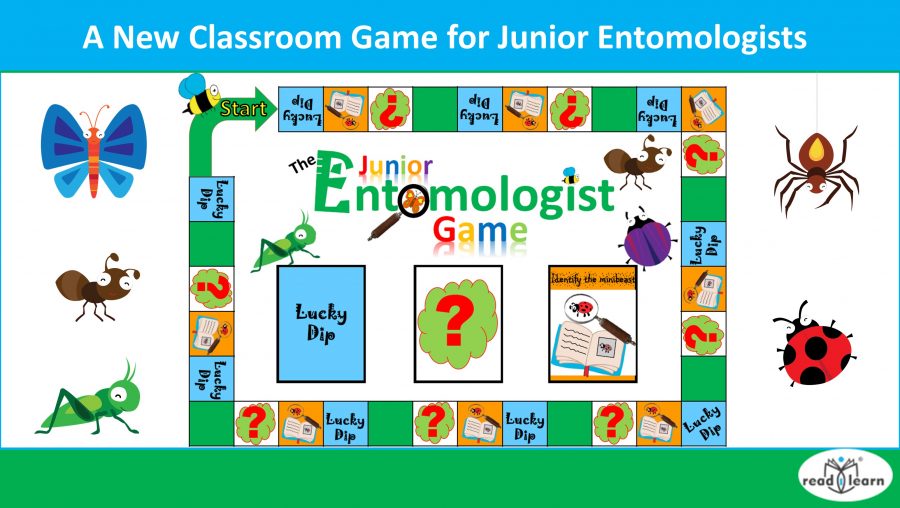
    This week I have added a new classroom game for junior entomologists to the collection. The game is a fun way to integrate learning across the curriculum and, while appropriate for use at any time of the year, is particularly so when completing a unit of work about minibeasts.

    The game works well as a group activity in science, literacy or maths lessons. It is also great as an activity with buddy classes. It is best if an adult or older buddy is available to explain and oversee the play.

    Cross-curricular links

    The game involves children in learning and practice of skills across curriculum areas; including:

    Science

    Biology – focus minibeasts

    • Living things
    • Features of living things
    • Needs of living things
    • Life stages of living things

    Literacy

    Reading:

    • For information
    • To follow instructions

    Research skills – finding the answers to questions

    Maths

    • Subitisation – spots on the dice
    • Counting one for one correspondence – moving spaces around the board
    • Tallies – recording points
    • Adding – totalling points
    • Comparing numbers – establishing the winner

    Social-Emotional Skills

    Games are an excellent way of teaching children the essential skills of getting along, including:

    • Taking turns
    • Being honest
    • Accepting decisions
    • Accepting that winning is not always possible nor the most important part of the game
    • Winning and losing gracefully

    Contents of the Junior Entomologist Game package

    a new classroom game for junior entomologists

    All components of the game are downloadable and printable. Laminating is recommended for durability.

    The package includes:

    Continue reading: A New Classroom Game for Junior Entomologists – readilearn

  • Surprise Party for a Koala

    Surprise Party for a Koala

    Carrot Ranch flash fiction challenge Koala

    Last week at the Carrot Ranch, Charli Mills challenged writers to In 99 words (no more, no less) write a story about a koala in a kingdom. You can create a character out of Norah’s koala and give it a Vermont adventure. Or you can make up a story however you want! Can you pull off a BOTS (based on a true story)? Go where the prompt leads!

    While most prompts run for just one week, this one runs for two as Charli has been in Vermont conducting the inaugural and very successful Carrot Ranch Writers’ Refuge.

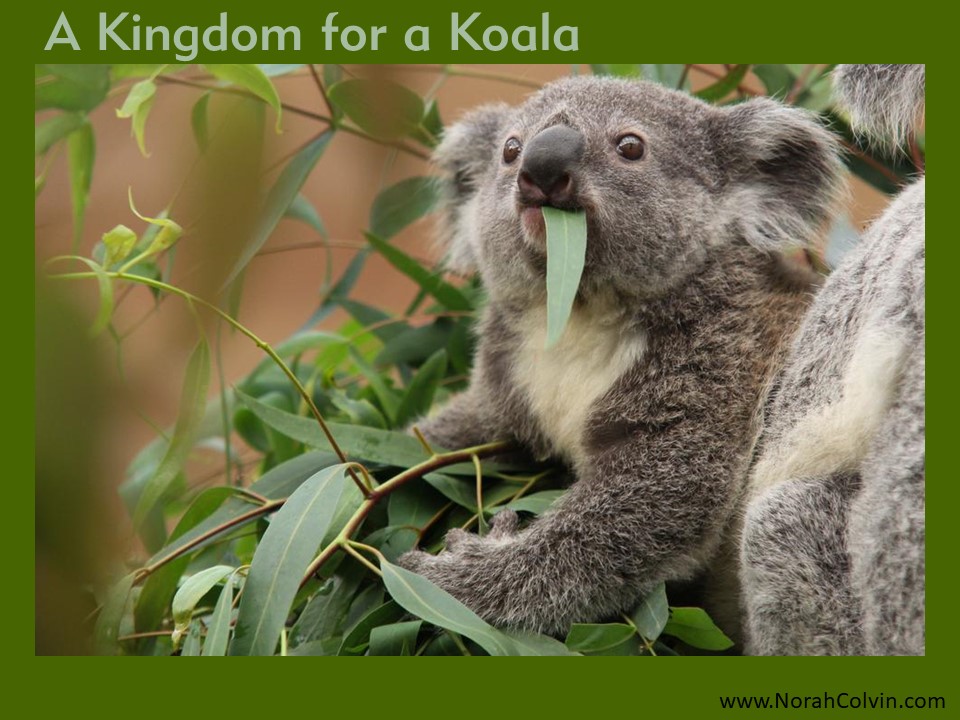
    A Kingdom for a Koala flash fiction

    Although I submitted A kingdom for a Koala in response to the prompt last week, I thought I’d have another go this week. The koala is one of my favourite Australian animals and also the animal emblem of my home state Queensland.

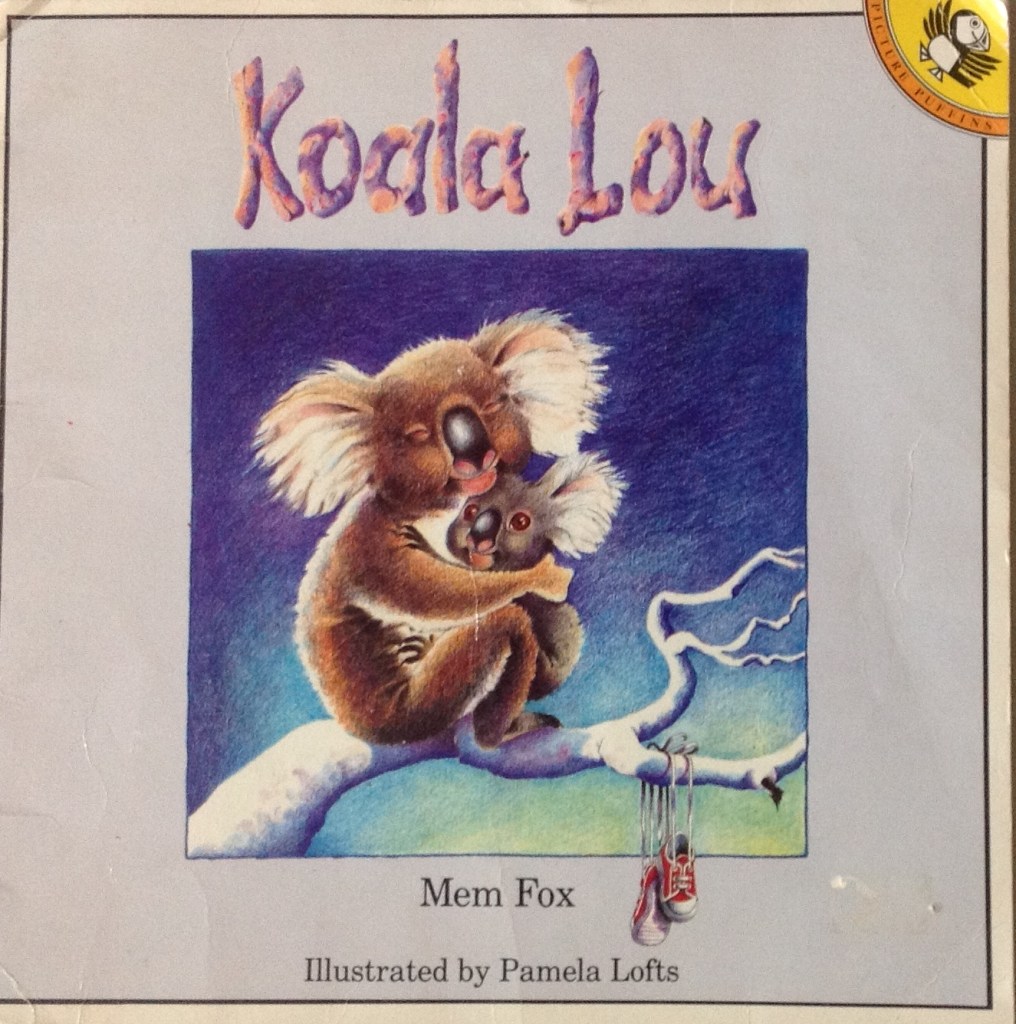
    Koala Lou by Mem Fox

    I always list Koala Lou by Mem Fox among my (many) favourite picture books. (You can listen to Mem read it by following that link.)

    Little koala's party

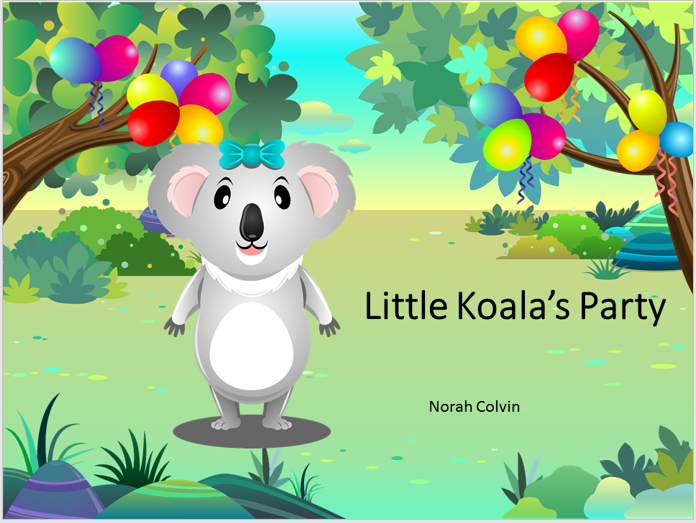
    Little Koala’s Party — a story for problem solving is one of my favourite readilearn teaching resources. The story engages children in helping Little Koala work out the number of guests and items required for her party. They can then use the same strategies to organise a party of their own. I always loved the illustrations that were done by an artist I met on 99designs.

    That’s a lot of favourites so how could I not write another koala story? I decided that, for this week’s story, I would link Charli’s prompt with thoughts of a party. I hope you like it.

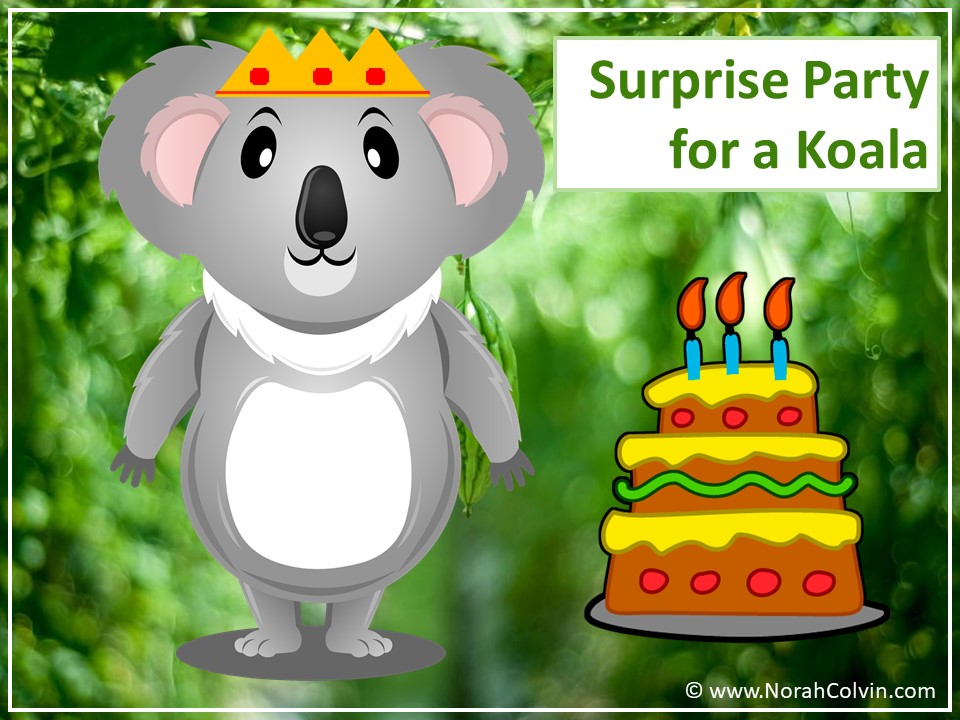
    Surprise Party for a Koala

    BANG! BANG! BANG!

    Little Koala’s eyes pinged open.

    There it was again. BANG! BANG!

    She stretched, clambered down the tree and headed towards the noise.

    She stopped under possum’s tree and peered into the branches.

    “What’s going on here?”

    Possum peeked out, glancing left and right. “Nothing.”

    “Tell me!”

    “Nothing. Go away.”

    Koala scrambled up the tree. “What’re you doing?”

    Possum grimaced, pointing to a sign.

    “You know I can’t read yet.”

    Possum placed a crown on Koala’s head. “It was supposed to be a surprise. Happy birthday.”

    Koala felt special as a princess when all her friends arrived.

    Thank you blog post

    Thank you for reading. I appreciate your comments. Please share your thoughts.

  • School Days, Reminiscences of Sherri Matthews

    School Days, Reminiscences of Sherri Matthews

    Welcome to the School Days, Reminiscences series in which my champion bloggers and authors share reminiscences of their school days. It’s my small way of thanking them for their support and of letting you know about their services and publications.

    This week, I am pleased to introduce Sherri Matthews, memoir writer, essayist, short story writer and blogger. It seems Sherri and I have been friends forever. We love to hang out (online) at each other’s places as time permits and are always understanding when life gets in the way. We know we will pick up where we left off.  Sherri’s Summerhouse is always open to visitors and she has been one of the most active in raising awareness of SMAG (Society of Mutual Appreciation and Gratitude) and I love that, after four years since its inception, she still refers to it in her comments.
    Before we begin the interview, I’ll allow Sherri to tell you a little of herself:

    Sherri once worked in the medical and legal fields. When she got laid off, she praised the heavens for the chance, at last, to write her book. Six years later, her memoir, Stranger In A White Dress, is in final edits. Blogging at her Summerhouse along the way, Sherri also writes from her life as a Brit mum raising her children in California and as advocate for her youngest, diagnosed with Asperger’s Syndrome at 18. Sherri also shares snippets of life with her dear old jailbird dad. Today, Sherri lives in England with her hubby, Aspie, two black cats and a grumpy Bunny Nutkins. She walks, takes photos and finds joy creating a garden full of bees and butterflies with her dad’s words, ‘Keep smiling, Kid’, ringing in her ears. Especially when the robin sings.
    Sherri Matthews reminiscences of school days

    Welcome, Sherri.

    Let’s talk school. First, could you tell us where you attended school?

    England, first in Surrey, then at ten moved to Suffolk.

    Did you attend a government, private or independent school?

    Government.

    What is the highest level of education you achieved?

    I left high school at 16 with enough ‘O’ Level qualifications to get a semi-decent first job. Buying a car was my priority, thanks to living miles from town. And yes, even turning down the opportunity to go on to University, fully funded by the Government (I know, I know…kick me, someone, please…). But at 19 and wanting better prospects, I returned to full time education and was accepted for a full time, year-long course, at my local college, attaining an RSA (Royal Society of Arts) Diploma as a Personal Assistant with business and legal studies.

    What work or profession did you choose after school and was there anything in school that influenced this choice?

    Sherri Matthews reminiscences of school days

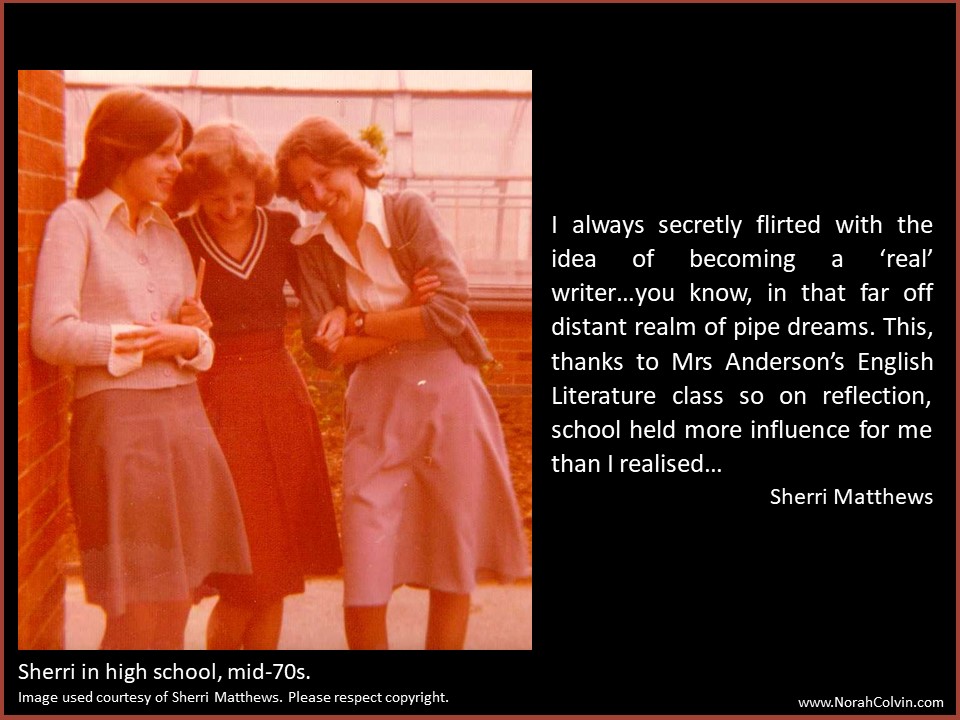
    At first thought, nothing at school influenced me, finding rather than choosing my job as a Postal Officer, which I enjoyed. Had my own till and everything. I was always drawn to both the medical and legal profession, but it was my diploma that influenced my eventual chosen profession of paralegal when I moved to California. But now you ask, Norah, I always secretly flirted with the idea of becoming a ‘real’ writer…you know, in that far off distant realm of pipe dreams. This, thanks to Mrs Anderson’s English Literature class so on reflection, school held more influence for me than I realised…

    What is your earliest memory of school?

    Feeling homesick and counting the seconds to the last bell and the school bus ride home. And calling my teacher ‘Mummy’ by mistake, going bright red when she smiled and gently corrected me. She had white, fluffy hair I recall, strangely and rather amusingly reminding me of Rupert Bear.

    What memories do you have of learning to read?

    Oh, I loved to read! I had a lot of Ladybird early reader Janet and John books at home and was able to read by the time I started primary school. I adored all of Enid Blyton’s The Famous Five books, especially Five Go To Treasure Island, a wonderful ripping adventure. I loved the tomboy Georgina. I had the A A Milne paperback book set of Winnie The Pooh and felt very grown up reading Now We Are Six when I was…well…six. Most of my reading, I recall, was in bed waiting for my dad to come home from work.

    What memories do you have of learning to write?

    My earliest memories are of scribbling illegible ‘notes’ in the margin of my reading books and getting told off by Mum. At school, I practised letters in a lined exercise book, graduating to daily ‘Morning News’ about the night before, mine usually describing eating baked beans on toast and watching Jackanory. Later, we learnt how to write italics with ink filled fountain pens, beautiful flowing cursive I would not recognise as my own today. Being a leftie, I always ended up with ink smudges on my hand and arm.

    What do you remember about math classes?

    Sherri Matthews reminiscences of school days

    Not liking it, except when my maths teacher turned up in old tweeds, a projector and slides of his safaris in Africa. No wonder I didn’t learn much. Yet mental arithmetic I’ve used in several jobs, so I must have learned something. But algebra and the like? Forget it. The best maths lesson that actually helped me in life came from the headmistress of my village primary school in Suffolk. At the end of each day, our class stood up reciting by rote until we knew by heart the entire Times Table. We grumbled, but it’s ingrained to this day.

    What was your favourite subject?

    Creative writing, biology, music, athletics and gymnastics. And country dancing, because we girls got to hold hands with the boys.

     What did you like best about school?

    Sherri Matthews reminiscences of school days

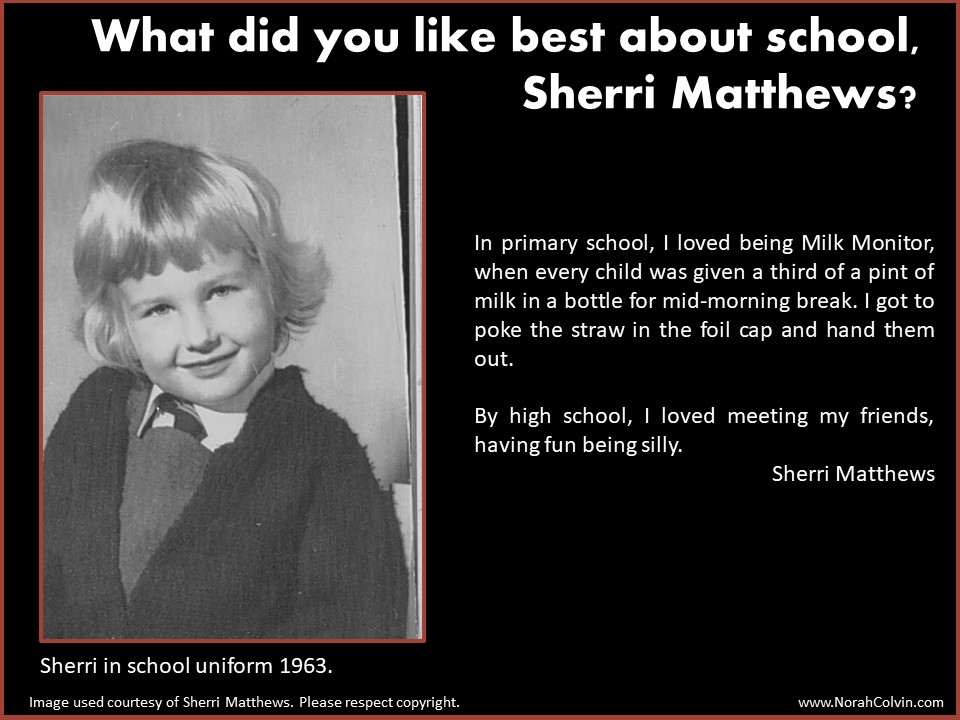
    The last bell. I jest…or do I? In primary school, I loved being Milk Monitor, when every child was given a third of a pint of milk in a bottle for mid-morning break. I got to poke the straw in the foil cap and hand them out. I loved quiet reading and writing time and holiday times like Christmas when we got to make homemade gifts. By high school, I loved meeting my friends, having fun being silly. I met my then best friend playing flute in the school orchestra. And drama was fun, though I scraped my shin falling off the stage once and still have the scar.

    What did you like least about school?

    I enjoyed my Food and Nutrition class, but each week I had to write an in-depth essay and bring all the ingredients to school. I then had to travel home with my cooked dishes. Not easy, since I travelled 20 miles each way by two buses, and often with no spare seat on the public bus. By the time I got home, I was sick to my stomach of the smell of my food, but my Mum and brother couldn’t wait for ‘tea’. I also didn’t like the girl gang headed up by a really mean girl nicknamed, Noddy.

    How do you think schools have changed since your school days?

    Because my children were raised and educated mostly in California, I am more familiar with the system as it was then, though students here seem now to have the same more relaxed relationship with their teachers as there, from what I have observed. The teachers in my day were much stricter. I got my knuckles rapped with a wooden ruler once and it hurt. No more of that, thank goodness. I think there’s more interaction today in class, fostering more interest from the students instead of the boredom of rote learning of my day.

    What do you think schools (in general) do well?

    I was struck by the way my children’s elementary classes in California fostered a climate of being kind and thoughtful to others, of being awarded for not just academic progress, but for good citizenship. I was fully hands-on as a volunteer, but I never saw my parents at school, except for sport’s day. Nobody noticed when I cried at school, but today I think there is more awareness generally for struggling children, though there is still a great need for improvement. My youngest slipped through the cracks and wasn’t diagnosed with Asperger’s Syndrome until eighteen.

    How do you think schools could be improved?

    Sherri Matthews - how schools could be improved

    Which leads me to…less focus on those dreaded OFSTED ratings (Office for Standards in Education, Children’s Services and Skills) and more on the individual.  The expectation that all students should be good at all subjects is something I think needs to go. More emphasis on each student’s talents and strengths in smaller classrooms and rapport building between the teachers, student and parent is needed, fostering mutual respect. My youngest and middle boy finished their schooling years in England at a high OFSTED rated school, yet despite my frequent calls asking for support for my youngest, we got none.

    thank you for your participation

    Thank you for sharing your reminiscences of school and thoughts about education in general, Sherri. It’s been a pleasure to have you here. I enjoyed reading about your own school experiences and agree with your suggestions for improving schools through smaller classes and better relationships. It is disappointing to know that your own daughter was one of those who ‘slipped through the cracks’.

    Catch up with Sherri Matthews on her blog

    A View from My Summerhouse

    Or connect with her on social media

    Facebook Author Page: A View from My Summerhouse

    Twitter: @WriterSherri

    LinkedIn: Sherri Matthews

    Blurb for Sherri Matthew’s soon-to-be-published memoir Stranger in a White Dress

    ‘We must be willing to let go of the life we have planned,
    so as to have the life that is waiting for us.’
    ~E. M. Forster~

    Set against the backdrop of the late 1970s, the story of a chance meeting one summer’s night between two eighteen year olds unfolds: Sherri, an English girl living in rural Suffolk, and Jonathan (Jon), an American G. I. from California newly posted to a USAF base nearby.

    They fall in love fast, but Sherri, delighted to show off her homeland to this “new boy”,  soon discovers that although growing up thousands of miles apart, they share dark similarities, which quickly threaten to unravel their relationship.

    Their mothers divorced from alcoholic fathers, both were raised by abusive step-fathers.  Jon’s increasing drug use and resulting paranoia clash with Sherri’s insecurities as hopes of “fixing” him and of the stable family life she dreams of slip away.

    Los Angeles and lust; obsession and rage; passion and the power of love: theirs is a love affair defined by break-ups and make-ups, and then a shattering revelation explodes into this already volatile mix, altering the course of both their lives profoundly and forever.

    A tale of darkest tragedy, yet dotted with moments of hilarity and at times the utterly absurd, this is a story of two young people who refuse to give up, believing their love will overcome all.

    Not until decades after their chance meeting, and during a return trip to Los Angeles in 2013, does Sherri discover that Jon’s last wish has been granted.

    It’s then that she knows the time has come to tell her story.

    ♦♦♦

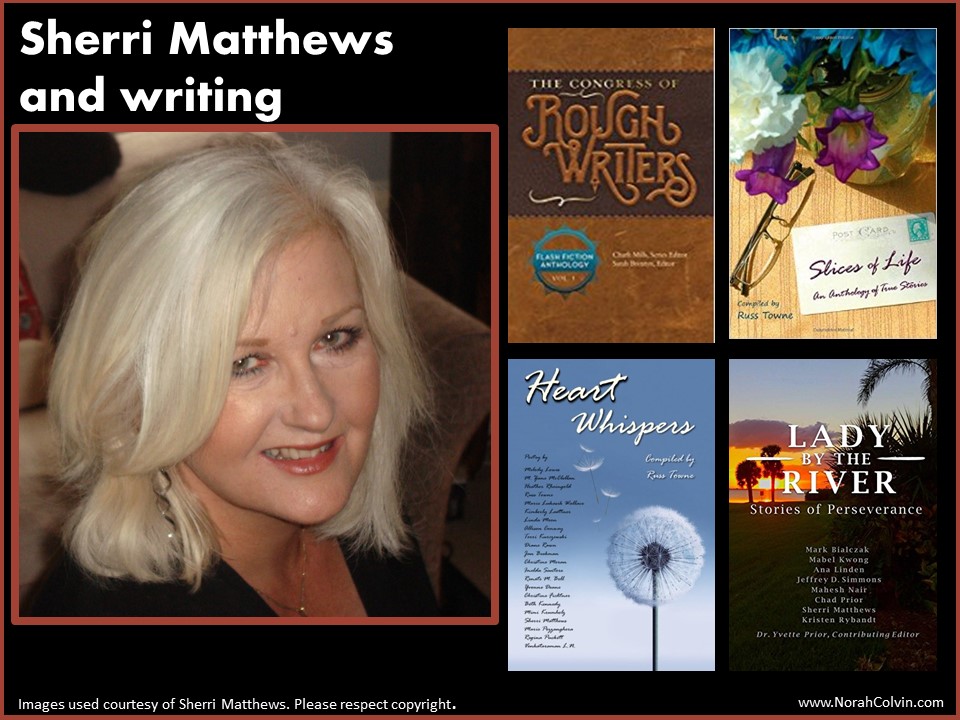
    Other publications by Sherri Matthews

    Sherri Matthews - writing

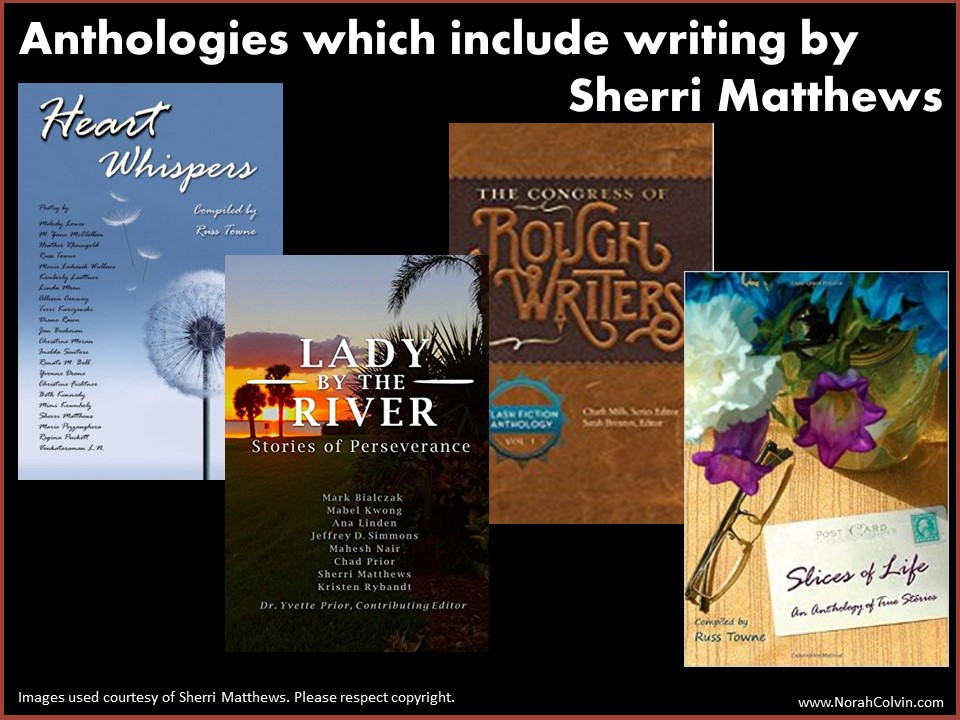
    You can find a list of where Sherri has been published in magazines and online here.

    Her writing also appears in these anthologies:

    The Congress of Rough Writers: Flash Fiction Anthology Vol. 1

    Lady By The River: Stories of Perseverance

    Slices of Life: An Anthology of Selected Non-Fiction Short Stories

    Heart Whispers: A Poetry Anthology

    If you missed previous reminiscences, check them out here:

    Charli Mills

    Sally Cronin

    Anne Goodwin

    Geoff Le Pard

    Hugh Roberts

    Debby Gies

    Pauline King

    JulesPaige

    D. Avery

    Christy Birmingham

    Miriam Hurdle

    Robbie Cheadle

    Marsha Ingrao

    Ritu Bhathal

    Joy Lennick

    Darlene Foster

    Susan Scott

    Barbara Vitelli

    Look for future interviews in this series to be posted on Sunday evenings AEST.

    Coming soon:

    Mabel Kwong

    Chelsea Owens

    Pete Springer

    Carol Taylor

    Thank you blog post

    Thank you for reading. I appreciate your comments. Please share your thoughts.