
I have many discussions with parents about whether they should read fairy tales and stories with magical elements to their children. These parents raise a number of issues, for example:
- Horrible things happen – Hansel and Gretel are abandoned in the woods (by their parents) and are captured by a wicked witch – the wolf tries to trick the seven little kids left at home alone
- Parents are often dead or absent – Cinderella, Beauty and the Beast, Rapunzel, Red Riding Hood, Jack and the Beanstalk
- Stepmothers are mean – Cinderella, Snow White
- Sexism, especially the need for a female to be rescued by a handsome prince – Cinderella, Sleeping Beauty
- They contain “magical” creatures such as fairy godmothers (Cinderella, Sleeping Beauty), witches (Snow White), giants (Jack and the Beanstalk), trolls (Three Billy Goats)
- Myth of happily ever after
- Stereotypes – beauty is good, ugly is bad
- The presence of magic – good magic of fairies and bad magic of witches – Sleeping Beauty; magical bean seeds and geese (Jack and the Beanstalk)
- Bullying – Cinderella
Maria L. Hughes, writing for The Little Prickle Press sums up the concerns this way:
“many of the older tales incorporated rather dark themes devoted to death, suffering and children being murdered. But then there is also a second incorporation that has to do with later Disney movies of these fairy tales and them being too happy and can result in parents thinking their child will be deluded with ideas that the world will just work for them and things will be good.”
While I acknowledge these elements occur, I am not prepared to abandon fairy tales because of it.
While I may consider a diet of only fairy tales problematic, I think something would be lacking if a child was refused access to the richness of their stories and tradition. Like most fiction, they offer an avenue for escapism. In addition, the stories can be used as a tool for initiating non-threatening discussions of the issues listed above.
In Once upon an if The Storythinking Handbook Peter Worley writes
“Stories are just one way that we are able to sharpen our own character in order to prepare for the narratives we will one day find ourselves in as the story of our life unfolds before, around and within us.”
Following a comment by Richard Dawkins, a recent discussion on The Guardian considered whether fairy tales are harmful to children. So far the consensus seems to be that they are not.
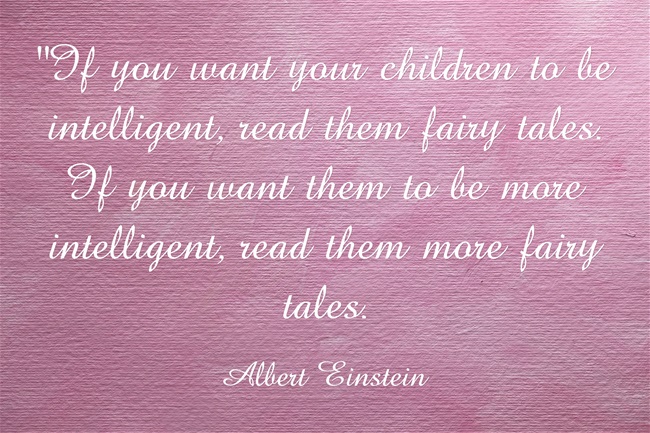
Albert Einstein was a supporter of fairy tales and is often attributed with the following quote, discussed in more detail by Maria Popova on brain pickings.
Anne Fine, in the Foreword to Once upon an if The Storythinking Handbook explains
“In an increasingly complicated world, we more than ever want our children to be able to think with clarity, rather than lead lives hampered or derailed by all those false assumptions and unexamined prejudices that seem as easily inherited as freckles or brown eyes.
How can we go about teaching them to peel back the surface of their first thoughts on a matter, or even their strongest beliefs, and look at them with more care? . . . fiction has always fostered the moral, intellectual and emotional development of the growing child. (‘Should she have done that?’ ‘Would I?’ ‘What else could have been done?’ ‘How would it feel?’) Good stories highlight the sheer complexity of things. They furnish a far greater understanding of the world and everyone in it. For most of us, fiction has always been the earliest – and many would argue the best – instrument we have had for ethical enquiry.”
Think of the ethical inquiry that could occur when discussing Goldilocks and her break and enter, Jack’s theft of the giant’s belongings and the constant portrayal of the wolf as the bad guy; just to get you started.
Melissa Taylor on her blog “Imagination Soup” suggests the following 8 reasons why fairy tales are essential to childhood:
- Show kids how to handle problems
- Build emotional resilience
- Give us a common language (Cultural literacy and canon)
- Cross cultural boundaries
- Teach story
- Develop imagination
- Can be used to teach critical thinking skills
- Teach lessons
In a previous post about fairy tales, written in response to a flash fiction challenge set by Charli Mills I mentioned that I was not a keen reader of adult fantasy. In a comment on that post Charli mentioned that she knew others with similar feelings. I will leave you with a link to another article on brain pickings in which Maria Popova discusses the thoughts of one of the masters of fantasy, J.R.R. Tolkien on Fairy Tales, Language, the Psychology of Fantasy, and Why There’s No Such Thing as Writing “For Children”
What do you think? Should we read fairy tales to children? Why/why not?
What are your favourite fairy tales and what lessons have you learned from them?
Please share your thoughts.


















 Norah Colvin