Live Love Laugh Learn … Create the possibilities

Category: Creativity

  • Imagine that!

    Imagine that!

    Recently Hope at Nanny Shecando sent me a tweet requesting some thoughts about imaginative play in a school setting. Sadly I would say that imaginative play has been just about pushed out in the ever-increasing content-driven and assessment focused curriculum. Seeing children as young as five spending much of their day sitting at desks filling in worksheets and parroting back isolated bits of information flashed at them in meaningless drill and practice sessions is about as far away from my thoughts about education as you could get. If it is difficult for early childhood teachers to squeeze time for imaginative play into their programs, imagine (there’s that word) how difficult it is for teachers of older children.

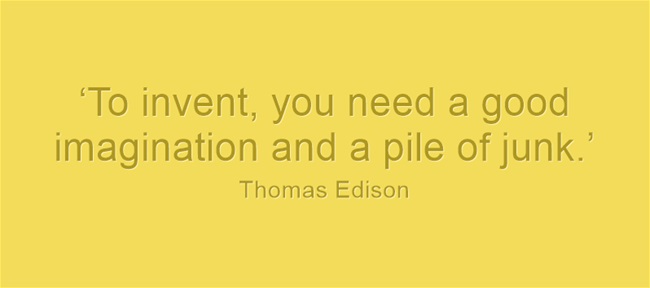
    However, whenever I hear the above quote by Thomas Edison, I am reminded of how an early childhood classroom should be: a place for imagination, exploration and discovery.  Parents may tire of the cardboard box creations that children regularly bring home, wondering where each one can be stored (or discreetly disposed of!), but the value to be had from the opportunity to create, imagine and play must not be understated.

    For imagination to flourish in an early childhood classroom, I suggest the following ingredients are essential:

    A recognition of the importance of play and imagination in the healthy development of children and the prioritisation of opportunities for imaginative play every day by providing:

    • Time – lengthy and uninterrupted, with the opportunity for created play areas to be left intact over a number of days or weeks
    • Space – both indoor and outdoor with a variety of larger and smaller spaces
    • Opportunities for self-selection of activity and self-direction
    • Books for story reading and play acting
    • Variety of props: things such as dress-up items including lengths of fabric that can be a kings robe, a princess’s dress, a magic carpet, an apron, a bed; hats and scarves; toys like cars, dolls, animal toys; building blocks and cardboard boxes; paper, cardboard scissors and pens for creating signs, posters and crowns; areas for quiet play with cushions; open spaces for creating larger ‘worlds’ . . . the items that can be used to inspire imagination are limitless.

    When children are showing interest in a particular topic, an observant teacher may gather up a variety of props and leave then in a box for children to discover and use as they decide.

     

    https://openclipart.org/image/800px/svg_to_png/30889/lampada_di_aladino_alad_01.png
    https://openclipart.org/image/800px/svg_to_png/30889/lampada_di_aladino_alad_01.png

    In an earlier post, Learning at its best: A classroom of magic, Hope herself described a school with an open space ‘where magic happens’. She described a friendship tree where ‘friendship and freedom of speech are fostered’; an area with a ‘magic carpet . . . plush beaded cushions and Middle Eastern style blankets . . . a place for imagination to prosper. Anything is possible when dreamed, imagined or conjured whilst on the magic carpet.’

    magic carpet

    She described an area for drama and the opportunity of being and expressing yourself. She described a creativity corner where young inventors could create anything they could imagine; and spaces to read, explore, share and dream. One could think this school was in Hope’s dreams, her imagination of what is possible. But it is a real school educating real children in very positive ways that will have a very different effect that the scenario I described above. However it is not a typical school. There is not one like it in every suburb. In Hope’s words, it is a ‘very select private school’. But don’t all children deserve learning opportunities such as these?

    After re-reading Hope’s post, I’m not entirely certain why she invited me to share my thoughts about imaginative play in a school setting. I think she has described a wonderful example of imagination in practice. The design of the school and the aspects of the program described above, show the value of imagination, not only of the students but of the school designers, administrators and teachers.

    In a recent post Just imagine . . . the power of imagination I talked about the power of imagination to drive creativity and innovation, and suggested that much of what we now accept as commonplace was once only in someone’s imagination. Einstein said that,

    ‘Imagination is more important than knowledge. For knowledge is limited to all we now know and understand, while imagination embraces the entire world, and all there ever will be to know and understand.’

    Maria Montessori is attributed with the idea that Play is child’s work’. In this article Thinking about Children’s Play David Elkind, refutes that idea citing works by both Freud and Piaget, a psychologist whose work greatly influenced thinking about child development and learning. Elkind, himself a professor of child development and of author of books such as The Hurried Child, The Power of Play  and Miseducation, says that ‘Although Montessori has made many important and lasting contributions to early childhood education, her identification of work and play in young children was unfortunate.’ He says that, in play, children are not preparing for life, they are living life.

    Early-instruction - David Elkind

    Elkind does not favour the imposition of formal learning situations upon children of increasingly younger ages.  The following excerpt from Miseducation, shared in Commentary: The ‘Miseducation’ of Young Children Elkind says, ‘When we instruct children in academic subjects, or in swimming, gymnastics, or ballet, at too early an age, we miseducate them; we put them at risk for short-term stress and long-term personality damage for no useful purpose. There is no evidence that such early instruction has lasting benefits, and considerable evidence that it can do lasting harm.’

    He continues, saying that ‘The most important thing is an excitement about and enthusiasm for learning. Skills are easily learned when the motivation is there.’ I agree wholeheartedly and have joined in with a discussion of motivation in a number of posts, most recently in Motivation – why we do the things we do.

    An-ounce-of-motivation David Elkind

    In another article Can we play? shared on The Greater Good in 2008, Elkind explains that imaginative play is important to academic as well as social and emotional development. Unbelievably, he said that ‘More than 30,000 schools in the United States have eliminated recess to make more time for academics.’ It is difficult to imagine how unwelcoming and uninspiring a school without recess would be. I wonder how much lunch time those who made these rules allow themselves.

    He says ‘Play is motivated by pleasure. It is instinctive and part of the maturational process. We cannot prevent children from self-initiated play; they will engage in it whenever they can. The problem is that we have curtailed the time and opportunities for such play.

    In the words of Cat Stevens (Yusuf Islam), ‘Where do the children play?’  I add ‘and when?’


    If you wish to read further, here are some links to get you started. I don’t agree with all the content. Some suggest a more structured approach than I would favour. However, as with everything, a broader knowledge helps one more clearly formulate one’s own position.

    Assessing and Scaffolding Make-Believe Play by Deborah J. Leong and Elena Bodrova

    Teachosaur thoughts ‘Play is the work of children’ … J. Piaget

    Tools of the Mind Supporting Make-Believe Play

    Psychology today The Need for Pretend Play in Child Development


    I value your feedback. Please join in the discussion by sharing your thoughts about any aspect of this post.


  • Will you be my friend?

    Having friends, people you connect with, is an essential part of life.

    Children, whether at the park, the shops, kindy, school or anywhere else are always looking for someone to engage with or play.

    Often when children come home from their first day at school or other activity, a parent will ask (if the information isn’t volunteered) “Did you meet a new friend today?”

    https://openclipart.org/image/800px/svg_to_png/192642/Children_holding_hands.png
    https://openclipart.org/image/800px/svg_to_png/192642/Children_holding_hands.png

    Children of before school age are often happy to play alongside whomever happens to be around; everyone is their ‘friend’. As they get older interactions with others of similar interests become more important and they begin to form stronger friendships with individual or small groups of children.

    If children have an unhappy day at school it is often because they have had no one to play with. Maybe their best friend was absent or chose to play with someone else; or they may have had a disagreement with a friend or group of friends.

    A few years ago I was engaged to construct and implement a friendships skills program with early childhood classes. Through discussion, stories, song, role play and cooperative games, the program taught children strategies for initiating and maintaining friendships.

    applications-internet

    The need for friendship is just as important on the internet playground of social media as it is in the school playground. People seek out others with similar interests and form online communities collecting followers, favourites, friends and likes. Just as in the playground, there are certain strategies which should be followed online to maintain those friendships.

    The home page of each platform is a good place to start for ‘rules’ of engagement. In addition, many bloggers offer recommendations for friendly behaviour. Some that I have found useful include:

    I’m sure you are aware of, or will find, many others offering similar advice.

    The one thing they all agree on is being friendly and polite, engaging in conversation and not making it all ‘me, me, me’. Just as one-sided in-person relationships have a limited life span, so too do one-sided friendships on social media.

    In the ‘real’ world, people belong to different groups and organisations which are quite distinct in their goals and purposes. It is not always desirable to have these ‘worlds collide’ in a way that would provide information about oneself not previously revealed to a particular group; for example one may not wish to mix neighbourhood friends with work colleagues.

    The same situation may also exist online with people publishing, or participating in groups that publish, very different material. The use of a pseudonym is sometimes suggested as a way of masking one’s identity or to keep separate two distinct styles of authorship.

    While neighbourhood friendships are important to both children and adults and may be easier to maintain, the planning that is required to engage with like-minded friends who live further away is usually worth the effort.

    https://openclipart.org/image/800px/svg_to_png/148843/1310261210.png
    https://openclipart.org/image/800px/svg_to_png/148843/1310261210.png

    The same is true online. Because I blog, and am already signed in, at WordPress, it is very easy for me to engage with (by following, commenting, liking and sharing) others who also blog at WordPress. Notifications of others’ posts are received in my everyday email inbox as well as my WordPress reader. Additionally, when I link to them in my posts, pingbacks are automatic.

    Engaging with those using hosts other than WordPress requires effort, some more than others. It can often be difficult to leave a comment because doing so requires signing in using a platform to which I don’t already belong. Frustratingly, sometimes lengthy and well-thought out comments disappear if a mistake is made signing in or copying a captcha.  Oftentimes a like or share button can be impossible to find, and following can also be difficult as I miss notifications sent to an infrequently used email address. There are particular blog hosts that are so problematic that I now ignore them, regardless of how interesting I think the posts might be.

    sad
    https://openclipart.org/image/800px/svg_to_png/178504/sad.png

    While following WordPress bloggers may be easier, I don’t follow all or only WordPress bloggers. Those I follow must meet my criteria for interest and engagement. The extra effort required to follow non-WordPress bloggers is worth it when we have interests in common and engage in conversations which expand my horizons and thinking. (I am thinking particularly of Anne Goodwin and Caroline Lodge, both non-WordPress users.)

    I have talked about maintaining real-world friendships, the need to belong to different groups, and the desire to achieve separation between some of those groups. I have also discussed a similar situation with regards to online friendships.

    Warnings about the dangers of forming online ‘friendships’ with unscrupulous people are publicised almost daily with their accompanying stories of tragic events. I agree that these are very real and very present dangers and one must practise extreme caution when forming any friendships, online as well as off. Of less interest to the media, but probably of greater magnitude, are the number of real friendships forged as a result of online communication.

    So what do you think about mixing real-world with online friendships?

    If the adage, ‘strangers are only friends that haven’t met’ is true, should one maintain separation from one’s online friends, or take the risk of meeting in person should the opportunity arise?

    What is your experience? Which of your online friends would you like to meet in person?

    I value your feedback. Please share your thoughts about any aspect of this post.

    Here are two more of my favourite songs about friendship (just to help your thinking):


  • Motivation – why we do the things we do

    Over at the Carrot Ranch this week Charli Mills is talking about motivation, specifically the motivation of fictional characters to do the things they do. She explains that ‘motivation can be external–a desire to please, to be found attractive, to be accepted’ or ‘internal–a drive to succeed, a passion to experience adventure, a fear of failure’.

    Motivation is not a new concept to this blog and I have explored it in a number of previous posts.

    stars

    In What did you do that for? Rewards and motivation I discussed the use of extrinsic rewards (such as stickers, awards and cash incentives) for school students; and questioned the authenticity of intrinsic motivation, which ‘is usually related to something of one’s own choice through interest, challenge or purpose’, in an institution at which attendance is compulsory.  I suggested some strategies that teachers may employ to stimulate an intrinsic love of learning.

    why am I doing thiswhat's the point

    Continuing the consideration of the effect of compulsory schooling on a learner’s motivation, the post Why do I have to? explored the use of philosophy as a tool for making the goals of education explicit. All three philosophers: Peter Worley, Michael Hand and Stephen Boulter agreed that if students knew why they were expected to learn certain things, they would be more motivated to do so.

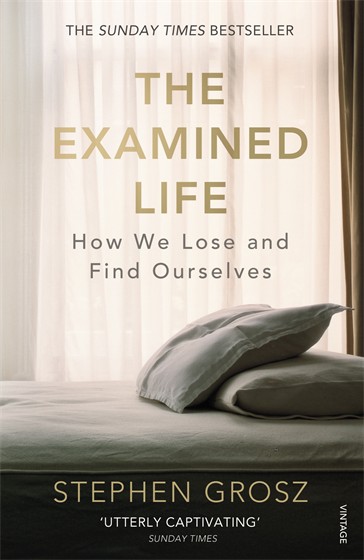
    the examined life

    A discussion of the impact of praise upon a learners’ motivation and achievement was stimulated by reading The Examined Life by Stephen Grosz, a book recommended by Anne Goodwin.  The Post Seeking praise – Stephen Grosz revisited explored Grosz’s suggestion that praise could cause a loss of competence, especially if children were being praised for being clever. Responses to the post, including a guest post by Anne Goodwin, added greater depth to the discussion.

    Other ideas about motivation abound.

    https://openclipart.org/image/800px/svg_to_png/59389/happy_sun_gm.png
    https://openclipart.org/image/800px/svg_to_png/59389/happy_sun_gm.png

    Shelley Wilson’s blog Live every day with intention,  which promises to inspire and motivate you (‘A motivational blog about living life to the full, writing, reading and feeling inspired to follow your dreams’) is the basis of her new book ‘How I changed my life’.

    In this TED talk The puzzle of motivation, Dan Pink explains that the value of intrinsic motivation is a scientific fact. While the focus of his talk is the business world, the findings are equally relevant to education. He says that external rewards may work in limited situations but that they often impede creativity. He says that ‘the secret to high performance isn’t rewards and punishments, but that unseen intrinsic drive – the drive to do things for their own sake. The drive to do things because they matter.

    Which brings me back to my motivation for writing this post and sharing these thoughts: Charli’s post, mentioned at the beginning of this article, was an introduction to her flash fiction prompt to In 99 words (no more, no less) show the underlying motivation of a character.

    My motivations for engaging with the flash fiction challenges set by Charli are both intrinsic and extrinsic:

    I enjoy:

    • the dual challenges of writing to a prompt with a clearly defined word count;
    • the opportunity of writing fiction;
    • exploring the application of Charli’s prompt, however tenuous, to education;
    • the camaraderie of the fellow writers and the opportunity to read and comment on their posts and flash fiction pieces; and

    I appreciate the feedback, support and encouragement I receive in response to my writing.

    In her prompt, Charli suggested that the character ‘may not even understand the motivation fully, but (that I should) let the reader grasp it.’ I have written two pieces in response to this prompt. I hope you enjoy them, and get an inkling of what motivates the characters.


    More than numbers

    The more he stared at the numbers the less sense they made.

    They swirled and blurred. He just didn’t get it.

    “Numbers don’t lie,” they’d admonished.

    “But they don’t tell either,” he’d thought.

    The hollowness left when all he knew had been extracted could not be filled with the smorgasbord of numbers loaded on the page.

    The richness of lives reduced to mere squiggles.

    “This is what’s important,” they’d said, fingers drumming tables of data.

    With heaviness of heart he closed the book and walked away.

    “They are not even numbers,” he thought. “If they were numbers, they’d count!”


    More than words

    “More!” they implored.

    She surveyed their eager faces then glanced at the clock.

    “Just one more?”

    “Okay. Just one more.”

    Before she could choose, a book landed in her lap.

    “This one,” he said.

    “Yes,” they chorused. “It’s a good one!”

    She smiled agreement, then started to read.

    They joined in, remembering, anticipating.

    She turned the page.

    “Wait!” he said. “Go back.”

    “Did you see that?” He pointed to the page.

    “But look what he’s doing,” someone else chimed in.

    They all laughed.

    The shared joy of a beloved book. Each time the same. Each time a little more.

    Thank_you_pinned_note

    Thank you for reading. I do appreciate your feedback. Please share your thoughts about any aspect of this post or my flash fiction pieces.

  • What would happen if . . . ?

    The message of this video alone provides reason enough to ensure children are provided opportunities to question, be creative and think critically.

    Listen to Nikolai Begg convince you!

    Enjoy!

  • Just imagine . . . the power of imagination

    Have you ever wished you could:

    • be in two places at once?
    • clone yourself to ensure you get everything done?
    • slow time down so that you could achieve all you wanted?
    • make time stand still so you could stay in the present moment forever?
    • pop back in time to undo that embarrassing moment, or peek forward to see the result of a decision that is pending?
    • choose both options and follow each through consecutively, as in parallel universes?

    I have.

    https://openclipart.org/image/800px/svg_to_png/194578/07-Juli-goin-on-a-summer-holiday.png
    https://openclipart.org/image/800px/svg_to_png/194578/07-Juli-goin-on-a-summer-holiday.png

    Multiple invitations or engagements often occur on the same date. Deciding between desired activities is not always easy. Cloning would make choosing unnecessary. Additionally, sending a clone to an unpleasant but unavoidable engagement could also be desirable.

    penguins

    Sometimes the number of must-do tasks can be overwhelming. The ability to engage the assistance of clones, especially to complete less desirable tasks would be great.

    Time travel, wormholes and parallel universes are the stuff of science fiction; and while I am not a fan of the science fiction genre, I wouldn’t mind having access to some of its features. However, whether any, or which, of those features ever move from science fiction to science fact remains to be seen.

    The power of imagination to drive creativity and innovation cannot be overstated. Much of what we now accept as commonplace was once a part of science fiction. Imagination, the stuff of science fiction and scientific exploration and investigation, has brought them to reality.

    You are probably familiar with following quote, initially attributed to George Bernard Shaw but also made famous by Robert F. Kennedy:

     “Some men see things as they are and say why. I dream things that never were and say why not.”

    These words highlight the importance of questioning to stimulate imagination, and when paired with creative thinking, innovation can occur.

    Einstein said that,

     “Imagination is more important than knowledge. For knowledge is limited to all we now know and understand, while imagination embraces the entire world, and all there ever will be to know and understand.”

    He also said that,

     “Education is what remains after one has forgotten everything he learned in school.”

    Although I cannot be certain, from those quotes, what Einstein’s attitude to the current trends in schooling would be (he did attend school and was very advanced in maths and sciences but did not perform so well in the humanities) I think he would not favour a content-driven curriculum which excluded opportunities for imagination and creativity.

    On the other hand, Thomas Edison, the world’s most prolific inventor, was mostly educated at home by his mother who was able to encourage his experimentation and love of learning. He said,

     “To invent, you need a good imagination and a pile of junk.”

    If these significant thinkers of the 20th century, each of whom followed different educational pathways, recognise the importance of imagination, why would anyone argue against it?

    Charli Mills at Carrot Ranch Communications certainly doesn’t. As a fiction writer she embraces imagination. It is the tool of her trade, creating stories where before there were none. This week her challenge is to In 99 words (no more, no less) craft a multiverse situation, setting or character(s)

    Now the term ‘multiverse’ takes me back to the science fiction genre: wormholes, parallel universes and time travel, for example. I’m not sure how well I’ll do with this unfamiliar genre, but I will call upon my imagination and give it a try. See what you think – does my piece fit the criteria?


    Clone Magic

    Clone magic

    All night Leone had huddled in line, sleepless with excitement, waiting for the release.

    Now she had them! Clone pills!

    ‘Take one with water. Cloning occurs in 30 minutes and lasts 24 hours.’

    Leone swallowed one tablet, then another, and another; ignoring the small print: ‘Do not take multiple tablets. Effects are unpredictable.’ 

    When three clones appeared she instructed:

    “1. Clean the house. 2. Exercise. 3. Weed the garden.”

    She flopped on the couch. “Now to read.”

    But — their hands grabbed for her book, pulling her hair and clawing her eyes.

    “Me read! Me read! Me read!”


    Thanks for reading. I appreciate your feedback. Please share your thoughts about any aspect of this article or my multiverse flash.


  • Celebrating 100!

    Celebrating 100!

    Welcome to my 100th post!

    I’m excited!

    When I started this blog just under a year ago (I published my first post on August 15 2013) I set myself the goal of writing two posts a week. I am pleased that I have maintained that output, with only an occasional variance.

    Thank_you_pinned_noteI thank you all, my readers, whether you have been with me from the beginning, joined in along the way, or pop in occasionally to see what I am up to. I really appreciate your support and encouragement. If it wasn’t for your interest I may not have achieved my goal.

    One of the most rewarding things about blogging is belonging to a very special online community of readers and bloggers from whom I have learned a lot, and from whose encouragement I have developed the confidence to share my ideas.

    Celebrating 100 anything is a milestone.

    In Australia if you live to celebrate your 100th birthday you can receive a letter from the Prime Minister, the Governor-General and the Queen.

    In my year one classroom we would celebrate 100 days of school. In the ‘old’ days, when pre-school was part-time and not compulsory, before prep became the first year of formal schooling, year one was the first year of ‘real’ school, and the celebration really was of the first 100 days of school. After the advent of prep it simply became a celebration of the first 100 days of year one.

    Many valuable learning opportunities accompany the celebration.

    Preparation for the celebration would begin on the first day of school. We would count off each day on the number board, counting up the days we had been at school and how many more days there would be until we reached 100.

    Closer to the day we would explore what 100 items ‘looked like’ and count 100 children lined up for class, a tower built of 100 blocks, or 100 paperclips arranged around the edge of a piece of paper. We would count and collage 100 different items, and play games that involved counting to 100.

    celebratory cake

    One of the things that I enjoyed most was discussing with the children what they thought they would be like at 100 years of age. We would read A. A. Milne’s poem Now I am Six and talk about them being six or seven – what they looked like, things they could do, and their favourite things and activities. They would draw a self-portrait and write a description of themselves to accompany it.

    Then we would read books about growing older and discuss what it might be like to be 100 years old. They would do a self-portrait to show what they thought they would look like and write about what they would be able to do and activities they would enjoy.

    https://openclipart.org/image/800px/svg_to_png/154735/faltige_frau.png
    https://openclipart.org/image/800px/svg_to_png/154735/faltige_frau.png
    https://openclipart.org/image/800px/svg_to_png/103549/old_man01.png
    https://openclipart.org/image/800px/svg_to_png/103549/old_man01.png


    I wish I had some of their portraits and descriptions to share with you. They wrote about having grey hair, wrinkly skin and wearing glasses. They wrote about using walking sticks, living in nursing homes and having a lot of grandchildren. Overwhelmingly, they were happy.

    The last group of year one children I taught were born this century. They turned seven in year one in 2011. They will not celebrate their 100th birthdays until 2105! Chances are, with improvements to health and the increasing length of life expectancy, many of these children will get to celebrate that milestone.

    While the children had no difficulty imagining themselves as 100 years of age, I can’t imagine what life will be like for them in the next century; or even fifty years ahead. One hundred posts ago, I couldn’t even be sure if I would still be here writing this blog; but I am, and I thank you very much for reading and participating.

    To mark my 100th post, I have placed a new item in my Teachers Pay Teachers store with suggestions for celebrating 100 days of school. This also coincides with a storewide sale on Teachers Pay Teachers; so, for any teachers out there, it may be worth taking a look.

    sale_160_200

    Thank you for reading. I appreciate your feedback. Please share your thoughts about any aspect of this post or my blog in general.


  • Are you a lemon or a grapefruit? – Ten articles about creativity

    Are you a lemon or a grapefruit? – Ten articles about creativity

    I am a great fan of creativity.

    Imagination and creative thinking are what inspire and drive improvement, innovation and progress.

    I affirm my belief in the power of creativity in my header: ‘Create the possibilities . . .’

    In this post I share articles and blog posts that discuss creativity. It is not an exhaustive list, just a few to get you started. You will notice that many, but not all, are from Edutopia, a website that is ‘dedicated to improving the K-12 learning process through innovative, replicable, and evidence-based strategies that prepare students to thrive in their studies, careers, and adult lives’; and TED, an organisation of people who ‘believe passionately in the power of ideas to change attitudes, lives and, ultimately, the world.’

    1. In this article on Creativity and education Judy O’Connell says that

    ‘Every student is creative in some way, and the job of educators is to release and support that creative talent in an appropriate manner.’

    She adds that

    ‘Teaching creatively and for creativity entails taking students on a creative journey where their responses are not predetermined.’

    In her article Judy lists some features of teaching for creativity and includes a video of a new school in New Zealand that she suggests fits the criteria. It is quite exciting and worth a look.

    1. In this article shared on Edutopia Do Standards Kill Creativity Claus von Zastrow suggests creative ways of teaching creativity while teaching standards.

    Linking of subject areas, as we used to do through ‘themes’ in the old days, or more recently ‘integrated units’, before subjects were divided and each given their own slot in the timetable, was one suggestion.  A number of varied and interesting comments accompany the article.

    1. I have previously shared this TED talk by Sir Ken Robinson on How schools kill creativity here and here. If you have not yet listened to it, please do. As well as sharing a very important message, Ken is a very entertaining speaker. I’m sure you will enjoy it.

    4. Following on from that talk is this article by Bruce Price shared on examiner.com Ken Robinson and the Factory Method of Education. The article shares an animated talk by Ken Changing Education Paradigms.

    Bruce does not agree with Ken’s views and warns readers to be sceptical of information imparted by Ken. He says that Ken’s opposition to traditional schooling is unhelpful and argues that, unlike most others referenced here, that creativity cannot be taught.

    5. In this article by Deepak Kulkarni Recreational and Educational Value of Math Puzzles shared on Edutopia the suggestion is made that creative problem solving can be taught using maths puzzles.

    6. A variety of Techniques for creative teaching are shared on the Iowa State University Center for Excellence in Learning and Teaching website which states that

    in order to teach creativity, one must teach creatively’.

    7. In yet another article shared on Edutopia, Andrew Miller states enthusiastically Yes, You Can Teach and Assess Creativity! Andrew provides suggestions for recognising creativity as well as teaching and assessing it.

    8. Also on Edutopia, Diane Darrow talks about Creativity on the Run: 18 Apps that Support the Creative Process.

    9. In this rather long TED talk on his life, authenticity vs karaoke culture Malcolm McLaren postulates that ‘we’re living in a karaoke culture, with false promises of instant success, and that messiness and failure are the key to true learning.’ He talks about his own schooling and attitude to creativity.

    10. Michael Michalki shared an article on Edutopia regarding what he considers the 7 Tenets of Creative Thinking, including:

    Believe you are creative

    ‘While creative people believe they are creative, those who don’t hold that belief are not.’

    Work at it and ‘produce an incredible number of ideas — most of which (may be) bad. He says that

    ‘more bad poems were written by major poets than by minor poets’.

    Go through the motions – ‘Every hour spent activating your mind by generating ideas increases creativity’; visualise what you want and go for it.

    On his own website Creative Thinking, Michael Michalko suggests many more ideas for getting you to think creatively.

    The header of Michael’s website states that “A grapefruit is a lemon that took a chance.”

    lemons and grapefruit

    So which are you: a lemon or a grapefruit?

    I appreciate your feedback. Please share your thoughts about any aspect of this post and let me know whether you agree or disagree with the value of creativity and if it can be taught.

    Thanks for reading.

  • Water wise

    https://openclipart.org/image/800px/svg_to_png/9353/egonpin_Paisaje_3.png
    https://openclipart.org/image/800px/svg_to_png/9353/egonpin_Paisaje_3.png

    My first thought when reading this week’s flash fiction prompt set by Charli Mills at the Carrot Ranch: in 99 words (no more, no less) write a story about water, was of the street on which I had hoped to open an alternative to school twenty years ago. I thought I could write about the property which, located on the corner of Water and Love Streets, seemed ideal. I thought I could write about the vision of our group “The Centre of Learning Opportunities” with its focus on the children’s program “Kids First” and how our centre would cater for children and families. I thought I could write about how we would implement our motto “Create the possibilities” which I have also adopted for my blog. But just like the centre itself, it didn’t eventuate.

    https://openclipart.org/image/800px/svg_to_png/169893/1336367663.png
    https://openclipart.org/image/800px/svg_to_png/169893/1336367663.png

    Instead I thought a little deeper, considering how water is the substance of life, how fortunate we are in developed countries to be able to turn on a tap and access clean water whenever we want. According to the UN almost 8 million people do not have access to clean water and more than 2 million do not have adequate sanitation. Millions of people die each year from diseases related to water. The projections of water availability and access are quite alarming.

    I thought about the use and misuse that is made of water in our rivers and streams and of a local issue that was reported quite recently.

    I decided to write a poem about the journey of a river, from its beginnings high up in the mountains down to the sea; how it starts out crystal clear but picks up toxins as it wends it was down. You can probably guess that my next thought was of education; of how children begin full of wonderment and creativity but, as they are subjected to years of schooling, collect toxic thoughts and attitudes.

    That may seem a bit harsh I know, and I have written a poem before comparing what I consider Education is to what I think schooling is.

    education-is-2

    However I thought I’d try to write a poem as an allegory of the schooling process; likening the way we are polluting our waterways to the way we are polluting and muddying the minds of our children. I’m not very happy with my first (fifth!) attempt, but I have met the word requirement and Charli’s ‘deadline’ is fast approaching.

    Let me know what you think.


    Water

    It started way up

    In the highest of hills     

    So crystal-clear pure

    With a life to fulfill


    It babbled through forests

    And danced in the streams

    Marveling  at wonders

    Before never seen


    It passed through the valleys

    Irrigated the farms

    Taking the runoff

    And doing no harm


    Down past the villages

    Watered them too

    Acquiring their discards

    Now murky like stew


    Passing by factories

    Spewing out waste

    Picked up their burden

    And left without haste


    Weaving its brown trail

    Way down to the sea

    From its mouth vomited out

    A poisonous mix

    Deceiving all living things

    Expecting a gift

    However I don’t want to leave you on a negative note. I’d rather acknowledge that there are many wonderful things happening in schools around the world. There must be, or we couldn’t be making the advancements we do.

    https://openclipart.org/image/800px/svg_to_png/59389/happy_sun_gm.png
    https://openclipart.org/image/800px/svg_to_png/59389/happy_sun_gm.png


    I have shared many great things with you before like some of these great articles on edutopia.org. Just last week I shared information about a prize for innovation in inclusive curricula being awarded for a program, Big Questions teaching philosophy to children. Listen to any TED talk to be amazed at advancements and innovations.

    I value your feedback. Please share your thoughts about any aspect of the article or my flash ‘poetic’ fiction piece.


  • Are you ready to embrace the future?

    http://openclipart.org http://goo.gl/XApwuV
    http://openclipart.org http://goo.gl/XApwuV


    The flash fiction challenge posed by Charli Mills at the Carrot Ranch this week deals with the future. What a perfect prompt for a teacher, for is not education firmly focused on the future?

    We educate ourselves so that we will know more, be more skilled, or be able to do more in the future than in the past; we may learn new skills that keep us up-to-date with the changing demands of society or technology; or we may seek to improve our employability or income possibilities.

    We educate our children so that they will be independent and contributing members of society, able to participate in the world of the future, and having the knowledge and skills to enable them to achieve their goals.

    We educate for the future, but we are unable to predict the future, so the challenge to making decisions about education is difficult and highly-charged, attracting many different opinions and suggestions for solutions.

    Forbes Magazine featured an article in 2012 which queried the purpose of education.

    A 2013 TED conversation about the purpose of education, related to a talk by Ken Robinson, Changing education paradigms, attracted many and varied comments.

    In 2014 Tony Ryan hosted an online seminar about Future-proofing Kids. Tony says,

    “Many of the children alive today in Western societies will still be around in the 22nd Century. How can we possibly predict what they will experience between now and then? And if we can’t do that, then how do we best prepare them for whatever is up ahead?”

    I think of greatest importance in preparation for life, all of which will be in the future, except for the present moment, is the development of attitudes and character traits including:

    •  Confidence
    • Persistence
    • Resourcefulness
    • Resilience
    • Able to seek solutions to problems
    • Openness to new ideas and possibilities
    • Creativity
    • Divergent thinking
    • Questioning
    • Optimism

    In addition to the character traits, a certain level of skill is required in both literacy and numeracy, and especially an ability to locate and critically evaluate information.

    The title of Tony Ryan’s seminar, Future-proofing Kids, to me belies the value of the content Tony shares. To me ‘future-proofing’ indicates that the future is something to be protected from, like water proofing protects us from water; something perhaps of which to be scared. But Tony’s seminar is far more optimistic and future-oriented than that.

    We don’t know what the future will bring, but we never have. We can plan for it, we can hope and dream and set goals; but we can make no guarantees. Prophesies have never accurately foretold the future. I’m thinking of George Orwell’s Nineteen Eighty-Four or the more recent Y2K Bug.  I’m thinking of all the teachers who told their students they would never amount to anything, like Thomas Edison’s teachers who said he was “too stupid to learn anything”.

    peole_laptop

    In the early 1980s I was told at a conference that by the year 2000 computers would do so many of our menial tasks that we would have an enormous amount of free time and wouldn’t know what to do with ourselves! How inaccurate was that prediction! The menial tasks have only increased in number and instead of computers being a tool to simplify our lives, in teaching anyway, they are now an unrelenting, ever-increasing and demanding master requiring the completion of data bases and spreadsheets, the creation of graphs and statistics, reducing life to a series of expected numbers and standards

    The potential employment opportunities of today’s young women could not even be imagined when I was growing up and making my work choices. My apparent choices were teacher, nurse or office worker, and ultimately mum. Because I had chosen an academic path after year 8 and hadn’t learned shorthand and typing, office worker was eliminated. If I had chosen the commercial, shorthand and typing, path my choices would have been even further restricted.

    My generation was the one that began shuffling the female role in society. Had I been born just a few years earlier, I would have worked until I married; after which I would have stayed home and looked after the children. Many female teachers were required to resign when they married. Pregnancies were hidden under loose and voluminous clothing, and the whole process was considered an illness. Unmarried mothers were considered an embarrassment and ‘sinful’ and most had their babies removed and that part of their history hidden.

    Women of my era were able to return to the workforce, but it was not encouraged before the youngest child had started school. At that time child care was not readily available and often grandmothers, who had not returned to the workforce after marriage, looked after the children for mothers who worked, often part-time and for low wages.

    The current generation of women have far more career opportunities but are also expected to stay in the workforce, often required to return to work when their babies are only a few weeks old in order to maintain security of employment. Many now work through pregnancy, almost until the birth of their baby.

    Pregnant women no longer try to hide under voluminous layers of clothing but, partly with thanks to Demi Moore and Annie Leibovitz in 1991, take pride in showing off their changing shape. The term ‘unmarried mother’ is almost an anachronism in today’s Western world. There is no shame in having a child, whether married or living with someone or not; and babies are not forcibly removed from their mothers.

    I am no more able to predict the future than I am to make sense of the injustices and horrors of the past.  However I think part of the purpose of education must be to help individuals grow so that they are able to stride towards the future with arms outstretched saying, “Give me what you’ve got!” while at the same time with a listening ear and an open heart asking, “What can I do to help?”

    What do you think?

    I welcome your feedback. Please share your thoughts about any aspect of the article or my flash fiction piece:

    Ready

    I’m off now,” she said.

    “Have you got everything?” asked Mum.

    Yes Mum.”

    “Are you sure you haven’t forgotten anything?”

    I’m sure.”

    Mum looked around. There must be something she’d missed.

    “What about . . .?”

    No, Mum. I’ve got everything.”

    “Okay. If you’re sure.”

    “Bye Mum!”

    ”Bye.”

    She walked through the door and down the stairs.

    Mum watched, anxious. What could she have forgotten?

    “Wait!”

    She turned, puzzled.

    Mum leapt down the stairs.

    “What?”

    Mum hugged her tightly, whispering softly, “I love you very, very much. Always have and always will.”

    “I know. Love you too Mum.”


  • 3 Inspiring educators

    3 Inspiring educators

    Like every other teacher, I want to make a difference in the world.

    The thought that I could make a positive difference to the life of another is both empowering and inspiring.

    To do so, I seek out others making a positive difference and pay it forward, hoping that the ripple effect will carry it far and wide.

    flag on twitter

    Three inspiring educators who have positively influenced me are:

    Brian Cambourne

    Brian is an amazing literacy educator from whom I had the extreme good fortune of learning many years ago. I have written about him before here and here.

    Brian’s work focused on the conditions necessary for literacy development. His influence has spread beyond the classroom with the application of the conditions to learning in the workforce demonstrated.

    Tony Ryan

    Tony is an amazing educator who does his best to be the change he wants to see in the world. He talks about future-proofing and using innovative thinking to solve problems of both local and global importance.

    Anyone who believes ‘that education is the most important profession on the planet’ and does everything in his power to support teachers to be outstanding, as does Tony; must be pretty good in my books.

    One of Tony’s books The Ripple Effect is particularly apt for mention in this post. Tony says,

    “you must believe in your personal power to create ripples that spread out and change the world. In fact, if it is not you who is going to do it, then who else do you think is likely to make the effort? Remember that every change on this planet begins with a human being somewhere, somehow. It may as well be you.”

    This year Tony has started a new project called The Earth Movers Foundation which ‘helps young teenagers to create solutions to local and global issues. And they get to choose their own project. No adults will be telling them what project to do. They decide for themselves.’ Sounds pretty good to me.

    Ken Robinson

    Ken is another amazing educator. I fell in love with his ideas when I listened to his TED talk Do schools kill creativity? which I have also shared before here.

    The statement on his website declares that

    “Imagination is the source of all human achievement”.

    I could not argue with that.

    Ken introduces this short video The writing spirit which presents quotes from artists, thinkers, writers, innovators and snippets of interviews with writers. Just incidentally, and exciting for me, Richard Bach is included. Richard is the author of Jonathan Livingston Seagull, one of my favourite books for its inspirational message.

    It is more than likely that these educators have no idea how they have influenced my life (and others as a result).

    How wonderful might it be to know of the positive influence you have had on someone, and to have the opportunity of letting others know that they have positively impacted your life?

    This is the purpose of The Butterfly Light Award which was bestowed upon me my Lisa Reiter, a lovely lady who is herself inspirational for her courage and her positive attitude which she shares with others through her blog Sharing the story. Thank you, Lisa. I am honoured and accept with pleasure.

    As with any award, it comes with conditions:

    1. You should write an acceptance post, making sure you link back to the blogger who awarded you and thank them. You MAY NOT lump this award in with a batch of other awards.

    Thank you Lisa Reiter!

    1. You must individually name and re-award to a minimum of 1 and a maximum of 9999999 bloggers. You must let them know either personally with a comment on their blog OR a pingback.

    As I have been writing about educators, I am going to stick with that theme. A quick visit to these blogs will explain why I have selected them.

    Ruth Mancini

    The Nerdy Book Club

    Two Writing Teachers

    Raising a literate human

    3.  You should link back to Belinda’s blog either to http://idiotwriting.wordpress.com/about/ or http://idiotwriting.wordpress.com/2014/03/13/i-love-charismatic-geeks/

    Done!

    1. You must write a short paragraph entitled either “How I’m Spreading Light” OR “How I’m A Positive Influence” (what Lisa calls ‘the squirmy bit’).

    Done! See beginning of article.

    5. Display Belinda’s lovely “Butterfly Light Award” badge on your blog.

    Thank you, Belinda. It’s a pleasure! We can never have too many butterflies!

    butterfly-light-award

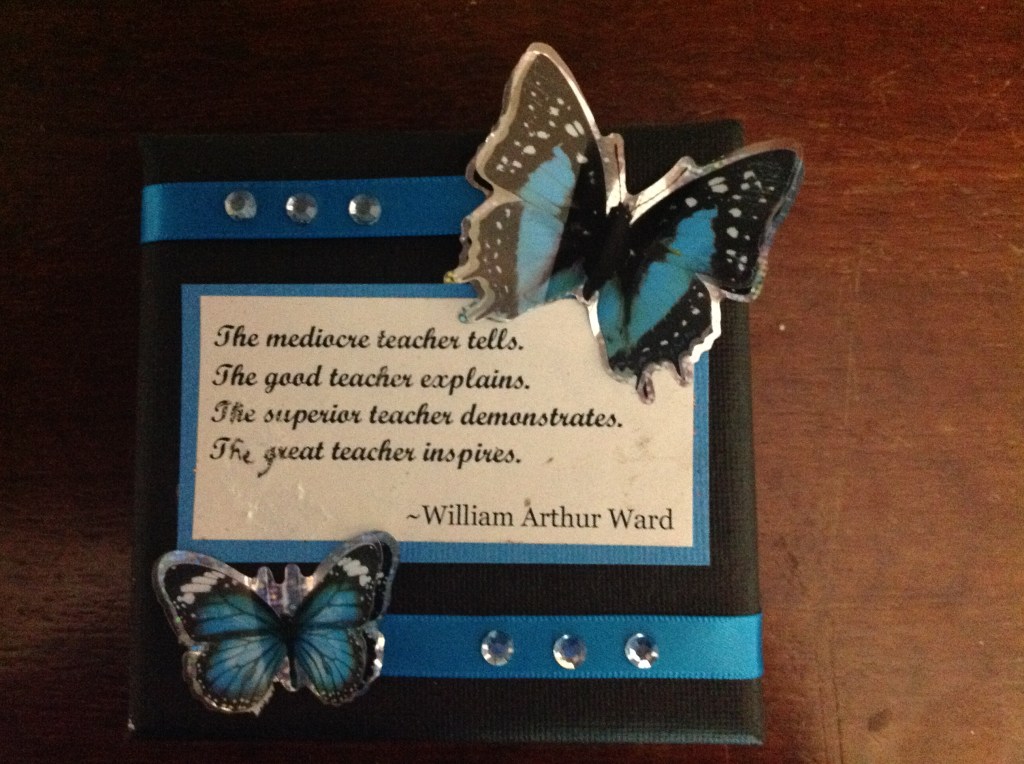
    Note: The beautiful framed quote, pictured at the top of this post, was made for me by a wonderful lady, the mother of two of my students. They all share my love of butterflies! I thank them for sharing their appreciation of my positive influence.

    I welcome your feedback. Please share your thoughts about any aspect of the article.