This week, I was delighted to be invited by Gulara Vincent to discuss my new website readilearn on her blog.
Gulara is an amazing writer herself and offers support for writers who struggle to find their inner voice or to complete their manuscripts. Please pop over to her website and blog to check out her wonderful work.
Thank you, Gulara, for offering me your support. I very much appreciate it.
Without a doubt, education and my love for learning changed the course of my life for the better on more than one occasion. This is why it gives me an immense pleasure to introduce you Norah Colvin, whose passion for learning shines through on her blog, and now also through her early learning resources she shares through readilearn.
Hi Norah, Welcome to my blog.
Thank you for inviting me. I am delighted to be here.
Norah, congratulations on the recent launch of your website. Tell us a little about readilearn.
Thank you. I am very excited about my new website. readilearn is a collection of early childhood teaching resources that I have written. Many of the resources I used, trialled if you like, in my own classroom. I had always thought about sharing them with others but, when I was teaching full time, didn’t have the time to…
Hi, and welcome again to the readilearn blog. I hope you’ve had a good week.
Rarely, when the costs of education are being calculated, is the contribution made by teachers from their own pockets acknowledged. It is not very well publicised that many teachers spend a lot of their own money resourcing their classrooms, which would be far less interesting places if teachers refused to contribute in this way.
Today I demonstrate that not all resources need be expensive. A versatile, free, and readily available resource is the humble bottle cap or lid, which is often discarded, but can fulfill a number of functions in the classroom.
It doesn’t take long to gather an extensive collection of lids even on your own. But ask your children to bring in lids from home and the collection builds even quicker.
Lids have many uses.
Children can, for example:
Sort by colour or size
Order according to size – diameter or height
Make patterns – repeating or growing
Count – by ones, twos or fives
Learn to subitise, and discover conservation of number
Compare, add, substract and share
Measure length and mass
Use for collage or craft, or as tokens when playing games
These are just a few ideas. What other uses have you found for lids? Please share in the comments below.
What’s new – Uploaded this week!
These ideas and others are now available in a free maths resource Caps off for maths.
Getting to know readilearn resources
Snakes and Ladders is a popular game and great for maths groups. With some guidance from an adult, the game can be used to stimulate mathematical thinking alongside practice of computations. Thereadilearn resource Snakes and Ladders – An activity for maths groups provides suggestions that can be given to an assistant to maximise learning opportunities while playing the game.
Please contact me if you have any questions. I welcome your feedback, especially suggestions for improvements to existing resources and ideas for new ones.
Remember, if you haven’t yet subscribed, an introductory discount of 20% is available to all who subscribe during 2016. Just use the coupon code welcome1 at the checkout to receive your discount.
I’ll see you next week. In the meantime, enjoy the weekend.
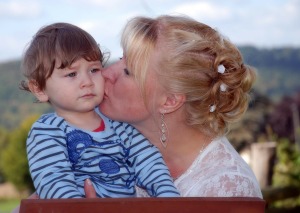
The first goodbye between a parent and a child will elicit a range of emotions from each. The feelings, and responses, of both parent and child, are dependent upon a range of factors including who the child is being left with, how well the child and the substitute carer know each other, the feelings of all parties about each other, the circumstances, the environment, and the list goes on.
A parent who feels empowered by the decision, and views the child’s new situation positively, will accept and adjust to the change more easily. That’s not to say a parent won’t feel some sense of loss and anxiety as well, but it is important that the child is prepared with reassurance rather than the negativity of anxiety or concerns. A more confident and secure child will view the situation with positive expectations.
Anne Goodwin, on her blog Annecdotal, often refers to attachment theory, and the responses of children to real or imagined abandonment. In her post Compassion: Something we all need Anne shares the following video, explaining that
“Research psychologist Mary Ainsworth developed an ingenious method of assessing whether or not an infant has developed secure attachments. In the Strange Situation, babies play in a comfortable room until, at a given signal, the mother leaves. What distinguishes securely from insecurely attached infants, is not how they behave when the mother (or other primary carer) leaves, but whether they are able to settle on her return.”
She continues
“Research suggests that about two thirds of the population can be categorised as securely attached. That’s a whopping one third of us who aren’t.”
The research also suggests that how secure children feel in their infancy influences how secure they feel later in life. A sense of security influences one’s ability to adapt to change and new situations.
It is not unusual for children, or anyone, to feel a little apprehension in a new situation. A more secure individual generally accepts and adapts more easily. When carers drop their children at child care, kindy, or school, they may be advised to “drop and go”. Mostly the children are fine once the parents have disappeared and the children have time to settle.
If children experience more difficulty than most, or if it occurs for a prolonged period, causes may need to be investigated. Sometimes a child may suffer from anxiety. Sometimes the environment may not be welcoming or appropriate to the child’s needs. Happy, secure, confident children will always face new situations better than those who feel anxious and insecure.
Parents can help children prepare for that first day of kindy or school by:
Talking about what to expect and the fun things they will do
Having special items for the child to take or wear; for example, a back pack or lunch container, hat or shoes
Rehearsing the journey
Visiting the kindy or school, and meeting the carers or teachers if possible
Writing happy messages (in words or pictures) to be found in bags, or lunchboxes
Establishing routines, including the goodbye routine
While the routine doesn’t have to be as elaborate or serious as that in Ian Whybrow’s Hey, I Love You!, a signal that the parent is leaving is useful in making the break. It doesn’t have to be immediate. Depending on the practices established, parents may be able to accompany the child to the door, or into the room.
I always welcomed parents to come in with their children in the morning. The children could show their parents around and discuss work we were doing. Parents could help children organise their belongings, and talk to other parents and children. When it was time for work to begin, I would play music that would signal children to join the song or dance, and parents to take their leave.
This week at the Carrot RanchCharli Mills is talking about goodbyes. She is on the move from a place to which she felt attached, to a situation unfamiliar. She is sad at leaving but is able to view with hopefulness the situation to which she is moving. Charli has challenged writers to
Usually I post my response as the deadline draws close. However, as she is on the move, Charli has extended the submission period. If you would like to join in with a flash fiction “goodbye”, you have another week until September 13 to do so.
(Parent and child chant the verses together or take turns, changing the pronouns to suit. They begin by clapping their own, then each other’s’ hands. On the last three beats of each line, they clap each other’s hands. The pattern for each line is “Own, other’s, own other’s, own, other’s. other’s. other’s. On the last line they smile, wave, blow a kiss, and leave! It’s meant to be a bit of nonsense and a bit of fun establishing a goodbye routine.)
It’s time for you to go, go, go
I’ve lots to do and can’t be slow.
It’s time for me to fly, fly, fly
Upon my broom into the sky.
It’s time for you to leave, leave, leave
I will be happy, do not grieve.
It’s time for me to run, run, run
And jump so high I touch the sun
It’s time to say goodbye, bye, bye
You’ve work to do and so have I.
I’ll blow a kiss, and smile, smile, smile
I’ll see you in a little while.
Bye. Have a good day. Love you!
Thank you for reading. I appreciate your feedback. Please share your thoughts.
Hi, and welcome again to the readilearn blog. I hope you’ve had a good week. Thank you for your interest in readilearn. I apologise to those who have experienced difficulty in applying the discount coupon codes at the checkout. Know that I will honour the coupon offer with a PayPal discount refund if your subscription goes through with payment in full. I appreciate your persistence and patience while we improve flow with the payment system. Please contact me if you experience any difficulties.
Getting to know readilearn resources
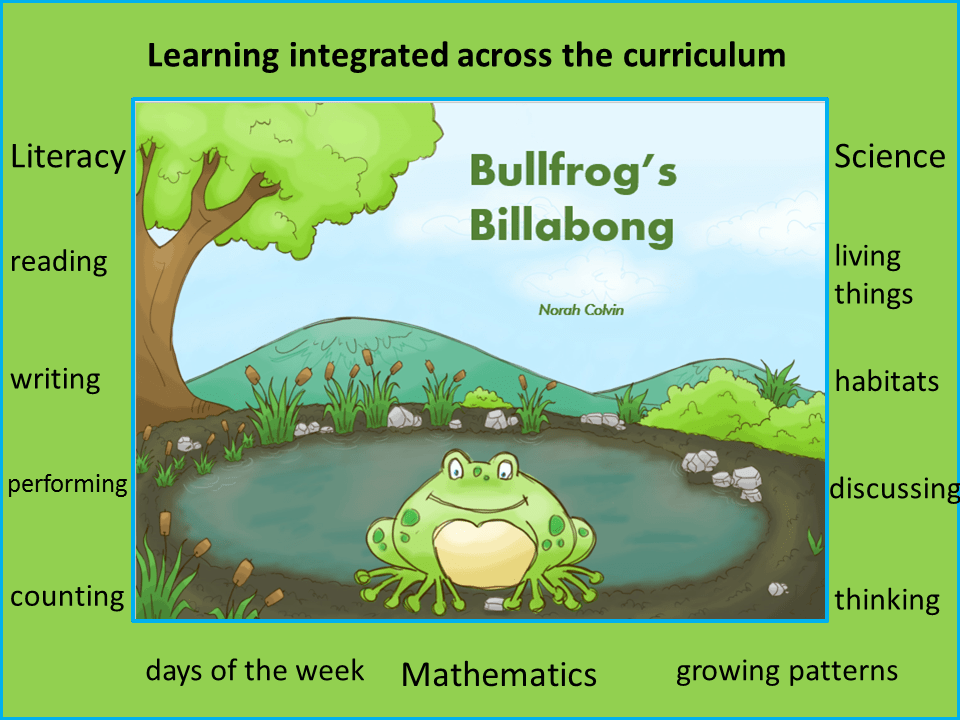
In this post I discuss the Bullfrog’s Billabong suite of resources.
Bullfrog’s Billabong is a cumulative story which takes place at a fictitious Australian Billabong. Bullfrog is the first to arrive at the billabong. He decides it would be a great place to live and makes it his home. Each day, more animals arrive at the billabong. They too think it would be a good home and, after asking permission, decide to stay. Unfortunately, as the billabong becomes more and more crowded, the animals have difficulty in getting along. Their racket attracts another visitor who also sees the potential of the billabong as a home.
The story includes mathematical concepts including counting, growing patterns and days of the week.
The repetitive structure supports children’s reading and encourages them to make predictions based upon obvious patterns involving counting and days of the week. Their knowledge of narrative structure encourages prediction of possible events and conclusion. The end may surprise some children and they may or may not approve of the author’s choice. A discussion of alternative ways to conclude the story could lead to some interesting writing, and an understanding that what happens in stories is a choice made by the author.
While the animals will be familiar to Australian children, the story provides a great opportunity for children from other countries to find out about them too.
I hope you and your children enjoy reading the story and using the resources.
Bullfrog’s Billabong – Covered cloze (This interactive resource for use on the whiteboard is great for teaching effective reading strategies. For best effect, it should be used before any other Bullfrog’s Billabong resources.)
I have been working on new resources to support and complement the existing Bullfrog’s Billabong resources.
This week I have added three new resources to the collection:
Bullfrog’s Billabong – The facts (This information sheet explains what a billabong is and verifies that all the story’s animals may live in a billabong, though possibly not the same one.)
Bullfrog’s Billabong – Days of the week (Use these three sets of printable cards when teaching or revising the days of the week. There are A5 cards for use with the whole class, and smaller cards for use by individuals or small groups.)
I am working on other resources to add to the suite, including presentation of the story as a play. There is also a set of animals to print that can be used to make pop stick puppets for a performance. Watch for these, and others, coming soon.
I hope you and your children enjoy using these resources. I had fun making them and thinking about the responses of children.
Please contact me if you have any questions. I welcome your feedback, especially suggestions for improvements to existing resources and ideas for new ones.
Introductory discount
Remember, if you haven’t yet subscribed, an introductory discount of 20% is available to all who subscribe this year. Just use the coupon code welcome2 at the checkout to receive your discount.
I’ll see you next week. In the meantime, enjoy the weekend.
This week at the Carrot RanchCharli Mills is talking about playgrounds. I love playgrounds. Who doesn’t? They are a familiar part of life. Most neighbourhoods have at least one park or playground where children can go to play.
Playgrounds are great places for children to:
Meet other children
Learn to socialize, through sharing of equipment and taking turns
Develop physical skills such as coordination, balance, strength
Develop confidence and persistence, and a willingness to have a go and try out new things
Play imaginatively, on one’s own or collaboratively
Be outdoors in the fresh air and in nature
Be active
Charli suggested we think about empty playgrounds. I thought about the differences between modern playgrounds and the playgrounds of my childhood.
So many pieces of play equipment that were common and popular in “my day” are no more. They disappeared over the years, due to changing attitudes to safety and responsibility. So much of the playground equipment I played on as a child would not be allowed in a playground today.
It got me thinking about the history of playgrounds and playground equipment, and I was surprised to find that playgrounds are a fairly recent invention, little more than 150 years old. This article about playgrounds on Wikipedia states that playgrounds originated in Germany and were attached to schools. The first “purpose built public-access playground was built in a park in Manchester England in 1859.” The first in the USA appeared in San Francisco in 1887.
I was pleased to find that the philosophies of both Froebeland Dewey had been influential in the early days of playground design. I wrote about Froebel, the father of kindergarten, and provided links to information about his works in a previous post Let them Play! My thoughts about education and pedagogy were heavily influenced by the philosophy of progressive educator John Dewey. I previously shared some of his ideas, though not specifically related to play, in John Dewey’s Dream.
Of course I couldn’t write about playgrounds without including something about school playgrounds. I hope that all schools have somewhere for children to run and play at break times. I recently read This is why Finland has the best schools and was impressed to find that
‘schoolchildren in Finland have a mandatory 15-minute outdoor free-play break every hour of every day. Fresh air, nature and regular physical activity breaks are considered engines of learning. According to one Finnish maxim, “There is no bad weather. Only inadequate clothing.””
The benefits to health, happiness and learning must be enormous.
Play at break time can be the highlight of a child’s day. Children may love the opportunity to run and play with their friends in a relatively unstructured, but safe environment. However, it is not so for all children. Some children dislike the freedom, the space, the lack of structure, the noise. Some don’t know how to make friends or how to play.
While it is great for children to have unstructured play time. It is also important to have equipment to support their play, be it imaginative, social, or physical. I have seen many disagreements occur when children have nothing to play with and no ideas for creating games of their own. It seems that many of the games we used to play, before the invention of video games and (cough cough) television, have been lost to subsequent generations. One day I will compile a list!
For now I will leave you with my response to the flash fiction challenge set by Charli at Carrot Ranch Communications. She challenged writers to
She stopped abruptly as her scattered thoughts aligned to focus on the playground gate. As if restrained by an invisible chain, she was motionless. Beyond the gate children called to each other; but never her. She was not welcome, never included. Their taunts stabbed at her emptiness, twisting as they penetrated deep into the chasm within. She’d wait until they’d gone.
Suddenly a child was there, eying her quizzically; then a mother, appraising her, uncertain.
“Miss. Miss. Are you all right?”
“Y-yes,” she said, straightening herself. “J-just reminiscing.” How could a life once empty, be now so full?
Self-determination.
Thank you for reading. I appreciate your feedback. Please share your thoughts.
Responses to a previous post on the importance of feedback suggested that I trial republishing readilearn posts here. As the suggestion came from a number of people I considered it sound advice and worth trying. As always, I will be interested to hear what you think.
The first day of September marks the first day of spring in Australia. It is also recognised throughout Australia as Wattle Day. The golden wattle is our national floral emblem. Its colours give the recognisable green and gold to our sporting teams.
Like the people of our land, it is a plant that shows both diversity and resilience. There are hundreds of species of wattle growing in many different habitats across Australia. They may be seen growing wild in bush areas and national parks, and cultivated in botanic gardens, on footpaths and in home gardens.
I have three varieties of wattle growing in my garden. Last year, when the plants were one-year-old, they flowered abundantly and were home to ladybirds. It was wonderful to watch each stage of the ladybird’s growth, from egg to adult. This year, the trees were more heavily laden with blossoms, but there were no ladybirds. I was disappointed as I was looking forward to seeing the ladybirds again. However, it has been suggested that the absence of ladybirds may indicate the tree is healthier this year. I don’t know.
In Australia we generally refer to seasons as occurring in particular months:
Spring in September, October, and November
Summer in December, January, and February
Autumn in March, April, and May
Winter in June, July, and August.
However, it is not as simple as that. Australia is a land of extremes, with different climate zones and types of weather experienced across the country. It can be cooler in the summers of southern areas than it is the months called winter in the north. For example, the average January (summer) daytime temperature in Hobart is 21.7⁰C, and the average July (winter) daytime temperature for Darwin is 30.5⁰C.
Spring is a great time for exploring the garden and it’s inhabitants. What is spring like where you are?
Getting to know readilearn resources
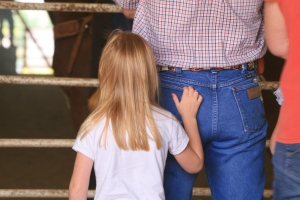
Also coinciding with the beginning of spring is the Australian Father’s Day, celebrated on the first Sunday in September. It is a day not just for dads, but for grandfathers, stepfathers, and other male carers and role models. It is a day to let them know how much they are appreciated.
One great way of providing children with a purpose and targeted audience for writing is to get them to make a book for their father figure. I have provided some ideas to get the writing started in the resource How to make a book cover. The resource itself provides step by step instructions for making a cover for a book using complementary colours. The instructions can be displayed on the white board for children to read and follow.
Suggestions for writing include:
A list of statements about their Dad e.g. My Dad goes to work. My Dad makes my breakfast. My Dad has curly hair and a bushy beard. Children write and illustrate one statement on each page.
A recount or memoir about a favourite holiday or activity they do with their Dad.
A series of things about fathers e.g. Some fathers ride motorbikes. Some fathers ride horses. Children finish with a statement about their own dads, for example; But my father rides a skateboard.
A list of things that Dad likes, one to each page.
Five Fabulous books to read for Father’s Day
Guess How Much I Love You by Sam McBratney, illustrated by Anita Jeram
My Dad by Anthony Browne
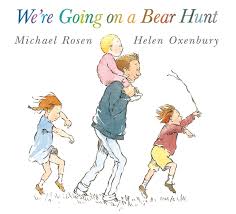
We’re Going on a Bear Hunt by Michael Rosen, illustrated by Helen Oxenbury
Just Me and My Dad by Mercer Mayer
Hey, I Love You by Ian Whybrow, illustrated by Rosie Reeve
Of course, there are many more too.
The readilearn estory The Ice Cream Shop also features an outing with Dad. However, before reading it with your children, decide if you wish to use the interactive covered cloze version with them. If desired, for most effective teaching and learning, the covered cloze should be used prior to any other familiarisation with the story. (You can find information about covered cloze as a teaching strategy here.)
Please contact me if you have any questions. I welcome your feedback, especially suggestions for improvements to existing resources or ideas for new ones.
Remember to use your coupon codes at the checkout to activate your discount. If you can’t see where to enter the coupon code, select “View basket“.
Thank you for reading. I appreciate your feedback. Please share your thoughts.
My family has had a love affair, some might say obsession, certainly a fascination, with dinosaurs for almost forty years. My son initiated the affair when he was about three after being undecided whether to watch or not when dinosaurs burst onto the drive-in screen in One Million Years BC. I’m not sure when I first discovered dinosaurs, but It may have been at the same time.
By the time Rob was four, like many children, he knew the names of a great number of dinosaurs and could rattle off screeds of information about them. It had been a steep learning curve for all of us, though he remembered far more than I. A travelling encyclopedia salesman was so impressed by his knowledge that he gave him a book about dinosaurs. (I’d already purchased; it wasn’t an incentive.) Later, his little sister Bec shared his interest.
Now the affair continues with Rob’s own children. Six-year-old G1 can name and identify far more dinosaurs than I realised existed. His younger sister G2 is not far behind. Such is the power of these mighty, and not so mighty, beasts to excite the imagination. The entire family become dinosaur experts in support of the children’s quest for knowledge.
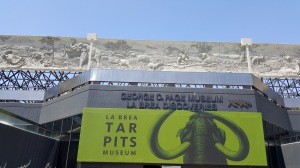
La Brea Tar Pits is a museum located at a fossil site where there are ongoing excavations. In the grounds, we saw realistic sculptures of prehistoric woolly mammoths trapped in the tar. Inside, we saw fossilised skeletons removed from the tar pits; including skeletons of animals such as mammoths, sabre-toothed cats, dire wolves, and camels. Yes, camels originated in North America.
Walking the grounds, we had to sidestep the smelly tar that still oozes in puddles around the site. It’s an amazing experience, walking on the same land where these prehistoric creatures walked, their presence almost tangible. In an enclosed area, a group of paleontologists were working with fossils recovered from the site. Scientists use these fossils to help construct our understanding of life before human history began.
What I find interesting about the understandings derived from these fossils, is that much of it is guesswork; educated guesswork, yes, but fossils tell only part of the story. The rest must be filled in using knowledge of contemporary and recorded life. Sometimes assumptions are made, especially when only partial skeletons are found, that must be altered when, or if, complete skeletons are found.
I was very impressed with the way this aspect of science was dealt with in the American Museum of Natural History. Many signs informed us that scientists don’t know for sure, but that they have substantial evidence for making their assumptions. Other signs told of claims that had been revised as new information was discovered. I appreciated being told, in essence: “This is what we know, this is what we think, and this is the evidence to support our claims.”
This talk by palaeontologist Jack Horner, which I discovered via a link from Charli Mills’ post, demonstrates the process with some fascinating dinosaur discoveries and assumptions.
A study of dinosaurs provides many opportunities for learning across the curriculum and what a great way to incorporate children’s natural interests and curiosity when looking at topics such as scientific method, evolution and climate change.
Since “discovering dinosaurs”, so to speak, I’ve always thought how wonderful it must be to unearth a great find. I haven’t made it an ambition, but I appreciate the potential for excitement. Here’s my response to Charli’s challenge. I hope you enjoy it.
Old Bones
She scratched at the surface tentatively at first, all senses keened, certain of imminent success. She’d uncovered bones here before. Usually one meant there’d be more. All it required was patience and persistence. Suddenly she contacted something more solid than the surrounding earth. She froze. Then exhaled. Could this be the object of her search? Frantically she scraped away the surrounding soil, exposing her find. She stepped back momentarily, assessing it, assuring herself it was real. Then with one final swoop, she removed the bone as carefully and proudly as any paleontologist would a dinosaur bone. “Woof!”
Thank you for reading. I appreciate your feedback. Please share your thoughts.
Any material being read, or listened to, will connect with individuals differently, depending on their prior knowledge and interests. An idea might spark curiosity in one, that another would dismiss as inconsequential. Sometimes a reader will pick at a thread that hadn’t been intentionally placed for further investigation. Oftentimes, authors don’t get to benefit from readers’ feedback, and may not be inspired to conduct further research for themselves.
But bloggers do!
Or bloggers with wonderful readers who participate in discussions and share their ideas! I am always grateful to you my readers for your encouragement to keep on learning. You are constantly challenging my assumptions, offering alternate views, and inspiring me to seek more information. I love it.
While I emphasize the importance of maintaining a sense of wonder, and of encouraging children to ask questions, I’m not always good at asking those questions myself. I learned that lesson well; so am appreciative when others stimulate questions.
During this past week there have been a couple of robust conversations here: one about audiobooks and cheating; and another about common curricula. The conversations branched into fields as different as science fiction and history. Thank you to those who joined in.
In This too will pass I mentioned that each state in Australia had its own set of curricula. This places an extra burden on children changing schools, particularly interstate. The mention of our new National Curriculum made Charli Millscurious about how US education evolved. She assumed it was fairly uniform across the states, with the school year developed around farming so that children could help out in the fields.
I thought that our Western systems of schooling had originated with industrialisation. However, Charli responded saying that industrialisation had had little influence on education in the West (of the States). So of course I was compelled to check my assumptions!
A Google search brought me to this document Industrialization and Public Education: Social Cohesion and Social Stratification which does seem to verify a relationship between industrialisation and schooling. (But one of the most interesting things to me is the cost of a chapter, and of the entire book this first page comes from. Have a look!)
I couldn’t let the topic of schooling and industrialisation go without sharing a talk by one of my favourite educators Sir Ken Robinson. This is a shorter animated version of a longer talk, which I’ve also included if you are interested in listening to the original.
This is the animated abridged version:
This is the original:
Now, I have to wonder, in light of the discussion about cheating mentioned earlier, would watching the shortened version qualify as having watched the talk, or would it be considered cheating?
Thank you for reading. I appreciate your feedback. Please share your thoughts.
When the idea of an Australian National Curriculum was mooted, many teachers and parents looked forward to the uniformity that would enable students to move from school to school or state to state without the impediments to learning posed by different curriculums. Each state had its own curriculum, its own school-starting age, its own handwriting style, textbooks, exercise books, and so on. Each state trained their own teachers in different philosophies and pedagogies, and few states gave automatic recognition to qualifications earned in another. In addition to state differences, each school had its own uniform, variation on rules, routines, and culture.
When children arrived at a school from interstate, making the decision about which class to assign them to was always problematic. Should they be placed with age peers, or with those who had been at school the same number of years, or with those at the same level of achievement? Rarely was there a neat match between even two of these, and there were just as many reasons for and against each placement.
With a change of school, particularly with numerous changes occurring frequently, children may have missed key areas of learning. Sometimes they would be challenged by work that was too difficult as they had no foundation on which to build. Other times the work would be too easy, often requiring repetition of familiar material. Such was the inconsistency from state to state.
There are many reasons for children and their families to transfer interstate, and not all doing so are itinerant. Some make a once-only move.
Some families move:
when a parent is transferred for work, including military transfers
because they are part of a travelling circus or show
to obtain seasonal farm work
to flee difficult circumstances
for a change of lifestyle or location
to be closer to, or further away from, family or friends
when they lose their home and/or employment.
There are probably as many reasons as there are families. In addition to differences in curriculum and school culture, each family has its own set of issues to deal with when moving interstate. Not least among these are the emotional and social issues for children who leave behind established routines and possible friendships, and face learning new routines and making new friends.
How well children cope with the change depends upon many factors, especially the reason for the change and the parental response to it. The number and frequency of changes will also be influential and it would not be unexpected for each to require a period of adjustment.
Students who arrive one at a time for a lengthy stay, are easier to accommodate than an influx of transient students staying for just a few months; for example, for harvest season. The attitudes of the community in general, including that of teachers, parents and children, are not always positive towards itinerants. Many hold pre-conceptions of families and their children as having deficits in learning, potential, and lifestyle. These views create barriers which can be difficult to overcome, and compound rather than alleviate any problems.
Of course, while it was hoped that an Australian National Curriculum might overcome the difficulties caused by curriculum disparity, it wouldn’t necessarily be able to address some of those associated difficulties faced by individual children, their families, the schools, and their communities.
Although the national curriculum has been rolled out, it wasn’t the panacea hoped for, even in with regard to curriculum uniformity. Indeed, the imposition of uniformity of content and pedagogy has been riddled with controversy and it has not been fully embraced, with only partial implementation, in differing degrees, by each state. It has recently undergone a review from which came a number of recommendations for improvements.
It seems that curriculum disparity cannot yet be removed from the list of problems faced by children when changing schools.
For my flash, I have decided to write about an itinerant child, one who has been on the move, and faces yet another first day at yet another new school.
Déjà vu
“I don’t wanna go.”
“You have to.”
“Why?”
“I have to work.”
“I could look after m’self.”
“No. You have to go to school.”
Tears cascaded as the parent thrust the child onto the back seat littered with clothing, books, and assorted paraphernalia.
“How long are we gonna be here?”
…
“How long?”
…
A small hand thumped the door. Feet pushed hard into the back of the front seat.
Hands trembled on the steering wheel. Ash tumbled.
“I don’t know.”
“Where are we?”
“Nowhere.”
Finally, with only a cursory glance at the sign, they approached the school office.


 Hi Norah, Welcome to my blog.

























 Norah Colvin