

And the TUFFest Write is nearing the finish line. The Fab Five are now the Thrilling Three as they dash to the end. Results will be announced on Friday. Check out their latest entries here.
Tag: Writing
-
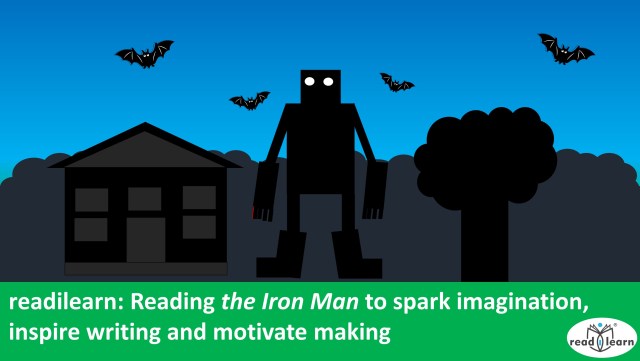
Reading the Iron Man to spark imagination, inspire writing and motivate making – Readilearn
One of my favourite read-aloud books is The Iron Man by Ted Hughes. The influence of poetry is obvious in this compelling modern fairy tale that begins as it might end.
When I introduce this book to children, I conceal it so they cannot see from which part of it I am reading. I tell them the title of the book and ask them to tell me whether I am reading from the beginning, the middle or the end of the book.
I then read, mostly without interruption though I do explain that ‘brink’ is the very edge, the first two pages that describe the Iron Man and how he stepped off the top of a cliff into nothingness and crashed into pieces on the rocks below.
The children listen in awe, fascinated by the size of the Iron Man, incredulous that he would step off the cliff, mesmerised by the telling of each part breaking off and crashing, bumping, clanging to lie scattered on the rocky beach.
They invariably tell me it is the end of the story. How could it be otherwise? When I tell them it is just the beginning, they are amazed and excitedly discuss how the story might continue. This could lead to writing if the children are keen, but there are other opportunities further into the story.
When this initial discussion has run its course, I go back to the beginning and read it again, stopping to encourage further discussion and to spark the children’s imaginations.
allow their imaginations to contemplate possibilities
Continue reading: Reading the Iron Man to spark imagination, inspire writing and motivate making – Readilearn
Share this:
-

Rodeo #4: Fractured Fairy Tales
I’m excited. It’s now time for the fourth Carrot Ranch Flash Fiction Rodeo Contest, and it’s mine! Are you up for writing a fractured fairy tale? Head on over to the Ranch for contest details. I can’t wait to read your stories.
Share this:
-
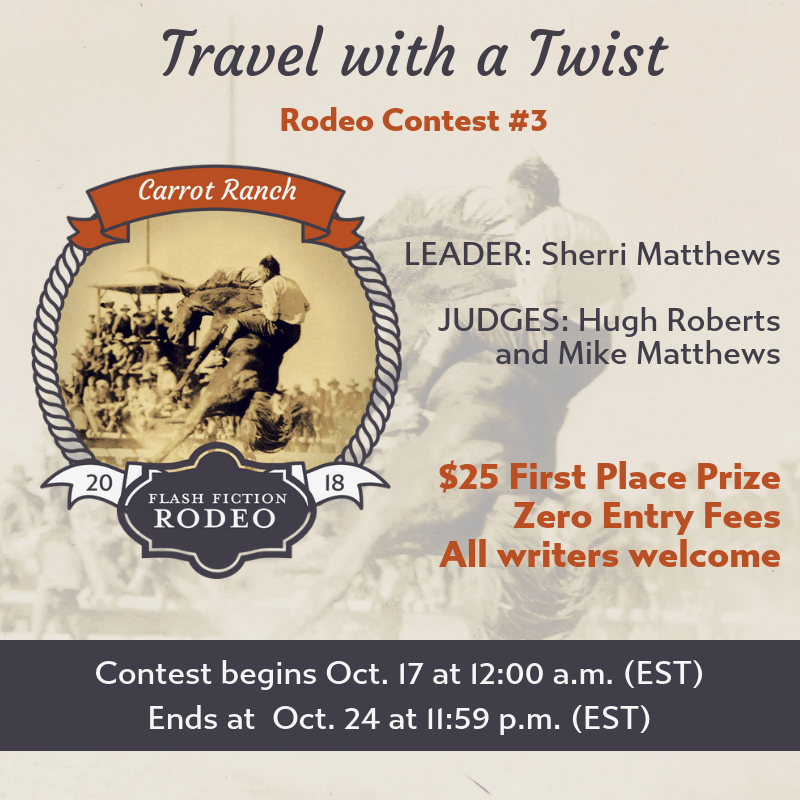
Rodeo #3: Travel with a Twist
Saddle up and get ready to ride with Sherri Matthews for Contest #3 at the Carrot Ranch. Sherri’s looking for some twisty travel tales. Don’t tie yourself in a knot over this one. Just write. It’ll work itself out in the end.
Share this:
-

The TUFFest Ride Third Challenge
Week #3 of the TUFF challenge begins. Are you following along at home? Charli shares progress of the Fab Five’s writing and explains the process using examples by CalmKate.
Share this:
-

readilearn: Books on Wednesday — The Forever Kid by Elizabeth Cummings
This week I have great pleasure in introducing Elizabeth Cummings author of The Forever Kid. This post is but one of several celebrating Elizabeth’s beautiful picture book in Romi Sharp’s Books on Tour. Please read to the end of the post for details of other posts celebrating Elizabeth’s work.
About Elizabeth Cummings
Elizabeth Mary Cummings is a British author based in Australia. She writes, advocates for and speaks about storytelling and health matters for families and youth. She is a qualified Primary School teacher and has worked in many schools in the UK, New Zealand and Australia. She is a member of the American Psychology Association and studied psychology and business studies at The University of Edinburgh in Scotland before training to be a Primary School teacher and travelling around the world with her family.
The topics in Elizabeth’s books are of both local and global significance. Elizabeth travels globally to talk about family and mental health matters as well as creative writing.
About The Forever Kid
The Forever Kid, a sensitively written picture book about life after the death of a sibling, is a culmination of four years’ work. Beautifully illustrated by Cheri Hughes, it is published in Australia by Big Sky Publishing.
Synopsis
It is Johnny’s birthday and, although Johnny is no longer with them, his family gather to celebrate. Johnny’s brother explains to the reader how much Johnny meant to every member of the family and how the family feel closest to him when they remember him on his birthday. The story finishes with the family lying together on the grass telling each other cloud stories, just like they used to with Johnny.
Continue reading: readilearn: Books on Wednesday — The Forever Kid by Elizabeth Cummings
Share this:
-

The TUFFest Ride Second Challenge
Are you riding along with the TUFFest writing challenge at home? Charli has posted the second challenge. We’re not only staying muddy for another week, we’re calling others in too! Check it out over at the Ranch.
Share this:
-

49 Days In 1988: Week 38 – Mixed Emotions
I am honoured to be featured as a guest on Hugh Roberts’ blog this week as part of his ’49 Days in 1988′ series. If you haven’t yet popped over to meet Hugh on his blog Hugh’s Views and News, please do so soon. As well as writing entertaining and often surprising stories, he is generous with his support of bloggers. Thank you for inviting me over to your place, Hugh.
Share this:
-
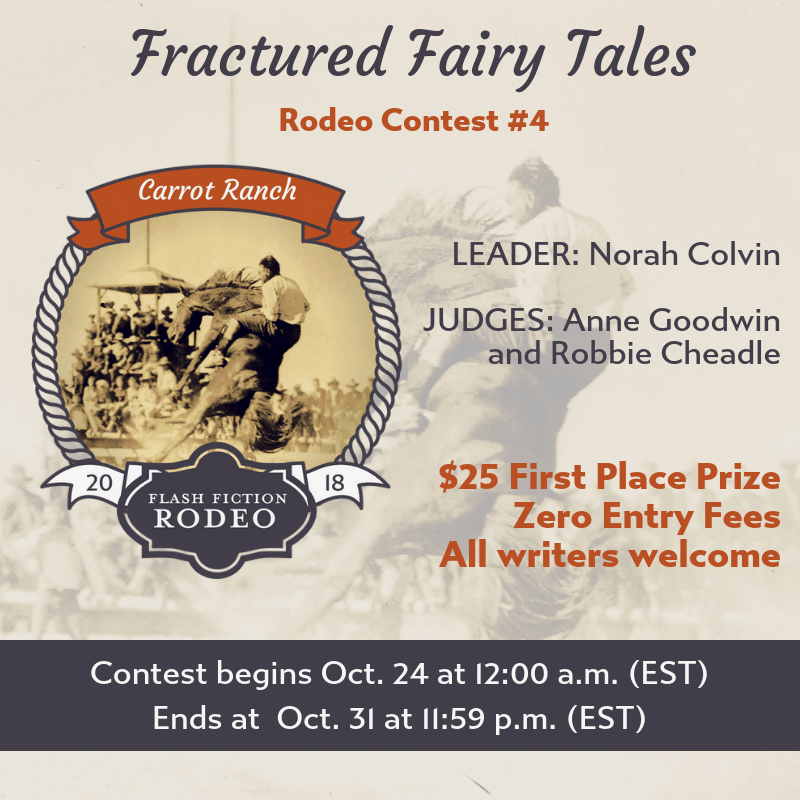
Once Upon a Rodeo Time
As promised, here’s some information to start your thinking in preparation for the fractured fairy tale flash fiction contest in the Carrot Ranch Rodeo next month. (Try saying that five times real fast!)
Please note: The correct date is Oct 24, not Oct 17 as shown below.
Share this:
-

A sprinkle of this, a pinch of that, and poof! It’s reading — magic!
ArtbyJonz ©Norah Colvin 2015 My children were early readers. Both began reading real books well before their fourth birthdays. Of course, the timing, whether early or late, matters little now that they are adults. What matters is that they are readers who read competently and confidently for a range of purposes including for information and pleasure. They are readers by choice as well as purpose.
The ability to read is something that most of us take for granted. Many have no recollection of learning to read, only of being able to do so all of a sudden, as if we just could, by magic.
But, as with any spell, there are certain essential ingredients that make the magic happen and others that inhibit the process. Creating readers of choice and not just purpose is the real magic. Creating non-readers is the effect of a spell in reverse, of a bad mix of ingredients, that sadly occurs all too often.
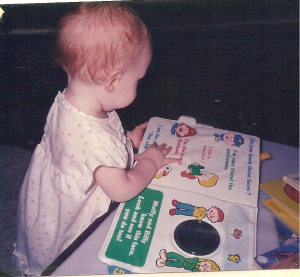
Bec reading to herself at 12 months My children were readers of choice long before they could read anything for themselves. I wouldn’t say I set out to “teach” them to read. In fact, I didn’t at all. I set out to encourage in them a love of books and writing. Their learning to read was a by-product of sharing the love of words, language and reading.
The magic ingredients for developing readers:
- Talk
- Play
- Read
- Write
- Love
- Fun
I loved having time with my children. Being with them, watching them grow and develop was special, the best and most magical of days. They taught me as much or more about love, life and learning as they learned from me.
Talk
From their earliest days I talked to them, explained things to them — what was happening, what we were doing, and how things worked. I pointed things out and told them what it was called, what it was doing, what it was used for, or how it worked. When we were out and about, I’d point out signs and explain how I knew to stop or where to go. I avoided “baby” talk and always used appropriate everyday language.
Play
We played and had fun together, using our imaginations to create our own games. Sometimes we played simple board games and completed jigsaw puzzles. Whatever we played, talk always accompanied it.
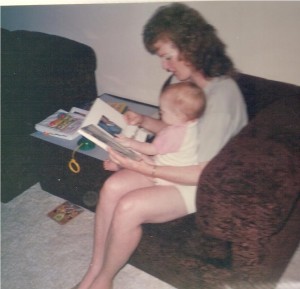
Reading to Bec at about 12 months old. Read
I read to them, every day, not just one but many books. As I read, we discussed details in the illustrations and made predictions about the stories, sharing our thoughts. If a word was presented in a large or colourful font, I’d point to it as I read it. We’d laugh at the funny stories and cry at the sad and discuss all the story events. When they could read, they’d read to me, and we took turns reading together until they were early teens.
Write
When they first started to talk, I made books with pictures and words from their growing vocabulary. I labelled items in their rooms; for example, bed, shelf, window, door.
I made books about things we did with photographs and text. A book about our family made for my daughter’s first birthday was one of the favourites when cousins came to visit too.
The environment
I provided my children with an environment rich in language, books and opportunities for thinking. I’d read and write with them and to them, and they’d see me reading and writing for myself as well.
When son Rob was little, I didn’t yet know what I now know about the development of language, reading, and thinking. He taught me much that was later confirmed by my studies.

Rob, aged two, reading to some of his toys. When he was only two, Rob would line up his toys on the couch, sit in the middle, and “read” to them. He would almost recite the stories from beginning to end. He already knew that the words in a book remain the same each time they are read — an important concept for beginning readers to grasp. When he was only three, he’d jump into bed beside me in the early morning after Hub had gone to work, prise my eyes open, and read to me! Magic!
Daughter Bec was born twelve years after Rob. Meanwhile, I had returned to college and studied the development of reading and language. I was amazed to find that we had unwittingly created the essential mix of ingredients for his learning to occur
Naturally, armed with experience as well as understanding, I did things pretty much the same for Bec — talking, reading, writing, playing, having fun and enjoying time together.

Bec sharing one of her favourite books. When she was five, Bec was invited to participate in a study of children who learned to read before starting school. Of the children (maybe half a dozen) involved in the study, Bec was the only one the researcher considered to be really reading. She was reading fluently, with comprehension and at a higher level than the other children.
Some of the children were able to recognise isolated words, but not read them in continuous text. Others had been taught letters and sounds using flashcards and stopped to ‘sound’ out every word. They hadn’t become real readers.
Bec was not subjected to reading “lessons” as the other children had been. She was immersed in an environment that encouraged a love of learning, language and literacy. The other parents had a need for their children to read as if their value as parents depended on it.
While I had an expectation that Bec would read, I was confident that she would come to it in her own time. My credibility as a parent was not tied to her ability. Having said that, both children (adults) are now very successful in their chosen fields, so I must have done something right. Or perhaps we were just lucky that we chanced upon the magic mix of ingredients.
I do wish that all parents would include a sprinkle of language and a pinch of reading mixed with love and fun into their children’s lives every day. It would contribute greatly toward eradicating illiteracy.

What got me thinking about reading, and magic in particular, is the challenge by Charli Mills at the Carrot Ranch to In 99 words (no more, no less) write a story that includes magic. It can be a supernatural force, a moment or idea, or use it as a verb. Go where the prompt leads.
The ability to be transported into other realms is pure magic. The ability to share this magic with others is bliss.
Mem Fox has more to say about that in her lovely book for parents Reading Magic, a book I always include when selecting gifts for first-time parents.
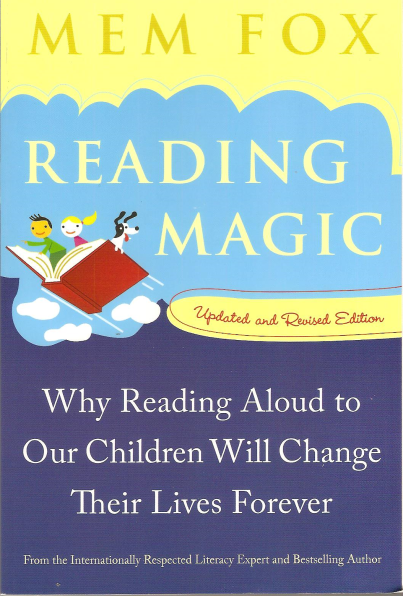
Here is my response to Charli’s prompt. I hope you enjoy it.
A Sprinkle of This and a Pinch of That
“Whatcha doin?”
“Makin’ a spell.”
“What sorta spell?”
“A magic spell.”
“Can I help?”
“Sure.”
“Whadda I do?”
“Put stuff in the pot.”
“What sorta stuff?”
“Gotta read the recipe.”
“What’s it say?”
“Ya gotta read it.”
“I can’t.”
“Oh. Okay. I’ll help. Look, it says …”
Mum stopped at the door to the kitchen. “Wha— What are you doing?”
“Nothin’,” mumbled the older.
“Makin’ magic spells,” grinned the younger, covered in flour from head to toe.
“What sort of magic spell?” asked Mum, wishing for her own magic spell.
“Take us to outa space.”
“Can I come too?”
Thank you for reading. I appreciate your feedback. Please share your thoughts.
Share this:


 Norah Colvin